
BIBLES NET. COM
Back to Bibles Net. Com
THE LIFE OF JESUS CHRIST FOR THE YOUNG BY
THE REV. RICHARD NEWTON, D.D.
ROYAL SCOTTISH ACADEMY
VOL. III
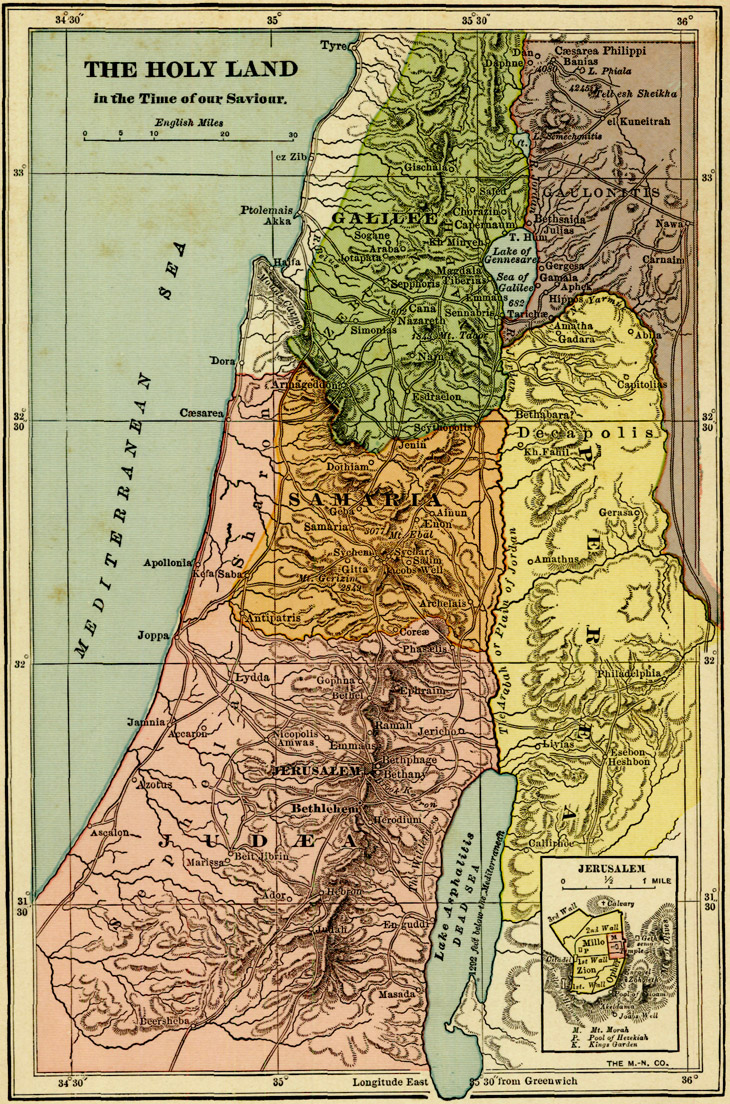
THE GALLERY OF THE LIFE OF JESUS CHRIST
VOLUME III
CONTENTS:
III CHRIST TEACHING BY PARABLES
IV CHRIST TEACHING BY MIRACLES
VII CHRIST AND THE LITTLE CHILDREN
ILLUSTRATIONS:
42. SIMON PETER’S FAITH IN CHRIST
43. THE TRANSFIGURATION OF CHRIST
45. LET HE WHO IS WITHOUT SIN AMONG YOU
46. ONE OF TEN LEPERS CURED IS GRATEFUL
47. JESUS, MARTHA, MARY, AND LAZARUS
48. JESUS BLESSETH LITTLE CHILDREN
49. THE RESURRECTION OF LAZARUS, FOUR DAYS DEAD
50. CONVERSION OF ZACCHAEUS, A PUBLICAN
51. JESUS RESTORETH SIGHT TO BARTIMAEUS
52. CHRIST’S TRIUMPHAL ENTRY INTO JERUSALEM
53. CHRIST AVOUCHETH HIS AUTHORITY
54. AT NIGHT, JESUS ABODE ON THE MOUNT OF OLIVES
55. JESUS WASHETH HIS DISCIPLES’ FEET
56. THE BETRAYAL FORETOLD AT THE SUPPER
57. IN THE GARDEN OF GETHSEMANE
59. JESUS EXAMINED BY CAIAPHAS
60. JESUS IS THRICE DENIED BY PETER
THE APOSTLES CHOSEN
As soon as he returned victorious from the temptation in the
wilderness, Jesus entered on the work of his public ministry. We find
him, at once, preaching to the people, healing the sick, and doing
many wonderful works. The commencement of his ministry is thus
described by St. Matt. iv: 23-25. “And Jesus went about all Galilee,
teaching in their synagogues, and preaching the gospel of the
kingdom, and healing all manner of sickness, and all manner of
disease among the people. And his fame went throughout all Syria; and
they brought unto him all sick people that were taken with divers
diseases and torments, and those which were possessed with devils,
and those which were lunatic, and those that had the palsy; and he
healed them. And there followed him great multitudes of people from
Galilee, and from Decapolis, and from Jerusalem, and from Judea, and
from beyond Jordan.” What a blessed beginning of the most blessed of
all ministries this was! He came to bless our world. He did bless it,
as no one else could have done. And here, we see, how he entered on
his work.
And one of the first things he did, after thus beginning his
ministry, was to gather his disciples round him. The first two that
we find named among his disciples are John and Andrew. They had been
disciples of John the Baptist. Their master pointed them to Jesus,
and said—”Behold the Lamb of God.” When they heard this they
followed Jesus, and became his disciples. When Andrew met with his
brother Simon Peter, he said to him “we have found the Messias—the
Christ. And he brought him to Jesus.” After this we are told that
“Jesus findeth Philip, and saith unto him, Follow me.” He was an
acquaintance of Andrew and Peter, and lived in the same town with
them. He obeyed the call at once and became one of the disciples of
Jesus.
Philip had a friend named Nathanael. The next time he met him, he
said, “we have found him of whom Moses in the law, and the prophets
did write, Jesus of Nazareth, the son of Joseph.” But Nazareth was a
despised place, and had a bad reputation. Nathanael had a very poor
opinion of the place, and he asked—”Can there any good thing come
out of Nazareth?” Philip saith unto him—”Come and see.”
And this is what we should say to persons when we wish them to become
Christians. There is so much that is lovely and excellent in Jesus
that if people will only “come and see,” if they will only prove for
themselves what a glorious Saviour he is, they will find it
impossible to help loving and serving him. Nathanael came to Jesus.
And when he heard the wonderful words that Jesus spoke to him he was
converted at once, and expressed his wonder by saying—”Rabbi, thou
art the Son of God; thou art the King of Israel.” We can read all
about this in John i: 43-51. Nathanael became a disciple of Jesus,
and one of the twelve apostles, and is supposed to be the same one
who bears the name of Bartholomew in the different lists of the
apostles.
After this we read of Jesus calling Matthew the publican, who was a
tax-gatherer. This is what is meant by his “sitting at the receipt of
custom.” “Follow me,” were the words spoken to him. He obeyed at
once; left all and followed Jesus. St. Luke and St. Mark mention this
same call, but they give the name of Levi to the person thus called.
This is not strange, for it was common among the Jews for persons to
have two names. Sometimes they were called by one of these names and
sometimes by the other.
Here we have the account of six persons, who became disciples of
Jesus; and of the different ways in which they were led to follow
him. No doubt many others were led to become his disciples from
simply hearing him preach; and from listening to the gracious words
that he spoke.
And very soon after he had gathered together a large company of
disciples, he made choice of twelve, out of this number, who were to
be his apostles. He wished these men to be with him all the time.
They were to hear his teaching, and see his miracles, and so be
prepared to take his place, and carry on his work when he should
return to heaven.
It was necessary for these men to be chosen. When Washington was
appointed to conduct our armies during the Revolution, he chose a
number of generals to help him. And it is natural for us to think of
Washington and his generals. But just as natural it is to think
of—Jesus and his apostles.
And this is the subject we have now to consider—The Apostles
Chosen.
And in considering this subject there are four things of which to
speak.
The first, is the condition and character of the men whom Jesus
chose as his apostles.
The second, is the work these men were called to do.
The third, is the help that was given them in doing this work; and
The fourth, is the lesson taught us by this subject. Or, to make the
points of the subject as short as possible, we may state them thus:
The men. The work. The help. The lesson.
We begin then with speaking of—THE MEN—or the condition and
character of those whom Jesus chose to be his apostles or helpers.
Now we might have thought that Jesus would have chosen his apostles,
or helpers, from among the angels of heaven. They are so wise, and
good, and strong, that we wonder why he did not choose them. But he
did not. He chose men to be his apostles. And what kind of men did
he choose? If we had been asked this question beforehand, we should
have supposed that he would certainly have chosen the wisest and the
most learned men, the richest and greatest men that could be found in
the world. But it was not so. Instead of this he chose poor men,
unlearned men, men that were not famous at all; and who had not been
heard of before. Fishermen, and tax-gatherers, and men occupying very
humble positions in life, were those whom Jesus chose to be his
apostles.
And one reason, no doubt, why Jesus made choice of men of this
character to be his apostles was that when their work was done, no
one should be able to say that it was the learning, or wisdom, or
riches, or power of men by whom that work was accomplished. The
apostle Paul teaches us that this is the way in which God generally
acts; and that he does it for the very reason just spoken of. He
says, “God hath chosen the foolish things of the world to confound
the wise; and God hath chosen the weak things of the world to
confound the mighty; and base things of the world, and things which
are despised hath God chosen, yea, and things which are not, to bring
to nought the things that are; that no flesh should glory in his
presence.” I. Cor. i: 27-29. The meaning of this passage is that God
loves to work by little things. This was the reason why Jesus chose
poor, unlearned fishermen to be his apostles. And we see God working
in the same way continually.
Look at yonder sun. God made it, and hung it up there in the sky that
it might give light to our world. But the light which this sun gives
comes to us in tiny little bits, smaller than the point of the finest
needle that ever was made. They are so small that hundreds of them
can rush right into our eyes, as they are doing all the time, and not
hurt them the least. Here we see how God makes use of little things,
and does a great work with them.
And then look at yonder ocean. The waves of that ocean are so
powerful that they can break in pieces the strongest ships that men
have ever built. And yet, when God wishes to keep that mighty ocean
in its place, he makes use of little grains of sand for this purpose.
Here again we see how God employs little things, and does a great
work with them. And we find God working in this way continually. Let
us look at one or two illustrations.
“What a Plant Did.” A little plant was given to a sick girl. In
trying to take care of it, the family made changes in their way of
living, which added greatly to their comfort and happiness. First,
they cleaned the window, that more light might come in to the leaves
of the plant. Then, when not too cold, they opened the window, that
fresh air might help the plant to grow; and this did the family good,
as well as the plant. Next the clean window made the rest of the room
look so untidy that they washed the floor, and cleaned the walls, and
arranged the furniture more neatly. This led the father of the family
to mend a broken chair or two, which kept him at home several
evenings. After this, he took to staying at home with his family in
the evenings, instead of spending his time at the tavern; and the
money thus saved went to buy comforts for them all. And then, as
their home grew more pleasant, the whole family loved it better than
ever before, and they grew healthier and happier with their flowers.
What a little thing that plant was, and yet it was God’s apostle to
that family! It did a great work for them in blessing them and making
them happy. And that was work that an angel would have been glad to
do.
“Brought In by a Smile.” A London minister said to a friend one day;
“Seven persons were received into my church last Sunday, and they
were all brought in by a smile.”
“Brought in by a smile! Pray what do you mean?”
“Let me explain. Several months ago, as I passed a certain house on
my way to church, I saw, held in the arms of its nurse, a beautiful
infant; and as it fixed its bright black eyes on me, I smiled, and
the dear child returned the smile. The next Sabbath the babe was
again before the window. Again I smiled, and the smile was returned,
as before. The third Sabbath, as I passed by the window, I threw the
little one a kiss. Instantly its hand was extended and a kiss thrown
back to me. And so it came to pass that I learned to watch for the
baby on my way to church; and as the weeks went by, I noticed that
the nurse and the baby were not alone. Other members of the family
pressed to the window to see the gentleman who always had a smile for
the dear baby—the household pet.
“One Sunday morning, as I passed, two children, a boy and a girl,
stood at the window beside the baby. That morning the father and
mother had said to those children: ‘Get ready for church, for we
think that the gentleman who always smiles to the baby is a minister.
When he passes you may follow him, and see where he preaches.’
“The children were quite willing to follow the suggestion of their
parents, and after I had passed, the door opened, and the children
stepped upon the pavement, and kept near me, till I entered my
church, when they followed me, and seats were given them.
“When they returned home, they sought their parents and eagerly
exclaimed: ‘He is a minister, and we have found his church, and he
preached a beautiful sermon this morning. You must go and hear him
next Sunday.’
“It was not difficult to persuade the parents to go, and guided by
their children they found their way to the church. They, too, were
pleased, and other members of the family were induced to come to the
house of God. God blessed what they heard to the good of their souls,
and seven members of this family have been led to become Christians,
and join the church, and, I repeat what I said before: ‘they were all
brought in by a smile.'”
What a little thing a smile is! And yet, here we see how God made use
of so small a thing as this, to make seven persons Christians, and to
save their souls forever! Of the God who can work in this way, it
may well be said that he loves to work by little things. It is the
way in which he is working continually.
How eagerly, then, we may try to learn and to practise what has been
very sweetly expressed in
THE MITE SONG.
“Only a drop in the bucket,
But every drop will tell,
The bucket would soon be empty,
Without the drops in the well.
“Only a poor little penny,
It was all I had to give;
But as pennies make the dollars,
It may help some cause to live.
“A few little bits of ribbon,
And some toys—they were not new,
But they made the sick child happy,
And that made me happy, too.
“Only some out-grown garments;
They were all I had to spare;
But they’ll help to clothe the needy,
And the poor are everywhere.
“A word now and then of comfort,
That cost me nothing to say;
But the poor old man died happy,
And it helped him on the way.
“God loveth the cheerful giver,
Though the gifts be poor and small;
But what must he think of his children
Who never give at all?”
God loves to work by little means. We see this when we think of the
men whom Jesus chose to be his apostles. The first thing about this
subject is—the men.
The second thing to speak of, in connection with this subject,
is—THE WORK—they had to do.
What this work was we find fully stated in the fourteenth chapter of
St. Matthew. In this chapter Jesus told the apostles all about the
work they were to do for him, and how they were to do it. In the
seventh and eighth verses of this chapter we have distinctly stated
just what they were to do. “As ye go, preach, saying, The kingdom of
heaven is at hand; Heal the sick, cleanse the lepers, raise the dead,
cast out devils.”
On this occasion Jesus sent his apostles to do the work committed to
them, not among the Gentiles, but only among the Jews; or as he calls
them—”the lost sheep of the house of Israel,” v. 5,6. But, after his
resurrection, and just before he went up to heaven, he enlarged their
commission. His parting command to them then was—”Go ye into all
the world, and preach the gospel to every creature.” St. Mark xvi:
15.
When Jesus, their Master, went to heaven they were to take up and
carry on the great work that he had begun. Those twelve men were to
begin the work of changing the religion of the world. They were to
overturn the idols that had been worshiped for ages. They were to
shut up the temples in which those idols had been worshiped. They
were to “turn men from darkness to light, and from the power of Satan
unto God.” Acts xxvi: 18. They were to go up and down the world,
everywhere, telling the wondrous story of Jesus and his love. And in
doing this work they were to be the means of saving the souls of all
who believed their message, and in the end of winning the world back
to Jesus, till, according to God’s promise, he has “the heathen for
his inheritance, and the utmost parts of the earth for his
possession.” Ps. ii: 8.
This was the grandest and most important work that men were ever
called upon to do. The apostles spent their lives in doing this work;
and then they left it for others to carry on. The work is not
finished yet. And, if we learn to love and serve Jesus, we may help
to carry it on. We may be apostles, too, though in a lower sense than
that in which the first twelve were apostles. An apostle means—one
sent. But Jesus sends into the vineyard to work for him all who
become his loving children. And, in this sense it is true that all
who love and serve Jesus are his apostles. He says to each of
us—”Go, work to-day, in my vineyard.” St. Matt, xxi: 28. And in
another place he says—”Let him that heareth, say, Come.” Rev. xxii:
17.
And when we are trying to tell people of Jesus and his love, and to
bring them to him, then we are helping to carry on the same great
work that Jesus gave his apostles to do. Let us look at some examples
of persons who have been apostles for God and helped to do the work
of apostles.
“Aunt Lucy.” I heard the other day of a good old woman in the State
of Michigan, known as Aunt Lucy. She is eighty-four years old, and
lives all alone, supporting herself principally by carpet-weaving.
All that she can save from her earnings, after paying for her
necessary expenses, she spends in buying Bibles, which she
distributes among the children and the poor of the neighborhood.
Thirteen large family Bibles, and fifty small ones, have thus been
given away—good, well-bound Bibles.
A neighbor, who has watched this good work very closely, says that
two-thirds of the persons to whom Aunt Lucy has given Bibles have
afterwards become Christians. In doing this work Aunt Lucy was an
apostle.
“The Charcoal Carrier.” One Sunday afternoon, in summer, a little
girl named Mary, going home from a Sunday-school in the country, sat
down to rest under the shade of a tree by the roadside. While sitting
there she opened her Bible to read. As she sat reading, a man, well
known in that neighborhood as Jacob, the charcoal carrier, came by
with his donkey. Jacob used to work in the woods, making charcoal,
which he carried away in sacks on his donkey’s back, and sold. He was
not a Christian man, and was accustomed to work with his donkey as
hard on Sunday as on week-days.
When he came by where Mary was sitting, he stopped a moment, and
said, in a good-natured way:
“What book is that you are reading, my little maid?”
“It is God’s book—the Bible,” said Mary.
“Let me hear you read a little in it, if you please,” said he,
stopping his donkey.
Mary began at the place where the book was open, and read:—”Remember
the Sabbath day, to keep it holy. Six days shalt thou labor, and do
all thy work.”
“There, that’s enough,” said Jacob, “and now tell me what it means.”
“It means,” said Mary, “that you mustn’t carry charcoal, on Sunday,
nor let your donkey carry it.”
“Does it?” said Jacob, musing a little. “I tell you what then, I must
think over what you have said.”
And he did think over it. And the result of his thinking was, that
instead of going with his donkey to the woods on the next Sunday, he
went with his two little girls to the Sunday-school. And the end of
it all was that Jacob, the charcoal carrier, became a Christian, and
God’s blessing rested on him and his family.
Little Mary was doing an apostle’s work when she read and explained
the Bible to Jacob and was the means of bringing him to Jesus.
“The Use of Fragments.” In the Cathedral at Lincoln, England, there
is a window of stained glass which was made by an apprentice out of
little pieces of glass that had been thrown aside by his master as
useless. It is said to be the most beautiful window in the Cathedral.
And if, like this apprentice, we carefully gather up, and improve the
little bits of time, of knowledge, and of opportunities that we have,
we may do work for God more beautiful than that Cathedral window. We
may do work like that which the apostles were sent to do. Here are
some sweet lines, written by I know not whom, about that beautiful
window, made out of the little pieces of glass:
“Great things are made of fragments small,
Small things are germs of great;
And, of earth’s stately temples, all
To fragments owe their weight.
“This window, peer of all the rest,
Of fragments small is wrought;
Of fragments that the artist deemed
Unworthy of his thought.
“And thus may we, of little things,
Kind words and gentle deeds,
Add wealth or beauty to our lives,
Which greater acts exceeds.
“Each victory o’er a sinful thought,
Each action, true and pure,
Is, ‘mid our life’s engraving, wrought
In tints that shall endure.”
The second thing about the apostles is, the work—they did.
The third thing, for us to notice about the apostles, is—THE
HELP—they received.
In one place, we are told that Jesus “gave them power against unclean
spirits, to cast them out, and to heal all manner of sickness, and
all manner of disease.” St. Matt. x: 1. In another place we are told,
that for their comfort and encouragement in the great work they had
to do, Jesus said to them, “Lo, I am with you always, even unto the
end of the world.” St. Matt. xxviii: 20. And if they only had Jesus
with them, no matter what the work was they had to do, they would be
sure of having all the help they might need. The apostle Paul
understood this very well, for he said, “I can do all things through
Christ, which strengtheneth me.” Phil. iv: 13.
And then, as if his own presence with them were not enough, Jesus
promised that his apostles should have the help of the Holy Spirit in
carrying on their work. Just before leaving them to go to heaven, he
said to the disciples—”Ye shall receive power, after that the Holy
Ghost is come upon you.” Acts i: 8. And what this power was we see in
the case of the apostle Peter; for the first sermon he preached
after the Holy Ghost came upon him, on the day of Pentecost, was the
means of converting three thousand souls. Acts ii: 41.
And the same God who gave the apostles all the help they needed, has
promised to do the same for you, and me, and for all who try to work
for him. There are many promises of this kind in the Bible to which I
might refer. But I will only mention one. This is so sweet and
precious that it deserves to be written in letters of gold. There is
no passage in the Bible that has given me so much comfort and
encouragement in trying to work for God as this I refer here to Is.
xli: 10. “Fear thou not; for I am with thee; be not dismayed; for I
am thy God; I will strengthen thee; yea—I WILL HELP THEE.” This
promise was not given for prophets and apostles only, but for all
God’s people to the end of time. You and I, if we are trying to serve
God, may take it as ours. God meant it for us. And when we get this
promised help from God, we can do any work he has for us to do, and
be happy in doing it.
“For Thine is the Power.” “I can’t do it—it’s quite impossible. I’ve
tried five times, and can’t get it right”—and Ben Hartley pushed his
book and slate away in despair. Ben was a good scholar. He was at
the head of his class, and was very anxious to stay there. But the
sums he had now to do were very hard. He could not do them, and was
afraid of losing his place in the class. Most of the boys had some
one at home to help them; but Ben had no one. His father was dead,
and his mother, though a good Christian woman, had not been to school
much when a girl, and she could not help Ben.
Mrs. Hartley felt sorry for her son’s perplexity, and quietly said,
“Then, Ben, you don’t believe in the Lord’s prayer?”
“The Lord’s prayer, mother! Why, there’s nothing there to help a
fellow do his sums.”
“O, yes; there is. There is help for every trouble in life in the
Lord’s prayer, if we only know how to use it. I was trying a long
time before I found out what the last part of this prayer really
means. I’m no minister, or scholar, Ben, but I’ll try and show you.
You know that in this prayer we ask God for our daily bread; we ask
him to keep us from evil; and to forgive us our sins; and then we
say: ‘for thine is the kingdom, and the power, and the glory.’
It’s God’s power that we rely on—not our own; and it often helps
me, Ben, when I have something hard to do. I say, ‘For thine is the
power—this is my duty, heavenly Father; but I can’t do it myself;
give me thy power to help me,’ and he does it, Ben, he does it.”
Ben sat silent. It seemed almost too familiar a prayer. And yet he
remembered when he had to stay home from school because he had no
clothes fit to go in, how he prayed to God about it, and the
minister’s wife brought him a suit the very next day. “But a boy’s
sums, mother! it seems like such a little thing to ask God about.”
“Those sums are not a little thing to you, Ben. Your success at
school depends on your knowing how to do them. That, is as much to
you, as many a greater thing to some one else. Now I care a great
deal about that, because I love you. And I know your Father in heaven
loves you more than I do. I would gladly help you, if I could; but he
can help you. His ‘is the power;’ ask him to help you.”
After doing an errand for his mother, Ben picked up his book and
slate and went up to his little room. Kneeling down by the bed he
repeated the Lord’s prayer. When he came to—”thine is the kingdom,”
he stopped a moment, and then said, with all his heart—”‘And thine
is the power,’ heavenly Father. I want power to know how to do these
sums. There’s no one else to help me. Lord, please give me power, for
Jesus’ sake, Amen.”
Ben waited a moment, and then, still on his knees, he took his slate
and tried again. Do you ask me if he succeeded? Remember what Saint
James says, “If any man lack wisdom let him ask of God, who giveth to
all men liberally, and upbraideth not: and it shall be given him.”
Jas. i: 5. That is God’s promise, and heaven and earth must pass away
before one of his promises shall fail. Ben had prayed to God to help
him, and God answered his prayer. He tried once more to work out
those sums. After thinking over them a little while, he saw the
mistake he had made in neglecting one of the rules for working the
sums. He corrected this mistake, and then he found they all worked
out beautifully. The next day he was head of the class; for he was
the only boy who could say that he had done the sum himself, without
getting any one at home to help him.
“And yet I was helped, mother,” said Ben, “for I am sure my Father in
heaven helped me.” But that was not what the teacher meant. After
this, Ben never forgot the last part of the Lord’s prayer. When he
needed help he knew where the power was that could help him.
Here was where the apostles got the help they needed in doing the
hard work they had to do. And how much help we might get in doing our
work if we only make a right use of this “power which belongeth unto
God;” and which he is always ready to use in helping us.
The help they received, is the third thing to remember when we think
about the apostles and their work.
The last thing to bear in mind when we think of Jesus choosing his
twelve apostles, is—THE LESSON—it teaches us.
There are many lessons we might learn from this subject; but there is
one so much more important than all the rest that we may very well
let them go, and think only of this one. When St. Luke tells us about
Jesus choosing the twelve apostles, he mentions one very important
thing, of which St. Matthew, in his account of it says nothing at
all. And it is this thing from which we draw our lesson. In the
twelfth verse of the sixth chapter of his gospel, St. Luke
says—”And it came to pass in those days, that he (Jesus) went out
into a mountain to pray, and continued all night in prayer to God.”
And after this, the first thing he did, in the morning, was to call
his disciples to him, and out of them to choose the twelve, who were
to be his apostles. And the lesson we learn from this part of the
subject is:
“The Lesson of Prayer.” Jesus spent the whole night in prayer to God,
before he chose his apostles. How strange this seems to us! And yet
it is easy enough to see at least two reasons why he did this. One
was because he loved to pray. We know how pleasant it is for us to
meet, and talk with a person whom we love very much. But prayer
is—talking with God—telling him what we want, and asking his help.
But Jesus loved his Father in heaven, with a love deeper and stronger
than we can understand. This must have made it the most delightful of
all things for him to be engaged in prayer, or in talking with his
Father in heaven. And, if we really love Jesus, prayer will not be a
hard duty to us, but a sweet privilege. We shall love to pray,
because, in prayer we are talking to that blessed Saviour, “whom,
not having seen, we love.” And this was one reason why Jesus spent
the whole night in prayer, before choosing his twelve apostles.
But there was another reason why Jesus spent so much time in prayer
before performing this important work, and that was to set us an
example. It was to teach us the very lesson of which we are now
speaking—the lesson of prayer. Remember how much power and wisdom
Jesus had in himself; and what mighty things he was able to do. And
yet, if He felt that it was right to pray before engaging in any
important work, how much more necessary it is for us to do so!
Let us learn this lesson well. Let it be the rule and habit of our
lives to connect prayer with everything we do. This will make us
happy in our own souls, and useful to those about us.
How full the Bible is of the wonders that have been wrought by
prayer! Just think for a moment of some of them.
Abraham prays, and Lot is delivered from the fiery flood that
overwhelmed Sodom and Gomorrah. Gen. xix: 29. Jacob prays, and he
wrestles with the angel, and obtains the blessing; his brother
Esau’s mind is wonderfully turned away from the wrath he had
cherished for twenty years. Moses prays and Amalek is discomfited.
Joshua prays and Achan is discovered. Hannah prays and Samuel is
born. David prays and Ahithophel hangs himself. Elijah prays and a
famine of three years comes upon Israel. He prays again, and the rain
descends, and the famine ends. Elisha prays, and Jordan is divided.
He prays again, and the dead child’s soul is brought back from the
invisible world. Isaiah and Hezekiah pray, and a hundred and
eighty-five thousand Assyrian soldiers are slain in one night by the
unseen sword of the angel. These are Bible illustrations of the help
God gives to his people in answer to prayer. And the Bible rule for
prayer, as given by our Saviour, is, “that men ought always to
pray,” Luke xviii: 1. St. Paul’s way of stating it is—”Praying
always, with all prayer,” Ephes. vi: 18. In another place he
says—”Pray without ceasing,” I. Thess. v: 17. And even the heathen
teach the same rule about prayer. Among the rules of Nineveh, an
inscription on a tablet has been found, which, on being translated,
proved to contain directions about prayer. It may be entitled:
“An Assyrian Call to Prayer.” These are the words of the call:
“Pray thou! pray thou!
Before the couch, pray!
Before the throne, pray!
Before the canopy, pray!
Before the building of the lofty head, pray!
Before the rising of the dawn, pray!
Before the fire, pray!
By the tablets and papyri, pray!
By the side of the river, pray!
By the side of a ship, or riding in a ship, or leaving the ship, pray!
At the rising of the sun, or the setting of the sun, pray!
On coming out of the city, on entering the city, pray!
On coming out of the great gate, on entering the great gate, pray!
On coming out of the house, pray! on entering the house, pray!
In the place of judgment, pray!
In the temple, pray!”
This is like the Bible rule of—”praying always.”
“Praying for a Dinner.” “Grandma, aren’t we going to church this
morning?” asked a little girl.
“My child, we have had no breakfast, and have no dinner to eat when
we come back,” said her grandma.
“But the Lord Jesus can give it to us if we ask him,” said the little
girl. “Let’s ask him.” So they kneeled down, and asked that God, “who
feedeth the young ravens when they cry,” to remember them, and help
them.
Then they went to church. They found it very much crowded. An old
gentleman took the little girl upon his knee. He was pleased with her
quiet behaviour. On parting with her at the close of the service, he
slipped a half crown into her hand. “See, Grandma,” she said, as soon
as they were out of church, “Jesus has sent us our dinner.”
But when we ask God to help us, we must always try to help ourselves.
“Working as well as Praying.” Two little girls went to the same
school; one of them, named Mary, always said her lessons well, the
other, named Jane, always failed. One day Jane said, “Mary, how does
it happen that you always say your lessons so well?” Mary said she
prayed over her lessons, and that was the secret of her success.
Jane concluded to try praying. But the next day she failed worse than
ever. In tears, she reproached Mary for deceiving her. “But, did you
study hard, as well as pray over your lesson?” asked Mary.
“No; I thought if I only prayed, that was all I had to do,” replied
Jane. “Not at all. God only helps those who try to help themselves.
You must study hard as well as pray, if you wish to get your lessons
well,” was Mary’s wise answer. The next day Jane studied, as well as
prayed, and she had her lesson perfectly.
The greatest work we can ever do, is to bring a soul to Jesus, or to
convert a sinner from the error of his way. Here is an illustration
of the way in which this may be done by prayer and effort combined:
“The Coachman and His Prayer.” “I was riding once, on the top of a
stage-coach,” said a Christian gentleman, “when the driver by my side
began to swear in a dreadful manner. I lifted up my heart for God’s
blessing on what I said; and presently, in a quiet way, I asked him
this question: ‘Driver, do you ever pray?’ He seemed displeased at
first; but after awhile he replied, ‘I sometimes go to church on
Sunday; and then I suppose I pray, don’t I?’ ‘I am afraid you never
pray at all; for no man can swear as you do, and yet be in the habit
of praying to God.’
“As we rode along he seemed thoughtful. ‘Coachman, I wish you would
pray now,’ I said. ‘”Why, what a time to pray, Sir, when a man is
driving a coach!”‘ ‘Yet, my friend, God will hear you,’ ‘”What shall
I pray?”‘ he asked, in a low voice. ‘Pray these words: ‘”O Lord,
grant me thy Holy Spirit, for Christ’s sake. Amen.”‘ He hesitated,
but in a moment he repeated them; and then, at my request, he said
them over a second, and a third time. The end of the journey was
reached, and I left him.
“Some months passed away, and we met once more. ‘Ah, Sir,’ said he,
with a smile, ‘the prayer you taught me on that coach-box was
answered. I saw myself a lost, and ruined sinner; but now, I humbly
hope, that through the blood which cleanseth from all sin, and by the
power of the Holy Spirit, I am a converted man.'”
And so, when we think of the twelve apostles, appointed by Jesus to
preach his gospel, these are the four things for us to remember in
connection with them, viz.:—the men whom he chose; the work they
had to do; the help given them in doing that work; and the lesson
we are taught by this subject—the lesson of prayer.
Whatever we have to do, let us do it with all our hearts, and do it
as for God, and then we shall be his apostles—his sent ones. Let me
put the application of this subject in the form of some earnest,
practical lines that I lately met with. The lines only speak of
boys, but they apply just as well to girls. They are headed:
DRIVE THE NAIL.
“Drive the nail aright, boys,
Hit it on the head,
Strike with all your might, boys,
While the iron’s red.
“Lessons you’ve to learn, boys,
Study with a will;
They who reach the top, boys,
First must climb the hill.
“Standing at the foot, boys,
Gazing at the sky,
How can you get up, boys,
If you never try?
“Though you stumble oft, boys,
Never be downcast;
Try and try again, boys,
You’ll succeed at last.
“Ever persevere, boys,
Tho’ your task be hard;
Toil and happy cheer, boys,
Bring their own reward.
“Never give it up, boys,
Always say you’ll try;
Joy will fill your cup, boys,
Flowing by and by.”
THE GREAT TEACHER
Teaching was the great business of the life of Christ during the days
of his public ministry. He was sent to teach and to preach. The
speaker in the book of Job was thinking of this Great Teacher when he
asked—”Who teacheth like him?” Job xxxvi: 22. And it was he who
was in the Psalmist’s mind when he spoke of the “good, and upright
Lord” who would teach sinners, if they were meek, how to walk in his
ways. Ps. xxv: 8-9. And he is the Redeemer, of whom the prophet
Isaiah was telling when he said—He would “teach us to profit, and
would lead us by the way that we should go.” And thus we know how
true was what Nicodemus said of him, that “he was a teacher sent
from God.” John iii: 2. Thus what was said of Jesus, before he came
into our world, would naturally lead us to expect to find him
occupied in teaching. And so he was occupied, all through the days
of his public ministry. St. Matthew tells us that—”Jesus went about
all Galilee, teaching in their synagogues.” Ch. iv: 23. Further on
in his gospel he tells us again that “Jesus went about all the
cities, and villages, teaching in their synagogues.” Ch. ix: 35. When
on his trial before Pilate, his enemies brought it as a charge
against him that he had been—”teaching throughout all Jewry.” Luke
xxiii: 5. We read in one place that—”the elders of the people came
unto him as he was teaching.” Matt. xxi: 23. Jesus himself gave
this account of his life work to his enemies—”I sat daily with you
teaching in the temple.” Matt. xxvi: 55. And so we come now to look
at the life of Christ from this point of view—as a Teacher. There
never was such a Teacher. We do not wonder at the effect of his
teaching of which we read in St. John vii: 46, when the chief priests
sent some of their officers to take him prisoner, and bring him unto
them; the officers went, and joined the crowd that was listening to
his preaching. His words had such a strange effect on them that they
could not think of touching him. So they went back to their masters
without doing what they had been sent to do. “And when the chief
priests and Pharisees said unto them—Why have ye not brought him?
The officers answered, Never man spake like this man.” Jesus was
indeed—The Great Teacher. In this light we are now to look at him.
And as we do this we shall find that there were five great things
about his teaching which made him different from any other teacher
the world has ever known.
In the first place Jesus may well be called the Great Teacher,
because of the—GREAT BLESSINGS—of which he came to tell.
We find some of these spoken of at the opening of his first great
sermon to his disciples, called “The Sermon on the Mount.” This is
the most wonderful sermon that ever was preached. Jesus began it by
telling about some of the great blessings he had brought down from
heaven for poor sinful creatures such as we are. The sermon begins in
the fifth chapter of St. Matthew, and the first twelve verses of the
chapter are occupied in speaking of these blessings. As soon as he
opened his mouth and began to speak a stream of blessings flowed out.
It was a beautiful thought, on this subject, which a boy in
Sunday-school once had. The teacher had been talking to his class
about the beginning of this sermon on the mount. He had spoken of the
sweetness of the words of Jesus, when “He opened his mouth and
taught” his disciples. “How pleasant it must have been, my dear
boys,” said he, “to have seen the blessed Saviour, and to have heard
him speak!”
A serious-minded little fellow in the class said, “Teacher, don’t you
think that when Jesus opened his mouth, and began to speak to his
disciples, it must have been like taking the stopper out of a scent
bottle?” I cannot tell whether this boy had ever read the words of
Solomon or not; but he had just the same idea that was in his mind
when he said of this “Great Teacher,” “thy name is as ointment
poured forth.” Cant, i: 3. We perceive the fragrance of this
ointment as soon as Jesus opens his mouth and begins to speak. If we
had been listening to Jesus when he began this sermon, saying:—”
Blessed are the poor in spirit; blessed are the meek; blessed are the
pure in heart; blessed are the peace-makers”—and so on till he had
spoken of nine different kinds of blessing, we might have thought
that he had nothing but blessings of which to tell. It would have
seemed as if his mind, and heart, and lips, and hands were all so
filled with blessings that he could do nothing else till he had told
about these. And the blessings spoken of here are not all the
blessings that Jesus brought. They are only specimens of them. The
blessings he has obtained for us are innumerable. David says of them,
“If I would declare and speak of them they are more than can be
numbered.” Ps. xl: 5. And these blessings are not only very numerous,
but very great. Look at one or two of these blessings that Jesus,
the Great Teacher, brings to us. He says, “Blessed are they that
mourn, for they shall be comforted.” Jesus came to bring comfort to
the mourners. Hundreds of years before Christ came the prophet Isaiah
had said of him that he would come to “comfort all that mourn.” Is.
lxi: 2. And to show how complete this blessing would be which he was
to bring, Jesus said himself—”As one whom his mother
comforteth—so will I comfort you.” Is. lxvi: 13. A young girl was
dying. A friend who came in to see her said:
“I trust you have a good hope.”
“No,” she answered, distinctly; “I am not hoping—I am certain. My
salvation was finished on the cross. My soul is saved. Heaven is
mine. I am going to Jesus.”
What a great blessing it is to have comfort like that!
When Jesus was speaking to the woman of Samaria, as he sat by Jacob’s
well, he compared the blessing of his grace to the water of that
well. Pointing to the well at his side, he said: “Whosoever drinketh
of this water will thirst again. But whosoever drinketh of the water
that I shall give him, shall never thirst; but the water that I shall
give him, shall be in him, a well of water, springing up unto
everlasting life.” John iv: 13, 14. This is one of the most
beautiful illustrations of the blessing Jesus gives that ever was
used. It is a great blessing to have a well of clear, cold water in
our garden, or near our door. But, only think of having a well of
water in our hearts. Then, wherever we go, we carry that well with
us. We never have to go away from it. No one can separate between us
and the water of this well. Other wells dry up and fail. But this is
a well that never dries up, and never fails. This well is deep, and
its water is all the time “springing up unto everlasting life.” How
happy they are in whose breasts Jesus opens this well of water!
Coleridge, the English poet, in writing to a young friend, just
before his death, said:
“Health is a great blessing; wealth, gained by honest industry, is a
great blessing; it is a great blessing to have kind, faithful, loving
friends and relatives, but, the greatest, and best of all blessings
is to be a Christian.”
One of the most able and learned lawyers that England ever had was
John Selden. He was so famous for his learning and knowledge that he
is always spoken of as “the learned Selden.” On his deathbed he
said—”I have taken much pains to know everything that was worth
knowing among men; but with all my reading and all my knowledge,
nothing now remains with me to comfort me at the close of life but
these precious words of St. Paul: ‘This a faithful saying, and worthy
of all acceptation, that Christ Jesus came into the world to save
sinners;’ to this I cling. In this I rest. This gives me peace, and
comfort, and enables me to die happy.”
William Wilberforce was another of the great and good men who have
been a blessing and an honor to England. When he was on his deathbed,
he said to a dear friend:
“Come, let us talk of heaven. Do not weep for me. I am very happy.
But I never knew what happiness was till I found Christ as my
Saviour. Read the Bible. Let no other book take its place. Through
all my trials and perplexities, it has been my comfort. And now it
comforts me, and makes me happy.”
Here we see “this well of water springing up unto everlasting life.”
And Jesus, who came to tell us of this water, and to open up this
well in our breasts, may well be called, “the Great Teacher,” because
of the great blessings—of which he tells.
In the second place Jesus may be called “the Great Teacher” because
of the—GREAT SIMPLICITY—of his teachings.
I do not mean to say that we can understand every thing that Jesus
taught. This is not so. He had some things to speak about that are
not simple. He said to his disciples, “I have yet many things to say
unto you, but ye cannot bear them now.” John xvi: 12. This means
that there are some things about God, and heaven, of which he wished
to tell them, but they were too hard for them to understand, although
they were full-grown men. And so he did not tell them of these
things. But even among the things that Jesus did tell about, there
are some which the wisest and most learned men in the world have
never been able to understand or explain. Some one has compared the
Bible to a river, in which there are some places deep enough for an
elephant or a giant to swim in; and other places where the water is
shallow enough for a child to wade in. And it is just so with the
teachings of Jesus. Some of the most important lessons he taught are
so plain and simple that very young people can understand them.
We have a good illustration of this in that sweet invitation which
Jesus gave when he said,—”Come unto me, all ye that labor and are
heavy laden, and I will give you rest.” Matt. xi: 28. Very young
people know what it is to feel tired and weary from walking, or
working too much, or from carrying a heavy burden. And, when they are
too tired to do anything else, they know what it is to go to their
dear mother and throw themselves into her arms, and find rest there.
And, in just the same way, Jesus invites us to come to him when we
are tired, or troubled, that our souls may find rest in him. We come
to Jesus, when we pray to him; when we tell him all about our
troubles; when we ask him to help us; and when we trust in his
promises.
“Was there ever gentlest shepherd
Half so gentle, half so sweet,
As the Saviour, who would have us
Come and gather round his feet?
“There’s a wideness in God’s mercy,
Like the wideness of the sea;
There’s a kindness in his justice
Which is more than liberty.
“There is no place where earth’s sorrows
Are more felt than up in heaven;
There is no place where earth’s failings
Have such kindly judgments given.
“There is plentiful redemption
In the blood that has been shed;
There is joy for all the members
In the sorrows of the head.
“If our love were but more simple,
We should take him at his word;
And our lives would all be sunshine,
In the sweetness of our Lord.”
The prophet Isaiah foretold that when Jesus came, he would teach his
doctrines to children just weaned. Chap. xxviii: 9. This shows us
that his teaching was to be marked by great plainness and simplicity.
And this was just the way in which he did teach when he uttered those
loving words:—”Suffer the little children to come unto me, and
forbid them not; for of such is the kingdom of God.” Mark x: 14.
None of the other famous teachers known to the world ever took such
interest in children as Jesus did. And none of them ever taught with
such great simplicity. What multitudes of young people have been led
to love and serve Jesus by thinking of the sweet words he spoke about
children!
“The Child’s Gospel.” A little girl sat still in church listening to
the minister. She could not understand what he was saying till he
quoted these words of Jesus about the children. But she understood
them. She felt that they were words spoken for her. They made her
feel very happy. And when she went home she threw her arms around her
mother’s neck, who had been kept at home by sickness, and said, “O,
mother, I have heard the child’s gospel to-day.”
“It’s For Me.” Little Carrie was a heathen child, about ten years
old. After she had been going to the Mission School for some time,
her teacher noticed, one day, that she looked sad.
“Carrie, my dear,” she said, “why do you look so sad to-day?”
“Because I am thinking.”
“And what are you thinking about?”
“O, teacher, I don’t know whether Jesus loves me, or not.”
“Carrie, what did Jesus say about little children coming to him when
he was on earth?”
In a moment the sweet words she had learned in the school were on her
lips—”Suffer the little children to come unto me, &c.”
“Well, Carrie, for whom did Jesus speak these words?” At once she
clapped her hands and exclaimed: “It’s not for you, teacher, is it?
for you are not a child. No: it’s for me! it’s for me!”
And so this dear child was drawn to Jesus by the power of his love.
And thus, through all the hundreds of years that have passed away
since “Jesus was here among men,” these same simple words have been
drawing the little ones to him.
And so, because of the great simplicity which marked his teaching,
Jesus must truly be called—the Great Teacher.
But in the third place there was—GREAT TENDERNESS—in Jesus, and
this was another thing that helped to make him the Great Teacher.
It was this great tenderness that led him, when he came to be our
Teacher and Saviour to take our nature upon him and so become like
us. He might have come into our world in the form of a mighty angel,
with his face shining like the sun, as he appeared when the disciples
saw him on the Mount of Transfiguration. But then we should have been
afraid of him. He would not have known how we feel, and could not
have felt for us. But instead of this, his tenderness led him to take
our nature upon him, that he might be able to put himself in our
place, and so to understand just how we feel, and what we need to
help and comfort us. This is what the apostle means in Heb. ii: 14,
when he says—”Forasmuch as the children were partakers of flesh and
blood, he also himself likewise took part of the same.” He did this
on purpose that he might know, by his own experience, how we are
tried and tempted; and so be able to sympathize with us and help us
in all our trials.
Here is a little story, very simple, and homely; but yet, one that
illustrates very well the point of which we are speaking. It is a
story about:
“A Lost Horse Found.” A valuable horse was lost, belonging to a
farmer in New England. A number of his neighbors turned out to try
and find the horse. They searched all through the woods and fields
of the surrounding country, but in vain. None of them could find the
horse. At last a poor, weak-minded fellow, who was known in that
neighborhood as “simple Sam,” started to hunt the horse. After awhile
he came back, bringing the stray horse with him. The owner of the
horse was delighted to see him. He stroked and patted him, and then,
turning to the simple-minded man who had found him, he said:
“Well, Sam, how came you to find the horse, when no one else could do
it?”
“Wal, you see,” said Sam, “I just ‘quired whar the horse was seen
last; and then I went thar, and sat on a rock; and just axed mysel’,
if I was a horse, whar would I go, and what would I do? And then I
went, and found him.” Now, when Sam, in the simplicity of his feeble
mind, tried to put himself, as far as he could, in the horse’s place,
this helped him to find the lost horse, and bring him back to his
owner again. And so, to pass from a very little thing to a very great
one, when Jesus came down from heaven to seek and to save sinners
that were lost, this is just the way in which he acted. He put
himself in our place as sinners. As the apostle Paul says: “he who
knew no sin, was made sin for us,” that he might save us from the
dreadful consequences of our sins.
And we see the tenderness of Jesus, not only in taking our nature
upon him and becoming man, but in what he did when he lived in this
world as a man. “He went about doing good.” It was his great
tenderness that led him to do this. Suppose that you and I could have
walked about with Jesus when he was on earth as the apostles did.
Just think for a moment what we should have seen. We should have seen
him meeting with blind men and opening their eyes that they might
see. We should have seen him meeting with deaf men, and unstopping
their ears that they might hear. We should have seen him meeting sick
people who were taken with divers diseases and torments and healing
them. We should have seen him raising the dead; and casting out
devils; and speaking words of comfort and encouragement to those who
were sad and sorrowful. If we could have looked into his blessed
face, we should have seen tenderness there, beaming from his eyes and
speaking from every line of his countenance. If we could have
listened to his teaching we should have found tenderness running
through all that he said. Just take one of his many parables as a
sample of his way of teaching—the parable of the lost sheep—and see
how full of tenderness it is. The sweet lines of the hymn, about the
shepherd seeking his lost sheep, that most of us love to sing, bring
out the tenderness of Jesus here very touchingly.
“There were ninety and nine that safely lay
In the shelter of the fold,
But one was out on the hills away,
Far off from the gates of gold—
Away on the mountains, wild and bare,
Away from the tender shepherd’s care.
“‘Lord, Thou hast here Thy ninety and nine;
Are they not enough for Thee?’
But the Shepherd made answer: ‘One of mine
Has wandered away from me;
And, although the road be rough and steep,
I go to the desert to find my sheep.’
“But none of the ransomed ever knew
How deep were the waters crossed;
Nor how dark was the night that the Lord passed through,
Ere he found his sheep that was lost.
Out in the desert he heard its cry—
Sick and helpless, and ready to die.
“‘Lord, whence are those blood-drops all the way
That mark out the mountain’s track?’
They were shed for one who had gone astray,
Ere the shepherd could bring him back.
‘Lord, why are Thy hands so rent and torn?’
They are pierced, to-night, by many a thorn.
“But all through the mountains, thunder-riven,
And up from the rocky steep,
There rose a cry to the gates of heaven,
‘Rejoice! I have found my sheep!’
And the angels echoed around the throne,
‘Rejoice, for the Lord brings back his own.'”
And all that we know of Jesus as “the good Shepherd,” demonstrates
his great tenderness for his sheep.
But perhaps there was no act in all the life of our blessed Redeemer
that showed his tenderness more than taking the little children in
his arms, and putting his hands upon them, and blessing them.
To think of the Son of God, who made this world, and all worlds, and
whom all the angels of heaven worship, showing so much interest in
the little ones; this proves how full of tenderness his heart was.
“I Like Your Jesus.” An English lady who had spent six months in
Syria, writes: “Going through the places where the Mohammedans live,
you continually hear the girls singing our beautiful hymns in Arabic.
The attractive power of Christ’s love is felt even by the little
ones, as we learned from a dear Moslem child, who, when she repeated
the text, ‘Suffer the little children,’ said, ‘I like your Jesus,
because he loved little children. Our Mohammed did not love little
children.'”
And if we all try to imitate the tenderness of Jesus, then, though we
may have no money to give, and no great thing to do, yet by being
tender, and gentle, and loving, as Jesus was, we shall be able to do
good wherever we are.
“Doing Good by Sympathy.” A Christian mother used to ask her children
every night if they had done any good during the day. One night in
answer to this question, her little daughter said: “At school this
morning I found little Annie G—-, who had been absent for some
time, crying very hard. I asked her what was the matter? Then she
cried more, so that I could not help putting my head on her neck, and
crying with her. Her sobs grew less, and presently she told of her
little baby brother, whom she loved so much; how sick he had been;
and how much pain he had suffered, till he died and was buried. Then
she hid her face in her book, and cried, as if her heart would break.
I could not help putting my face on the other page of the book, and
crying, too, as hard as she did. After awhile she kissed me, and told
me I had done her good. But, mother, I don’t know how I did her good;
for I only cried with her!“
Now this little girl was showing the tenderness of Jesus, the Great
Teacher. Nothing in the world could have done that poor sorrowing
child so much good as to have some one cry with her. Sometimes tears
of tenderness are worth more than diamonds. And this is why the Bible
tells us to “weep with them that weep.” Rom. xii: 15. Jesus did this
in the tenderness of his loving heart. And this was one of the things
that made him the Great Teacher.
But then there was—GREAT KNOWLEDGE—in Jesus; and this was
another thing that made him great as a teacher.
If we wish to be good teachers, we must study, and try to understand
the things we expect to teach. If a young man wishes to be a
minister, he must go through college; and then spend three years in
the Divinity School, so that he may understand the great truths of
the Bible, which he is to teach the people who hear him. But Jesus
never went to college, or to a divinity school. And yet he had
greater knowledge about all the things of which he spoke than any
other teacher ever had. We are told in the book of Job that “He is
perfect in knowledge.” Job xxxvi: 5. And the apostle Paul tells us
that “in him are hid all the treasures of wisdom and knowledge.”
Col. ii: 3. This is more than can be said of any man, or any angel.
If we could take all the knowledge of all the best teachers who ever
lived, and give it to one person, it would be as nothing compared to
the knowledge which Jesus, “the Great Teacher” had. He knew all about
heaven; for that had always been his home before he came into our
world. He knew all about God; for, he was “in the bosom of the
Father,” John i: 18; and, as he tells us himself, had shared his
glory with him, “before the world was.” John xvii: 5. He knew all
about the world we live in, for he made it. John i: 10. He knew all
about all other worlds, for he made them, too. John i: 3; Heb. i: 2.
He knew all about his disciples and every body else in the world, for
he made them all. He saw all they did; he heard all they said; he
knew all they thought, or felt. Wise and learned men have been
studying, and finding out things for hundreds of years, about
geography and natural history—and astronomy;—about light, and heat,
and electricity—and steam—and the telegraph, and many other things.
Jesus knew all about these things when he was on earth. He could have
told about them, if he had seen fit to do so. But he only told us
what it is best for us to know, in order that we might be saved; and
kept back all the rest. The things that Jesus did teach us when he
was here on earth were wonderful; but it is hardly less wonderful to
think of the things that he might have taught us, and yet did not.
When we think of the great knowledge of Jesus, as a Teacher, we are
not surprised that some of those who heard him “wondered at the
gracious words” he spake; or that others asked the question: “Whence
hath this man this knowledge, having never learned?”
Some one has written these sweet lines about Christ as—The Great
Teacher:
“From everything our Saviour saw,
Lessons of wisdom he could draw;
The clouds, the colors in the sky;
The gentle breeze that whispers by;
The fields all white with waving corn;
The lilies that the vale adorn;
The reed that trembles in the wind;
The tree, where none its fruit could find;
The sliding sand, the flinty rock,
That bears unmoved the tempest’s shock;
The thorns that on the earth abound;
The tender grass that clothes the ground;
The little birds that fly in air;
The sheep that need the shepherd’s care;
The pearls that deep in ocean lie;
The gold that charms the miser’s eye;
The fruitful and the thorny ground;
The piece of silver lost and found;
The reaper, with his sheaves returning;
The gathered tares prepared for burning;
The wandering sheep brought back with joy;
The father’s welcome for his boy;
The wedding-feast, prepared in state;
The foolish virgins’ cry, ‘too late!’—
All from his lips some truth proclaim,
Or learn to tell their Maker’s name.”
But the difference between Jesus, the Great Teacher, and all other
teachers is seen, not only in the greater knowledge he has of the
things that he teaches, but in this also, that he knows how to make
us understand the lessons he teaches. Here is an incident that
illustrates how well Jesus can do this. We may call it:
“The Well Instructed Boy.” A minister of the gospel was travelling
through the wildest part of Ireland. There he met a shepherd’s boy,
not more than ten or twelve years old. He was poorly clad, with no
covering on his head, and no shoes or stockings on his feet; but he
looked bright and happy. He had a New Testament in his hand. “Can you
read, my boy?” asked the minister.
“To be sure I can.”
“And do you understand what you read?”
“A little.”
“Please turn to the third chapter of St. John, and read us a little,”
said the minister. The boy found the place directly, and in a clear
distinct voice, began:
“There was a man of the Pharisees named Nicodemus, a ruler of the
Jews; the same came to Jesus by night, and said unto him, Rabbi.”
“What does Rabbi mean?”
“It means a master.”
“Right; go on.”
“We know thou art a teacher come from God; for no man can do these
miracles that thou doest, except God be with him.”
“What is a miracle?”
“It is a great wonder. ‘Jesus answered and said unto him, verily,
verily, I say unto thee.'”
“What does verily mean?”
“It means ‘indeed.’ ‘Except a man be born again.'”
“What does that mean?”
“It means a great change, a change of heart.”
“Except a man be born again he cannot see the kingdom of God.”
“And what is that kingdom?”
He paused a moment, and with a very serious, thoughtful look, placing
his hand on his bosom, he said, “It is something here;” and then,
raising his eyes to heaven, added, “and something up yonder.” This
poor boy had been taking lessons from “the Great Teacher,” and he had
taught him some of the most important things that we can ever learn.
Jesus may well be called “the Great Teacher,” because of his great
knowledge.
But there is one other thing that Jesus has, which helps to make him
“the Great Teacher,” and that is—GREAT POWER.
Other teachers can tell us what we ought to learn, and to do, yet
they have no power to help us learn, or do what they teach. But Jesus
has this power. Let us take a single illustration from many of the
same kind that occurred while he was on earth. One day he was going
about teaching in the streets of Jerusalem. As he went on, he passed
by the office of a man who was gathering taxes for the Roman
government. The persons who did this were called publicans. This
man, sitting in his office, was named Matthew. He was busily engaged
in receiving the taxes of the people. It was a very profitable
business. The men engaged in it generally made a great deal of money.
Jesus stopped before the window or door of this office. He beckoned
to Matthew, and simply spoke these two words:—”Follow me.”
Now, if any other teacher had spoken these words to Matthew, and had
tried to make him quit his business and engage in something else, he
would have said: “No; I can’t leave my office. This is all the means
I have of getting a living. The business pays well, and I am not
willing to give it up.” But when Jesus spoke to him, he did, at once,
what he was told to do. We read that “He left all, rose up, and
followed him.” Matt. ix: 9; Luke v: 28. He became one of the twelve
apostles and wrote the gospel which bears his name. But it was the
great power which Jesus has over the hearts of men that made Matthew
willing to do, at once, what he was told to do.
And the power which Jesus exercised over Matthew, in this case, he
still has, and still uses. And when he is pleased to use this power
the very worst people feel it, and are made good by it. And Jesus,
“the Great Teacher,” uses this power sometimes in connection with
very simple things. Here is an illustration. We may call it:
“Saved by a Rose.” Some time ago, a Christian gentleman was in the
habit of visiting one of our prisons. It occurred to him, one day,
that it would be a good thing to have a flowering plant in the little
yard connected with each cell. He got permission from the officers of
the prison to do so. He had a bracket fastened to the wall, in each
yard, and a flower pot, with a plant in it, placed on each bracket.
One of these prisoners was worse than all the rest. He was the most
hardened man that had ever been in that prison. His temper was so
violent and obstinate that no one could manage him. The keeper of the
prison was afraid of him, and never liked to go near him. He was such
a disagreeable-looking man that the name given to him in the prison
was “Ugly Greg.” A little rose bush was put on the bracket in Ugly
Greg’s yard, and the effect produced by it is told in these simple
lines, which some one has written about it:
“Ugly Greg was the prisoner’s name,
Ugly in face, and in nature the same;
Stubborn, sullen, and beetle-browed,
The hardest case in a hardened crowd.
The sin-set lines in his face were bent
Neither by kindness nor punishment;
He hadn’t a friend in the prison there,
And he grew more ugly and didn’t care.
“But some one—blessings on his name!
Had caused to be placed in that house of shame,
To relieve the blank of the white-washed wall,
Flower-pot brackets, with plants on them all.
Though it seemed but a useless thing to do,
Ugly Greg’s cell had a flower-pot, too,
And as he came back at the work-day’s close,
He paused, astonished, before a rose.
“‘He will smash it in pieces,’ the keeper said,
But the lines on his face grew soft instead.
Next morning he watered his plant with care,
And went to his work with a cheerful air;
And, day by day, as the rose-bush grew,
Ugly Greg began changing, too.
“The soft, green leaves unfolded their tips,
And the foul word died on the prisoner’s lips;
He talked to the plant, when all alone,
As he would to a friend, in a gentle tone;
And, day by day, and week by week,
As the rose grew taller, so Greg grew meek.
“But, at last they took him away to lie
On a hospital bed, for they knew he must die,
They placed the rose in the sunny light,
Where Greg might watch it, from morn till night,
And the green buds grew, from day to day,
As the sick man faded fast away.
“The lines which sin and pain had traced,
Seemed by the shadowing plant effaced,
Till, came at last, the joyful hour,
When they knew that the bud must burst its flower.
Greg slept, but still one hand caressed
The plant; the other his pale cheek pressed.
The perfumed crimson shed a glow
On the old man’s hair, as white as snow;
The nurse came softly—’Look, Greg!’ she said,
Ay, the rose had bloomed, but the man was dead.”
And the meaning of all this is, not that the rose itself saved this
hardened sinner. No; but it led him to think of the lessons of his
childhood, when he had been taught about Jesus, “the Rose of
Sharon”. It led him to think about his sins. It led him to repent of
them; to pray to Jesus; to exercise faith in him; and in this way
he became a changed man, and was saved. And so, though we speak of
him as—”a man saved by a rose;” yet it was the power of Jesus, “the
Great Teacher,” exercised through that rose, which led to this
blessed change and saved Greg’s soul from death.
And thus we have spoken of five things which help to make up the
greatness of Jesus as a Teacher. These are—The Great Blessings—The
Great Simplicity—The Great Tenderness—The Great Knowledge—and the
Great Power connected with his teachings. Let us seek the grace that
will enable us to learn of him, and then we shall find rest for our
souls!
CHRIST TEACHING BY PARABLES
We have spoken of our Saviour as “The Great Teacher,” and tried to
point out some of the things in his teaching which helped to make him
great. And now, it may be well to speak a little of the illustrations
which he made use of as a Teacher. These are called—parables. Our
Saviour’s parables were illustrations. This is what is meant by the
Greek word from which we get the word parable. It means something
set down by the side of another. When we teach a lesson we are
setting something before the minds of our scholars. But suppose it is
a hard lesson and they do not understand it. Then we use an
illustration. This is something set down beside the lesson to make it
plain. Then this, whatever it be, is a parable.
At the beginning of his ministry, our Saviour did not make much use
of parables. But, after he had been preaching for some time, he made
a change in his way of teaching, in this respect. He began to use
parables very freely. His disciples were surprised at this. On one
occasion, after he had used the parable of the Sower, they came to
their Master and asked him why he always spake to the people now in
parables? We have our Saviour’s answer to this question in St. Matt,
xiii: 11-18. And it is a remarkable answer. The meaning of it is that
he used parables for two reasons: one was to help those who really
wished to learn from him to understand what he was teaching. The
other was that those who were not willing to be taught might listen
to him without understanding what he was saying. These people had
heard him when he was teaching without parables. But, instead of
thanking him for coming to teach them, and of being willing to do
what he wanted them to do, they found fault with his teaching, and
would not mind what he said.
Now, there is a great difference between the way in which we are to
learn what the Bible teaches us about God and heaven; and the way in
which we learn other things. If we want to learn what the Bible
teaches us we must be careful that we are having right feelings in
our hearts; but if we want to learn other things it does not matter
so much what our feelings are. For instance, suppose you have a
lesson to learn in geography; no matter how you are feeling, whether
you are proud, or humble; whether you are cross, or gentle; yet if
you only study hard enough, and long enough, you can learn that
lesson. But, if you want to learn one of the lessons that Jesus
teaches, no matter how hard, or how long you study it, yet while you
are giving way to proud, or angry feelings in your heart, you can
never learn that lesson. And the reason is that we cannot learn these
lessons unless we have the special help of Jesus, by the Holy Spirit.
But this help can never be had while we give way to wrong feelings in
our hearts. In learning geography, and other such lessons, we do not
need the special help of God. We can learn them ourselves, if we
only try. But we cannot learn the lessons that Jesus teaches in this
way. This is what the Psalmist means when he says:—”The meek will
he teach his way.” Ps. xxv: 9. And this was what our Saviour meant
when he said: “If any man will do his will, he shall know.” St.
John vii: 17. We must be willing to be taught;—and willing to obey;
if we wish to understand what Jesus, “The Great Teacher,” has to tell
us.
Some one has well said that truth, taught by a parable, is like the
kernel hid away in a nut. The parable, like the shell of the nut,
covers up the kernel. Those who really want the kernel will crack the
shell, and get it: but those who are not willing to crack the shell
will never get the kernel. The shell of the nut keeps the kernel safe
for one of these persons, and safe from the others.
But, after the time of which we have spoken, Jesus used parables
freely. We are told that—”without a parable spake he not unto the
people.” St. Mark xiii: 34. He used parables among his disciples for
two reasons: these were to help them to understand, and to remember
what he taught them.
We have a great many of the parables of Jesus in the gospels. A full
list of them will contain not less than fifty. It would be easy
enough to make a sermon on each of these parables. But that would
make a larger work than this whole LIFE OF CHRIST, on which we are
now engaged. It is impossible therefore to speak of all the parables.
We can only make selections, or take some specimens of them. We may
speak of five different lessons as illustrated by some of the
parables of Christ. These are—The value of religion: Christ’s love
of sinners: The duty of forgiveness: The duty of kindness: and the
effect of good example.
Well then, we may begin by considering what Jesus taught us of—THE
VALUE OF RELIGION—in his parables.
The parable of The Treasure Hid in the Field teaches us this truth.
We find this parable in St. Matt. xiii: 44. Here Jesus says, “The
kingdom of heaven is like unto treasure hid in a field; the which
when a man hath found, he hideth, and for joy thereof goeth and
selleth all that he hath, and buyeth that field.” The words “kingdom
of heaven” are used by our Saviour in different senses. Sometimes, as
here, they mean the grace of God, or true religion. And what Jesus
teaches us by this parable is that true religion is more valuable
than anything else in the world.
The next parable, in the forty-fifth and forty-sixth verses of the
same chapter, is about The Pearl of Great Price. This teaches the
same lesson. It reads thus:—”The kingdom of heaven is like unto a
merchantman seeking goodly pearls: who, when he had found one pearl
of great price, went and sold all that he had and bought it.” By this
“pearl of great price” Jesus meant true religion, as he did by the
treasure hid in the field in the former parable. And the truth he
teaches in both these parables is that religion is more important to
us than anything else in the world. Let us look at some incidents
that may help to illustrate for us the value of religion.
“Jesus Makes Everything Right.” A poor lame boy became a Christian,
and in telling what effect this change had upon him, these are the
words he used to a person who was visiting him: “Once every thing
went wrong at our house; father was wrong, mother was wrong, sister
was wrong, and I was wrong; but now, since I have learned to know and
love Jesus it is all right. I know why everything went wrong
before:—it was because I was wrong myself.” And this is true. The
first thing that religion does for us is to make us be right
ourselves, and then to do right to others.
“Be.” A young lady had been trying to do something very good, but had
not succeeded. Her mother said, “Marian, my child, God gives us many
things to do, but we must not forget that he gives us some things
to be; and we must learn to be what God would have us be, before
we can do what God would have us do.”
“O dear mother, please tell me about being, and then I shall know
better about doing.”
“Well, listen my child, while I remind you of some of the Bible be’s:
God says:
“Be—ye kindly affectioned one to another.”
“Be—ye also patient.”
“Be—ye thankful.”
“Be—ye children in malice.”
“Be—ye therefore perfect.”
“Be—courteous.”
“Be—not wise in your own conceits.”
“Be—not overcome of evil.”
“Thank you, dear mother,” said Marian. “I hope I shall have a better
day to-morrow; for I see now that doing grows out of being.”
This is a point worth dwelling on, and so I will introduce to your
notice here:
A SWARM OF BEES WORTH HIVING.
“Be patient, Be prayerful, Be humble, Be mild,
Be wise as a Solon, Be meek as a child.
“Be studious, Be thoughtful, Be loving, Be kind,
Be sure you make matter subservient to mind.
“Be cautious, Be prudent, Be trustful, Be true,
Be courteous to all men, Be friendly with few.
“Be temperate in argument, pleasure and wine,
Be careful of conduct, of money, of time.
“Be cheerful, Be grateful, Be hopeful, Be firm,
Be peaceful, benevolent, willing to learn;
“Be courageous, Be gentle Be liberal, Be just,
Be aspiring, Be humble, because you are dust.
“Be penitent, circumspect, sound in the faith,
Be active, devoted; Be faithful to death.
“Be honest, Be holy, transparent and pure;
Be dependent, Be Christ-like and you’ll be secure.”
Here is a swarm of between forty and fifty bees. The religion of
Jesus will help us to make these all our own. How great then must the
value of religion be! Surely it is worth while for each of us to try
and secure it!
I think I never saw a better view of the value of religion than is
seen in the following statement of what it does for us. I know not by
whom it was written, but it is put in the form of that sacred sign to
which we owe all the blessings of salvation—the sign of
THE CROSS.
“Blest they who seek
While in their youth,
With spirit meek,
The way of truth.
To them the sacred scriptures now display
Christ as the only true and living way;
His precious blood on Calvary was given
To make them heirs of endless bliss in Heaven.
And e’en on earth the child of God can trace
The glorious blessings of the Saviour’s grace.
For them He bore
His Father’s frown;
For them He wore
The thorny Crown;
Nailed to the Cross,
Endured its pain,
That his life’s loss
Might be their gain.
Then haste to choose
That better part,
Nor dare refuse
The Lord thy heart,
Lest he declare,—
‘I know you not,’
And deep despair
Should be your lot.
Now look to Jesus, who on Calvary died,
And trust on him who there was crucified.”
“Leaving it All with Jesus.” Annie W … was a young Christian. In
her fourteenth year she was taken with a severe illness, from which
the doctor said she could not recover. When she became too weak to
leave the sofa, she would send for one and another of the neighbors
to come in to see her, and then she would speak to them of Jesus and
his great salvation. One day a poor old woman who was not a
Christian, came in to see her.
“You are very ill, my dear,” she said to Annie.
“Yes,” she replied, “but I shall soon be well.”
The poor woman shook her head as she looked at Annie’s mother,
saying, “Poor dear creature; she cannot possibly get well. No: she
will never get over it.” Then turning to Annie, she said:
“Don’t you know, my dear, that you are going to die?”
“I know I am going to live,” she said with a sweet smile. “I shall
soon be with Jesus in heaven, and live forever with him.”
“Oh, how can you know that, my dear? We must not be too sure you
know,” said the poor woman.
“Oh,” said Annie, pointing to a card hanging on the wall, near her
bed, on which was printed in large letters the hymn headed—”I leave
it all with Jesus.” “That’s what I do! That’s what I do.” These are
the words of the hymn which gave that dear child so much comfort on
her dying bed:
“I leave it all with Jesus,
Then wherefore should I fear?
I leave it all with Jesus,
And he is ever near.
“I leave it all with Jesus,
Trust him for what must be;
I leave it all with Jesus,
Who ever thinks of me.
“I bring it all to Jesus,
In calm, believing prayer;
I bring it all to Jesus,
And I love to LEAVE it there!
“Each tear, each sigh, each trouble,
Each disappointment,—all
I love to GIVE to Jesus,
Who loves to TAKE them all.”
And here we have a beautiful illustration of one of the things which
Jesus taught us in his parables, namely—the value of religion.
Another thing we are taught in these parables is—CHRIST’S LOVE FOR
SINNERS.
The parable of the lost sheep teaches us this truth: but as we had
occasion to speak of this in our last chapter, when illustrating the
tenderness of Christ, as the Great Teacher, we may let that pass now.
But the parable of the lost piece of money teaches the same lesson.
We have this parable in St. Luke xv: 8th and 9th verses. Here we are
told of a woman who had ten pieces of silver, and lost one of them.
Then she laid the others aside, and searched diligently for the lost
piece till she found it. This woman represents Jesus. The lost piece
of money represents our souls lost by sin. The efforts of the woman
to find the lost piece represent what Jesus did, when he left heaven,
and took our nature upon him, and came as “the Son of man to seek
and to save that which was lost.” And it was the love of Jesus for
poor sinners which led him to do all this for us. And everything
connected with the history of Jesus when he was on earth shows the
greatness of his love. Think of Bethlehem and its manger; there we
see the love of Jesus. Think of Gethsemane with its bloody sweat;
there we see the love of Jesus. Think of Calvary with its cross of
shame and agony; for there we see the love of Jesus.
And the parable of the prodigal son teaches us the same lesson. We
read of this in the same chapter, St. Luke xv: 11-32. This son had
been disobedient and ungrateful. He had taken the money his father
gave him and had gone away and spent it in living very wickedly. And
when the money was all spent and he was likely to starve, he went
back to his father, hungry and ragged, and asked to be taken in. And
instead of scolding and punishing him as he deserved, as soon as his
father saw him, he ran, and fell on his neck and kissed him; and took
off his rags, and dressed him in good clothes, and made a great feast
for him. How beautifully this parable illustrates the love of Christ
for sinners!
And when we learn to know and feel the love of Christ for us, it does
two blessed things for us.
One is, it makes us good. We hear a great deal about conversion.
This word conversion simply means—turning. When a person has been
living without trying to serve or please God, and is led to see how
wrong it is to live in that way, and then feels an earnest desire to
turn around, and live differently, and really does so:—that is
conversion. The teaching or preaching of the gospel is the chief
means that God employs to convert men. And the thing about the gospel
in which this converting power lies is—the love of Christ. Here
is an illustration of what this means.
“He Loved Me.” An English minister of the gospel was traveling in
Switzerland one summer. As he passed from place to place, he preached
by means of an interpreter in various churches. One Sunday night he
preached from the words, “He loved me, and gave himself for me.”
Gal. ii: 20. Then he went on his way without knowing what effect had
followed from his preaching.
One Saturday evening, several weeks after, the minister of this
church was sitting in his study. There came a faint knock at his
door. He opened it, when, to his great surprise he saw there a young
man, who was known as the wickedest young man in that neighborhood,
and the leader of others in all sorts of wickedness. He invited him
in, gave him a seat, and asked him what he wished. Judge of his
surprise when the young man said he wished to inquire if he might
come to the sacrament of the Lord’s Supper, which was to be
celebrated in his church the next day!
“But are you not aware, my young friend,” said the minister, “that
only those who love Christ, and are trying to serve him, have any
right to come to that holy ordinance?”
“I know it, sir,” said the young man, “and I am thankful to feel
that I am among that number.”
“But,” asked the astonished pastor, “are you not known in this
village as the ringleader in all evil doings?”
“Alas! it is too true that it has been so,” he replied, “but thank
God all is changed now.”
“I am happy indeed to hear it; but pray tell me what led to this
great change.”
“I was in your church, sir,” said he, “some weeks ago, when that
English minister preached from the words, ‘Who loved me and gave
himself for me,’ That was the first time I ever understood about the
love of Christ. It led to my repentance and conversion; and now I
wish to show my love to Jesus by trying to serve and please him.”
Here we see how the love of Christ makes us good.
But it makes us happy, as well as good. Here is a little story that
illustrates this point very well. We may call it:
“Maggie’s Secret.” “Maggie Blake, how can you study so hard, and be
so provokingly good?” This question was asked by Jennie Lee, who was
one of the largest and wildest girls in the school. Maggie hesitated
a moment, whether to tell her secret or not. But, presently she
lifted up her eyes, looked her companion bravely in the face, and
said—”It’s for Jesus’ sake, Jennie.”
“But do you think he cares?” asked Jennie in a soft, subdued
voice,—”do you think he cares how we act?”
“I know he does,” said Maggie. “And it makes it so pleasant you
see, even to study and get hard lessons, when I know he is looking at
me, and is pleased to have me working my best for him. He always
helps me to get my lessons; and then helps me to say them right. You
know I used to be so frightened I could not say them, even when I had
learned them well.”
“Yes,” said Jennie, remembering very well how Maggie had changed in
that respect.
“That was before I thought of learning them for Jesus. After that he
helped me all along. It makes me like school; and even disagreeable
things are pleasant when I think of doing them for him.”
Jennie had often watched Maggie, and wondered what made her have such
a bright, cheerful, happy look. Now she knew the secret of it. It was
doing everything “for Jesus’ sake.”
She felt she would gladly give everything she had to be as happy as
Maggie. She asked Maggie to pray for her, and she began to pray for
herself. Then Jesus helped her, and she soon had Maggie’s secret for
her own. The girls in school wondered at the change which had come
over Jennie. But when they heard that she had been confirmed, and had
joined the church, they understood it all. They knew she “had been
with Jesus;” and that it was learning to know and feel his wonderful
love which had made Jennie so good, and so happy.
And so, we see that Jesus was doing a blessed thing for us when he
taught the parables which show his love for sinners.
A third thing taught us by some of the parables of Jesus is—THE
DUTY OF KINDNESS.
One day, while Jesus was on earth, a young man came to him with the
great question, what he should do to obtain eternal life. Jesus
referred him to the Ten Commandments; and reducing them to two, he
told the young man that these commandments required him to love God
with all his heart, and his neighbor as himself; and then said if he
would do this he would be saved.
This is perfectly true. Any one would be saved who would do this.
But no one ever has done this except our blessed Lord Himself. He
“magnified the law and made it honorable” by keeping it perfectly. I
suppose that Jesus intended to give this young man some lessons about
the commandments of God which would lead him to see that he never
could keep them himself; and that he would need some one to keep them
for him, and that this was the only way in which he, or any one
else could be saved. It may have been that the young man did not want
to hear any thing more on that subject, and so he gave the
conversation a different turn by asking—”who is my neighbor?” when
Jesus said he must love his neighbor as himself. And then, in answer
to this question Jesus told the parable of the “Good Samaritan.” We
have this parable in St. Luke x: 30-37.
Here we are told of a certain man who was going down from Jerusalem
to Jericho, and fell among thieves. They robbed him; and wounded him;
and left him half dead. While he was lying there helpless and
suffering, a priest and a Levite came, and looked on him, and passed
by on the other side, without giving him any help. Then we are told
that a certain Samaritan came by, and when he saw the poor wounded
man lying there, although he was a Jew, and the Jews and the
Samaritans hated each other very much, yet he pitied him, and went up
to him, and bound up his wounds, and set him on his own beast, and
carried him to an inn, and told them to take care of him, and said
that he would pay all his expenses. Then Jesus asked the question,
“Which now, of these three thinkest thou was neighbor to him that
fell among thieves? And he said, he that showed mercy on him. Then
said Jesus unto him, Go, and do thou likewise.”
Thus Jesus taught the duty of kindness. This kindness we must show,
not to our friends only, but to our enemies. Kindness to all is the
duty that Jesus teaches.
Let us look at one or two illustrations of the way in which we should
do this.
“The Honey Shield.” It is said that wasps and bees will not sting a
person whose skin is covered with honey. And so those who are exposed
to the sting of these venomous little creatures smear their hands and
faces over with honey, and this, we are told, proves the best shield
they can have to keep them from getting stung. And the honey here
very well represents the kindness which Jesus teaches us to practise.
If kindness, gentleness, and forbearance are found running through
all our words and actions, we shall have the best shield to protect
us from the spiteful stings of wicked people.
“Androcles and the Lion.” Most of those who read these pages may have
heard this story, but it illustrates the point before us so well that
I do not hesitate to use it here.
Androcles was a Roman slave. To escape the cruel treatment of his
master he ran away. A lonely cave in the midst of the forest was his
home for a while. Returning to his cave one day he met a lion near
the mouth of the cave. He was bellowing as if in pain; and on getting
nearer to him, he found that he was suffering from a thorn which had
run into one of his paws. It was greatly swollen and inflamed, and
was causing him much pain. Androcles went up to the suffering beast.
He drew out the rankling thorn and thus relieved him of his pain. His
nature, savage as it was, felt the power of the kindness thus shown
to him. He became attached to the lonely slave, and shared his prey
with him while they remained together.
But, after a while the retreat of Androcles was discovered. He was
taken and carried back to his master. The lion also was made a
prisoner soon after. Androcles was kept in prison for some time; and
finally, according to the custom of the Romans, he was condemned to be
devoured by wild beasts. The lion to be let loose on Androcles had
been kept a long time without food and was very hungry. When the door
of his den was opened he rushed out with a tremendous roar. The
Colosseum was crowded with spectators. They expected to see the poor
slave torn to pieces in a moment. But, to the surprise of everyone,
the great monster, hungry as he was, instead of devouring the
condemed man, crouched at his feet, and began to fondle him, as a pet
dog would do. He recognized in the poor prisoner his friend of the
forest and showed that he had not forgotten his kindness. The
kindness of Androcles had been like the honey shield to him. It saved
his life, first from the savage beast in the forest; and then from
the savage men in the city. Let us all put on this shield, and wear
it wherever we go. The lesson of kindness which Jesus teaches in
this parable, has been very well put by some one in these sweet
lines:
THE LESSON OF KINDNESS.
“Think kindly of the erring!
Thou knowest not the power
With which the dark temptation came
In some unguarded hour;
Thou knowest not how earnestly
They struggled, or how well,
Until the hour of weakness came,
And sadly then they fell.
“Speak kindly to the erring!
Thou yet may’st lead him back
With holy words, and tones of love,
From misery’s thorny track:
Forget not thou hast often sinned
And sinful yet must be:—
Deal kindly with the erring one
As God hath dealt with thee!”
The duty of kindness was the third lesson Jesus taught in the
parables.
A fourth lesson taught us in some of the parables of Jesus is—-
THE DUTY OF FORGIVENESS.
The apostle Peter came to Jesus one day, and asked him how often he
ought to forgive a brother that offended him; and whether it would be
enough to forgive him seven times. The answer of Jesus was, “I say
not unto thee, until seven times, but until seventy times seven.”
St. Matt. 18: 22. Then Jesus spoke the parable of the two debtors.
St. Matt. 18: 23-35. One of these owed his master ten thousand
talents. If these were talents of silver they would amount to more
than fifteen millions of dollars. If they were talents of gold, they
would amount to three hundred millions. This would show that his debt
was so great that he never could pay it. Then his master freely
forgave him. But not long after, he found one of his fellow-servants,
who owed him a hundred pence, or about fifteen dollars of our money.
The man asked him to forgive him the debt. He would not do it; but
put him in prison. When his master heard this he was very angry, and
put him in prison, where he should be punished until he had paid all
his great debt. And Jesus finished the parable by saying—”so
likewise, shall my heavenly Father do unto you, if ye, from your
hearts forgive not every one his brother their trespasses.” And here
we are taught the great duty of forgiveness. And this same duty is
taught us in the Lord’s Prayer, where he says—”Forgive us our
trespasses, as we also forgive those who trespass against us.” If we
use this prayer without forgiving those who injure us, then, in so
using it, we are really asking God not to forgive us. And Jesus
practised what he preached. As he hung bleeding and agonizing on
the cross, while his enemies were cruelly mocking his misery, he
looked up to heaven, and uttered that wonderful prayer—”Father
forgive them; for they know not what they do.” Here we have the best
illustration of forgiveness that the world has ever seen.
“Example of Forgiveness.” In a school in Ireland, one boy struck
another. The offending boy was brought up to be punished, when the
injured boy begged for his pardon. The teacher asked—”Why do you
wish to keep him from being flogged?” The ready reply was—”Because I
have read in the New Testament that our Lord Jesus Christ said that
we must forgive our enemies; and therefore I forgive him, and beg
that he may not be punished for my sake.”
“Good for Evil.” At the foot of a street in New York, stood an
Italian organ grinder, with his organ. A number of boys had gathered
round him, but they were more anxious to have some fun than to hear
music. One of them said to his companions:
“See! I’ll hit his hat!”
And sure enough he did. Making up a snow ball, he threw it with so
much force that the poor man’s hat was knocked into the gutter. A
gentleman standing by expected to see him get very angry, and swear
at the boy. But, very different from this was the result that
followed. The musician stopped; stepped forward and picked up his
hat. Then he turned to the rude boy, and gracefully bowing, said:
“And now, I’ll play you a tune to make you merry!” There was real
Christian forgiveness.
“The Power of the Gospel.” Years ago some carpenters moved to the
Island of New Zealand, and set up a shop for carrying on their
business. They were engaged to build a chapel at one of the Mission
Stations. One of these carpenters, a pleasant, kind-hearted man,
engaged a native Christian to dig his garden for him. When the work
was done the man went to the shop for his pay. Another of the
carpenters there, who was a very ill-tempered man, told the native to
get out of the shop. “Don’t be angry,” was the gentle reply; “I have
only come to have a little talk with your partner, and to get my
wages from him.” “But I am angry.” And then taking hold of the New
Zealander by the shoulder, he abused and kicked him in the most cruel
manner.
The native made no resistance till the carpenter ceased. Then he
jumped up, seized him by the throat, and snatching a small axe from
the bench, flourished it threateningly over his head. “Now, you see,”
said he, “your life is in my hand. You see my arm is strong enough to
kill you; and my arm is quite willing, but my heart is not. I have
heard the missionaries preach the gospel of forgiveness. You owe your
life to the preaching of the gospel. If my heart was as dark now as
it was before the gospel was preached here, I should strike off your
head in an instant!”
Then he released the carpenter without injuring him and accepted from
him a blanket as an apology for the insult. How faithfully this man
was practising the duty of forgiveness which Jesus taught!
The only other thing of which we shall now speak, as taught by our
Saviour in the parables, is—THE INFLUENCE OF GOOD EXAMPLE.
The parable which teaches this lesson is that of the lighted candle.
It is one of the shortest of our Lord’s parables, and yet the truth
it teaches is very important. We first find this parable in the
sermon on the mount. These are the words in which it is given:
“Neither do men light a candle and put it under a bushel, but on a
candlestick; and it giveth light unto all that are in the house. Let
your light so shine before men, that they may see your good works,
and glorify your Father which is in heaven.” Matt, v: 15. This
parable is so important that we find it repeated in three other
places. Mark iv: 21, Luke viii: 16, and xi: 33.
We find the same idea taught by one of England’s greatest writers.
Looking at a candle shining through a window, he says:
“How far yon little candle throws its beam!
So shines a good deed in a naughty world.”
And the lesson we are here taught is that we should always set a good
example by doing what we know to be right, and then, like a candle
shining in a dark place, we shall be useful wherever we go. Let us
look at one or two incidents that illustrate this.
“A Boy’s Influence.” Two families lived in one house. In each of
these families there was a little boy about the same age. These boys
slept together. One of them had a good pious mother. She had trained
him to kneel down every night, before getting into bed, and say his
prayer in an audible voice, and to repeat a text of scripture which
she had taught him. Now the first time he slept with the other little
boy, who never said any prayers, he was tempted to jump into bed, as
his companion did, without kneeling down to pray. But he was a brave
and noble boy. He said to himself—”I am not afraid to do what my
mother taught me. I am not ashamed for anybody to know that I pray to
God. I’ll do as I have been taught to do.” He did so. He let his
light shine. And see what followed from its shining!
The little boy who had never been taught to pray learned his
companion’s prayer, and the verse he repeated, by hearing them, and
he never forgot them. He grew up to be an earnest Christian man. When
he lay on his deathbed, quite an aged man, he sent for the friend,
whose prayer he had learned, to come and see him, and told him that
it was his little prayer, so faithfully said every night when they
were boys, which led him to become a Christian. He repeated the
prayer and the verse, word for word, and with his dying lips thanked
his friend for letting his light shine as he did, for that had
saved his soul.
Here is another illustration of a Christian letting his light shine
and the good that was done by it. We may call it:
“The Shilling Bible, and what Came of It.” Some years ago a
Christian gentleman went on a visit for three days to the house of a
rich lady who lived at the west end of London. After tea, on the
first evening of his arrival, he called one of the servants, and
telling her that in the hurry of leaving home he had forgotten to
bring a Bible with him, he requested her to ask the lady of the house
to be kind enough to lend him one.
Now that house was beautifully furnished. There were splendid
pictures on the walls, and elegantly bound volumes in the library and
on the tables in the parlor; but there was not a Bible in the house.
The lady felt ashamed to own that she had no Bible. So she gave the
servant a shilling and told her to go to the book store round the
corner and buy a Bible. The Bible was bought and given to the
gentleman. He used it during his visit, and then went home, little
knowing how much good that shilling Bible was to do.
When he was gone the lady at whose house he had been staying said to
herself:
“How strange it is that an intelligent gentleman like my friend could
not bear to go for three days without reading the Bible, while I
never read it at all, and don’t know what it teaches. I am curious
to know what there is in this book to make it so attractive. I mean
to begin and read it through.” She began to read it at first out of
simple curiosity. But, as she went on reading she became deeply
interested in it. It showed her what a sinner she was in living
without God in the world. It led her to pray earnestly for the pardon
of her sins; and the end of it was that she became a Christian. Then
she desired that her children should know and love the Saviour too.
She prayed for them. She talked with them, and taught them the
precious truths contained in that blessed book. And the result was
that, one by one, they were all led to Jesus and became Christians.
And so that whole family were saved by means of that shilling
Bible.
When that gentleman asked for the use of a Bible in the house where
he was visiting, he was setting a good example. He was putting his
candle on a candlestick and letting it shine. And the result that
followed gives us a good illustration of the meaning of our Saviour’s
words when he said:—”Let your light so shine before men, that they
may see your good works and glorify your Father which is in heaven.”
And so, when we remember the parables that Jesus taught, among other
things illustrated by them, we can think of these,—the value of
religion;—Christ’s love for sinners;—the duty of kindness;—the
duty of forgiveness;—the influence of a good example.
I know not how to finish this subject better than in the words of the
hymn:
“Father of mercies! in thy word,
What endless glory shines!
Forever be thy name adored
For these celestial lines.
O, may these heavenly pages be
My ever dear delight;
And still new beauties may I see,
And still increasing light.”
CHRIST TEACHING BY MIRACLES
We have seen how many valuable lessons our Saviour taught while on
earth by the parables which he used. But we teach by our lives, as
well as by our lips. It has passed into a proverb, and we all admit
the truth of it, that “Actions speak louder than words.” If our words
and our actions contradict each other, people will believe our
actions sooner than our words. But when both agree together, then the
effect is very great. This was true with our blessed Lord. There was
an entire agreement between what he said, and what he did. His words
and his actions, the teaching of his lips, and the teaching of his
life—were in perfect harmony. He practised what he preached.
But then, in addition to the every day common actions of the life of
Christ, there were actions in it that were very uncommon. He was
daily performing miracles, and doing many mighty and wonderful
works. And the prophets before him, and apostles after him, performed
miracles too; yet there were two things in which the miracles of
Christ differed from those performed by others. One was as to the
number of them. He did a greater number of wonderful things than
anyone else ever did. Indeed if we take the miracles that were done
by Moses, by Elijah and Elisha, in the Old Testament, and those that
were done by the apostles in the New Testament and put them all
together we shall find that they would not equal, in number, the
miracles of Christ. There are between thirty and forty of the mighty
works wrought by our Saviour mentioned in the gospels. And these, as
St. John says, are only a small portion of them. Ch. xxi: 25.
The other thing in which the miracles of Christ are different from
those performed by other persons, is the way in which they were
done. The prophets and apostles did their mighty works in the name
of God, or of Christ. Thus when Peter and John healed the lame man at
the gate of the temple they said:—”In the name of Jesus Christ of
Nazareth, rise up and walk.” Acts iii: 6. But Jesus had all the
power in himself by which those wonderful things were done. He could
say to the leper,—”I will; be thou clean.” He could say to the
sick man:—”Take up thy bed and walk.” When speaking of his death and
resurrection, he could very well say that it was his own power which
would control it all. His life was in his own hands. It was true, as
he said, “No man taketh it from me; but I lay it down of myself. I
have power to lay it down and I have power to take it again.” John x:
18. And it was the same with all his other mighty works. He had all
the power in himself that was needed to do them.
And these miracles of Christ were the proofs that he was the Messiah,
the great Saviour, of whom the prophets had spoken. This was what
Nicodemus meant when he said to Jesus:—”We know that thou art a
teacher come from God: for no man can do these miracles that thou
doest, except God be with him.” John iii: 2. And Jesus himself
referred to his miracles as the proof that God had sent him. John v:
36; x: 25.
And this was what he meant by the message which he sent to John the
Baptist, when his disciples came to Jesus, saying, “Are thou he that
should come, or look we for another?” Jesus answered and said unto
them, “Go, and show John again those things which ye do hear and see;
the blind receive their sight; and the lame walk; the lepers are
cleansed; and the deaf hear; the dead are raised up; and the poor
have the gospel preached unto them.” Matt, xi: 2-6. These were the
very things which the prophets had foretold that Christ would do when
he came. Is. xxix: 18. xxxv: 4-6. xlii: 7.
It is clear from these passages that all the miracles performed by
our Lord were intended to teach this lesson, that he was the great
Saviour of whom the prophets had spoken. But then, in addition to
this, these wonderful works of Jesus were made use of by him to show
that he has power to do everything for his people that they may need
to have him do.
It is impossible for us to speak of all the miracles of Christ. We
can only make selections from them, as we did with the parables in
the last chapter. In looking at these we may see Jesus teaching us
that he has power to do four things for his people.
In the first place some of the miracles of Christ teach us that he
has great power to—HELP.
We see this in the account given us of the miraculous draught of
fishes. Luke v: 1-11.
Peter was a fisherman before he became a disciple of Jesus. And James
and John, the sons of Zebedee, were partners with him in the same
business. On one occasion they had been busy all night throwing out
and hauling in their nets, but without catching a single fish. Early
the next morning, Jesus was walking along the shore of the lake, near
where their boats were. He knew how tired and discouraged they were,
and how much they needed help; and he wished to show them what
wonderful power he had to help in time of need. So he told them to
cast their net on the other side of the ship. They did so; and
immediately their nets were full; and they had more fish than they
could well manage. Here we are taught that even in the depths of the
sea nothing can be hid from the all-seeing eye of our divine Saviour.
He knows where everything is that his people can need; and he has the
power to bring it to them.
And then, by his miracle of walking on the sea Jesus taught the same
lesson. We have an account of this miracle in three places. Matt,
xix: 22-33. Mark vi: 45-52. John vi: 14-21.
At the close of a busy day, in which he had been teaching the people
and feeding them by miracle, Jesus told his disciples to go on board
a vessel and cross over to the other side of the lake. Then he sent
the multitude away, and went up into the mountain to pray to his
Father in heaven whom he loved so much. It proved to be a stormy
night. The wind was dead ahead; and the sea was very rough. The
disciples were having a hard time of it. Tired of rowing, and making
little progress, there was no prospect of their getting to land
before morning. But, dark as the night was, Jesus saw them. It is
true as David says, that—”The darkness and the light are both alike
to thee.” Ps. cxxxix: 12. He saw they needed help and he resolved to
give it to them. But there was no boat at hand for him to go in.
True: but he needed none. He could walk on the water as well as on
the land. He steps from the sandy shore to the surface of the
storm-tossed sea. He walks safely over its troubled waters. The
disciples see him. Supposing it to be a spirit, they are alarmed, and
cry out in their fear. But presently the cheering voice of their
Master comes to them, saying: “It is I. Be not afraid.” He steps on
board. The wind ceases, and immediately, without another stroke of
the oars, the mighty power of Jesus brings them “in safety to the
haven where they would be.” Other miracles might be referred to as
teaching the same lesson. But these are sufficient. And Jesus has the
same power to help now that he had then.
Here are some illustrations of the strange way in which he sometimes
helps his people in their times of need.
“The Dead Raven.” A poor weaver in Edinburgh lost his situation one
winter, on account of business being so dull. He begged earnestly of
his employer to let him have work; but he said it was impossible.
Well said he, “I’m sure the Lord will help.” When he came home and
told his wife the sad news she was greatly distressed. He tried to
comfort her with the assurance—”The Lord will help.” But as he could
get no work, their money was soon gone; and the day came at last,
when there was neither food nor fuel left in the house. The last
morsel of bread was eaten one morning at breakfast. “What shall we do
for dinner?” asked his wife.
“The Lord will help”—was still his reply. And see how the help came.
Soon after breakfast, his wife opened the front window, to dust off
the sill. Just then a rude boy, who was passing, threw a dead raven
in through the window. It fell at the feet of the pious weaver. As
he threw the bird in, the boy cried out in mockery, “There, old
saint, is something for you to eat.” The weaver took up the dead
raven, saying as he did so:—”Poor creature! you must have died of
hunger!”
But when he felt its crop to see whether it was empty, he noticed
something hard in it. And wishing to know what had caused its death,
he took a knife and cut open its throat. How great was his
astonishment on doing this, to find a small diamond bracelet fall
into his hand! His wife gazed at it in amazement. “Didn’t I tell
you,” he asked, in grateful gladness, “that the Lord will help?”
He went to the nearest jeweler’s, and telling how he had found the
precious jewels, borrowed some money on them. On making inquiry about
it, it turned out that the bracelet belonged to the wife of the good
weaver’s late employer. It had suddenly disappeared from her chamber.
One of the servants had been charged with stealing it, and had been
dismissed. On hearing how the bracelet had disappeared, and how
strangely it had fallen into the hands of his late worthy workman,
the gentleman was very much touched; and not only rewarded him
liberally for returning it—but took him back into his employ, and
said he should never want work again so long as he had any to give.
How willing, and how able our glorious Saviour is to help those who
trust in him!
“The Sailor Boy’s Belief.” One night there was a terrible storm at
sea. All at once a ship, which was tossing on the waves, keeled over
on her beam ends. “She’ll never right again!” exclaimed the captain.
“We shall all be lost!”
“Not at all, sir!” cried a pious sailor boy who was near the captain.
“What’s to hinder it?” asked the captain. “Why you see, sir,” said
the boy, “they are praying at this very moment in the Bethel ship at
Glasgow for all sailors in danger: and I feel sure that God will hear
their prayers: Now see, sir, if he don’t!”
These words were hardly out of the boy’s mouth, before a great wave
struck the ship, and set her right up again. And then a shout of
praise, louder than the howling of the storm, went up to God from the
deck of that saved ship.
And so, in the miracles that he performed, one thing that Jesus
taught was his power to help.
In the next place, among the miracles of Christ, we find some that
were performed in order to teach us his power to—COMFORT.
One day, a great multitude of people waited on Jesus from morning
till evening, to listen to his preaching. They were so anxious to
hear that even when hungry they would not go away to get food. As the
evening came on, the disciples asked their master to send the people
away to get something to eat. But Jesus told them to give the people
food. They said they had only five loaves and two fishes. Jesus told
them to make the people sit down on the grass. And when they were
seated he took the loaves and blessed, and brake them, and gave them
to the disciples, and they gave them to the people. And great as that
multitude was the supply did not fail. This was wonderful! Those
loaves were very small. They were not bigger than a good-sized roll.
The whole of the five loaves and two fishes would not have been
enough to make a meal for a dozen men. And yet they were made
sufficient to feed more than five thousand hungry people. How strange
this was! The mighty power of Jesus did it. We are not told just
where, in the interesting scene, this wonder-working power was put
forth. It may have been that as Jesus brake the loaves and gave the
pieces to the disciples, the part left in his hands grew out at once,
to the same size that it was before. Or the broken pieces may have
increased and multiplied while the disciples were engaged in
distributing them. It is most likely that the miracle took place in
immediate connection with Jesus himself. The power that did it was
his: and in his hands, we may suppose that the wonderful work was
done. As fast as he broke the loaves they increased, till all the
people were fed. This was indeed not one miracle, but a multitude
of miracles, all performed at once. The hungry multitude ate till all
were satisfied: and yet the fragments left filled twelve baskets.
Five thousand men were fed, and then there was twelve times as much
food left as there was before they began to eat. All this was done to
satisfy that hungry crowd, and to teach them, and us, what power this
glorious Saviour has to comfort those who are in need or trouble.
And when he healed the daughter of the Syrophoenician woman, as we
read in St. Matt, xii: 21-28; when he healed the lunatic child, as we
read in St. Matt, xvii: 14-21; and when he raised Lazarus from the
dead, after he had lain four days in the grave, as we read in St.
John xi: 1-54, he was working miracles to show his power to comfort
those in trouble.
And we see him using his power still to comfort persons who are in
distress. Here are some illustrations of the way in which he does
this:
“Shining in Every Window.” A Christian lady, who spent much time in
visiting among the poor, went one day to see a poor young girl, who
was kept at home by a broken limb. Her room was on the north side of
the house. It did not look pleasant without or cheerful within. “Poor
girl!” she said to herself, “what a dreary time she must have!” On
entering her room she said:
“I am sorry, my friend, that your room is not on the other side of
the house, where the sun could shine upon you. You never can have any
sunshine here.”
“Oh, you are mistaken,” she said: “the sunshine pours in at every
window, and through every crack.”
The lady looked surprised.
“I mean Jesus, ‘the Sun of righteousness,’ shines in here, and makes
everything bright to me.”
Here we see Jesus showing his power to comfort.
“Ice in Summer.” Some years ago a Christian merchant, in one of our
eastern cities, failed in business, and lost everything he had. After
talking over their affairs with his wife, who was a good Christian
woman, they concluded to move out to the west and begin life again
there. He bought some land on the wide rolling prairie, built a log
cabin, and began to cultivate his farm. In the midst of the second
summer, hard work and exposure to the sun brought on an attack of
sickness, and a raging fever set in. They were twelve miles away from
the nearest town. One of the neighbors went there and came back with
a doctor. He examined the case very carefully, and left some medicine
with them, and told them what to do. He said it was a very dangerous
attack. If they could only get some ice to apply to the burning brow
of the sick man, he thought he might get over it; but, without that,
there was very little prospect of his recovery.
As soon as the doctor was gone, the sorrowful wife gathered her
family and friends round the bedside of her sick husband, and kneeled
down with them in prayer. She told God what the doctor had said, and
prayed very earnestly that he who has the power to do everything,
would send them some ice.
When the prayer was over, some of the neighbors whispered to each
other that the poor distressed woman must be losing her mind. “The
idea of getting ice here,” they said, “when everybody knows there
isn’t a bit of ice in all the country! It would be contrary to all
the laws of nature to have ice in summer.”
The wife of the sick man heard their remarks, but they did not shake
her faith in God, and in the power of prayer. Silently, but
earnestly, her heart breathed forth the cry for ice.
As the day wore on, heavy clouds began to gather in the western sky.
They rolled in darkness over the heavens. The distant thunder was
heard to mutter. Nearer and louder it was heard. The lightning began
to flash. Presently the storm burst in its fury. It came first in
rain, and then in hail. The hail-stones came in lumps of ice as big
as eggs. They lay thick in the furrows of the field. The thankful
wife went out, and soon came in rejoicing with a bucket full of ice.
It was applied in bags to her husband’s head. The fever broke, and he
was restored to life and health.
This grateful woman never troubled herself with any questions about
whether it was a miracle or not. She only knew that she had prayed
for ice in summer, and that the ice had come. And her faith was
stronger than ever that the gracious Saviour, who did so many
miracles when he was on earth, has just the same power now to comfort
his people when they are in trouble.
In the third place, we see Jesus performing miracles to teach us
what power he has to—ENCOURAGE—his people.
We have an account in St. Luke xiii: 10-17, of the miracle he
performed on the woman who had “a spirit of infirmity.” This means
that she was a cripple. Her body was bound down, so that she had no
power to straighten herself or to stand upright. She had been in this
condition we are told for eighteen years. How hard to bear—and how
discouraging this trial must have been to her! No doctor could give
her any relief, and she had made up her mind, no doubt, that there
was no relief for her till death came. But when Jesus saw her, he
pitied her. A miracle of healing was performed upon her. He laid his
loving hand upon her bent and crippled body, and in a moment her
disease was removed. She stood straight up, and glorified God. What
encouragement that must have given to her!
One day, when Jesus was at Capernaum, the tax-gatherers came to Peter
to get the tribute, or tax-money, that was due to the Roman
government, for himself and his master. But, it happened so that
neither of them had money enough with which to pay that tax. Peter
went into the presence of Jesus to speak to him about this matter.
But Jesus knowing what was in his mind, before Peter had time to say
anything on the subject, told him what to do. He directed him to take
his fishing-line and go to the lake, and cast in his line, and catch
the first fish that should bite; and said that in its mouth he would
find a piece of money with which he might pay the tribute that was
due for them both.
Peter went. He threw in his line. He soon caught a fish. He looked
into the fish’s mouth and lo! there was a piece of money called a
stater. It was worth about sixty cents of our money, and was just
enough to pay the tribute for two persons. How wonderful this was! If
Jesus made this piece of money in the mouth of the fish, at the time
when Peter caught it, how wonderful his power must be! And if,
without making it then, he knew that that one fish, the only one in
the sea, probably, that had such a piece of money in its mouth, would
be the first to bite at Peter’s line, then how wonderful his
knowledge must be!
Peter would not be likely to forget that day’s fishing as long as he
lived. And when he thought of the illustration it afforded of the
wonderful power and the wonderful knowledge of the master whom he was
serving, what encouragement that would give him in his work!
And Jesus is constantly doing things to encourage those who are
trying to serve him.
Let us look at some of the ways in which this is done. Our first
illustration is from the life of Washington Allston, the great
American painter. We may call it:
“Praying for Bread.” Many years ago Mr. Allston was considered one of
the greatest artists in this country. At the time to which our story
refers, he was living in London. Then he was so poor that he and his
wife had not a morsel of bread to eat; nor a penny left with which to
buy any. In great discouragement he went into his studio, locked the
door, and throwing himself on his knees, he told the Lord his
trouble, and prayed earnestly for relief.
While he was still upon his knees, a knock was heard at the door. He
arose and opened the door. A stranger stood there.
“I wish to see Mr. Allston,” said he.
“I am Mr. Allston,” replied Mr. A.
“Pray tell me, sir, who has purchased your fine painting of the
‘Angel Uriel,’ which won the prize at the exhibition of the Royal
Academy?”
“That painting has not been sold,” said Mr. A.
“Where is it to be found?”
“In this very room,” said the artist, bringing a painting from the
corner, and wiping off the dust.
“What is the price of it?” asked the gentleman.
“I have done fixing a price on it,” said Mr. A., “for I have always
asked more than people were willing to give.”
“Will four hundred pounds be enough for it?” was the next question.
“That is more than I ever asked.”
“Then the painting is mine,” said the stranger, who introduced
himself as the Marquis of Stafford; and from that day he became one
of Mr. Allston’s warmest friends.
What a lesson of encouragement the great painter learned that day,
when he asked for bread, and while he was asking, received help that
followed him all his days!
“The Hushed Tempest.” A minister of the gospel in Canada gives this
account of a lesson of encouragement to trust God in trouble, which
he once received.
“It was in the year 1853, about the middle of the winter that we had
a succession of snowstorms, followed by high winds, and severe cold.
I was getting ready to haul my supply of wood for the rest of the
winter. I had engaged a man to go out the day before and cut the wood
and have it ready to haul. I borrowed a sled and two horses from a
neighbor and started early in the morning to haul the wood. Just as I
reached the place, it began to snow hard. The wind blew such a gale
that it was impossible to go on with the work. What was I to do? If
it kept on snowing, I knew the roads would be impassable by the next
day. Besides, that was the only day on which I could get the help of
the man or the team. Unless I secured the wood that day it would not
be in my power to get the fuel we needed for the rest of the winter.
I thought of that sweet promise, ‘Call on me, in the day of trouble,
and I will deliver thee,’ Ps. i: 15.
“I kneeled down amid the drifting snow, and said, ‘O, my God, this is
a day of trouble to me. Lord help me. The elements are subject to thy
will: Thou holdest the winds in thy hands. If thou wilt speak the
word, there will be a great calm. O Lord, for the sake of my helpless
little ones, let this snow lie still, and give me the opportunity of
doing what I came to do, and what it is so necessary to do to-day,
for Jesus’ sake. Amen!’
“I do not think it was more than fifteen minutes from the time I
began to pray, before there was a visible change. The wind became
more moderate; the sky was calm; in less than half an hour all was
still; and a more pleasant time for wood-hauling than we had that day
I never saw, nor desire to see. While I live, I never shall forget
the lesson of encouragement to trust in God that was taught me on
that day.” And this was one of the lessons Jesus taught us by his
miracles.
In the fourth place, among the miracles of Jesus we see some that
were intended to teach us his power to—PROTECT—his people.
And there is no lesson that we more need to be taught than this;
because we are exposed to many dangers, from which we are too weak
to protect ourselves.
One day, Jesus went into the house of the apostle Peter, and found
the family in great distress, because the mother of Peter’s wife was
very ill and in danger of dying. We judge from the history that she
was the head of the family. Her death would have been a great loss to
them all, and yet it seemed as if no human power could protect them
from that loss. But Jesus performed a miracle to save them from this
threatened danger. He went into the room where she lay. He put his
healing hands upon her, and at once she was well. Immediately she
rose up from that sick bed, and took her place in the family and
waited on Jesus.
On another occasion he was crossing the sea of Galilee with his
disciples. Weary with the work of love in which he had been engaged,
he laid down in the hinder part of the ship and fell asleep. While he
was lying there a sudden storm burst upon the sea. The wind howled in
its fury. The angry waves rose in their might and dashed against the
vessel in hissing foam. The ship was full of water, and in danger of
sinking. The terrified disciples came to their sleeping Master with
the earnest cry:—”Lord save us: we perish.” He heard their cry. He
rose at once. Quietly he took his stand by the side of the
storm-tossed vessel. He rebuked the winds, and said unto the sea:—”
Peace: be still.” They recognized their Master’s voice and obeyed.
“The wind ceased, and immediately there was a great calm.”
As long as those disciples lived they never would forget the lesson
he taught them by that miracle of his power to protect in danger.
And then many of the miracles of our Saviour were performed for the
purpose of showing what power he had to protect his people from
Satan, and the evil spirits that serve him. It pleased God to allow
these evil spirits to have more power over men during the time when
Jesus was on earth than they had before, or than they have now. We
often read in the gospels of men who were “possessed of devils.” This
means that the evil spirits entered into the bodies of these men, and
used them as their own; just as you, or I, might go into an empty
house, and use it as if it belonged to us. But Jesus performed a
number of miracles to show that he was able to control those spirits;
to cast them out of the bodies of men and to protect his people from
their power. We have an account of one of these miracles in St. Matt,
viii: 28, 34; of another in St. Mark v: 1-20; and of another in St.
Luke viii: 26-39.
The Bible speaks of Satan “going about, like a roaring lion, seeking
whom he may devour.” I. Peter v: 8. But he is a chained lion: and
Jesus holds the chain. If we are trying to love and serve Jesus, we
need not be afraid of this roaring lion. He cannot touch us till our
Saviour gives him permission; and he will not let him hurt us. We see
this illustrated in Job’s case. Satan wanted very much to injure Job
in some way. But he could not do it. And the reason of it was, as he
said himself, that God had “put an hedge about him, and about his
house, and about all that he had on every side.” Job i: 10. This
hedge, or fence, means the power which Jesus exercises to protect his
people from the harm that Satan desires to do to them. In this way he
protected Job. And in this way he protects all who love and serve
him.
Let us take an illustration or two to show how he is doing this
continually.
“Providential Deliverance.” One of the best men, and one of the most
useful ministers in London, during the last century, was the Rev.
John Newton. Before entering the ministry he held an office under
the government. One of the duties of this office was for him to visit
and inspect the vessels of the navy as they lay at anchor in the
river Thames. One day he was going out to visit a man-of-war that lay
there. He was a very punctual man. When he had an engagement he was
always ready at the very moment. But when he reached the dock on this
occasion the boat which was to take him off to the man-of-war was not
there. He was obliged to wait five, ten, fifteen minutes before the
boat came. This displeased him very much. But the hand of God was in
this delay. For, just as the boat was leaving the dock, a spark fell
into the powder magazine on board the man-of-war. An explosion took
place. The huge vessel was blown to pieces, and all the men on board
of her were killed. That delay of a quarter of an hour saved Mr.
Newton’s life. In this way that gracious Saviour whom he served
protected him from the danger to which he was exposed.
“Willie’s Heroism.” One summer afternoon a teacher told her geography
class that they might close their books and rest a little, while she
told them a story. The story was about William Tell, the famous hero
of Switzerland. She told the scholars how a wicked governor placed an
apple on the head of Tell’s little boy and then compelled the father
to take his bow and arrow and shoot the apple from the head of his
son. He was very unwilling to do it, for he was afraid the arrow
might miss and kill his child. But the brave boy stood firm, and
cried out—”Shoot, father! I am not afraid.” He took a steady aim;
fired, and knocked the apple off without hurting his son.
Just as the teacher was telling this story a sudden storm burst from
the sky. There was a flash of lightning, and a loud crash of thunder.
Some of the children screamed, and began to cry and ran to the
teacher for protection. But a little boy named Willie Hawthorne, kept
his seat and went on quietly studying his lesson.
When the storm was over the teacher said:
“Willie why were you not afraid like the other children?”
“Because,” said he, “I knew the lightning was only an arrow in my
Heavenly Father’s hand, and why should I be afraid?”
How well Willie had learned the lesson which Jesus taught his
disciples when he performed so many miracles to show what power he
has to protect his people from danger!
Here is just one other story to illustrate this truth. We may call
it:
“The Widow’s Tree,” Some years ago a violent storm, with wind and
thunder, swept through the valley of Yellow Creek, in Indiana County,
Georgia. For more than a mile in width trees were uprooted, houses,
barns, and fences were thrown down, and ruin and desolation was
spread all over the land.
In the centre of the region over which this hurricane swept stood a
small cabin. It was occupied by an aged Christian widow, with her
only son. The terrible wind struck a large tree in front of her
humble dwelling, twisting and dashing it about. If the tree should
fall it would crush her home, and probably kill herself and son. The
storm howled and raged, and the big trees were falling on every hand.
In the midst of all the danger the widow knelt in prayer, and asked
God to spare that tree, and protect her home, and save her own life,
and that of her son. Her prayer was heard. And when the storm was
over, the widow’s tree was spared, and strange as it may seem, was
the only one left amidst that scene of desolation. There it stood,
as if on purpose to show what power our loving Saviour has to protect
from danger those who trust in him!
But, in the last place, we see that Jesus performed some of his
miracles for the purpose of teaching us that he has power
to—PARDON.
A man was brought him, one day, who was sick of the palsy. His limbs
were helpless. He was not able to come to Jesus himself, so his
friends carried him on a bed. At this time Jesus was preaching in the
yard, or court, connected with some rich man’s house. In those
eastern countries the houses were not built as ours are, with a yard
back of them. There is a square yard in the centre, and the house is
built round the four sides of this square. This open space is
generally used as a garden. It has a fountain playing in it, and a
covering of cloth or mats spread over it to keep off the sun. It was
in one of these open courts that Jesus was preaching on this
occasion. A great crowd had gathered round him, so that the friends
of the palsied man could not get near him with the bed on which the
sufferer lay. Then they concluded to carry him up to the top of the
house, and lower him down inside. This would not be easy to do with
us. But the eastern houses are not so high as ours. And then they
have flat roofs, and a flight of steps leading from the ground, on
the outside, to the top of the house. This made it very easy to get
up. When they were on the roof they removed the covering from the
inner court, and let down the bed, with the sick man on it, directly
in front of our Saviour. When he saw him he pitied him, and said,
“Son, be of good cheer; thy sins be forgiven thee.” The people were
surprised at this. The Pharisees said among themselves “This man
blasphemeth.” Jesus knew their thoughts and told them it was as easy
for him to heal the souls of men, as it was to heal their bodies. And
then, to show them that he had power on earth to forgive sins, he
said to the sick man—”Arise, take up thy bed, and go unto thine
house. And he arose, and went to his house,” Matt, ix: 1-8. Certainly
the object Jesus had in view, in performing this miracle, was to
prove that he had power to forgive sins; or to pardon.
And when he healed the leper it was to teach us the same great truth.
This disease was not only like all other diseases, the result of sin;
but, unlike most other diseases, it was a type, or figure of sin. It
affected the body as sin affects the soul. And then, leprosy was a
disease which none but God could cure; just as sin is an offence
which none but God our Saviour can pardon. And so Jesus performed the
miracle of healing the palsied man and the lepers in order to teach
his disciples the great lesson that he “had power on earth to forgive
sins.”
And he has the same power still. Here are some illustrations of the
way in which he exercises this power now.
“No Pardon but From Jesus,” There was a heathen man in India once,
who felt that he was a sinner, and longed to obtain pardon. The
priests had sent him to their most famous temples, all over the
country, but he could get no pardon, and find no peace. He had fasted
till he was about worn to a skeleton, and had done many painful
things—but pardon and peace he could not find. At last he was told
to put pebbles in his shoes and travel to a distant temple, and make
an offering there; and he would find peace. He went. He made the
offering; but still he found no relief from the burden of his sins.
Sad, and sorrowful, he was returning home with the pebbles still in
his shoes. Wearied with his journey, he halted one day in the shade
of a grove, by the wayside, where a company of people was gathered
round a stranger who was addressing them. It was a Christian
missionary preaching the gospel. The heathen listened with great
interest. The missionary was preaching from the words:—”The blood of
Jesus Christ cleanseth from all sin.” He showed what power Jesus had
to forgive sins and how able and willing he is to save all who come
unto him. The heart of the poor heathen was drawn to this loving and
glorious Saviour. He took off his shoes and threw away the pebbles,
saying “This is the Saviour I have long sought in vain. Thank God! I
have found salvation!”
Here is one more illustration of the way in which Jesus pardons our
sins, and of the effect which that pardon has on those who receive
it. We may call it:
“Pardon and Peace.” An officer who held a high position under the
government of his country, and was a favorite with the king, was once
brought before the judge and charged with a great crime. He took his
place at the bar with the greatest coolness, and looked at the judge
and jury and the great crowd of spectators as calmly as if he were
at home, surrounded by his own family.
The trial began. The witnesses were called up, and gave clear
evidence that he was guilty. Still he remained as calm and unmoved as
ever. There was not the least sign of fear visible on his
countenance; on the contrary, his face wore a pleasant smile.
At last the jury came in, and while the crowd in the court-room held
their breath, declared that the prisoner was guilty. In an instant
every eye was turned upon the prisoner to see what effect this
sentence would have upon him. But just then, he put his hand in his
bosom, drew out a paper, and laid it on the table. It was a pardon, a
full, free pardon of all his offences, given him by the king, and
sealed with the royal signet. This was the secret of his peace. This
was what gave him such calmness and confidence in his dreadful
position as a condemned prisoner.
And so Jesus gives his people pardon in such promises as these:
“Though your sins be as scarlet, they shall be white as snow: though
they be red like crimson, they shall be as wool,” Is. i: 16. “Let
them return unto the Lord, for he will abundantly pardon.” Is. lv:
7. “All that believe are justified from all things.” Acts xiii:
39. These promises are like the king’s pardon which the officer had
received. Faith in these promises brings pardon, and the pardon
brings peace. And so, by what he is doing now, as well as by the
miracles he performed when on earth, we are taught the precious
truth, that—”The Son of man hath power to forgive sins.”
Then when we think of the wonderful miracles that Jesus did, let us
always remember the illustrations they afford of the power he had to
help—to comfort—to encourage—to protect—and to pardon.
Let us seek to secure all these blessings to ourselves, and then we
shall find that what Jesus taught by his miracles will be very
profitable teaching to us!
CHRIST TEACHING LIBERALITY
If we should attempt to mention all the parables which Jesus spoke,
and the miracles which he performed, and the many other lessons which
he taught, it would make a long list. As we have done before we can
only take one or two specimens of these general lessons which Jesus
taught.
We have one of these in the title to our present chapter, which
is—Christ Teaching Liberality. This was a very important lesson
for Jesus to teach. One of the sad effects of sin upon our nature is
to make it selfish, and covetous. We are tempted to love money more
than we ought to do. We are not so willing to part with it as we
should be. And we never can be good and true Christians unless we
overcome the selfishness of our sinful hearts, and not only learn to
give, but to give liberally. The Bible teaches us that God not only
expects his people to give, but, as St. Paul says, in one place, to
give “cheerfully.” II. Cor. ix: 7.
And this is the lesson Jesus taught when he said to his
disciples,—”Give, and it shall be given unto you; good measure,
pressed down, and shaken together, and running over, shall men give
into your bosoms.” St. Luke vi: 38.
And when we come to consider these words of Jesus, there are three
things to engage our attention. The first of these is the—LESSON
OF LIBERALITY—here set before us.
The second is—THE PROOF—that this lesson is taught all through
the Bible.
And the third is—THE ILLUSTRATIONS—of this lesson.
And then, when put into its shortest form, our present subject may be
thus expressed—the lesson of liberality; its proofs; and its
illustrations.
And the lesson which Jesus here taught is all wrapped up in this
little word—”Give.” Here we learn what the will of Jesus is on
this subject. This is not simply the expression of his opinion. It is
not merely his advice; no, but it is his command. He is speaking
here as our Master—our King—our God. He commands us to—give.
And when we remember how he said to his disciples, “If ye love me,
keep my commandments,” we see plainly, that we have no right to
consider ourselves as his disciples if we are neglecting this or any
other of his plain commands.
And this command about giving is not intended for any one class of
persons among the followers of Christ, but for all of them. It is
not a command designed for kings, or princes, or rich men only, but
for the poor as well. It is not a command for grown persons alone,
but for children also. As soon as we begin to get, God expects us
to begin to give.
Jesus says nothing here about how much he expects us to give. But,
from other places in the Bible, we learn that he expects us to give
at least one-tenth of all that we have. If we have a thousand
dollars he expects us to give one hundred out of the thousand. If we
have a hundred he expects us to give ten. If we have ten dollars we
must give one of them to God. If we have only one dollar we must give
ten cents of it to Him. If we have but ten cents we must give one of
them. If we have no money to give, God expects us to give kind words,
and kind actions, our sympathy and love.
Jesus does not tell us here how often we are to give, but
simply—give. This means that we are to learn the lesson and form the
habit of giving. His command is—give. And in giving us this command
he is only asking us to imitate his own example. He is giving all
the time. The apostle Paul tells us that Jesus is “exalted to the
right hand of the Father to—give.” He never tires of giving. “He
giveth to all life, breath, and all things.” And if we have not the
Spirit of Christ in this respect, “we are none of his.”
This, then, is the lesson of liberality that Jesus taught when he
said—”give.” And that giving is God’s rule for getting is what we
are taught by our Saviour, when he said—”Give, and it shall be
given unto you.”
And now, having seen what this lesson of liberality is, which Jesus
taught, let us look at some of the Scripture proofs of it. The same
lesson is taught in other places in the Bible. Let us see what is
said about it in some of these places.
In Ps. xli: 1 David says—”Blessed is he that considereth the poor:
the Lord will deliver him in time of trouble.” Considering the poor
here, means being kind to them, and giving them such things as they
need. And the blessing promised to those who do this means that God
will reward them by giving to them good things in great abundance.
And, if this is so, then we have proof here that “giving is God’s
rule for getting.”
We have another proof that “giving is God’s rule for getting,” in
Prov. iii: 9, 10. Here Solomon says—”Honor the Lord with thy
substance, and with the first-fruits of all thine increase: So shall
thy barns be filled with plenty, and thy presses shall burst out with
new wine.”
When the Jewish farmers gathered in their harvests they were required
to make an offering to God, of what had been gathered, before they
used any part of it for themselves; and the offerings thus made were
called “the first-fruits.” God considered himself honored by his
people when they did this, because they were keeping his commandments
and doing what he wished them to do. And the meaning of this command,
when we apply it to ourselves, is that we should give something to
the cause of God from all the money, or property we have, and from
all the gain, or increase that we make to the same. This is the Bible
rule—the will or command of God for all his people. And then, in
the other part of this passage we have the promise of God to all who
do this. “So shall thy barns be filled with plenty, and thy presses
shall burst out with new wine.”
This means that they shall be rich and prosperous. And so we see that
this passage from the book of Proverbs, teaches the same lesson of
liberality that our Saviour taught when he said—”Give and it shall
be given unto you.” It proves that “giving is God’s rule for
getting.”
And Solomon teaches the same, again, when he says, “The liberal soul
shall be made fat; and he that watereth shall be watered also
himself.” Prov. xi: 25.
A “liberal soul” means a person who is in the habit of giving; and to
be “made fat” means to be prospered and happy. If you undertake to
water a garden, you are giving to the thirsty plants that which
they need to make them grow and thrive; and when it is promised that
the person who does this shall “be watered also himself,” the meaning
is that he shall have given to him all that is most important to
supply his wants, and make him happy. And this, we see, is only
teaching what our Saviour taught when he said, “Give, and it shall be
given unto you.” It furnishes us with another proof that “giving is
God’s rule for getting.”
In the nineteenth chapter of Proverbs and seventeenth verse we have a
very clear proof of the lesson we are now considering. Here we find
it said: “He that hath pity upon the poor, lendeth unto the Lord;
and that which he hath given will he pay him again.” Having pity on
the poor, as here spoken of, means giving them such things as they
need. Whatever we use in this way God looks upon as so much money
lent unto him; and we have his solemn promise that when we lend
anything to him, in this way, “He will pay us again.” And when he
pays again what has been lent to him, it is always with interest. He
pays back four, or five, or ten times as much as was lent: to him.
This proves that “giving is God’s rule for getting.”
One other passage is all that need be referred to in order to prove
that the lesson of liberality which our Saviour taught is the same
lesson which the Bible teaches everywhere. In Eccles. xi: 1, God
says, “Cast thy bread upon the waters; for thou shalt find it after
many days.”
If we should see a man standing on the end of a wharf and throwing
bread upon the waters, we should think that he was a foolish man,
who was wasting his bread, or only feeding the fishes with it. But
suppose that you and I were travelling through Egypt—the land of the
celebrated pyramids and other great wonders. The famous river Nile is
there. During our visit the inundation of that river takes place. It
overflows its banks, and spreads its water over all the level plains
that border on the river. This takes place every year. And when the
fields are all overflowed with water, the farmers go out in boats,
and scatter their grain over the surface of the water. The grain
sinks to the bottom. The sediment in the water settles down on the
grain, and covers it with mud. By and by the waters flow back into
the river. The fields become dry. The grain springs up and grows. The
mud that covered it is like rich manure, and makes it grow very
plentifully, and yield a rich harvest. And here we see the meaning of
this passage. God makes use of this Egyptian custom to teach us the
lesson of liberality that we are now considering. He tells us that
the money which we give to the poor, or use to do good with, is like
the grain which the Egyptian farmer casts upon the water, and which
will surely yield a rich harvest by and by.
This teaches us the lesson of liberality. And when we think of all
these passages, we see very clearly that the Bible teaches the same
lesson which Jesus taught when he said to his disciples, “Give, and
it shall be given unto you.” And what we learn, both from the
teaching of Christ, and from the different passages referred to,
is—that “giving is God’s rule for getting.”
And now, having seen some of the Bible, proofs for this lesson of
liberality, or for this rule about giving and getting, let us go on
to speak of some of the illustrations of this rule. These are very
numerous.
And we may draw our illustrations from three sources, viz.:—from
the Bible; from nature; and from everyday life.
There are two illustrations of which we may speak from the Bible. We
find one of these in the history of the prophet Elijah. You remember
that there was a great famine in the land of Israel during the
lifetime of this prophet. For more than three years there was not a
drop of rain all through the land. The fields, the vineyards, and
gardens dried up, and withered, and yielded no fruit. During the
first part of the time when this famine was prevailing, God sent
Elijah to “the brook Cherith, that is before Jordan,” I. Kings xvii:
7-17. There the ravens brought him food, and he drank of the water of
the brook.
But after awhile the brook dried up. Then God told him to go to the
city of Zarephath, or Sarepta, on the coast of the Mediterranean Sea,
and that he had commanded a widow woman there to sustain him. He did
not tell him the name of the woman; nor the street she lived in; nor
the number of her house. Elijah went. When he came near the place he
met a woman, picking up some sticks of wood. I suppose God told him
that this was the woman he was to stay with. Elijah spoke to her, and
asked her if she would please give him a drink of water. When she was
going to get it, he called to her again, and said he was hungry, and
asked her to bring him a piece of bread. Then she told him that there
was not a morsel of bread in her house. All she had in the world was
a handful of meal in a barrel, and a little oil in a cruse, and that
she was gathering a few sticks, that she might go and bake the last
cake for herself and her son, that they might eat it and die. And
Elijah said, “Fear not; go, and do as thou hast said; but make me
thereof a little cake first, and bring it unto me, and after make
for thee, and for thy son. For thus saith the Lord God of Israel,
The barrel of meal shall not waste, neither shall the cruse of oil
fail, until the day that the Lord sendeth rain upon the earth.”
This was a hard thing to ask a mother to do. It was asking her to
take the last morsel of bread she had, and that she needed for
herself and for her hungry boy, and give it to a stranger. Yet she
did it; because she believed God. I seem to see her turning the meal
barrel up, to get the meal all out. Then she pours out the oil from
the cruse, and drains out the last drop. She mixes the meal and the
olive oil together, as is the custom in that country still, and makes
a cake which can soon be baked. She takes it to the man of God, who
eats it thankfully, and is refreshed. Then she returns to the empty
barrel and cruse, and finds as much in them as she had lately taken
out. She prepares some bread for herself and her son, and they eat it
thankfully as bread sent from heaven. The next day it is the same,
and the day after, and so on through all the days of the famine. We
are not told how long it was after Elijah went to the widow’s house
before the days of the famine were over. But suppose we make a
calculation about it. The famine lasted for three years. Now let us
suppose, that the first half of this time was spent by the prophet at
the brook Cherith. Then his stay at the widow’s house must have been
at least eighteen months. And, if this miracle of increasing the meal
and the oil was repeated only once a day, there would be for the
first twelve months, or for the year, three hundred and sixty-five
miracles; and for the six months, or the half year, one hundred and
eighty-two more; and adding these together we have the surprising
number of five hundred and forty-seven miracles, that were
performed to reward this good widow for the kindness she showed to
the prophet Elijah, when she gave him a piece of bread, and a drink
of water! What an illustration we have here of the truth we are
considering, that giving is God’s rule for getting.
But the best illustration of this subject to be found in the Bible is
given in our Saviour’s own experience. He not only preached the
lesson of liberality, but practised it. He is himself the greatest
giver ever heard of. In becoming our Redeemer he showed himself the
Prince of givers. He gave—not silver and gold; not all the wealth of
the world, or of ten thousand worlds like ours; but “He gave
Himself for us.” He can say indeed, to each of us, in the language
of the hymn:
“I gave my life for thee,
My precious blood I shed,
That thou might’st ransomed be,
And quickened from the dead.”
And what is the result of this glorious giving to Jesus himself? St.
Paul answers this question when he says, “Wherefore God also hath
highly exalted him; and given him a name which is above every name;
that at the name of Jesus every knee should bow, of things in heaven,
and things in earth, and things under the earth; And that every
tongue should confess that Jesus Christ is Lord, to the glory of God
the Father,” Phil, ii: 9-11. Because of what he gave “for us men, and
for our salvation,” he will be loved and praised and honored in
heaven, on the earth, and through all the universe, above all other
beings, for ever and ever. What a glorious illustration we have here
of the truth of this statement, that “giving is God’s rule for
getting.” These are some of the illustrations of this lesson of
liberality that we find in the Bible.
And now, let us look at some illustrations of this subject, that we
have in nature.
Solomon suggests one of these when he says, “There is that
scattereth, and yet increaseth.” Prov. xi: 26. He is evidently
speaking here of a farmer sowing his fields with grain.
Now suppose that we had never seen a man sowing; and that we knew
nothing at all about the growth of grain, or how wonderfully the seed
sown in the spring is increased and multiplied when the harvest is
reaped. Then, the first time we saw a farmer sowing his fields, we
should have been ready to say, “What a foolish man that is! He is
taking that precious grain by the handful, and deliberately throwing
it away.”
Of course, we should have expected that the grain thus thrown away,
or scattered over the ground, would all be lost. But, if we could
have come back to visit that farmer when he was gathering in his
harvest, how surprised we should have been! Then we should have
learned that for every handful of grain that the farmer had
scattered, or, as we thought, thrown away, in the spring, when he was
sowing, he had gained forty or fifty handfuls when he reaped in his
harvest. Then we should have understood what Solomon meant when he
said, “There is that scattereth, and yet increaseth.” And we should
have here a good illustration of our Saviour’s lesson of liberality,
when he said, “Give, and it shall be given unto you;” and of the
Bible truth we are now studying, that “giving is God’s rule for
getting.”
Yonder is the great ocean; it is one of the grandest of nature’s
works. And the ocean gives us a good illustration of the lesson of
liberality which our Saviour taught. The waters of the ocean are
spread out for thousands of miles. As the sun shines on the surface
of the ocean, it makes the water warm, and turns it into vapor, like
the steam that comes from the boiling kettle. This vapor rises into
the air, and helps to form the clouds that are floating there. These
clouds sail over the land, and pour out the water that is in them, in
refreshing and fertilizing showers of rain. This rain makes the rills
start from the sides of the mountains. The rills run down into the
rivers, and the rivers flow back into the sea again. In this way the
ocean is a great giver. It has been giving away its water for
hundreds and thousands of years, ever since the day when God made it.
Now, let us suppose that the ocean could think, or speak; and that it
had power to control its own motions. And suppose that the ocean
should say:—”Well, I think I have been giving away water long
enough. I am going to turn over a new leaf. The sun may shine as much
as it pleases. I won’t let another drop of water go out from my
surface. I am tired of giving, and I mean to stop doing it, any
longer.” Let us pause for a moment here, and see what the effect of
this would be upon the ocean itself.
We know that all the water in the ocean is salt water. But when the
sun takes water from the ocean, in the form of vapor, it is always
taken out as fresh water. It leaves the salt behind it. Then the
water on the surface of the ocean, from which this vapor has been
taken, has more salt in it than the water underneath it. This makes
it heavier than the other water. The consequence of this, is that
this heavier water, on the top of the ocean, sinks to the bottom; and
at the same time the lighter water at the bottom rises to the top.
And so a constant change is taking place all over the ocean. The
water from the top is sinking to the bottom, and the water from the
bottom is rising to the top. And this is one of the means which God
employs to keep the waters of the ocean always pure and wholesome.
But if the ocean should stop giving away its water, as it has always
been doing, then this constant change of its waters would cease. The
ocean would be left still and stagnant. It would become a great mass
of corruption; and the breezes from the ocean, that now carry health
and life to those who breathe them, would carry only disease and
death. And the thousands of people who now love the ocean and seek
its shores every summer, to get strong and well by breathing the air
that sweeps over its surface, and by bathing in its foaming surf,
would all be afraid of the ocean; and would keep as far away from its
shores as they could. And so we see how the ocean stands before us as
a grand illustration of the lesson of liberality which our Saviour
taught when he said, “Give, and it shall be given unto you.” The
ocean gives away its water continually, and, in return for this, God
gives it freshness and purity, and makes it a blessing to the world.
And so the ocean illustrates the truth of the lesson we are now
studying, that “giving is God’s rule for getting.”
And yonder is the great sun, shining up in the sky. We do not know as
much about the sun as we do about the ocean, because it is so far
away from us. The ocean is very near us. We can walk along its
shores, and plunge into its waters, and sail over its surface. We
can study out all about the laws that govern it, and what the effect
of those laws is upon it. But it is very different with the sun. It
is about ninety millions of miles away from us. This is too far off
for us to know much about it. And yet, we know enough about the sun
to get from it a good illustration of God’s rule about giving and
getting. The sun, like the ocean, is a great giver. It is giving away
light all the time. It was made for this purpose; and for this
purpose it is preserved. If the sun should stop giving, and should
try to keep all its light and heat for itself, the effect would be
its ruin. By ceasing to give it would be burnt up and destroyed. And
so, when we see the sower sowing his seed, or the reaper gathering in
his harvest; when we look upon the ocean, and see the clouds formed
from its waters, as they go sailing through the sky; or when we see
the sun rising in the morning, going forth again to his appointed
work of giving light to a dark world; let us remember that these are
nature’s illustrations of the lesson of liberality which Jesus taught
when he said, “Give, and it shall be given unto you.” They all help
to show how true it is, that “giving is God’s rule of getting.”
And now we may go on to look for our illustrations of this subject
from everyday life.
If we are only watchful we shall meet with illustrations of this kind
continually. It would not be difficult to fill a volume with them.
Here are a few out of many that might be given.
“The Travellers in the Snow.” Two travellers were on a journey in a
sleigh during a very severe winter. It was snowing fast as they drove
along. One of the travellers was a liberal, generous-hearted man, who
believed in giving; and was always ready to share whatever he had
with others. His companion was a selfish ungenerous man. He did not
believe in giving; and liked to keep whatever he had for himself. As
they drove along, they saw something covered up in the snow that
looked like the figure of a man. “Look there,” said the generous man
to his friend, “that must be some poor fellow overcome by the cold.
Let’s stop and see what we can do for him.”
“You can get out, if you like,” was his reply, “but it’s too cold for
me. I intend to stay where I am;” and he wrapped his furs closely
round him.
The other traveller threw aside his furs and jumped out of the
sleigh. He found it was a poor man, who had sunk down in the snow a
short time before, overcome by the cold. He shook the snow from him,
and began to rub his hands and face and feet. He kept on rubbing for
a good while. At last the man began to get warm again and was saved
from death. Then the generous-hearted traveller helped him into the
sleigh, and shared his wrappings with him. The exertion he had made
in doing this kind act put him all in a glow of warmth. He made the
rest of the journey in comfort. But when they stopped at the end of
their journey, the selfish man, who was not willing to do anything
for the help of another, had his fingers, and toes, and nose, and
ears frozen. This illustrates the lesson of liberality; and shows
that “giving is God’s rule for getting.”
Here we see the truth of the lines which someone has written:
“Numb and weary on the mountain
Wouldst thou sleep amidst the snow?
Chafe the frozen form beside thee,
And together both shall glow.
Art thou stricken in life’s battle?
Many wounded round thee moan;
Lavish on their wounds thy balsams,
And that balm shall heal thine own.”
“The Officer and the Soldier.” In one of the terrible battles in
Virginia, during the late war, a Union officer fell wounded in front
of the Confederate breastwork, which had been attacked. His wounds
brought on a raging fever, and he lay on the ground crying piteously
for water. A kind-hearted Confederate soldier heard the touching cry,
and leaping over the fortifications, with his canteen in his hand, he
crawled up to the poor fellow and gave him a drink of water. O, what
a comfort this was to the wounded man! His heart was filled with
gratitude towards this generous and noble soldier. He pulled out his
gold watch from his pocket, and cheerfully offered it to his
benefactor; but he refused to take it. Then he asked the soldier’s
name and residence. He said his name was James Moore, and that he
lived in Burke County, North Carolina. Then they parted. This noble
soldier afterwards lost a limb in one of the Virginia battles, and
returned to his home as a cripple.
The officer recovered from his wounds; but he never forgot the
kindness of that Confederate soldier. And when the war was over, and
he was engaged in his business again, he wrote to James Moore,
telling him that he intended to send him the sum of ten thousand
dollars in four quarterly installments of twenty-five hundred
dollars each; and that he wished him to receive the same in token of
the heartfelt gratitude with which his generous kindness on the
battle-field was remembered. Certainly these were two noble men. It
is hard to tell which was the more noble of the two. But when the
crippled soldier thought of the drink of water which he gave to the
wounded officer, and of the ten thousand dollars which he received
for the same, he must have felt how true our Saviour’s words were,
when he said: “Give, and it shall be given unto you.” And he must
have felt sure of the lesson we are now considering, that “Giving is
God’s rule for getting.”
“The Secret of Success.” Some time ago a Christian gentleman was
visiting a large paper mill that belonged to a friend of his, who was
a very rich man. The owner of the mill took him all through it, and
showed him the machinery, and told him how the paper was made. When
they were through the visitor said to his friend, “I have one
question to ask you; and if you will answer it, I shall feel very
much obliged to you. I am told that you started in life very poor,
and now you are one of the richest men in this part of the country.
My question is this: will you please tell me the secret of your
success in business?”
“I don’t know that there is any great secret about it,” said his
friend, “but I will tell you all I know. I got a situation, and began
to work for my own living when I was only sixteen years old. My
wages, at first, were to be forty dollars a year, with my board and
lodging. My clothing and all my other expenses were to come out of
the forty dollars. I then made a solemn promise to the Lord that
one-tenth of my wages, or four dollars out of the forty, should be
faithfully laid aside to be given to the poor, or to some religious
work. This promise I kept religiously, and after laying aside
one-tenth to give away, at the end of the year, besides meeting my
expenses, I had more than a tenth left for myself. I then made a vow
that whatever it might please God to give me, I would never give
less than one-tenth of my income to him. This vow I have faithfully
kept from that day to this. If there be any secret to my
success—this is it. Whatever I receive during the year, I feel
sure that I am richer on nine-tenths of it, with God’s blessing, than
I should be on the whole of it, without that blessing. I believe that
God has blessed me, and made my business prosper. And I am sure that
anyone who will make the trial of this secret of success, will find
it work as it has done in my case.”
This man was certainly proving the truth of our Saviour’s words, when
he said—”Give, and it shall be given unto you.” And his experience
shows most satisfactorily that “giving is God’s rule for getting.”
“The Steamboat Captain and the Soldier.” During the late war there
was a steamboat, one day, in front of a flourishing town on the Ohio
River. The captain, who had charge of her was the owner of the boat.
The steam was up; and the captain was about to start on a trip some
miles down the river with an excursion party, who had chartered the
boat for the occasion. While waiting for the party to come on board,
a poor wounded soldier came up to the captain. He said he was
suffering from severe sickness, as well as from his wounds. He had
been in the hospital. The doctor had told him he could not live long;
and he was very anxious to get home, and see his mother again, before
he died; and he wished to know if the captain would give him a
passage down the river on his boat. On hearing where his home was,
the captain said that the party who had chartered his boat were
going near that place; and he told the poor soldier that he would
gladly take him to his home.
But, when the excursion party came on board, and saw the soldier,
with his soiled and worn clothes, and his ugly-looking wounds, they
were not willing to let him go; and asked the captain to put him
ashore. The captain told the soldier’s sad story, and pleaded his
cause very earnestly. He said he would place him on the lower deck
and put a screen round his bed, so that they could not see him. But
the young people refused. They said as they had hired the boat, it
belonged to them for the day, and they were not willing to have such
a miserable-looking object on board their boat; and that if the
captain did not put him off, they would hire another boat, and he
would lose the twenty dollars they had agreed to give him for the
day’s excursion.
The good captain made one more appeal to them. He asked them to put
themselves in the poor soldier’s place, and then to think how they
would like to be treated. But still they refused to let the soldier
go. Then the noble-hearted captain said: “Well, ladies and gentlemen,
whether you hire my boat or not, I intend to take this soldier home
to-day.”
The party did hire another boat. The captain lost his twenty
dollars. But, when he returned the poor dying soldier to the arms of
his loving mother, he felt that the tears of gratitude with which she
thanked him were worth more than the money he had lost. The gentle
mother dressed the wounds of her poor suffering boy; and nursed and
cared for him, as none but a mother knows how to do. But she could
not save his life. He died after a few days; and the last words he
spoke, as his loving parents stood weeping at his bedside
were—”Don’t forget the good captain.” And he was not forgotten. For
after the soldier’s funeral was over, his father went up the river to
the town where the captain lived. He found him out. He thanked him
again for his kindness in bringing home his dying boy; and made him a
present that was worth four or five times the twenty dollars he had
lost for the hire of his boat.
But this was not the end of it. For not long after this, the captain
and his wife were taken suddenly ill with a fatal disease that was
prevailing in that region of the country. They both died; leaving two
little orphan children, with no one to take care of them. The
soldier’s father heard of it; and he went at once and asked that he
might be permitted to take the two helpless little ones and adopt
them as his own children. He took them home; and was a father and a
friend to them as long as he lived.
How beautifully our Saviour’s words—”Give, and it shall be given
unto you,” are illustrated in this story! How clearly we see here,
that “Giving is God’s rule for getting!”
I have just one other illustration before closing this subject. We
may call it:
“The Miser and the Hungry Children.” In a village in England were two
little motherless girls who lived in a small cottage. Sally, the
elder, was about eight years old and her sister Mary was six. They
were very poor. Their father was a laboring man, and he found great
difficulty in supporting himself and his children.
Once, in the midst of winter, these two little girls were left alone
all day, as their father had gone out to work. They had their
breakfast in the morning with their father, before he left. But they
had no dinner, nor anything to eat during the rest of the day. About
the middle of the afternoon, Mary said to her sister: “Sally, I’m
very hungry. Is there anything in the closet that we can get to eat?”
“No,” said Sally; “I’ve looked all through the closet; but there
isn’t a crust of bread, or a cold potato; nor anything to eat. I wish
there was something; for I’m hungry too.”
“O, dear! what shall we do?” cried Mary; “I’m too hungry to wait till
father comes home!”
“Mary,” said her sister, “suppose we ask our Father in heaven to give
us something to eat? Let us kneel down, and say the Lord’s Prayer.
When we come to that part about ‘daily bread’ we’ll say it over three
times, and then wait, and see if God will send us some.”
Mary agreed to this. They both kneeled down, and Sally began: “Our
Father, who art in heaven; hallowed be thy name; thy kingdom come;
thy will be done on earth, as it is in heaven: give us this day our
daily bread; give us this day our daily bread; give us this day our
daily bread.” Then they waited quietly, to see if anything would
come.
And now, while this was going on inside of that little cottage, let
me tell you what was taking place outside.
Not far from this cottage lived an old man who was a miser. He had a
good deal of money, but he never gave any of it to others; and never
would spend a penny for himself, if he could possibly help it. But,
on that afternoon, he had left home to go to the baker’s and buy a
loaf of bread. He got the loaf, and, as it was a stormy afternoon, he
put it under his coat before starting to walk home. Now, it happened,
that just as he was passing the cottage in which the little girls
were, a strong blast of wind blew the rain in his face, and he
stepped into the porch of the cottage and crouched down in the
corner, to shelter himself from the wind and rain. In this position
his ear was brought quite close to the keyhole of the door. He heard
what the little girls had said about being hungry. He heard their
proposal to pray to the Father in heaven to give them bread. He heard
the thrice repeated prayer—”give us this day our daily bread.” And
then came the silence, when the little ones waited, and watched for
the bread. This had a strange effect on the miser. His hard, selfish
heart, which had never felt a generous feeling for anyone, warmed up,
and grew suddenly soft in tenderness towards these helpless, hungry
little ones. Tears moistened his eyes. He put his thumb on the latch
of the door. The latch was gently lifted and the door opened. He took
the loaf from under his coat and threw it into the room. The little
girls, still waiting and watching on their knees, saw the loaf go
bouncing over the floor. They jumped up on their feet, and clapped
their hands for joy.
“O, Sally,” said little Mary, “how good God is to answer our prayer
so soon! Did He send an angel from heaven to bring us this bread?”
“I don’t know who brought it,” answered Sally, “but I am sure that
God sent it.”
And how about the miser? For the first time in his life he had given
to the poor. Did the promise fail which says, “Give, and it shall be
given unto you?” No; God’s promises never fail. He went to the
bakery and bought another loaf for himself, and then he went home
with different feelings from what he had ever had before. The warm,
soft feeling that came into his hard heart when he gave the loaf to
those children did not pass away. It grew upon him. He had found so
much pleasure in doing that one kind act that he went on and did
more. And God blessed him in doing it. He began to pray to that God
who had answered the prayer of those little girls for bread in such a
strange way. He read the Bible. He went to church. He became a
Christian; and some time after, he died a happy Christian death. But
before he died, as he was the owner of the cottage in which the
little girls lived, he gave it to their father. What a beautiful
illustration we have here of our Saviour’s words—”Give, and it shall
be given unto you!” This miser gave a loaf of bread to these hungry
children and God gave him the grace that made him a Christian! And
as we think of this we may well say that “giving is God’s rule for
getting.”
And thus we have considered the lesson of liberality which our
Saviour taught; the proofs of that lesson found in the Bible; and the
illustrations of it from the Bible, from nature, and from everyday
life. The three things to be remembered from this subject are the
lesson—the proofs—the illustrations.
I will quote here, in finishing, three verses which teach the same
lesson that our Saviour taught when he spoke the words from which I
have tried to draw the lesson of liberality. The title at the head of
them is taken from Solomon’s words in one of the passages from the
book of Proverbs, which we have already used.
“THERE IS THAT SCATTERETH AND YET INCREASETH.”
“Is thy cruse of comfort wasting?
Rise, and share it with another;
And through all the years of famine,
It shall serve thee and thy brother.
God himself will fill thy storehouse,
Or thy handful still renew:
Scanty fare for one will often
Make a royal feast for two.
“For the heart grows rich in giving;
All its wealth is living grain:
Seeds which mildew in the garner,
Scattered, fill with gold the plain.
Is thy burden hard and heavy?
Do thy steps drag wearily?
Help to bear thy brother’s burden,—
God will bear both it and thee.
“Is thy heart a well left empty?
None but God its void can fill;
Nothing but a ceaseless fountain
Can this ceaseless longing still.
Is the heart a living power?
Self-entwined its strength sinks low;
It can only live in loving,
And by serving love will grow.”
CHRIST TEACHING HUMILITY
During the earthly life of our blessed Saviour, we see how
everything connected with it teaches the lesson of humility. This is
pointed out in the beautiful collect in The Book of Common Prayer for
the first Sunday in Advent. Here we are taught to say:—”Almighty
God, give us grace to cast away the works of darkness, and put upon
us the armor of light, now in the time of this mortal life, in which
thy Son Jesus Christ came to visit us in—great humility.”
If Jesus had come into our world as an angel, it would have been an
act of humility. If he had come as a great and mighty king, it would
have been an act of humility. But when he was born in a stable, and
cradled in a manger; when he could say of himself, “the foxes have
holes, and the birds of the air have nests, but the Son of man hath
not where to lay his head;” when there never was an acre, or a foot
of ground that he called his own, although he made the world and all
things in it; when he sailed in a borrowed boat, and was buried in a
borrowed tomb; how well it might be said that he was teaching
humility all the days of his life on earth! Yet he did not think that
this was enough. And so he gave his disciples a special lesson on
this subject.
We have an account of this lesson in St. John xiii: 4-15. It is
taught us in these words:—”He riseth from supper, and laid aside his
garments; and took a towel and girdled himself. After that he poureth
water into a bason, and began to wash his disciples’ feet, and to
wipe them with the towel wherewith he was girded.” Then occurs the
incident about the objection which Peter made to letting Jesus wash
his feet, and the way in which that objection was overcome. And then
the story goes on thus:—”So after he had washed their feet, and had
taken his garments, and was set down again, he said unto them, ‘Know
ye what I have done unto you? Ye call me Master, and Lord; and ye say
well; for so I am. If I then, your Lord and Master, have washed your
feet; ye ought also to wash one another’s feet. For I have given you
an example, that ye should do as I have done to you.'”
This was a very surprising scene. How astonished the angels must have
been when they looked upon it! They had known Jesus in heaven, before
he took upon him our nature, and came into this fallen world. They
had seen him in “the glory which he had with the Father, before the
world was.” They had worshipped him in the midst of all that glory.
And then, when they saw him, girded with a towel and washing the feet
of poor sinful men whom he came from heaven to save, how surprising
it must have seemed to them! And when Jesus told his disciples that
his object in doing this was to set them an example, that they should
do as he had done to them, he did not mean that they should literally
make a practice of washing each other’s feet; but that they should
show the same humility to others that he had shown to them, by being
willing to do anything, however humble it might be, in order to
promote their comfort and happiness. It is not the act itself, here
spoken of, that Jesus teaches us to do; but the spirit of humility in
which the act was performed that he teaches us to cultivate. We might
go through the form of washing the feet of other persons, and yet
feel proud and haughty all the time we were doing it. Then we should
not be following the example of Jesus at all. When Jesus washed his
disciples’ feet, what he wished to teach them, and us, and all his
people, is how earnestly he desires us to learn this lesson of
humility. And when we think of the wondrous scene which took place on
that occasion, the one thought it should impress on our minds, above
all others is—the importance of humility.
And if any one asks what is meant by humility? No better answer can
be given to this question than we find in Romans xii: 3, where St.
Paul tells us “not to think of ourselves more highly than we ought to
think, but to think soberly.” Pride is “thinking of ourselves more
highly than we ought to think.” Humility is—not “thinking of
ourselves more highly than we ought to think.” And humility is the
lesson we are now to study. This is the lesson that Jesus wishes all
who love him to learn. It is easy to speak of five reasons why we
should learn this lesson.
And the first reason for learning it is—the COMMAND—of Jesus.
When he had finished washing his disciples’ feet, he told them that
“they should do as he had done to them.” This was his command to his
disciples, and to us, to learn the lesson of humility. And this is
not the only place in which Jesus taught this lesson. He gave some of
his beautiful parables to teach humility. We find one of these in St.
Luke xiv: 7-12.
On one occasion when he saw the people all pressing forward to get
the best seats for themselves at a feast, he took the opportunity of
giving his disciples a lesson about humility. He told them, when they
were bidden to a wedding feast, not to take the highest seats;
because some more honorable person might be bidden, and when the
master of the feast came in he might say to them ‘let this man have
that seat, and you go and take a lower seat’; then they would feel
mortified, and ashamed. And then he gave his disciples this command:
“When thou art bidden, go and sit down in the lowest room,” or seat;
“that when he that bade thee cometh, he may say unto thee, Friend, go
up higher: then shalt thou have worship”—or honor—”in the presence
of them that sit at meat with thee.” Here we have Jesus repeating
his command to all his people to learn and practise the lesson of
humility.
And then we have another of our Saviour’s parables in which he taught
this same lesson of humility, and that is the parable of the Pharisee
and the Publican. We find it in St. Luke xviii: 10-15. The parable
reads thus: “Two men went up into the temple to pray; the one a
Pharisee, and the other a publican. The Pharisee stood and prayed
thus with himself, ‘God, I thank thee, that I am not as other men
are, extortioners, unjust, adulterers, or even as this publican. I
fast twice in the week, I give tithes of all that I possess.'” Here
we have a picture of a proud man. He pretended to pray, but asked for
nothing, because he did not feel his need of anything. And so his
pretended prayer brought him no blessing.
And then in the rest of the parable we have our Saviour’s description
of a man who was learning the lesson of humility, and of the blessing
which it brought to him.
Here is a story told by one of our missionaries of the way in which
this parable brought a heathen man to Christ.
“That’s Me.” A poor Hottentot in Southern Africa lived with a Dutch
farmer, who was a good Christian man, and kept up family prayer in
his home. One day, at their family worship he read this parable. He
began, “Two men went up into the temple to pray.” The poor savage,
who had been led to feel himself a sinner, and was anxious for the
salvation of his soul, looked earnestly at the reader, and whispered
to himself, “Now I’ll learn how to pray.” The farmer read on, “God, I
thank Thee that I am not as other men are.” “No, I am not,” whispered
the Hottentot, “but I’m worse.” Again the farmer read, “I fast twice
in the week; I give tithes of all that I possess.” “I don’t do that.
I don’t pray in that way. What shall I do?” said the distressed
savage.
The good man read on till he came to the publican, “standing afar
off.” “That’s where I am,” said the Hottentot. “Would not lift up so
much as his eyes unto heaven,” read the farmer. “That’s me,” cried
his hearer. “But smote upon his breast saying, God be merciful to me
a sinner.” “That’s me; that’s my prayer,” cried the poor creature,
and smiting on his dark breast, he prayed for himself in the words of
the parable,—”God be merciful to me a sinner!” And he went on
offering this prayer till the loving Saviour heard and answered him,
and he went down to his house a saved and happy man.
Thus we see how this poor man learned the lesson of humility which
Jesus taught, and how much good it did to him.
And it is Jesus who is speaking to us and commanding us to learn this
lesson of humility, when we read, in other passages of Scripture,
such words as these:—”Put on therefore—humbleness of mind,
meekness, long-suffering.” Col. iii: 12. “Humble yourself therefore
in the sight of God.” James iv: 10. “Be clothed with humility.” I.
Pet. v: 5. In all these places we have Jesus repeating his command to
us to learn the lesson of humility. And this command is urged thus
earnestly upon us because it is so important.
When St. Augustine, one of the celebrated fathers of the early
Church, was asked—What is the first important thing in the Christian
religion? his reply was—”Humility.” “What is the second?”
“Humility.” “And what is the third?”—the reply still
was—”Humility.”
And if this be true, we need not wonder that Jesus should have been
so earnest in teaching this lesson; or that he should have urged so
strongly on his disciples to learn it.
The command of Christ is the first reason why we should learn the
lesson of humility.
But the second reason why we should learn this lesson is, because of
the—EXAMPLE—of Christ.
There are many persons “who say and do not.” There are some ministers
who preach very well, but they do not practise what they preach.
Such persons may well be compared to finger-boards. They point out
the way to others, but they do not walk in it themselves. But this
was not the case with our blessed Saviour. He practised everything
that he preached. And when he gave us his command to learn this
lesson of humility, he gave us, at the same time, his example to show
us how to do it.
He was illustrating this command by his example when he washed his
disciples’ feet. And this was only one out of many things in which he
set us this example. When he chose to be born of poor parents, he was
giving an example of humility. When he lived at Nazareth till he was
thirty years of age, working with his reputed father as a carpenter,
and during the latter part of the time, as is supposed, laboring for
the support of his mother, he was giving an example of humility. When
he said, “The Son of man came not to be ministered unto, but to
minister,” Matt. xx: 28; and again—”I am among you as he that
serveth,” Luke xxii: 27, he was giving an example of humility. When
he borrowed an ass to make his triumphal entrance into Jerusalem;
though he could say in truth, “every beast of the forest is mine, and
the cattle upon a thousand hills;”—(Ps. 1: 10), he was setting an
example of humility. When he hid himself away from the people because
he saw that they wanted to take him by force and make him king, he
was giving a lesson of humility. When he allowed himself to be taken
prisoner, though he knew that if he had asked his Father in heaven,
he would, at once, have sent “more than twelve legions of angels” to
deliver him, he was giving an example of humility. When he kept
silence, at the bar of the high-priest, of Herod, of Pontius Pilate,
like “a lamb dumb before her shearers,” while his enemies were
charging him falsely with all kinds of wickedness; when he allowed
the Roman soldiers to scourge him with rods, till his back was all
bleeding; to put a crown of thorns upon his head; to array him in a
purple robe in mockery of his being a king; to smite him with the
palms of their hands, and spit upon him; and then to nail him to the
cross, and put him to the most shameful of all deaths—as if he were
a wicked man, who did not deserve to live—he was giving the most
wonderful example of humility that ever was heard of. Jesus, the Lord
of glory hanging on the shameful cross!—O, this was an example of
humility that must have filled the angels of heaven with surprise,
and wonder!
And when we think of all that Jesus did and suffered, to set us an
example of humility, it should make us ashamed of being proud; and
anxious, above all things, to learn this lesson which he did so much
to teach us.
“Imitating Christ’s Humility.” I think I never heard of a more
beautiful instance of persons learning to imitate the humility of
Christ, than is told of some Moravian Missionaries. These good men
had heard the story of the unhappy slaves in the West Indies. Those
poor creatures were wearing out their lives in hard bondage. They had
very little comfort in this life, and no knowledge of that gracious
Saviour who alone can secure, for sinful creatures, such as we are, a
better portion in the life to come. These missionaries offered to go
out to the West Indies, and teach those slaves about Jesus, and the
great salvation that is to be found in him. But they were told that
the owners of the slaves would not let them go to school or to
church. They would not allow them to take time enough from their work
to learn anything about the salvation of their souls. There was only
one way in which those poor slaves could be taught anything about
Jesus and his love, and that was, for those who wished to teach them,
to go and be slaves on the plantations, to work, and toil, if need
be, under the lash, so that they could get right beside them and then
tell them about the way of salvation that is in Christ Jesus. This
was a hard thing to undertake. But those good missionaries said they
were willing to do it. And they not only said it, but did it.
They left their homes, and went to the West Indies. They worked on
the plantations as slaves. And working thus, by the side of the
slaves, they got close to their hearts. The slaves heard them. Their
hearts were touched because these teachers of the gospel had humbled
themselves to their condition. While they were teaching the commands
of Christ, they were illustrating and following his example. How
beautiful this was! How grand! How glorious!
And yet Christ’s own example was still more glorious. He laid aside
the glory of his Godhead, and came down from heaven to earth, that he
might get by our side. He laid himself beside us that we might feel
the throbbings of his bosom and the embrace of his loving arms; and
he draws us close to himself, while he whispers in our ears the sweet
words, “God so loved the world that he gave his only begotten Son,
that whosoever believeth in him should not perish, but have
everlasting life.”
And so, when we think of the example of Christ, we should strive to
learn the lesson of humility which he taught.
A third reason why we should learn this lesson of humility is
because of the—COMFORT—that is found in it.
Just think for a moment what God says on this subject, in Is. lvii:
15. These are his words:—”Thus saith the high and mighty One that
inhabiteth eternity, whose name is Holy; I dwell in the high and holy
place, with him also that is of a contrite and humble spirit, to
revive the spirit of the humble, and to revive the heart of the
contrite ones.” Here, the same loving Saviour who gave us the command
to learn the lesson of humility promises to give comfort to all who
learn this lesson. And the way in which he secures this comfort to
them is by coming and dwelling in their hearts. And who can tell
what a comfort it is for a poor pardoned sinner to have Jesus—the
Lord of heaven and earth—dwelling in his heart? It is his presence
in heaven which makes those who dwell there feel so happy. This is
what David taught, when he looked up to him, and said—”In thy
presence is fulness of joy.” Ps. 16: 11. And when that presence is
felt, here on earth, it gives comfort and joy, as certainly as it
does in heaven. It was the presence of Jesus which enabled Paul and
Silas to sing at midnight, for very joyfulness, in the prison at
Philippi, though their feet were fastened in the stocks, and their
backs were torn and bleeding from the cruel scourging which they had
suffered. And it was this presence of Christ in the hearts of his
people that good John Newton was speaking of, in one of his sweet
hymns, when he said:
“While blest with a sense of his love
A palace a toy would appear;
And prisons would palaces prove,
If Jesus would dwell with me there.”
But it is only those who learn the lesson of humility that Jesus will
dwell with. He says himself, “If any man love me, he will keep my
words; and My Father will love him; and we will come unto him, and
make our abode with him.” St. John xiv: 23. And among the words of
Christ which we must keep, if we wish him to dwell in our hearts, are
those in which he commands the lesson of humility. It is only the
humble with whom he will dwell. For “every one that is proud in heart
is an abomination unto the Lord.” Prov. xvi: 5.
The reason why so many people are unhappy in this world is that they
do not learn the lesson of humility.
“Learn to Stoop.” The story is told of some celebrated man—I think
it was Dr. Franklin—who had a friend visiting him on one occasion.
When the gentleman was about to leave, the doctor accompanied him to
the front door. In going through the entry there was a low beam
across it, which made it necessary to stoop, in order to avoid being
struck by it. As they approached it the doctor stooped himself, and
called out to his friend to do the same. He did not heed the caution,
and received a severe thump on his head as the result of his neglect.
In bidding him good-bye, the doctor said—”Learn to stoop, my friend;
and it will save you from many a hard knock, as you go on through
life.” This illustrates the comfort which comes from learning the
lesson of humility. It is those who are unwilling to stoop; or to be
anything, or nothing, as God wants them to be, who have no comfort.
“The Fable of the Oak and the Violet.” In a large garden there grew a
fine oak tree, with its wide-spreading branches, and at its foot
there grew a sweet and modest violet. The oak one day looked down in
scorn upon the violet, and said: “You, poor little thing, will soon
be dead and withered; for you have no strength, no size, and are of
no good to anyone. But I am large and strong; I shall still live for
ages, and then I shall be made into a large ship to sail on the
ocean, or into coffins to hold the dust of princes.”
“Yes,” answered the violet, in its humility, “God has given you
strength, and me sweetness. I offer him back my fragrance, and am
thankful. I hope to die fragrantly, as I have lived fragrantly, but
we are both only what God made us, and both where God placed us.”
Not long after the oak was struck by lightning and shivered to
splinters. Its end was to be burned. But the violet was gently
gathered by the hand of a Christian lady, who carefully pressed it,
and kept it for years, in the leaves of her Bible to refresh herself
with its fragrance. Here we see illustrated the difference between
pride and humility.
“The Secret of Comfort.” Some years ago there was a boy who had been
lame from his birth. He was a bright intelligent boy, but he was not
a Christian. As he grew up, with no other prospect before him but
that of being a cripple all his days, he was very unhappy. As he sat
by his window, propped up in his chair, and saw the boys playing in
the street, he would say to himself: “Why has God made me thus? Why
have I not limbs to run and jump with like other boys?”
These thoughts filled him with distress, and caused him to shed many
bitter tears.
One day a Christian friend, who was visiting him, gave him a book and
requested him to read it. He did so; and it led to his becoming a
Christian. His heart was renewed; the burden of his sin was removed;
and the love of God was shed abroad in his heart by the Holy Ghost.
He learned the lesson of humble submission to the will of God. After
this, as he looked out, and saw the young people happy at their
sports; or, as he gazed on the green earth and the beautiful sky, and
knew that he must remain a helpless cripple as long as he lived, he
yet could say, with the utmost cheerfulness:—”It’s all right. My
Father in heaven has done it. I love him. He loves me. I know he is
making all things work together for my good.” He had learned the
lesson we are now considering, and we see what comfort it gave him.
And the thought of the comfort which this lesson gives, should be a
good reason with us all for learning it.
A fourth reason why we should learn the lesson of humility is
because of the—USEFULNESS—connected with it.
Jesus tells us, by his apostle, that “God resisteth the proud, but
giveth grace to the humble.” St. James iv: 6. If we have the grace of
God we can be useful in many ways, but, without that grace we cannot
be useful at all. And this is what our Saviour taught his disciples,
when he said to them—”without me ye can do nothing.” St. John xv: 5.
By the words “without me” he meant without my help, or without my
grace; or without the help of my grace. And it was of this grace that
St. Paul was speaking when he said—”I can do all things through
Christ who strengtheneth me.” Phil, iv: 13.
And we could not possibly have a stronger reason for trying to learn
the lesson of humility than this, that our receiving the grace of
God, and consequently our usefulness, depends upon it. God will not
give us his grace to enable us to be truly good and to make ourselves
useful, unless we learn this lesson. And unless we have the grace of
God, we cannot be useful. Like barren fig-trees we shall be useless
cumberers of the ground.
Now let us look at one or two illustrations which show us how pride
hinders the usefulness of men, while humility helps it.
“The Fisherman’s Mistake.” An English gentleman was spending his
summer holidays in Scotland. He concluded to try his hand at fishing
for trout in one of the neighboring streams. He bought one of the
handsomest fishing rods he could find, with line and reel, and
artificial flies, and everything necessary to make a perfect outfit
for a fisherman. He went to the trout stream, and toiled all day, but
never caught a single fish.
Towards the close of the day he saw a ragged little farmer boy, with
a bean pole for a rod, and the simplest possible sort of a line, who
was nipping the fish out of the water about as fast as he could throw
his line in. He watched the boy in amazement for awhile, and then
asked him how it was that one, with so fine a rod and line, could
catch no fish, while he with his poor outfit was catching so many.
The boy’s prompt reply was:—”Ye’ll no catch ony fish Sir, as lang as
ye dinna keep yersel’ oot o’ sicht.”
The gentleman was proud of his handsome rod and line, and was showing
it off all the time. His pride hindered his usefulness as a
fisherman. The farmer’s boy had nothing to show off; so he kept
himself out of sight, and thus his humility helped his usefulness in
fishing.
“The Thames’ Tunnel Teaching Humility.” Most strangers who visit the
great city of London go to see the famous tunnel under the river
Thames. This is a large, substantial road that has been built, in the
form of an arch, directly under the bed of the river. It is one of
the most wonderful works that human skill ever succeeded in making.
The man who planned and built it was made one of the nobility of
England. His name was Sir Isambard Brunel. He was so humble that he
was willing to learn a lesson from a tiny little ship worm. These
worms bore small round holes through the solid timbers of our ships.
One day Mr. Brunel visited a ship-yard. An old ship was on the
dry-dock getting repaired. A quantity of worm-eaten timber had been
taken out from her sides. He picked up one of these pieces of timber,
and saw a worm at work, boring its way through. If he had been a
proud man, he might have thrown the timber aside, and said—”Get away
you poor little worm. I am a great master builder. You can’t teach me
anything.” And if he had done so that famous tunnel under the Thames
would probably never have been built. But Mr. Brunel had learned the
lesson of humility. He was willing to learn from anything that God
had made, however insignificant it might be. So he sat down and
watched the worm at its work. He studied carefully the form of the
hole it was boring. The thought occurred to him how strong a tunnel
would be, that was made in the shape of this hole! And when he was
asked whether it would be possible to build a tunnel under the
Thames, he said he thought it could be done. He undertook to build
it. He succeeded in the work. But, in accomplishing the great
undertaking that little ship-worm was his teacher.
And now, if any of my young friends who may read this book should
ever visit London, and go to see the great tunnel, as they gaze in
wonder at it, let them remember Sir I. Brunel, and that little
ship-worm; and then, let them say to themselves: “This mighty tunnel
is an illustration of the truth that humility helps to make us
useful.”
“George Washington and His Humility.” Here is a story connected with
the great and good Washington—”the Father of his country,” which
illustrates very well this part of our subject.
During the war of the American Revolution, the commander of a little
squad of soldiers was superintending their operations as they were
trying to raise a heavy piece of timber to the top of some military
works which they were engaged in repairing. It was hard work to get
the timber up, and so the commander, who was a proud man and thought
himself of great importance, kept calling out to them from time to
time, “Push away, boys! There she goes! Heave ho!”
While this was going on, an officer on horseback, but not in military
dress, rode by. He asked the commander why he did not take hold, and
give the men a little help. He looked at the stranger in great
astonishment, and then, with all the pride of an emperor, said:
“Sir, I’d have you know that I am a corporal!”
“You are—are you?” replied the officer, “I was not aware of that,”
and then taking off his hat, and making a low bow, said, “I ask your
pardon Mr. Corporal.”
After this he got off his horse, and throwing aside his coat, he took
hold and helped the men at their work till they got the timber into
its place. By this time the perspiration stood in drops upon his
forehead. He took out his handkerchief and wiped his brow. Then
turning to the commander he said:
“Mr. Corporal, when you have another such job on hand, and have not
men enough to do it, send for your Commander-in-chief, and I will
come and help you again.”
It was General Washington who did and said this. The Corporal was
thunderstruck! The great Washington, though honored above all men on
the continent, was humble enough to put his hand and shoulder to the
timber, that he might help the humblest of his soldiers, who were
struggling for the defence of their country, to bear the burdens
appointed to them.
This is an excellent illustration of the truth we are now
considering. And certainly we should all try to learn the lesson of
humility which Jesus taught, when we see how it helps to make us
useful.
And then there is one other reason why we should learn this lesson,
and that is because of the—BLESSING—that attends it.
Mary, the Mother of Jesus, in her noble song about the birth of her
wonderful Son, said that God “filleth the hungry with good things,
and sendeth the rich empty away.” By the “hungry” she meant the
humble and by the “rich” the proud. And the “good things” with
which God fills them mean the blessings He bestows on the humble. Our
Saviour taught the same truth when he said, “he that humbleth himself
shall be exalted.” Luke xiv: 11. Being exalted here means being
honored and blessed. These passages teach very clearly the truth of
which we are now speaking. They show us that we must learn the lesson
of humility if we hope to have God’s blessing rest upon us. And it is
not more true that two and two make four, than it is that God’s
blessing does attend and follow those who learn the lesson of
humility.
How many illustrations of this truth we find in the Bible! Moses had
learned the lesson of humility before God sent him on his great
mission, which has given him a name and a place among the most
famous men of the world.
Gideon had learned the lesson of humility before God made choice of
him to be the deliverer of his people Israel from the hands of their
enemies; and then, for years to be their honored ruler. John the
Baptist was so humble that he said of himself that he was not worthy
to stoop down and unloose the latchet of our Saviour’s shoe; and yet
Jesus said of him that he was one of the greatest men that ever had
been born.
The apostle Paul was so humble that he considered himself “less than
the least of all saints,” and “the chief of sinners;” and yet God
honored and blessed him till he became the most famous and useful of
all the apostles.
If we turn from the Bible, and look out into the world around us, we
may compare proud people to the tops of the mountains; these are bare
and barren, and of little use to the world. We may compare humble
people to the plains and valleys. These are fertile and beautiful,
and are the greatest blessing to the world, in the abundance of
grain, and fruit, and other good things which they yield.
And then, if we take notice of what is occurring in the scenes of
daily life, we shall meet with incidents continually which furnish
us with illustrations of the part of our subject now before us, that
God crowns the humble with his blessing. Let us look at one or two of
these illustrations.
“The Little Loaf.” In a certain part of Germany, some years ago, a
famine was prevailing, and many of the people were suffering from
hunger. A kind-hearted rich man sent for twenty of the poorest
children in the village where he lived, to come to his house. As they
stood on the porch of his house, he came out to them bringing a large
basket in his hand. He set it down before him and said: “Children, in
this basket there is bread for you all. Take a loaf, each of you, and
come back every day at this hour, till it shall please God to send us
better times.”
Then he left the children to themselves and went into the house, but
watched them through the window. The hungry children seized the
basket, quarreled and struggled for the bread, because each of them
wished to get the best and largest loaf. Then they went away without
ever thanking the good gentleman for his kindness.
But one little girl, named Gretchen, poorly but neatly dressed,
remained, humbly standing by, till the rest were gone. Then she took
the last loaf left in the basket, the smallest of the lot. She looked
up to the window where the gentleman stood; smiled at him; threw him
a kiss, and made a low curtsey in token of her gratitude, and then
went quickly home.
The next day the other children were just as ill-behaved as they had
been before, and the timid humble Gretchen received a loaf this time
not more than half the size of the one she had on the previous day.
But when she came home, and her poor sick mother cut the loaf open, a
number of new silver pieces of money, fell rattling and shining out
of it.
Her mother was frightened, and said, “Take the money back at once to
the good gentleman; for it must certainly have dropped into the dough
by accident. Be quick Gretchen! be quick!”
But when the little girl came to the good man and gave him her
mother’s message, he kindly said, “No, no, my child, it was no
mistake. I had the silver pieces put into the smallest loaf as a
reward for you. Continue to be as humble, peaceable, self-denying,
and grateful as you have now shown yourself to be. A little girl who
is humble enough to take the smallest loaf rather than quarrel for
the larger ones, will be sure to receive greater blessings from God
than if she had silver pieces of money baked in every loaf of bread
she ate. Go home now, and greet your good mother very kindly for me.”
Here we see how God’s blessing attends the humble.
“Humility Proving a Blessing.” Some time ago a young man went into
the office of one of the largest dry-goods houses in New York and
asked for a situation. He was told to call again another day.
Going down Broadway that same afternoon, when opposite the Astor
House, he saw an old apple woman, in trying to cross the street,
struck by an omnibus, knocked down, and her basket of apples sent
scattering into the gutter.
The young man stepped out of the crowd, helped the old woman to her
feet, put her apples into her basket, and went on his way, without
thinking of it.
Now a proud man would never have thought of doing such a thing as
that. But this young man had learned the lesson of humility, and did
not hesitate a moment to do this kind act.
When he called again to see about the situation, he was asked what
wages he expected.
He stated what he thought would be right. His proposal was accepted.
The situation was given him, and he went to work.
About a year afterwards, his employer took him aside one day,
reminded him of the incident about the old apple woman; told him he
was passing at the time, and saw it; and that it was this
circumstance which induced him to offer the vacant situation to him,
in preference to a hundred others who were applying for it.
Here we see what a blessing this young man’s humility proved to him!
And thus we see that there are five good reasons why we should learn
the lesson of humility. These are the command of Christ; the
example of Christ; the comfort that humility gives; the
usefulness to which it leads; and the blessing that attends it.
The first verse of the hymn we often sing contains a very suitable
prayer to offer when we think of the lesson of humility we have now
been considering:
“Lord forever at thy side
Let my place and portion be;
Strip me of the robe of pride
Clothe me with humility.”
CHRIST AND THE LITTLE CHILDREN
If, when Jesus was here on earth, he had shown a great interest in
kings, and princes, in rich, and wise, and great men, it would not
have been surprising; because he was a king and a prince, himself; he
was richer than the richest, and wiser than the wisest, and greater
than the greatest. But he did not do this. He took no particular
notice of them; but he showed the greatest possible interest in
children. When mothers brought their little ones to him, the
disciples wanted to keep them away. They thought, no doubt, that he
was too busy to take any notice of them. But they were mistaken. He
was very busy indeed. He had many lessons to teach. He had sermons to
preach; and sick people to heal; and blind eyes to open; and deaf
ears to unstop; and lame men to make whole; and dead men to raise to
life again. He had all his Father’s will to make known to men; and
all his Father’s commandments to keep. He had to suffer, and to die
for the sins of the world; that he might “open the kingdom of heaven
to all believers.” He was the busiest man that ever lived. Nobody
ever had so much to do as he had. And yet, he was not too busy to
attend to the little children. He had time to give to them. So he
rebuked his disciples for trying to keep the children away from him.
He told the mothers to bring them near. They did so. And then, one by
one, “he took them up in his arms, put his hands upon them and
blessed them.” And when he had done this, as though that were not
enough, he spoke those precious, glorious, golden words:—”Suffer
the little children to come unto me, and forbid them not, for of such
is the kingdom of heaven,” “verily I say unto you, whosoever shall
not receive the kingdom of God as a little child, he shall not enter
therein.”
These things are told us by three of the evangelists. St. Matthew
mentions them in chapter xix: 13-15. St. Mark x: 13-16, and St. Luke
xviii: 15-17.
On another occasion, when he was in the temple, the children sang
hosannas to him as the son of David. The chief priests and scribes
were greatly displeased, when they heard it, and “said unto him,
hearest thou what these say? and Jesus said unto them, yea: have ye
never read, out of the mouths of babes and sucklings thou hast
perfected praise?” Matt, xxi: 15, 16. Here he quoted from the Old
Testament (Ps. viii: 2) to prove to them from their own scriptures,
that God loves little children, and delights to have them engage in
his service, and sing his praises.
And there was one other occasion on which Jesus spoke about the
children, and showed his interest in them. This was after his
resurrection. We read about it in St. John xxi: 15-18. He met his
disciples, one day, on the shore of the sea of Galilee. Peter, who
had shamefully denied his Master on the night in which he was
betrayed was present with them. Jesus said to him, as if to remind
him of his great sin, “Simon, son of Jonas, lovest thou me?” “Yea,
Lord, thou knowest that I love thee,” said the penitent disciple.
“Feed my lambs,” was his Master’s reply. Here again, how beautifully
Jesus showed his great love for the little ones of his flock!
From these different passages, we see clearly how dear little
children are to the heart of our blessed Saviour! He is the only
great Teacher who ever showed such an interest in children. And the
religion of Jesus is the only religion which teaches its followers to
love and care for the little ones. The worshipers of the idol Moloch,
mentioned in the Bible, used to offer their children as
burnt-sacrifices to their cruel god. Mahometans look upon their women
and children as inferior beings. The Hindoos neglect their infants,
and leave them exposed on the banks of the Ganges, or throw them into
the river to be devoured by the hungry crocodiles. In the city of
Pekin many infants are thrown out into the streets every night.
Sometimes they are killed by the fall. Sometimes they are only half
killed, and linger, moaning in their agony, till the morning. Then
the police go around, and pick them up, and throw them all together
into a hole and bury them.
In Africa, the children are sometimes buried alive; and sometimes
left out in the fields or forests for the wild beasts to devour them.
In the South Sea Islands three-fourths of all the children born used
to be killed. Sometimes they would strangle their babies. Sometimes
they would leave them, where oxen and cattle would tread on them, and
trample them to death; while, at other times, they would break all
their joints, beginning with their fingers and toes, and then go on
to their wrists, and elbows, and shoulders. How dreadful it is to
think of such practices! And when we turn from these scenes of
heart-rending cruelty and think of the gracious Saviour,—the “gentle
Jesus, meek and mild,” stretching forth his arms in loving
tenderness, and uttering the sweet words,—”Suffer the little
children to come unto me, and forbid them not; for of such is the
kingdom of God,”—what a wonderful contrast it makes!
And when we think of all that Jesus did and said to show his interest
in children, we may well ask ourselves such questions as these,—Why
was it so? What did he do it for? And when we come to look carefully
into this part of the life of Christ, we can see four great things in
it; and these are the reasons why Jesus did and said so much about
children.
In the first place we see—GREAT LOVE—in the interest Christ
manifested towards the young.
It was the same love which brought him down from heaven, and made him
willing to become a little child himself; the same love which made
him willing to live in poverty—and suffer the dreadful death upon
the cross that led him to show such interest in the little ones. But
if he had not told us himself how he feels on this subject, we could
not have been sure of it. Children might well have said, when they
heard about the love of Christ, “Yes, we have no doubt that Jesus
does love grown up people, men and women in general. We believe this
because the Bible tells us so; but how do we know that he loves us
children?” If he had not told us so himself, we could not have been
sure of it. But we know it now. And when we hear, or read of the love
of Christ, we may be sure that it takes the children in.
During a famine in Germany, a family became so poor that they were in
danger of starving. The father proposed that one of the children
should be sold, and food provided for those that remained. At last
the mother consented; but then the question arose which one of the
four should be selected. The eldest, their first-born, could not be
spared; the second looked like the mother, the third was like his
father, and they could not give either of them up; and then the
youngest—why, he was their pet, their darling, how could they give
him up? So they concluded that they would all perish together,
rather than part with one of their little ones. When those children
knew of this, they might very well feel sure that their parents loved
them. But Jesus did more than this for us, he was willing to die upon
the cross, and he did so die, that “not one of his little ones should
perish.”
“Being Loved Back Again.” Little Alice Lee sat in her rocking chair.
She was clasping a beautiful wax doll to her bosom, and singing sweet
lullabies to it. But every little while she looked wistfully at her
mother. She was busy writing, and had told Alice to keep as quiet as
possible till she got through.
It seemed a long time to Alice; but after awhile her mother laid down
her pen, and pushed aside her papers, and said:—”Now I am through
for to-day, Alice, and you can make as much noise as you please.”
In a moment Alice laid down her doll, and running to her mother,
threw her arms round her neck, and nestled sweetly in her loving
bosom.
“I’m so glad,” said Alice, “I wanted to love you so much, mamma.”
“Did you, darling?” and the mother clasped the little one tenderly in
her arms. “I am very glad that my little girl loves me;” replied her
mother, “but I thought you were not very lonely while I was writing;
you and dollie seemed to be having a good time together.”
“Yes, we had, mamma; but I always get tired of loving dollie after
awhile.”
“Do you, dear? Tell me why?”
“O, because she never loves me back again.”
“And is that why you love me?”
“That is one why, mamma; but not the first one, or the best one.”
“And what is the first, and best?”
“Why, mamma, can’t you guess?” and the little girl’s blue eyes grew
very bright, as they gazed earnestly into her mother’s face. “It’s
because you loved me when I was too little to love you back; that’s
why I love you so.”
And what a reason this is why we should love Jesus! He loved us when
we were too little to love him back. The Bible says—”We love him
because he first loved us.” He loved us before we knew him, or had
ever heard of him. He loved us before we were born. Before the world
was made Jesus thought of you and me, and loved us. This is what he
means when he says:—”I have loved thee with an everlasting love.”
Jer. xxxi: 3. This means a love that never had a beginning, and that
will never have an end. This is very wonderful. And when we think of
it, we may well sing out our thankfulness in the words of the hymn:
“I am glad that our Father in heaven
Tells of his love in the Book he has given;
Wonderful things in the Bible I see;
This is the sweetest, that Jesus loves me.
I am so glad that Jesus loves me,
Jesus loves—even me“
And when we think of all the kind words and actions of Jesus, by
which he showed his interest in little children, the first thing that
we see in them is—great love.
Now, let us take another look at this part of our Saviour’s life,
and the second thing that we see in it is—GREAT WISDOM.
It is wise to take care of the children and try to bring them to
Jesus when young, because then they are easily controlled.
Suppose we plant an acorn in a corner of our garden. After awhile a
green shoot springs out from it. We go to look at it when it is about
a foot high. We find it getting crooked; but with the gentlest touch
of thumb and finger, we can straighten it out. We wish it to lean in
a particular direction. We give it a slight touch, and it leans just
that way. Afterwards we conclude to have it lean in the opposite
direction. Another slight touch, and it takes that direction. It is
true, as the poet says, “Just as the twig is bent, the tree’s
inclined.” But, suppose we let it grow for twenty or thirty years,
and then come back to it. It is now a great oak tree. There is an
ugly twist in its trunk. We try to straighten it out; but in vain. No
power on earth can do that now. You can cut it down; or saw it up; or
break it into splinters; but you cannot straighten it.
Suppose, that you and I should go to one of the highest summits of
the Rocky Mountains. In a certain place there, we should find two
little fountains springing up near each other. With the end of a
finger we might trace the course in which either of those little
springs should flow. We could lead one down the eastern side of the
mountains, and the other down the western side. It would be very easy
to control them then. But suppose now we travel down the side of the
mountain till we reach the plain, at its base. Now see, yonder is a
great river, rolling on its mighty flood of waters. That is what the
little spring has grown to. It is too late to control it now. The
time for controlling it was up yonder near the spring.
It is easy to control the spring; it is very hard to control the
river. Jesus wished to control the spring when he directed us to
bring the children to him. And in this he showed his wisdom.
It is wise to take an interest in children, and bring them early to
Jesus—because they have great influence in the world.
Who can tell the influence that children are exerting in the world?
We have an illustration of this in the words that were once spoken by
Themistocles, the celebrated Grecian governor and general. He had a
little boy, of whom his mother was very fond and over whom the child
had very great influence. His father pointed to him, one day, and
said to a friend, “Look at that child; he has more power than all
Greece. For the city of Athens rules Greece; I rule Athens; that
child’s mother rules me, and he rules his mother.”
I feel sure our Saviour must have felt very much as some one has
done, who writes in this way about
THE GOOD THAT CHILDREN DO.
“A dreary place would be this earth
Were there no little people in it;
The song of life would lose its mirth
Were there no children to begin it;
“No little forms, like buds to grow,
And make the admiring heart surrender;
No little hands, on breast and brow,
To keep the thrilling love-chords tender.
“No babe within our arms to leap,
No little feet towards slumber tending;
No little knee in prayer to bend,
Our loving lips the sweet words lending.
“Life’s song indeed would lose its charm,
Were there no babies to begin it;
A doleful place this world would be,
Were there no little people in it.”
And if children have so great an influence in the world it was wise
in Jesus to desire to have them brought early to him that they might
learn to use that influence in the best possible way.
And then it was wise in Jesus to desire this, again, because
bringing children to him prevents great trouble, and secures great
blessing.
We are all familiar with Dr. Watts’ sweet hymn, which says:
“‘Twill save us from a thousand snares
To mind religion young.”
Here is a striking illustration of this truth in the history of:
“One Neglected Child.” A good many years ago, in one of the upper
counties of New York, there was a little girl named Margaret. She
was not brought to Christ, but was turned out on the world to do as
she pleased. She grew up to be perhaps the wickedest woman in that
part of the country. She had a large family of children, who became
about as wicked as herself; her descendants have been a plague and a
curse to that county ever since. The records of that county show that
two hundred of her descendants have been criminals. In a single
generation of her descendants there were twenty children. Three of
these died in infancy. Of the remaining seventeen, who lived to grow
up, nine were sent to the state prison for great crimes; while all
the others were found, from time to time, in the jails, the
penitentiaries, or the almshouses. Nearly all the descendants of this
woman were idiots, or drunkards, or paupers, or bad people, of the
very worst character. That one neglected child thus cost the county
in which she lived hundreds of thousands of dollars, besides the
untold evil that followed from the bad examples of her descendants.
How different the result would have been if this poor child had been
brought to Jesus and made a Christian when she was young!
“The Result of Early Choice.” Here is a short story of two boys, of
the choice they made when young, and the different results that
followed from that choice.
A minister of the gospel was preaching on one occasion to the
convicts in the state prison of Connecticut. As he rose in the desk
and looked around on the congregation, he saw a man there whose face
seemed familiar to him. When the service was over he went to this
man’s cell, to have some conversation with him.
“I remember you very well, sir,” said the prisoner. “We were boys in
the same neighborhood; we went to the same school; sat beside each
other on the same bench, and then my prospects were as bright as
yours. But, at the age of fourteen, you made choice of the service of
God, and became a Christian. I refused to come to Christ, but made
choice of the world and sin. And now, you are a happy and honored
minister of the gospel, while I am a wretched outcast. I have served
ten years in this penitentiary and am to be a prisoner here for
life.”
Jesus knew what blessings would follow to those who were early
brought to him, and we see that there was great wisdom in the words
that he spake when he said—”Suffer the little children to come unto
me.”
In the next place there was—GREAT ENCOURAGEMENT—in what Jesus
did and said about children.
If a company of boys or girls should try to get into the presence of
a monarch, some great king, or emperor, they would find it a pretty
hard thing to do. At the door of the palace they would meet with
soldiers or servants, the guards of the queen or king. They would say
to the children—”what do you want here?” And if the children should
say, “Please sir, we wish to go into the palace and see the queen,”
the answer would be: “Go away; go away. The queen is too busy. She
has no time to attend to little folks like you.” And the children
would have to go away without getting to see the queen.
But, Jesus is a greater king than any who ever sat upon an earthly
throne. He has more to do than all the kings and queens in the world
put together. And yet he never gave orders to the angels, or to any
of his servants to keep the children away from him. On his great
throne in yonder heavens he says still, what he said when he was on
earth—”Suffer the little children to come unto me, and forbid them
not.” And he says this on purpose to encourage the children to come
to him. And the thought that Jesus loves them and feels an interest
in them has encouraged multitudes of little ones to seek him and
serve him. Here are some illustrations of this:
“Learning to Love Jesus.” “A little girl came to me one day,” said a
minister of the gospel, and said, “‘Please sir, may I speak to you a
minute?’ I saw that she was in some trouble; so I took her kindly by
the hand, and said, ‘Certainly, my child. What do you wish to say?’
“‘Please, sir,’ said she, as her lip quivered and tears filled her
eyes, ‘it’s a dreadful thing; but I don’t love Jesus.’
“‘And are you not going to love him?’ I asked.
“‘I don’t know; but please sir, I want you to tell me how.’ She spoke
sadly, as if it was something she never could do.
“‘Well,’ I said, ‘St. John, who loved our Lord almost more than any
one else ever did, says that “we love him because he first loved us.”
Now if you go home to-night, saying in your heart, “Jesus loves
me,” I think that to-morrow you will be able to say—”I love
Jesus.”‘
“She looked up through her tears, and repeated the words very softly,
‘Jesus loves me.’ She began to think about it on her way home, as
well as to say it. She thought about his life, about his death on the
cross, and about his sweet words to the little ones, and she began to
feel it too.
“The next evening she came to see me again; and, putting both her
hands in mine, with a bright happy face, she said:
“‘Oh! please sir, I love Jesus now; for I know he does love me so!'”
Here was a little one encouraged to come to Jesus by thinking of the
interest he feels in children.
“Doesn’t He Love to Save?” A mother had just tucked her little boy in
bed, and had received his good-night kisses. She lingered awhile, at
his bedside, to speak to him about Jesus, and to see if he was
feeling right toward him. He was a good, obedient boy, but that day
he had done something that grieved his mother. He had expressed his
sorrow for it, and asked his mother’s forgiveness. As she stooped
down for the last kiss, he said—”Is it all settled, mother?”
“Yes, my child,” she said, “it’s all settled with me; but have you
settled it all with Jesus?” “Yes, mother: I’ve asked him to forgive
me: and I believe him when he says he will; for doesn’t he love to
help and save children?” “He does, my child, he does,” said his
mother, as she gazed on his happy little face, lighted up with the
joy of that gospel, so often hidden from the wise and prudent, but
revealed to babes.
Here we see how this little fellow was encouraged to seek Jesus from
the assurance that he feels an interest in children, and loves to
help and bless them.
“Love Leads to Love.” A little boy named Charley stood at the window
with his mother one morning, watching the robins as they enjoyed
their morning meal of cherries from the tree near their house.
“Mother,” said Charley, “How the birdies all love father.”
“They do,” said his mother, “but what do you suppose is the reason
that the birdies love your father?”
This question seemed to set Charley to thinking. He did not answer at
first, but presently he said, “Why mother all the creatures seem to
love father. My dog is almost as glad to see him as to see me. Pussy,
you know, always comes to him, and seems to know exactly what he is
saying. Even the old cow follows him around the meadow, and the other
day I saw her licking his hand, just as a dog would. I think it must
be because father loves them. You know he will often get up and give
pussy something to eat; and he pulls carrots for the cow, and pats
her; and somehow I think his voice never sounds so sweet as when he
is talking to these dumb creatures.”
“I think his voice is very pleasant when he is talking to his little
boy,” said his mother.
Charley smiled, and said, “That’s so, mother. Father loves me, and I
love him dearly. But he loves the birdies too I am sure. He whistles
to them every morning when they are eating their cherries, and they
don’t seem a bit afraid of him, although he is near enough to catch
them. Mother I wish everything loved me as they do father.”
“Do as father does, Charley, and they will. Love all things and be
kind to them. Don’t kick the dog, or speak roughly to him. Don’t pull
pussy’s tail, nor chase the hens, nor try to frighten the cow. Never
throw stones at the birds. Never hurt nor tease anything. Speak
gently and lovingly to them and they will love you, and everybody
that knows you will love you too.”
Now Charley’s father, in acting as he did, was trying to make all the
dumb creatures about him know that he was their friend; that he loved
them, and had nothing but kindness in his heart towards them. In
this way he encouraged them to come to him, and not be afraid of him.
And this is just the way in which Jesus was acting when he did and
said so much to show his interest in children. He wants them all to
understand that he is their friend; that he loves them, and wants
them to come to him and love and serve him. And so every child who
hears or reads about Jesus may feel encouraged to say:
“Once in his arms the Saviour took
Young children just like me,
And blessed them with his voice and look
As kind as kind could be.
“And though to heaven the Lord hath gone,
And seems so far away,
He hath a smile for every one
That doth his voice obey.
“I’d rather be the least of them
That he will bless and own,
Than wear a royal diadem,
And sit upon a throne.”
And so we may well say that in what Jesus did and said about the
children there is great encouragement.
And then there are—GREAT LESSONS—too, in this part of the life
of Christ.
There are two lessons taught us here. One is about the work we are
to do for Jesus here on earth. When Jesus said to Peter, “Lovest
thou me? Feed my lambs,” he meant to teach him, and you, and me, and
all his people everywhere, the best way in which we can show our love
to him. The lambs of Christ here spoken of mean little children,
wherever they are found. And to feed these lambs is to teach them
about Jesus. When we are trying to bring the young to Jesus and
teaching them to love and serve him, then we are doing the work that
is most pleasing to him:—the work that he most loves to have his
people do. It was thinking about this that first led me to begin the
work of preaching regularly to the young. And this is the lesson that
Jesus would have all his people learn when he says to each of
them:—”Lovest thou me? Feed my lambs.”
“The Angel in the Stone.” Many years ago there was a celebrated
artist who lived in Italy, whose name was Michael Angelo. He was a
great painter, and a great sculptor, or a worker in marble. He loved
to see beautiful figures chiseled out of marble, and he had great
power and skill in chiseling out such figures. One day, as he was
walking with some friends through the city of Florence, he saw a
block of marble lying neglected in a yard, half covered with dust and
rubbish. He stopped to examine that block of marble. That day
happened to be a great holiday in Florence and the artist had his
best suit of clothes on; but not caring for this he threw off his
coat, and went to work to clear away the rubbish from that marble.
His friends were surprised. They said to him:—”Come on, let’s go;
what’s the use of wasting your time on that good-for-nothing lump of
stone?”
“O, there’s an angel in this stone,” said he, “and I must get it
out.”
He bought that block; had it removed to his studio, and then went to
work with his mallet and his chisel, and never rested till out of
that rough, unshapen mass of stone he made a beautiful marble angel.
Now, every child born into our world is like such a block of marble.
The only difference is that children are living stones—marble that
will last forever. And when we bring our children to Jesus, and by
his help teach them to love and serve him, we are doing for them just
what Michael Angelo was doing for his block of marble—we are getting
the angels out of the stones. And this is what Jesus loves to have us
do.
“How to Get the Angels Out.” A Christian mother, whose children had
all been early taught to love and serve Jesus, was asked the secret
of her success in bringing up her children. This was her
answer:—”While my children were infants on my lap, as I washed them
day by day, I raised my heart to God that he would wash them in that
blood which cleanseth from all sin; as I clothed them in the morning,
I asked my heavenly Father to clothe them with the robe of Christ’s
righteousness; as I provided them food I prayed that God would feed
their souls with the bread of heaven, and give them to drink of the
water of life. When I prepared them for the house of God I pleaded
that their bodies might be made fit temples for the Holy Ghost to
dwell in. When they left me daily for the week-day school, I followed
their youthful footsteps with the prayer that their path through life
might be like that of the just, which shineth more and more unto the
perfect day. And night after night, as I committed them to rest, the
silent breathing of my soul has been, that their heavenly Father
would take them under his tender care and fold them in his loving,
everlasting arms.”
Let Christian mothers follow this example and they will not fail to
bring the angel out from every block of living marble that God has
given them.
“The Best Time for Doing This.” A faithful minister of Christ had a
dear only daughter. She had been a thoughtful praying child. When
only twelve years old she had joined her father’s church. She now lay
on her dying bed. “As I sat by her bedside,” says her father, “among
the things she said which I shall never forget were these:—’Father
you know I joined the church when I was young—very young. Some of
our friends thought that I was too young. But, oh! how I wish I could
tell everybody what a comfort it is to me now to think of it.’ Then
reaching out her hand—the fingers were already cold—and grasping
mine, she said with great earnestness:—’Father, you are at work for
the young. Do all you can for them while they are young. It’s the
best time—the best time. Oh! I see it now as I never did before. It
is the best time—while they are young—the younger the better. Do
all you can for them while they are very young.’ And then she fell
asleep in Jesus.”
This is the lesson about the work we are to do for him on earth, that
Jesus taught in what he said concerning the children.
But when we think of those sweet words of Jesus—”Of such is the
kingdom of heaven,” we are taught a lesson about the company we
shall meet there. We learn from what our blessed Lord says on this
subject that he saves all the little ones who die before they are
accountable for their actions. And we know that of all the persons
born into our world more than half of them die before they reach this
age. And this makes it very certain that more than half the company
of heaven will be made up of little children. This is a very sweet
thought to those who have lost little ones; and to those who love
them.
And some people think that when young children die and go to heaven,
they will not grow up to be men and women, but will always remain
children. The Rev. Mr. Bickersteth, of England, in speaking of a
father meeting his little ones in heaven, who died years before he
did, represents him as meeting them there, just of the same age and
size as they were when they died. And then he expresses his own
thought on this subject in a single line:
“A babe in glory, is a babe forever.”
But God has not said anything on this subject in the Bible. And when
he himself has not spoken on such a point as this, it is impossible
for us to say certainly which way it will be. But when we get to
heaven and find just how it is, we shall all agree that God’s way is
the best way.
And then Jesus shows us plainly what our character must be if we
hope to go to heaven and join the happy company there.
These are the words he spake on this subject; “Verily I say unto you,
whosoever shall not receive the kingdom of God as a little child, he
shall not enter therein.” Mark x: 15. Jesus refers here to some of
the best things that we find marking the character of a good child.
Such a child is gentle, and loving, and kind; and this must be our
character, if we hope to enter heaven. Such a child is willing to be
taught:—believes all that his parent or teacher tells him; and does
everything that he is told to do; and such must our character be if
we hope to enter heaven.
And so when we come to study out this part of our Saviour’s life, and
think of all that he did and said to show his interest in children,
we see these four great things in it: viz., great love; great wisdom;
great encouragement; and great lessons.
I know not how to express in a better way the feelings which should
be in the heart of everyone, young or old, on thinking of this great
subject, than in the words of one who has thus sweetly written:
“Lamb of God! I look to Thee,
Thou shalt my example be;
Thou art gentle, meek and mild;
Thou wast once a little child.
“Fain I would be as Thou art,
Give me thy obedient heart:
Thou art pitiful, and kind;
Let me have thy loving mind.
“Let me above all fulfill
God my heavenly Father’s will;
Never his good Spirit grieve,
Only to his glory live.
“Loving Jesus, gentle Lamb!
In thy gracious hands I am;
Make me, Saviour, what Thou art;
Live thyself within my heart.
“I shall then show forth thy praise;
Serve thee all my happy days;
Then the world shall always see
Christ, the Holy Child in me.”
THE TRANSFIGURATION
This was one of the most surprising scenes in the life of our blessed
Lord. It forms a great contrast to the other events mentioned in his
history. He “came to visit us in great humility.” When we read how he
was born in a stable, and cradled in a manger; how he had “not where
to lay his head;” when we read of the lowliness, and poverty, and
suffering that marked his course, day by day, we come naturally to
think of him as “the man of sorrows and acquainted with grief.” And
though, when we remember how he healed the sick, and cast out devils,
and raised the dead to life again; how he walked upon the waters, and
controlled the stormy winds and waves with his simple word, he seems
wonderful in his power and majesty; yet there is nothing, in all his
earthly life, that leads us to think so highly of him, as this scene
of the Transfiguration, of which we are now to speak.
The account of this event is given us by three of the evangelists. We
find it described by St. Matt, xvii: 1-13. St. Mark ix: 2-13. St.
Luke ix: 28-29.
A short time before this took place, Jesus had told his disciples how
he was to go up to Jerusalem, to suffer many things, to be put to
death, be buried, and be raised again on the third day. St. Matt,
xvi: 21. He also told them of the self-denial, which all who became
his disciples would be required to exercise. This was very different
from what they were expecting and must have been very discouraging to
them. They did not yet understand that their Master had come into the
world to suffer and to die. Instead of this, their minds were filled
with the idea that the object of his coming was to establish an
earthly kingdom and to reign in glory. And, for themselves, they were
expecting that they would share his glory and reign as princes with
him. And so they must have been greatly troubled by his words. To
encourage and comfort them, therefore, he told them that, before they
died, some of them should “see the Son of Man coming in his kingdom.”
And then, some days after this, he took three of his disciples, the
favored John and James and Peter, and went up with them “into a
mountain, apart by themselves, and was transfigured before them.” We
are not told what mountain it was that was thus honored. Mount Tabor,
near Nazareth, on the borders of the Plain of Esdraelon, has long
been regarded as the favored spot. But, in our day, many persons
think that it was not on the top of Tabor, but on one of the summits
of Mount Hermon, where this wonderful event took place. One of the
principal objections to supposing that Tabor was the place is, that
in those days there was a large fortress on the top of this mountain,
and this, they think, would interfere with the privacy that would be
desired on such an occasion. But, for myself, I still incline to
think that Tabor was the mountain chosen. I went to the top of this
mountain, when in Palestine. And though there is a large convent
there now, yet the summit of Tabor covers a wide space of ground. And
outside of the walls of the convent, and even out of sight of its
walls, I saw a number of retired, shady places that would be
particularly suitable for such a scene as this.
But, it is impossible to decide positively which was the Mount of
Transfiguration. And it is not a matter of much consequence. Those
who think it was Hermon are at liberty to think so; and those who
think it was Tabor, have a right to their opinion, for none can prove
that they are mistaken in thinking so.
And when we come to consider this great event in the life of our
Saviour, there are two things to speak of in connection with it;
these are the wonders we see in it; and the lessons we may learn
from it. Or, to express it more briefly—The Transfiguration—its
wonders, and its lessons.
There are three wonders to be spoken of, and three lessons to be
learned from this subject.
The first wonder is—THE WONDERFUL CHANGE—that took place in the
appearance of our Lord on this occasion.
Jesus went up the mountain with his disciples. It was probably at the
close of one of his busy days that he did this. It would seem from
St. Luke’s account,—chap. ix: 32—that Peter and his companions were
weary with the day’s work, and soon fell asleep. But, while they were
sleeping, Jesus was praying. And it was while he was engaged in
prayer that the Transfiguration took place. St. Luke tells us it
was—”as he prayed.”
Let us notice now, what the different evangelists tell us about this
change. St. Matthew says—”He was transfigured before them: and his
face did shine as the sun, and his raiment was white as the light.”
St. Mark says, “His raiment became exceeding white as snow, so as no
fuller”—one who cleans, or whitens cloth—”on earth can white them.”
St. Luke says—”As he prayed, the fashion of his countenance was
altered, and his raiment was white and glistening.”
These are the different accounts we have of this surprising scene. If
the disciples had been awake when this marvellous change began to
take place, we cannot for a moment suppose that they would have gone
to sleep while the heavens must have seemed to be opening above them
and this blaze of glory was shining around them. They were, no doubt,
asleep when the transfiguration began. And, as we know that the
taking of an ordinary light into the room where persons are asleep
will often awaken them, it is not surprising that the disciples
should have been aroused from their slumber by the flood of light and
glory that was beaming round their Master then. How surprised they
must have been when they opened their eyes on that scene! They would
never forget it as long as they lived. It was more than half a
century after this when St. John wrote his gospel; and it was, no
doubt, to this scene that he referred when he said, in speaking of
Jesus;—”we beheld his glory, the glory as of the only begotten of
the Father” St. John i: 14. And, not long before his death, St.
Peter thus refers to it:—”We were eyewitnesses of his majesty. For
he received from God the Father, honor and glory, when there came
such a voice from the excellent glory, saying, This is my beloved Son
in whom I am well pleased.” II. Pet. i: 16, 17.
One object for which this wonderful transfiguration of our Lord took
place was, no doubt, to give to the disciples then, and to the
followers of Jesus in all coming time, an idea of what his glory now
is in heaven, and of what it will be when he shall come again in his
kingdom. He had told his disciples about his sufferings and death,
and the shame and dishonor connected with them; and here, as if to
counterbalance that, he wished to give them a glimpse of the glory
that is to shine around him forever.
How wonderful it must have seemed to the astonished disciples! When
they had last looked on their Master, before going to sleep, they had
seen him as “the man of sorrows,” in his plain everyday dress, such
as they themselves wore: but, when they looked on him again, as they
awoke from their sleep, they saw his face shining as the sun, and his
raiment dazzling in its snowy whiteness.
To what may we compare this wonderful change? Suppose you have before
you the bulbous root of the lily plant. You look at it carefully, but
there is nothing attractive about it. How rough and unsightly it
appears! You close your eyes upon it for a brief space. You open them
again. But what a change has taken place! That plain-homely looking
bulb has disappeared, and in its place there stands before you the
lily plant. It has reached its mature growth. Its flower is fully
developed and blooming in all its matchless beauty! What a marvellous
change that would be! And yet it would be but a feeble illustration
of the more wonderful change that took place in our Saviour at his
transfiguration.
Here is another illustration. Suppose we are looking at the western
sky, towards the close of day. Great masses of dark clouds are
covering all that part of the heavens. They are but common clouds.
There is nothing attractive or interesting about them. We do not care
to take a second look at them. We turn from them for a little while,
and then look at them again. In the meantime, the setting sun has
thrown his glorious beams upon them. How changed they now appear! All
that was commonplace and unattractive about them is gone. How they
glow and sparkle! Gold, and purple, and all the colors of the rainbow
are blending, how beautifully there! Are these the same dull clouds
that we looked upon a few moments before? Yes; but they have been
transfigured. A wonderful change has come over them. And here we have
an illustration of our Lord’s transfiguration. The first wonder about
this incident in his life is the wonderful change which took place in
his appearance then.
The second wonder about the transfiguration is—THE WONDERFUL
COMPANY—that appeared with our Saviour then.
At the close of his temptation in the wilderness, Jesus had some
wonderful company too, but it was different from what he had now.
Then, we are told that “angels came, and ministered unto him.”
And in the garden of Gethsemane, when he was sinking to the earth,
overcome by the terrible agony through which he was passing, he had
more company of the same kind; for we read that—”there appeared
unto him an angel from heaven strengthening him.” St. Luke xxii: 43.
But it was not the company of angels that waited on him at the time
of his Transfiguration. No: but we read that, “there appeared unto
him Moses, and Elias,” or Elijah. And if we ask why did not the
angels come to him now, as they did on other occasions? Why did these
distinguished persons, of the Old Testament history, come from heaven
to visit him in place of the angels? It is easy enough to answer
these questions. This transfiguration of Christ took place, as he
himself tells us, in order to give his disciples a view of the glory
that will attend him when he shall come in his kingdom. When he shall
appear, on that occasion, all his people will come with him. Those
who shall have died before he comes will be raised from the dead and
come with him, in their glorious resurrection bodies. And those who
shall be living when he comes will, as St. Paul tells us,—”be
changed in a moment, in the twinkling of an eye“—I. Cor. xv: 52,
53—and have beautiful, glorified bodies, like the bodies of those
who have been raised from the dead. And both these classes of
Christ’s people were represented by the distinguished persons who
formed the company that appeared with Jesus at the Transfiguration.
Moses had been in heaven nearly fifteen hundred years when this scene
took place. He had died, as other men do, and had been buried. It is
supposed by many wise and good men that his body had been raised from
the dead, that he might appear in it on this occasion. And thus Moses
represented all the dead in Christ, who will be raised to life again
at his coming. Elijah had been in heaven for almost a thousand years.
He had never died, and never lain in the grave. He was translated.
This means that he was taken up to heaven without dying. But St. Paul
tells us that bodies of flesh and blood, like ours, cannot enter
heaven. I. Cor. xv: 50. They must be changed, and made fit for that
blessed place. And so, we know, that as Elijah went up to heaven, in
his chariot of fire, the same wonderful change must have passed over
his body which we have seen will take place with those of Christ’s
people who shall be living on the earth when he comes again.
Jesus was transfigured that we might know how he himself will appear
when he comes in his kingdom. And Moses and Elias “appeared with him
in glory,” to show us how the people of Christ will appear when they
enter with him into his kingdom. And this was a good reason why these
very persons, and not the angels, should have formed the company that
came to visit our Saviour on the Mount of Transfiguration. It was
wonderful company indeed that waited on Jesus then. But, it was a
wonderful occasion. None like it had ever occurred before; none like
it has ever occurred since; and none like it will ever occur again
till Jesus shall come in the glory of his heavenly kingdom. The
second wonder of the Transfiguration was the wonderful company.
The third wonder connected with this great event was—THE WONDERFUL
CONVERSATION—that took place between Jesus and his visitors.
All the three evangelists, who tell of the Transfiguration, speak of
this conversation. St. Matthew and St. Mark merely state the fact
that Moses and Elias “were talking with Jesus;” but they do not tell
us the subject of the conversation, or what it was about which they
talked. But St. Luke supplies what they leave out. He says, “they
spake of his decease, which he should accomplish at Jerusalem” This
means that they talked about the death upon the cross which he was to
suffer. And when we remember that these great and good men had just
come down from heaven, where God, the loving Father of Jesus dwells,
and where all the holy angels are; and that this was the only time
when they were to be present with Jesus, and have an opportunity of
talking with him, during all his life on earth, we may wonder why
they did not choose some more pleasant subject of conversation. And
yet they did not make a mistake. God the Father had sent them from
heaven to meet his beloved Son on this occasion. And, no doubt, he
had told them what subject they were to talk about, and what they
were to say to Jesus, on that subject. And then they knew very well
how Jesus felt about this matter. And painful as the death upon the
cross would be, they knew it was the nearest of all things to the
heart of Jesus. It was the will of his Father that he should die on
the cross, and it was the delight of his heart—the very joy of his
soul to do his Father’s will. And here we learn the unspeakable
importance of the death of Christ. The apostle Paul was showing his
sense of its importance when he said, “God forbid that I should
glory, save in the cross of our Lord Jesus.” Gal. vi: 14. He puts the
word “cross” of Christ, for the death of Christ, but it means the
same thing.
Some one has compared the cross of Christ to a key of gold, that
opens the gate of heaven to us, if we believe in Jesus; but if we
refuse to hear and obey the words of Jesus, it becomes a key of iron,
and opens the gate of destruction before us.
“The Power of the Cross.” A heathen ruler had heard the story of the
cross and desired to know its power. When he was sick and near his
end, he told his servants to make him a large wooden cross, and lay
it down in his chamber. When this was done, he said—”Take me now and
lay me on the cross, and let me die there.” As he lay there dying he
looked in faith to the blood of Christ, that was shed upon the cross,
and said—“It lifts me up: it lifts me. Jesus saves me!” and thus
he died. It was not that wooden cross that saved him; but the death
of Christ, on the cross to which he was nailed—the death of which
Moses and Elias talked with him, that saved this heathen man. They
knew what a blessing his death would be to the world, and this was
why they talked about this death. Here is one of Bonar’s beautiful
hymns which speaks sweetly of the blessedness and comfort to be found
in the cross of Christ.
“Oppressed with noonday’s scorching heat,
To this dear cross I flee;
And in its shelter take my seat;
No shade like this to me!
“Beneath this cross clear waters burst;
A fountain sparkling free;
And here I quench my desert thirst,
No spring like this to me.
“A stranger here, I pitch my tent
Beneath this spreading tree;
Here shall my pilgrim life be spent,
No home like this to me!
“For burdened ones a resting place
Beside this cross I see;
Here, I cast off my weariness;
No rest like this for me!”
Moses and Elias understood how the blessing of the world was to flow
out from that death upon the cross which Jesus was to suffer; and so,
we need not wonder that during the short visit which they made to
Jesus, amidst the glory of his Transfiguration, the subject, above
all others, about which they desired to talk with him—was his death
upon the cross,—”his decease, which he should accomplish at
Jerusalem.”
These are the three great wonders of the Transfiguration—the
wonderful change—the wonderful company—and the wonderful
conversation.
And this brings us to the second part of our subject, which is—the
three lessons taught by the Transfiguration.
The first of these is—THE LESSON OF HOPE.
One thing for which the Transfiguration took place was to show us
what we may hope to be hereafter, if we are the servants of Christ.
We are told how Jesus appeared on this occasion. His glory is
described. The brightness and glory that shone around him exceeded
that of the noonday sun. But there is no particular description given
Moses and Elias. We are not told how they looked. It is only said of
them that—”they appeared in glory.” St Luke ix: 31. I suppose the
meaning of this is that they shared in the glory which Jesus himself
had when he was transfigured. Their raiment was as white as his; and
the same brightness and beauty beamed forth from their faces which
made his so glorious. They shared their Master’s glory. And, if we
are loving, and serving Jesus, this is what we may hope to share
with him hereafter. This is what we are taught to pray for in the
beautiful Collect for the sixth Sunday after the Epiphany. These are
the words of that prayer: “O God, whose blessed Son was manifested
that he might make us the sons of God, and heirs of eternal life;
Grant us, we beseech thee, that having this hope, we may purify
ourselves, even as he is pure; that when he shall appear again, with
power and great glory, we may be made like unto him in his eternal
and glorious kingdom; where, with thee, O Father, and thee, O Holy
Ghost, he liveth and reigneth, ever One God, world without end.
Amen.”
And it is right to offer such a prayer as this, because the Bible
teaches us to hope for this great glory. How well a hope like this
may be called “a hope that maketh not ashamed,” Rom. v: 5; “a good
hope through grace,” II. Thess. ii: 16; “that blessed hope,” Tit.
ii: 13; “a lively hope,” I. Peter i: 3. And how well it may be
spoken of as “a helmet“—to cover the head in the day of battle;
and as “an anchor” to keep the soul calm and steadfast when the
storms of life are bursting upon it! Moses and Elias appeared with
Jesus at his Transfiguration, and shared his glory on purpose to
teach us this lesson of hope, and to show us what we shall be
hereafter. We shall be as glorious as Jesus was on the Mount of
Transfiguration! This seems something too great and too good to be
true. But no matter how great, or how good it is—it is true. Jesus
taught this lesson of hope when he said—speaking of the time when he
shall come in his kingdom, “Then shall the righteous shine forth as
the sun in the kingdom of their Father,” St. Matt, xiii: 43. He
taught us the same lesson, in his prayer to his Father, when he said,
speaking of all his people, “And the glory which thou gavest me, I
have given them,” St. John xvii: 21. And the apostle John taught us
the same lesson, when he said,—”We know that when he shall appear
we shall be like him,” I. John iii: 2. These sweet passages make
this lesson of hope very sure. And this is just the way in which we
are made sure about other things we have not seen.
“How we Know There is a Heaven.” A Sunday-school teacher was talking
to one of her scholars about heaven and the glory we shall have when
we reach that blessed place. He was a bright boy, about nine or ten
years old, named Charlie. After listening to her for awhile, he said:
“But you have never been there, Miss D., and how do you know there
really is any such place?”
“Charlie,” said the teacher, “you have never been to London; how do
you know there is such a city?”
“O, I know that very well,” said Charlie, “because my father is
there; and he has sent me a letter, telling me all about it.”
“And God, my Father, is in the heavenly city,” said Miss D., “and he
has sent me a letter, telling me about the glory of heaven, and about
the way to get there. The Bible is God’s letter.”
“Yes, I see,” said Charlie, after thinking awhile, “there must be a
heaven, if you have got such a nice long letter from there.”
The lesson of hope is the first lesson taught us by the
Transfiguration.
The next lesson taught us here is—THE LESSON
OF INSTRUCTION.
The great event of the Transfiguration took place in our Saviour’s
life for this reason, among others, that we might learn from it
how we are to think of Christ. While the disciples were gazing on
the glory of that scene, and on the distinguished visitors who were
there, there came a cloud and overshadowed them. This cloud, we may
suppose, was like a curtain round Moses and Elias, hiding them from
the view of the disciples. And, as Jesus in his glory was left alone
for them to gaze upon, there came a voice from the overshadowing
cloud, saying—”This is my beloved Son; in whom I am well
pleased.” This was the voice of God, the Father. It spoke out on
this occasion to teach the disciples then, and you and me now, and
all God’s people in every age, what to think about Christ. God, the
Father, tells us here what he thinks about him; and we must learn to
think of him in the same way. His will, his command is that “all men
should honor the Son, even as they honor the Father,” St. John v: 3.
Moses and Elias were great men in their day. They appeared on this
occasion to add to the honor of Christ. And then they disappeared, as
if to show that they were nothing in comparison with him. He is the
greatest and the best of all beings. He must be first. Prophets and
priests, and kings, and angels even, are as nothing to him. We must
love him—and honor him above all others. The words of the hymn we so
often sing, show us how God would have us think and feel towards him:
“All hail the power of Jesus’ name
Let angels prostrate fall;
Bring forth the royal diadem,
And crown him Lord of all.
“Let every kindred, every tribe,
On this terrestrial ball,
To him all majesty ascribe,
And crown him Lord of all.”
“How Christ Should be Honored.” There is a story told of the Emperor
Theodosius the Great which illustrates very well how we should honor
Christ. There were at that time two great parties in the church. One
of these believed and taught the divinity of Christ—or that he is
equal to God the Father. The other party, called Arians, believed and
taught that Christ was not divine; and that he was not to be honored
and worshiped as God. The Emperor Theodosius favored this latter
party. When his son, Arcadius, was about sixteen years old, his
father determined to make him a sharer of his throne, and passed a
law that his son should receive the same respect and honor that were
due to himself. And, in connection with this event, an incident
occurred which led the emperor to see how wrong the view was which he
held respecting the character of Christ, and to give it up. When
Arcadius was proclaimed the partner of his father in the empire, the
officers of the government, and other prominent persons, called on
the emperor in his palace, to congratulate him on the occasion, and
to pay their respects to his son.
Among those who thus came, was a celebrated bishop of the church. He
was very decided in the views he held about the real divinity of
Christ, and very much opposed to all who denied this divinity.
Coming into the presence of the emperor, the bishop paid his respects
to him, in the most polite and proper manner. Then he was about to
retire from the palace, without taking any special notice of the
emperor’s son. This made the father angry. He said to the bishop, “Do
you take no notice of my son? Have you not heard that I have made him
a partner with myself in the government of the empire?”
The good old bishop made no reply to this, but going to Arcadius, he
laid his hand on his head, saying, as he did so—”The Lord bless
thee, my son!” and was again turning to retire.
Even this did not satisfy the emperor, who asked, in a tone of
surprise and displeasure, “Is this all the respect you pay to a
prince whom I have made equal in dignity with myself?”
With great warmth the bishop answered—”Does your majesty resent so
highly my apparent neglect of your son, because I do not treat him
with equal honor to yourself? What, then, must the Eternal God—the
King of heaven—think of you, who refuse to render to his only
begotten Son, the honor and the worship that he claims for him?”
This had such an effect upon the emperor that he changed his views on
this subject, and ever afterwards took part with those who
acknowledged the divinity of Christ, and honored the Son, even as
they honored the Father.
And so we see that the second lesson taught by the Transfiguration
was the lesson of instruction. We must learn to think of Christ as
the Father in heaven thinks of him.
And then there is—A LESSON OF DUTY—that comes to us from this
Transfiguration scene.
We are taught this lesson by the last two words that were spoken, by
the voice which the apostles heard from the cloud that overshadowed
them. These are the words:—”Hear Him.” “This is my beloved Son, in
whom I am well pleased: Hear Him.” This is God’s command to every
one of us. To hear Jesus, means to listen attentively to what he has
to say, and to do it. And what does Jesus say to us? He says many
things. But the most important thing he has to say to the young, is
what we find in St. Matt, vi: 33: “Seek ye FIRST the kingdom of
God.” This means that we must give our hearts to Jesus, and serve
him while we are young. We must do this first,—before we do
anything else. We cannot hear or obey Jesus in anything, till we hear
and obey him in this. And there are three good reasons why we should
do this.
We should “hear him” because there is safety in it. We are exposed
to dangers every day, and nothing will so help to keep us safe in the
midst of these dangers as hearing Jesus, and doing what he tells us
to do. Here is an illustration of what I mean.
“Life in the Midst of Danger.” There was an alarm of fire one day,
near one of our large public schools. The children in the school were
greatly frightened. They screamed, and left their places, and began
to rush to the windows and stairs. The stairway leading to the door
was soon choked up; and although the fire never reached the
school-house, many of the children had their limbs broken and were
bruised and wounded in other ways.
But there was one little girl who remained quietly in her seat
during all this excitement. When the alarm was over, and the wounded
children had been taken home, and order was restored in the school,
the teacher asked this little girl why she sat still in her seat, and
did not rush towards the door, as the other girls had done.
“My father is a fireman,” she said, “and he has always told me that
if ever there was a cry of fire when I was in school, I must remain
quiet in my seat, for that was the safest way. I was dreadfully
frightened; but I knew that what father had told me was best; and so
I sat still, while the others were running to the door.” This little
girl heard her father. She minded him. She did what he told her to
do, and she found safety in doing so. And if we “hear him” of whom
the voice from the Mount of Transfiguration speaks to us—we shall
find safety from many a danger.
We ought to learn this lesson of duty, and “hear him,” because there
is success in it.
In old times, when the racers were running in the public games, if a
man wished to be successful in the race, it was necessary for him to
fix his eye on the prize, at the end of the race-course, and keep it
fixed there till he reached the end. No one could have any success in
racing who did not do this.
Here is an incident about some boys at play that illustrates the
point now before us.
“How to Walk Straight.” A light snow had fallen in a certain village,
and some of the village boys met to make the best use they could of
the new fallen snow. It was too dry for snowballing, and was not deep
enough for coasting; so they thought they would improve the occasion
by playing at making tracks in the snow.
There was a large meadow near by, with a grand old oak tree standing
in the centre of it. The boys gathered round the tree, and stood, on
opposite sides, each one with his back against the tree. At a given
signal they were to start, and walk to the fence opposite to each of
them; and then return to the tree, and see which had made the
straightest track.
The signal was given. They started. They reached the fence, and
returned to the tree. “Now, boys, who has made the straightest
track?” said one of the boys, named James Allison.
“Henry Armstrong’s is the only one that is straight at all,” said
Thomas Sanders.
“I don’t see how we all contrived to go so crooked, when the meadow
is so smooth, and there is nothing to turn us out of the way,” said
one of the boys.
And then, looking to their successful companion, they said—”Tell us,
Harry, how you managed to make so straight a track?”
Now mark what Harry said:—”I fixed my eye on yonder tall pine tree
on the other side of the fence towards which I was to walk, and never
looked away from it till I reached the fence.”
The other boys were walking without any particular aim in view. No
wonder that their walk was crooked. After the apostle Paul became a
Christian, he made one of the straightest tracks through this world
to heaven that ever was made. And he made it in just the same way in
which Harry Armstrong made his straight track through that meadow. We
have seen what Harry said of his track through the snow; now see what
St. Paul says of the way in which he made his straight track through
this world to heaven. This is what he says:
“One thing I do; forgetting those things which are behind, and
reaching forth unto those things which are before, I press toward the
mark, for the prize of the high calling of God, in Christ Jesus,”
Phil, iii 13,14. This was just what the racer used to do in the
ancient games, when he fixed his eye on the prize and pressed right
forward till he reached it. And it was just what Harry Armstrong did
in his play. He fixed his eye on the big pine tree and never turned
to the right hand or to the left till he reached it. The apostle Paul
fixed his eye on Jesus, and made a straight track through the world
till he reached the glorious heaven where Jesus dwells. And, in doing
this, the great apostle was only practising the lesson of duty taught
by the voice that speaks from the Transfiguration scene. “Hear
him,” said that voice. And if you and I listen to it, and obey it,
as St. Paul did, it will lead us to follow him as he followed Christ;
and then we shall make a straight path through this world to heaven,
as he did in his Christian course. There is success in doing this.
And then there is—profit—in learning this lesson, as well as
safety and success.
David says, when speaking of God’s commands, “In keeping of them
there is great reward,” Ps. xix: 11. This is true of all God’s
commands; and it is especially true of the command we are now
considering—”Hear him.”
Samuel obeyed this command, and it made him a blessing and an honor
to the nation of Israel. David obeyed it, and it made him one of the
greatest and most successful kings. Daniel obeyed it, and it covered
him with honor, and made him a blessing to his own nation, and to the
church of Christ in every age.
“The Reward of Obedience.” Here is an Eastern story which illustrates
this point of our subject. The story says there was once an enchanted
hill. On the top of this hill a great treasure was hidden. This
treasure was put there to be the reward of any one who should reach
the top of the hill without looking behind him. The command and the
promise given to every young person who set out to climb that hill,
were—do not look behind you, and that treasure shall be yours. But
there was a threat added to the command and promise. The threat was,
if you look behind, you will be turned into a stone. Many young
persons started, to try and gain the prize. But the way to the top of
the hill led them through beautiful groves, which covered the side of
the hill. In these groves were birds singing sweetly, and sounds of
music were heard, and melodious voices inviting those who passed by
to stop and rest awhile. One after another of those who set out for
the prize at the top of the hill would stop, and look round to see
where the voices came from; and immediately they were turned into
stones. “Hence,” says the story, “in a little while the hillside was
covered with stones, into which those had been turned who neglected
the command given them when they started.”
Of course there never was such a hill as this. But the story gives us
a good illustration. Our life may well be compared to such a hill.
The treasure, on the top of it, represents the reward that awaits us
in heaven, if we serve God faithfully. The songs, and the voices,
from the groves, on the hillside, represent the temptations that
surround us in our daily paths. The lesson of duty that comes to us
from the Transfiguration scene—”Hear him”—is the only thing that
can preserve us from these temptations. If we hear Jesus when he says
to us—”follow me;” if we give him our hearts and walk in his way, he
will carry us through all temptations; he will bring us safely to the
top of the hill; and the reward laid up there will be ours. Let us
learn this lesson of duty, because there is safety in it; there is
success in it; there is profit in it.
And so we have spoken of two things in connection with the
Transfiguration; these are the wonders that attended it, and the
lessons taught by it. The wonders are three—the wonderful
change—the wonderful company—and the wonderful conversation; and
the lessons are three—the lesson of hope—the lesson of
instruction—and the lesson of duty.
In leaving this subject, let us lift up our hearts to Jesus, and say,
in the beautiful language of the Te Deum:
“Thou art the King of Glory, O Christ!
Thou art the everlasting Son of the Father.
When Thou hadst overcome the sharpness of death
Thou didst open the kingdom of heaven to all believers.
Thou sittest at the right hand of God,
In the glory of the Father.
We believe that thou shalt come to be our Judge.
We therefore pray thee, help thy servants
Whom thou hast redeemed with thy precious blood.
Make them to be numbered with thy saints,
In glory everlasting. Amen.”
THE LESSONS FROM OLIVET
Our last chapter was on the Transfiguration. The next will be on The
Last Supper. Between these two events in our Saviour’s life, how many
interesting incidents took place! How many important sayings that
fell from his gracious lips during this period are written for our
instruction by the four evangelists! There is, for instance, the
beautiful lesson about what it is on which the value of our gifts
depend. He taught this lesson when he saw the rich casting their
gifts into the treasury. Among them came “a certain poor widow,
casting in two mites. And he said, Of a truth I say unto you, that
this poor widow hath cast in more than they all;—for she of her
penury hath cast in all the living she had,” Luke xxi: 1-4. But, from
among all these, we have only room for one chapter. A dozen, or
twenty chapters would be needed on this part of the life of Christ.
Where there are so many that might be taken, it has been very
difficult to decide which is the best. In deciding this matter, I do
not think we could do better than join the company of the three
favored disciples, Peter, John, and James, and go, in thought with
them, as they followed their Master from his last visit to the temple
in Jerusalem, up to the top of the Mount of Olives. There Jesus took
his seat, and his disciples sat around him, anxious to ask him some
questions about what he had said to them in the temple. We read in
St. Mark xiii: 1-2, that as he was going out of the temple the
disciples called his attention to the beauty of that sacred building
and the great size and splendor of some of the stones that were in
it. Then Jesus pointed to that great building, and told them that the
time was coming when it would be destroyed, and “there should not be
left one stone upon another that should not be thrown down.” This
filled the minds of the disciples with surprise and wonder. They
supposed that their temple would last as long as the world stood.
They thought that it was the end of the world of which Jesus was
speaking; and they were very anxious that he should tell them
something more about it. And so, as soon as they were seated around
him, on the Mount of Olives, they said, “Tell us, when shall these
things be? and what shall be the sign, when all these things shall be
fulfilled?” St. Mark xii: 4.
And now, we may imagine ourselves sitting with Jesus and his
disciples on the Mount of Olives. As we look down we see the city of
Jerusalem spread out beneath our feet. We see its walls, and its
palaces. And there, just before us, outshining everything in its
beauty, is that sacred temple, that was “forty and six years in
building.” Its white marble walls, its golden spires, and pinnacles,
are sparkling in the beams of the sun, as they shine upon them. No
wonder the Jews were so proud of it! It was a glorious building.
But now Jesus is beginning to speak. Let us listen to what he says.
The lessons that he taught on the Mount of Olives run all through the
twenty-fourth and twenty-fifth chapters of St. Matthew. In the first
of these chapters, Jesus gave them a sign, by which those who learn
to understand what he here says, might know when his second coming is
to take place. These are some of the lessons from Olivet. I should
like, very much, to stop and talk about them. But this cannot be
now. We pass over to the twenty-fifth chapter of St. Matthew. In this
chapter we have three of our Saviour’s parables. These are very
solemn and instructive. They all refer to the judgment that must take
place when Jesus shall come into our world again. The second of these
parables is the one we are now to consider. It is called—”The
Parable of the Talents.” We find it in St. Matt, xxv: 14-30. And the
lessons from Olivet, which we are now to try and learn, are all
drawn from the words of our Saviour, contained in the verses just
mentioned.
This, then, is our present subject—The Lessons from Olivet. And
there four lessons, in this part of our Saviour’s discourse, of
which we are now to speak. The first is—the lesson about the
Master. The second—the lesson about the servants. The third is—the
lesson about the talents; and the fourth, the lesson about the
rewards.
The lesson about—THE MASTER—is the first thing of which we are
to speak.
In the 14th verse of this 25th chapter of St. Matthew, Jesus speaks
of himself as—”a man travelling into a far country,”—and of his
people as—”his own servants.” In the 19th verse he speaks of himself
as “the lord of those servants, coming back, after a long time, to
reckon with them.”
In St. Luke xix: 11-27 we have another of our Saviour’s parables,
very similar to the one now before us. There, he speaks of himself as
“a nobleman who went into a far country to receive for himself a
kingdom, and to return.” This language was borrowed from a custom
that prevailed in those days. The headquarters of the government of
the world then was in the city of Rome. The kings and rulers of
different countries received their appointments to the offices they
held from the Roman Emperor. Archelaus, the son of Herod, succeeded
his father as king of Judea. But, it was necessary for him to go to
Rome and get permission from the emperor to hold and exercise that
office. He had done this, not very long before our Saviour applied to
himself the words we are now considering. This was a fact well known.
And this is the illustration which Jesus here uses in reference to
himself. He is the Head—the Prince—the Lord—the Master of all
things in his church. He spoke of himself to his disciples as their
“Lord and Master,” St. John xiii: 14. He tells us that he has gone to
heaven, as Archelaus went to Rome, “to receive for himself a kingdom
and to return.” He said he would be absent “a long time,” verse 19.
And this is true. He has been absent more than eighteen hundred
years. He said he would “return,” or come again. And so he will. It
is just as certain that he will come again as it is that he went
away. And he will come, not in figure, or in spirit, but in person,
as he went. Remember what the angels said about this to his
disciples, at the time of his departure. “Ye men of Galilee, why
stand ye gazing up into heaven? this same Jesus, which is taken from
you into heaven, shall so come, in like manner as ye have seen him
go into heaven,” Acts i: 11. He said he would return, and so he will.
But, in the meantime, he would have us remember that he is still our
Lord and Master. No master ever had such a right to be Lord and Ruler
as he has. God the Father has appointed him to be “Head over all
things to his church,” Ephes. i: 22. He is our Master, because he
made us. This is what no other ever did for his servants. He is our
Master because he preserves us. We cannot keep ourselves for a
single moment, but he keeps us all the time,—by night, and by day.
And he is our Master because, when we had sold ourselves into sin,
and were appointed unto death, he redeemed us. He bought us with
the price of his own precious blood. He made our hands to work for
him; and our feet to walk in his ways. He made our hearts to love
him;—our minds to think about him; our eyes to see the beauty of his
wondrous works, our ears to listen to his gracious words, and our
lips and tongues to be employed in speaking and singing his praises.
We cannot be our own masters. “I am my own master!”—said a young
man, proudly, to a friend who was trying to persuade him from doing a
wrong thing; “I am my own master!”
“That’s impossible,” said his friend. “You can not be master of
yourself, unless you are master of everything within, and everything
around you. Look within. There is your conscience to keep clear, and
your heart to make pure, your temper to govern, your will to control,
and your judgment to instruct. And then look without. There are
storms, and seasons; accidents, and dangers; a world full of evil men
and evil spirits. What can you do with these? And yet, if you don’t
master them, they’ll master you.”
“That’s so,” said the young man.
“Now, I don’t undertake any such thing,” said his friend. “I am sure
I should fail, if I did. Saul, the first king of Israel, wanted to be
his own master, and failed. So did Herod. So did Judas. No man can be
his own master. ‘One is your Master, even Christ,’ says the apostle.
I work under his direction. He is my regulator, and when he is Master
all goes right. Think of these words,—’He is your Master even
Christ.’ If we put ourselves under his leadership we shall surely
win at last.”
And as we cannot be our own master, if we refuse to take Christ as
our Ruler, there is nothing left for us but to have Satan as our
master. These are the only two masters we can have. We must make our
choice between them. If Jesus is not our Master, Satan must be. If
Jesus is our Master here, he will share his glory with us hereafter.
If we serve Satan here, we must share his punishment hereafter. This
is one of the solemn lessons that Jesus taught on Olivet. He is
speaking of the day of judgment. He represents himself as on the
judgment-seat. Two great companies are before him. On his right hand
are those who took him for their Master. To them he says—”Come, ye
blessed children of my Father, inherit the kingdom prepared for you,
from the foundation of the world,” St. Matt, xxv: 34.
On his left are those who took Satan for their master. The awful
words he speaks to them are:—”Depart from, ye cursed, into
everlasting fire, prepared for the devil and his angels.” St. Matt.
xxv: 41.
This is our first lesson from Olivet—the lesson about the Master.
The second lesson from Olivet is the lesson about—THE SERVANTS.
We are told that before this nobleman went away to the far country,
he called to him “his own servants.” The nobleman here spoken of
means Jesus, our blessed Master. And now the question is—who are
meant by “his own servants?” He has three kinds of servants. The
first kind is made up of those who serve him ignorantly. This takes
in all those things that have no knowledge or understanding. There,
for instance are the sun,—the moon,—the stars,—the mountains,—the
hills,—the plains,—the valleys,—the rivers,—the seas,—the wind
that blows,—the rains that descend,—and the dews that distil; these
all serve God, without knowing it. He made them to serve him, and
they do it; but they do it ignorantly. “His kingdom ruleth over
all,” and it makes all these things his servants. They do exactly
what they were made for, but they do it ignorantly.
And there is another class of our Lord’s creatures who serve him
unwillingly. This is a very large class. It takes in all the wicked
men, and the wicked spirits who are to be found anywhere. They do not
wish to serve God, and yet, in spite of themselves, they are obliged
to do it. We see this illustrated, when we think of the way in which
the crucifixion of our blessed Saviour was brought about. Satan
stirred up the Jews to take Jesus and put him to death. God allowed
them to do it. They did it of their own choice—as freely, and as
voluntarily, as they ever did anything in their lives. They did it
because they hated him, and wished to get him out of their way. So
they nailed him to the cross in their malice and their rage. This was
the very thing God had determined should be done, that he might save
and bless the world. He allowed Satan, and the Jews, to do just what
their wicked hearts prompted them to do; and then he overruled it for
good. And, in this way, as David says, he “makes the wrath of man to
praise him, and the remainder of it he restrains.” And thus we see
how evil men, and evil spirits, are God’s servants unwillingly.
But then, there is another class of persons who serve God
willingly. This takes in all those who know and love him. He speaks
of them, in this parable as “his own servants.” When they find out
what he has done for them, the thought of it fills their hearts with
love; and then they desire to serve him, and do all he tells them to
do, in order to show their love to him. And this is what Jesus means
when he says—”Take my yoke upon you; for my yoke is easy, and my
burden is light,” When we really love a person, anything that we can
do for that person is easy and pleasant to us. And so it is the great
love for Jesus, that his people have, which makes his yoke easy, and
his burden light to them.
“How to Become a Willing Servant to Jesus.” A little boy came to his
grandmother one day, and asked her how he could become a Christian.
She answered very simply, “Ask Jesus to give you a new heart, and
believe he does it when you ask him.”
“Is that all?” said the little fellow joyfully; “oh! that is easy
enough.” So he went to his room, and kneeling beside his bed, asked
Jesus to give him a new heart. He believed that the dear Saviour,
who loves little children, did hear and answer his prayer. And he
left his room with a happy heart, for he felt sure that he was now
one of Christ’s own loving children, and willing servants. And this
is the way in which we must take the yoke of Jesus upon us, and
become his willing servants. And then in everything that we do we can
be serving him. As St. Paul says—”whether we eat or drink, or
whatsoever we do, we can do all to the glory of God.”
A good man once said “that if God should send two angels down from
heaven, and should tell one of them to sit on a throne and rule a
kingdom, and the other to sweep the streets of a city, the latter
would feel that he was serving God as acceptably in handling his
broom as his brother angel was in holding his sceptre. And this is
true. We see the same illustrated in the fable of:
“The Stream and the Mill.” “I notice,” said the stream to the mill,
“that you grind beans as well and as cheerfully as you do the finest
wheat.” “Certainly,” said the mill; “what am I here for but to grind?
and so long as I work, what does it signify to me what the work is?
My business is to serve my master, and I am not a whit more useful
when I turn out the finest flour than when I turn out the coarsest
meal. My honor is, not in doing fine work, but in doing any thing
that is given me to do in the best way that I can.” That is true. And
this is just the way in which Jesus wishes us to serve him when he
says to “his own servants,” “Occupy till I come.” This means serve
me, in everything, as you would do if you saw me standing by your
side.
“How to Serve God.” Willie’s mother let him go with his little sister
into the street to play. She told them not to go off the street on
which their house stood. Willie was a little fellow, and lisped very
much in talking; but he was brave, and he was obedient. Presently his
sister asked him to go into another street; but he refused. “Mamma
thaid no,” was Willie’s answer. “The thaid we muthn’t do off thith
threet,” said Willie in his lisping way. “Only just a little way
round the corner,” said his teasing sister. “Mamma’ll never know it.”
“But I thall know it my own thelf; and I don’t want to know any thuch
a mean thing; and I won’t!” And Willie straightened himself, and
stood up like a man. That was brave and beautiful in Willie. And that
is the way in which we should try to serve our heavenly Master.
“How a Boy May Serve God.” A gentleman met a little boy wheeling his
baby brother in a child’s carriage. “My little man,” said the
gentleman, “what are you doing to serve God?” The little fellow
stopped a moment, and then, looking up into the gentleman’s face, he
said:—”Why, you see, Sir, I’m trying to make baby happy, so that he
won’t worry mamma who is sick.” That was a noble answer. In trying to
amuse his baby brother, and to relieve his poor sick mother, that
little boy was serving God as truly and as acceptably as the angel
Gabriel does when he wings his way, on a mission of mercy, to some
far off world.
And this is the lesson about the servants that comes to us from
Olivet.
The lesson about—THE TALENTS—is the third lesson that comes to
us from Olivet.
This parable tells us that before the Master went away, he “called
his own servants, and delivered unto them his goods. Unto one he gave
five talents, to another two, to another one; to every man according
to his several ability.” verses 14, 15, In St. Luke’s account of the
parable, what the master gave to his servants is spoken of as
pounds, and each servant is said to have received one pound. These
talents or pounds both mean the same thing. They denote something
with which we can do good, and make ourselves useful. And it is
plain, from both these parables, that the Master gave at least one
talent, or one pound, to each of his servants. None of them were left
without some portion of their Master’s goods. And the lesson from
Olivet which comes to us here is that every one of us has a talent,
or a pound, that our Master Jesus, has given us, and which he expects
us to use for him. And the most important thing for us is to find out
what our talents are, and how we can best use them, so as to be ready
to give a good account of them when our Master comes to reckon with
us.
A TALENT FOR EACH.
“God entrusts to all
Talents few or many;
None so young and small
That they have not any.
“Little drops of rain
Bring the springing flowers;
And I may attain
Much by little powers.
“Every little mite,
Every little measure,
Helps to spread the light,
Helps to swell the treasure.
“God will surely ask,
Ere I enter heaven,
Have I done the task
Which to me was given?”
“One Talent Improved.” One day, amidst the crowded streets of London,
a poor little newsboy had both his legs broken by a dray passing over
them. He was laid away, in one of the beds of a hospital, to die. On
the next cot to him was another little fellow, of the same class, who
had been picked up, sick with the fever which comes from hunger and
want. The latter boy crept close up to his poor suffering companion
and said:
“Bobby, did you ever hear about Jesus?”
“No, I never heard of him.”
“Bobby, I went to the mission-school once; and they told us that
Jesus would take us up to heaven when we die, if we axed him; and
we’d never have any more hunger or pain.”
“But I couldn’t ax such a great gentleman as he is to do anything for
me. He wouldn’t stop to speak to a poor boy like me.”
“But hell do all that for you Bobby, if you ax him.”
“But how can I ax him, if I don’t know where he lives? and how could
I get: there when both my legs is broke?”
“Bobby, they told us, at the mission-school, as how Jesus passes by.
The teacher said he goes around. How do you know but what he might
come round to this hospital this very night? You’d know him if you
was to see him.”
“But I can’t keep my eyes open. My legs feels awful bad. Doctor says
I’ll die.”
“Bobby, hold up yer hand, and he’ll know what you want, when he
passes by.” They got the hand up; but it dropped. They tried it
again, and it slowly fell back. Three times they got up the little
hand, only to let it fall. Bursting into tears he said, “I give it
up.”
“Bobby,” said his tender-hearted companion, “lend me yer hand. Put
your elbow on my piller: I can do without it.” So the hand was
propped up. And when they came in the morning, the boy lay dead; but
his hand was still held up for Jesus. And don’t you think that he
heard and answered the silent but eloquent appeal which it made to
him for his pardon and grace, and salvation, to that poor dying boy?
I do, I do.
Bobby’s friend had been once to the mission-school. He had but a
single talent; but, he made good use of it when he employed it to
lead that wounded, suffering, dying boy to Jesus.
“Good Friends.” “I wish I had some good friends, to help me on in
life!” cried lazy Dennis, with a yawn.
“Good friends,” said his master, “why you’ve got ten; how many do you
want?”
“I’m sure I’ve not half so many; and those I have are too poor to
help me.”
“Count your fingers, my boy,” said the master.
Dennis looked down on his big, strong hands. “Count thumbs and all,”
added the master.
“I have; there are ten,” said the lad.
“Then never say you have not ten good friends, able to help you on in
life. Try what those true friends can do, before you go grumbling and
fretting because you have none to help you.”
Now, suppose that we put the word talents, for the word friends, in
this little story. Then, we may each of us hold our two hands before
us, and say “here are ten talents, which God has given me to use for
him. Let me try and do all the good I can with these ten talents.”
THE BEST THAT I CAN.
“‘I cannot do much,’ said a little star,
‘To make the dark world bright;
My silvery beams can not struggle far
Through the folding gloom of night;
But I’m only a part of God’s great plan,
And I’ll cheerfully do the best I can.’
“A child went merrily forth to play,
But a thought, like a silver thread,
Kept winding in and out, all day,
Through the happy golden head.
Mother said,—’Darling, do all you can;
For you are a part of God’s great plan.’
“So he helped a younger child along,
When the road was rough to the feet,
And she sung from her heart a little song
That we all thought passing sweet;
And her father, a weary, toil-worn man,
Said, ‘I, too, will do the best I can.'”
“A Noble Boy.” “Not long ago,” said a Christian lady, “I saw a boy do
something that made me glad for a week. Indeed it fills my heart with
tenderness and good feeling whenever I think about it. But let me
tell you what it was.
“As I was walking along a crowded street I saw an old blind man
walking on without any one to lead him. He went very slowly, feeling
his way with his cane.
“‘He’s walking straight to the highest part of the curb-stone,’ said
I to myself. ‘And it’s very high too. I wonder if some one won’t help
him and start him in the right direction.’
“Just then, a boy, about fourteen years old, who was playing near by,
ran up to the old man and gently putting his hand through the man’s
arm, said:—’Allow me, my friend, to lead you across the street.’ By
this time there were three or four others watching the boy. He not
only helped the old man over one crossing, but led him over another
to the lower side of the street. Then he ran back to his play.
“Now this boy thought he had only done an act of kindness to that old
man. But just see how much farther than that the use of his one
talent went. The three boys with whom he was playing, and who had
watched his kind act, were happier and better for it, and felt that
they must be more careful to do little kindnesses to those about
them.
“The three or four persons who stopped to watch the boy turned away
with a tender smile upon their faces, ready to follow the good
example of that noble boy. I am sure that I felt more gentle and
loving towards every one, from what I saw that boy do.
“And then, another one that was made happy was the boy himself. For,
it is impossible for us to do a kind act, or to make any one else
happy, without feeling better and happier ourselves. To be good and
to do good, is the way to be happy. This is our mission here in
this world. Whatever talents our Master has given us, he intends that
we should use them in this way.”
“Tiny’s Work for God.” Two little girls, Leila and Tiny, were
sitting, one summer day, under the tree which grew beside their home.
Both children had been quiet for a little while, when suddenly Tiny
raised her blue eyes and said, “I am so happy, Leila. I do love the
flowers, and the birdies, and you, and everybody so much.” Then she
added, in a whisper, “And I love God, who made us all so happy.
Sister, I wish I could do something for him.”
“Mother says if we love him, that is what he likes best of all,” said
Leila.
“Yes, but I do want to do something for him—something that would
give me trouble. Can’t you think of anything?”
Leila thought a little, and said, “Perhaps you could print a text
for the flowers mother sends every week to the sick people in the
hospital. They are so glad to have the flowers, and then the text
might help them think about our Father in heaven.”
“Oh! thank you, sister, that will be so nice! I will write—’Suffer
the little children to come unto me, and forbid them not.'”
But Tiny was only a little over four years old, and it was hard for
her to hold a pen, but she managed to print two letters every day
till the text was finished. Then she went alone to her room, and
laying the text on a chair, she kneeled down beside it, and
said—”Heavenly Father, I have done this for you: please take it from
Tiny, for Jesus Christ’s sake. Amen.” And God heard the prayer, for
he always listens when children truly pray.
So Tiny’s text was sent up to London, and a lady put a very pretty
flower into the card and took it to the hospital. She stopped beside
a bed where a little boy was lying. His face was almost as white as
the pillow on which he lay, and his dark eyes were filled with tears.
“Is the pain very bad to-day, Willie?”
“Yes, miss; its dreadful-like. But it’s not so much the pain as I
mind. I’m used to that, yer know. Father beat me every day a’most,
when he was drunk. But the doctor says I’m too ill for ‘im to ‘ave
any ‘opes for me, and I’m mighty afeard to die.”
“If you had a friend who loved you, and you were well, would you be
afraid to go and stay with him, Willie?”
“Why no, I’d like to go, in course.”
“I have brought you a message from a Friend, who has loved you all
your life long. He wants you to trust him, and to go and live with
him. He will love you always, and you will always be happy.”
Then the lady read Tiny’s text, “Suffer the little children to come
unto me, and forbid them not.” She told him how Jesus had died, and
then had risen again, and had gone to heaven, to prepare a place for
him, and for many other children. She told him how Jesus is still
saying “Come,” and his hand is still held out to bless.
So Willie turned to the Good Shepherd, and was no longer afraid. A
few days afterwards he whispered—”Lord Jesus, I am coming;” and he
died with Tiny’s text in his hand.
That little girl used the talent that was given her, and it helped
to bring a soul to Jesus.
EVERY TALENT USEFUL.
“Though little I bring,
Said the tiny spring,
As it burst from the mighty hill,
‘Tis pleasant to know,
Wherever I flow,
The pastures are greener still.
“And the drops of rain
As they fall on the plain,
When parched by the summer heat,
Refresh the sweet flowers
Which droop in the bowers,
And hang down their heads at our feet.
“May we strive to fulfill
All His righteous will,
Who formed the whole earth by His word!
Creator Divine!
We would ever be Thine,
And serve Thee—our God, and our Lord!”
Let us never forget this third lesson from Olivet, the lesson
about,—the talents.
The fourth, and last lesson from Olivet is the lesson about—THE
REWARDS.
The parable tells us that when the Master came back, and reckoned
with his servants, he said to each of those who had made a right use
of his talents:—”Well done, good and faithful servant, thou hast
been faithful over a few things, I will make thee ruler over many
things; enter thou into the joy of thy lord.” In the parable in St.
Luke we are told that the servant who had gained ten pounds was made
ruler over ten cities; and he who had gained five pounds was made
ruler over five cities. This shows us that God will reward his
people, hereafter, according to the degree of faithfulness with which
each one shall have used the talents given to him. And this is the
lesson which the apostle Paul teaches us when he says that, “Every
man shall receive his own reward according to his own labor.” I.
Cor. iii: 8.
All the willing, loving servants of God will receive a crown of life
when Jesus comes to reckon with them. But those crowns will not be
all alike. They are spoken of as “crowns of gold:” Rev. iv: 4; as
“crowns of glory:” I. Peter v: 4, and as “crowns of life:” Rev. iii:
11. But still there will be very great differences between these
crowns. Some will be simply crowns of gold, or of glory, without any
gems or jewels to ornament them. Some will have two or three small
jewels shining in them. But, others again will be full of the most
beautiful jewels, all glittering and sparkling with glory. And this
will all depend upon the way in which those who wear these crowns
used their talents while they were on earth, and the amount of work
they did for Jesus. There is an incident mentioned in Roman history
about a soldier, which illustrates this part of our subject very
well.
“The Faithful Soldier and His Rewards.” This man had served forty
years in the cause of his country—of these, ten years had been spent
as a private soldier, and thirty as an officer. He had been present
in one hundred and twenty battles, and had been severely wounded
forty-five times. He had received fourteen civic crowns, for having
saved the lives of so many Roman citizens; three mural crowns, for
having been the first to mount the breach when attacking a fortress;
and eight golden crowns, for having, on so many occasions, rescued
the standard of a Roman legion from the hands of the enemy. He had in
his house eighty-three gold chains, sixty bracelets, eighteen golden
spears, and twenty-three horse trappings,—the rewards for his many
faithful services as a soldier. And when his friends looked at all
those honors and treasures which he had received, from time to time,
how well they might have said as they pointed to those numerous
prizes—that he had “received his own reward, according to his own
labor,” and faithfulness! And so it will be with the soldiers of the
cross, who are faithful in using the talents given them by their
heavenly Master.
“A Great Harvest from a Little Seed,” Some years ago there was a
celebrated artist in Paris whose name was Ary Scheffer. On one
occasion he wished to introduce a beggar into a certain picture he
was painting. Baron Rothschild, the famous banker, and one of the
richest men in the world, was a particular friend of this artist. He
happened to come into his studio at the very time he was trying to
get a beggar to be the model of one which he desired to put into his
painting.
“Wait till to-morrow,” said Mr. Rothschild, “and I will dress myself
up as a beggar, and make you an excellent model.”
“Very well,” said the artist, who was pleased with the strangeness of
the proposal. The next day the rich banker appeared, dressed up as a
beggar, and a very sorry looking beggar he was. While the artist was
engaged in painting him, another friend of his came into the studio.
He was a kind-hearted, generous man. As he looked on the model
beggar, he was touched by his wretched appearance, and as he passed
him, he slipped a louis d’or—a French gold coin, worth about five
dollars of our money—into his hand. The pretended beggar took the
coin, and put it in his pocket.
Ten years after this, the gentleman who gave this piece of money
received an order on the bank of the Rothschilds for ten thousand
francs. This was enclosed in a letter which read as follows:
“Sir: You one day gave a louis d’or to Baron Rothschild, in the
studio of Ary Scheffer. He has invested it, and made good use of it,
and to-day he sends you the capital you entrusted to him, together
with the interest it has gained. A good action is always followed by
a good reward.
“JAMES DE ROTHSCHILD.”
In those few years that one gold coin, of twenty francs, had
increased to ten thousand francs. And this illustrates the way in
which Jesus the heavenly Master rewards those who use their talents
for him. See how he teaches this lesson, when he says—”Whosoever
shall give to drink unto one of these little ones a cup of cold
water only in the name of a disciple, verily I say unto you, he shall
in no wise lose his reward.” St. Matt, x: 42. And in another place
we are told that the reward shall be “an hundred fold,” and shall run
on into “everlasting life.” St. Matt, xix: 29. How sweetly some one
has thus written about
THE REWARD OF HEAVEN.
“Light after darkness, gain after loss,
Strength after weariness, crown after cross;
Sweet after bitter, song after sigh,
Home after wandering, praise after cry;
Sheaves after sowing, sun after rain,
Light after mystery, peace after pain;
Joy after sorrow, calm after blast,
Rest after weariness, sweet rest at last;
Near after distant, gleam after gloom,
Love after loneliness, life after tomb.
After long agony, rapture of bliss,
Christ is the pathway leading to this!”
The last lesson from Olivet is the lesson about the rewards. And
taking these lessons together, let us remember that they are—the
lesson about the Master: the lesson about the servants: the
lesson about the talents: and the lesson about the rewards.
The Collect for the thirteenth Sunday after Trinity is a very
suitable prayer to offer after meditating on the lessons from Olivet:
“Almighty and merciful God, of whose only gift it cometh that thy
faithful people do unto thee true and laudable service: Grant, we
beseech thee, that we may so faithfully serve thee in this life, that
we fail not finally to attain thy heavenly promises; which exceed all
that we can desire; through the merits of Jesus Christ our Lord.
AMEN!”
THE LORD’S SUPPER
We are approaching now the end of our Saviour’s life. The last week
has come, and we are in the midst of it. This is called Passion week.
We commonly use this word passion to denote anger. But the first
and true meaning of the word, and of the Latin word from which it
comes, is—suffering. And this is the sense in which we find the word
used in Acts i: 3. There, St. Luke, who wrote the Acts, is speaking
of Christ’s appearing to the apostles, after his resurrection, and he
uses this language: “To whom he showed himself alive, after his
passion;” or after his suffering and death.
In the midst of this last week—this passion week—one of the
interesting things that Jesus did was to keep the Jewish Passover for
the last time with his disciples. This Passover feast had been kept
by the Jews every year for nearly fifteen hundred years. It was the
most solemn religious service they had. It was first observed by
them in the night on which their nation was delivered from the
bondage of Egypt and began their march towards the promised land of
Canaan. We read about the establishment of this solemn service in
Exodus, twelfth chapter. The first Passover took place on the
fourteenth day of the month Nisan. This had been the seventh month of
the year with the Jews. But God directed them to take it for their
first month ever afterwards. They were to begin their year with that
month. Every family was to choose out a lamb for themselves, on the
tenth day of the month. They were to keep it to the fourteenth day of
the month. On the evening of that day, they were to kill the lamb.
The blood of the lamb was to be sprinkled on the two side-posts and
upper lintels of every door. They were to roast the lamb and eat it,
with solemn religious services. And, while they were doing this, the
angel of the Lord was to pass over all the land of Egypt, and, with
his unseen sword, to smite and kill the first-born, or eldest child,
in every family, from Pharaoh on his throne to the poorest beggar in
the land. But the blood, sprinkled on the door-posts of the houses in
which the Israelites dwelt, was to save them from the stroke of the
angel of death as he passed over the land. And so it came to pass.
The solemn hour of midnight arrived. The angel went on his way. He
gave one stroke with his dreadful sword—and there was a death in
every Egyptian family. But in the blood-sprinkled dwellings of the
Israelites, there was no one dead. What a wonderful night that was!
Nothing like it was ever known in the history of our world. It is not
surprising that the children of Israel, through all their
generations, should have kept that Passover feast with great
interest—an interest that never died out, from age to age. Nor do we
wonder that our blessed Saviour looked forward longingly to the
occasion when, for the last time, he was to celebrate this Passover
with his disciples. As they began the feast he said to them, “With
desire I have desired” that is, I have earnestly, or heartily desired
“to eat this passover with you before I suffer,” St. Luke xxii: 15.
It is easy to think of many reasons why Jesus should have felt this
strong desire. Without attempting to tell what all those reasons
were, we can readily think of some things which would lead him, very
naturally, to have this feeling. It was the last time he was to eat
this Passover with them on earth. This showed that his public work,
for which he came into the world, was done. He had only now to suffer
and die; to rise from the dead, and then go home to his Father in
heaven.
This Passover had been one of the services established and kept for
the purpose of pointing the attention of men to himself as the Lamb
of God who was to take away the sins of the world. And now, the time
had come when all that had thus been pointed out concerning him, for
so many hundred years, was about to be fulfilled. He, the one true
Lamb of God, had come. He was about to die for the sins of the world.
Then the Jewish church would pass away, and the Christian church
would take its place. And then the blessings of true religion,
instead of being confined to one single nation, would be freely
offered to all nations; and Jews and Gentiles alike, would be at
liberty to come to Christ, and to receive from him pardon, and grace,
and salvation, and every blessing.
There was enough in thoughts like these to make Jesus long to eat
this last Passover with his disciples. In each of the four gospels we
have an account of what took place when the time came for keeping
this Passover. What is said concerning it we find in the following
places: St. Matt xxi: 17-30, St. Mark xiv: 12-26, St. Luke xxii:
7-39. St. John begins with the thirteenth chapter, and ends his
account at the close of the seventeenth chapter. He is the only one
of the four evangelists who gives a full and particular account of
the wonderful sayings of our Lord in connection with this last
passover, and of the great prayer that he offered for all his
people.
Here is a brief outline of these different accounts. When the time
came to keep the Passover, Jesus sent two of his disciples from
Bethany, where he was then staying, to Jerusalem. He told them, that,
when they entered the city, they would meet a man bearing a pitcher
of water. They were to ask him to show them the guest-chamber, where
he and his disciples might eat the Passover together. There were
always great crowds of strangers in Jerusalem at the time of this
festival; and many furnished chambers were kept ready to be hired to
those who wished them, for celebrating the Passover. This man, of
whom our Saviour spoke, was probably a friend of his, and according
to our Lord’s word, he showed the disciples such a room as they
needed. Then they made the necessary preparations; and, when the
evening came, Jesus and his disciples met there to keep this solemn
feast.
Many of the pictures that we see of this last Supper, represent the
company as seated round a table, very much in the way in which we are
accustomed to sit ourselves. But this is not correct. The people in
those Eastern countries were not accustomed to sit as we do. On this
occasion the roasted lamb, with the bread and wine to be used at the
feast, was placed on a table, and the guests reclined on couches
round the table, each man leaning on his left arm, and helping
himself to what he needed with his right hand.
Various incidents took place in connection with this last Supper. The
disciples had a contest among themselves about which of them should
be greatest. This led Jesus, in the course of the evening, to give
them the lesson of humility, by washing his disciples’ feet, of which
we have already spoken. Then he told them how sorrowfully he was
feeling. He said they would all forsake him, and one of them would
betray him that very night. This made them feel very sad. Each of
them suspected himself—and asked sorrowfully—”Lord, is it I?” They
did not suspect each other; and none of them seems to have suspected
Judas Iscariot at all. Then Peter whispered to John, who was leaning
on the bosom of Jesus, to ask who it was that was to do this? In
answer to John’s question, Jesus said it was the one to whom he
should give a piece of bread when he had dipped it in the dish. Then
he dipped the sop and gave it to Judas.
After this, we are told that Satan entered into him, and he went out
and made preparation for doing the most dreadful thing that ever was
done from the beginning of the world—and that was the betrayal of
his great, and good, and holy Master, into the hands of his enemies.
When Judas was gone, and before the Passover feast was finished,
making use of some of the materials before him, Jesus established one
of the two great sacraments to be observed in his church to the end
of the world—the sacrament of the Lord’s Supper—or the holy
Communion.
This is St. Luke’s account of the way in which it was done, chapter
xxii: 19, 20—”And he took the bread, and gave thanks, and brake it,
and gave unto them, saying, This is my body which is given for you:
this do in remembrance of me. Likewise also the cup after supper,
saying, This cup is the New Testament in my blood, which is shed for
you.” St. Matthew adds, and—”for many.”
Such is the account we have of the first establishment of the Lord’s
Supper. It was to take the place of the Jewish Passover, and to be
observed by the followers of Christ all over the earth, until the
time when he shall come again into our world.
And this solemn sacrament—this holy communion—this Supper of our
Lord, ought to be observed, or kept, by all who love him, for three
reasons: these are its connection with the word of his command—the
memory of his sufferings—and the hope of his glory.
Jesus connected this sacrament with the word of his command when he
said—”This do in remembrance of me.” St. Luke xxii: 19. This is
the command of Christ. It is a plain, positive command. Jesus did
not give this command to the apostles only, or to his ministers, or
to any particular class of his followers, but to all of them. It was
given first to his apostles, but it was not intended to be confined
to them. Jesus does not say—”This do,” ye who are my apostles; or,
ye who are my ministers. He does not say—”This do,” ye old men, or
ye rich men, or ye great men; but simply, “This do.” And the meaning
of what he here says, is—”This do,” all ye who profess to be my
followers, all over the world, and through all ages. And the words
that he spake on another occasion come in very well here: “If ye love
me, keep my commandments.” And this is one of the commandments that
he expects all his people to keep. He points to his holy sacrament,
which he has ordained in his church, and then to each one of his
people he says—”This do.” No matter whether we wish to do it or not;
here are our master’s words—”This do.” No matter whether we see the
use of it, or not; Jesus says—”This do.” It is enough for each
follower of Jesus to say, “here is my Lord’s command; I must obey
it.”
In an army, if the general issues an order, it is expected that every
soldier will obey it. And no matter how important, or useful, in
itself considered, any work may be, that is done by one of those
soldiers, yet, if it be done while he is neglecting the general’s
order, instead of gaining for that soldier the praise of the general,
or of securing a reward from him, it will only excite his
displeasure:—he will order that soldier to be punished.
But the church of Christ is compared in the Bible to an army. He is
the Captain or Leader of this army. And one of the most important
orders he has issued for his soldiers is—”This do in remembrance of
me.” If we profess to be the soldiers of Christ, and are enlisted in
his army, and yet are neglecting this order, he never can be pleased
with anything we may do while this order is neglected. We seem to see
him pointing to this neglected order, and saying to each of us, as he
said to Saul, the first king of Israel, by the prophet
Samuel:—”Behold, to obey is better than sacrifice: and to hearken,
than the fat of rams.” I. Sam. xv: 22.
No age is fixed in the New Testament at which young people may be
allowed to come to the sacrament of the Lord’s Supper. But, as soon
as they have learned to know and love Christ and are really trying to
serve him, they ought to be allowed to come. And yet ministers and
parents sometimes keep them back, and tell them they must wait, and
be tried a little longer, before they receive the help and comfort of
this ordinance of Christ, even when their conduct shows they are
sincerely trying to love and serve the blessed Saviour.
If a farmer should send his servant out into the field, when winter
was approaching, telling him to put the sheep into the fold, that
they might be protected from the wolves, and from the cold, it would
be thought a strange thing if he should allow him to bring the sheep
into the shelter of the fold, and leave the little lambs outside.
This is a good illustration to show the importance of taking care of
the lambs. But it fails at one point. The shelter of the fold is
absolutely necessary for the protection of the farmer’s lambs. They
could not live without it. If left outside of the fold they would
certainly perish. But there is not the same necessity for admitting
young people to the Lord’s Supper. They are not left out in the cold,
like the lambs in the field, even when not admitted to this holy
ordinance. They are already under the care and protection of the good
Shepherd. He can guard them, and keep them, and cause them to grow in
grace, even though, for awhile, they do not have the help and comfort
of this sacrament. And, if they are kept back through the fault or
mistake of others, he will do so. This sacrament, like that of
baptism, is, as the catechism says, “generally necessary to
salvation.” This means that it is important “where it may be had.”
But, if circumstances beyond our control should prevent us from
partaking of it, we may be saved without it. Still, I think that
young people who give satisfactory evidence that they know and love
the Saviour, and are trying to serve him, ought to be allowed to come
forward to this holy sacrament.
Some people when urged to come to the Lord’s Supper excuse
themselves, by saying that—”they are not prepared to come.”
But this will not release any one from the command of Christ—”This
do.”
What the preparation is that we need in order that we may come, in a
proper way, to this holy sacrament, is clearly pointed out in the
exhortation that occurs in the communion service of our church. Here
the minister says—”Ye who do truly and earnestly repent of your
sins, and are in love and charity with your neighbors, and intend to
lead a new life, following the commandments of God, and walking from
henceforth in his holy ways: draw near with faith, and take this holy
sacrament to your comfort.” And there is no excuse for persons not
being in the state these words describe: for this is just what God’s
word, and our own duty and interest require of us. If we have not
yet done what these words require, we ought to do it at once; and
then there will be nothing in the way of our obeying the command of
Christ, when he says—”This do, in remembrance of me,” By all the
authority which belongs to him our Saviour commands us to keep this
holy feast. And the first reason why we ought to “do this,” is
because of its connection with the word of his command.
The second reason why we ought to “do this”—is because of its
connection with the memory of his sufferings.
We are taught this by the word remembrance, which our Saviour here
uses. He says, “This do in remembrance of me.” This means in
remembrance of my sufferings for you. And this is the most
important word used by him when he established this sacrament. It is
the governing word in the whole service. It is the word by which we
must be guided in trying to understand what our Lord meant to teach
us by all he did and said on this occasion.
You know how it is when we are trying to understand the music to
which a particular tune has been set. There is always one special
note in a tune, which is called the key-note. The leader of a
choir, when they are going to sing, will strike one of the keys of
the organ, or the melodeon they are using, so as to give to each
member of the choir the proper key-note of the piece of music they
are to sing. It is very important for them to have this key-note,
because they cannot have a proper understanding of what they are to
do without it. This holy sacrament of the Lord’s Supper is like a
solemn song. And the key-note of the music to which the song is set
is this word—remembrance. It teaches us that the sacrament of the
Lord’s Supper is a memorial service. And, in going through the
music to which the song of this service has been set, every note that
we use must be a memorial note. And the language used by our blessed
Lord when he established this Supper, or sacrament, must be explained
in this way. When he broke the bread and gave it to his disciples,
saying—”This is my body, which is given for you: this do in
remembrance of me,” he meant that we should understand him as
saying—”This is the memorial of my body.” And when he gave them
the cup, and said—”This is my blood of the New Testament,” he meant
that we should understand him as saying—”This is the memorial of
my blood.” And we are sure that this was the meaning, for two
reasons.
One reason for believing this is that this was the way in which
similar words had been used in the Jewish Passover, which Jesus and
his disciples were then keeping.
In the Passover service, when the head of the family distributed the
bread, he always said—”This is the bread of affliction.” When he
distributed the flesh of the lamb, roasted for the occasion, he used
to say—”This is the body of the Passover.”
But every one knows, and every one admits, that the Jewish Passover
was a memorial service. It was kept in memory of the wonderful
deliverance of their forefathers from the bitter bondage of Egypt.
And the words used at that service were memorial words. And so, when
Jesus, a little while before, had given to his disciples the Passover
bread, saying—”This is the bread of affliction:” he did not mean to
say that that was the very same bread which their forefathers had
eaten, in the time of their affliction in Egypt. What he meant to say
was—this is the bread which you are to eat in memory of your
forefathers’ trial and deliverance. And when he gave to each of them
a piece of the sacrificial lamb, saying, “This is the body of the
Passover;” he did not mean that in any mysterious, or supernatural
sense, that was the very lamb of which their forefathers had eaten
on the solemn night of the Passover; he only meant that it was the
body of which they were to eat in memory of the Passover. The
Passover was a memorial service; and the words used at the Passover
were memorial words.
And so, when Jesus went on, from the last Passover of the Jewish
church, to the first sacramental feast of the Christian church, and
began by saying, “This do in remembrance of me,” what else could
the apostles possibly have thought, but that he intended this new
service of the Christian church to be a memorial service, just as the
old festival of the Jewish church had been? When he gave them the
broken bread, and said, “This is my body;” they could only have
understood him as meaning this is the memorial of my body. And when
he gave them the cup into which he had just poured the wine, and
said: “This is my blood;” they could only understand him as meaning
this is the memorial of my blood. And so, the sense in which he had
just before used the words employed in the Jewish festival must have
led the disciples to understand them in the same way when he used
similar words in the Christian sacrament. This is a good, strong
reason for thinking of this sacramental feast as a memorial service.
There is indeed, one point of difference between the Jewish Passover
and the Christian sacrament, when we think of them as memorial
services. The Jews kept their solemn festival in memory of a dead
lamb—the Passover lamb that was put to death for them, but never
came to life again. We keep our Christian sacrament in memory of the
Lamb of God, who died for us indeed, but who rose from the dead, and
is alive forevermore. As we keep this solemn festival, we may lift up
our adoring hearts to him and say for ourselves personally,
“O, the Lamb! the loving Lamb!
The Lamb of Calvary!
The Lamb that was slain, but liveth again,
And intercedes for me!”
And though they are both memorial services, yet this one thought
makes a world-wide difference between them. The bread and meat which
the pious Jew ate, when he kept the Passover, and the wine which he
drank on that occasion, would strengthen his body, but there was
nothing connected with those material substances that would do any
special good to his soul. It is different, however, with our
Christian festival of the Lord’s Supper. And this difference is
clearly brought out in what we find in the catechism of our church on
this subject. In speaking of this holy sacrament, the question is
asked—”What are the benefits whereof we are partakers thereby?” And
the answer to this question is—”The strengthening and refreshing of
our souls, by the body and blood of Christ, as our bodies are by the
bread and wine.”
Here we see that while the Lord’s Supper is a memorial service
indeed, it is at the same time something more than that.
And then, the actual bodily presence of Christ with them must have
compelled the apostles to understand the words he used on that
occasion, in this memorial sense.
They could not possibly have considered him as meaning that the bread
and wine which he gave them at that solemn service did, in any
mysterious and supernatural way, become his actual flesh and blood;
because, these were already before them in the form of his own body.
And they could not be in his body and in the bread and wine, at the
same time. The sense in which Jesus first used these words—”my body”
and “my blood,” was clearly the memorial sense. He meant his
disciples to understand him as saying “Take this bread in remembrance
of my body, which is to be crucified for you;” and “Take this wine in
remembrance of my blood which is to be shed for you.”
This was what he taught the apostles when he first used these words
among them; and this was all he taught them; and we have no right to
use these words in any other sense till our blessed Lord himself
shall give us authority to do so.
Let us never forget the word—remembrance, as used by our Saviour
here. It is the root out of which the whole tree of this solemn
service grows. Let us hold on to this root word, and it will save us
from the errors into which many have fallen in reference to this
subject.
And, surely, there is nothing so precious for us to store away in our
memories as the thought of Christ in the amazing sufferings he once
bore for us, in the great work he is now doing for us, and in the
saving truth he embodies in his own glorious character. The story is
told of Alexander the Great, that when he conquered King Darius he
found among his treasures a very valuable box or cabinet. It was made
of gold and silver, and inlaid with precious jewels. After thinking
for awhile what to do with it, he finally concluded to use it as his
choicest treasury, or cabinet, in which to keep the books of the poet
Homer, which he was very fond of reading. Now, if we use our memory
aright, it will be to us a treasury far more valuable than that
jeweled box of the great conqueror. And the thought of Christ, not in
his sufferings only, but in his work, and in his character, is the
most precious thing to lay up in our memory. And if we keep this
remembrance continually before us it will be the greatest help we can
have in trying to love and serve him better.
Here is an illustration of what I mean, in a touching story. We may
call it:
“Love Stronger than Death.” Some years ago there was a great fire in
one of our Western cities that stood in the midst of a prairie. A
mother escaped from her burning dwelling. Her husband was away from
home. She took her infant in her arms, and wrapped a heavy shawl
round herself and the baby. Her little girl clung to the dress of
her mother, and they went out into the prairie, to get away from the
flames of the burning buildings. It was a wild and stormy winter’s
night and intensely cold. She tried to run; but burdened as she was
that was impossible. Presently she found that the tall dry grass of
the prairie had caught fire. It was spreading on every side. A great
circle of flame was gathering round her.
A little way off she saw a clump of trees on a piece of rising
ground. Towards that spot she directed her steps, and strained every
nerve to reach it. At last she succeeded in doing so.
For a moment the poor mother and her child were comparatively safe.
But, on looking around, she saw that the flames were approaching her
from opposite directions. Escape was impossible. Death—a terrible
death by fire, seemed to be the only thing before her. She might wrap
herself in that great shawl, and perhaps live through it. But, there
were the children. Of course a mother could not hesitate a moment
what to do under such circumstances. Wrapping the baby round and
round in the folds of the shawl, she laid it carefully down, at the
foot of one of the trees. Then, taking off her outer clothing, she
covered the other child with it. She laid her down beside the baby,
and then stretched herself across them. In a few moments the helpless
little ones were sound asleep. The long hours of the night passed.
The raging flames licked up the withered foliage about that clump of
trees, and then left their blackened trunks to the keenness of the
wind and frost.
The next day the heart-broken husband and father returned to find his
home burnt, and his family gone—he knew not whither. He set out to
search for his lost treasures. He found them by that clump of trees.
There lay his wife—her hair and eyebrows, her face and neck scorched
and blackened by the fire—but her body frozen stiff. Whether she
perished by the flames or the frost no one ever knew. But, on lifting
her burnt form they found, warm and cozy beneath, her two sleeping
children. The elder child as they roused her, opened her eyes
exclaiming, “Mamma, is it morning?” Yes: it was morning with that
faithful mother, in the bright world to which she had gone!
Now, suppose that those children, as they grew up, should have had
preserved among their treasures a piece of the burnt dress, or a lock
of the scorched hair, of their devoted mother. As they looked at it,
every day, it would be in remembrance of her. How touchingly it
would tell of her great love for them, in being willing to lay down
her life to save theirs! And how that thought would thrill their
hearts and make them anxious to do all they could to show their
respect and love for such a mother!
And so the broken bread and the poured out wine of this solemn
sacrament should melt our hearts in the remembrance of the wonderful
love of Christ to us, and should lead us to show our love to him by
keeping his commandments.
And as we keep this solemn memorial service, how well we may say, in
the words of the hymn:
“According to thy gracious word,
In meek humility,
This will we do, our dying Lord,
We will remember thee.
Thy body, broken for our sake,
Our bread from heaven shall be:
Thy sacramental cup we take,
And thus remember thee.
“Can we Gethsemane forget?
Or there thy conflict see,
Thine agony and bloody sweat,
And not remember thee?
When to the cross we turn our eyes,
And rest on Calvary,
O Lamb of God, our sacrifice,
We must remember thee.”
But Jesus has connected this blessed sacrament with the hope of his
glory—as well as with the word of his command and the memory of his
sufferings.
He made this connection very clear when he said at the institution of
this solemn service—”I will not drink henceforth of this fruit of
the vine until that day when I drink it new with you in my Father’s
kingdom.” St. Matt, xxvi: 29. And the apostle Paul pointed out the
same connection when he said, “As often as ye eat this bread, and
drink this cup, ye do shew the Lord’s death, till he come.” I. Cor.
xi: 26. This sacrament of the Lord’s Supper is the point of meeting
between the sufferings of Christ and the glory that is to
follow—between his cross, with all its shame and anguish, and his
kingdom, with all its honor and blessedness.
We have sometimes heard or read of magicians who have pretended to
have wonderful mirrors into which persons might look and see all that
was before them in this life. If there were such a mirror, it would
be a strange thing indeed to look into it and find out what was going
to happen to-morrow, or next month, or next year, or twenty years
hence. But, there never was any such mirror. As the apostle says,
“We know not what shall be on the morrow.” No mortal man can tell
what will happen to him as he takes the very next step in life.
Yet, this solemn sacrament is like such a magical mirror. We can look
into it and see, clearly represented there, what will happen to us in
the future, not of this life indeed, but of the life to come. It
leads our minds on to the marriage supper of the Lamb. And a voice
from heaven declares—”Blessed are they who are called to the
marriage supper of the Lamb.” Rev. xix: 9. That marriage supper
represents the highest joys of heaven. It gathers into itself all the
glory and happiness that await us in the heavenly kingdom. And this
sacramental service is the type or shadow of all the bliss connected
with that great event in the future. If we are true and faithful
partakers of this solemn sacrament—this memorial feast, we shall
certainly be among the number of those whose unspeakable privilege it
will be to sit down at the marriage supper of the Lamb, in heaven.
There we shall be in the personal presence of Jesus, our glorified
Lord. Our eyes “shall see the King in his beauty.” And we shall see
all his people too in the perfection of glory that will mark them
there. And in happy intercourse with that blessed company we shall
find all “the exceeding great and precious promises” of God’s word
fulfilled in our own personal experience.
And then there is nothing that can sustain and comfort us under the
many trials of this mortal life like the hope of sharing this joy
with our blessed Lord, when he shall come in the glory of his
heavenly kingdom.
“The Hope of Glory.” A Christian gentleman was in the habit of
visiting, from time to time, a poor afflicted widow woman who lived
in his neighborhood. She had once been very well off, and was the
wife of a well-known and apparently successful merchant. But finally
he failed in business and died soon after, leaving her alone in the
world, and without anything to live on but what she could earn by her
own labor.
After awhile her health failed, and then she was entirely dependent
for her support on the kindness of her Christian friends. But she was
always cheerful and happy. “On going in to see her one day,” says
this gentleman, “I found, on talking with her, that she was feeling
very comfortable in her mind.
“‘Tell me, my friend,’ I asked, ‘have you always felt as bright and
cheerful as you seem to feel now?’
“‘O, no,’ she replied, ‘very far from it. When my husband died, and
I was left alone in the world, I used to feel very sad and
rebellious. Many a time I was so sorrowful and despairing as to be
tempted to take away my own life. But, in the good providence of God,
I was led to read the Bible, and to pray for help from above. I
became a member of the church. But, for a while, I did not find much
comfort in my religion. And the reason of it was that I did not have
very clear views of Christ as my Saviour, and of the wonderful things
he has promised to do for his people in the future.
“‘But, on one communion occasion, my minister preached on the
words—”Christ in you the hope of glory.” That was a blessed
communion to me. I saw then, as I had never seen before, how that
sacred and solemn service was intended by him to be to all his
people, at one and the same time, the means of preserving in their
minds the remembrance of the sufferings he has borne for them in the
past, and also of keeping alive in their hearts the hope of sharing
in the glory which he has prepared for them in the future. And I have
never had any trouble in my mind since then. My communion seasons
were always bright and blessed seasons to me as long as I was able
to go to church. And though I can no longer go up to the sanctuary
and partake of the bread and wine, “the outward and visible signs”
made use of in the heavenly feast; yet, blessed be God’s holy name, I
can, and do partake in a spiritual manner of that which those signs
represent. I feel and know what it is to have “Christ in me the hope
of glory.” And this “satisfies my longing, as nothing else can do.” I
find peace and comfort in simply “looking unto Jesus.” I have had
much outward trouble and affliction since then. I live alone. There
is no one here to help me. Sometimes I have nothing to eat, and but
little to keep me warm. You see me sitting here now. Thus I have to
spend my nights. My complaint is the dropsy, and this prevents me
from lying down. But I would not exchange my place as a forgiven
sinner, with “Christ in me the hope of glory,” for all the wealth and
the honor that Queen Victoria could bestow upon me!‘”
What a blessed Saviour Jesus is, who can thus spread the sunshine of
his peace and hope through the hearts and homes of the poorest and
most afflicted in the land!
And thus, we have spoken of three good reasons, why all who love our
Lord Jesus Christ should keep this solemn sacrament which he has
ordained; we should do it because we see in it—the word of his
command—the memorial of his sufferings—and the hope of his glory.
And when we partake of this solemn ordinance ourselves, or see others
partaking of it, how well we may say in the beautiful lines of
Havergal, the English poetess:
“Thou art coming! At thy table
We are witnesses for this,
While remembering hearts thou meetest,
In communion closest, sweetest,
Earnest of our coming bliss.
Showing not thy death alone,
And thy love exceeding great,
But thy coming, and thy throne,
All for which we long and wait.
“O the joy to see thee reigning,
Thee, our own beloved Lord;
Every tongue thy name confessing,
Worship, honor, glory, blessing,
Brought to thee with glad accord,
Thee our master and our Friend,
Vindicated and enthroned;
Unto earth’s remotest end,
Glorified, adored, and owned.”
“THIS DO IN REMEMBRANCE OF ME.”
ILLUSTRATIONS:
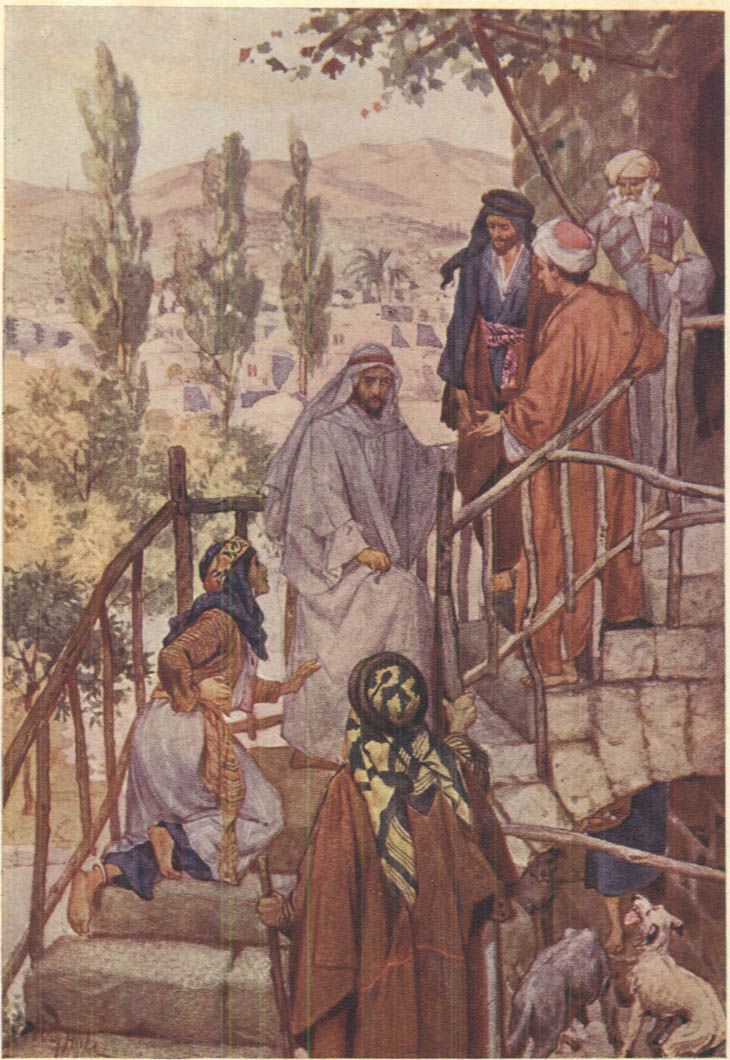
THE WOMAN OF CANAAN
Then Jesus went thence, and departed into the coasts of Tyre and
Sidon. And, behold, a woman of Canaan came out of the same coasts,
and cried unto him, saying, Have mercy on me, O Lord, thou son of
David; my daughter is grievously vexed with a devil. But he answered
her not a word. And his disciples came and besought him, saying, Send
her away; for she crieth after us. But he answered and said, I am not
sent but unto the lost sheep of the house of Israel. Then came she
and worshipped him, saying, Lord, help me. But he answered and said,
It is not meet to take the children’s bread, and to cast it to
dogs. And she said, Truth, Lord: yet the dogs eat of the crumbs which
fall from their masters’ table. Then Jesus answered and said unto
her, O woman, great is thy faith: be it unto thee even as thou
wilt. And her daughter was made whole from that very hour.—St.
Matt. xv: 21-28.
NOTE BY THE ARTIST
The picture illustrates the scenery and gardens in the neighborhood
of Beyrout, which lies on the coast at the foot of Lebanon and within
the Syro-Phoenician border.
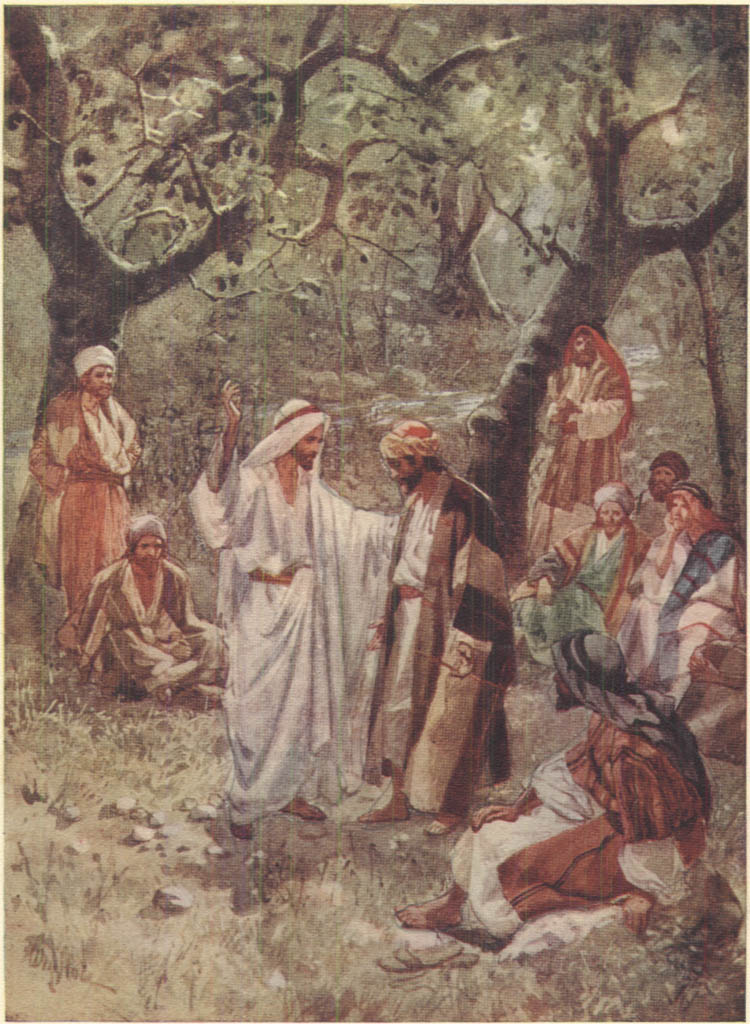
SIMON PETER’S FAITH IN CHRIST
When Jesus came into the coasts of Cæsarea Philippi, he asked his
disciples, saying, Whom do men say that I the Son of man am? And they
said, Some say that thou art John the Baptist: some, Elias; and
others, Jeremias, or one of the prophets. He saith unto them, But
whom say ye that I am? And Simon Peter answered and said, Thou art
the Christ, the Son of the living God. And Jesus answered and said
unto him, Blessed art thou, Simon Bar-jona: for flesh and blood hath
not revealed it unto thee, but my Father which is in heaven. And I
say also unto thee, That thou art Peter, and upon this rock I will
build my church; and the gates of hell shall not prevail against it.
And I will give unto thee the keys of the kingdom of heaven: and
whatsoever thou shalt bind on earth shall be bound in heaven: and
whatsoever thou shalt loose on earth shall be loosed in heaven. Then
charged he his disciples that they should tell no man that he was
Jesus the Christ.—St. Matt, xvi: 13-20.
NOTE BY THE ARTIST
The site of Cæsarea Philippi is one of the loveliest spots in
Northern Palestine. On ground carpeted with an infinite variety of
wild flowers, the traveller rests in the grateful shade of oak and
mulberry, olive and fig tree. The sound of many waters is heard on
all sides as they hasten from the adjacent slopes of Herman to join
the head waters of Jordan, bursting in strength from a cavern at the
foot of a mighty cliff. Hither, with his handful of followers, came
Jesus, weary and in deep depression of spirit, a fugitive from his
own people, who had finally rejected him; and here, in reply to
searching and anxious enquiry, “Whom say ye that I am?” he received
from Simon Peter the memorable confession, “Thou art the Christ, the
Son of the living God.”
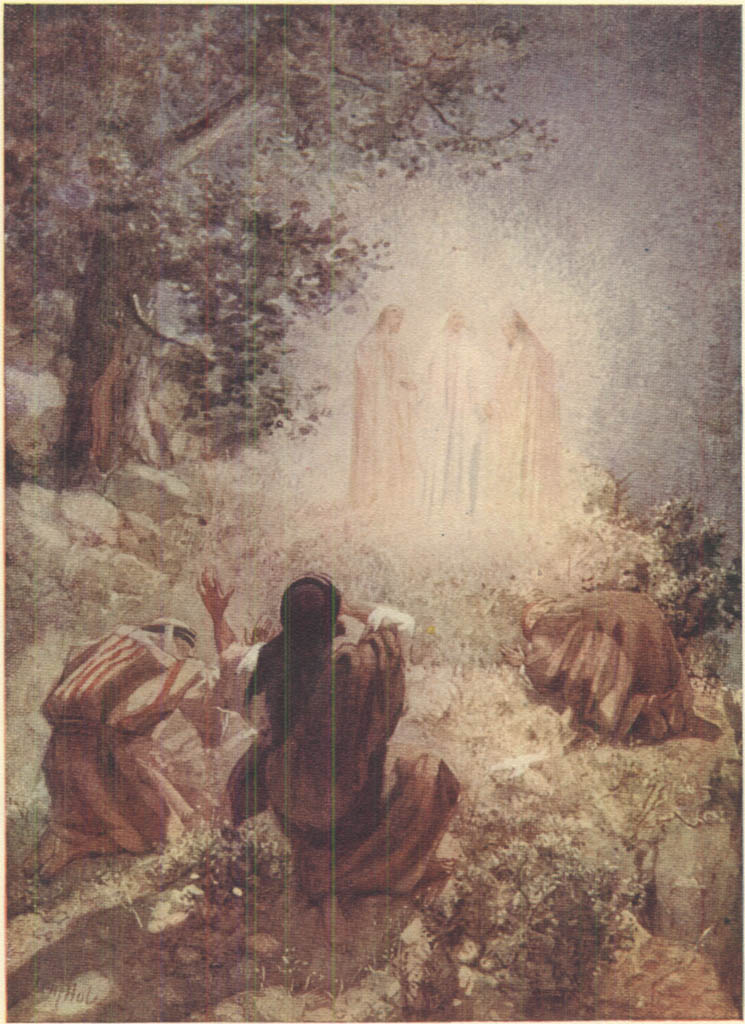
THE TRANSFIGURATION OF CHRIST
And after six days Jesus taketh Peter, James, and John his brother,
and bringeth them up into an high mountain apart. And was
transfigured before them: and his face did shine as the sun, and his
raiment was white as the light. And, behold, there appeared unto them
Moses and Elias talking with him. Then answered Peter, and said unto
Jesus, Lord, it is good for us to be here: if thou wilt, let us make
here three tabernacles; one for thee, and one for Moses, and one for
Elias. While he yet spake, behold, a bright cloud overshadowed them:
and behold a voice out of the cloud which said, This is my beloved
Son, in whom I am well pleased; hear ye him. And when the disciples
heard it, they fell on their face, and were sore afraid. And Jesus
came and touched them, and said, Arise, and be not afraid. And when
they had lifted up their eyes, they saw no man, save Jesus
only.—St. Matt, xvii: 1—8.
NOTE BY THE ARTIST
From the days of St. Jerome, when pilgrims first began the attempt
to identify sites hallowed by sacred events, Mount Tabor has, until
recent years, been regarded as the Mount of the Transfiguration. But
closer examination of the text and comparison of dates, and the fact
that Tabor itself was at that time the site of a fortified town
containing a Roman garrison, combine in this instance to discredit
tradition. One of the spurs of Herman must therefore be the
alternative and more probable scene of the Transfiguration; the
seclusion of this district of mountain, valley, and woodland
providing opportunity for contemplation, and preparation for the end
which was now imminent, “the decease which Jesus was to accomplish at
Jerusalem”.
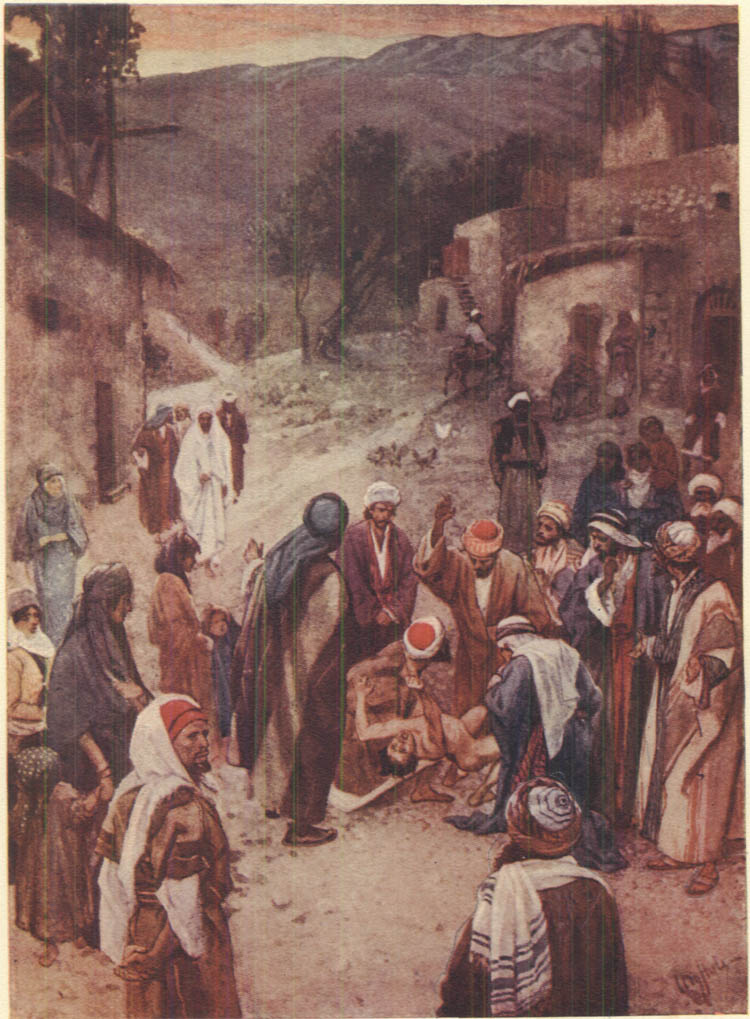
JESUS HEALETH A LUNATIC
And it came to pass, that on the next day, when they were come down
from the hill, much people met him. And, behold, a man of the company
cried out, saying, Master, I beseech thee, look upon my son: for he
is mine only child. And, lo, a spirit taketh him, and he suddenly
crieth out; and it teareth him that he foameth again, and bruising
him hardly departeth from him. And I besought thy disciples to cast
him out; and they could not. And Jesus answering said, O faithless
and perverse generation, how long shall I be with you, and suffer
you? Bring thy son hither. And as he was yet a coming, the devil
threw him down, and tare him. And Jesus rebuked the unclean spirit,
and healed the child, and delivered him again to his father.—St.
Luke ix: 37-42.
NOTE BY THE ARTIST
The picture gives an average representation of the outskirts of a
village in Northern Palestine, with its sordid, untidy, mud-built
houses, on the roofs of which are seen the reed booths or Succôth,
occupied by the inhabitants during the oppressive heats of summer.
The snow-capped ridge of Hermon is indicated in the distance.
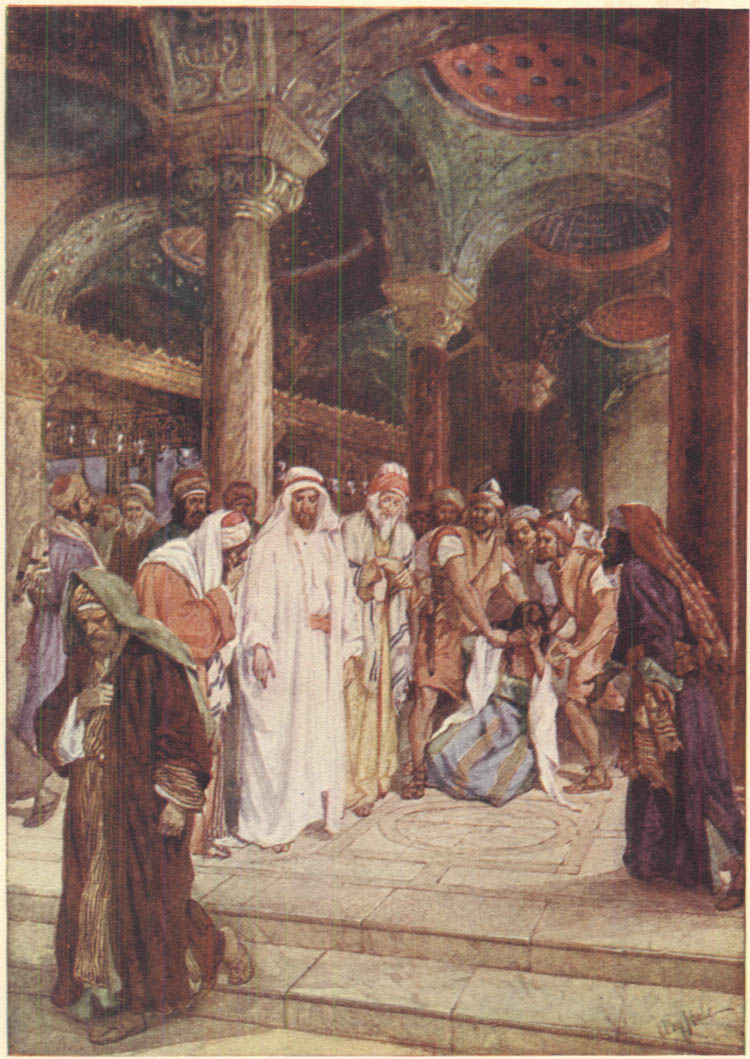
LET HE WHO IS WITHOUT SIN AMONG YOU
Now about the midst of the feast Jesus went up into the temple, and
taught. And the Jews marvelled, saying, How knoweth this man letters,
having never learned? Jesus answered them, and said, My doctrine is
not mine, but his that sent me. And the scribes and Pharisees brought
unto him a woman …; and when they had set her in the midst. They
say unto him, … Moses in the law commanded us, that such should be
stoned: but what sayest thou? This they said, tempting him, that they
might have to accuse him. But Jesus stooped down, and with his
finger wrote on the ground, as though he heard them not. So when
they continued asking him, he lifted up himself, and said unto them,
He that is without sin among you, let him first cast a stone at her.
And again he stooped down, and wrote on the ground. And they which
heard it, being convicted by their own conscience, went out one
by one, beginning at the eldest, even unto the last: and Jesus was
left alone, and the woman standing in the midst. When Jesus had
lifted up himself, and saw none but the woman, he said unto her,
Woman, where are those thine accusers? hath no man condemned thee?
She said, No man, Lord. And Jesus said unto her, Neither do I condemn
thee: go, and sin no more.—St. John vii: 14-16; viii: 3-11.
NOTE BY THE ARTIST
The scene is represented as taking place in one of the great
cloisters or porticoes which surrounded the Temple courts, and which
like the Forum of Rome, and “Paul’s Wall” in Elizabethan, London,
served the purpose of a public promenade and place of meeting. These
porticoes were of magnificent construction and proportions, the Stoa
Basilica alone, upon the south side, with its quadruple colonnade of
one hundred and sixty-two pillars, covering a great area. The Eastern
Cloister, known as “Solomon’s Porch,” was probably so-called as
having been erected upon the site of a similar construction in the
first Temple.
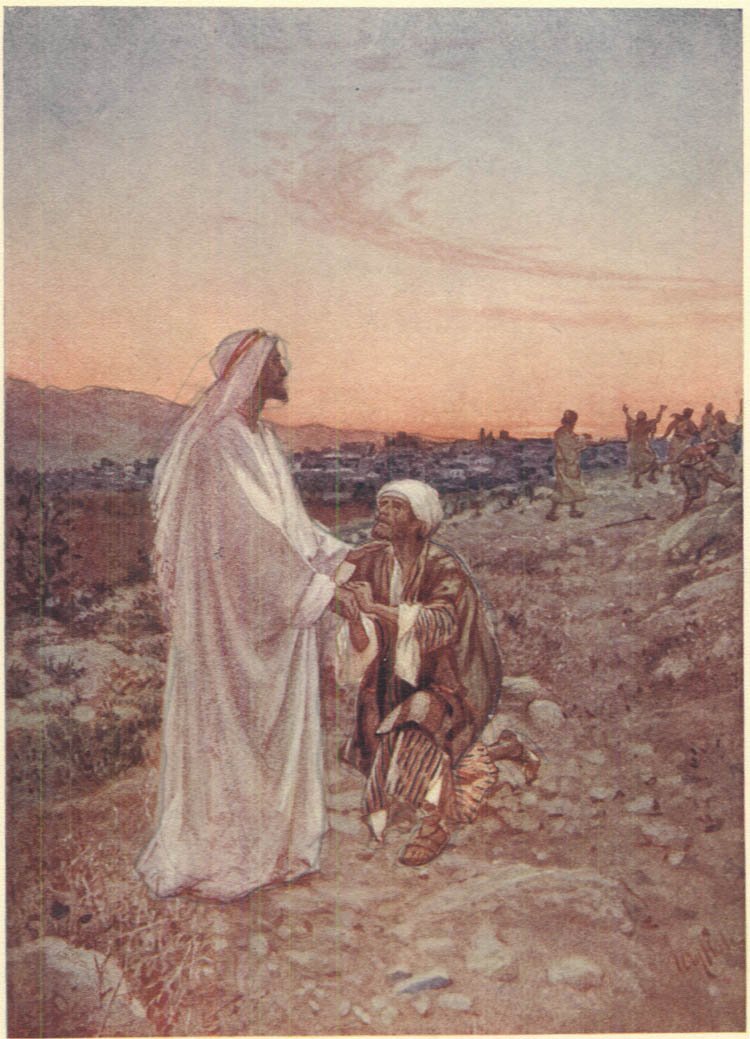
ONE OF TEN LEPERS CURED IS GRATEFUL
And it came to pass, as he went to Jerusalem, that he passed through
the midst of Samaria and Galilee. And as he entered into a certain
village, there met him ten men that were lepers, which stood afar
off. And they lifted up their voices, and said, Jesus, Master, have
mercy on us. And when he saw them, he said unto them, Go shew
yourselves unto the priests. And it came to pass, that, as they went,
they were cleansed. And one of them, when he saw that he was healed,
turned back, and with a loud voice glorified God. And fell down on
his face at his feet, giving him thanks: and he was a Samaritan.
And Jesus answering said, Were there not ten cleansed? but where
are the nine? There are not found that returned to give glory to
God, save this stranger. And he said unto him, Arise, go thy way: thy
faith hath made thee whole.—St. Luke xvii: II—19.
NOTE BY THE ARTIST
The town of Cana in Galilee, with its background of low hills, as
seen from the Nazareth Road, supplies a landscape setting for this
picture. The ingratitude of the nine lepers no doubt added to our
Lord’s sorrow just now at the growing influence of the opposition of
his enemies.
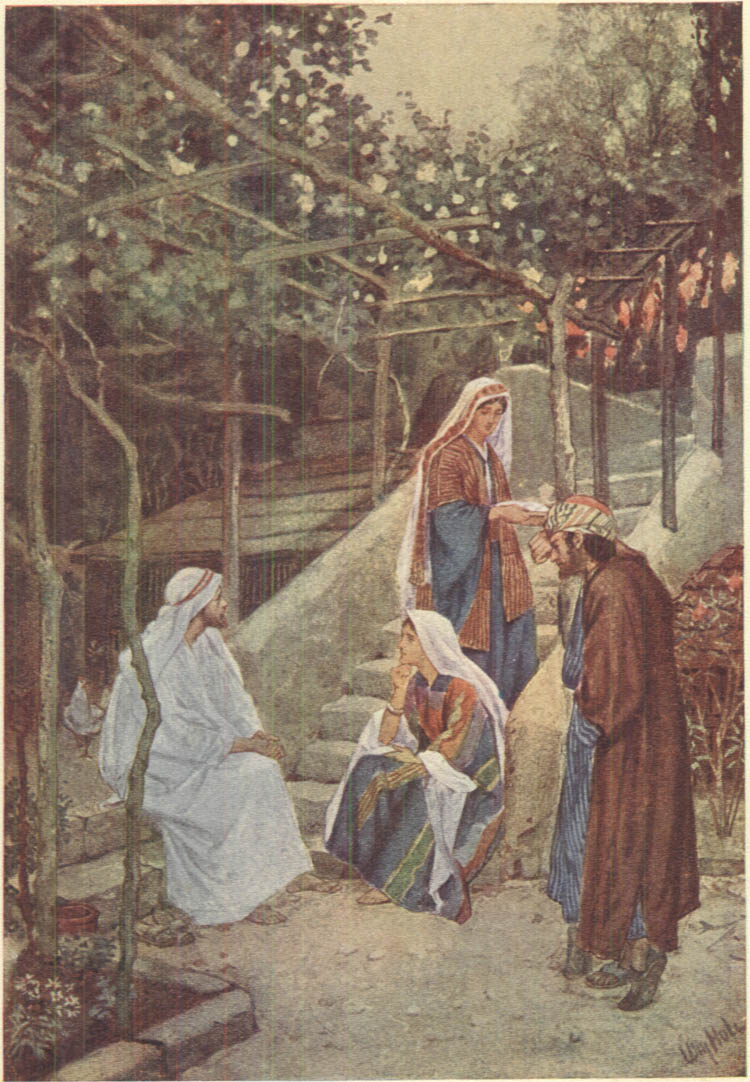
JESUS, MARTHA, MARY, AND LAZARUS
Now it came to pass, as they went, that he entered into a certain
village: and a certain woman named Martha received him into her
house. And she had a sister called Mary, which also sat at Jesus’
feet, and heard his word. But Martha was cumbered about much serving,
and came to him, and said, Lord, dost thou not care that my sister
hath left me to serve alone? bid her therefore that she help me. And
Jesus answered and said unto her, Martha, Martha, thou art careful
and troubled about many things. But one thing is needful: and Mary
hath chosen that good part, which shall not be taken away from
her.—St. Luke x: 38-42.
NOTE BY THE ARTIST
Bethany is situated on the southern slope of the Mount of Olives,
about two miles from Jerusalem. The house of his friends, Martha,
Mary, and Lazarus, the only place which, during the latter part of
his ministry, Jesus could call a home, was probably that of people in
easy circumstances, and as such is here represented. In the vineyards
of Palestine the vine is cultivated bushlike on the ground; but in
gardens, the plant is occasionally trained erect, as in Europe and
America, or, as in the present instance, for the purposes of shade,
upon a pergola. In the middle of the village of Bethany are the ruins
of an important house. Here some years ago a French explorer
discovered on the base the remains of an ancient chapel This seems to
point with probability to a valid tradition of the site of the house
of Martha, Mary, and Lazarus.
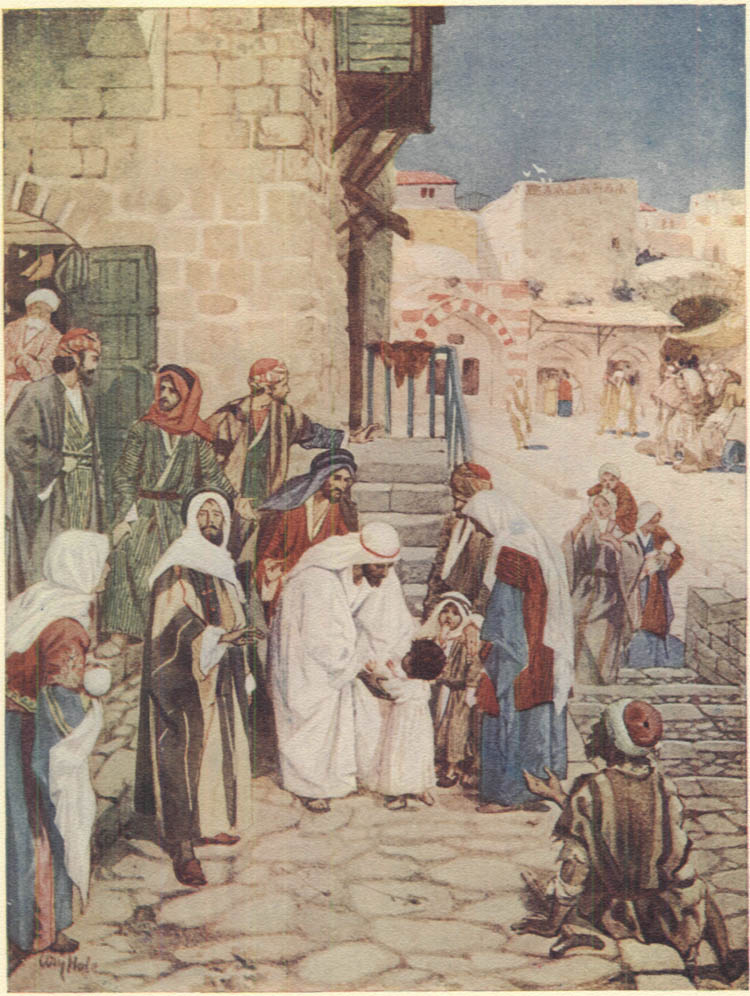
JESUS BLESSETH LITTLE CHILDREN
And they brought young children to him, that he should touch them:
and his disciples rebuked those that brought them. But when Jesus
saw it, he was much displeased, and said unto them, Suffer the
little children to come unto me, and forbid them not: for of such is
the kingdom of God. Verily I say unto you, Whosoever shall not
receive the kingdom of God as a little child, he shall not enter
therein. And he took them up in his arms, put his hands upon them,
and blessed them.—St. Mark x: 13-16.
NOTE BY THE ARTIST
In the Hebrew Bible—the Talmud—it is stated that, according to
pious custom, parents brought their little children to the synagogue
that they might receive the benefit of the prayers and blessings of
the elders. Rabbis also, of recognized sanctity, were frequently
appealed to in a like manner; and his fame as a prophet and
benefactor having preceded him into Peraea, infants were now brought
to Jesus, that he might lay his hands upon them in supplication and
blessing. The architectural setting of the picture is adapted from
that of a small square near the Damascus Gate of Jerusalem. This
kindly and gentle act of our Lord has been of incalculable
consequence to the life of children in the development of Christian
civilization.
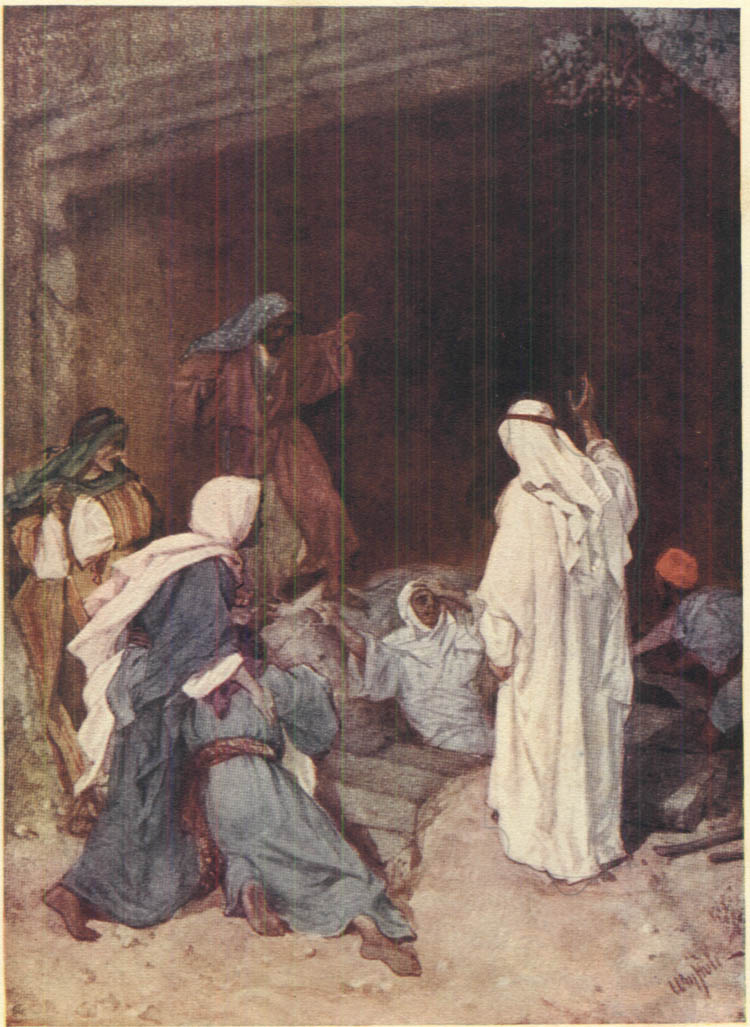
THE RESURRECTION OF LAZARUS, FOUR DAYS DEAD
Then said Jesus unto them plainly, Lazarus is dead. And I am glad for
your sakes that I was not there, to the intent ye may believe;
nevertheless let us go unto him. Jesus therefore again groaning in
himself cometh to the grave. It was a cave, and a stone lay upon it.
Jesus said, Take ye away the stone. Martha, the sister of him that
was dead, saith unto him, Lord, by this time he stinketh: for he hath
been dead four days. Jesus saith unto her, Said I not unto thee,
that, if thou wouldest believe, thou shouldest see the glory of God?
Then they took away the stone from the place where the dead was
laid. And Jesus lifted up his eyes, and said, Father, I thank thee
that thou hast heard me. And I knew that thou hearest me always: but
because of the people which stand by I said it, that they may
believe that thou hast sent me. And when he thus had spoken, he cried
with a loud voice, Lazarus, come forth. And he that was dead came
forth.—St. John xi: 14., 15,38-44.
NOTE BY THE ARTIST
The painting illustrates a form of rock-cut tomb which, though not
so common as others in the neighborhood of Jerusalem, is nevertheless
selected as being in accordance with the description of what took
place in the present instance. It is obviously the type of tomb which
is referred to on a subsequent occasion, and explains the meaning of
“the stone rolled away from the sepulchre” The entrance of the tomb
is at the bottom of a flight of steps, and is covered by a
disc-shaped stone, like a mill-stone, which can be rolled back into a
slot cut in the rock for its reception. (The kneeling man in the
background has apparently just performed this duty?) The entrance is
closed by rolling the stone forward, dropping a small block behind it
to prevent its recession, and finally by covering the
before-mentioned slot with a slab, which, being cemented down, the
tomb is “sealed.”

CONVERSION OF ZACCHAEUS, A PUBLICAN
And Jesus entered and passed through Jericho. And, behold, there
was a man named Zacchæus, which was the chief among the publicans,
and he was rich. And he sought to see Jesus who he was; and could not
for the press, because he was little of stature. And he ran before,
and climbed up into a sycomore tree to see him: for he was to pass
that way. And when Jesus came to the place, he looked up, and saw
him, and said unto him, Zacchæus, make haste, and come down; for to
day I must abide at thy house. And he made haste, and came down, and
received him joyfully. And when they saw it, they all murmured,
saying, That he was gone to be guest with a man that is a sinner. And
Zacchæus stood, and said unto the Lord: Behold, Lord, the half of my
goods I give to the poor; and if I have taken any thing from any man
by false accusation, I restore him fourfold. And Jesus said unto
him, This day is salvation come to this house, forsomuch as he also
is a son of Abraham. For the Son of man is come to seek and to save
that which was lost.—St. Luke xix: 1-10.
NOTE BY THE ARTIST
The sycomore tree referred to in the text is a species of fig
bearing small, coarse fruit, which is used as food only in cases of
necessity. Although occasionally of great size, the tree is easily
climbed, as the trunk is short, and the branches are numerous and
wide spreading. Jericho, rebuilt by Herod, was a somewhat fashionable
town. To signalize the despised tax-gatherer in such a way was to
teach a permanent lesson of absolute unworldliness.

JESUS RESTORETH SIGHT TO BARTIMAEUS
And they came to Jericho: and as he went out of Jericho with his
disciples and a great number of people, blind Bartimaeus, the son of
Timaeus, sat by the highway side begging. And when he heard that it
was Jesus of Nazareth, he began to cry out, and say, Jesus, thou
son of David, have mercy on me. And many charged him that he should
hold his peace: but he cried the more a great deal, Thou son of
David, have mercy on me. And Jesus stood still, and commanded him to
be called. And they called the blind man, saying unto him, Be of good
comfort, rise; he calleth thee. And he, casting away his garment,
rose, and came to Jesus. And Jesus answered and said unto him, What
wilt thou that I should do unto thee? The blind man said unto him,
Lord, that I might receive my sight. And Jesus said unto him, Go thy
way; thy faith hath made thee whole. And immediately he received his
sight, and followed Jesus in the way.—St. Mark x: 4.6—52.
NOTE BY THE ARTIST
The site of Jericho is still an oasis in the surrounding desert, but
neither its fertility nor its dimensions bear comparison with those
which it attained in former days; and hardly a tree remains of the
celebrated groves of balsam, spice, and fruit-bearing trees, and the
palms which earned for Jericho the title of “The City of the Palm
Trees,” and which made its neighboring plain the garden of
Palestine—the “divine district” as Joseph us calls it. This
fertility was owing entirely to skilful irrigation, traces of no less
than twelve aqueducts having been discovered. No class of sufferers
more frequently claimed and obtained from Jesus the exercise of his
compassion and healing power than that represented by blind
Bartimaus. The malady of blindness is grievously common in Palestine,
the proportion of those thus afflicted being one in every hundred of
the population, whereas in Europe the proportion is only one in a
thousand.
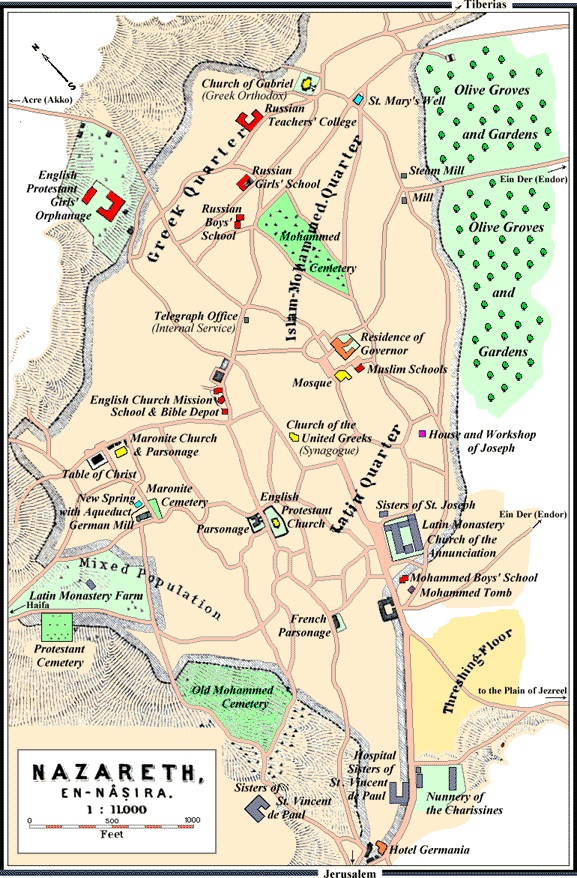
CHRIST’S TRIUMPHAL ENTRY INTO JERUSALEM
And when they drew nigh unto Jerusalem, and were come to Bethphage,
unto the mount of Olives, then sent Jesus two disciples. Saying unto
them, Go into the village over against you, and straightway ye shall
find an ass tied, and a colt with her: loose them, and bring them
unto me. And if any man say ought unto you, ye shall say, The Lord
hath need of them; and straightway he will send them. All this was
done, that it might be fulfilled which was spoken by the prophet. And
the disciples went, and did as Jesus commanded them. And brought the
ass, and the colt, and put on them their clothes, and they set him
thereon. And a very great multitude spread their garments in the way;
others cut down branches from the trees, and strawed them in the
way. And the multitudes that went before, and that followed, cried,
saying, Hosanna to the son of David: Blessed is he that cometh in
the name of the Lord; Hosanna in the highest. And when he was come
into Jerusalem, all the city was moved, saying, Who is this? And the
multitude said, This is Jesus the prophet of Nazareth of
Galilee.—St. Matt, xxi: 1-4., 6-11.
NOTE BY THE ARTIST
Had Jesus omitted to command to bring its mother along with the
colt, upon which he elected to ride, his disciples would probably
have brought her as a matter of course. It is the custom of the
country; and as journeys are accomplished at a walking pace, mares
and she-asses are frequently accompanied by their foals. It may be
noted that in this picture one of the gates of Hebron does duty for
that through which Jesus makes his triumphal entry into Jerusalem;
the former being suggestive of far greater antiquity than any which
are to be found at the present day in Jerusalem itself.
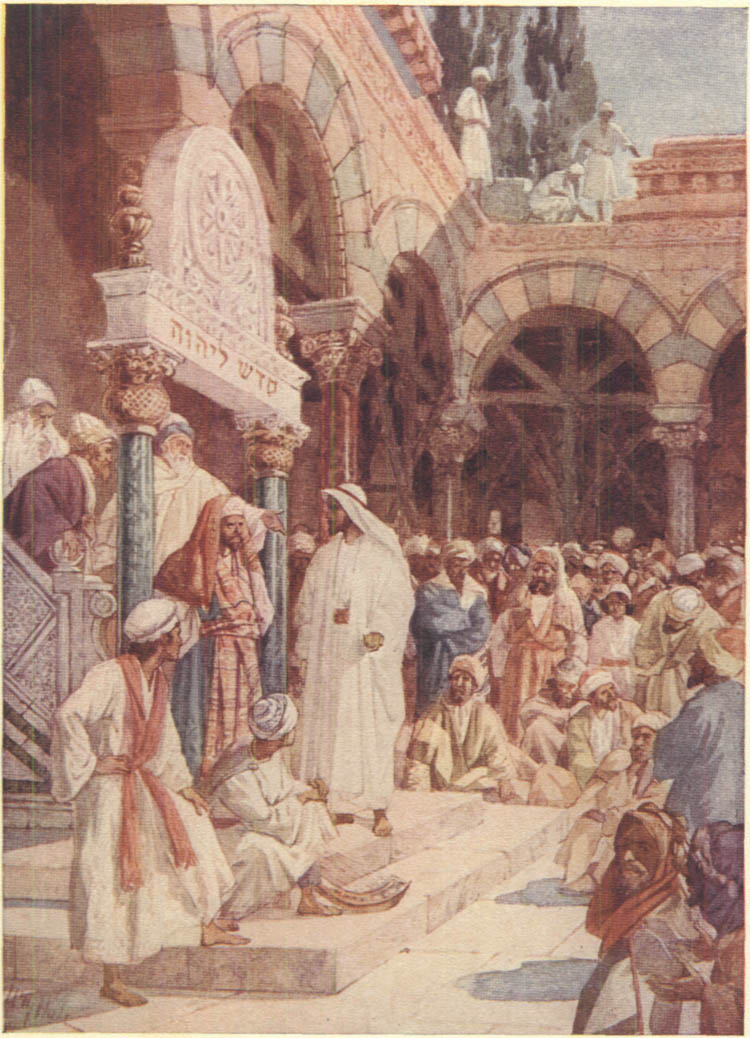
CHRIST AVOUCHETH HIS AUTHORITY
And he taught daily in the temple. But the chief priests and the
scribes and the chief of the people sought to destroy him. And could
not find what they might do: for all the people were very attentive
to hear him. And it came to pass, that on one of those days, as he
taught the people in the temple, and preached the gospel, the chief
priests and the scribes came upon him with the elders. And spake
unto him, saying, Tell us, by what authority doest thou these things?
or who is he that gave thee this authority? And he answered and said
unto them, I will also ask you one thing; and answer me: The baptism
of John, was it from heaven, or of men? And they reasoned with
themselves, saying, If we shall say, From heaven; he will say, Why
then believed ye him not? But and if we say, Of men; all the people
will stone us: for they be persuaded that John was a prophet. And
they answered, that they could not tell whence it was. And Jesus
said unto them, Neither tell I you by what authority I do these
things.—St. Luke xix: 47, 48; xx: 1-8.
NOTE BY THE ARTIST
The occasion on which Jesus encountered for the last time the
opposition of his priestly enemies to his teaching, and when, in the
presence of the assembled multitudes, he exposed and denounced their
hypocrisy, is supposed to take place in one of the great outer courts
of the Temple, the buildings of which, although begun forty-six years
previously, were at this time still unfinished, and were indeed never
fully completed in accordance with their original design.
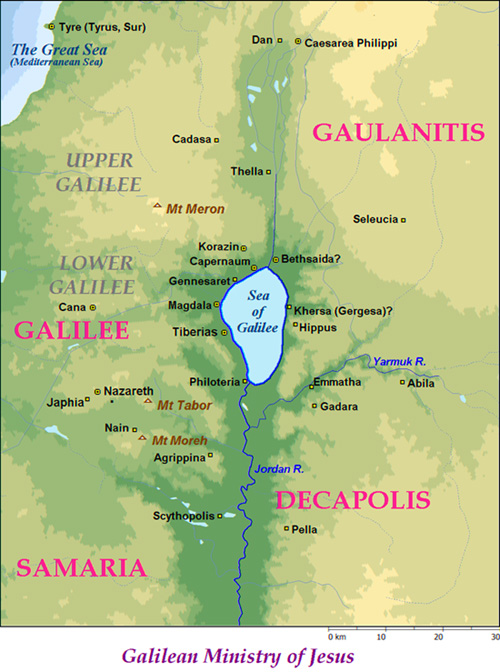
AT NIGHT, JESUS ABODE ON THE MOUNT OF OLIVES
And in the day time he was teaching in the temple; and at night he
went out, and abode in the mount that is called the mount of
Olives.—St. Luke xxi: 37.
NOTE BY THE ARTIST
As we ascend towards sunset the slopes of Olivet, and pause to gaze
on the scenes beneath, the panorama of the city presented to view is
in its leading features essentially similar to that upon which the
eyes of Jesus rested, when “at night he went out, and abode in the
mount that is called the Mount of Olives” Yonder stands a temple
within that sacred enclosure which, for well-nigh three thousand
years, save for the period during which, “the abomination of
desolation spoken of by Daniel the prophet stood in the Holy place,”
has been dedicated to the worship of Jehovah. The citadel of
Jerusalem breaks the skyline where stood the tower of Hippicus, and
to the left, against the setting sun, the cypresses in a monastery
garden mark the spot once covered by the gardens of the palace of
Herod. Siloam stands as of old on the hither side, overlooking the
valleys of Hinnom and Kidron; while to-day, as in former times, the
olive yards beneath and the trees around, might well give the name
which it bears to the hill on which we stand.

JESUS WASHETH HIS DISCIPLES’ FEET
Now before the feast of the passover, when Jesus knew that his hour
was come that he should depart out of this world unto the Father,
having loved his own which were in the world, he loved them unto the
end. And supper being ended, the devil having now put into the heart
of Judas Iscariot, Simon’s son, to betray him. Jesus knowing that
the Father had given all things into his hands, and that he was come
from God, and went to God. He riseth from supper, and laid aside his
garments; and took a towel, and girded himself. After that he poureth
water into a bason, and began to wash the disciples’ feet, and to
wipe them with the towel wherewith he was girded. Then cometh he to
Simon Peter: and Peter saith unto him, Lord, dost thou wash my feet?
Jesus answered and said unto him, What I do thou knowest not now; but
thou shalt know hereafter. Peter saith unto him, Thou shalt never
wash my feet. Jesus answered him, If I wash thee not, thou hast no
part with me. Simon Peter saith unto him, Lord, not my feet only, but
also my hands and my head. Jesus saith to him, He that is washed
needeth not save to wash his feet, but is clean every whit: and ye
are clean, but not all.—St. John xiii: 1-10.
NOTE BY THE ARTIST
A dwelling house, claiming to be one of the most ancient in
Jerusalem, supplied materials for the study of the “large upper
room,” represented in this and some other of the paintings. The
general features of the chamber, with its arched ceiling and
flattened dome, its leewans (raised platform) and the
entrance-passage of colored stones, where guests leave their
foot-gear before stepping upon the mat-covered floor of the room,
may, for the reasons adduced elsewhere, be accepted as typical of
similar apartments of the period under consideration.
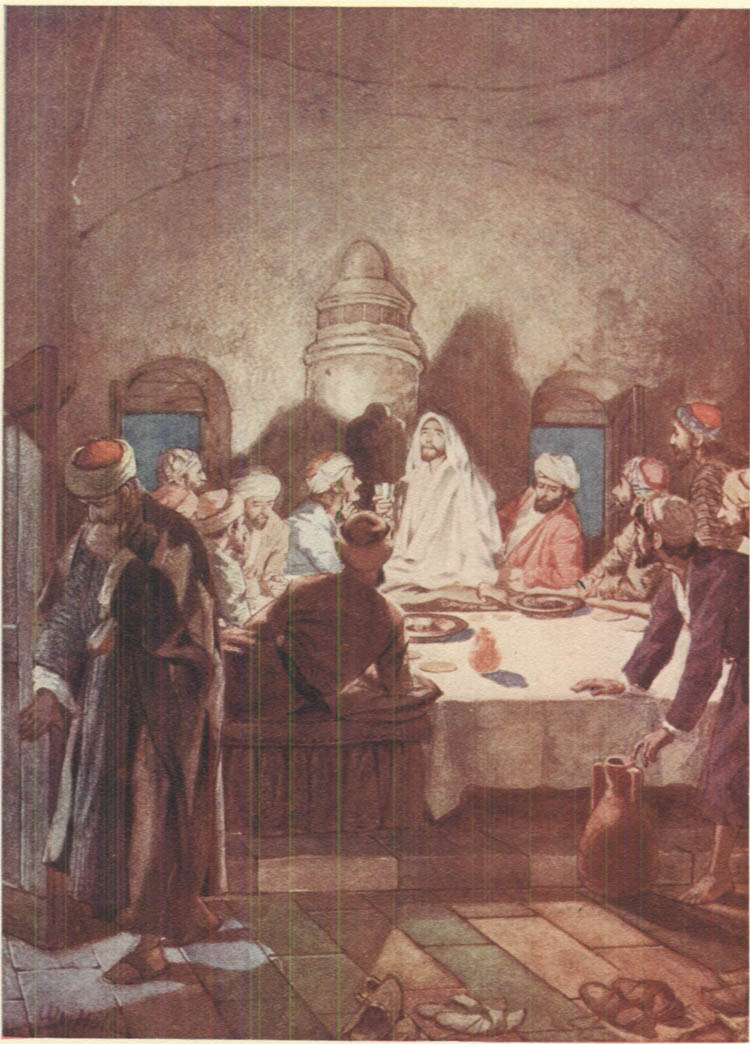
THE BETRAYAL FORETOLD AT THE SUPPER
When Jesus had thus said, he was troubled in spirit, and testified,
and said, Verily, verily, I say unto you, that one of you shall
betray me. Then the disciples looked one on another, doubting of whom
he spake. Now there was leaning on Jesus’ bosom one of his disciples,
whom Jesus loved. Simon Peter therefore beckoned to him, that he
should ask who it should be of whom he spake. He then lying on Jesus’
breast saith unto him, Lord, who is it? Jesus answered, He it is, to
whom I shall give a sop, when I have dipped it. And when he had
dipped the sop, he gave it to Judas Iscariot, the son of Simon.
And after the sop Satan entered into him. Then said Jesus unto him,
That thou doest, do quickly. Now no man at the table knew for what
intent he spake this unto him. For some of them thought, because
Judas had the bag, that Jesus had said unto him, Buy those things
that we have need of against the feast; or, that he should give
something to the poor. He then having received the sop went
immediately out: and it was night.—St. John xiii: 21-30.
NOTE BY THE ARTIST
Comment has already been made upon the custom prevailing at this
time of reclining at meat. We are aware, from other sources of
information, that in partaking of the Passover, the attitude of
standing had, as a point of ritual, long been abandoned in favor of
the recumbent posture, and this is directly evidenced by the words of
the text (v: 23 and 25), which are only compatible with the
supposition that on the present occasion the guest-chamber was
furnished with couches which ran around the three sides of the table
in the usual manner. Authorities differ as to which was regarded as
the “highest seat” some maintaining that this was the outermost place
on the right-hand couch; others, again, preferring the arrangement
followed in the painting, where Jesus occupies the centre.
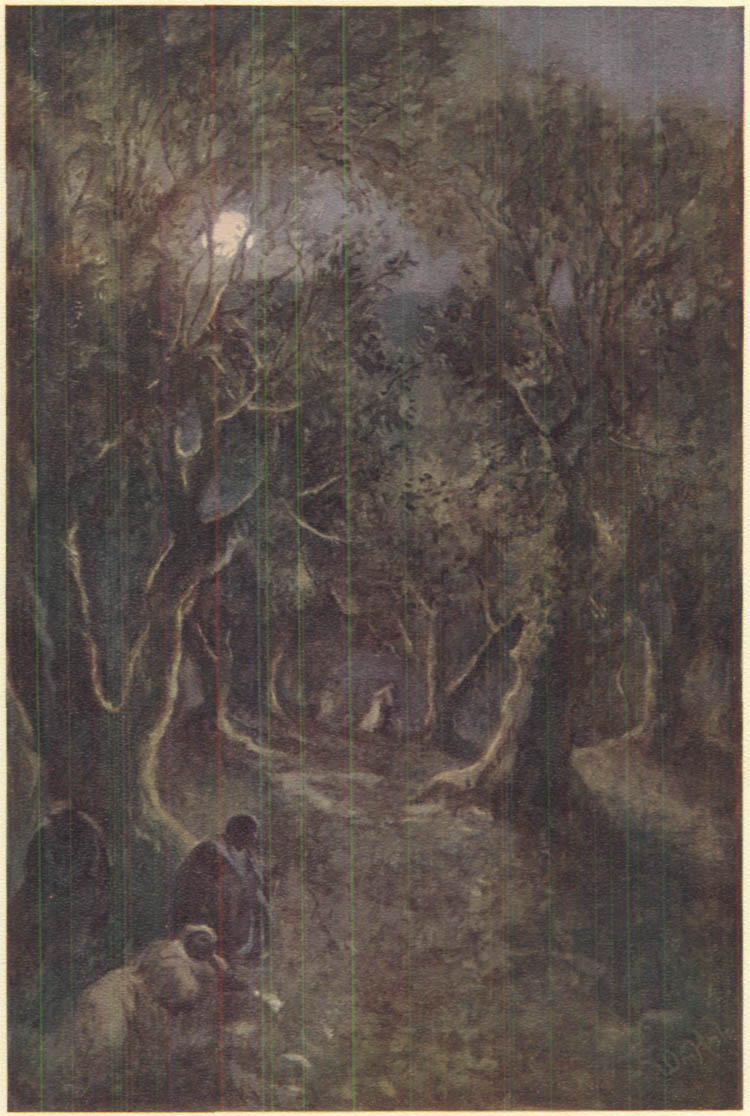
IN THE GARDEN OF GETHSEMANE
Then cometh Jesus with them unto a place called Gethsemane, and saith
unto the disciples, Sit ye here, while I go and pray yonder. And he
took with him Peter and the two sons of Zebedee, and began to be
sorrowful and very heavy. Then saith he unto them, My soul is
exceeding sorrowful, even unto death: tarry ye here, and watch with
me. And he went a little farther, and fell on his face, and prayed,
saying, O my Father, if it be possible, let this cup pass from me:
nevertheless not as I will, but as thou wilt. And he cometh unto
the disciples, and findeth them asleep, and saith unto Peter, What,
could ye not watch with me one hour? Watch and pray, that ye enter
not into temptation: the spirit indeed is willing, but the flesh
is weak. He went away again the second time, and prayed, saying, O
my Father, if this cup may not pass away from me, except I drink it,
thy will be done. And he came and found them asleep again: for their
eyes were heavy. And he left them, and went away again, and prayed
the third time, saying the same words. Then cometh he to his
disciples, and saith unto them, Sleep on now, and take your rest:
behold, the hour is at hand, and the Son of man is betrayed into the
hands of sinners. Rise, let us be going: behold, he is at hand that
doth betray me.—St. Matt, xxvi: 36-46.
NOTE BY THE ARTIST
As the word Gethsemane means the “oil press” the “Garden” was in all
probability an olive yard, whose actual site, though it cannot be
determined with certainty, must have been in the immediate vicinity
at least of the spot which age-long tradition indicates as the scene
of the Agony. The great age of the trees in this enclosure has been
urged in favor of the tradition, but it is fatal to their claim as
witnesses, that Titus is known to have cut down, for military
purposes, all the trees in the neighborhood of the besieged city.
This site is now owned by the Russians who have turned it into a neat
and trim garden, and built a bright new white church on the upper
level with five large gilded bulbous domes.
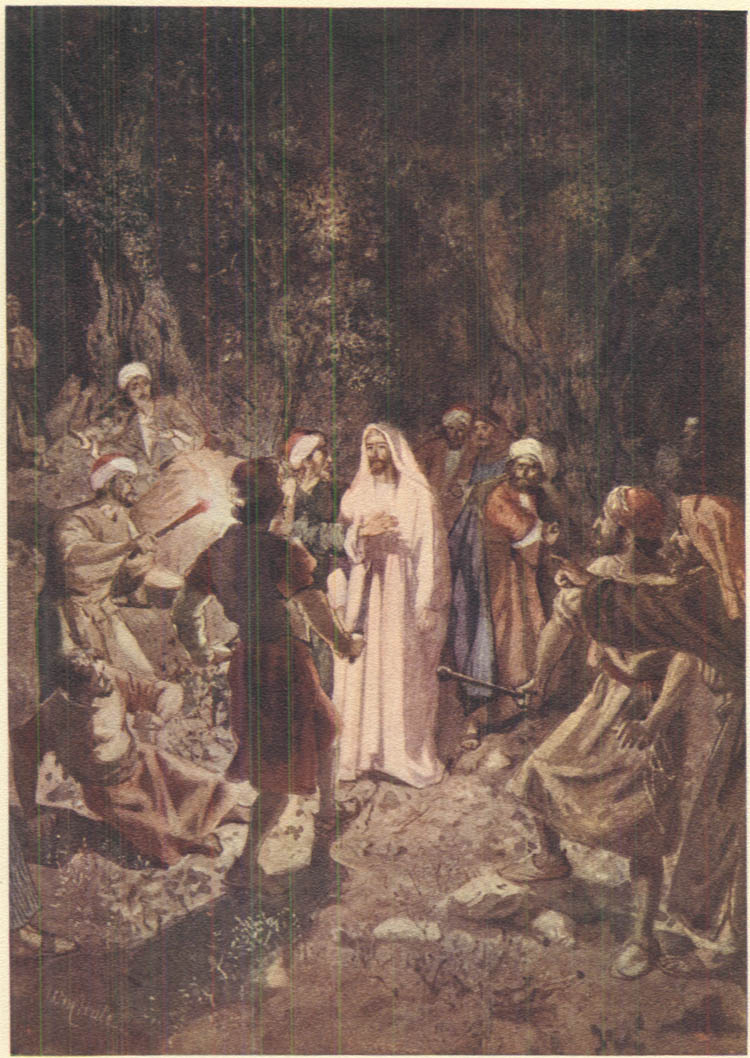
THE ARREST OF JESUS
Judas then, having received a band of men and officers from the
chief priests and Pharisees, cometh thither with lanterns and torches
and weapons. Jesus therefore, knowing all things that should come
upon him, went forth, and said unto them, Whom seek ye? They answered
him, Jesus of Nazareth. Jesus saith unto them, I am he. And Judas
also, which betrayed him, stood with them. As soon then as he had
said unto them, I am he, they went backward, and fell to the
ground.—Now he that betrayed him gave them a sign, saying,
Whomsoever I shall kiss, that same is he: hold him fast. And
forthwith he came to Jesus, and said, Hail, master; and kissed him.
And Jesus said unto him, Friend, wherefore art thou come? Then came
they, and laid hands on Jesus, and took him. And, behold, one of them
which were with Jesus stretched out his hand, and drew his sword,
and struck a servant of the high priest’s, and smote off his ear.
Then said Jesus unto him, Put up again thy sword into his place: for
all they that take the sword shall perish with the sword. Thinkest
thou that I cannot now pray to my Father, and he shall presently give
me more than twelve legions of angels? But how then shall the
scriptures be fulfilled, that thus it must be? In that same hour said
Jesus to the multitudes, Are ye come out as against a thief with
swords and staves for to take me? I sat daily with you teaching in
the temple, and ye laid no hold on me. But all this was done, that
the scriptures of the prophets might be fulfilled. Then all the
disciples forsook him, and fled.—St. John xviii: 3-6; St. Matt,
xxvi: 48-56.
NOTE BY THE ARTIST
Cunningly conceived indeed was that signal of the kiss; for in the
very act of betrayal, Judas thus covered his own treachery; and, had
the plot failed, it would even have appeared as if, when “all the
disciples forsook him and fled” Judas alone had courage, in the hour
of danger, to stand by and openly to acknowledge Jesus as his
Master.
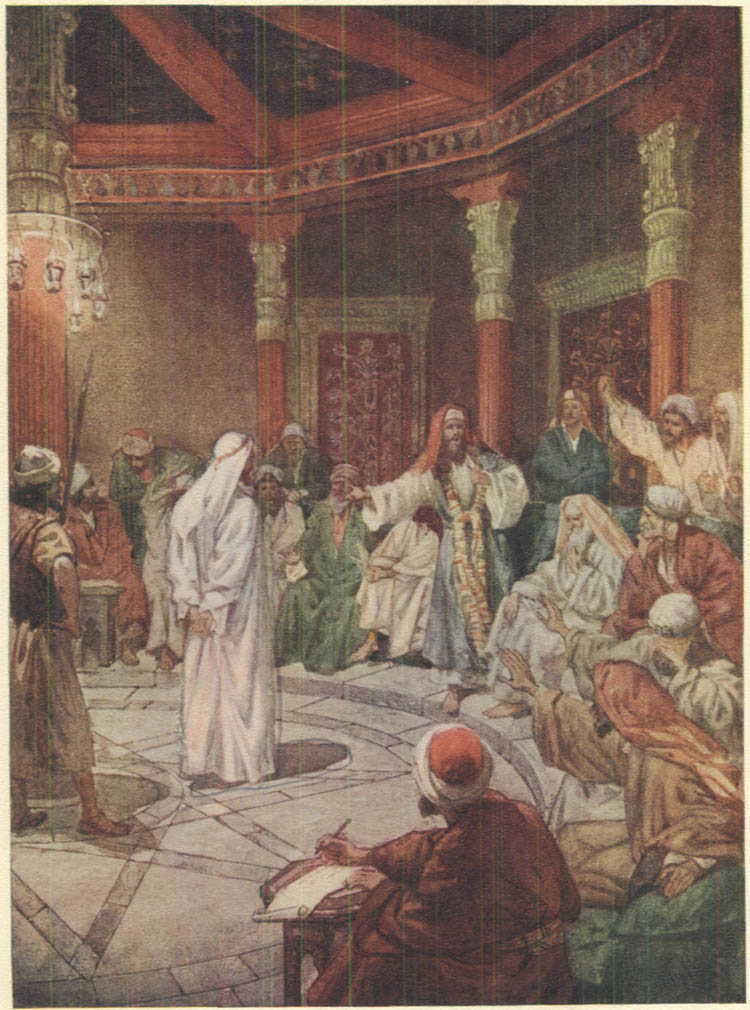
JESUS EXAMINED BY CAIAPHAS
And they that had laid hold on Jesus led him away to Caiaphas the
high priest, where the scribes and the elders were assembled. But
Peter followed him afar off unto the high priest’s palace, and went
in, and sat with the servants, to see the end. Now the chief priests,
and elders, and all the council, sought false witness against Jesus,
to put him to death. But found none: yea, though many false witnesses
came, yet found they none. At the last came two false witnesses,
And said, This fellow said, I am able to destroy the temple of God,
and to build it in three days. And the high priest arose, and said
unto him, Answerest thou nothing? what is it which these witness
against thee? But Jesus held his peace. And the high priest answered
and said unto him, I adjure thee by the living God, that thou tell us
whether thou be the Christ, the Son of God. Jesus saith unto him,
Thou hast said: nevertheless I say unto you, Hereafter shall ye see
the Son of man sitting on the right hand of power, and coming in the
clouds of heaven. Then the high priest rent his clothes, saying, He
hath spoken blasphemy; what further need have we of witnesses?
behold, now ye have heard his blasphemy. What think ye? They answered
and said, He is guilty of death.—St. Matt, xxvi: 57—66.
NOTE BY THE ARTIST
The outward ceremonial of the hastily convoked and Irregular
tribunal before which Jesus underwent the mockery of a trial was
similar to that of the ancient Sanhedrim. The members sat on a
semi-circular divan, the president in the centre, and a scribe at
each extremity, who recorded the evidence and the decisions of the
court. It may be noted, that while laws had been carefully formulated
for the conduct of such trials, almost every one of them was
flagrantly violated on the present occasion in order to ensure a
pre-arranged condemnation. For example, these rules provided that
witnesses should be summoned, and that an advocate should plead on
behalf of the accused; and they forbade that criminal trials should
be conducted at night, that condemnation should be pronounced on the
day of trial or on a holy day; and, if the crime were capital, that
execution should follow on the day of sentence.
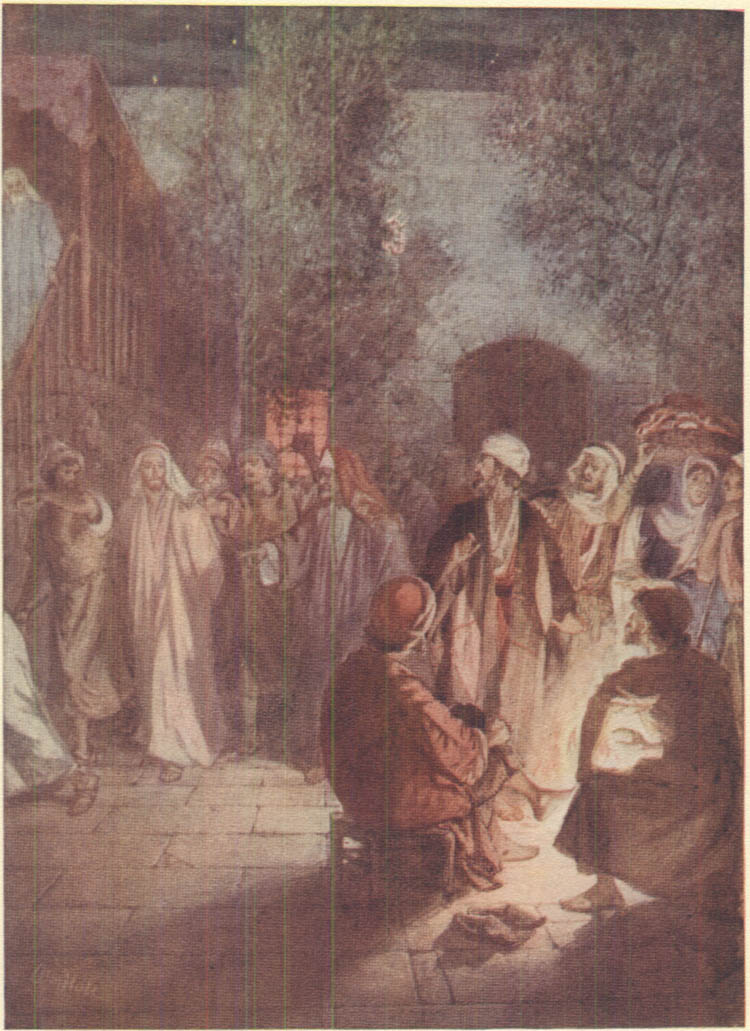
JESUS IS THRICE DENIED BY PETER
Now Peter sat without in the palace: and a damsel came unto him,
saying, Thou also wast with Jesus of Galilee. But he denied before
them all, saying, I know not what thou sayest. And when he was gone
out into the porch, another maid saw him, and said unto them that
were there, This fellow was also with Jesus of Nazareth. And again
he denied with an oath, I do not know the man. And after a while came
unto him they that stood by, and said to Peter, Surely thou also
art one of them; for thy speech betrayeth thee. Then began he to
curse and to swear, saying, I know not the man. And immediately the
cock crew. And the Lord turned, and looked upon Peter. And Peter
remembered the word of the Lord, how he had said unto him, Before the
cock crow, thou shalt deny me thrice. And he went out, and wept
bitterly.—St. Matt, xxvi: 69-74.; St. Luke xxii: 61, 62.
NOTE BY THE ARTIST
In the East, the houses of the great and official residences usually
consist of a group of separate yet connected buildings, surrounding a
quadrangular paved court planted with trees and flowering shrubs, and
furnished in the centre with an open cistern or fountain. Such was
probably the construction of the palace of the High Priest
(Caiaphas), and, apparently, this open court, across which Jesus
would be conducted to or from the hall of trial, was the place where
bitterness was added to his sorrow in hearing himself denied by his
friend—and that man who had been the first to profess belief in his
Messiahship, and who, but a few brief hours before, had stoutly sworn
to stand by him, even unto death.
Copyright 2008. Bibles Net. Com. All Rights Reserved.