
BIBLES NET. COM
The Children’s
Bible
We believe in a real God, who really cares and who has great plans for you. We’d love for you to come and visit us at our sister website Questions God. Com and see what we’re all about here.
The Children’s Bible
Bibles Net. Com Back to Home Page
THE CHILDREN’S BIBLE
 |
 |
|---|
THE CHILDREN’S BIBLE
BY HENRY A. SHERMAN AND CHARLES FOSTER KENT
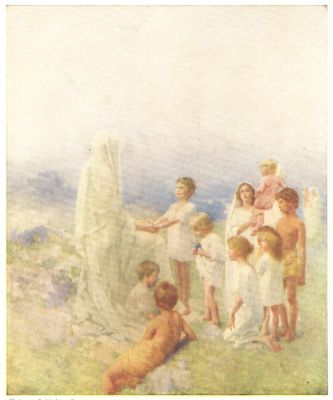 © Curtis Publishing Company
“Suffer the little children to come unto me, and forbid them not: for of such is the kingdom of God”
PREFACE
“The Children’s Bible” provides, in simple English, a translation
of selections from both the Old and the New Testament. These
selections have been made as a result of more than twenty-five years
of observation and study. The text is that of the Bible itself, but
in the language of the child, so that it may easily be read to the
younger children and by those who are older. It is not in words
of one syllable, for while the child is reading the Bible he should
gradually learn the meaning of new words and idioms.
The Bible contains the foundations on which the religious life
of the child must be built. The immortal stories and songs of the
Old and New Testaments are his richest inheritance from the past.
To give him this heritage in language and form that he can understand
and enjoy is the duty and privilege of his parents and
teachers.
It is hoped that “The Children’s Bible” will meet the need and
the demand, which parents and educators alike have long felt and
often expressed, for a simple translation of selections from the Bible
most suited to the needs and the interests of the child. It is also
believed that after the child has learned to appreciate and love these
stories and songs, he will be eager and able to read the Bible as a
whole with genuine interest and understanding.
CONTENTS
| PAGE | |
| The Story of Creation | 3 |
| God’s Good Gifts to Man | 4 |
| The First Disobedience | 5 |
| Cain and His Brother Abel | 6 |
| Noah and the Great Flood | 7 |
| The Story of the Tower of Babel | 9 |
| Abraham the Friend of God and Man | 10 |
| Lot’s Escape from a Wicked City | 11 |
| God’s Care for the Boy Ishmael | 14 |
| Abraham’s Loyalty to God | 14 |
| How Rebekah Became the Wife of Isaac | 15 |
| How Jacob Deceived His Father | 19 |
| Jacob’s Dream | 21 |
| The Deceiver Deceived | 22 |
| Meeting a Brother Who Had Been Wronged | 24 |
| Joseph Sold as a Slave by His Brothers | 26 |
| Joseph’s Eagerness to Help Others | 27 |
| A Prisoner Who Became a Mighty Ruler | 29 |
| The Testing of Joseph’s Brothers | 32 |
| Joseph’s Forgiveness of His Brothers | 36 |
| Joseph’s Loyalty to His Family | 38 |
| [viii]The Boyhood and Training of Moses | 40 |
| The Voice from the Bush | 42 |
| Pharaoh the Stubborn Ruler | 44 |
| The Cost of Being Cruel and Stubborn | 45 |
| The Escape from Egypt | 49 |
| God’s Commands to the People | 52 |
| Our Duties to God and Man | 54 |
| The Report of the Hebrew Spies | 55 |
| The Last Words of Moses | 56 |
| Crossing the River Jordan | 57 |
| The Capture of Jericho and Ai | 60 |
| Women Who Saved a Nation | 62 |
| Gideon’s Brave Band | 64 |
| Jephthah’s Foolish Promise | 67 |
| Samson Who Did to Others as They Did to Him | 69 |
| A Strong Man Who Lost His Strength | 71 |
| The Devotion of Ruth | 74 |
| Samuel the Boy Prophet | 78 |
| The Ark Among the Philistines | 81 |
| How Samuel Found a Leader | 84 |
| Jonathan’s Brave Deed | 87 |
| David’s Victory over the Giant | 90 |
| Saul’s Mean Jealousy | 93 |
| Jonathan’s Love for David | 94 |
| The Cost of a Lie | 97 |
| A Soldier Who Spared His Enemy | 98 |
| [ix]Abigail’s Sensible Advice | 101 |
| Making the Best of Trouble | 103 |
| The Death of Two Brave Warriors | 106 |
| A Shepherd Boy Who Was Called to Lead a Nation | 109 |
| Jerusalem Made the Capital City | 111 |
| David’s Kindness to Jonathan’s Son | 112 |
| A Rich Man Who Was a Thief | 113 |
| Absalom the Ungrateful Son | 115 |
| A Broken-Hearted Father | 119 |
| How Solomon Became the Ruler of Israel | 120 |
| A Young Man’s Wise Choice | 123 |
| Building a Great Temple | 124 |
| A Ruler Who Wronged His People | 125 |
| Rehoboam’s Great Mistake | 127 |
| Elijah and the Widow’s Son | 128 |
| The Prophet of Fire | 130 |
| God’s Low Whisper | 132 |
| Ahab the Thief | 134 |
| Micaiah’s Courage in Telling the Truth | 135 |
| The Mantle of Elijah | 137 |
| Elisha Healing the Sick Boy | 138 |
| A Slave Girl Who Helped Her Master | 139 |
| Elisha’s Way of Treating Enemies | 141 |
| The End of Ahab’s Selfish Family | 144 |
| The Boy Joash on the Throne of Judah | 146 |
| A Young Man Who Said, “Send Me” | 147 |
| [x]Jeremiah’s Call to Do a Hard Task | 148 |
| The Young Josiah and the Book of the Law | 149 |
| The Writing of an Ancient Book | 151 |
| A Prophet Who Saved a Great City | 153 |
| Jeremiah’s Courage in Danger | 155 |
| The Sad Fate of a Guilty Nation | 156 |
| The Courage of Four Captives | 158 |
| A King’s Strange Dream | 159 |
| The Test by Fire | 162 |
| The Handwriting on the Wall | 164 |
| Daniel in the Lions’ Den | 166 |
| Queen Esther’s Love for Her People | 167 |
| Rebuilding the Temple | 174 |
| Nehemiah’s Answer to a Call for Help | 175 |
| Overcoming Great Difficulties | 177 |
| A Brave Knight | 179 |
| Jonah the Narrow-Minded Patriot | 180 |
| The Story of Job | 182 |
| The King of Glory | 190 |
| God the Loving Father | 193 |
| God from Whom All Good Things Come | 194 |
| God’s Goodness and Mercy | 194 |
| God the All-seeing | 195 |
| God Who Always Watches over His People | 197 |
| God Who Protects from All Danger | 197 |
| [xi]God’s Protection of Those Who Trust in Him | 199 |
| God’s Loving Care | 200 |
| Trusting in God’s Care | 201 |
| A Prayer of Trust | 201 |
| Safety in God’s Care | 202 |
| God Our Refuge | 203 |
| The Joy of Worshipping God | 204 |
| What God Asks of Those Who Worship Him | 205 |
| A Call To Praise God | 206 |
| The United Song of Praise | 206 |
| Man’s Place in God’s World | 208 |
| The Reward of Doing Right | 208 |
| A Prayer for Forgiveness | 209 |
| The Rewards of Listening to the Advice of the Wise | 211 |
| What God Likes and Dislikes | 212 |
| God’s Care for Those Who Try to Do Right | 213 |
| The Way to Be Well and Happy | 214 |
| The Importance of Being Willing to Learn | 214 |
| How To Honor Your Parents | 215 |
| The Troubles of Those Who Are Lazy | 216 |
| Things That Are Better Than Riches | 216 |
| Right Eating and Drinking | 217 |
| The Right Use of the Tongue | 218 |
| The Control of the Temper | 218 |
| What It Means to Be Modest | 219 |
| Being Generous and Loving | 219 |
| Jesus Is Born at Bethlehem | 223 |
| The Wise Men Bring Gifts to the Young Child | 224 |
| The Boy Jesus Asks Questions | 225 |
| John the Baptist Tells of Jesus’ Work | 225 |
| Jesus Decides How He Will Do His Work | 226 |
| Jesus Wins Devoted Friends | 227 |
| The Wedding at Cana | 228 |
| The Healing of the Ten Lepers | 229 |
| Healing the Man at the Pool | 229 |
| Jesus Talks with a Samaritan Woman | 230 |
| Giving Life to a Widow’s Son | 231 |
| Jesus Heals the Sick | 232 |
| Jesus Cures a Man Who Cannot Walk | 233 |
| Jesus Makes Even Wrong-doers His Friends | 233 |
| Jesus Finds Joy in All His Work | 234 |
| Jesus Calms the Storm | 235 |
| Jesus Heals a Little Girl | 236 |
| Jesus Visits His Old Home | 237 |
| Jesus Calls Together His Friends and Helpers | 238 |
| What Jesus Asks of His Friends and Helpers | 238 |
| The Way to Learn From Jesus | 239 |
| The Rewards for Following Jesus’ Teachings | 241 |
| God’s Love Even for Sinners | 242 |
| God’s Readiness to Answer Prayer | 243 |
| [xiii]How to Pray | 244 |
| Why We Should Trust God | 245 |
| The Kingdom of God | 245 |
| The Two Great Commandments | 247 |
| The Rewards of Modesty and Unselfishness | 247 |
| How to Use Money | 248 |
| Different Ways of Using Talents | 249 |
| The Good Samaritan | 250 |
| The Way to Treat Those Who Wrong Us | 250 |
| The Golden Rule | 251 |
| The People Who Are Really Happy | 252 |
| Jesus Sends Out the First Missionaries | 252 |
| Jesus Praises John the Baptist | 253 |
| Jesus Feeds the Hungry | 254 |
| Jesus Tells What It Means to Be Clean | 256 |
| Jesus Is Kind to a Stranger | 256 |
| Jesus Makes an Heroic Choice | 257 |
| Jesus Is Glorified | 258 |
| Jesus Tells How One May Become Great | 258 |
| Jesus Makes the Wicked Zaccheus His Friend | 259 |
| Jesus Is Gladly Welcomed by the People | 259 |
| Jesus Fights Wrong in the Temple | 260 |
| Jesus Condemns Those Who Pretend to Be Good | 262 |
| Jesus Warns His Disciples | 263 |
| Jesus Cures a Blind Man | 264 |
| Jesus Tells What He Came to Do | 265 |
| [xiv]Jesus Brings Lazarus Back to Life | 266 |
| Jesus Praises a Woman Who Gave Her Best | 268 |
| Jesus Eats the Last Supper with His Disciples | 268 |
| Jesus Encourages His Friends and Helpers | 269 |
| Jesus Is Seized by the Mob | 271 |
| Jesus in the Hands of His Enemies | 272 |
| Jesus Is Crucified by His Enemies | 274 |
| Jesus Conquers Death | 276 |
| Jesus Walks and Talks With Two of His Disciples | 277 |
| Jesus Gives His Last Command to His Helpers | 278 |
| The Wonders of the Day of Pentecost | 280 |
| The Healing of the Lame Man at the Beautiful Gate | 281 |
| The Generosity of the Early Christians | 283 |
| Stephen the First Christian Martyr | 284 |
| Philip and the Ethiopian | 286 |
| Peter and the Roman Officer | 287 |
| Peter’s Escape from Prison | 289 |
| Paul’s Account of What He Saw and Heard on His Way to Damascus | 290 |
| The Christian Church at Antioch | 291 |
| Paul and Barnabas in Foreign Lands | 292 |
| Why Paul Went to Macedonia | 295 |
| Paul and Silas in Macedonia | 296 |
| Paul’s Great Speech at Athens | 298 |
| Paul Writes to His Friends at Thessalonica | 299 |
| Paul’s Work at Corinth | 301 |
| Paul Writes To His Friends in Corinth | 301 |
| [xv]The New Life After Death | 304 |
| Ways of Showing Love | 305 |
| Paul’s Trials and Victories at Ephesus | 305 |
| Paul Writes to the Christians at Rome | 307 |
| Paul’s Last Journey To Jerusalem | 308 |
| Paul’s Narrow Escape From Death | 310 |
| A Prisoner Who Preached To His Judges | 313 |
| Paul’s Shipwreck | 315 |
| The End of Paul’s Long Journey | 318 |
| Paul’s Last Words To His Friends | 319 |
| The Meaning of Faith | 321 |
| The Importance of Doing What Is Right | 322 |
| The Love That Makes Men Brothers | 323 |
| The Glory and Honor That Jesus Has Won | 324 |
| The Reward of the Faithful | 326 |
| The New Heaven on Earth | 327 |
ILLUSTRATIONS
| “The Lord Is My Shepherd” | Painted by W. L. Taylor | Cover |
| “Suffer the Little Children to Come Unto Me” | Painted by W. L. Taylor | Title page |
| FACING PAGE | ||
| Hagar and Ishmael in the Wilderness | Painted by W. L. Taylor | 14 |
| Rebekah Comes to Isaac | Painted by W. L. Taylor | 18 |
| Saul and David | Painted by W. L. Taylor | 90 |
| The Parting of Elijah and Elisha | Painted by W. L. Taylor | 138 |
| The Prophet Isaiah | Painted by W. L. Taylor | 148 |
| “Lo, Children Are a Heritage of the Lord” | Painted by W. L. Taylor | 194 |
| “I Will Lift Up Mine Eyes Unto the Hills” | Painted by W. L. Taylor | 198 |
| The Nativity | Painted by W. L. Taylor | 223 |
| The Three Wise Men | Painted by W. L. Taylor | 224 |
| “O Little Town of Bethlehem” | Painted by W. L. Taylor | 226 |
| Seeking the Lost Sheep | Painted by Herbert Moore | 242 |
| The Prodigal Son | Painted by Herbert Moore | 244 |
| The Good Samaritan | Painted by Herbert Moore | 250 |
| Among the Lowly | Painted by L. L’hermitte | 256 |
| FACING PAGE | ||
| Building the Tower of Babel | Painted by J. James Tissot | 10 |
| The Testing of Abraham | Painted by Fritz von Uhde | 16 |
| Joseph Converses with Judah, His Brother | Painted by J. James Tissot | 36 |
| The Finding of Moses | Painted by Juliaan de Vriendt | 42 |
| Ruth | Painted by Henry Ryland | 76 |
| [xviii]Daniel’s Answer to the King | Painted by Briton Riviere | 166 |
| Esther Denouncing Haman | Painted by Ernest Normand | 174 |
| Christ and the Fishermen | Painted by E. Zimmerman | 228 |
| Raising the Daughter of Jairus | Painted by Léon Gérôme | 236 |
| Christ with Mary and Martha | Painted by H. Siemiradzki | 238 |
| The Sower | Painted by Herbert Moore | 240 |
| Christ on the Hilltop | Painted by C. A. Slade | 252 |
| Christ in the Temple | Painted by C. A. Slade | 260 |
| The Last Supper | 268 | |
| The Walk to Emmaus | Painted by Eugène Girardet | 278 |
| St. Paul Preaching at Athens | Painted by Raphael | 298 |
THE OLD TESTAMENT
THE CHILDREN’S BIBLE
THE STORY OF CREATION
In the beginning God made the heavens and the earth, and
while the earth was still unformed, God said, “Let there be light,”
and there was light. And God saw that the light was good. Then
God separated the light from the darkness. And God called the
light Day and the darkness Night. And there was an evening and
a morning, making the first day.
And God said, “Let there be a sky and let it divide the waters
that are below from the waters that are above the sky.” And it
was done. And God called the sky the Heavens. And there was
an evening and a morning, making the second day.
And God said, “Let the waters under the heavens be brought
together, and let the dry land appear.” And it was done. And
God called the dry land Earth and the waters that were brought
together Seas. And God saw that it was good.
And God said, “Let plants and trees grow from the earth.”
And it was done. And plants and trees grew from the earth, each
plant bringing forth its own kind of seed and each tree its own kind
of fruit, and God saw that it was good. And there was an evening
and a morning, making the third day.
And God said, “Let there be lights in the heavens to separate
the night from the day. Let them be signs to mark the seasons,
the days, and the years. Let them be lights in the heavens to light
the earth.” And it was done. So God made the two great lights
(the sun and the moon): the greater to rule the day and the lesser
to rule the night. God made the stars also and placed them in the
heavens to throw light upon the earth. And God saw that it was
good. And there was an evening and a morning, making the fourth
day.
And God said, “Let the waters bring forth many living creatures[4] and let birds fly above the earth and in the sky.” And God made
large sea-monsters and all kinds of living creatures with which the
waters abound, and all kinds of birds. And God saw that it was
good. And he blessed them, saying, “Increase and fill the waters
in the seas, and let the birds increase on the earth.” And there
was an evening and a morning, making the fifth day.
And God said, “Let the earth bring forth all kinds of living
creatures, cattle and creeping things and wild beasts.” And it was
done. So God made all the different kinds of wild beasts, and the
cattle, and everything that crawls upon the ground. And God saw
that it was good.
And God said, “Let us make man like ourselves. Let him rule
over the fish in the sea, the birds of the sky, the cattle, the wild
beasts and all the living things that crawl upon the ground.” And
God made man like himself, like God he made him. He made them
male and female.
And God blessed them, and said to them, “Have children, increase,
live all over the earth, and conquer it; rule over the fish of
the sea, the birds of the sky, and over every living thing that crawls
upon the ground.”
And God said, “See, to you I give every plant which grows on
all the earth, and every tree which bears fruit with its own kind of
seed. It shall be food for you. And to every wild beast and to
every bird of the sky and to every thing that crawls on the earth
and is alive, I give every green herb for food.” And it was done.
And when God saw everything that he had made, he saw that it
was very good. And there was an evening and a morning, making
the sixth day.
And the heavens and the earth were finished and all that there
was in them. And on the seventh day when God had finished the
work which he had done, he rested from all his work. And God
blessed the seventh day and made it holy, for in it he rested from
all the work which he had done.
Back to Top
GOD’S GOOD GIFTS TO MAN
At the time when Jehovah made earth and heaven, no trees or
plants grew on the earth, for Jehovah had not yet sent the rain;
and there was no man to till the soil; but a mist rose from the
earth and watered the ground.[5]
Then Jehovah made man out of dust taken from the ground and
breathed into him the breath of life; and man became a living being.
And Jehovah planted a garden in Eden, far in the East; and out
of the ground he made grow all kinds of trees that are pleasant to
look at and good for food, also the tree of life and the tree that gives
the knowledge of good and evil.
Then Jehovah took the man and put him in the garden of Eden
to till it and to care for it. And Jehovah gave the man this command:
“You may eat all you wish from every tree of the garden,
except from the tree that gives the knowledge of good and evil; from
this you shall not eat, for if you eat from it you shall surely die.”
Then Jehovah said, “It is not good for the man to be alone; I
will make a companion for him.” So out of the ground Jehovah
made all the wild beasts and birds, and brought them to the man to
see what he would name them; and whatever he called each living
thing that became its name. But for the man himself there was
found no companion suited to him.
Then Jehovah made the man fall into a deep sleep; and while
he slept, he took one of his ribs and closed up its place with flesh.
The rib which he had taken from the man, Jehovah made into a
woman and brought her to the man. Then the man said, “Because
she was made from my body, she shall be called Woman.”
Back to Top
THE FIRST DISOBEDIENCE
Now the serpent was more deceitful than any other animal that
Jehovah had made; and it said to the woman, “Has God really said,
‘You shall not eat from any tree of the garden’?” The woman
answered, “We may eat of the fruit of all the trees of the garden except
the fruit of the tree which is in the middle of the garden, for
God has said, ‘You shall not eat from it, nor shall you touch it;
for if you do, you shall die.'” Then the serpent said to the woman,
“You shall not surely die; for God knows that as soon as you eat of
it your eyes will be opened, and you will know what is good and
what is evil.”
When the woman saw that the tree was good for food, beautiful
to look at and that it would make her wise, she took some of its fruit
and ate it. Then she gave some to her husband who was with her,
and he ate.[6]
Then the eyes of both of them were opened, so that they knew
that they were naked; and they sewed fig-leaves together and made
girdles for themselves. When they heard the sound of the footsteps
of Jehovah, as he was walking in the garden in the cool of
the day, the man and his wife hid from him among the trees of the
garden.
And Jehovah called to the man and said to him, “Where are
you?” and he answered, “I heard the sound of thy footsteps in the
garden and I was afraid, because I was naked; so I hid myself.”
Jehovah said, “Who told you that you were naked? Have you
eaten from the tree from which I forbade you to eat?” The man
answered, “The woman whom thou didst give to me—she gave me
fruit from the tree and I ate.” Jehovah said to the woman, “What
is this that you have done?” The woman replied, “The serpent
deceived me, and I ate.”
Then Jehovah said to the serpent, “Because you have done this,
you shall be hated more than all beasts. You shall crawl on your
belly and eat dust all your life, and men and serpents shall always
be enemies. They shall bruise your head, and you shall wound
them on the heel.”
To the woman he said, “I will greatly increase your trouble and
your pain, and you shall be subject to your husband, and he shall
rule over you.”
But to the man he said, “Because you have listened to your
wife and have eaten of the tree from which I forbade you to eat,
as long as you live you shall earn a living only by hard work. By
hard work shall you raise food to eat. And you shall die and your
body go back to the ground, for from dust you were made, and to
dust you shall return!”
And Jehovah made garments of skins for the man and his wife,
and clothed them. And he sent them out of the garden of Eden
to till the ground.
Back to Top
CAIN AND HIS BROTHER ABEL
Adam named his wife Eve, because she was the mother of all
living beings. She had two sons, Cain and Abel. Abel was a shepherd,
but Cain was a farmer.
One day Cain brought, as an offering to Jehovah, some fruit
and grain that he had grown. Abel, too, brought some of the best[7] animals of his flock and sacrificed their fat pieces to Jehovah. Jehovah
was pleased with Abel and his offering, but Cain and his
offering did not please him.
This made Cain very angry and his face showed it. So Jehovah
said to Cain, “Why are you angry and why do you scowl? If you
do what is right and good, will not your offering be accepted? But
if you do wrong, sin crouches like a wild beast at the door and the
desire to sin will overcome you; but you should master it.”
Cain said to his brother Abel, “Let us go into the field.” And
while they were in the field, Cain struck his brother Abel and killed
him.
When Jehovah said to Cain, “Where is your brother Abel?”
Cain answered, “I do not know; am I my brother’s keeper?” Jehovah
said, “What have you done? Hark! your brother’s blood is
crying to me from the ground. Even now you are condemned by
the very ground that has opened to receive your brother’s blood
from your hand. Whenever you till the ground, it shall no longer
yield to you its strength; you shall be a tramp and a wanderer on
the earth.”
Then Cain said to Jehovah, “My punishment is more than I can
bear. See, thou hast driven me out to-day from this land, and I
shall no longer be able to worship thee; I shall become a tramp and
a wanderer on the earth, and whoever finds me will kill me.”
But Jehovah said to him, “If any one kills you, he shall be punished
sevenfold.” So Jehovah placed a mark on Cain, to keep any
one who found him from killing him. And Cain went out from
Jehovah’s presence and lived as a wanderer, away from Eden.
Back to Top
NOAH AND THE GREAT FLOOD
When Jehovah saw that men were growing more wicked in the
world and that their thoughts were always evil, he was greatly
grieved and regretted that he had made man. Therefore, Jehovah
said, “I will completely destroy all living beings from off the earth,
for I regret that I have made them.”
But Noah had won Jehovah’s favor. So Jehovah said to Noah,
“I have decided to put an end to all living beings, for the earth is
filled with their wicked acts. I am going to destroy them from the
earth. Make yourself an ark of cypress wood. Build rooms in the[8] ark, and cover it within and without with pitch. This is how you
shall build it: the ark shall be five hundred feet long, eighty feet
wide, and fifty feet high. Make a roof for it and place the door on
the side. Build it with lower, second, and third stories. For I am
about to bring floods of water upon the earth to destroy every living
creature in which is the breath of life. Every creature that is
on the earth shall die.”
Then Jehovah said to Noah, “Enter with all your household into
the ark, for I see that of all the people who are now alive you alone
are upright. Of all the beasts that are fit for food and sacrifice you
shall take with you seven, the male and the female; but of the beasts
that are not fit for food and sacrifice two, the male and the female;
and of the wild birds that are fit for food and sacrifice seven, to keep
each kind alive on all the earth. After seven days I will send rain
on the earth for forty days and forty nights; and I will destroy
every living thing that I have made.”
Then Noah did all that Jehovah commanded him. When the
waters of the flood came upon the earth, he, his sons, his wife, and
his sons’ wives, together with the beasts that were fit for food and
sacrifice and the beasts that were not fit, and the birds, and everything
that creeps upon the ground, entered the ark because of the
waters of the flood.
The rain fell upon the earth forty days and forty nights, and
Jehovah shut Noah in the ark. And the waters rose higher and
higher and raised up the ark, and it was lifted high above the earth.
All creatures living on the land died. Noah only was left and they
who were with him in the ark.
Then God remembered Noah and all the beasts and all the
animals that were with him in the ark. And God caused a
wind to blow over the earth, and the flood went down, the rain
from heaven ceased, and the waters withdrew more and more from
the land.
After forty days Noah opened the window of the ark and sent out
a raven; and it kept going to and fro until the waters were dried up
on the earth. He also sent out a dove to see if the waters had gone
from the surface of the earth. But the dove found no rest for her
foot, and so returned to him to the ark, for the waters covered the
whole earth. Therefore, Noah reached out his hand and took her
and brought her back into the ark.
Then he waited seven days longer and again sent out the dove[9] from the ark. And the dove came in to him at dusk; and in her
mouth was a freshly plucked olive-leaf. So Noah knew that the
waters had gone from the earth. And he waited seven days more
and again sent out the dove, but it did not return to him.
So Noah took off the covering of the ark and looked and saw
that the surface of the ground was dry. Then he, with his sons,
his wife, and his sons’ wives, went out of the ark.
And Noah built an altar to Jehovah and took one of every beast
and bird that was fit for sacrifice and offered burnt-offerings on the
altar. And Jehovah said to himself, “I will never again condemn
the ground because of man, nor will I again destroy every living
creature, as I have done. While the earth remains, seedtime and
harvest, cold and heat, summer and winter, day and night, shall
not cease.”
And God said, “This is the sign of the solemn agreement that I
make for all time between me and you and every living creature that
is with you: I have placed my rainbow in the cloud and it shall be
the sign of the solemn agreement between me and the people who
live on the earth. Whenever I bring a cloud over the earth and the
rainbow is seen in the cloud, I will remember the agreement which
is between me and you and every living creature; and the waters
shall never again become a flood to destroy them.”
Back to Top
THE STORY OF THE TOWER OF BABEL
All the people of the earth spoke one language; and as they traveled
westward, they found a broad valley in the land of Babylonia,
and made their home there.
Then they said one to another, “Come, let us make bricks and
thoroughly bake them.” So they had bricks for stone and asphalt
for mortar. And they said, “Come, let us build us a city, and a
tower whose top will touch the heavens, and thus make a landmark,
that we may not be scattered over all the earth.”
But when Jehovah came down to see the city and the tower
men had built, he said, “See, they are one people and all have one
language. This is but the beginning, and now nothing which they
plan to do will seem too difficult for them. Come, let us go down
and confuse their language, that they may not understand one
another.”[10]
So Jehovah scattered them from there over all the earth; and they
stopped building the city. Therefore they named it Babel, which
means Confusion, for there Jehovah confused the language of all the
people on the earth and scattered them over the whole world.
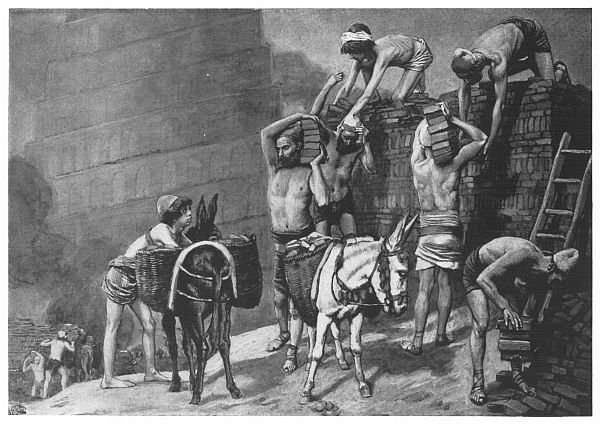 Building the Tower of Babel
Painted by J. James Tissot
ABRAHAM, THE FRIEND OF GOD AND MAN
The sons of Noah who came out of the ark were Shem, Ham
and Japheth. Terah, a descendant of Shem, was the father of Abraham,
Nahor and Haran; and Haran was the father of Lot.
Jehovah said to Abraham, “Go from your country, your relatives,
and your father’s house to the land that I will show you.
And I will make of you a great nation; and I will surely bless you
and make your name famous, so that you shall be a blessing. And
all the families of the earth shall ask for themselves a blessing like
your own.”
So Abraham set out, as Jehovah had commanded him; and Lot
went with him. Abraham was seventy-five years old when he left
Haran. He took Sarah his wife and Lot his brother’s son and everything
that they had, and started for the land of Canaan.
Abraham passed through the land to a place called Shechem, to
the oak of Moreh. There Jehovah appeared to Abraham and said,
“To your children will I give this land.” There Abraham built an
altar to Jehovah who had appeared to him. From there he removed
to the hill near Bethel and pitched his tent with Bethel on one side
and Ai on the other, and there too he built an altar to Jehovah and
prayed to him.
Now Abraham was very rich in cattle, in silver, and in gold;
Lot also, who went with Abraham, had so many flocks and herds
and tents that the land was not rich enough to support them both.
So when there was a quarrel between Lot’s herdsmen and Abraham’s
herdsmen, Abraham said to Lot, “I beg of you, let there be no quarrel
between me and you, nor between my herdsmen and yours, for
we are relatives. Is not the whole land before you? I beg of
you, separate yourself from me. If you go to the left, then I will
go to the right; or if you go to the right, then I will go to the left.”
So Lot looked about and saw that all the plain of the Jordan, as
far as Zoar, was well watered everywhere, like a garden of Jehovah.
So Lot chose for himself all the valley of the Jordan, and lived in[11] the cities of the plain and moved his tent as far as Sodom. But
the men of Sodom were very wicked and sinned against Jehovah.
Jehovah said to Abraham, after Lot had gone away from him,
“Lift up your eyes and look from the place where you are northward,
southward, eastward and westward, for all the land that you
see I will give to you and to your children forever. I will make
them as many as the dust of the earth, so that if a man can count
the dust of the earth, then your children may also be counted.
Rise, walk through the length and breadth of the land, for I will
give it to you.”
Then Abraham moved his tent and lived in the oak grove of
Mamre, which is in Hebron, and built there an altar to Jehovah.
Jehovah also appeared to Abraham by the oaks of Mamre, as
he was sitting at the entrance of his tent in the heat of the day;
and, as he looked up, three men stood there before him. As soon
as he saw them, he ran from the entrance of his tent to meet them
and bowed to the ground and said, “Sirs, if you are willing to do me
a favor, do not, I beg of you, pass by your servant. Since you have
come to your servant, let a little water be brought, that you may
wash your feet, and lie down under the tree. And let me bring some
food, that you may refresh yourselves; afterward you may go on
your way.” They replied, “Do as you have said.”
So Abraham hastened to Sarah’s tent and said, “Make ready
quickly four measures of fine meal, knead it, and make cakes.”
Abraham also ran to the herd, and took a calf that was tender and
good, and gave it to the servant, and he prepared it quickly. Then
Abraham took curd and milk, with the calf which he had prepared,
and served them; and he waited on them under the tree, while they ate.
Then they said to him, “Where is your wife?” He said, “There,
within the tent.” One of them said, “I will surely return to you
about nine months from now, and then, Sarah your wife shall have
Back to Top
LOT’S ESCAPE FROM A WICKED CITY
And Abraham went along with them to start them on their way.
Jehovah said, “The complaint has come that the people of Sodom
and Gomorrah have committed great and terrible sins. I will go
down and see whether they have done exactly as the complaint
comes to me; and if they have not, I will know.”[12]
Then the men turned from there and looked off in the direction
of Sodom.
Then Abraham drew near to Jehovah and said, “Wilt thou sweep
away the righteous with the wicked? Suppose there are within the
city fifty people who are righteous. Wilt thou sweep away and not
spare the place for the fifty righteous who are in it? Far be it from
thee to do this: to slay the righteous with the wicked! And that
the righteous should be treated as the wicked, far be it from thee!
Shall not the Judge of all the earth do what is just?” Jehovah
said, “If I find in the city of Sodom fifty who are righteous, I will
spare the whole place for their sake.” Abraham answered, “I have
dared to speak to Jehovah, even though I am but dust and ashes.
Suppose there be five lacking of the fifty righteous. Wilt thou
sweep away all the city for lack of five?” Jehovah said, “I will not
sweep it away, if I find forty-five there.”
Then Abraham spoke to him again, and said, “Suppose forty
are found there?” He replied, “For the sake of forty I will not do
it.” Then Abraham said, “Oh, let not Jehovah be angry, but let
me speak. Suppose thirty are found there?” He answered, “I
will not do it, if I find thirty there.” Then Abraham said, “Thou
seest that I have dared to speak to Jehovah. Suppose twenty are
found there?” He replied, “For the sake of twenty I will not
destroy it.” Then Abraham said, “Oh, let not Jehovah be angry,
but let me speak just once more. Suppose ten are found there?”
And he said, “For the sake of the ten I will not destroy it.” Then
Jehovah went his way, and Abraham returned home.
Two angels in human form came to Sodom in the evening, as
Lot was sitting at the gate of Sodom. When Lot saw them, he rose
up to meet them, and he bowed with his face to the earth and said,
“Sirs, turn aside, I beg of you, into your servant’s house and spend
the night and wash your feet; then you can rise up early and go on
your way.” They said, “No, we will spend the night in the street.”
But he urged them so strongly that they went with him and entered
his house. And he made a feast for them and baked bread made
without yeast, and they ate.
But before they had lain down, the people of Sodom, both young
and old, all the people from every quarter, surrounded the house.
And they called out to Lot, “Where are the men who came in to
you to-night? Bring them out to us that we may do to them what
we desire.”[13]
Then Lot went out to them at the entrance of his house, but he
shut the door after him. And he said, “I beg of you, my friends,
do not do what is wrong. Do nothing to these men, for they have
come under the shadow of my roof.” But they replied, “Stand
back, or we will treat you worse than them.” And they pressed
hard against Lot and advanced to break the door. But the men
reached out and drew Lot to them into the house and shut the door.
Then they smote the men who were at the door of the house, both
small and great, with blindness, so that they grew tired of searching
for the door.
Then the men said to Lot, “Have you any one else here? Bring
your sons-in-law, your sons, and daughters, and whoever you have
in the city out of this place, for we are about to destroy it, because
great complaint concerning the people has come to Jehovah and he
has sent us to destroy it.” So Lot went out and said to his sons-in-law,
“Up, go out of this place, for Jehovah will destroy the city.”
But his sons-in-law thought he was only jesting.
When the dawn appeared, the angels urged Lot, saying, “Get up,
take your wife and your two daughters that you may not be swept
away in the punishment of the city.” When he hesitated, the men
took him by the hand and led him and his wife and his two daughters
outside the city, for Jehovah was merciful to him.
When they had brought them outside, they said, “Run for your
life; do not look behind you nor stay anywhere in the plain. Escape
to the heights, that you may not be swept away!” But Lot said to
them, “Oh, sirs, not so! See, your servant has found favor with
you, and you have shown great mercy to me in saving my life. I
cannot escape to the heights, lest some evil overtake me, and I die.
See now, this village is near enough to run to, and it is small. Oh,
let me escape there, and my life will be saved.” Jehovah said to
him, “I have also granted you this favor, in that I will not destroy
the village of which you have spoken. Make haste, escape to it,
for I can do nothing until you arrive there.”
The sun had risen when Lot came to Zoar. Then Jehovah caused
brimstone and fire from heaven to rain upon Sodom and Gomorrah,
and he destroyed those cities and all the plain, with all the people
who lived in it and all that grew on the ground. But Lot’s wife,
who was following him, looked back, and she became a pillar of salt.
Early in the morning Abraham rose and went to the place where
he had stood before Jehovah; and as he looked toward Sodom and[14] Gomorrah and all the plain, he saw the smoke of the land going up
as the smoke of a smelting-furnace.
Back to Top
GOD’S CARE FOR THE BOY ISHMAEL
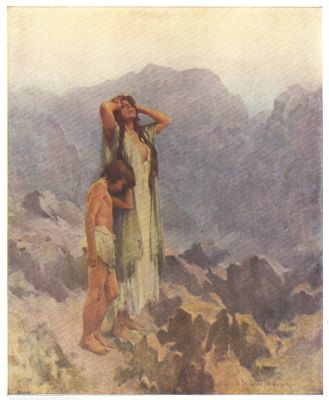
Painted by W. L. Taylor
Jehovah remembered what he had told Sarah, and he did as he
had promised. So Sarah had a son, and when the child grew up,
Abraham made a great feast on the day that he was weaned. But
Sarah saw the son of Hagar the Egyptian and of Abraham playing
with her son Isaac. And she said to Abraham, “Drive out this
slave girl and her son, for the son of this slave girl shall not be heir
with my son Isaac.” This request was very displeasing to Abraham
because the boy was his son. But Jehovah said to Abraham, “Do
not be displeased because of the boy and because of your slave girl.
Listen to all that Sarah says to you, for Isaac only and his children
shall bear your name. But I will also make of the son of the slave
girl a great nation, because he is your son.”
Then Abraham rose early in the morning and took bread and
a skin of water and gave it to Hagar; and he put the boy upon her
shoulder and sent her away. So she set out and wandered in the
desert of Beersheba. When the water in the skin was gone, she left
the child under one of the desert shrubs and went a short distance
away and sat down opposite him, for she said, “Let me not see the
child die.”
While she sat there, the boy began to cry; and Jehovah heard
the cry of the boy, and said, “What troubles you, Hagar? Fear
not, for Jehovah has heard the cry of the boy. Rise, lift him up,
and hold him fast by the hand, for I will make him a great nation.”
And Jehovah opened her eyes and she saw a well of water. Then
she went and filled the skin with water and gave the boy a drink.
And Jehovah cared for the boy; and when he grew up, he lived
in the wilderness of Paran and became a bowman. And his mother
secured a wife for him from Egypt.
Back to Top
ABRAHAM’S LOYALTY TO GOD
Later Jehovah tested Abraham, saying to him, “Abraham”;
and he answered, “Here am I.” Jehovah said, “Take your son,
your only son Isaac, whom you love, and go to the land of Moriah,
and offer him there as a burnt-offering on one of the mountains of
which I shall tell you.”
So Abraham rose early in the morning and saddled his ass and
took two of his servants with him, and his son Isaac. When he had
split the wood for the burnt-offering, he set out for the place of which
God had told him. On the third day, when Abraham looked up
and saw the place in the distance, he said to his servants, “Stay here
with the ass, while I and the lad go over there. When we have worshipped,
we will come back to you.”
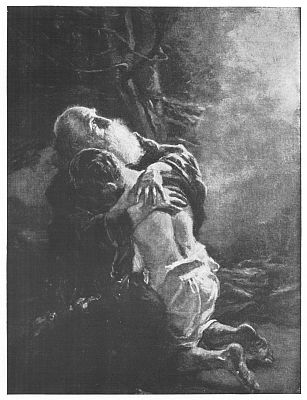 The Testing of Abraham
Painted by Fritz von Uhde
Then Abraham took the wood for the burnt-offering and laid
it on Isaac, his son. And he took the fire and the knife, and they
both went on together. And Isaac spoke to Abraham his father
and said, “My father!” and Abraham answered, “Yes, my son.”
Isaac said, “Here is the fire and the wood, but where is the lamb
for a burnt-offering?” Abraham answered, “My son, God will
himself provide a lamb for a burnt-offering.” So the two went on
together.
When they came to the place of which God had told him, Abraham
built the altar there and laid the wood on it and bound Isaac
his son and laid him on the altar upon the wood. Then Abraham
reached out his hand, and took the knife to kill his son. But the
angel of Jehovah called to him from heaven, saying, “Abraham,
Abraham!” and he answered, “Here am I.” And he said, “Do
not put your hand upon the boy, nor do anything to him, for now
I know that you love God, for you have not refused to give your
son, your only son, to him.”
Then Abraham looked up, and he saw a ram caught in the
thicket by his horns. So Abraham took the ram and offered him
up as a burnt-offering instead of his son. And he named the place
Jehovah-jireh, which means, “Jehovah will Provide.”
The angel of Jehovah again called to Abraham and said, “Jehovah
declares, ‘Because you have done this thing and have not
kept back your son, your only son, I will surely bless you, and I will
make your children as many as the stars of the heavens and as the
sand, which is on the seashore, so that they shall conquer their enemies,
and all the nations of the earth shall ask for themselves a
blessing like theirs, because you have obeyed my command.'”
Back to Top
HOW REBEKAH BECAME THE WIFE OF ISAAC
When Abraham was very old and Jehovah had blessed him in
every way, Abraham said to the eldest of his household servants,
who had charge of all his affairs, “Put your hand under my hip,[16] while I make you promise by Jehovah, the God of heaven and earth,
that you will not let my son marry one of the daughters of the
Canaanites, among whom I live, but that you will go to my own
country and to my relatives and there get a wife for my son Isaac.”
The servant said to him, “Perhaps the woman will not be willing
to follow me to this land. Must I then take your son back to the
land from which you came?” Abraham said to him, “See to it that
you do not take my son back there. Jehovah, the God of heaven,
who took me from my father’s house and from my native land and
who solemnly promised me, ‘To your children I will give this land,’
will send his angel before you and there you will get a wife for my
son. But if the woman is not willing to come with you, then you
will be free from this promise to me; only never take my son back
there.” So the servant put his hand under Abraham’s hip and
made the promise.
Then the servant took ten of his master’s camels and set out
with precious gifts from his master. So he went to the town of
Nahor. And he made the camels kneel down outside the town by
the well in the evening, at the time when women go out to
draw water. Then he said, “O Jehovah, the God of my master
Abraham, give me, I pray thee, success to-day, and show kindness
to my master Abraham. Here I am standing by the spring of water,
and the daughters of the men of the town are coming out to draw
water. May that young woman to whom I shall say, ‘Please let
down your water-jar that I may drink’; and who answers, ‘Drink
and I will also water your camels,’ may she be the one thou hast
chosen for thy servant Isaac. By this I shall know that thou hast
shown kindness to my master.”
Then even before he was through speaking, Rebekah, who was
the grand-daughter of Nahor, Abraham’s brother, came out with her
water-jar upon her shoulder. She was very beautiful and unmarried.
She went down to the spring, filled her jar, and came up.
Then the servant ran to meet her and said, “Please let me drink
a little water from your jar.” She answered, “Drink, sir,” and
quickly let down her water-jar from her shoulder upon her hand
and gave him a drink.
When she had finished giving him a drink she said, “I will draw
water for your camels also, until they have finished drinking.” So
she quickly emptied her jar into the trough and ran again to the
well to draw water, and drew for all his camels. Meanwhile the[17] man was silently gazing at her in order to find out whether Jehovah
had made his journey successful or not.
As soon as the camels had finished drinking, the man took a gold
ring, five ounces in weight, and put it in her nose, and put on her
arms two golden bracelets weighing five ounces, and said, “Whose
daughter are you? Tell me, I beg of you. Is there room in your
father’s house for us to spend the night?” She answered, “I am
the grand-daughter of Milcah and Nahor. We have plenty of straw
and feed, and there is a place for you to spend the night.”
Then the man bowed his head and worshipped Jehovah, saying,
“Blessed be Jehovah, the God of my master Abraham, who has continued
to show his mercy and his faithfulness toward my master.
As for me, Jehovah has led me on the way to the house of my master’s
relatives.”
Then the young woman ran and told these things to her mother’s
family. Now Rebekah had a brother named Laban; and Laban
ran out to the man at the spring. And when he saw the bracelets
on his sister’s hands and the ring, and when he heard Rebekah say,
“This is what the man said to me,” he went to the man, who was
still standing by the camels at the spring, and said, “Come in, you
who are blessed by Jehovah! Why do you stand outside? For I
have cleared the house and have room for the camels.” So he
brought the man into the house and took the packs off the camels
and furnished straw and feed for them, and water to wash his feet
and the feet of the men who were with him.
But when food was set before him to eat, he said, “I will not
eat until I have made known my errand.” They answered,
“Speak.” He said, “I am Abraham’s servant; and Jehovah has
blessed my master greatly, so that he has become very rich. He
has given him flocks and herds, silver and gold, servants, and camels
and asses. Now Sarah, my master’s wife, had a son when she was
old, and my master has given him all that he has. My master also
made me promise, saying, ‘Do not let my son marry one of the
daughters of the Canaanites, in whose land I live, but go to my
father’s home and to my relatives and there find a wife for my
son.’
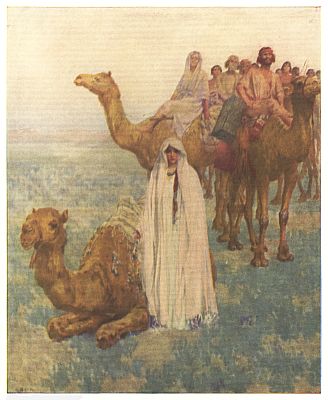 © Curtis Publishing Company
Rebekah Comes to Isaac
Painted by W. L. Taylor
“When I said to my master, ‘What if the woman will not follow
me?’ he said to me, ‘Jehovah, whom I love and serve, will send
his angel with you and make you successful, and you will find for
my son a wife from among my relatives and my father’s family.[18] Then you shall be free from your promise to me. But if you go to
my family and they do not give her to you, you shall also be free
from your promise to me.’ So I came to-day to the spring and said,
‘O Jehovah, the God of my master Abraham, see, I am standing
by the spring of water, if thou wilt make the errand on which I am
going successful, then let the young woman who comes to draw,
to whom I say, Please give me a little water from your jar to drink,
and who shall say to me, Drink, and I will also draw for your camels,
let that one be the woman whom Jehovah has chosen for my master’s
son.’
“Even before I was through speaking, Rebekah came out with
her water-jar on her shoulder and went down to the spring and drew
water. And when I said to her, ‘Please let me drink,’ she quickly
let down her water-jar from her shoulder and answered, ‘Drink,
and I will also water your camels.’ So I drank, and she also watered
the camels. Then I asked her, ‘Whose daughter are you?’ And
she said, ‘The grand-daughter of Nahor and Milcah.’ So I put the
ring in her nose and the bracelets on her arms. And I bowed my
head and worshipped and blessed Jehovah the God of my master
Abraham who had led me on the right way to find the daughter of
my master’s brother for his son. Tell me whether or not you will
deal kindly and truly with my master, so that I shall know what
to do!”
Then Laban and his family answered, “The matter is in the
hands of Jehovah. We cannot say either ‘yes’ or ‘no.’ See, Rebekah
is before you; take her and go and let her be the wife of your
master’s son, as Jehovah has said.”
When Abraham’s servant heard their words, he bowed to the
ground before Jehovah. Then he brought out gold and silver ornaments
and clothing and gave them to Rebekah. He also gave costly
gifts to her brother and to her mother. And he and the men who
were with him ate and drank and spent the night there.
When they rose in the morning, the servant said, “Send me
away to my master.” But Rebekah’s brother and mother answered,
“Let the young woman stay with us a month or at least ten days;
after that she may go.” But he said to them, “Do not delay me,
for Jehovah has given me success. Send me away that I may go
to my master.”
Then they said, “We will call the young woman and ask her.”
So they called Rebekah and said to her, “Will you go with this[19] man?” She answered, “I will go.” So they sent away their sister
Rebekah and her nurse with Abraham’s servant and his men.
They also blessed Rebekah, saying to her, “Our sister! may
your children and their children become thousands and thousands!”
Then Rebekah set out with her maids and, riding upon the camels,
they followed the man. So the servant took Rebekah and went
away.
Now Abraham had given all that he had to Isaac and had
breathed his last, dying in a good old age, satisfied with living. In
the evening, when Isaac had gone out in the field to meditate, he
looked up and saw camels coming. Rebekah too looked up, and
when she saw Isaac, she quickly alighted from the camel and said
to the servant, “Who is this man walking in the field to meet us?”
When the servant said, “It is my master,” she took her veil and
covered her face. Then the servant told Isaac all that he had done.
And Isaac brought Rebekah to the tent of Sarah his mother, and
she became his wife; and he loved her.
Back to Top
HOW JACOB DECEIVED HIS FATHER
Now Isaac prayed to Jehovah for his wife, because she had
no children; and Jehovah heard his prayer, and Rebekah became
the mother of twin boys. They named one Esau and the other
Jacob.
As they grew up, Esau became a skilful hunter, a man who lived
out in the fields; but Jacob was a quiet man who stayed about the
tents. Isaac loved Esau, for he was fond of game; but Rebekah
loved Jacob.
Once when Jacob was preparing a stew, Esau came in from the
fields, and he was very hungry; so he said to Jacob, “Let me swallow
some of that red stew, for I am very hungry.” But Jacob said,
“Sell me first of all your right as the eldest.” Esau replied, “See,
I am nearly dead now! So of what use is this birthright to me?”
Jacob said, “First solemnly promise to give it to me.” So Esau
solemnly promised and sold his birthright to Jacob. Then Jacob
gave Esau bread and stewed lentils, and when he had had something
to eat and drink, he got up and went away. In this way Esau gave
away his birthright.
When Isaac was so old and so nearly blind that he could not see,[20] he called Esau his oldest son and said to him, “My son.” Esau
answered, “Here am I.” Then Isaac said, “See, I am old and do
not know how soon I may die. Now, therefore, take your quiver
and your bow and go out into the fields and hunt game for me and
prepare for me savory food, such as I love, and bring it to me that I
may eat and that I may bless you before I die.”
Rebekah was listening when Isaac spoke to his son Esau. So
when Esau went into the fields to hunt game, Rebekah said to her
son Jacob, “I just now heard your father say to your brother Esau,
‘Bring me game and prepare for me savory food that I may eat it
and bless you before I die.’ Now, my son, do as I tell you: Go to
the flock and bring me from there two good kids, and I will make of
them savory food for your father, such as he loves. Then take it to
him, that he may eat, so that he may bless you before he dies.”
But Jacob said to Rebekah his mother, “You know that my brother
Esau is a hairy man, while I am smooth. Perhaps my father will
feel of me; then I shall appear to him as a deceiver, and I shall bring
blame upon me and not a blessing.” But his mother said to him,
“Upon me be the blame, my son; only obey me and go, bring the
kids to me.” So he went and brought them to his mother, and his
mother made savory food such as his father loved.
Rebekah also took the fine clothes of her older son Esau, which
she had with her in the tent, and put them on her younger son
Jacob. Then she put the skins of the kids upon his hands and upon
the smooth part of his neck, and she placed the savory food and
the bread which she had prepared in his hand, and he went to his
father and said, “My father.” Isaac answered, “Here am I; who
are you, my son?” Jacob said, “I am Esau your oldest son. I
have done as you commanded me. Sit up and eat of my game,
that you may bless me.” Isaac said to his son, “How very quickly
you have found it, my son.” He answered, “Yes, because Jehovah
your God gave me success.”
Then Isaac said to Jacob, “Come here, my son, that I may feel
of you to find out whether you are really my son Esau or not.” So
Jacob went near to Isaac his father, and he felt of him and said,
“The voice is the voice of Jacob, but the hands are the hands of
Esau. Are you really my son Esau?” Jacob answered, “I am.”
And Isaac did not recognize him, for his hands were hairy like his
brother Esau’s. So he blessed him. Then Isaac said, “Bring the
food to me, that I may eat of my son’s game and bless you.” So he[21] brought it to him, and he ate. Jacob also brought him wine, and
he drank.
Then his father Isaac said to him, “Come near now and kiss me,
my son.” As he came near and kissed him, he smelled the smell of
his garment, and blessed him.
As soon as Isaac had given Jacob his blessing, and Jacob was
about to leave his father, Esau his brother came in from his hunting.
He also had made savory food and was bringing it to his
father. So he said to him, “Father, rise and eat of your son’s game,
that you may bless me.” But Isaac his father said to him, “Who
are you?” He answered, “I am your son, your oldest, Esau.”
Then Isaac trembled and said, “Who then is he that has hunted
game and brought it to me, so that I ate plentifully before you
came, and blessed him? Also blessed shall he be!”
When Esau heard the words of his father, he uttered a loud and
bitter cry and said to his father, “Bless me, even me also, O my
father.”
But Isaac said, “Your brother came with deceit and has taken
away your blessing.” Esau said, “Is it not because he was named
Jacob, which means Supplanter, that he has supplanted me these two
times: he took my birthright, and now he has taken my blessing!”
Then he said, “Have you kept a blessing for me?” Isaac answered
Esau, “See, I have made him your master and I have given to him
all his relatives as servants and grain and wine as his food. What
then can I do for you, my son?” Esau said to his father, “Is that
the only blessing you have, my father?” and Esau began to weep
aloud. Then Isaac his father answered him:
And away from the dew of heaven.
By your sword you shall live,
And your brother you shall serve.”
JACOB’S DREAM
Esau hated Jacob because of the blessing which his father had
given him. And Esau said to himself, “My father will soon die;
then I will kill Jacob, my brother.”
When the words of her older son Esau were told to Rebekah, she
sent for her younger son Jacob and said to him, “Your brother, Esau,[22] is going to kill you. Now therefore, my son, listen to me: run away
to my brother Laban at Haran and stay with him for a time until
your brother is no longer angry and he forgets what you have done
to him. Then I will send and bring you back. Why should I lose
both of you in one day?”
Then Jacob set out from Beersheba and went toward Haran.
And when he arrived at a certain place, he passed the night there,
because the sun had set. And he took one of the stones from its
place and put it under his head and lay down to sleep. Then he
dreamed and saw a ladder set up on the earth, and its top reached
to heaven; and the angels of God were going up and down on it.
Jehovah also stood beside him and said, “I am Jehovah, the
God of Abraham and the God of Isaac. The land on which you lie
I will give to you and to your children. See, I am with you, and
will keep you wherever you go and will bring you again to this land;
for I will not leave you until I have done what I have promised you.”
When Jacob awoke from his sleep, he said, “Surely Jehovah is
in this place, and I did not know it.” And he was filled with awe
and said, “This place is the house of God, and this is the gate of
heaven.”
So Jacob rose early in the morning and took the stone that he
had put under his head and set it up as a pillar and poured oil upon
the top of it. And he named that place Bethel, which means House
of God. Jacob also made this promise, “If God will be with me
and protect me on this journey which I am making and give me
bread to eat and clothing to put on, and if I return safe and sound
to my father’s house, then Jehovah shall be my God, and this stone
which I have set up as a pillar shall be a house of God. And of all
that thou shalt give me I will surely give a tenth to thee.”
Back to Top
THE DECEIVER DECEIVED
Then Jacob went on his journey and arrived at the land of the
children of the East. And he looked and saw a well in the field,
and there were three flocks of sheep lying down by it; for from that
well they watered the flocks; but there was a large stone over the
well. When all the flocks were gathered there, they used to roll
away the stone and water the sheep and then put the stone back
in its place over the well.[23]
Jacob said to the men, “My friends, from where do you come?”
They said, “We are from Haran.” Then he said to them, “Do you
know Laban the son of Nahor?” And they said, “We know him.”
And he said to them, “Is all well with him?” And they said, “All
is well; indeed, this is Rachel his daughter coming with the sheep.”
And he said, “See, the sun is still high! It is not time for the cattle
to be gathered together. Water the sheep and feed them.” But
they said, “We cannot until all the flocks are gathered together, and
they roll away the stone from the well; then we will water the
sheep.”
While he was still speaking with them, Rachel came with her
father’s sheep; for she was a shepherdess. When Jacob saw Rachel
the daughter of Laban, his mother’s brother, and Laban’s sheep, he
went up and rolled the stone from the well and watered the flock of
Laban his mother’s brother. Then Jacob kissed Rachel and wept
aloud. And when Jacob told Rachel that he was a relative of her
father and that he was Rebekah’s son, she ran and told her father.
As soon as Laban heard about Jacob, his sister’s son, he ran to
meet him, put his arms around him, kissed him many times, and
brought him to his home. When Jacob told Laban all about these
things, Laban said to him, “Surely you are my bone and my flesh.”
So he remained with him a whole month.
Then Laban said to Jacob, “Should you serve me for nothing
simply because you are related to me? Tell me what shall be your
wages?” Now Laban had two daughters: the name of the older
was Leah, and the name of the younger was Rachel. Leah’s eyes
were weak, but Rachel was beautiful. Jacob loved Rachel, and so
he said, “I will serve you seven years for Rachel your younger
daughter.” And Laban said, “It is better for me to give her to you
than to give her to any other man. Stay with me.” So Jacob
served seven years for Rachel, and they seemed to him but a few
days, because he loved her so.
Then Jacob said to Laban, “Give me my wife, for my time is
up, and let me marry her.” So Laban gathered all the men of the
place and made a feast. In the evening he took Leah his daughter
and brought her to him, and Jacob received her as his wife.
When in the morning Jacob found it was Leah, he said to Laban,
“What is this you have done to me? Did I not serve you for
Rachel? Why then have you deceived me?” Laban said, “It is
not the custom among us to give the younger in marriage before[24] the older. Remain with this one during the marriage week, then
we will give you the other also for the service which you shall give
me during seven more years.” Jacob did so: he remained with Leah
during the marriage week. Then Laban gave him Rachel his daughter
to be his wife, but Jacob loved Rachel more than Leah. So he
had to serve Laban seven years more.
Back to Top
MEETING A BROTHER WHO HAD BEEN WRONGED
In time Jacob became very wealthy, and he had large flocks,
slaves, and asses. But he heard Laban’s sons say, “Jacob has taken
all that was our father’s, and from that which was our father’s he
has gotten all this wealth.” He also saw that Laban did not act
toward him the same as before. So Jacob rose and put his sons and
his wives upon the camels and drove away all his cattle. He deceived
Laban, for he did not tell him that he was fleeing away. So
he fled across the river Euphrates, with all that he had, and set out
on his way toward Mount Gilead.
Then Jacob sent messengers before him to his brother Esau.
And he gave them this command, “Say to my lord Esau: ‘Your
servant Jacob declares, I have lived with Laban and have stayed
until now. I have oxen and asses, flocks and slaves, and I have sent
to tell my lord, in order that I may win your favor.'” The messengers
returned to Jacob with the report, “We came to your brother
Esau, even as he was coming to meet you with four hundred men.”
Then Jacob was greatly alarmed and worried. So he divided
the people that were with him and the flocks and the herds and the
camels into two parts and said, “If Esau comes to the one and attacks
and destroys it, then the other which is left can escape.”
Jacob also prayed, “O God of my father Abraham and God of
my father Isaac, deliver me, I pray thee, from the hand of my
brother, from the hand of Esau, for I fear that he will come and attack
me and kill the mothers and the children.”
Then Jacob took as a present for his brother Esau, two hundred
female goats and twenty male goats, two hundred ewes and twenty
rams, thirty milch camels and their young, forty cows and ten bulls,
twenty female asses and ten young asses. These he put, each drove
by itself, in the care of his servants and said to them, “Go on before
me and leave a space between the droves.”[25]
He gave those in front this command: “When my brother Esau
meets you and asks you, ‘To whom do you belong? and where are
you going? and whose are these before you?’ then you shall say,
‘To your servant Jacob; it is a present sent by him to my lord Esau;
and Jacob himself is just behind us.'” Jacob also commanded the
second, and the third, and all that followed the droves, to make the
same answer, and to say, “Jacob himself is just behind us.” For
he said to himself, “I will please him with the present that goes before
me, and then, when I meet him, perhaps he will welcome me.”
So he sent the present over before him; but he himself spent that
night in the camp.
Later that night he rose up and took his two wives, his two maid
servants, and his eleven children, and sent them over the river Jabbok.
Jacob was left alone, and one wrestled with him until daybreak.
When he saw that he did not win against Jacob, he struck the socket
of his hip, and the socket of Jacob’s hip was strained, as he wrestled
with him. Then he said, “Let me go, for the dawn is breaking.”
But Jacob replied, “I will not let thee go unless you bless me.” So
he said to him, “What is your name?” He answered, “Jacob.”
Then he said, “Your name shall be no longer Jacob, but Israel, which
means Struggler with God; for you have struggled with God and
with men and have won.” So he blessed him there. And Jacob
called the place Penuel, which means Face of God, for he said, “I
have seen God face to face, and my life has been saved.”
When Jacob looked up, he saw Esau coming with four hundred
men. And he put the maid servants and their children in front,
Leah and her children next, and Rachel and her son Joseph in the
rear. Then Jacob himself went in front of them, and he bowed down
to the ground seven times, as he drew near to his brother. Esau ran
to meet him, threw his arms about his neck, and kissed him, and
they wept.
When Esau looked up and saw the women and the children, he
said, “Who are these with you?” Jacob answered, “The children
whom God has so kindly given me.” Then the maid servants with
their children came up and bowed down to the ground. Leah and
her children also came and bowed down, and afterward Joseph and
Rachel came up and bowed down before Esau.
Esau asked, “What do you mean by all this company which
I met?” Jacob answered, “To win your friendship, my lord.” Esau
said, “I have enough, my brother; keep what you have.” But[26] Jacob replied, “No, if now I have won your favor, receive this present
from me to show that you are my friend. Take, I beg of you,
the gift that I bring to you, for God has been generous to me, and
I have enough.” So he urged Esau until he took it.
Then Esau said, “Let me at least leave with you some of the
people who are with me.” But Jacob replied, “What need is there?
Let me only enjoy your friendship, my Lord.” So Esau turned back
that day on his way to Seir.
Back to Top
JOSEPH SOLD AS A SLAVE BY HIS BROTHERS
When Joseph was seventeen years old, he and his brothers were
shepherds, but he made them angry, for he brought a bad report
about them to their father. Now Jacob loved his son Joseph, who
was born in his old age; and he made him a long coat with sleeves.
When his brothers saw that their father loved him more than all
his other sons, they hated Joseph and would not speak to him in a
friendly way.
Joseph had a dream which he told to his brothers; and they
hated him still more. This is what he said to them, “I dreamed
that, as we were binding sheaves in the field, my sheaf rose up and
remained standing, while your sheaves came around and bowed
down to my sheaf.” His brothers said to him, “Will you really be
king over us? Will you indeed rule over us?” So they hated him
still more because of his dreams and his words.
Then he had another dream and told it to his brothers, saying,
“I have had another dream, and it seemed to me that the sun and
the moon and eleven stars bowed down to me.” But when he told
it to his father and his brothers, his father reproved him and said,
“What is this dream that you have dreamed? Shall I and your
mother and your brothers indeed come and bow down to the earth
before you?” Therefore his brothers were jealous of him; but his
father remembered the dream.
When his brothers went to pasture his father’s flocks in Shechem,
Jacob said to Joseph, “Go, see whether all goes well with your
brothers and with the flock, and bring me back word.” So he sent
him out, and a certain man found him, as he was wandering in the
field, and the man asked him, “What are you looking for?” He
said, “I am looking for my brothers; tell me, I beg of you, where
they are pasturing the flock.” The man said, “They have gone[27] away, for I heard them say, ‘Let us go to Dothan.'” So Joseph went
after his brothers and found them in Dothan.
When they saw him in the distance, before he came to them,
they planned together to kill him. And they said one to another,
“See, here comes that great dreamer! Come, let us kill him and
throw him into one of the pits, and we will say, ‘A fierce beast has
devoured him.’ Then we shall see what will become of his dreams!”
Judah, however, when he heard it, saved Joseph’s life by saying,
“Let us not take his life.” Reuben also said to them, “Do not
shed blood; throw him into this pit, here in the wilderness; but
do not harm him.” Reuben said this to save Joseph from their
hands so that he could bring him back to his father. So when Joseph
came to his brothers, they took off his long coat with sleeves and
threw him into the pit. But the pit was empty, there being no water
in it.
Then they sat down to eat and, when they looked up, they saw
a band of Ishmaelites coming from Gilead; and their camels were
loaded with spices, gum, and ladanum on their way to carry it down
to Egypt. And Judah said to his brothers, “What do we gain if
we kill our brother and hide his blood? Come, let us sell him to the
Ishmaelites, and let us do him no harm, for he is our brother, our
own flesh and blood.” So his brothers listened to him; and, drawing
up Joseph, they sold him for twenty pieces of silver to the Ishmaelites,
who brought him to Egypt.
Then his brothers took Joseph’s long coat, killed a he-goat,
dipped the coat in the blood, and brought it to their father, and
said, “We found this; see whether it is your son’s coat or not.” He
recognized it and said, “It is my son’s coat! A wild beast has devoured
him! Joseph surely is torn in pieces.” Then Jacob tore
his clothes, put sackcloth about his waist, and mourned for his son
many days. All his sons and his daughters tried to comfort him,
but he refused to be comforted, saying, “I shall go down to the grave
mourning for my son.” Thus Joseph’s father mourned for him.
Back to Top
JOSEPH’S EAGERNESS TO HELP OTHERS
Joseph was taken down to Egypt, and Potiphar, an Egyptian,
one of Pharaoh’s officers, the captain of the guard, bought him from
the Ishmaelites.[28]
Now Jehovah was with Joseph, so that he prospered; and he
was in the house of his master, the Egyptian. When his master saw
that Jehovah was with him and made everything succeed that he
undertook, he trusted him and made him his own servant. He
also made him overseer of his household and placed all that he had
in his care. From the time that he made him overseer in his house
and over all that he had, Jehovah blessed the Egyptian’s household
for Joseph’s sake, and the blessing of Jehovah was upon all that he
had in the house and in the field. Potiphar left all that he had in
Joseph’s charge, and he knew nothing about his affairs except about
the food which he ate. And Joseph was handsome and attractive.
After these honors had come to Joseph, his master’s wife tried
to tempt him to be unfaithful to his trust. But he refused, saying
to her, “See, my master knows nothing about what I do in the house,
and he has put all that he has in my charge. How then can I do this
great wrong and sin against God?” Day after day she tempted
Joseph, but he did not listen to her. One day, however, when he
went into the house to do his work and when none of the men of the
household were at home, she caught hold of his garment and again
tried to tempt him, but he left his garment in her hand and fled out
of the house.
She kept his garment by her until his master came home; then
she said to him, “The Hebrew slave whom you have brought to us
came to me to insult me; and when I cried aloud, he left his garment
with me and fled.”
When Joseph’s master heard what his wife said to him, he was
very angry; and he took Joseph and put him into the prison, in the
place where the king’s prisoners were kept. So he was left there
in prison. But Jehovah was with Joseph and showed kindness to
him and helped him to win the friendship of the keeper of the prison,
so that he placed all the prisoners in Joseph’s charge and made him
responsible for whatever they did there.
After these things the butler of the king of Egypt and his baker
offended their master the king of Egypt, and Pharaoh was so angry
with these two officers that he put them in the same prison where
Joseph was. And the captain of the guard appointed Joseph to
wait on them; and they stayed in prison for some time.
And the butler and the baker of the king of Egypt, who were in
the prison, both had dreams the same night, each with a different
meaning. When Joseph came in to them in the morning, he saw[29] plainly that they were sad. So he asked Pharaoh’s officers, “Why
do you look so sad to-day?” They answered, “We have had a
dream, and there is no one who can tell what it means.” Then
Joseph said to them, “Is not God the one who knows what dreams
mean? Tell them to me, if you will.”
Then the chief butler told his dream to Joseph and said to him,
“In my dream I saw a vine before me, and on the vine were three
branches, and the buds put out blossoms, and its clusters brought
forth ripe grapes. Pharaoh’s cup was in my hand, and I took the
grapes and squeezed the juice into his cup and gave the cup to
Pharaoh.”
Then Joseph said to him, “This is what it means: the three
branches are three days. Within three days Pharaoh will let you
out of prison and restore you to your office, and you will give
Pharaoh’s cup into his hand as you used to do when you were his
butler. But when all goes well with you, remember me, show kindness
to me and speak for me to Pharaoh and bring me out of this
prison; for I was unjustly stolen from the land of the Hebrews, and
here also I have done nothing that they should put me in the
dungeon.”
When the chief baker saw that the meaning of the butler’s dream
was good, he said to Joseph, “I also saw something in my dream:
there were three baskets of white bread on my head, and in the
upper basket there were all kinds of baked food for Pharaoh, and
the birds were eating them out of the basket on my head.” Joseph
answered, “This is what it means: the three baskets are three days;
within three days Pharaoh will take off your head and hang you on
a tree, and the birds shall eat your flesh.”
Now on the third day, which was Pharaoh’s birthday, he made a
feast for all his servants. Then he set free the chief butler and the
chief baker. He restored the chief butler to his office, so that he
again gave the cup to Pharaoh; but the chief baker he hanged, as
Joseph had told them. Yet the chief butler did not remember
Joseph, but forgot him.
Back to Top
A PRISONER WHO BECAME A MIGHTY RULER
Two years later Pharaoh had a dream: as he stood by the river
Nile, he saw coming up from the water seven cows, well fed and
fat, for they had been feeding in the river grass. Then seven other[30] cows came up after them out of the Nile, poorly fed and thin, and
they stood by the other cows on the bank of the Nile. The poorly
fed, lean cows ate up the seven well-fed, fat cows. Then Pharaoh
awoke.
Afterward he slept and had a second dream and saw seven ears,
plump and good, growing up on one stalk. Also seven ears, thin
and withered by the east wind, grew up after them. The thin ears
swallowed up the seven plump, full ears. Then Pharaoh awoke, and
knew that it was only a dream.
In the morning Pharaoh was worried. So he sent for all the
magicians and wise men of Egypt and told them his dreams; but
no one could tell him what they meant.
Then the chief butler said to Pharaoh, “I now remember my
sins: Pharaoh was very angry with his servants and put me and the
chief baker in prison in the house of the captain of the guard. We
both had dreams the same night, each with a different meaning.
There was also with us a young Hebrew, a servant of the captain of
the guard. We told him our dreams and he told each of us what
our dreams meant. And our dreams came true just as he said they
would: I was restored to my office, but the chief baker was hanged.”
Then Pharaoh sent for Joseph, and they quickly brought him
out of the dungeon; and he shaved his face, changed his clothes, and
came to Pharaoh. Pharaoh said to Joseph, “I have had a dream,
and there is no one who can tell what it means. Now I have heard
that when you hear a dream, you can tell what it means.” Joseph
answered Pharaoh, “Not I; God alone can give Pharaoh a true
answer.”
Then Pharaoh said to Joseph, “In my dream as I stood on the
bank of the Nile, I saw seven cows, fat and well fed, which had been
feeding in the river grass. There came up after them seven more
cows, poorly fed and thin, worse than I ever saw in all the land of
Egypt; and the lean and poorly fed cows ate up the first seven fat
cows. When they had eaten them up, one could not tell that they
had eaten them, for they were still as thin as at the beginning.
Then I awoke.
“Again I dreamed and saw seven ears, plump and good, grow up
on one stalk; then seven thin ears, withered with the east wind,
sprang up after them; and the thin ears swallowed up the seven
good ears. I have told the dream to the magicians, but there is no
one who can tell me what it means.”[31]
Then Joseph said to Pharaoh, “Pharaoh’s two dreams mean the
same thing; God has made known to Pharaoh what he is about to
do. The seven good cows are seven years, and the seven good ears
are seven years. It is one dream. The seven lean and poorly fed
cows that came up after them are seven years, and the seven empty
ears withered with the east wind mean seven years of famine. That
is why I said to Pharaoh, ‘God has shown to Pharaoh what he is
about to do.’ Seven years of great plenty all through the land of
Egypt are coming. They shall be followed by seven years of
famine, so that all the plenty will be forgotten in the land of Egypt.
The famine will use up all that the land produces; and plenty will
not be known in the land because of that famine which follows, for
it will be very severe.
“The dream came twice to Pharaoh to show that the famine will
surely come, and that God will soon make the dream come true.
Now therefore let Pharaoh pick out a man who is sensible and wise
and place him in charge of the land of Egypt. Let Pharaoh act
quickly and put overseers over the land and collect one-fifth of all
that grows in the land of Egypt in the seven years of plenty. Let
them gather all the food of these good years that are coming
and store up grain under the authority of Pharaoh, and let them
hold it in the cities for food. The food will supply the land
during the seven years of famine which shall be in the land of
Egypt, so that the people of the land may not die because of the
famine.”
The plan pleased Pharaoh and all his people; and he said to his
people, “Can we find one like this, a man in whom is the spirit of
God?” So Pharaoh said to Joseph, “As God has shown you all
this, there is no one so sensible and wise as you. You shall be at
the head of my country, and all my people shall be ruled as you
command. Only on the throne I will be above you.”
So Pharaoh said to Joseph, “See, I have placed you over all the
land of Egypt.” And Pharaoh took off his signet-ring from his
finger and put it upon Joseph’s finger and clothed him in garments
of fine linen and put a golden collar about his neck. He also made
him ride in the second chariot which he had; and they cried before
him, “Attention!” So he placed him over all the land of Egypt.
Pharaoh also said to Joseph, “I am Pharaoh, but without your consent
no man shall lift up his hand or his foot in all the land of
Egypt.” Pharaoh gave him as a wife Asenath, the daughter of[32] Potiphera. And Joseph was thirty years old when he was made
the ruler of the land of Egypt.
In the seven years of plenty there were large harvests, and
Joseph gathered up all the food of the seven years of plenty, which
were in the land of Egypt, and stored the food in the cities, putting
in each city the food that grew in the fields about it. Joseph stored
up grain as the sand of the sea, in great quantities, until he no
longer kept account, because it could not be measured.
When the seven years of plenty in the land of Egypt were over,
the seven years of famine began, as Joseph had said. There was
famine in all lands, but all through the land of Egypt there was
food, for when all the land of Egypt was hungry, the people cried
to Pharaoh for bread, and Pharaoh said to all the Egyptians, “Go
to Joseph and do what he tells you.” So when the famine was over
all the country, Joseph opened all the storehouses and sold food to
the Egyptians: but the famine was severe in the land of Egypt.
The peoples of all lands came to Joseph in Egypt to buy grain, for
everywhere the famine was severe.
Back to Top
THE TESTING OF JOSEPH’S BROTHERS
When Jacob learned that there was grain for sale in Egypt, he
said to his sons, “Why do you stand looking at each other? I
have heard that there is grain for sale in Egypt; go down there
and buy some for us, that we may live and not die.” So Joseph’s
ten brothers went down to buy grain from Egypt. But Jacob did
not send Benjamin, Joseph’s own brother, with his brothers, for he
feared that some harm might come to him. So the sons of Jacob
went with others to buy grain, for the famine was in the land of
Canaan.
Now Joseph was the governor over Egypt; it was he who sold
grain to all the people of the land. So Joseph’s brothers came and
bowed before him with their faces to the earth. When Joseph saw
his brothers, he knew them; but he acted as a stranger toward them
and spoke harshly to them and said, “Where do you come from?”
They said, “From the land of Canaan to buy food.” So Joseph knew
his brothers, but they did not know him.
Joseph also remembered the dreams which he had had about
them and said to them, “You spies! you have come to see how defenseless
the land is.” But they said to him, “No, my lord; your[33] servants have come to buy food. We are all sons of one man; we
are honest men; your servants are not spies.” But he again said
to them, “No, you have come to see how defenseless the land is.”
They answered, “We, your servants, are twelve brothers, the sons
of one father in the land of Canaan. The youngest is to-day with
our father, and one is dead.” Joseph said to them, “It is just as I
said to you, ‘You are spies.’ By this you shall be tested: as sure
as Pharaoh lives you shall not go away unless your youngest brother
comes here. Send one of you, and let him bring your brother, while
you remain in prison, that it may be proved whether you are telling
the truth or not. Or else, as sure as Pharaoh lives, you are indeed
spies.” So he put them all into prison for three days.
Then Joseph said to them on the third day, “Do this and live,
for I fear God: if you are honest men, let one of your brothers stay
in prison, but you go, carry grain for the needs of your households
and bring your youngest brother to me. So you will prove that you
have told the truth and you shall not die.”
They did as Joseph commanded, but they said to one another,
“We are indeed guilty because of the way we treated our brother,
for when we saw his trouble and when he pleaded with us, we would
not listen. That is why this trouble has come upon us.” Reuben
added, “Did I not say to you, ‘Do not sin against the boy,’ but you
would not listen?”
They did not know, however, that Joseph understood them,
for he had spoken to them through an interpreter. But he turned
away from them and wept. Then he came back and spoke to them,
and taking Simeon from among them, bound him before their eyes.
Then Joseph gave orders to fill their vessels with grain and to put
every man’s money back in his sack and to give them food for the
journey; and thus it was done to them. So they loaded their asses
with their grain and went away.
When they came to Jacob their father in the land of Canaan,
they told him all that had happened, saying, “The man who is master
in that land spoke harshly to us and put us in prison as spies.
We said to him, ‘We are honest men; we are not spies; we are
twelve brothers, sons of the same father; one is no longer living,
and the youngest is to-day with our father in the land of Canaan.’
But the man who is master in that land said to us, ‘This is how I
shall know that you are honest men: leave one of your brothers
with me and take the grain to supply the needs of your households
and go. Bring your youngest brother to me; then I shall know[34] that you are not spies, but that you are honest men; and I will
give your brother back to you and you shall be free to go about in
the land.'”
As they were emptying their sacks, they found that each man’s
purse with his money was in his sack; and when they and their
father saw their purses and the money, they were afraid and they
turned trembling to one another with the question, “What is this
that God has done to us?” Jacob their father said to them, “You
have robbed me of my children: Joseph is no longer living and Simeon
is no longer here, and now you would take Benjamin also!
All this trouble has come to me!” But Reuben said to his father,
“You may put my two sons to death, if I do not bring him to you.
Put him in my charge and I will bring him back to you.”
Then Jacob said, “My son shall not go down with you, for his
brother is dead and he only is left. If harm should come to him on
the way by which you go, then you will bring down my gray hairs
with sorrow to the grave.”
The famine was severe in the land; and when Joseph’s brothers
had eaten up the grain which they had brought from Egypt, their
father said to them, “Go again, buy us a little food.” But Judah
said to him, “The man plainly said to us: ‘You shall not see me
again unless your brother is with you.’ If you will send our brother
with us, we will go down and buy you food, but if you will not send
him, we will not go down; for the man said to us, ‘You shall not
see me unless your brother is with you.'” Jacob said, “Why did
you bring trouble upon me by telling the man you had another
brother?” They replied, “The man asked all about us and
our family, saying, ‘Is your father still alive? Have you another
brother?’ So we answered his questions as he asked them. How
were we to know that he would say, ‘Bring your brother down’?”
Then Judah said to Jacob, his father, “Send the lad with me,
and we will go at once, that both we and you and our little ones may
live and not die. I will be responsible for him; from me you may
demand him. If I do not bring him to you and set him before you,
let me bear the blame forever; for if we had not waited so long,
surely we would by this time have come back the second time.”
So their father said to them, “If it must be so, then do this: take
some of the fruits of the land in your jars and carry a present to the
man, a little balsam, a little syrup, spices, ladanum, pistachio nuts,
and almonds. Take twice as much money with you, carrying back
the money that was put in your sacks. Perhaps it was a mistake.[35] Take also your brother and go again to the man. May God Almighty
grant that the man may be merciful to you and free Benjamin and
your other brother. But if I am robbed of my sons, I am bereaved
indeed!” So the men took the present and twice as much money
and Benjamin, and went down to Egypt and stood before Joseph.
When Joseph saw Benjamin with them, he said to the steward
of his house, “Bring the men into the house, kill animals, and prepare
the meal, for these men will dine with me at noon.” The steward
did as Joseph ordered, and brought the men into Joseph’s house.
But the men were afraid, because they were brought into Joseph’s
house, and they said, “We are being brought in on account of the
money that was put in our grain sacks at our first visit, that he may
accuse us and fall upon us and take us as slaves, together with our
asses.”
So when they came near to Joseph’s steward, they spoke to him
at the door of the house and said, “Oh, my lord, we came down the
first time only to buy food; but when we reached home, we opened
our sacks and found that each man’s money was in the mouth of
his sack, our money in its full weight; and we have brought it
back with us. We have brought down with us more money with
which to buy food. We do not know who put our money into
our sacks.” He replied, “Peace be to you, fear not; your God and
the God of your father has given you the treasure in your sacks;
your money came to me.”
Then he brought Simeon out to them. The steward also took
the men to Joseph’s house and gave them water with which to wash
their feet, and he gave their asses fodder. Then they made ready
the present for Joseph, when he should come at noon, for they had
heard that they were to eat there.
When Joseph came into the house, they gave him the present
which they had brought and bowed down low before him. He asked
them about their welfare and said, “Is your father well, the old man
of whom you spoke? Is he still living?” They replied, “Your servant,
our father, is well; he is still alive.” Then they bowed their
heads and knelt down before him.
When Joseph looked up and saw Benjamin his brother, his own
mother’s son, he said, “Is this your youngest brother of whom you
spoke to me?” And he added, “God be gracious to you, my son.”
Then because of his longing for his brother he sought a place in which
to weep. So he went into his room and wept there.
Then he bathed his face and came out and said, “Bring on the[36] food.” So they brought food for him by himself and for them by
themselves and for the Egyptians who ate with him by themselves,
because the Egyptians would not eat with the Hebrews, for to do
so was hateful to them. Joseph’s brothers were seated before him,
the eldest first, as was his right as the oldest, and the youngest last,
and the men looked at each other in astonishment. Then Joseph
had portions served to them from the food before him. But Benjamin’s
portions were five times as much as any of theirs. So they
drank and were merry with him.
 Joseph Converses with Judah, his Brother
Painted by J. James Tissot
Then he gave this command to the steward of his household:
“Fill the men’s grain sacks with food, as much as they can carry,
and put my cup, the silver cup, in the mouth of the sack of the youngest
and the money too that he paid for his grain.” And the steward
did as Joseph commanded.
As soon as the morning light appeared, the men were sent away
with their asses. When they had gone out of the city, but were not
yet far away, Joseph commanded his steward, “Follow after the
men and when you overtake them, say to them, ‘Why have you returned
evil for good? Why have you stolen my silver cup, that
from which my master drinks? You have done wrong in so doing.'”
So the steward overtook them and said these words to them.
They said to him, “Why does my lord speak such words as these?
Far be it from your servants to do such a thing! Remember that
we brought back to you from the land of Canaan the money which
we found in our sacks. Why then should we steal silver or gold from
your master’s house? Let that one of your servants with whom it
is found die, and we will be my lord’s slaves.” He said, “Let it now
be as you have said: he with whom it is found shall be my slave;
but you shall be innocent.” Then each one quickly took down his
sack and opened it. The steward searched, beginning with the oldest
and ending with the youngest; and the cup was found in Benjamin’s
sack. Then they tore their clothes, and every man loaded his ass
and returned to the city.
Back to Top
JOSEPH’S FORGIVENESS OF HIS BROTHERS
When Judah and his brothers came back to Joseph’s house, Joseph
was still there; and they threw themselves before him on the ground.
Joseph said to them, “What deed is this that you have done? Do
you not know that a man like me can always tell where things are?”[37] Judah replied, “What shall we say to my lord? What shall we speak
or how shall we clear ourselves? God has found out the guilt of
your servants. See, both we and he also with whom the cup was
found are my lord’s slaves.” But Joseph said, “Far be it from me
that I should do so! The man with whom the cup was found shall
be my slave; but you yourselves go up in peace to your father.”
Then Judah came close to him and said, “Oh, my lord, let your
servant, I beg of you, speak a word in my lord’s ears, and let not
your anger be aroused against your servant, for you are even as
Pharaoh. My lord asked his servants, saying, ‘Have you a father
or a brother?’ And we said to my lord, ‘We have a father, an old
man, and a child of his old age, a little one. As his brother is dead,
he is the only son of his mother who is left; and his father
loves him.’ You said to your servants, ‘Bring him down to me,
that I may see him.’ But we said to my lord, ‘The boy cannot
leave his father; for if he should leave his father, his father would
die.’ Then you said to your servants, ‘Unless your youngest brother
comes down with you, you shall not see me again.’
“When we went up to your servant, my father, we told him the
words of my lord; and our father said, ‘Go again, buy us a little
food.’ But we said, ‘We cannot go down. If our youngest brother
is with us, then we will go; for we cannot see the man again unless
our youngest brother is with us.’ Your servant, my father, said to
us, ‘You know that my wife had two sons; and one went from me,’
and I said, ‘Surely he is torn in pieces; and I have not seen him
since. If you take this one also from me, and harm come to him,
you will bring down my gray hairs with sorrow to the grave.’ Now
if I return to your servant, my father, and Benjamin with whose life
his heart is bound up is not with us, and he sees that there is no boy,
he will die, and your servants will bring down the gray hairs of your
servant our father with sorrow to the grave. For your servant became
responsible for the boy to my father, when I said, ‘If I do not
bring him to you, then I will bear the blame before my father forever.’
Now, therefore, let me, instead of the boy, remain as a slave
to my lord, I beg of you; but let the boy go back with his brothers.
For how can I go back to my father, if the boy is not with me, lest
I should see the sorrow that would come upon my father?”
Then Joseph could not control himself before all those who were
standing by him; so he cried out, “Let every man leave me.” So
no Egyptian was present while Joseph made himself known to his[38] brothers. But he wept so loudly that the Egyptians and Pharaoh’s
court heard.
And Joseph said to his brothers, “I am Joseph. Is my father
still alive?” But his brothers could not answer him, for they were
too ashamed to look him in the face. Then Joseph said to his
brothers, “Come near to me, I beg of you.” So they came near.
He said, “I am Joseph, your brother, whom you sold into Egypt.
Do not be troubled nor angry with yourselves that you sold me here,
for God sent me before you to save your lives. For the famine has
already been two years in the land, and there are still five years in
which there shall be neither ploughing nor harvest. God sent me
before you to save your lives through a great deliverance and thus
give you children on the earth. So now it is not you who sent me
here, but God. He has made me like a father to Pharaoh and master
of all his household and ruler over all the land of Egypt.
“Go up quickly to my father and say to him, ‘Your son Joseph
says: God has made me master of all Egypt. Come down to me
without delay. You shall live in the land of Goshen, and you shall
be near me with your children and your grandchildren, with your
flocks and your herds and all that you have, so that you, with your
household and all that you have, may never want. There I will
provide for you, for there will be five more years of famine.’ Now
you and my brother Benjamin see that it is I who am speaking to
you. Tell my father all about my honor in Egypt and what you
have seen; and you must quickly bring him down here.”
Then he fell upon his brother Benjamin’s neck and wept, and
Benjamin wept upon his neck. He also kissed all his brothers and
wept upon them. After that his brothers talked with him.
Back to Top
JOSEPH’S LOYALTY TO HIS FAMILY
The news that Joseph’s brothers had arrived became known in
Pharaoh’s palace; and it pleased Pharaoh and his servants greatly.
Pharaoh said to Joseph, “Say to your brothers, ‘Do this: load your
beasts, go to the land of Canaan, and take your father and
your families and come to me, and I will give you the best there is
in the land of Egypt, and you shall eat the best that the land can
give. Now you are commanded to do this: take wagons from the
land of Egypt for your little ones and for your wives, and bring your[39] father and come. Also do not pay any attention to your household
goods, for the best of all there is in the land of Egypt is yours.'”
And the sons of Jacob did as they were commanded.
So Joseph gave them wagons, as Pharaoh ordered, and what
was needed for the journey. To each of them he gave a change of
clothing, but to Benjamin he gave three hundred pieces of silver
and five changes of clothing. To his father he sent this gift:
ten asses loaded with the best products of Egypt and ten asses
loaded with grain and bread and provisions for his father on the
journey.
So he sent his brothers away, and, as they went, he said to them,
“See that you do not quarrel on the journey!” So they went up
out of Egypt and came into the land of Canaan to Jacob their father,
and told him, “Joseph is still alive, and he is ruler over all the land
of Egypt!” Then Jacob’s heart stood still, for he could not believe
them. But when they told him all that Joseph had said to them
and when he saw the wagons which Joseph had sent to carry
him, the spirit of Jacob their father revived, and he said, “It is
enough; Joseph my son is still alive. I will go and see him before
I die.”
Then Jacob set out on his journey with all that he had. He first
went to Beersheba and offered sacrifices to the God of his father
Isaac. God spoke to him in a vision by night and said, “Jacob,
Jacob.” He answered, “Here am I.” God said, “I am God, the
God of your father. Do not fear to go down into Egypt, for there
I will make of you a great nation. I myself will go down with you
into Egypt; I will surely bring you back again; and Joseph shall
close your dying eyes.”
When Jacob left Beersheba, his sons carried him and their little
ones and their wives in the wagons that Pharaoh had sent. Jacob
also sent Judah before him to Joseph, that he might show him the
way to Goshen.
When they came into the land of Goshen, Joseph made ready
his chariot, and went up to Goshen to meet Jacob his father. When
he met him, Jacob fell on his neck and wept there a long time.
Then Jacob said to Joseph, “Now let me die, for I have seen
your face and know that you are still alive.” But Joseph said to
his brothers and to his father’s household, “I will go up and tell
Pharaoh and will say to him, ‘My brothers and my father’s family
who were in the land of Canaan have come to me. Now the men[40] are shepherds, for they have been keepers of cattle; and they have
brought their flocks and cattle and all that they have.’ When Pharaoh
calls you, and asks, ‘What is your business?’ you shall say,
‘Your servants have been keepers of cattle from our youth even
until now, both we and our fathers.’ Say this that you may live
in the land of Goshen, for every shepherd is looked down upon by
the Egyptians.”
Then Joseph went in and told Pharaoh and said, “My father
and my brothers with their sheep and cattle and all that they possess
have come from the land of Canaan; and now they are in the
province of Goshen.” And he took five of his brothers and presented
them to Pharaoh. Pharaoh said to them, “What is your business?”
They answered, “Your servants are shepherds, both we and our
fathers.” They also said to Pharaoh, “We have come to live in your
country; because the famine is severe in the land of Canaan, and
there is no pasture for your servants’ flocks. Now, therefore, we
beg of you, let your servants stay in the land of Goshen.” Then
Pharaoh said to Joseph, “Let them stay in the land of Goshen; and
if you know any able men among them, put them in charge of my
cattle.”
Joseph also brought in Jacob his father and presented him to
Pharaoh; and Jacob blessed Pharaoh. Then Pharaoh said to Jacob,
“How many years have you lived?” Jacob answered, “I have lived
a hundred and thirty years; few and evil have been the years of
my life, and they have not been as many as those that my forefathers
lived on earth.” After Jacob had blessed Pharaoh, he went out from
Pharaoh’s presence. So Joseph gave his father and his brothers a
place to live in and a home in the land of Goshen, in the best part
of the land of Egypt, as Pharaoh had commanded.
Joseph also provided food for his father and his brothers and all
his father’s family according to the number of the little children.
So the Israelites lived in Egypt, in the land of Goshen, and there
they grew wealthy and had many children.
Back to Top
THE BOYHOOD AND TRAINING OF MOSES
After the death of Joseph and his brothers, the Israelites increased
so rapidly and became so many and powerful that the land
was filled with them. But a new king who did not know Joseph[41] ruled over Egypt. He said to his people, “See, the Israelites are
becoming too many and powerful for us. Come, let us deal wisely
with them, for fear that they become so many that, if war is begun
against us, they will join our enemies and fight against us and leave
the land.”
So the Egyptians set taskmasters over them to put burdens upon
them. And they built for Pharaoh the store-cities, Pithom and
Rameses. But the more the Egyptians afflicted them, the more
numerous they became and the more they spread everywhere, so
that the Egyptians dreaded what they might do. And the Egyptians
were cruel and made slaves of them, making their lives bitter
with hard labor in mortar and brick, and by all kinds of hard work
in the field.
Pharaoh also gave this command to all his people, “You shall
throw into the river every son that is born to the Hebrews, but
every daughter you shall save alive.”
Now a man of the tribe of Levi married a woman of the same
tribe, and she had a son. When she saw that he was a beautiful
child, she hid him for three months. But when she could no longer
hide him, she took a basket made of papyrus reeds, daubed it with
mortar and pitch, and put the child in it. Then she placed it in
the reeds by the bank of the river Nile, while his sister stayed
near by to see what would happen to him.
The daughter of Pharaoh came down to bathe in the Nile, and
while her maids were walking along the river’s bank, she saw the
basket among the reeds and sent her waiting-maid to bring it.
When she opened it and saw the child, the boy was crying; and she
felt sorry for him and said, “This is one of the Hebrew children.”
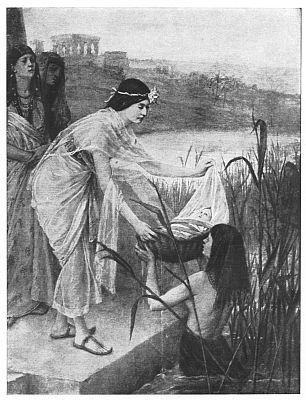 The Finding of Moses
Painted by Juliaan de Vriendt
Then his sister said to Pharaoh’s daughter, “Shall I go and call
one of the Hebrew women to nurse the child for you?” Pharaoh’s
daughter said to her, “Go.” So the maiden went and called the
child’s mother, and Pharaoh’s daughter said to her, “Take this
child away and nurse it for me, and I will pay you your wages.”
Then the woman took the child and nursed it. When the child had
grown up, she brought him to Pharaoh’s daughter, and he became
her son; and she named him Moses, for she said, “I drew him out
of the water.”
One time, after Moses had grown up, he went out to his own
people; and as he was watching them at their hard labor, he saw an
Egyptian beating a Hebrew, one of his own race. He looked around[42] and seeing that there was no one in sight, he killed the Egyptian
and hid him in the sand.
On the next day Moses went out, and saw two Hebrews struggling
together; and he said to the one who was in the wrong, “Why
do you strike your fellow workman?” The man replied, “Who
made you a ruler and a judge over us? Do you intend to kill me
as you killed the Egyptian?” Then Moses was afraid and said,
“What I have done is known!” When Pharaoh heard what had
taken place, he tried to put Moses to death; but Moses left the
country and made his home in the land of Midian.
As he was sitting by a well, the seven daughters of the priest of
Midian came and drew water and filled the troughs to water their
father’s flock, but the shepherds came and drove them away. Then
Moses stood up and protected the women and watered their
flock.
When they came to their father, he said, “How is it that you
have come back so early to-day?” They replied, “An Egyptian
protected us from the shepherds, and besides, he drew water for us
and watered the flock.” Then he said to his daughters, “Where is
he? Why have you left the man? Ask him to eat with us.” So
Moses made his home with the man; and he gave Moses his daughter
Zipporah to be his wife. She had a son, and Moses named him
Gershom.
Back to Top
THE VOICE FROM THE BUSH
After a long time the king of Egypt died. Moses was taking
care of the flock of Jethro his wife’s father. Once he led the flock
to the other side of the pasture and came to Horeb, the mountain of
God. There the angel of Jehovah appeared to him in a flame of
fire from the midst of a thorn bush. As he looked, the bush flamed
up without being burned. Moses said, “I will stop here and see
this wonderful sight, why the bush is not burned up.”
When Jehovah saw that Moses stopped to look, he called to
him from the midst of the bush, “Moses, Moses.” Moses answered,
“Here am I.” Then God said, “Do not come near; take your shoes
off your feet, for the place where you are standing is holy ground.”
He also said, “I am the God of your forefathers, the God of Abraham,
the God of Isaac, and the God of Jacob.” Then Moses covered
his face; for he was afraid to look upon God.[43]
But Jehovah said, “I have certainly seen the suffering of my
people who are in Egypt and have heard their cry of distress because
of their taskmasters, for I know their sorrows. I have come down
to rescue them from the power of the Egyptians and to bring them
out of that land into a land that is beautiful and wide, to a land
with plenty of milk and honey. I have heard the cry of the Israelites
and I have seen how they suffer at the hands of the Egyptians.
Come now, I will send you to Pharaoh that you may bring my
people, the Israelites, out of Egypt.”
But Moses said to God, “Who am I, that I should go to Pharaoh
and should bring the Israelites out of Egypt?” He answered, “I
will surely be with you; and this shall be the sign to you that I have
sent you: when you have brought the people out of Egypt, you shall
worship God upon this mountain.”
Then Moses said to God, “If I go to the Israelites and say to
them, ‘The God of your forefathers has sent me to you,’ and they
ask me, ‘What is his name?’ what shall I answer them?” God
said to Moses, “I AM WHAT I AM”; and he said, “Declare to
the Israelites: ‘I AM has sent me to you.’ Go and gather the
leaders of Israel together and say to them, ‘Jehovah the God of
your forefathers, the God of Abraham, Isaac, and Jacob, has appeared
to me and said, I have surely remembered you and have seen
what is being done to you in Egypt, and I have declared that I will
bring you up out of the suffering in Egypt to a land with plenty
of milk and honey.’ They will listen to your voice; and you, together
with the leaders of Israel, shall go to the king of Egypt and
say to him, ‘Jehovah, the God of the Hebrews, has appeared to us.
Now let us go three days’ journey into the wilderness, that we may
offer a sacrifice to Jehovah our God.’ But I know that the king of
Egypt will not let you go unless he is made to do so by a mighty
power. Therefore I will use my power and overwhelm Egypt with
all the marvellous deeds that I will do there. After that he will let
you go.”
Moses said to Jehovah, “O, Lord I am not able to speak well;
for I am slow to speak and slow in saying what I think.” Jehovah
said to him, “Who has given man a mouth? Or who makes one
deaf or dumb, or blind or able to see? Is it not I, Jehovah? Now
go, and I will be with you and teach you what you shall say; and
your brother Aaron shall speak for you to the people.”
Then Moses went back to Jethro, his wife’s father, and said to[44] him, “Let me go again to my people in Egypt to see whether they
are still alive.” Jethro answered Moses, “Go, with my blessing.”
Back to Top
PHARAOH THE STUBBORN RULER
Then Jehovah said to Aaron, “Go into the wilderness to meet
Moses.” So he went and met him on the mountain of God and
kissed him. And Moses told Aaron all that Jehovah had sent him
to declare. So Moses and Aaron gathered all the leaders of the
Israelites, and Aaron repeated all the words which Jehovah had
spoken to Moses. The people believed; and when they heard that
Jehovah had remembered the Israelites and that he had seen their
suffering, they bowed their heads and worshipped.
Then Moses and Aaron went to Pharaoh and said to him,
“Jehovah, the God of Israel commands, ‘Let my people go that
they may hold a feast in my honor in the wilderness.'” But
Pharaoh said, “Who is Jehovah that I should obey his command to
let Israel go? I do not know Jehovah, and I will not let Israel go.”
They said, “The God of the Hebrews has appeared to us; let us go
three days’ journey into the wilderness that we may offer a sacrifice
to Jehovah our God, that he may not attack us with pestilence or
with the sword.” But the king of Egypt replied, “Moses and
Aaron, why do you try to turn the people from their work? Go
to your tasks!”
The same day Pharaoh gave this command to the taskmasters
who were over the people: “You shall no longer give the people
straw for making bricks as before. Let them go and gather straw
for themselves. But you shall demand of them the same number of
bricks that they have been making before; you shall not lessen the
number at all, for they are lazy; that is why they cry out, ‘Let us
go and offer a sacrifice to our God.’ Let heavier work be laid upon
the men, that they may be kept so busy that they will not pay attention
to lying words.”
So the taskmasters who were over the people went out and said
to them, “This is Pharaoh’s order, ‘I will no longer give you straw.
Go yourselves, get straw wherever you can find it; but your work
shall not be made less.'” So the people were scattered over all
the land of Egypt to gather stubble for straw. The taskmasters
urged them on, saying, “You must finish your daily task just[45] as when there was straw.” The overseers of the Israelites, whom
Pharaoh’s taskmasters had put over them, were also beaten and
asked, “Why have you not finished to-day as many bricks as yesterday?”
Then the overseers of the Israelites went to Pharaoh and said,
“Why do you deal in this way with your servants? No straw is
given to your servants, and yet they say to us, ‘Make bricks.’ See
how your servants are beaten and how you wrong your people.”
But he said, “You are lazy, you are lazy; therefore you say, ‘Let
us go and offer a sacrifice to Jehovah.’ Now go and work, for no
straw shall be given you; yet you must make the same number of
bricks.”
Then Moses turned again to Jehovah and said, “Jehovah, why
hast thou brought misfortune upon this people? Why is it that
thou has sent me? For since I came to Pharaoh to speak in thy
name he has wronged this people, and thou hast done nothing at
all to rescue thy people.”
Jehovah answered Moses, “Now you shall see what I will do
to Pharaoh; for compelled by a mighty power he shall surely let
them go, and compelled by a mighty power he shall drive them out
of his land.”
Back to Top
THE COST OF BEING CRUEL AND STUBBORN
Then Jehovah said to Moses, “Pharaoh is stubborn; he will not
let the people go. Go to Pharaoh early in the morning, as he is going
out on the water, and stand by the bank of the Nile to meet him.
Say to him, ‘Jehovah, the God of the Hebrews, has sent me to you
with this command: Let my people go that they may worship me
in the wilderness, but so far you have not listened. Jehovah declares,
By this you shall know that I am Jehovah: See, I will strike
the waters which are in the river with the rod that is in my hand
and they shall be changed into blood. The fish, too, that are in the
Nile shall die, and the Nile shall become foul, so that the Egyptians
will hate to drink its water.'”
Then Moses lifted up the staff and in the presence of Pharaoh
and his servants struck the waters that were in the river Nile; and
all its waters were changed into blood. The fish, too, that were in
the Nile died, and the river became so foul that the Egyptians could
not drink its water, but dug round about the Nile for water to drink.[46]
Seven days later Jehovah gave this command to Moses, “Go in
to Pharaoh and say to him, ‘Jehovah commands: Let my people go
that they may worship me. If you refuse to let them go, then I
will afflict all your land with frogs; and the Nile shall swarm with
frogs which shall go up and come into your house, into your sleeping
chamber, upon your bed, into the houses of your servants, upon
your people, and into your ovens and kneading-troughs; and the
frogs shall come up even upon you and your people and all your
servants.'”
Then Jehovah said to Moses, “Say to Aaron: ‘Stretch out your
hand with your staff over the rivers, over the canals, and over the
pools, and cause frogs to come up over the land of Egypt.'” So
Aaron stretched out his hand over the waters of Egypt; and the
frogs came up and covered the land of Egypt.
Then Pharaoh called for Moses and Aaron and said, “Pray to
Jehovah to take away the frogs from me and my people; then I will
let the people go, that they may offer a sacrifice to Jehovah.” Moses
said to Pharaoh, “Will you do yourself the honor of telling me at
what time I shall pray to Jehovah in your behalf and in behalf of
your servants and people, that the frogs be destroyed from your
palaces and be left only in the Nile?” Pharaoh answered, “To-morrow.”
Then Moses said, “Let it be as you say; that you may
know that there is none like Jehovah our God, the frogs shall depart
from you, from your palaces, and from your servants and people;
they shall be left only in the Nile.”
When Moses and Aaron had gone out from Pharaoh, Moses
prayed to Jehovah to remove the frogs which he had brought upon
Pharaoh; and Jehovah did as Moses asked. The frogs died in the
houses, in the courts, and in the fields, and the people gathered them
together in many heaps; and the land was filled with a vile odor.
But when Pharaoh saw that relief had come, he was stubborn and,
as Jehovah had said, did not listen to Moses and Aaron.
Then Jehovah said to Moses, “Get up early in the morning and
stand before Pharaoh, just as he goes out to the water, and say to
him, ‘Jehovah commands: Let my people go that they may worship
me. If you will not let my people go, I will send swarms of flies
upon you, upon your servants, and upon your people and into your
palaces, so that the houses of the Egyptians shall be full of swarms
of flies, as well as the ground upon which they stand. But at that
time I will set apart the land of Goshen in which my people live,[47] and no swarms of flies shall be there, so that you may know that
I, Jehovah, am in the midst of the earth.'”
And Jehovah did so: a vast swarm of flies came upon Pharaoh’s
palace and into the homes of his servants; and all the land of Egypt
was ruined by the swarms of flies.
Then Pharaoh called for Moses and Aaron and said, “I will let
you go that you may offer a sacrifice to Jehovah your God in the
wilderness; only you must not go far away. Pray for me.” Moses
replied, “I will go out and will pray to Jehovah that the swarms of
flies may depart from Pharaoh, from his servants and from his people
to-morrow; only let not Pharaoh again act deceitfully by refusing
to let the people go to offer a sacrifice to Jehovah.”
So Moses went out from Pharaoh and prayed to Jehovah. And
Jehovah did as Moses asked; but this time also Pharaoh was stubborn
and would not let the people go.
Then Jehovah said to Moses, “Go to Pharaoh and tell him, ‘Jehovah
the God of the Hebrews commands: Let my people go that
they may worship me. For if you refuse to let them go and still hold
them, then the power of Jehovah will bring a very severe pest upon
your cattle which are in the field, upon the horses, the asses, the
camels, the herds, and the flocks. But Jehovah will make a difference
between the cattle of Israel and the cattle of Egypt, and not
one that belongs to the Israelites shall die.'”
So Jehovah set a fixed time, saying, “To-morrow Jehovah will
do this in the land.” Jehovah did this on the next day, and all the
cattle of the Egyptians died; but none of the cattle of the Israelites.
Then Pharaoh sent and found that not even one of the cattle of the
Israelites was dead; but Pharaoh was stubborn and would not let
the people go.
Then Jehovah said to Moses, “Get up early in the morning and
stand before Pharaoh, and say to him,’Jehovah, the God of the Hebrews,
commands: Let my people go, that they may worship me.
Do you still set yourself against my people, so that you will not let
them go? To-morrow about this time I will send down a very heavy
fall of hail, such as has not been in Egypt from the day that it became
a nation until now.'”
So Jehovah sent down hail upon the land of Egypt, and the lightning
flashing in the midst of the hail was very severe, such as had
not been before in all Egypt since it became a nation. Through the
whole land of Egypt the hail struck down everything that was in[48] the field, both man and beast. The hail also struck down all the
growing plants and broke all the trees in the fields. Only in the
land of Goshen, where the Israelites were, there was no hail.
Again Pharaoh sent and called for Moses and Aaron and said
to them, “I have sinned this time; Jehovah is right and I and my
people are wrong. Pray to Jehovah, for there has been enough of
these mighty thunderings and hail, and I will let you go, and you
shall stay no longer.” Moses said to him, “As soon as I have gone
out of the city, I will spread out my hands in prayer to Jehovah;
the thunders shall stop, and there shall be no more hail, that you
may know that the earth is Jehovah’s. But as for you and your servants,
I know that even then you will not fear Jehovah.”
So Moses went out of the city from Pharaoh and spread out his
hands to Jehovah; and the thunders and hail stopped, and the rain
was no longer poured upon the earth. But when Pharaoh saw that
the rain and the hail and the thunders had stopped, he sinned again,
and he and his servants became stubborn, and he would not let the
Israelites go.
So Moses and Aaron went to Pharaoh, and said to him, “Jehovah,
the God of the Hebrews, commands: ‘How long will you refuse
to obey me? Let my people go that they may worship me. For
if you refuse to let my people go, then to-morrow I will bring locusts
into your land, and they will cover the surface of the earth, so that
no one will be able to see the ground, and they shall eat the rest of
that which is left to you from the hail, and they shall eat all your
trees which grow in the field.'”
Then Moses and Aaron were driven out from Pharaoh’s presence,
but Moses stretched out his staff over the land of Egypt, and
Jehovah caused an east wind to blow over the land all that day and
night. In the morning the east wind brought the locusts, and they
went over all the land of Egypt and settled down in all the land of
Egypt, a very large swarm, more locusts than there ever were before
or ever will be again. For they covered the surface of the whole
land, so that the land was darkened and nothing green was left,
neither tree nor growing plants, anywhere in all the land of Egypt.
Then Pharaoh called for Moses in haste and said, “I have sinned
against Jehovah your God and against you. Now therefore forgive
my sin only this once, and pray to Jehovah your God to take away
from me this deadly plague.” So Moses went out from Pharaoh
and prayed to Jehovah, and Jehovah made a very strong west wind
to blow which took up the locusts and drove them into the Red Sea;[49] not a single locust was left in all the land of Egypt. But Jehovah
let Pharaoh’s heart remain stubborn, so that he would not let the
Israelites go.
Then Jehovah said to Moses, “Stretch out your hand toward
heaven, that there may be darkness over the land of Egypt, so dark
that it may be felt.” So Moses stretched out his hand toward
heaven; and there was complete darkness in all the land of Egypt
for three days; no one could see another, nor did any one move
about for three days. But the Israelites had light in their homes.
Then Pharaoh called Moses and said, “Go, worship Jehovah;
only let your flocks and your herds stay behind; let your little ones
go with you.” But Moses said, “You must also give us animals
for sacrifices and burnt-offerings, that we may offer a sacrifice to
Jehovah our God. Our cattle too must go with us; not a hoof shall
be left behind, for we must take these to offer to Jehovah our God,
and we do not know what we must offer to Jehovah until we arrive
there.”
But Jehovah let Pharaoh’s heart remain stubborn, and he would
not let them go. And Pharaoh said to him, “Go away from me;
take care that you never come to me again; for on the day that you
come to me you shall die.” Moses replied, “You have spoken
truly, I shall never see you again.”
Moses said to Pharaoh, “Jehovah declares: ‘About midnight I
will go through all of Egypt. All the eldest sons in the land of
Egypt shall die, from the eldest son of Pharaoh who sits upon his
throne, even to the eldest son of the slave girl who is behind the
mill, and all the first-born of the cattle. There shall be a great cry
of sorrow all over the land of Egypt, such as has never been before
and never shall be again.’ But not a single dog shall bark at any
of the Israelites nor their animals, that you may know that Jehovah
does make a difference between the Egyptians and Israelites. All
these your servants shall come to me and bow down before me, saying,
‘Go away, together with all the people that follow you.’ After
that I will go away.” And Moses went from Pharaoh in great
Back to Top
THE ESCAPE FROM EGYPT
Moses called together all the leaders of Israel, and said to them,
“Take lambs from the herds according to your families and kill the
passover lamb. You shall also take a bunch of hyssop and dip it in[50] the blood that is in the basin and strike the lintel and the two door
posts with the blood that is in the basin. And not one of you shall
go out of the door of his house until morning, for Jehovah will pass
through to kill the Egyptians, and when he sees the blood upon the
lintel and on the two door posts, he will pass over the door and will
not let the destroyer come into your houses to destroy you. You
and your children shall observe this event as a custom forever.
“When your children shall say to you, ‘What do you mean by
this service?’ you shall say, ‘It is the sacrifice of the passover of
Jehovah, for he passed over the houses of the Israelites in Egypt,
when he destroyed the Egyptians and released our people.'”
Then the people bowed their heads and worshipped; and the
Israelites went and did as Jehovah had commanded Moses and
Aaron.
At midnight Jehovah destroyed all the eldest sons in the land of
Egypt, from the eldest son of Pharaoh who sat on his throne to the
eldest son of the captive who was in prison. Then Pharaoh arose
in the night, together with all his servants and all the Egyptians,
and there was a great cry of sorrow, for there was not a house in
Egypt in which there was not one dead. Pharaoh called Moses and
Aaron at night and said, “Go away from among my people, both
you and the Israelites; go, worship Jehovah as you have asked.
Also take with you your sheep and your cattle, as you have asked,
go and ask a blessing for me also.” The Egyptians also told the
people to hasten out of the land, for they said, “We shall all perish.”
So the people took their dough before the yeast had worked, and
their kneading-troughs were bound up in their clothes upon their
shoulders.
The Israelites went on foot from Rameses to Succoth; and a
mixed multitude went with them, and they had a great many flocks
and herds. They baked unraised cakes of the dough which they
had brought with them from Egypt, for there was no yeast in it,
because they had been driven out of Egypt and could not wait,
neither had they prepared for themselves any food for the journey.
And they went from Succoth and camped at Etham on the border
of the wilderness. Jehovah went before them by day in a pillar
of cloud, to show them the way, and at night in a pillar of fire,
to give them light, that they might march both by day and by
night; the pillar of cloud by day and the pillar of fire at night stayed
in front of the people.[51]
When the king of Egypt was told that the people had fled, the
feeling of Pharaoh and his servants toward them was changed, and
they said, “Why have we done this and let the Israelites escape
from serving us?” So he made ready his chariot and took his
people with him. He also took six hundred chosen chariots and the
rest of the chariots of Egypt with captains over all of them; and
Jehovah let the heart of Pharaoh, king of Egypt, remain stubborn,
so that he followed the Israelites, because they had defied him.
When Pharaoh drew near to them the Israelites looked up and
saw the Egyptians marching after them; and they were very much
afraid and cried to Jehovah. And they said to Moses, “Why have
you misled us by bringing us out of Egypt? Is not this what we
told you in Egypt, when we said, ‘Let us alone, that we may serve
the Egyptians? For it is better for us to serve the Egyptians than
to die in the wilderness.'” But Moses said to the people, “Do not
be frightened, remain quiet and you will see how Jehovah will save
you to-day; for as surely as you now see the Egyptians you shall
never see them again. Jehovah will fight for you, and you are to
keep still.”
Then the angel of God who went before the army of Israel
changed his position and went behind them. The pillar of cloud
also changed its position from in front of them and stood behind
them, coming between the army of the Egyptians and the army of
the Israelites. On the one side the cloud was dark and on the other
side it lighted up the night, so that throughout all the night neither
army came near the other.
Then Moses stretched out his hand over the sea, and Jehovah
by means of a strong east wind caused the sea to go back all that
night and made the bed of the sea dry. And the Israelites crossed
over on the dry bed of the sea. The Egyptians followed and all of
Pharaoh’s horses, his chariots, and his horsemen went after them
into the sea. In the morning before sunrise, Jehovah looked out
through the pillar of fire and of cloud upon the army of the Egyptians
and threw them into confusion. He also bound their chariot
wheels, so that they dragged heavily. Therefore the Egyptians
said, “Let us flee from the Israelites, for Jehovah fights for them
against us.”
Then Jehovah said to Moses, “Stretch out your hand over the
sea, that the waters may come back upon the Egyptians, upon their
chariots, and upon their horsemen.” So Moses stretched out his[52] hand over the sea, and toward morning the sea returned to its
ordinary level while the Egyptians were flying before it. So Jehovah
overthrew the Egyptians in the midst of the sea, and the waters
returned and covered the chariots and the horsemen, and all the
army of Pharaoh that went after them into the sea, so that not one
of them was left. Thus Jehovah saved the Israelites that day from
the power of the Egyptians; and they saw the Egyptians dead upon
the seashore. When the Israelites saw the great work which Jehovah
did to the Egyptians, the people feared Jehovah and believed
in him and in his servant Moses.
And Miriam the prophetess, the sister of Aaron, took a tambourine
in her hand; and as all the women followed her with tambourines
and with dancing, she sang with them:
Both horse and rider has he hurled into the sea.”
Then Moses and the Israelites sang this song to Jehovah:
Both horse and rider he has hurled into the sea.
Jehovah is my strength and song, he has delivered me;
He is my God, I will praise him; my father’s God whom I honor.”
GOD’S COMMANDS TO THE PEOPLE
Moses led the Israelites forward from the Red Sea until they
came to the wilderness of Sinai, and there the Israelites camped
before the mountain.
Moses went up into the presence of God, and Jehovah called to
him from the mountain and said, “Tell the Israelites: ‘You have
seen what I did to the Egyptians and how I bore you on eagles’
wings and brought you to myself. Now therefore, if you will listen
to my voice and keep your solemn agreement with me, you shall be
my own treasure taken from among all peoples, for all the earth is
mine. You shall be a nation of priests, a people devoted to my service.'”
So Moses called together the leaders of the people and told them
all these words, as Jehovah had commanded him. And all the
people answered together, “We will do all that Jehovah has commanded.”[53]
When Moses told Jehovah the answer of the people, Jehovah
said to him, “See, I come to you in a thick cloud, that the people
may hear when I speak and may always believe in you.” And
Jehovah said to Moses, “Go to the people and keep them pure
to-day and to-morrow, and let them wash their garments and be
ready on the third day, for on the third day I will come down on
Mount Sinai within sight of all the people.”
On the third day, when morning came, there were thunderings
and lightnings and a thick cloud rested upon the mountain, and a
very loud trumpet blast sounded, so that all the people who were
in the camp trembled. Then Moses brought the people out of the
camp to meet God; and they stood at the foot of the mountain.
Mount Sinai was entirely covered with smoke, because Jehovah
came down upon it in fire. And from it smoke went up like the smoke
of a furnace, and the entire mountain shook violently.
Then God spoke all these words: “I am Jehovah your God who
brought you out of the land of Egypt, from a place where you were
slaves.
“Thou Shalt Have no other Gods except Me.
“Thou Shalt Not Make for Thyself a Graven Image, nor
any image of anything that is in the heavens above, on the earth
beneath, or in the waters that are under the earth. Thou shalt not
bow down before them, nor serve them, for I Jehovah thy God am
a jealous God visiting the sins of the fathers upon the children to
the third and fourth generation, but showing acts of kindness to the
thousandth generation of those who love me and keep my commands.
“Thou Shalt Not Take the Name of Jehovah Thy God in
Vain, for Jehovah will not leave him unpunished who takes his
name in vain.
“Remember the Sabbath Day to Keep It Holy. Six days
shalt thou labor and do all thy work; but the seventh day is the
Sabbath of Jehovah thy God. In it thou shalt not do any work,
neither thou, nor thy son, nor thy daughter, nor thy male servant,
nor thy female servant, nor thy cattle, nor the guest who is with
thee, for in six days Jehovah made the heavens and the earth, the
sea and all that in them is, and rested on the seventh day. Therefore
Jehovah blessed the Sabbath day and made it holy.[54]
“Honor Thy Father and Thy Mother, that thou mayest
live long on the land which Jehovah thy God giveth thee.
“Thou Shalt Not Murder.
“Thou Shalt Not Commit Adultery.
“Thou Shalt Not Steal.
“Thou Shalt Not Bear False Witness Against Thy Neighbor.
“Thou Shalt Not Covet Thy Neighbor’s House; thou shalt
not covet thy neighbor’s wife, nor his male servant, nor his female
servant, nor his ox, nor his ass, nor anything that belongs to thy
neighbor.”
Then Jehovah said to Moses, “Write down these words, for in
accord with these words I have made a solemn agreement with you
and with Israel.”
Back to Top
OUR DUTIES TO GOD AND MAN
Hear O Israel: Jehovah our God is the one Lord. You shall
love Jehovah your God with all your heart, with all your soul, and
with all your strength.
Behold, the heavens, the highest heavens, the earth and all that
is on it belong to Jehovah your God. Jehovah showed his love to
your fathers more than to any other people, and he has chosen their
children after them and you out of all the nations. Therefore, open
your heart to him and no longer refuse to be guided by him. For
Jehovah your God is God of gods and Lord of lords, the great, the
mighty, the wonderful God, who shows no favors and takes no
bribes, who sees that what is right is done to the orphan and widow,
who loves the foreigner and gives him food and clothing. Love
Jehovah your God and always keep his laws and his commands.
You shall not deceive one another.
You shall not lie to one another.
You shall not swear falsely in my name.
You shall not wrong nor rob your neighbor.
You shall not curse the deaf.
You shall not put a stumbling-block before the blind.
You shall not tell stories about one another.
You shall not hate any one.
You shall not take vengeance nor bear a grudge against any one.
You shall love your neighbor as yourself.[55]
You shall rise before the hoary head and honor an old man.
If a foreigner lives in your land, you shall do him no wrong.
You shall treat him as one of your own people and you shall love
him as yourself.
Back to Top
THE REPORT OF THE HEBREW SPIES
Moses sent certain men to explore the land of Canaan and said
to them, “Go up into the South Country and on into the highlands,
and see what the land is and whether the people who live there are
strong or weak, whether they are few or many, and whether the
land in which they live is good or bad, and what kinds of cities they
live in, whether in camps or in strongholds. See whether the land
is fertile or barren, whether there is wood in it or not. Be courageous
and bring some of the fruit of the land,” for it was the time
when the grapes first begin to ripen.
So they went up to the South Country and came to Hebron.
When they came to the valley of Eshcol, they cut down from there
a branch with one cluster of grapes and brought it away on a pole
carried by two men. They also took some pomegranates and figs.
That place was called the valley of the Grape Cluster because of the
cluster which the Israelites cut down there.
Then they returned to Moses and Aaron and all the Israelites
at Kadesh and brought back word to them and showed them the
fruit of the land. They reported to Moses, “We went to the land
to which you sent us; and it indeed is full of milk and honey; and
this is some of its fruit. But the people who live in the land are
strong, and the cities are very large and have high walls about them.”
Then Caleb quieted the people and said, “Let us go up at once
and take it, for we are well able to conquer it.” But the men who
had gone up with him said, “We are not able to conquer the people,
for they are stronger than we, and all the people whom we saw
there are very tall and large. There we saw the giants; we were as
grasshoppers in our own sight, and so we seemed to them.”
All the people wept that night and cried out, “Why did Jehovah
bring us to this land to fall by the sword? Our wives and our
little ones will be taken captive. Would it not be better for us to
return to Egypt?” So they said to one another, “Let us choose
a leader and return to Egypt.”
Then Moses and Aaron bowed low before all the Israelites who
were gathered there, and Joshua and Caleb, who were among those[56] who explored the land, tore their clothes and said to them, “The
land which we went to explore is a very good land. If Jehovah is
pleased with us, he will bring us into this land and give it to us, a
land which is full of milk and honey. Only do not rebel against
Jehovah. Fear not the people of the land, for they will supply us
with food. Their defense is taken away from over them, and
Jehovah is with us; fear them not.” But the people would not
trust Jehovah.
Then Jehovah said to Moses, “How long will this people despise
me? How long will they refuse to trust me in spite of all of the
wonders which I have performed before their eyes? I will send
sickness upon them and destroy them, and I will make you and
your family a nation greater and mightier than theirs.”
But Moses said to Jehovah, “When the Egyptians hear it, they
will say, ‘Jehovah has killed them in the wilderness because he was
not able to bring this people into the land which he solemnly promised
to them.’ Forgive, I pray thee, the guilt of this people, because
thy love is great, even as thou hast forgiven them from the
time they left Egypt even until now.”
Jehovah said, “I have forgiven as you have asked; but as surely
as I live and as surely as the whole earth shall be filled with the
glory of Jehovah, none of the men who have seen my glory and my
wonders which I performed in Egypt and in the wilderness, and yet
have tested me these ten times and have not listened to my voice,
shall see the land which I have solemnly promised to their fathers,
neither shall any of those who despise me see it. But I will bring
my servant Caleb to the land to which he went, for he has shown
a different spirit and has faithfully followed me, and his children
shall possess it. But your little ones, who, you said, would be
captives of war, I will bring in, and they shall possess the land
which you have refused. Your dead bodies shall fall in this wilderness,
and your children shall be wanderers there forty years and
shall suffer for your unfaithfulness until your bodies have all decayed
in the wilderness.”
Back to Top
THE LAST WORDS OF MOSES
When Moses was old, he said to all the Israelites, “I am a
hundred and twenty years old this day. I can no longer go out and
come in, and Jehovah has said to me, ‘You shall not go over this[57] river Jordan.’ Jehovah your God is going over before you. He will
destroy these nations before you, and you shall drive them out; and
Joshua is going over to lead you as Jehovah has commanded. Be
brave and strong, do not be afraid of them, for Jehovah your God
is leading you; he will not fail you nor forsake you.”
Moses also called Joshua and said to him in the presence of all
Israel, “Be brave and strong, for you shall bring this people into
the land which Jehovah has promised to their fathers to give them;
and you shall give it to them. Jehovah is going before you; he will
be with you, he will not fail nor forsake you; fear not, nor be frightened.”
Then Moses went up on the plains of Moab to Mount Nebo to
the summit of Pisgah opposite Jericho. And Jehovah showed him
all the land, and said to him, “This is the land which I have solemnly
promised to Abraham, to Isaac, and to Jacob, saying, ‘I will give it
to your children.’ I have let you see it with your own eyes, but
you shall not go over there.”
So Moses, the servant of Jehovah, died there in the land of
Moab as Jehovah had said. And Jehovah buried him in the deep
valley in the land of Moab; but to this day no man knows the place
where he was buried. Moses was a hundred and twenty years old
when he died, but his eye was not dim nor had he lost his strength.
The Israelites wept for Moses on the plain of Moab thirty days,
and then the days of weeping and mourning for Moses were
ended.
Joshua the son of Nun was filled with the spirit of wisdom, for
Moses had laid his hands upon him; and the Israelites listened to
him and did as Jehovah commanded Moses. But in Israel no
prophet had yet arisen whom Jehovah knew as well as he did Moses.
Back to Top
CROSSING THE RIVER JORDAN
After the death of Moses, Jehovah said to Joshua, Moses’ helper,
“Moses my servant is dead: Now arise, go over the Jordan with
all this people to the land which I am about to give to the Israelites.
As long as you live no one will be able to stand against you. As I
was with Moses, so I shall be with you: I will not fail you nor forsake
you. Be brave and strong, for you shall give this people the
land which I solemnly promised their fathers I would give them.[58] Only be brave and strong to keep faithfully all the law, as Moses
my servant commanded you. Turn not from it to the right nor to
the left, and you shall have success wherever you go. Have I not
commanded you? Be brave and strong; fear not nor be afraid,
for Jehovah your God is with you wherever you go.”
Then Joshua gave this order to the officers who were over the
people: “Go through all the camp and give this command: ‘Prepare
food for yourselves, for within three days you are to cross this
Jordan, to go in and take the land which Jehovah your God has given
you as your own.'”
While Joshua was at Shittim, he secretly sent two men as spies,
with the command: “Go, explore the land and especially Jericho.”
So they went and entered the house of a woman named Rahab, and
stayed there.
It was reported to the king of Jericho, “Some men came here
to-night from the Israelites to explore the land.” Therefore the
king of Jericho sent to Rahab and said, “Bring out the men who
entered your house, for they have come to explore all the land.”
Now the woman had taken the two men and hidden them; so
she said, “It is true, some men came to me, but I did not know where
they came from. When the time came to shut the gate at night,
the men went out and I do not know where they have gone. Follow
after them quickly, for you may overtake them.” She, however,
had brought them up to the roof and hidden them with the stalks
of flax which she had spread out there. So the men of Jericho followed
after them in the direction of the fords of the Jordan; and
as soon as the men of Jericho had gone out, the gate was closed.
The spies had hardly lain down when Rahab came up to them
on the roof and said, “I know that Jehovah has given you the land
and that fear of you has seized us and that because of you all who
live in the land are losing heart. Now therefore swear to me by Jehovah,
since I have treated you with kindness, that you will also
treat my family kindly, and promise me that you will save the lives
of my father, my mother, my brothers, and my sisters, together with
all that they have, and will not put us to death.” The men said to
her, “We are ready to give our lives for you, if you do not tell what
we are doing; and when Jehovah gives us the land, we will treat
you kindly and faithfully.”
Then she let them down by a rope through the window, for the
house in which she lived was built into the city wall. She said to[59] them, “Go into the hills, that the men who are looking for you may
not find you, and hide yourselves there three days until they have
returned. Then you may go on your way.”
The men said to her, “We shall be free from our solemn promise
to you, unless, when we come into the land, you bind this cord of
scarlet thread in the window through which you let us down and
gather your father, your mother, your brothers, and all your family
into your house. If any one goes out of the doors of your house into
the street, he shall be responsible for his death and we shall be innocent.
If any one stays with you in the house, we will be responsible
for his death if any one lays hands on him. But if you tell what
we are doing, we shall be free from our solemn promise to you.”
She replied, “It shall be as you say.” So she sent them away.
And when they were gone, she bound the scarlet cord in the
window.
So they left and went into the hills and stayed there three days
until those who were looking for them had returned. They sought
for them in every direction but did not find them. Then the two
men came down from the hills, crossed the river, and came to Joshua
and told him all that had happened to them.
Joshua rose up early in the morning and set out from Shittim.
And he and all the Israelites came to the Jordan and spent the night
there before crossing. And Joshua said to the people, “Consecrate
yourselves, for to-morrow Jehovah will do wonders among you.
Come and hear the words of Jehovah your God. By this you shall
know that a living God is with you: the ark of the Lord of all the
earth is about to pass over before you into the Jordan. When the
priests who bear the ark of the Lord of all the earth step into the
waters of the Jordan, its waters shall be cut off, so that the waters
that come down from above will stand still in a heap.”
So when the people left their tents to pass over the Jordan, the
priests, who were carrying the ark were in front of them. And when
the bearers of the ark came to the Jordan, and the feet of the priests
who were carrying the ark dipped in the brink of the water—for the
Jordan overflows all its banks during the harvest time—the waters
that came down from above stood still and its waters rose in a heap
a long distance up the river at Adam, the city that is near Zarethan.
The waters that went down toward the Dead Sea were wholly cut
off, while the people crossed over opposite Jericho. The priests who
were carrying the ark of Jehovah stood firm on dry ground in the[60] middle of the Jordan, while all the Israelites passed over on dry
ground, until the whole nation had completed the crossing of the
Jordan.
When they had all crossed, Jehovah said to Joshua, “Command
them to take from the middle of the Jordan, out of the place where
the priests’ feet stood, twelve stones and carry them over with you
and lay them down in the camping-place, where you pass the night,
that this may be a reminder to them. Then when your children ask
from time to time: ‘What do these stones mean to you?’ you shall
say to them, ‘They are reminders that the waters of the Jordan were
cut off before the ark of Jehovah, when it passed over the Jordan.’
These stones shall be a constant reminder to the Israelites.”
So the Israelites did as Joshua commanded and took up out of
the middle of the Jordan twelve stones corresponding to the number
of the tribes of the Israelites. They carried them over with them
to the place where they camped and laid them down there.
Then the waters of the Jordan returned to their place and the
river overflowed all its banks as before.
Back to Top
THE CAPTURE OF JERICHO AND AI
Now Jericho had closed its gates because of the Israelites, and
no one went in or out. But Jehovah said to Joshua, “See, I have
given Jericho to you with its king and its able warriors. You shall
march around the city, all the soldiers going about the city once.
You shall do this for six days, and on the seventh day the
people shall make the attack, each man going up straight before
him.”
Then Joshua said to the people, “March around the city and
let the armed men pass on before the ark of Jehovah. You shall
not shout the battle-cry nor let your voice be heard; not a word
shall escape from your mouth until the day I say to you, ‘Shout
the battle-cry’; then you shall shout!”
So he had the ark of Jehovah carried around the city once; then
they returned to the camp and spent the night there. The second
day they also marched around the city once and returned to the
camp. Thus they did six days. The seventh day they rose early
at dawn and made the circuit of the city in the same way, only on
that day they marched about the city seven times. The seventh[61] time the priests blew the trumpets, and Joshua said to the people,
“Shout the battle-cry; for Jehovah has given you the city. The
city and all that is in it shall be sacrificed to Jehovah; only Rahab
and those who are with her in her house shall live, because she hid
the messengers whom we sent.”
So the people shouted the battle-cry and the wall fell down and
they went straight up into the city and captured it. But Joshua
spared the lives of Rahab and her father’s family and all that she
had, because she hid the messengers whom Joshua sent to explore
Jericho; and they have lived among the Israelites even to this
day.
Then Joshua set out with all the warriors to go up to Ai. And
he selected thirty thousand brave soldiers and sent them out at night
with this command, “Hide somewhere beyond the town, not very
far from it, but be ready to act. I and all the people who are with
me will go toward the town, but when they come out against us, we
will flee before them. They will come out after us, until we have
drawn them away from the town; for they will say, ‘They are
fleeing before us.’ Then you shall rise up from where you are
hiding, and take the town. When you have captured it, set it on
fire.”
So Joshua sent them out, and they went to the place where they
were to hide and placed themselves on the west side of Ai. Joshua
spent that night among the people, and rose early the next morning
and gathered them, and he went up, together with the rulers of Israel,
before the people to Ai. And the warriors who were with him
went up and came before the town. When the king of Ai saw it,
the men of the town quickly rose up and went out to fight against
the Israelites, but the king did not know that men were hiding behind
the town to rise up and attack him.
Then Joshua and the Israelites pretended to be beaten and fled
toward the wilderness; and all the people that were in the town
were called together to pursue them. So they left the town unguarded
and pursued the Israelites. Then the men who were hiding
rose quickly out of their place and set the town on fire. When
the men of Ai looked back, they saw the smoke of the town rising
to heaven; and they had no chance to flee this way or that, for the
Israelites who had been fleeing to the wilderness turned back upon
those who were following them. When the smoke of the town rose
up, the rest of the Israelites came out of the town against them;[62] so they were surrounded by the Israelites, some on this side, and
some on that, so that they let none of the people of Ai remain or
escape.
Back to Top
WOMEN WHO SAVED A NATION
Later Sisera, who had nine hundred iron chariots, cruelly oppressed
the Israelites for twenty years. Then the prophetess Deborah,
the wife of Lappidoth, delivered Israel. She used to sit under
the palm-tree of Deborah between Ramah and Bethel in the highlands
of Ephraim; and the Israelites went to her to have her decide
their disputes.
She sent and called Barak, the son of Abinoam, from Kadesh
Naphtali and said to him, “Does not Jehovah the God of Israel
command you: ‘Go, march to Mount Tabor and take with you ten
thousand of the Naphtalites and of the Zebulunites? Then I will
draw out to you at the brook Kishon Sisera with his chariots and
his troops, and I will deliver him into your hands.'” Barak said to
her, “If you will go with me, I will go, but if you will not go with
me, I will not go.” She replied, “I will certainly go with you, only
you will not have the glory in this expedition on which you are
going, for Jehovah will deliver Sisera into the hands of a woman.”
So Deborah arose and went with Barak to Kadesh. Barak
called the Zebulunites and the Naphtalites together at Kadesh and
ten thousand men followed him; and Deborah also went up with him.
Now Heber the Kenite had left the Kenites, the children of
Jethro the father-in-law of Moses, and had pitched his tent as far
away as the oak which is near Kadesh.
When it was reported to Sisera that Barak the son of Abinoam
had gone up to Mount Tabor, Sisera gathered together all his
chariots, nine hundred iron chariots, and all his people from the
heathen city Harosheth to the brook Kishon. Then Deborah said
to Barak, “To the attack! for to-day Jehovah has delivered Sisera
into your hands. Has not Jehovah gone out before you?”
So Barak went down from Mount Tabor followed by ten thousand
men; and at the attack of Barak’s swordsmen Jehovah put to
flight Sisera and his chariots and all his forces, and Sisera got down
from his war-chariot and fled on foot. But Barak pursued the
chariots and the forces to Harosheth; and all the army of Sisera was
destroyed by the sword; not a single man was left.[63]
On that day Deborah and Barak, the son of Abinoam, sang this
song:
Marching from the region of Edom,
Earth trembled, the heavens swayed,
The clouds also dripped water;
The hills quaked before Jehovah,
Yon Sinai, before Israel’s God.
“In the days of Anath’s son, Shamgar,
In Jael’s days the roads were unused,
And travellers walked through byways.
Leaders disappeared in Israel,
Until you, O Deborah, rose,
Till you rose as a mother in Israel.
“My heart is with the commanders of Israel,
Who volunteered among the people. Bless Jehovah!
You who ride on tawny asses,
Who sit upon rich saddle-cloths;
You who walk by the way, tell of it.
Far from sounds of dividing the spoil,
In the places where water is drawn,
Let them tell of Jehovah’s righteous acts,
And the righteous deeds of his leaders!
“Then the people of Jehovah
Went down to the gates, crying:
‘Awake, awake, O Deborah,
Awake, awake, sing a battle-song!
Rise up, rise up, O Barak,
Take your captives, O son of Abinoam!’
“So they went down against the powerful,
The Lord’s people against the mighty.
From Machir, commanders went down,
From Zebulun, standard-bearers,
Issachar’s princes with Deborah,
And with Barak, the men of Naphtali;
Into the valley they streamed after him.
“Zebulun risked its life,
Naphtali on the heights of the field.
Rulers came, they fought,
The rulers of Canaan fought
[64]At Taanach by the waters of Megiddo.
“They took no booty of silver,
For from heaven the very stars fought,
From their courses they fought against Sisera.
The brook Kishon swept them away,
That ancient brook, the brook Kishon.
O my soul, march on with strength!
Then did their horse hoofs pound
With the gallop, gallop of steeds.
“Blessed above women shall Jael be,
That wife of Heber, the Kenite,
More blessed than all nomad women!
Water he asked, milk she gave,
Curdled milk she brought him
In a bowl well fitted for lords!
She put her hand to the tent-pin,
Her right hand to the workman’s hammer.
She struck Sisera, crushing his head,
She shattered, she pierced his temples.
At her feet he sank down and lay still,
At her feet he sank, he fell;
There he fell, a victim slain!
“Through the window she peered and cried,
Through the lattice, the mother of Sisera:
‘Why so long his chariot in coming?
Why tarry the hoof-beats of steeds?’
Then the wisest of her ladies replied,
She herself also answered her question,
‘Are they not dividing the spoil?
A woman or two for each warrior,
For Sisera a spoil of dyed stuffs,
A spoil of dyed stuffs embroidered,
Some pieces of lace for his neck?’
“So perish thy foes, O Jehovah!
But may those who love him be as the sun,
Rising up in invincible splendor!”
GIDEON’S BRAVE BAND
In course of time the Midianites conquered the Israelites. To
escape them the Israelites made for themselves dens in the mountains
and caves and strongholds. When the Israelites had sown
their crops, the Midianites would come up and leave nothing for the[65] Israelites to live on, neither sheep, nor ox, nor ass; for they came up
with their cattle and their tents. The Israelites were so robbed by
the Midianites, that they cried to Jehovah for help.
Then the angel of Jehovah came and sat down under the oak
which was in Ophrah that belonged to Joash the Abiezerite; and his
son, Gideon, was beating out wheat in the wine-press to hide it from
the Midianites. The angel of Jehovah appeared to him and said,
“Jehovah is with you, able warrior!” Gideon said to him, “O my
lord, if Jehovah is with us, why then has all this overtaken us?
Where are all his wonderful acts of which our fathers told us, saying,
‘Did not Jehovah bring us from Egypt?’ But now Jehovah has
cast us off and given us into the power of the Midianites.”
Then Jehovah turned to him and said, “With this strength
which you have go and save Israel from the rule of the Midianites:
do I not send you?” But Gideon said to him, “O Jehovah, how
can I save Israel? See, my family is the poorest in Manasseh, and
I am the least in my father’s house.” Jehovah said to him, “I will
surely be with you, and you shall overthrow the Midianites as if
they were only one man.”
Then the spirit of Jehovah took possession of Gideon, and he
sounded the war trumpet, and the Abiezerites assembled under his
leadership. He also sent messengers throughout all the land of the
Manassites, and they assembled under his leadership; and he sent
messengers to the Asherites, the Zebulunites, and the Naphtalites,
and they went up to join him. But Jehovah said to Gideon, “You
have too many people with you; if I give the Midianites up to the
Israelites they will boast, ‘We have saved ourselves!’ Therefore,
proclaim to your people, ‘Whoever is afraid may go home.'”
Then Gideon separated them, so that twenty-two thousand of
the people went back home, but ten thousand stayed. But Jehovah
said to him, “The people are still too many; take them down to the
water, and I will try them out for you there. Every one of whom
I say to you, ‘This one shall go with you,’ shall go with you; and
every one of whom I say to you, ‘This one shall not go with you,’
shall not go.”
So Gideon brought the people down to the water. And Jehovah
said to him, “You shall put by themselves all who lap the water
with their tongues, as a dog laps, and all who kneel down on their
knees to drink by themselves.” The number of those who lapped
with their tongue, putting their hand to their mouth, were three[66] hundred men; but all the rest of the people knelt down on their
knees to drink. Then Jehovah said to Gideon, “By the three hundred
men who lapped I will save you and deliver the Midianites into
your hands. Let all the rest of the people go home.” So they took
the food that the people had in their hands, and their trumpets; and
Gideon sent home all the other Israelites, keeping only the three
hundred men.
Then Gideon came to the Jordan and crossed it, and the three
hundred men were with him, faint yet pursuing. And he said to
the men of Succoth, “Give, I beg of you, loaves of bread to the
people who follow me, for they are faint and I am pursuing after
Zebah and Zalmunna, the kings of Midian.” But the rulers of Succoth
said, “Are Zebah and Zalmunna already in your power that
we should give bread to your band?” Gideon replied, “When Jehovah
has delivered Zebah and Zalmunna into my power, for this insult
I will thrash your bare flesh with desert thorns and briers.”
He went on from there to Penuel and made the same request of the
men of Penuel, but they made the same answer as the men of
Succoth. To the men of Penuel he also said, “When I come back
victorious, I will break down this tower.”
Zebah and Zalmunna were in Karkor, and their forces were with
them, in all about fifteen thousand men. Gideon went up by the
caravan road and surprised the horde as it was encamped with no
fear of being attacked. He divided the three hundred men into three
companies. Into the hands of all of them he put horns and empty
earthen jars. In each jar was a torch. He also said to them, “Watch
me and do as I do. When I reach the outside of the camp and those
who are with me blow a blast on the horn, then you also shall blow
your horns on every side of the camp and cry, ‘For Jehovah and
Gideon!'”
So Gideon and the hundred men with him reached the outside
of the camp at the beginning of the middle watch, when guards had
just been posted; and they blew the horns and broke in pieces the
jars that were in their hands. The two other companies also broke
their jars, took the torches in their left hands and their swords in
their right, and cried, “The Sword of Jehovah and of Gideon.” And
as they stood where they were, about the camp, the entire horde
awoke, sounded the alarm, and fled. Zebah and Zalmunna also
fled; but Gideon followed and captured the two kings of Midian
and threw all the horde into a panic.
When Gideon returned from the battle, he captured a young[67] man who lived at Succoth. At Gideon’s request he wrote down for
him the names of the rulers of Succoth and its leading men. There
were seventy-seven in all. When Gideon came to the men of Succoth,
he said, “See, here are Zebah and Zalmunna about whom you
mocked me, saying, ‘Are Zebah and Zalmunna already in your power
that we should give bread to your men who are weary?'” Then
he took desert thorns and briers, and with these he thrashed the
leading men of Succoth. He also broke down the tower of Penuel
and put to death the men of the town.
Then Gideon said to Zebah and Zalmunna, “What kind of men
were those whom you killed at Tabor?” They replied, “They were
just like you; each of them looked like a prince.” Gideon said,
“They were my own brothers, the sons of my mother. As surely
as Jehovah lives, if you had saved them alive, I would not kill you
now.”
Then he said to Jether, his oldest son, “Up and kill them.” But
the boy did not draw his sword, because he was afraid, for he was
only a boy. Then Zebah and Zalmunna said, “Get up yourself and
fall upon us; for a man has a man’s strength!” So Gideon rose
and killed Zebah and Zalmunna, and took the crescents that were
on their camels’ necks.
Then the men of Israel said to Gideon, “Rule over us, and not
only you but your son and your son’s son after you, for you have
saved us from the power of the Midianites.” Gideon said to them,
“I will not rule over you, nor shall my son rule over you; Jehovah
shall rule over you; but let me make one request of you: let every
man give me the ear-rings from his spoil” (for they had golden ear-rings,
because they were desert dwellers). They answered, “Certainly,
we will give them.” So they spread out a blanket and each
man threw into it the ear-rings from his spoil. The weight of the
golden ear-rings for which he had asked was nearly seventy pounds
of gold. Then Gideon made of the gold a priestly robe to wear
when asking questions of Jehovah, and placed it in his own city,
Ophrah.
Gideon died at a good old age and was buried in the tomb
of Joash, his father, in Ophrah of the Abiezerites.
Back to Top
JEPHTHAH’S FOOLISH PROMISE
Jephthah, the Gileadite, was an able warrior, but he was the son of
a wicked woman, and had fled from his relatives and lived in the land of[68] Tob. There certain rascals gathered about him, and they used to
go out on raids with him.
After a time the Ammonites made war against the Israelites.
Then the elders of Gilead went to bring Jephthah from the land of
Tob, and they said to him, “Come and be our commander, that we
may fight against the Ammonites.” But Jephthah said to the elders
of Gilead, “Are you not the men who hated me and drove me out
of my father’s house? Why then do you come to me now when you
are in trouble?” But the elders of Gilead said to Jephthah, “This
is why we have now turned to you, that you may go with us and
fight against the Ammonites, and you shall be our chief, even over
all the people who live in Gilead.” Then Jephthah said to the rulers
of Gilead, “If you take me back to fight against the Ammonites and
Jehovah gives me the victory over them, I shall be your chief.” The
elders of Gilead replied, “Jehovah shall be a witness between us;
we swear to do as you say.”
Then Jephthah went with the elders of Gilead, and the people
made him chief and commander over them. Jephthah also made
this vow to Jehovah: “If thou wilt deliver the Ammonites into my
power, then whoever comes out of the door of my house to meet
me, when I return victorious from the Ammonites, shall be Jehovah’s,
and I will offer that one as an offering to be burned with fire.”
So Jephthah went out to fight against the Ammonites; and Jehovah
gave him the victory over them, and delivered them into his
hands. But when he came home to Mizpah, his daughter was just
coming out to meet him with tambourines and choral dances. She
was his only child; besides this one he had neither son nor daughter.
So when he saw her, he tore his clothes and said, “Oh, my daughter,
you have stricken me! It is you who are the cause of my woe! for
I have made a solemn vow to Jehovah and cannot break it.” She
said to him, “My father, you have made a solemn vow to Jehovah;
do to me what you have promised, since Jehovah has punished your
enemies the Ammonites. But let this favor be granted me: spare
me two months that I may go out upon the mountains with those
who would have been my bridesmaids and lament because I will
never become a wife and mother.” He said, “Go.”
So he sent her away for two months with her friends, and she
mourned on the mountains because she would never become a wife
and mother. At the end of two months she returned to her father,
who did what he had vowed to do, even though she had never been[69] married. So it became a custom in Israel: each year the women
of Israel go out for four days to bewail the death of the daughter of
Jephthah, the Gileadite.
Back to Top
SAMSON WHO DID TO OTHERS AS THEY DID TO HIM
There was a certain man of Zorah, of the clan of the Danites,
named Manoah; and he and his wife had no children. But the angel
of Jehovah appeared to the woman and said to her, “See, you have
no children; but now be careful not to drink any wine nor strong
drink, and do not eat anything unclean, for you are about to have
a son. No razor shall be used upon your son’s head, for from birth
the boy shall belong to God.” So the woman had a son and named
him Samson.
Once Samson went down to Timnah and saw there a Philistine
woman. When he came back he said to his father and mother, “I
have seen a Philistine woman in Timnah. Get her as a wife for me.”
But his father and mother said to him, “Is there no woman in your
own tribe or among all our people, that you must marry a wife from
among the heathen Philistines?” But Samson said to his father,
“Get her for me, for she suits me.”
So Samson went with his father and mother to Timnah; and
just as they came to the vineyards of Timnah, a full-grown young
lion came roaring toward him. The spirit of Jehovah came upon
Samson and, although he had nothing in his hand, he tore the beast
in two as one tears a kid. But he did not tell his father and mother
what he had done.
Then he went down and talked with the woman, and she suited
him. When he returned after a while to marry her, he turned aside
to see what was left of the lion, and there was a swarm of bees and
honey in the carcass. He scraped the honey out into his hands
and went on, eating it as he went. When he came to his father
and mother, he gave some to them, and they ate; but he did
not tell them that he had taken the honey out of the carcass of
the lion.
Then Samson went down to the woman; and he gave a feast
there (for so bridegrooms used to do). When the Philistines saw
him, they provided thirty comrades to be with him. And Samson
said to them, “Let me now tell you a riddle. If you can tell me what[70] it is within the seven days of the feast, I will give you thirty fine
linen robes and thirty suits of clothes; but if you cannot tell me,
then you shall give me thirty fine linen robes and thirty suits of
clothes.” They said to him, “Tell your riddle, that we may hear
it.” And he said to them:
And out of the strong came something sweet.”
On the seventh day they said to Samson’s wife, “Tease your
husband until he tells us the riddle, or else we will burn up you and
your father’s house. Did you invite us here to make us poor?” So
Samson’s wife wept before him and said, “You only hate me and
do not love me at all! You have told a riddle to my fellow countrymen
and not told me what it is.” He said to her, “See, I have not
told it to my father or my mother, and shall I tell you?” So she
wept before him as long as their feast lasted, but on the seventh day
he told her, because she kept asking him; and she told the riddle to
her fellow countrymen.
So the men of the city said to him on the seventh day before the
sun went down, “What is sweeter than honey? And what is stronger
than a lion?” And he said to them:
You had not solved my riddle now.”
Then he was suddenly given divine strength, and he went down
to Ashkelon and killed thirty of their men and took the spoil from
them and gave the suits of clothes to those who had guessed
the riddle. But he was very angry and returned to his father’s
house. And his bride was given to his comrade who had been his
best man.
After a while, at the time of wheat harvest, Samson went to visit
his wife with a kid as a present; but when he said, “Let me go into
the inner room to my wife,” her father would not let him go in, but
said, “I thought that you must surely hate her, so I gave her to your
best man. Is not her younger sister fairer than she? Take her then,
instead.” But Samson said to him, “This time I shall be justified
if I do the Philistines an injury.” So he went and caught three hun[71]dred
foxes, turned them tail to tail, and put a torch between every
pair of tails. When he had set the torches on fire, he let them go
into the standing grain of the Philistines and burned up not only
the shocks and the standing grain, but the olive orchards as well.
Then the Philistines said, “Who has done this?” The reply
was, “Samson, the son-in-law of the Timnite, because that man
took Samson’s wife and gave her to his best man.” So the Philistines
went up, and burnt her and her father. Then Samson said to them,
“If this is the way you do, I will not stop until I have had
my revenge on you!” So he fought fiercely and killed many of them;
then he went and stayed in a cavern in the cliff of Etam.
When the Philistines went up and camped in Judah and made
a raid on Lehi, the Judahites said, “Why have you come up against
us?” They replied, “We have come up to bind Samson, to do to
him what he has done to us.” Then three thousand men of Judah
went down to the cavern in the cliff of Etam and said to Samson,
“Do you not know that the Philistines are our rulers? What are
you doing to us?” He replied, “I have done to them as they did
to me.” They said to him, “We have come down to bind you, to
turn you over to the Philistines.” Samson said to them, “Swear
to me that you will not attack me yourselves.” They said to him,
“No; we will simply bind you securely and deliver you to them;
but we will not kill you.” So they bound him with two new ropes,
and brought him up from the cliff.
When he came to Lehi, the Philistines shouted when they met
him. Then he was suddenly given divine strength, and the ropes
that were on his arms became like flax that has been burned in the
fire, and his bonds melted from his hands. And he found a fresh
jaw-bone of an ass, and having seized it, he killed a thousand men
with it. Then Samson said:
A thousand warriors have I slain with the jaw-bone of an ass.”
A STRONG MAN WHO LOST HIS STRENGTH
Afterward, Samson fell in love with a woman in the valley of
Sorek, named Delilah. Then the rulers of the Philistines came to
her and said, “Find out by teasing him how it is that his strength[72] is so great and how we may overpower and bind him that we may
torture him. Then we will each one of us give you eleven hundred
pieces of silver.” So Delilah said to Samson, “Tell me how it is that
your strength is so great and how you might be bound to torture
you?” Samson said to her, “If they should bind me with seven
green bowstrings which have not been dried, I would become weak
like any other man.”
Then the rulers of the Philistines brought her seven green bowstrings
which had not been dried, and she bound him with them.
She had the men lying in wait in the inner room, but when she said
to him, “The Philistines are upon you, Samson!” he snapped the
bowstrings as a piece of yarn is snapped when it comes near the fire;
so they did not find out the secret of his strength.
Then Delilah said to Samson, “You have deceived me and lied
to me; now tell me with what you can be bound fast.” He said to
her, “If they should bind me securely with new ropes with which
no work has been done, I would become weak like any other man.”
So Delilah took new ropes and bound him with them and said to
him, “The Philistines are upon you, Samson!” Men were also lying
in wait in the inner room; but he snapped the ropes from his arms
like thread.
Again Delilah said to Samson, “So far you have deceived me
and lied to me; tell me now with what you can be bound fast.” He
said to her, “If you should weave the seven braids on my head along
with the web and beat it into form with the weaving pin, I would
become weak like any other man.” So while he was asleep, she took
the seven braids of his hair and wove it with the web and beat it
into form with the pin, and said to him, “The Philistines are upon
you, Samson!” But he awoke out of his sleep and pulled up the
loom and the web.
Then she said to him, “How can you say, ‘I love you,’ when
you do not trust me? You have deceived me three times already and
have not told me the secret of your great strength.” But in time,
since she daily begged and urged him, he was wearied to death, and
told her all that he knew, saying, “A razor has never touched my
head; for I have belonged to God from my birth. If I should be
shaved, my strength would be gone, and I would become weak like
any other man.”
When Delilah saw that he had told her all that he knew, she sent
and called for the rulers of the Philistines and said, “Come at once,[73] for he has told me all that he knows.” Then the rulers of the Philistines
came up to her and brought the money with them. After she
had put Samson to sleep on her knees, she called for a man and had
him shave off the seven braids on his head. Then she began to tease
him, and his strength went from him; and she said, “The Philistines
are upon you, Samson!” And he awoke out of his sleep and
thought, “I will get up as I have done at other times and shake myself
free”; for he did not know that Jehovah had left him. So the
Philistines seized him and bored out his eyes. Then they brought
him down to Gaza and bound him with chains of brass, and then
he was set to grinding in the prison. But the hair of his head began
to grow again as soon as he was shaved.
Then the rulers of the Philistines assembled to offer a great sacrifice
to their god Dagon and to rejoice, for they said, “Our god has
given Samson, our enemy, into our power.” When the people saw
him, they also praised their god, saying:
He who brought our country woe,
He who slew us with many a blow.”
When they were in high spirits, they said, “Call Samson that
he may amuse us.” So they called Samson from the prison and
he amused them; and they placed him between the pillars.
Then Samson said to the young man who held him by the hand,
“Let me touch the pillars on which the building rests, that I may
lean against them.” Now the building was full of men and women,
and all the rulers of the Philistines were there, and on the roof about
three thousand men and women were looking on while Samson
amused them. Samson called on Jehovah and said, “O Jehovah,
remember me and strengthen me, I pray thee, just this once, O
God, that by one act I may avenge myself on the Philistines for the
loss of my two eyes.”
Then Samson took hold of the two middle pillars upon which
the building rested, one with his right hand and the other with his
left, and leaned against them. And Samson said, “Let me die
with the Philistines.” Then he bent over with all his strength, and
the house fell upon the rulers and upon all the people who were in
it. So those whom he killed at his death were more than those
whom he killed during his lifetime.[74]
Then his brothers and all his family came down and took him
away and buried him between Zorah and Eshtaol in the burying-place
of Manoah his father.
Back to Top
THE DEVOTION OF RUTH
During the days of the judges, there was once a famine in the
land; and a certain man from Bethlehem in Judah took his wife
and two sons to live in the territory of Moab. His name was Elimelech
and his wife’s Naomi, and his two sons were Mahlon and
Chilion. After they had been living in Moab for some time, Elimelech
died, and Naomi was left with her two sons. They married
Moabite women, named Orpah and Ruth. After they had lived
there about ten years, Mahlon and Chilion both died, and Naomi
was left without husband or children.
So she set out with her daughters-in-law to return from the
land of Moab, for she had heard that Jehovah had remembered his
people and given them food. As they were setting out on the
journey to Judah, Naomi said to her daughters-in-law, “Go, return
each of you to the home of your mother. May Jehovah be kind
to you, as you have been kind to the dead and to me. Jehovah
grant that each of you may find peace and happiness in the house
of a new husband.”
Then she kissed them; but they began to weep aloud and said
to her, “No, we will return with you to your people.” But Naomi
said, “Go back, my daughters; why should you go with me? Can
I still have sons who might become your husbands? Go back,
my daughters, go your own way, for I am too old to have a husband.
Even if I should say, ‘I have hope,’ even if I should have
a husband to-night and should have sons, would you wait for them
until they were grown up? Would you remain single for them?
No, my daughters! I am sorry for you, for Jehovah has afflicted
me.” Then they again wept aloud, and Orpah kissed her mother-in-law
good-by, but Ruth stayed with her.
Naomi said, “See, your sister-in-law is going back to her own
people and to her own gods; go along with her!” But Ruth answered,
“Do not urge me to leave you or to go back, for wherever
you go I will go, and wherever you stay I will stay; your people shall
be my people, and your God my God; I will die where you die and[75] be buried there. May Jehovah bring a curse upon me, if anything
but death separate you and me.” When Naomi saw that Ruth had
made up her mind to go with her, she ceased urging her to return.
So they travelled on until they came to Bethlehem. When they
arrived there, the whole town was interested, and the women said,
“Is this Naomi?” But she said to them, “Do not call me Naomi
which means Sweetness: call me Mara which means Bitterness, for
the Almighty has given me a bitter lot. I had plenty when I left,
but Jehovah has brought me back empty-handed. Why should
you call me Naomi, now that Jehovah has turned against me, and
the Almighty has afflicted me?” So Naomi and Ruth returned
from Moab; and they came to Bethlehem at the beginning of the
barley harvest.
Now Naomi was related through her husband to Boaz, a very
wealthy man of the family of Elimelech. Ruth, the Moabitess, said
to Naomi, “Let me now go into the fields and pick up the scattered
heads of grain after him whose favor I should win.” Naomi said
to her, “Go, my daughter.”
So she went to pick up grain in the field after the reapers; and
it was her good fortune to pick up grain in that part of the field
which belonged to Boaz, who was of the family of Elimelech. When
Boaz come from Bethlehem and said to the reapers, “Jehovah be
with you,” they answered him, “May Jehovah bless you.” Then
Boaz said to his servant who had charge of the reapers, “Whose
maiden is this?” The servant replied, “It is the Moabite maiden
who came back with Naomi from the land of Moab; and she said,
‘Let me pick up the scattered grain and gather sheaves after the
reapers.’ So she came and has worked all the time until now, and
she has not rested a moment in the field.”
Then Boaz said to Ruth, “Listen, my daughter. Do not go to
pick up grain in another field nor leave this place, but stay here
with my maidens. I have told the young men not to trouble you.
When you are thirsty, go to the jars and drink of that which the
young men have drawn.”
Then she bowed low and said to him, “Why are you so kind to
me, to take interest in me who am from another land?” Boaz
replied, “I have heard what you have done for your mother-in-law
since the death of your husband, and how you left your father and
mother and your native land to come to a people that you did not
know before. May Jehovah repay you for what you have done,[76] and may you be fully rewarded by the God of Israel, under whose
wings you have come to take refuge.” Then she said, “I trust I
may please you, my lord, for you have comforted me and spoken
kindly to your servant, although I am not really equal to one of
your own servants.”
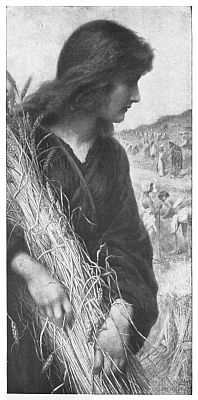
© Photographische Gesellschaft, Berlin
Ruth
Painted by Henry Ryland
At noonday Boaz said to her, “Come here and eat some of the
food and dip your piece of bread in the wine.” So she sat beside
the reapers; and he passed her the roasted grain, and she ate until
she had had enough and had some left. When she rose to gather
grain, Boaz gave this order to his young men: “Let her gather
grain even among the sheaves and do not disturb her. Also pull
out some for her from the bundles and leave it for her to gather
and do not find fault with her.”
So she gathered grain in the field until evening, then beat out
that which she had gathered; and it was about a bushel of barley.
Then she took it up and went into the city and showed her mother-in-law
what she had gathered. She also brought out and gave her
that which she had left from her meal after she had had enough.
Her mother-in-law said to her, “Where did you gather grain
to-day and where did you work? A blessing on him who took
interest in you!” Then she told her mother-in-law where she had
worked, and said, “The name of the man with whom I worked
to-day is Boaz.” Naomi said to her daughter-in-law, “May the
blessing of Jehovah rest upon him who has not ceased to show his
love to the living and to the dead.” Naomi also said to her, “The
man is a near relative of ours.” Ruth the Moabitess added, “He
said to me, ‘You must keep near my young men until they have
completed all my harvest.'” Naomi said to Ruth, “It is best, my
daughter, that you should go out with his maidens and that no
one should find you in another field.” So she gathered grain with
the maidens of Boaz until the end of the barley and wheat harvest;
but she lived with her mother-in-law.
Then Naomi said to her, “My daughter, shall I not try to find
a home for you where you will be happy and contented? Is not
Boaz, with whose maidens you have been, a relative of ours? This
very night he is going to winnow barley on the threshing-floor. So
bathe and anoint yourself and put on your best clothes and go
down to the threshing-floor; but do not make yourself known to
the man until he is through eating and drinking. Then when he
lies down, you mark the place where he lies. Go in, uncover his[77] feet, lie down, and then he will tell you what to do.” Ruth said to
her, “I will do as you say.”
So she went down to the threshing-floor and did just as her
mother-in-law told her. When Boaz was through eating and drinking
and was in a happy mood, he went to lie down at the end of the
heap of grain. Then Ruth came softly and uncovered his feet and
lay down. At midnight the man was startled and turned over,
and there was a woman lying at his feet. He said, “Who are you?”
She answered, “I am Ruth your servant; spread therefore your skirt
over your servant, for you are a near relative.” He said, “May
you be blest by Jehovah, my daughter; for you have shown me
greater favor now than at first, for you have not followed young
men, whether poor or rich. My daughter, have no fear; I will do
for you all that you ask; for all my townsmen know that you are a
good woman. Now it is true that I am a near relative; yet there
is one nearer than I. Stay here to-night, and then in the morning,
if he will marry you, well, let him do it. But if he, being your
nearest relative, will not marry you, then as surely as Jehovah lives,
I will do so. Lie down until morning.”
So she lay at his feet until morning, but rose before any one
could tell who she was, for Boaz said, “Let it not be known that a
woman came to the threshing-floor.” He also said, “Bring the
cloak which you have on and hold it.” So she held it while he
poured into it six measures of barley and laid it on her shoulders.
Then he went into the city.
When Ruth came to her mother-in-law, Naomi said, “Is it you,
my daughter?” Then Ruth told Naomi all that the man had done
for her. She said, “He gave me these six measures of barley; for
he said, ‘Do not go to your mother-in-law empty-handed.'”
Naomi said, “Wait quietly, my daughter, until you know how this
will turn out, for the man will not rest unless he settles it all to-day.”
Then Boaz went up to the gate and sat down. Just then the
near relative of whom Boaz had spoken came along. To him Boaz
said, “Ho!” calling him by name, “come here and sit down.” So
he stopped and sat down. Boaz also took ten of the town elders
and said, “Sit down here.” So they sat down.
Then he said to the near relative, “Naomi, who has come back
from the country of Moab, is offering for sale the piece of land which
belonged to our relative Elimelech, and I thought that I would lay
the matter before you, and ask you to buy it in the presence of these[78] men who sit here and of the elders of my people. If you will buy
it and so keep it in the family, do so; but if not, then tell me, that
I may know; for no one but you has the right to buy it, and I am
next to you.” He said, “I will buy it.”
Then Boaz said, “On the day you buy the field from Naomi,
you must also marry Ruth the Moabitess, the widow of Mahlon,
that a son may be born to bear his name and to receive this field.”
The near relative said, “I cannot buy it for myself, for fear I should
lose what already belongs to me. You take my right of buying it
as a relative, for I cannot do so.”
Now in those days this was the custom in Israel: to make an
agreement between two men the one drew off his shoe and gave it
to the other. So when the near relative said to Boaz, “Buy it for
yourself,” Boaz drew off the man’s shoe.
Then Boaz said to the elders and to all the people, “You are witnesses
at this time that I have bought all that was Elimelech’s and
all that was Chilion’s and Mahlon’s from Naomi. Moreover, I have
secured Ruth, the Moabitess, the widow of Mahlon, to be my wife
so that she may have a son who will receive this land and carry on
Mahlon’s name. You are witnesses this day.”
Then all the people who were at the gate and the elders said,
“We are witnesses. May Jehovah make the woman who is coming
into your house like Rachel and Leah, and make you also famous
in Bethlehem.”
So Boaz married Ruth, and she became his wife; and Jehovah
gave to her a son. Then the women said to Naomi, “Blessed be
Jehovah who has not left you at this time without a near relative,
and may his name be famous in Israel. This child will bring back
your strength and take care of you in your old age; for your daughter-in-law
who loves you, who is worth more to you than seven sons,
has a son!”
So Naomi took the child in her arms and she became its nurse.
Her neighbors also said, “Naomi has a son!” and they named him
Obed; he became the father of Jesse, who was the father of David.
Back to Top
SAMUEL THE BOY PROPHET
Elkanah, a Zuphite of the hill country of Ephraim, lived at
Ramah with his two wives, Hannah and Peninnah. Peninnah had
children, but Hannah had none.[79]
This man used to go up from his village each year to worship
and offer a sacrifice to Jehovah of hosts at Shiloh. Whenever the
day came for Elkanah to offer a sacrifice he gave portions to his wife
Peninnah and to all his sons and daughters; but although he loved
Hannah, he gave her only one portion, for Jehovah had given her
no children. Peninnah made her angry by mocking her, for Jehovah
had given her no children. Elkanah did this year after year; but
whenever Hannah went up to the temple of Jehovah, Peninnah made
her so angry that she wept and would not eat. So Elkanah her husband
said to her, “Hannah, why do you weep and why do you not
eat? Why are you so troubled? Am I not more to you than ten
sons?”
After they had eaten in Shiloh, Hannah arose and stood before
the temple of Jehovah, while Eli the priest was sitting on his seat
beside the door posts of the temple. With a sad heart she prayed
earnestly to Jehovah and wept bitterly. She also made this sacred
promise:
If thou wilt look at my affliction,
And remember, not forgetting thy servant,
But wilt give thy servant a son,
Then I will give him to thee,
Throughout all the days of his life;
And no razor shall touch his head.”
While she continued praying before Jehovah, Eli watched her
mouth. She spoke to herself; her lips moved, but her voice was
not heard, so that Eli thought that she was drunk and said to her,
“How long will you act like a drunken woman? Put away your
wine and go from the presence of Jehovah.” But Hannah answered,
“No, my lord, I am an unhappy woman; I have not drunk wine
nor any strong drink, but I have been pouring out my heart before
Jehovah. Do not think that your servant is a wicked woman, for
I have gone on speaking until now because my grief and vexation
are so great.” Eli answered, “Go in peace, and may the God of
Israel grant what you have asked of him.” She said, “May your
servant have your approval!” So the woman went away and ate,
and her face was no longer sad.
Early in the morning she and her husband rose; and after they
had worshipped Jehovah, they returned to their home at Ramah.
In the course of the year Hannah had a son and named him Samuel,
saying, “I asked him of Jehovah.”[80]
Elkanah and all his household again went to offer the yearly
sacrifice to Jehovah, but Hannah did not go up, for she said to her
husband, “When the child is weaned, then I will take him, and he
shall go to Jehovah’s temple and live there the rest of his life.”
Elkanah said to her, “Do what seems best to you; wait until you
have weaned him; only may Jehovah help you to do what you have
promised.”
So the woman waited and nursed her son until she weaned him.
Then she took him with her, and a three-year-old ox, a bushel of
flour, and a skin of wine, and brought him to the temple of Jehovah
at Shiloh. Then they killed the ox, and Hannah brought the child
to Eli and said, “Oh, my lord, as surely as you live, I am the woman
who stood near you here praying earnestly to Jehovah. This is the
boy for whom I prayed. Jehovah has granted what I asked of
him. Therefore I have given him to Jehovah; as long as he lives
he belongs to Jehovah.”
Elkanah returned to his home in Ramah, but the boy stayed to
serve Jehovah under the direction of Eli the priest. So Samuel—a
young boy dressed in a linen robe—did the duties of a priest in
the temple. His mother also made him a little robe and each
year brought it to him when she came up with her husband to offer
the yearly sacrifice.
Eli blessed Elkanah and said, “Jehovah repay you with children
from this woman for the gift which she has given to Jehovah.”
Then they returned to their home; and Hannah had three more
sons and two daughters. Meantime the boy Samuel grew up in
the temple of Jehovah.
The sons of Eli were very wicked. They knew not Jehovah, and
they despised the offerings which were brought to him. Eli was
very old, and whenever he heard that his sons were doing wrong
he said to them, “Why do you do such things, for I hear of your
wicked deeds from all the people. No, my sons: it is not a good
report that I hear from the people of Jehovah.” But they did not
listen to the words of their father.
The boy Samuel grew and won the favor both of Jehovah
and of men. He continued to serve Jehovah under the direction
of Eli; but in those days not many messages came from
Jehovah.
One day Eli was lying in his room. His eyes had begun to grow
dim so that he could not see. While the lamp of God was still[81] burning, and Samuel was lying in the temple of Jehovah where the
ark of God was, Jehovah called, “Samuel! Samuel!” He answered,
“Here am I.” Then he ran to Eli and said, “Here am I,
for you called me.” But Eli said, “I did not call, lie down again.”
So he went and lay down. Then Jehovah called again, “Samuel!
Samuel!” Samuel rose and went to Eli and said, “Here am I, for
you called me.” But Eli answered, “I did not call, my son; lie
down again.”
Now Samuel did not yet know Jehovah nor had a message
from Jehovah been given to him. So when Jehovah called Samuel
again the third time, he rose and went to Eli and said, “Here am
I, for you called me!” Then Eli knew that Jehovah was calling
the boy. So he said to Samuel, “Go, lie down, and if you are called,
say, ‘Speak, Jehovah, for thy servant is listening.'” So Samuel
went and lay down in his place.
Then Jehovah came and called as at other times, “Samuel!
Samuel!” And Samuel answered, “Speak, for thy servant is listening.”
Jehovah said to Samuel, “See, I am about to do a thing in
Israel that will make the ears of every one who hears it tingle. On
that day I will do to Eli all that I have said that I would do to his
family from the first to the last. For I have told him that I will
punish his family forever for the crime of which he knew his sons
were guilty, for they did not do what God commanded and he did
not stop them.”
Samuel lay until morning, and then he opened the doors of the
temple of Jehovah. He was afraid to tell the vision to Eli. But
when Eli called him and said, “Samuel, my son,” he said, “Here
am I.” Eli asked, “What is the thing that Jehovah said to you?
Keep nothing from me; may God do to you whatever he will, if
you keep from me a word of all that he said to you.” So Samuel
told him everything, and kept nothing from him. And Eli said,
“It is Jehovah; let him do what seems good to him.”
Back to Top
THE ARK AMONG THE PHILISTINES
In those days the Israelites went out to meet the Philistines,
and in a hard-fought battle the Israelites were defeated by the
Philistines.
When the people returned to the camp, the leaders of Israel[82] said, “Why has Jehovah let us be beaten to-day by the Philistines?
Let us bring the ark of our God from Shiloh. He may then go out
with us and deliver us from our enemies.”
So the people sent to Shiloh and took from there the ark of
Jehovah of hosts. When it came to the camp, all the Israelites
shouted so loud that the earth resounded.
The Philistines heard the sound of the shouting and said, “What
does this sound of great shouting in the camp of the Hebrews mean?”
When they knew that the ark of Jehovah had come to the camp,
they were afraid, for they said, “Their god has come to their camp.
Woe to us! for it has never been so before; but be strong and act
like men.” So the Philistines fought, and the Israelites were defeated
and each fled to his tent.
The same day a Benjamite from the ranks ran to Shiloh with his
clothes torn and with earth on his head. As he came, Eli was sitting
on his seat by the gate watching the road, for his heart was
trembling for the ark of God.
When the man came and told the people of the city, they all
cried out. Eli heard the sound of crying and said, “What is this
uproar?” So the man came quickly and told Eli, “I am the man
who came from the battle, for I fled from the ranks.” Eli said,
“How did it go, my son?” The messenger answered, “Israel fled
from the Philistines, and many people were killed, and your two
sons are dead, and the ark of God has been captured.” When he
spoke of the ark of God, Eli fell off his seat backward beside the
gate, and his neck was broken, for he was old and heavy, and he
died.
The Philistines took the ark of God and brought it to the temple
of Dagon in Ashdod and set it up by the side of Dagon. When
the people of Ashdod rose early the next day and came to the temple
of Dagon, there was Dagon on the ground flat on his face before
the ark of Jehovah. Then they raised up Dagon and set him in
his place again. But when they rose early on the following morning,
there was Dagon on the ground flat on his face before the ark
of Jehovah. The head of Dagon and both his hands were broken
off on the door sill, and only his body was left.
Jehovah severely punished the people of Ashdod, for he punished
them with boils. When the men of Ashdod saw this, they said,
“The ark of the god of Israel shall not stay with us, for he is
severely punishing us and Dagon our god.” So they sent for all[83] the rulers of the Philistines and asked, “What shall we do with
the ark of the god of Israel?” They answered, “Let it be carried
around to Gath.”
So they carried the ark of the God of Israel around to Gath.
Then Jehovah punished the men of that city, both young and old,
with boils. Therefore they sent the ark of the God of Israel to
Ekron; but when it came to Ekron, the Ekronites cried out, “They
have brought around the ark of the god of Israel to kill us and our
people!” They sent, therefore, and gathered all the rulers of the
Philistines and said, “Send the ark of the god of Israel back to its
own place, so that it will not kill us and our people!”
Then the Philistines called the priests and diviners and asked,
“What shall we do with the ark of Jehovah? Tell us with what
we shall send it to its place.” They said, “If you send back the
ark of the god of Israel, you must not send it away empty, but
must return to him an offering to repay him for all that you have
done to the ark. Then you shall be healed, and you shall know
why he has continued to punish you.” They said, “What offering
shall we send back in order to repay him?”
They said, “Five golden boils and five golden mice, the same
number as the rulers of the Philistines; for one plague was upon you
as well as upon your rulers. Now therefore prepare a new cart
and two milch cows that have never worn a yoke, and fasten the
cows to the cart, but leave their calves behind them at home. Then
take the ark of Jehovah and place it upon the cart and put in a
box at its side the golden objects which you are sending to
them as an offering to repay him. Then send it away. If it
goes on the way to its own border, to Bethshemesh, then it is
Jehovah who has done us this great harm; but if not, then we
shall know that it is not he who has punished us; it was only an
accident.”
The men did so, and the cows took a straight course along the
Bethshemesh road. They went along the highway, lowing as they
went, and did not turn aside to the right nor to the left. The
rulers of the Philistines also went after them as far as Bethshemesh.
The inhabitants of Bethshemesh were harvesting their wheat
in the valley, and when they looked up and saw the ark, they rejoiced
at the sight. When the ark came into the field of Joshua,
the Bethshemeshite, it stood still there. And a great stone was[84] there; so they split up the wood of the cart and offered the cows
as a burnt-offering to Jehovah. When the five rulers of the Philistines
saw it, they returned to Ekron the same day.
Back to Top
HOW SAMUEL FOUND A LEADER
There was a rich Benjamite named Kish, who lived at Gibeah.
He had a son named Saul, a man full grown and handsome; no one
among the Israelites was more handsome than he. From his shoulders
and upward he was taller than any of the people.
Now the asses of Kish, Saul’s father, were lost. So Kish said
to Saul, “Take one of the servants with you and go, look for the
asses.” They went through the highlands of Ephraim and the land
of Shalishah, but did not find them. Then they crossed into the
land of Shaalim, but the asses were not there. They also went
through the land of Benjamin, but did not find them.
They had come into the land of Zuph when Saul said to his servant
who was with him, “Come, let us go back, that my father may
not stop thinking of the asses and be anxious about us.” The servant
answered him, “There is a man of God in this town who is
held in honor; all that he says is sure to come true. Now let us go
there; perhaps he can tell us the way we should go.”
Saul said to his servant, “But, suppose we go, what shall we
take to the man, for the bread is gone from our sacks, and there is
no present to take to the man of God? What have we?” The
servant answered Saul again and said, “See, I have with me a quarter
of a silver shekel. Give it to the man of God that he may tell
us our way.” Then Saul said to his servant, “Your advice is good;
come, let us go.” So they went to the town where the man of
God was.
As they were going up to the town, they met young women
going out to draw water and said to them, “Is the seer here?”
They answered them, “He is there; he is before you. Make haste,
for he has just come into the town, for the people have a sacrificial
feast to-day at the sacred place on the hilltop. As soon as you
come to the town, you will find him before he goes up to the high
place to eat, for the people will not eat until he comes, for he blesses
the sacrifice, and then the guests eat. Therefore go up now, for
at this time you will find him.”[85]
So they went up to the town, and when they came inside the
gate, Samuel was just coming out toward them to go up to the
high place. Now Jehovah had told Samuel the day before Saul
came, “About this time to-morrow I will send you a man out of the
land of Benjamin, and you shall anoint him to be a prince over
my people Israel. He shall deliver my people from the power of
the Philistines; for I have seen the suffering of my people, because
their cry has come to me.”
When Samuel saw Saul, Jehovah told him, “This is the man
of whom I spoke to you! He it is who shall rule over my people.”
So when Saul met Samuel in the gate, and said, “Tell me, if you
will, where the seer’s house is,” Samuel answered Saul, “I am the
seer; go up before me to the high place, for you shall eat with me
to-day; and in the morning I will let you go and will tell you all that
is in your mind. As for your asses that were lost three days ago,
do not trouble yourself about them for they have been found. And
to whom belongs all that is best in Israel? Does it not belong to
you and to your father’s house?” Saul answered and said, “Am
I not a Benjamite, of the smallest of the tribes of Israel, and is not
my family the least of all the families of the tribe of Benjamin?
Why then do you speak to me in this way?”
But Samuel took Saul and his servant and brought them into
the hall and made them sit at the head of the guests (who were about
thirty in number). Samuel also said to the cook, “Bring the part
which I gave you and told you to put aside.” So the cook took up
the leg and what was on it and placed them before Saul. Then
Samuel said, “See what has been kept for you! Set it before you
and eat, for it was kept for you until the appointed time, that you
might eat with the people whom I have invited.” So Saul ate with
Samuel that day.
After they came down from the high place into the town, they
spread a bed for Saul on the roof, and he lay down. Then at daybreak
Samuel called to Saul on the roof, saying, “Rise, that I may
send you away.” So Saul rose, and he and Samuel went out into
the street. As they were going out of the town, Samuel said to Saul,
“Tell the servant to go on before us, but you stand here that I may
tell you the message from God.”
Then Samuel took the flask of oil and poured it on Saul’s head,
and kissed him and said, “Has not Jehovah anointed you to be a
prince over his people Israel? You shall rule over Jehovah’s people[86] and deliver them from the power of their enemies on every side.
This is the sign that Jehovah has anointed you to be a prince over
his own people: when you go from me to-day you shall find two
men at Rachel’s tomb; and they will say to you, ‘The asses that
you went to seek are found, and now your father is thinking no more
about the asses but is worrying about you, saying, “What shall I
do for my son?”‘ Then you shall go on from there and come to
the oak of Tabor. There three men going up to God at Bethel will
meet you, one carrying three kids, another carrying three loaves
of bread, and another carrying a skin of wine. They will greet you
and give you two loaves of bread which you shall take from their
hand. After that you shall come to Gibeah. As you come to the
city you will meet a band of prophets coming down from the high
place with a lyre, a tambourine, a flute, and a harp before them,
while they prophesy. Then the spirit of Jehovah will come suddenly
upon you, and you shall prophesy with them, and shall be changed
into another man. When these signs come to you, do whatever you
can, for God is with you.” So when Saul turned away from Samuel,
God gave him a new heart, and all those signs came to pass that
day.
Saul’s uncle also said to him and to his servant, “Where did you
go?” He said, “To seek the asses; and when we saw that they
were not to be found, we went to Samuel.” Saul’s uncle said,
“Tell me what Samuel said to you.” Saul replied, “He told us that
the asses were surely found.” But Saul did not tell him that
Samuel had said he should become the ruler.
After about a month, Nahash, the Ammonite, came up and besieged
Jabesh in Gilead; and all the men of Jabesh said to Nahash,
“Make terms with us and we will serve you.” But Nahash, the Ammonite,
said to them. “On this condition will I make terms with you:
that I bore out the right eye of each of you, and so bring disgrace
upon all Israel.” The elders of Jabesh said to him, “Let us have
seven days in which to send messengers through all the land of Israel.
Then, if there are none to save us, we will come to you.”
So the messengers came to Gibeah where Saul lived and told
the facts in the hearing of the people, and they all set up a loud wail.
Just then Saul was coming from the field behind the oxen, and he
said, “What is the trouble with the people that they are wailing?”
Then they told him what the men of Jabesh had said. When he
heard it, the spirit of Jehovah came suddenly upon him and he be[87]came
very indignant. He took a pair of oxen, cut them in pieces,
and sent them through all the land of Israel by messengers, who
said, “Whoever does not come out after Saul and after Samuel,
the same shall be done to his oxen!”
Then a terror from Jehovah fell upon the people, and they all
gathered together. And Saul said to the messengers who came,
“Say to the men of Jabesh in Gilead, ‘To-morrow by the time the
sun grows hot help shall come to you.'”
So the messengers went and told the men of Jabesh, and they
were glad. Therefore the men of Jabesh said to the Ammonites,
“To-morrow we will come out to you, and you shall do to us whatever
you please.” So on the following day, Saul divided the people
into three divisions; and they went into the midst of the camp early
in the morning, and fought against the Ammonites until noon. The
Ammonites who stayed behind were so scattered that not two of
them were left together.
Then all the people went to Gilgal and there in the presence of
Jehovah made Saul their ruler, and they offered sacrifices there to
Jehovah; and Saul and all the men of Israel were very happy.
JONATHAN’S BRAVE DEED
Saul picked out three thousand men from the Israelites. Two
thousand were with Saul in Michmash and on the highland of Bethel,
and a thousand were with his son Jonathan in Gibeah. But Saul
had sent the rest of the people each to his home.
Then Jonathan attacked the company of the Philistines in
Gibeah; and the Philistines heard of it. But Saul sounded a call
to arms throughout all the land, saying, “Let the Hebrews hear!”
So all Israel heard the report that Saul had attacked the Philistines,
and also that Israel was hated by them.
Then the Philistines were gathered together to fight with Israel:
three thousand chariots, six thousand horsemen, and foot soldiers
as many as the sand of the seashore. They came up and camped in
Michmash. When the men of Israel saw that they were in a tight
place (for the people were hard pressed), the people hid themselves
in caves, in holes, in the rocks, in tombs, and in pits. Also many
people crossed over the Jordan to the land of Gad and Gilead.
Then Saul counted the people who were with him and found[88] that there were about six hundred men. And Saul and his son Jonathan,
together with the people who were with them, remained in
Gibeah, while the Philistines camped in Michmash. Then the Philistines
came out of the camp in three divisions to steal whatever they
could find: one division turned toward Ophrah, in the land of Shual,
another toward Bethhoron, and another toward the hill that looks
down over the valley of Zeboim. But the garrison of the Philistines
went out to the pass of Michmash.
Now on that day Jonathan the son of Saul said to the young man
who carried his armor, “Come, let us go over against the Philistines’
garrison that is on the other side.” But he did not tell his father.
Meantime Saul was sitting just outside of Gibeah under the
pomegranate-tree which is near the threshing-floor, and there were
with him about six hundred men. But the people did not know that
Jonathan had gone.
Along the ravine by which Jonathan tried to go over against
the Philistines there was a steep rock on one side, and a steep rock
on the other; one was named The Shining, and the other The
Thorny. One rock rose up north of Michmash, and the other south
of Geba.
So Jonathan said to the young man who carried his armor,
“Come, let us go over to the camp of these heathen Philistines.
Perhaps Jehovah will act for us, for there is nothing that can keep
Jehovah from delivering his people either by many or by few.” His
armor-bearer replied, “Do whatever you wish, I will do my best
to help you.” Then Jonathan said, “See, we will cross over to the
men and show ourselves to them. If they say to us, ‘Stand still until
we can reach you,’ then we will stand still in our place, and will not
go up to them. But if they say, ‘Come up to us,’ then we will go
up; for this shall be the proof that Jehovah has given them into
our power.”
When both of them showed themselves to the Philistines, the
Philistines said, “There are Hebrews coming out of the holes where
they have hidden.” So they called to Jonathan and his armor-bearer,
“Come up to us, and we will show you something!” Then
Jonathan said to his armor-bearer, “Come up after me, for Jehovah
has given them into the power of Israel.”
So Jonathan climbed up on his hands and feet and his armor-bearer
after him. And the Philistines fell before Jonathan, and his
armor-bearer followed and put them to death. In the first attack[89] Jonathan and his armor-bearer killed about twenty men with spears
and rocks from the field. Then there was a great panic in the camp,
in the open field, and among all the Philistines. Even those who
were out robbing were panic-stricken, and the earth quaked, so that
it produced a God-sent panic.
The watchmen of Saul in Gibeah looked and saw the great company
of Philistines melting away and rushing here and there. Then
Saul said to the people who were with him, “Look now and see who
is gone from us.” When they searched they found that Jonathan
and his armor-bearer were not there. So Saul said to Ahijah, “Bring
the ark of God here,” for at that time it was with the Israelites.
While Saul was still speaking to the priest, the noise and
disorder among the Philistines kept on increasing. Therefore, Saul
said to the priest, “Do not wait to consult Jehovah!”
Then Saul and all the people that were with him gathered together
and went into battle. And every Philistine’s sword was
turned upon his fellow, so that there was a very great confusion
among them. The Hebrews who once were on the side of the Philistines
and who had joined their army also went over to the side of
the Israelites who were with Saul and Jonathan. Likewise all the
men of Israel who were hiding in the highlands of Ephraim, when
they heard that the Philistines had fled, closely followed them in
the battle. So Jehovah delivered Israel that day, and the battle
passed over beyond Bethhoron. But Saul made a great mistake
that day, for he strictly commanded the people, saying, “The man
who shall eat any food until evening and until I take vengeance on
my enemies shall be punished.” So none of the people tasted food.
Now there was honey on the surface of the ground; and when
the people came to the forest, they saw a stream of honey, but no
one put his hand to his mouth, for the people feared the punishment.
But Jonathan had not heard when his father commanded the people.
Therefore he reached out the end of the staff that was in his hand
and dipped it in the honeycomb and put his hand to his mouth, and
he felt refreshed. Then one of the people spoke up and said, “Your
father strictly commanded the people, saying, ‘The man who eats
food this day shall be punished.'” But Jonathan replied, “My
father has brought great trouble on the land. See how I have been
refreshed because I tasted a little of this honey. If only the people
had eaten freely to-day of the spoil of their enemies, many more of
the Philistines would have been slain.”[90]
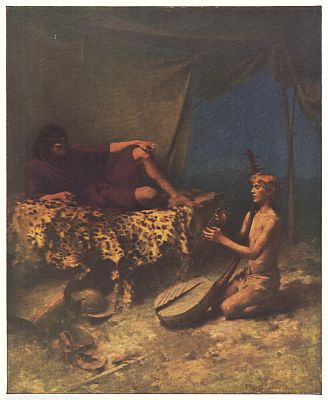
©Curtis Publishing Company
Saul and David
Painted by W. L. Taylor
Then Saul said, “Let us go down after the Philistines by night
and take spoil until daybreak, and let us not leave one of them.”
They said, “Do whatever you think best.” But the priest said,
“Let us ask of God.” So Saul asked of God, “Shall I go down after
the Philistines? Wilt thou deliver them over to Israel?” But he
did not answer him that day. Therefore Saul said, “Come here,
all you leaders of the people, and find out who has done wrong to-day.
For as surely as Jehovah the deliverer of Israel lives, even
though it be Jonathan my son, he shall die.” But not one of the
people answered him.
Then he said to all Israel, “You be on one side, and I and Jonathan
my son will be on the other.” The people said to Saul, “Do
what you think best.” Therefore Saul said, “Jehovah, God of Israel,
why hast thou not answered thy servant this day? If the sin be
mine or that of Jonathan my son, Jehovah, God of Israel, show it
by the lot marked Urim; but if the sin lies with thy people Israel,
show it by the lot marked Thummim.” Then the lot fell on Jonathan
and Saul and not on the people. So Saul said, “Cast the lot
between me and Jonathan my son. He whom Jehovah selects must
die.” The people said to Saul, “It shall not be so!” But Saul made
the people do as he said, and they cast the lot between him and Jonathan
his son; and it fell on Jonathan.
Then Saul said to Jonathan, “Tell me what you have done.”
So Jonathan told him, “I did indeed taste a little honey with the
end of the staff that was in my hand. Here I am! I am ready to
die.” Saul said, “God do so to me and more too; Jonathan, you
shall surely die!” But all the people said to Saul, “Shall Jonathan
die who has brought this great deliverance to Israel? Far from
it! As surely as Jehovah lives, not one hair of his head shall fall
to the ground, for he has done this day what God wished.” So the
people saved Jonathan from death.
Back to Top
DAVID’S VICTORY OVER THE GIANT
As long as Saul lived there was bitter war with the Philistines.
Whenever Saul saw a strong or able man, he would take him into
his service.
Now the spirit of Jehovah had left Saul and an evil spirit from
Jehovah troubled him. So Saul’s servants said to him, “See now,[91] an evil spirit from Jehovah is troubling you. Let your servants
who are here advise you, and let them seek a man skilled in playing
the lyre. Then, whenever the evil spirit comes upon you, he
shall play on the lyre, and you will be well.” Saul said to his servants,
“Find me a man who plays well, and bring him to me.”
Then one of the young men said, “I have seen a son of Jesse
the Bethlehemite who is a skilled musician, a strong and able man,
a soldier, careful in speech, handsome, and Jehovah is with him.”
So Saul sent messengers to Jesse with the command, “Send me
David your son, who is with the flock.”
Then Jesse took ten loaves of bread, a skin of wine, and a kid,
and sent them to Saul by his son David. So David came to Saul
and entered his service; and Saul loved him and he became his
armor-bearer. Saul sent this message to Jesse: “Let David remain
in my service, for I am well pleased with him.” And whenever
the evil spirit from God came upon Saul, David would take the
lyre and play, and Saul would breathe more easily and would be
well, and the evil spirit would depart from him.
Now the Philistines gathered their forces for war, and camped
between Socoh and Ezekah in Ephesdammim. Saul and the men
of Israel came together and camped in the valley of Elah; and they
were drawn up ready for battle against the Philistines.
The Philistines were standing on the hill on one side, and the
Israelites were standing on the hill on the other side with the valley
between them. Then there came out from the ranks of the Philistines
a champion named Goliath, who was about ten feet tall. He
had a helmet of bronze on his head and wore a bronze breastplate
of scales which weighed one hundred and fifty pounds. He also
had bronze greaves upon his legs and a bronze back-plate between
his shoulders. The shaft of his spear was like a weaver’s beam, and
the head of his iron spear weighed about twenty pounds; and his
shield-bearer went before him.
He stood and called to the ranks of Israel: “Why have you
come out to form the line of battle? Am I not a Philistine and you
servants of Saul? Choose a man for yourselves and let him come
down to me. If he is able to fight with me and kill me, then we
will become your servants; but if I conquer and kill him, then you
shall become our servants and serve us.” The Philistine added,
“I defy the ranks of Israel to-day; give me a man that we may
fight together.”[92]
When Saul and all the Israelites heard these words of the Philistine,
they were terrified. But David said to Saul, “Let not my
lord’s courage fail him; I will go and fight this Philistine.” Saul
said to David, “You are not able to go and fight against this Philistine,
for you are only a youth and he has been a warrior from
his youth.” But David said to Saul, “Your servant kept his father’s
sheep, and whenever a lion or a bear came and took a lamb out of
the flock, I would go out after him and kill him and rescue it from
his mouth. If he attacked me, I would seize him by his throat and
kill him with a blow. Your servant has killed both lion and bear.
Now this heathen Philistine shall be like one of them, for he has
defied the armies of the living God. Jehovah who saved me from
the paw of the lion and from the paw of the bear will save me from
the hand of this Philistine.” So Saul said to David, “Go, and may
Jehovah be with you.”
Saul clothed David with his own garments, and put a helmet of
bronze on his head and gave him a coat of mail. And David fastened
on his sword over his coat and was not able to walk, for he was
not used to them. So he said to Saul, “I cannot go with these, for
I am not used to them.” So David took them off.
Then he took his club in his hand, and he chose five smooth
stones from the bed of the brook and put them in his bag, and he
took his sling in his hand and drew near to the Philistine. When
the Philistine looked and saw David, he despised him, for he was
but a fair and ruddy youth. So the Philistine said to David, “Am
I a dog that you come against me with a club?” And he cursed
David by his gods, and said, “Come to me that I may give your
flesh to the birds of the heavens and to the beasts of the field.”
Then David answered the Philistine, “You come to me with a
sword and spear and javelin, but I come to you in the name of
Jehovah of hosts and of the God of the armies of Israel whom you
have insulted this day. Jehovah will deliver you into my hand
that I may kill you and cut off your head.”
When the Philistine started to attack him, David put his hand
into his bag and took from it a stone, and slung it and struck the
Philistine in the forehead. The stone sank into his forehead, and
he fell on his face to the earth. Then David ran and stood over the
Philistine, and drawing his sword from its sheath, he killed him
and cut off his head with it.
When the Philistines saw that their champion was dead, they[93] fled. The men of Israel and of Judah rose up and raised the battle-cry
and followed the Philistines to the entrance to Gath and to the
gates of Ekron, so that the wounded of the Philistines fell all the
way from the battle-field even to Gath and Ekron.
Back to Top
SAUL’S MEAN JEALOUSY
When the Israelites and David returned from slaying the Philistines,
the women came out from all the cities of Israel, singing and
dancing, to meet Saul with tambourines, with cries of rejoicing, and
with cymbals. The women sang gaily to each other and said,
And David his tens of thousands.”
Saul was very angry, for their words displeased him, and he said,
“To David they give credit for ten thousands, but to me only
thousands; what more can he have but the rulership?” So Saul
kept his eye on David from that day onward. Saul feared David
and did not let him stay near him. He made him commander over
a thousand men; and David went out and came in at the head of
the soldiers. In all that he did David acted wisely and had success,
for Jehovah was with him. When Saul saw that he acted
wisely, he was still more afraid of him. But all Israel and Judah
loved David, for he went out and came in at their head.
Michal, Saul’s daughter, also loved David, and when they told
Saul, he was pleased, for he said, “I will give her to him, that she
may lead him to destruction and that the Philistines may capture
him.” So Saul commanded his servants, “Say to David secretly:
‘See, the ruler is pleased with you and all his servants love you;
now therefore become his son-in-law.'” When Saul’s servants told
this to David, he said, “Do you think it easy for me to become the
son-in-law of a ruler when I am poor and have no reputation!”
When Saul’s servants told him David’s answer, he commanded,
“Say to David: ‘Saul wishes no price for his daughter except the
proof that you have killed a hundred Philistines;'” for Saul thought
that David would be killed by them.
So David went with his men and killed a hundred Philistines;
and Saul gave him his daughter Michal as his wife. Then Saul[94] knew that Jehovah was with David and that all Israel loved him, so
he feared David still more.
Then Saul commanded his son Jonathan and all his servants to
put David to death. But Jonathan was very fond of David. And
Jonathan spoke well of David to Saul his father and said to him,
“Do not sin against your servant David, for he has not wronged
you and his behavior toward you has been excellent; for he risked
his life and killed the Philistine, so that Jehovah saved all Israel.
You saw it and rejoiced. Why then will you sin by shedding innocent
blood in killing David without cause?”
So Saul listened to Jonathan and gave his solemn promise: “As
surely as Jehovah lives, he shall not be put to death.”
Then Jonathan called David and told him all these things. And
Jonathan brought David to Saul and he was with him as before.
But there was war again, and David went out and fought against
the Philistines and killed so many of them that they fled before
him. Then an evil spirit from Jehovah came upon Saul while he
was sitting in his house with his spear in his hand and while David
was playing on the lyre. Saul tried to pin David to the wall with
the spear, but David slipped away so that Saul drove the spear
into the wall; and David fled and so escaped.
That night Saul sent messengers to David’s house to watch
him, so as to kill him in the morning. But Michal, David’s wife,
told him, “If you do not save your life to-night, you will be killed
to-morrow.” So Michal let David down through the window;
and he fled away and escaped. Then Michal took the household
god and laid it in the bed, and she put a pillow of goat’s hair under
its head and covered it with a garment. And when Saul sent messengers
to seize David, she said, “He is sick.”
Again Saul sent the messengers to the house of David with the
command, “Bring him up to me on the bed, that I may put him to
death.” When the messengers came in, there was the household
god in the bed with the pillow of goat’s hair under its head. Saul
said to Michal, “Why have you deceived me thus and let my
enemy go?” Michal answered Saul, “He said to me: ‘Let me go;
why should I kill you?'”
Back to Top
JONATHAN’S LOVE FOR DAVID
Then David went and found Jonathan and said, “What have I
done? What is my guilt, and what is my sin in the mind of your[95] father, that he is seeking my life?” Jonathan replied, “No, no!
You shall not die. You know that my father does nothing great
or small that he does not tell me, and why should my father hide
this from me? He surely will not.” David answered, “Your father
well knows that you are fond of me, and he is saying to himself,
‘Do not let Jonathan know this that he may not be grieved.’ But
as surely as Jehovah lives and as you live, there is only a step between
me and death.”
Then Jonathan said to David, “What do you wish me to do
for you?” David answered, “To-morrow is the festival of the New
Moon and I ought to sit at the table with Saul, but let me go and I
will hide myself in the field until evening. If your father misses
me, then say, ‘David asked permission of me to run to Bethlehem,
his native town, for the yearly sacrifice is there for all his family.’
If he says, ‘Good,’ then it is well with your servant; but if he gets
angry, then you will know that he is planning to harm me. Now
show kindness to your servant, for in the presence of Jehovah you
have made a solemn agreement with your servant. But if I am
at all guilty, kill me yourself, for why should you bring me to your
father?” Jonathan said, “That shall never be! If I learn that
my father is planning to do you harm, I will tell you.”
Then David said to Jonathan, “Who will tell me if your father
answers you harshly?” Jonathan answered, “Jehovah the God of
Israel be witness that about this time to-morrow I will find out how
my father feels. If he feels kindly toward you, then I will send and
tell you. Should my father wish to do you harm, God do to Jonathan
whatever he will and more too if I do not tell you and send you
away that you may go in peace. May Jehovah be with you, as he
has been with my father. And if I am yet alive, O may you show
me kindness like that of Jehovah himself! But if I should die,
you must never cease to be kind to my family. And if, when
Jehovah destroys all the enemies of David from the face of the
earth, the family of Jonathan should be destroyed by the family
of David, may Jehovah punish the crime by the hand of
David’s enemies.” So Jonathan renewed his solemn promise to
David, because he loved him; for he loved him as much as he loved
his own life.
Then Jonathan said to him, “To-morrow is the festival of the
New Moon and you will be missed, for your seat will be empty. On
the third day, when you will be greatly missed, go to the place where[96] you hid yourself when my father attacked you, and sit down beside
the heap of stones. I will shoot three arrows on one side of it, as
though I shot at a mark. Then I will send the boy, saying, ‘Go,
find the arrows.’ If I call to the boy, ‘See, the arrows are on this
side of you; pick them up!’—then come; for all goes well with you,
and as surely as Jehovah lives, there is nothing to fear. But if I
call to the boy, ‘See, the arrows are beyond you,’ then go, for Jehovah
sends you away. And as for the promises which you and I have
made, Jehovah is witness between you and me forever.”
So David hid himself in the field; and when the festival of
the New Moon came, Saul sat down at the table to eat. He sat
on his seat, as usual, by the wall, and Jonathan sat opposite, and
Abner sat beside Saul; but David’s seat was empty. Saul, however,
did not say anything that day, for he thought, “It is an
accident.”
But on the next day when David’s place was again empty, Saul
said to Jonathan, “Why has not the son of Jesse come to the table,
either yesterday or to-day?” Jonathan answered, “David asked
permission to go to Bethlehem, for he said, ‘Let me go, for we have
a family sacrifice in the town, and my brother has commanded me
to be there. Now if you approve, let me go away that I may see
my family.’ Therefore, he has not come to your table.”
Then Saul’s anger was aroused against Jonathan, and he said to
him, “Son of a rebellious slave girl! Do I not know that you are
making the son of Jesse your friend to your own shame and to your
mother’s shame? For as long as the son of Jesse lives, neither you
nor your rule will be safe. Therefore, send now and bring him to
me, for he is doomed to die.”
Then Jonathan answered Saul his father and said, “Why should
he be put to death? What has he done?” But Saul flung his spear
at him to strike him. So Jonathan knew that his father had made
up his mind to put David to death. And Jonathan rose from the
table in hot anger and ate no food on the second day of the month,
for he felt hurt because his father had insulted David.
The next morning Jonathan went out into the field to the place
agreed upon with David, and a small boy was with him. He said
to his boy, “Run, find now the arrows which I shoot.” As the boy
ran, he shot an arrow beyond him. When the boy came to the place
where the arrow which Jonathan had shot lay, Jonathan called to
him, “Is not the arrow beyond you? Hurry, be quick, do not stop!”[97] So Jonathan’s lad gathered up the arrows, and brought them to his
master. But the boy knew nothing about the signal. Only Jonathan
and David understood.
Back to Top
THE COST OF A LIE
Then David went to Nob, to Ahimelech the priest who came
trembling to meet David and said to him, “Why are you alone, and
no one with you?” David answered Ahimelech the priest, “Saul
has given me orders about some business and has said to me, ‘Let
no one know anything about the business on which I am sending
you and about which I have given you orders.’ I have also directed
the young men to meet me at a certain place. Therefore, if you have
at hand five loaves of bread, give them to me or whatever can be
found.” The priest answered David, “There is no plain bread at
hand, but only holy bread.” So the priest gave him holy bread,
for there was no other bread there except that which had been removed
from the temple to be replaced at once by hot bread.
Now Doeg, the Edomite, the chief of Saul’s herdsmen, was there
that day. And David said to Ahimelech, “Have you not here at
hand a spear or sword? For I did not bring my sword or my
weapons with me, since the king’s business required haste.” The
priest said, “The sword of Goliath the Philistine whom you slew in
the valley of Elah is there, wrapped in a cloth. If you wish to take
that, do so, for there is no other except that here.” David answered,
“There is none like that; give it to me.”
Then David went from there and escaped to the stronghold of
Adullam. When his brothers and all his father’s clan heard of it,
they went down there to him. Every one who was in trouble and
every one who was in debt, and every one who was discontented
gathered about him, and he became their leader. About four hundred
men were with him.
When Saul heard that David and the men with him had been
found, he was sitting in Gibeah, under the tamarisk-tree at the high
place, with his spear in his hand. And all his servants were standing
about him. Saul said to his servants who stood about him,
“Hear, O Benjamites! Will the son of Jesse give all of you fields
and vineyards? Will he make all of you commanders of thousands
and commanders of hundreds? Is it not true that all of you have
plotted against me so that no one tells me that my son has made
an agreement with the son of Jesse, and that none of you has pity
upon me or tells me that my son has made my servant David my
enemy as he now is?” Then Doeg the Edomite, who was standing[98] by the servants of Saul, spoke up and said, “I saw the son of Jesse
go to Nob, to Ahimelech, the son of Ahitub. And the priest inquired
of God for him and gave him food and the sword of Goliath
the Philistine.”
Then Saul sent for Ahimelech the priest, and all his family and
the priests who were in Nob; and all of them came to him. Then
Saul said, “Listen, son of Ahitub!” He answered, “Here I am,
my lord!” Saul said to him, “Is it not true that you and the son
of Jesse have plotted against me and that you have given him bread
and a sword and have inquired of God for him, that he might rebel
against me?” Ahimelech answered Saul, “Who among all your
servants is trusted like David, your son-in-law, chief over your subjects,
and honored in your household? Is this the first time I have
inquired of God for him? Far be it from me to be disloyal! Do not
think that I or any of my clan have any evil intention, for your
servant does not know the slightest thing about all this.” But Saul
said, “Ahimelech, you shall surely die, you and all your family.”
Then Saul said to the guards who were standing about him,
“Turn and kill the priests of Jehovah, for they have plotted with
David; and although they knew that he was fleeing, they did not
tell me.” But Saul’s servants would not raise their hands to kill
the priests of Jehovah. Then Saul said to Doeg, “Turn and kill
the priests.” So Doeg, the Edomite, turned and killed them. On
that day he killed eighty-five men who wore the priestly robes.
But Abiathar, one of the sons of Ahimelech, escaped and fled
to David. When Abiathar told David that Saul had killed the
priests of Jehovah, David said to him, “I knew that day, because
Doeg the Edomite was there, that he would surely tell Saul. I myself
am responsible for the death of all your family. Stay with me,
have no fear, for whoever seeks your life must first take mine, for
you are placed in my charge.”
Back to Top
A SOLDIER WHO SPARED HIS ENEMY
Now when David was told, “The Philistines are fighting against
Keilah and are robbing the threshing-floors,” he inquired of Jehovah,
“Shall I go and attack these Philistines?” Jehovah said to David,
“Go, attack the Philistines and save Keilah.” But David’s men
said to him, “See, we are afraid here in Judah; how much more will
we be if we go to Keilah against the armies of the Philistines?”[99] When David again inquired of Jehovah, Jehovah answered him,
“Arise, go down to Keilah, for I will give the Philistines into your
hand.” So David and his men went to Keilah and fought with the
Philistines and drove away their cattle and killed a great many of
them. In this way David delivered the people of Keilah.
Now when Abiathar, the son of Ahimelech, fled to David in
Keilah, he came down with the priestly robe used in consulting Jehovah
in his hand. And when Saul was told that David had come
to Keilah, Saul said, “God has given him into my power, for by entering
a town that has doors and bars he has let himself be trapped.”
So Saul called all the people to arms to go down to Keilah to besiege
David and his men. But when David knew that Saul was plotting
evil against him, he said to Abiathar the priest, “Bring here
the priestly robe.” Then David said, “O Jehovah, the God of Israel,
thy servant has surely heard that Saul is planning to come to Keilah,
to destroy the town because of me. Will Saul come down, as thy
servant has heard? O Jehovah, God of Israel, tell thy servant.”
Jehovah said, “He will come down.” Then David said, “Will the
men of Keilah turn me and my men over to Saul?” Jehovah said,
“They will.” Then David and his men, who were about six hundred,
left Keilah, and wandered from one place to another. When
it was reported to Saul that David had escaped from Keilah, he no
longer followed him. So David lived in the Wilderness of Ziph and
stayed in the mountain strongholds.
Then the Ziphites came to Saul at Gibeah, saying, “Is not David
hiding in the hill country of Hachilah?” So Saul went down to the
Wilderness of Ziph with three thousand men of Israel to hunt for
David. And Saul camped in the hill country of Hachilah; but David
stayed in the wilderness. When David saw that Saul was following
him into the wilderness, he sent out scouts and learned that Saul
had come to the place just in front of him. David then arose and
went to the place where Saul had camped. And he saw the place
where Saul lay, with Abner the son of Ner, the commander of his
army; and Saul was within the barricade, and the people were
camped about him.
Then David turned to Ahimelech the Hittite and to Abishai the
son of Zeruiah, Joab’s brother, and said, “Who will go down with
me to Saul’s camp?” Abishai said, “I will go with you.” So
David and Abishai came to the people by night, and Saul was lying
asleep inside the barricade, with his spear stuck into the earth[100] at
his head and with Abner and the soldiers lying about him.
Then Abishai said to David, “God has given your enemy to you
to-day. Now let me pin him to the earth with his spear at one
stroke, for I will not need to strike him twice!” David replied,
“As surely as Jehovah lives, either Jehovah will smite him, or his
day will come to die, or he will go down into battle and meet his
end. Jehovah forbid that I should harm him whom Jehovah has
called to rule! But now take the spear that is at his head and the
jug of water, and let us go.” So David took the spear and the jug
of water from Saul’s head, and they departed. But no man saw it
or knew it, for they were all asleep, and no one awoke, for a deep
sleep from Jehovah had fallen upon them.
Then David went across and stood on the top of a hill at a distance
with a great space between them. And David called to the
soldiers and to Abner, the son of Ner, and said, “Do you make no
answer, Abner?” Abner answered, “Who are you that calls?”
David said to Abner, “Are you not a man, and who is like you in
Israel? Why then have you not kept guard over your lord the
ruler of Israel? For one of the people came to destroy your lord.
You have not done what is right. As surely as Jehovah lives you
ought to be put to death, for you have not kept watch over your
master whom Jehovah has called to rule. Now see where his spear
is and his jug of water that was at his head.”
Saul knew David’s voice and said, “Is this your voice, my son
David?” David replied, “It is my voice, my lord.” And he
added, “Why is it that my lord is following his servant? For what
have I done? Or of what am I guilty? Now therefore let my
lord listen to me. If Jehovah has stirred you up against me, let him
accept an offering. But if men have stirred you up against me,
let them be cursed before Jehovah, for they have driven me out
to-day, saying, ‘Go serve other gods,’ so that I have no share in the
land which Jehovah has given to his people. May I not meet my
end far away from the presence of Jehovah, for the ruler of Israel
has come out to seek my life, as one hunts a partridge on the
mountains.”
Then Saul said, “I have done wrong. Come back, my son
David, for I will do you no more harm, for you have spared my life
to-day. I have acted foolishly and have made a great mistake.”
David answered, “Here is Saul’s spear! Let one of the young
men come over and take it. May Jehovah reward each one who[101] does right and is faithful; for Jehovah gave you to me to-day, but I
would not harm one whom Jehovah had called to rule. Just as your
life was of great value in my sight so may my life be of great value
in Jehovah’s sight, and may he deliver me from all trouble.”
Then Saul said to David, “May you be blessed, my son David!
You shall do great deeds and shall surely succeed!” So David
went his way, but Saul returned home.
Back to Top
ABIGAIL’S SENSIBLE ADVICE
Then David went away into the Wilderness of Maon. Now
there was a man in Maon, whose property was in Carmel. The
man was very rich; he had three thousand sheep and a thousand
goats, and he was shearing his sheep at Carmel. His name was
Nabal, and his wife’s name was Abigail. The woman was sensible
and beautiful, but the man was rough and ill-mannered; and he
was a Calebite.
When David heard in the wilderness that Nabal was shearing
his sheep, he sent ten young men with the command, “Go up to
Carmel and enter Nabal’s house and greet him in my name. You
shall say to him and to his family, ‘Peace and prosperity be to you
and your family and to all that you have. Now I have heard that
you have sheep-shearers. Your shepherds were with us, and we
did not insult them, and nothing of theirs was missing all the while
they were in Carmel. Ask your young men and they will tell you.
Therefore receive my young men favorably, for we have come on
a feast-day. Give also whatever you have at hand to your servants
and to your son David.'”
When David’s young men came, they spoke to Nabal for David
as they were told, and then waited. But Nabal answered David’s
servants, “Who is David? And who is the son of Jesse? Many
are the slaves these days who break away from their masters!
Should I then take my bread and my water and my meat that I
have prepared for my shearers and give it to men of whom I know
nothing?” So when David’s young men returned and told him, he
said to them, “Let every man put on his sword.” So they all put
on their swords. David also put on his sword; and about four hundred
men followed David, and two hundred stayed with the baggage.
But one of the young men told Abigail, Nabal’s wife, “David
has just sent messengers from the wilderness to greet our master,
but he insulted them. The men have been very good to us and
we have not been harmed nor have we missed anything, as long as
we were with them in the open country. They were as a wall about
us both night and day all the time we were near them guarding the
sheep. Now therefore decide what you will do, for evil is planned
against our master and against all his household, for he is such an
ill-tempered man that no one can say a word to him.”
Then Abigail quickly took two hundred loaves of bread, two
skins of wine, five roasted sheep, five baskets of parched grain, a
hundred bunches of raisins, and two hundred cakes of figs, and
loaded them on asses. She said to her young men, “Go on ahead
of me; see, I am coming after you.” But she said nothing about it
to her husband Nabal. As she was riding on the ass and coming
down under cover of a hill, David and his men were coming down
toward her, so that she met them. David had just said, “It was in
vain that I guarded all that belongs to this fellow in the wilderness,
so that nothing of his was missing, for he has returned me evil for
good. May God bring a similar judgment upon David and more
too, if by daybreak I leave a single man of all those who belong to
him.”
When Abigail saw David, she dismounted quickly from her ass
and bowed down before him with her face to the ground. As she
fell at his feet she said, “Upon me, my lord, upon me be the blame.
Only let your servant speak to you, and listen to her words. Let
not my lord pay any attention to that mean man Nabal, for as his
name is, so is he. ‘Fool’ is his name and folly rules him. But
your servant did not see the young men of my lord, whom you
sent. Now, my lord, as surely as Jehovah lives and as you live,
since Jehovah has kept you from murder and from avenging yourself
by your own hand, may your enemies and those who seek to
harm my lord be like Nabal. Let this present which your servant
has brought to my lord be given to the young men who follow him.
I beg of you, forgive the wrong done by your servant, for Jehovah
will certainly make my lord’s family strong, for my lord is fighting
for Jehovah, and you shall not be guilty of any evil deed as long as
you live. Should a man rise up to pursue you and seek your life,
Jehovah your God will care for you, but he will cast away the lives
of your enemies as from a sling. When Jehovah has done for you
all the good that he has promised and has made you ruler over[103] Israel, you will not have to be sorry that you shed blood without
cause or that you were revenged by your own hand. When Jehovah
gives prosperity to my lord, then too remember your servant.”
David said to Abigail, “Blessed be Jehovah the God of Israel,
who sent you this day to meet me, and blessed be your good sense.
A blessing on you, who have kept me this day from murder and
from avenging myself by my own hand. For as surely as Jehovah
the God of Israel lives, who has kept me from doing you harm, unless
you had quickly come to meet me, truly by daybreak not one
man would have been left to Nabal.”
So David received from her all which she had brought him.
And he said to her, “Go back in peace to your house. See, I have
listened to your advice and granted your request.”
When Abigail returned to Nabal, he was holding a feast in his
house like a king. He was feeling merry, for he was very drunk;
so she told him nothing whatever until daybreak. But in the morning,
when the effects of the wine were gone, his wife told him what
she had done. Then his heart stopped beating and he became like
a stone. About ten days later he had a stroke from which he died.
When David heard that Nabal was dead, he said, “Thanks be
to Jehovah who has punished Nabal’s insult to me and has kept
me from doing wrong, for Jehovah has visited Nabal’s crime upon
his own head.”
Then David sent to ask Abigail to become his wife. When his
servants came to her at Carmel and said, “David has sent us to
you to take you to him to be his wife,” she rose and bowed her face
to the earth and said, “See, your slave is willing to be even a servant
to wash the feet of my lord’s servants.” Then Abigail quickly
rose and mounted an ass; and five of her maids followed as servants.
So she went with the messengers of David, and became his wife.
Back to Top
MAKING THE BEST OF TROUBLE
Then David said to himself, “I shall be killed some day by the
hand of Saul. There is nothing better for me than to escape into
the land of the Philistines. Then Saul will give up hope and search
no more for me in all the land of Israel; and so I will escape from
him.” David, therefore, with the six hundred men who were with
him went over to Achish, king of Gath. And David and his men[104] lived with Achish at Gath, each with his family. When Saul was
told that David had fled to Gath, he gave up looking for him.
David said to Achish, “If now you will grant me the favor, give
me a place in one of the towns in the open country, that I may live
there; for why should your servant live in the royal city with you?”
So Achish gave him Ziklag, and David lived in the open country of
the Philistines a year and four months.
And David and his men went up and made a raid upon the
Geshurites, the Girzites, and the Amalekites; for these tribes live
in the land which extends from Telem to the land of Egypt. As
often as David made a raid on the land, he did not leave alive man
or woman, but taking the sheep, the oxen, the asses, the camels,
and the clothing, he returned and went to Achish. Then when
Achish said, “Where have you made a raid to-day?” David answered,
“Against the South Country of Judah, or against the South
Country of the Jerahmeelites, or against the South Country of the
Kenites.” And Achish trusted David, thinking, “He has made
his people Israel hate him; therefore he will be my servant forever.”
Now in those days the Philistines gathered their forces to make
war against Israel. And Achish said to David, “You and your men
shall surely go with me in the army.” David replied, “You shall
then know what your servant can do.” Achish said to David,
“In that case I will make you the captain of my body-guard from
this time on.”
Then the Philistines gathered all their forces at Aphek, and the
Israelites camped at the fountain in Jezreel. When the rulers of
the Philistines were marching past, by hundreds and by thousands,
and David and his men were marching in the rear with Achish, the
commanders of the Philistines said, “What are those Hebrews doing
here?” Achish said to them, “Is this not David, the servant of
Saul the ruler of Israel, who has been with me these two years, and
I have found no fault in him from the time that he came to me to
the present?”
But the commanders of the Philistines were displeased and said
to him, “Send the man back to the place where you had stationed
him. Do not let him go down with us into battle, lest we have a
foe in the camp; for how could this fellow better win back the favor
of his master than with the heads of these men? Is not this the
David of whom they sang to one another in the dances:
And David his ten thousands?'”
Then Achish called David and said to him, “As surely as Jehovah
lives, you are upright, and your conduct toward me both in
and out of the camp has been satisfactory, for I have found nothing
wrong in you from the time that you came to me to the present;
but you are not trusted by the other rulers. Go back home, therefore,
in peace, that you may do nothing to displease the rulers of
the Philistines.” David said to Achish, “But what have I done?
What have you found in your servant from the day that I entered
your service, that I may not go out and fight the enemies of my
lord the king?” Achish answered, “I know that you are as faithful
to me as an angel of God, but the commanders of the Philistines
have said, ‘He shall not go with us into battle.’ Therefore, you and
those who came with you are to rise early in the morning, and go
to the place where I have stationed you. Do not plan any evil, for
I trust you, but rise early in the morning and, as soon as it is light,
depart.”
So David and his men arose early in the morning to return to
the Philistine land, but the Philistines went up to Jezreel.
On the third day, when David and his men returned to Ziklag,
the Amalekites had made a raid on the South Country and on
Ziklag, and had attacked Ziklag and burned it with fire, and had
also carried away captive all who were in it, including the women
and children. They had not killed any but had carried them away
with them. Then David and the people who were with him wept
aloud until they were no longer able to weep.
David was in great trouble, for the people spoke of stoning him,
because they all felt bitter, having lost their sons and daughters:
but David took courage, for he trusted in Jehovah his God. So
David with his six hundred followers went on to the Brook Besor,
where those who were too tired to cross the brook stayed behind.
They found there an Egyptian in the open field and brought him
to David and gave him food to eat and water to drink. Then David
said to him, “To whom do you belong, and where do you come
from?” He replied, “I am an Egyptian lad, an Amalekite’s servant,
and my master left me behind because three days ago I fell
sick. We marched into the South Country of the Cherethites and
into that which belongs to Judah and into the South Country [106]of
Caleb, and Ziklag we destroyed by fire.” David said to him, “Will
you guide me to this robber band?” He replied, “Swear to me by
your God, that you will neither kill me nor turn me over to my
master, and I will guide you to this band.”
When he had brought him down, the Amalekites were scattered
over all the land, eating and drinking and dancing, because of all
the great spoil that they had taken from the land of the Philistines
and from the land of Judah. David fought against them from twilight
to the evening of the next day, and only four hundred young
men who were mounted on camels escaped.
So David took from the Amalekites all that they had carried
away and rescued his two wives; nothing at all was missing. Then
he took all the flocks and the herds and drove those animals before
the people, and they said, “This is David’s spoil.”
When David came to the two hundred men who had been so
faint that they could not follow him, all the wicked, mean fellows
who went with him said, “Because these men did not go with us,
let us not give them any of the spoil that we have taken, except
that each man may take his wife and children and depart.” David
answered, “My brothers, you shall not do so with that which Jehovah
has given us, after he has saved our lives and given this
robber band that attacked us into our power. Those who stay
with the baggage shall have an equal share with those who fight.”
So from that day to the present he made this a law and a rule in
Israel.
When David came to Ziklag, he sent some of the spoil to the
leaders of Judah and to his relatives, saying, “See! a present for
you from the spoil of the enemies of Jehovah.”
Back to Top
THE DEATH OF TWO BRAVE WARRIORS
Samuel had died and all Israel had mourned for him and had
buried him in his own town Ramah. Saul, too, had put the mediums
and those who had messages from the spirits of the dead out of the
land.
Then the Philistines came and camped in Shunem, and Saul
gathered all the Israelites and camped in Gilboa. But when he
saw the army of the Philistines, he was terrified and filled with fear.
So he asked of Jehovah whether he should go against them[107], but
Jehovah did not answer him either by dream or by lot or by the
prophets. Then Saul said to his servants, “Find for me a woman
who is a medium, that I may go and ask through her.” His servants
said to him, “There is such a woman at Endor.”
So Saul did not let any one know who he was, but put on other
clothes and went, taking two men with him. And they came to
the woman at night. He said, “Ask for me through some departed
spirit and bring up for me the one for whom I shall ask.” The
woman said to him, “You know what Saul has done, how he has
driven from the land the mediums and those who have messages
from the spirits of the dead. Why then are you trying to catch
me, to put me to death?” But Saul swore to her by Jehovah, saying,
“As surely as Jehovah lives, no punishment will come to you
from this act.” Then the woman said, “Whom shall I bring up
to you?” Saul said, “Bring up Samuel.”
When the woman saw Samuel, she screamed and said to Saul,
“Why have you deceived me, for you are Saul?” Saul replied,
“Do not be afraid! What do you see?” The woman said to Saul,
“I see a god coming out of the earth.” Saul asked, “What does he
look like?” She said, “An old man is coming up, and he is wrapped
in a cloak.” Then Saul knew that it was Samuel; and he bowed
with his face to the earth and worshipped.
Samuel said to Saul, “Why have you disturbed me by bringing
me up?” Saul answered, “I am in great trouble, for the Philistines
are making war against me, and God has turned from me and answers
me no more, neither by prophets nor by dreams. So I have
called you to tell me what I shall do.” Samuel said, “Why do you
ask of me when Jehovah has turned from you and become your
enemy? He has taken the authority from your hand and given it
to another, even to David. To-morrow you, with your sons beside
you, shall fall, and Jehovah will deliver the army of Israel into the
power of the Philistines.”
Then Saul fell at full length upon the earth, for the words of
Samuel filled him with fear, so he had no strength left, for he had not
eaten any food all that day and night. When the woman came to
Saul and saw that he was in great trouble, she said to him, “See,
I have taken my life in my hand and have done what you asked me.
Now therefore, listen also to my advice and let me set before you a
little food, and eat that you may have strength to go on your way.”
Saul refused and said, “I will not eat”; but his servants, as we[108]ll as
the woman, urged him, until he listened to their advice. Then he
rose from the earth and sat upon the couch. And the woman had
a fat calf in the house which she quickly killed. And she took flour
and kneaded it and baked from it bread without yeast. She set it
before Saul and his servants, and they ate. Then they rose up and
went away that night.
The Philistines fought against Israel, but the Israelites fled from
them and fell dead on Mount Gilboa. Then the Philistines closely
followed Saul and his sons; and they killed Jonathan and Abinadab
and Malchishua, the sons of Saul. So the battle went against Saul,
and when the archers found out where he was, he was severely
wounded. Then Saul said to his armor-bearer, “Draw your sword
and kill me with it, so that these heathen Philistines may not come
and make sport of me.” But his armor-bearer would not, for he
was very much afraid. Saul, therefore, took his own sword and fell
upon it. When his armor-bearer saw that Saul was dead, he also
fell upon his sword and died with him. So Saul and his three sons
and his armor-bearer died on the same day.
When the Israelites who were in the towns of the lowland and
across the Jordan saw that the Israelites had fled and that Saul and
his sons were dead, they left their towns and fled, and the Philistines
came and took them.
On the next day, the Philistines came to rob the dead, and found
that Saul and his three sons had fallen on Mount Gilboa. They cut
off his head and stripped off his armor and sent messengers through
all the land of the Philistines to bring the good news to their idols
and to the people. And they put his armor in the temple of Ashtarte
and fastened his body on the wall of Bethshan.
When the inhabitants of Jabesh in Gilead heard what the Philistines
had done to Saul, their brave men rose up and marched all
night, and they took the bodies of Saul and his sons from the wall
of Bethshan and brought them to Jabesh and mourned over them
there. Then they took their bones and buried them under the oak-tree
in Jabesh and ate no food for seven days.
On the third day after David returned to Ziklag, after defeating
the Amalekites, a man came from the camp of Saul with his clothes
torn and with earth upon his head. When he came to David, he
fell on the ground before him. David said to him, “Where do you
come from?” He answered, “I have escaped from the camp of
Israel.” David said to him, “How did the battle go? Tell me.[109]”
He answered, “The people fled from the battle-field, and many of
them fell, and Saul and Jonathan his son are dead!”
Then David and all the men who were with him tore their
clothes and mourned and wept and went without food until evening,
because Saul and Jonathan his son and the people of Jehovah had
fallen by the sword.
David then sang this dirge over Saul and Jonathan:
Grieve, O Israel!
On your heights are the slain!
How the mighty have fallen!
“Saul and Jonathan, beloved and lovely!
In life and in death they were never parted;
They were swifter than eagles,
They were stronger than lions.
“O Jonathan, your death has mortally wounded me,
O Jonathan, my brother, for you I am sorrowing.
You were ever a friend to me most dear,
Your love meant far more than the love of women!
“How the mighty have fallen,
And the weapons of war vanished!”
A SHEPHERD BOY WHO WAS CALLED TO LEAD A NATION
After this David asked of Jehovah, “Shall I go up into one of
the towns of Judah?” Jehovah answered, “Go up.” When David
asked, “To which shall I go?” he said, “To Hebron.” So David
went up with his two wives, Ahinoam and Abigail. And David
brought the men who were with him, each with his family, and they
lived in the towns about Hebron. Then the men of Judah came
there and made David ruler over the people of Judah.
When they told David about the men of Jabesh in Gilead who
had buried Saul, David sent messengers to them and said, “May
you be blessed by Jehovah because you have shown this kindness
to your master Saul and have buried him. Even so may Jehovah
show kindness and faithfulness to you. I also will repay you for
this kind deed which you have done. Therefore be brave and courageous;
for Saul your master is dead, and the people of Judah have
made me ruler over them.”[110]
Now Abner, the commander of Saul’s army, had taken Ishbaal
the son of Saul and brought him over to Mahanaim and made him
ruler over Gilead and all Israel. But the people of Judah remained
loyal to David.
There was constant war between the followers of Saul and those
of David. But David kept growing stronger while the followers of
Saul grew weaker.
Then Rechab and Baanah, the sons of Rimmon, went about
midday to the palace of Ishbaal, as he was taking his rest at noon.
The doorkeeper of the palace was cleaning wheat, but he grew
drowsy and slept. So Rechab and Baanah his brother slipped in
and, attacking Ishbaal, they killed him and cut off his head.
Then all the tribes of Israel came to David at Hebron and said,
“See, we are your relatives. When Saul was ruler over us, it was
you who led the Israelites, and Jehovah has said to you, ‘You shall
be shepherd of my people Israel, and you shall become the leader of
Israel.'” So all the leading men of Israel came to David, and he
made an agreement with them in Hebron in the presence of Jehovah,
and they made David ruler over Israel. David was thirty
years old when he began to rule and he ruled forty years.
When the Philistines heard that they had made David ruler
over Israel, all the Philistines went up to search for David; but
when he heard of this he went down to the fortress.
Three of David’s thirty warriors went down to him to the top
of the rock, to the fortress of Adullam, while a force of the Philistines
was camped in the Valley of Rephaim. David was at that
time in the fortress, and a company of the Philistines was in Bethlehem.
And David said, longingly, “O that some one would bring
me a drink of water from the well of Bethlehem which is near the
gate!” Then the three famous warriors broke through the line of
the Philistines and drew water out of the well of Bethlehem which
was near the gate and brought it to David. He would not drink of
it, however, but poured it out as an offering to Jehovah and said,
“Jehovah forbid that I should drink it. This is the blood of the
men who went at the risk of their lives.” Therefore he would not
drink it.
When the Philistines came and spread out over the Valley of
Rephaim, David asked of Jehovah: “Shall I go out against the
Philistines? Wilt thou give them into my hand?” Jehovah said
to David, “Go; for I will certainly give the Philistines in[111]to your
hand.” So David went to Baal-perazim, and defeated them there;
and he said, “Jehovah has broken down my enemies before me,
like waters which break through their banks.”
Then the Philistines came up again and spread out over the
Valley of Rephaim. When David asked of Jehovah, he said, “You
shall not make a direct attack. Go around behind them and attack
them opposite the balsam-trees. When you hear the sound of
marching in the tops of the balsams, act quickly, for then Jehovah
will have gone out before you to overthrow the army of the Philistines.”
David did as Jehovah commanded him and drove the
Philistines from Gibeon as far as Gezer.
Back to Top
JERUSALEM MADE THE CAPITAL CITY
David and his men went to Jerusalem against the Jebusites, the
people of the land who had said to David, “You shall not come in
here, for the blind and the lame will turn you back,” for they
thought, “David cannot come in here.”
But David took the fortress of Zion, and lived there. He also
built a wall around it, and called it the City of David.
David continued to grow more powerful, for Jehovah of hosts
was with him. And Hiram, king of Tyre, sent messengers to him,
and cedar-trees and carpenters and masons, and they built a palace
for him. So David knew that Jehovah had made him ruler over
Israel and his kingdom powerful for the sake of his people Israel.
David again gathered all the chief men of Israel, thirty thousand
in all, and went with all the people to Baal-Judah, to bring up
from there the ark of God. They placed the ark of God upon a
new cart and brought it out of the house of Abinadab on the hill.
Uzzah and Ahio, the sons of Abinadab, guided the cart. Uzzah
went beside the ark of God, while Ahio went before it. David and
all the people of Israel danced before Jehovah with all their might to
the music of harps and lyres and drums and castanets and cymbals.
When they came to the threshing-floor of Nachon, Uzzah
stretched out his hand to hold up the ark of God, for the oxen
stumbled. Then the anger of Jehovah was aroused against Uzzah
and he struck him down there, because he had stretched out his
hand to the ark; so he died there in the presence of God. David
was afraid of Jehovah that day, and said, “How can the ark of[112] Jehovah come to me?” So David was not willing to remove the
ark of Jehovah to the City of David, but carried it aside to the
house of Obed-edom, the Gittite, and it remained there three
months. But Jehovah blessed Obed-edom and all his family.
When the report came to David, “Jehovah has blessed Obed-edom
and all his family because of the ark of God,” David joyfully
brought up the ark from the house of Obed-edom to the City of
David. When the bearers of the ark of Jehovah had gone six
paces, David offered an ox and a fat animal as a sacrifice; and he
danced before Jehovah with all his might, and he had about his
waist a priestly garment made of linen. So David and all the
house of Israel brought up the ark of Jehovah with shouting and
the blare of trumpets.
When they had brought in the ark of Jehovah and had set it in
its place in the tent that David had built for it, he offered burnt-offerings
and sacrifices to Jehovah. When David had finished offering
these sacrifices, he blessed the people in the name of Jehovah
of hosts and gave to each of the many Israelites who were there, to
both men and women, a roll of bread, a portion of meat, and a cake
of raisins. Then all the people went back to their homes.
This message also from Jehovah came to Nathan, the prophet:
“You shall say to my servant David: ‘Jehovah of hosts declares,
I took you from the pasture from following the sheep to be chief
over my people Israel. I have been with you wherever you went,
to destroy all your enemies before you, and I will make you a name,
like that of the great in the earth. When your life is ended and you
are buried with your fathers, I will raise up your son after you, and
I will make his rule strong. I will be a father to him, and he shall
be my son. When he goes astray I will gently correct him. I will
not withdraw my favor from him as I withdrew it from Saul. Your
house and your dominion shall always stand firm before me; your
authority shall stand forever.'”
Back to Top
DAVID’S KINDNESS TO JONATHAN’S SON
Then David asked, “Is any one left of the family of Saul to whom
I may show kindness for Jonathan’s sake?” And there was a servant
of Saul named Ziba. When they called him before David, he said
to him, “Are you Ziba?” He replied, “Your servant.” David
said, “Is there any one else belonging to the family of Saul to w[113]hom
I may show kindness like that which God shows to us?” Ziba answered,
“A son of Jonathan is still living, but he is lame in his feet.”
David inquired, “Where is he?” Ziba replied, “He is in the house
of Machir in Lodebar.”
Then David sent and brought him from the house of Machir;
and when Meribaal the son of Jonathan came to David, he bowed
down to the ground before him. David said, “Meribaal!” He
answered, “Here is your servant!” David said to him, “Fear not,
for I will surely show you kindness for the sake of your father Jonathan,
and I will give back to you all the land of your grandfather
Saul; and you shall always eat at my table.” Meribaal bowed down
and said, “What is your servant that you should look favorably
upon one as unworthy as I?”
Then David called to Ziba, Saul’s servant, and said to him, “I
have given to your master’s son all that belongs to Saul and to his
family. You with your sons and servants shall cultivate the land
for him and harvest the fruits, that your master’s son may have
food to eat; but Meribaal, your master’s son, shall always eat at my
table.” Now Ziba had fifteen sons and twenty servants; and he
said to David, “Your servant will do all that my lord commands.”
So Meribaal ate at David’s table like one of his own sons. Meribaal
also had a young son, whose name was Mica. And all who lived
in the house of Ziba were Meribaal’s servants. So Meribaal lived
in Jerusalem, and though he was lame in both feet, he always ate
at David’s table.
A RICH MAN WHO WAS A THIEF
One evening, while Joab was besieging Rabbath Ammon, David
rose from his bed and walked upon the roof of the royal palace.
From the roof he saw a woman bathing; and she was very beautiful.
And David sent to ask about the woman; and some one said,
“Is not this Bathsheba, the wife of Uriah the Hittite?” Then David
sent messengers to bring her; and she came to him, but later returned
to her home.
Then David wrote a letter to Joab and sent it by Uriah. In the
letter, he said, “Place Uriah in the front line where there is the
fiercest fighting, then draw back from behind him, that he may be
struck down and die.” So Joab, in posting guards over the city,
sent Uriah to the place where he knew there were brave men. When[114] the men of the city went out to fight against Joab, some of the soldiers
of David fell, and Uriah the Hittite was killed.
Then Joab sent to tell David all about the war, and he gave this
command to the messenger: “If, after you have finished telling
the ruler all about the war, he is angry and says to you, ‘Why did
you go so near to the city to fight? Did you not know that they
would shoot from the wall? Who struck down Abimelech the son
of Jerubbaal? Did not a woman cast an upper millstone upon him
from the wall, so that he died at Thebez? Why did you go near the
wall?’ then say, ‘Your servant Uriah the Hittite is dead also.'”
So the messenger of Joab went to Jerusalem and told David all
that Joab commanded him. Then David said to the messenger,
“Say to Joab, ‘Let not this thing trouble you, for the sword takes
one and then another. Go on fighting against the city and capture
it,’ and encourage him.”
When Bathsheba heard that Uriah her husband was dead, she
mourned for him as was the custom. When the mourning was over,
David sent for her, and she became his wife and she had a son.
What David had done displeased Jehovah and he sent the
prophet Nathan to David. Nathan went to him and said, “There
were two men in one city, the one rich and the other poor. The rich
man had many flocks and herds; but the poor man had nothing except
one little ewe lamb which he had bought. He fed it, and it grew
up with him and with his children. It used to eat of his own small
supply of food and drink out of his own cup, and it lay in his bosom
and was like a daughter to him.
“Now a traveller came to the rich man; and he spared his own
flock and did not take an animal from it nor from his own herd to
make ready for the traveller who had come to him, but took the
poor man’s lamb and prepared it for the guest who had come.”
Then David was very angry, and he said to Nathan, “As surely
as Jehovah lives, the man who has done this deserves to die; he shall
repay seven times the value of the lamb, because he showed no pity.”
Nathan said to David, “You are the man! Jehovah the God of
Israel declares: ‘I made you ruler over Israel and I delivered you
out of the hand of Saul. I gave you your master’s house and your
master’s wives to be your own, and I gave you the nations of Israel
and Judah. If that were too little, I would add as much again. Why
have you despised Jehovah by doing that which is wrong in his sight?
You have struck down Uriah the Hittite with the sword, and have
taken his wife to be your wife, and have killed him with the sword[115] of the Ammonites. Now, therefore, the sword shall never cease to
smite your family, because you have despised me and have taken
the wife of Uriah the Hittite to be your wife.'”
David said to Nathan, “I have sinned against Jehovah!” Then
Nathan said to David, “Jehovah has also put away your sin so that
you shall not die. Yet, because by this deed you have shown contempt
for Jehovah, the child that is born shall surely die.” Then
Nathan went to his house.
And Jehovah smote Bathsheba’s child so that it fell sick. David
prayed to God for the child, and ate no food but went in and lay all
night in sackcloth upon the earth. The older men in his house stood
over him to raise him up from the earth; but he would not rise nor
eat with them. When on the seventh day the child died, the servants
of David were afraid to tell him that the child was dead, for
they said, “While the child was yet alive, we spoke to him and he
paid no attention to our voice. How can we tell him that the child
is dead, for he will do some harm!”
But when David saw that his servants were whispering together,
he knew that the child was dead, and said to his servants, “Is the
child dead?” They replied, “He is dead.” Then David rose from
the earth, washed and put oil on himself, changed his clothes, and
went into the temple of Jehovah and worshipped. After that he
went to his own house; and he asked for bread, and when they set
it before him, he ate.
His servants said to him, “What is this you have done? You
ate no food and cried for the child while it was alive, but when the
child died, you rose and ate bread.” He replied, “While the child
was yet alive, I ate no food and cried aloud, for I said, ‘Who knows
whether Jehovah will have mercy, so that the child will live?’ But
now that he is dead, why should I eat no food? Can I bring him
back? I am going to him, but he will not come back to me.”
Back to Top
ABSALOM THE UNGRATEFUL SON
Some time later Absalom, David’s son, prepared a chariot and
horses and fifty men to run before him. He used to rise early and
stand beside the highway which led to the city gate. He would call
to him every man who had a suit that was to come before the ruler
for judgment and say, “Of what city are you?” When the man
replied, “Your servant is from one of the tribes of Israel,” Absal[116]om
would say to him, “Your claims are good and right; but the ruler
has not appointed any one to hear you. Oh, that some one would
make me judge in the land, so that every man who has any complaint
or cause would come to me, and I would see that he received
justice!” And whenever a man came near to bow before him, he
would put out his hand and take hold of him and kiss him. In this
way Absalom treated all the Israelites who came to David for justice.
Thus, Absalom stole from David the hearts of the Israelites.
At the end of four years, Absalom said to his father, “I should
like to go and keep my promise, which I have made to Jehovah in
Hebron.” David said to him, “Go in peace.” So he went to
Hebron; but Absalom sent messengers to all the tribes of Israel to
say, “As soon as you hear the sound of the trumpet, cry, ‘Absalom
has become ruler in Hebron.'” With Absalom there went two hundred
men from Jerusalem, who were invited and went innocently,
knowing nothing at all of what he was going to do. Absalom also
sent for Ahithophel, David’s adviser, from the city of Giloh, while
he was offering the sacrifices. And the plot was strong, for more
and more people kept going over to Absalom.
When a messenger came to David, saying, “The hearts of the
men of Israel have gone over to Absalom,” David said to all his servants
who were with him at Jerusalem, “Up, let us flee; for, if we
do not, none of us will escape from Absalom. Go at once, or he may
quickly overtake us and bring evil upon us and kill the people of the
city.” Then David’s servants said to him, “It shall be done as our
lord wishes; we are your servants.”
So David and all the people who followed him went out and stood
at the last house, while all the officers and the royal body-guard and
all the men of Ittai the Gittite, the six hundred who had followed
him from Gath, passed on before him.
Then David said to Ittai, “Why do you also go with us? Go
back and stay with the new ruler, for you are a foreigner and away
from your own land. Yesterday you came, and to-day shall I make
you go up and down the land with us, while I go where I may? Go
back and take your men with you, and may Jehovah show you kindness
and faithfulness.” But Ittai answered, “As surely as Jehovah
lives and as my lord the ruler of Israel lives, wherever my lord is,
whether dead or living, there your servant will be!” David said to
Ittai, “March on.” So Ittai marched on with all his men and with
all the children who were with him.[117]
All the people were weeping aloud while David stood in the Kidron
valley, and they went by before him on the way to the wilderness.
And Zadok and Abiathar came carrying the ark of Jehovah
and set it down until all the people had passed. Then David said
to Zadok, “Carry the ark of God back into the city. If I win Jehovah’s
favor, he will bring me back and show me both it and the place
where he dwells. But if he declares, ‘I have no trust in you, then
here am I, let him do to me as he thinks best.'” So Zadok and Abiathar
carried the ark of God back to Jerusalem and stayed there.
But David went up, weeping as he climbed the Mount of Olives
with his head covered and his feet bare. All the people who were
with him covered their heads and went up, weeping as they went.
And when David came to the summit, where one worships God,
Hushai the Archite with his garment torn and earth upon his head,
came to meet him. David said to him, “If you go on with me you
will be a burden to me. But if you go back to the city, and say to
Absalom, ‘Your brothers have gone away and your father has gone
after them; I will be your servant, O king; as I have been your
father’s servant in the past, so now I will be your servant,’ you can
defeat for me the advice of Ahithophel. And have you not there
with you Zadok and Abiathar the priests? See, they have there
with them their two sons, Ahimaaz, Zadok’s son, and Jonathan,
Abiathar’s son. By them you shall send word to me of everything
that you hear.” So Hushai, David’s friend, went into the city,
when Absalom came to Jerusalem.
Then David and all the people who were with him, reached the
Jordan tired out, but he refreshed himself there.
And Absalom, with all the men of Israel, came to Jerusalem,
and Ahithophel was with him. When Hushai, David’s friend, came
to Absalom, Hushai said to him, “May the king live, may the king
live!” But Absalom said to Hushai, “Is this your love for your
friend? Why did you not go with your friend?” Hushai answered,
“No! to him whom Jehovah and his people and all the men of Israel
have chosen, to him will I belong and with him will I stay. Also
whom should I serve? Should it not be his son? As I have served
your father, so will I serve you.”
The advice which Ahithophel gave in those days was thought
by David and Absalom to be the same as if it had come from God
himself. And Ahithophel said to Absalom, “Let me now pick out
twelve thousand men, and set out and follow David to-night[118]. Thus
I will come upon him when he is tired and weak and will frighten
him, and all the people who are with him will flee. Then I will kill
only the king, and I will bring back all the people to you as the bride
turns to her husband. Seek only the life of one man, and all the
people will be at peace.” This advice pleased Absalom and all the
leaders of Israel.
Then Absalom said, “Call now Hushai and let us hear also what
he has to say.” When Hushai came to Absalom, Absalom said to
him, “Thus Ahithophel has spoken; shall we act as he advises? If
not, you advise us.” Then Hushai said to Absalom, “The advice
that Ahithophel has given this time is not good. You know that
your father and his men are mighty warriors and are now angry, like
a bear robbed of her cubs. Your father is also a soldier and will not
stay at night with the people. Even now he has hidden himself in
one of the caves or in some other place. If some of the people fall
at first, whoever hears it will say, ‘There is a slaughter among the
people who follow Absalom.’ Then even he who is brave, whose
heart is like the heart of a lion, will completely lose courage; for
all Israel knows that your father is a great warrior, and they who
are with him are brave men. But I advise, let all the Israelites be
gathered to you, from Dan to Beersheba, as many as the sand that
is by the sea, with you yourself marching in the midst of them. In
this way we will come upon him in some place where he will be found,
and we will fall upon him as the dew falls on the ground; and of him
and of all the men who are with him not even one shall be left. If
he goes into a city, then all Israel will bring ropes to that city, and
we will pull it down into the valley, until not even a small stone is
found there.”
Absalom and all the men of Israel said, “The advice of Hushai
is better than the advice of Ahithophel.” For Jehovah had planned
to defeat the good advice of Ahithophel, so that Jehovah might bring
evil upon Absalom.
Then Hushai said to Zadok and to Abiathar the priests, “This
is what Ahithophel advised Absalom and the leaders of Israel; and
this is what I advised. So now send quickly and say to David, ‘Do
not spend this night at the fords of the wilderness, but by all means
cross over, for fear that David and all the people with him be
killed.'”
Now Jonathan and Ahimaaz were staying at Enrogel; and a
maid-serv[119]ant was to go and bring them news, and they were to go
and tell David, for they must not be seen coming into the city. But
a boy saw them and told Absalom. Then they both went away
quickly and entered into the house of a man in Bahurim, who had
a well in his courtyard into which they descended. The women took
and spread the covering over the mouth of the well, and scattered
dried fruit upon it, so that nothing was known. And when Absalom’s
servants came to the woman at the house and said, “Where
are Ahimaaz and Jonathan?” the woman answered, “They have
gone over the brook.” When they had searched and could find
nothing, they returned to Jerusalem.
But as soon as the men had gone away, Ahimaaz and Jonathan
came up out of the well, and went and told David and said, “Get
up, cross quickly over the water, for so has Ahithophel advised in
regard to you.” Then David and all the people who were with him
rose and crossed the Jordan. By daybreak there was not one left
behind.
Back to Top
A BROKEN-HEARTED FATHER
After Absalom and all the men of Israel crossed the Jordan,
David counted the troops who were with him, and put over them
commanders of thousands and of hundreds. And he divided the
troops into three divisions; one was under the command of Joab,
another under Abishai, and another under the command of Ittai.
Then David said to the people, “I too will surely go out with you.”
But the people said, “You shall not go out; for if we are defeated,
or if half of us die, it will make no difference, for you are equal to
ten thousand of us. It is therefore more important for you to be
ready to help us from the city.” David said to them, “I will do
what you think best!” So he stood beside the gate, while all the
troops marched out by hundreds and by thousands.
David commanded Joab and Abishai and Ittai, “Deal gently
for my sake with the young man, with Absalom!” All the people
heard when he gave the commanders this order about Absalom.
So the troops went out into the field against Israel. The battle
was fought in the forest of Ephraim. And the soldiers of Israel were
defeated there by those who were loyal to David, and the loss of
life on that day was great—twenty thousand men. The battle spread
over the whole country; and the dense thickets killed more people
than were killed by the sword.
Absalom happened to meet the soldiers of David while riding
upon his mule, and the mule we[120]nt under the thick branches of a great
oak, and Absalom’s head caught fast in the oak, and he was hung
between heaven and earth, while the mule that was under him went
on. A certain man saw it and told Joab, “I saw Absalom hanging
in an oak.” Joab said to the man who told him, “You saw him!
Why did you not strike him to the ground? I would have given
you ten pieces of silver and a belt.” But the man said to Joab, “If
I were to feel the weight of a thousand pieces of silver in my hand, I
would not raise my hand against the ruler’s son, for in our hearing
he commanded you and Abishai and Ittai, ‘Take care of the young
man Absalom.’ If I had treacherously taken his life, nothing would
have been hidden from the ruler of Israel, and you yourself would
not have tried to save me.” Joab answered, “I will not waste time
with you.”
So he took three spears in his hand and drove them into
Absalom’s heart, while he was still alive in the midst of the oak.
Then Joab said to a negro slave, “Go, tell the ruler of Israel what
you have seen.” And the negro bowed before Joab and ran off.
Now David was sitting between the two gates, and when the
negro came, he said, “Let my lord receive the good news; Jehovah
has punished for you this day all those who rose up against
you.'” David said to the negro, “Is it well with the young Absalom?”
The negro answered, “May the enemies of my lord and
all who rebel against you to harm you be as that young man!”
Then David was very sad and went up to the chamber over the
gate and wept. As he wept he said, “My son Absalom, my son,
O my son Absalom! Oh that I had died for you, Absalom, my son,
my son!” And it was reported to Joab, “The ruler of Israel is weeping
and mourning for Absalom.” So for all the people the victory
that day was turned to mourning, because they heard that David
was mourning for his son. Therefore, the people stole away into the
city, as people who are ashamed steal away when they have run
away in battle. But David covered his face and cried aloud, “My
son Absalom, Absalom, my son, my son!”
Back to Top
HOW SOLOMON BECAME THE RULER OF ISRAEL
Now when David was old, Adonijah thought, “I will be ruler of
Israel.” So he prepared for himself chariots and horsemen and fifty
men to run before him. His father, David, had never in his life
troubled him by saying, “Why have you done thus and so?”
Adonijah was very good-looking and was the next younger son after
Absalom. He also had made an agreement with Joab and with[121] Abiathar the priest to help him. But Zadok the priest and Benaiah
and Nathan the prophet, as well as Shimei and Rei and David’s
famous warriors, were not on his side.
Adonijah held a feast and killed for it sheep, oxen, and fat beasts
by the Serpent’s Stone, which is beside the Fuller’s Spring; and he
invited to the feast all his brothers and all the royal officials of Judah;
but he did not invite the prophet Nathan nor Benaiah nor the famous
warriors nor his brother Solomon.
Then Nathan said to Bathsheba the mother of Solomon, “Have
you not heard that Adonijah has been made ruler without David
our lord knowing it? Now, therefore, let me advise you that you
may save your own life and the life of your son Solomon. Go at
once to David and say to him, ‘Did you not, my lord, solemnly
promise your servant that Solomon your son should rule after you?
Why then has Adonijah been made ruler?’ While you are still
talking with him, I will come in and repeat your words.”
So Bathsheba went into David’s room; he was very old, and
Abishag the Shunamite was caring for him. When David said,
“What do you wish?” she said to him, “My lord, you solemnly
promised your servant by Jehovah: ‘Solomon your son shall rule
after me.’ But now Adonijah has been made ruler without your
knowledge, my lord! Now, my lord, all the Israelites are looking
to you, to tell them who shall rule after you. If you do not tell them,
then, when my lord dies, I and my son Solomon will be treated as
criminals.”
While she was still talking with David, Nathan the prophet came
in. And they told David, “Nathan the prophet is here.” So he
came in and bowed before David with his face to the ground. Then
Nathan said, “My lord, have you said, ‘Adonijah shall rule after
me?’ For he has gone down this day and killed many oxen and fat
beasts and sheep and has invited all your sons and the commanders
of the army and Abiathar the priest; and there they are eating and
drinking before him and saying, ‘May the new ruler Adonijah live!’
But he has not invited me, even me your servant, nor Zadok, the
priest, nor Benaiah nor your servant Solomon. If you have done
this, my lord, you have failed to show your servants who is to rule
after my lord.”
David answered, “Call Bathsheba to me.” So she came in and
stood before hi[122]m. Then David made this solemn promise; “As
surely as Jehovah lives, who has delivered me from all trouble, as
I have solemnly promised to you by Jehovah, the God of Israel,
saying, ‘Solomon your son shall rule after me’; so I will certainly
do to-day.” Then Bathsheba bowed her face to the earth and said,
“May my lord live forever.”
Then David said, “Call to me Zadok the priest, Nathan the
prophet, and Benaiah the son of Jehoiada.” When they came before
him, he said to them, “Take with you the servants of your lord.
Let Solomon my son ride upon my own mule, bring him down to
Gihon, and there let Zadok the priest and Nathan the prophet make
him ruler over Israel and blow the trumpet and say, ‘May Solomon
the ruler live!’ Then you shall go up after him, and he shall go in
and sit upon my throne, for he shall rule after me; and I have appointed
him to be chief over Israel and Judah.” Benaiah answered
David, “So may it be! May Jehovah confirm the words of my lord.
As Jehovah has been with my lord, even so may he be with Solomon,
and may he make his throne greater than the throne of my
lord David!”
Then Zadok, Nathan, and Benaiah together with the Philistine
body-guards, went down and put Solomon on David’s mule and
brought him to Gihon. Zadok the priest took the horn of oil out of
the tent and poured oil on Solomon’s head, and they blew the trumpet,
and all the people said, “May Solomon live!” Then all the
people followed him and the people played on flutes and rejoiced
so loudly that the earth seemed to be shaken by the sound that they
made.
Adonijah and all the guests who were with him heard it just as
they had finished eating. And they were terrified and each rose
up and went away. But Adonijah in his fear of Solomon went and
caught hold of the horns of the altar. When it was reported to Solomon,
“See, Adonijah fears Solomon the ruler, for he has caught
hold of the horns of the altar and says, ‘Let Solomon solemnly
promise me first that he will not kill his servant with the sword,'”
Solomon said, “If he shall show himself a worthy man, not one of
his hairs shall be touched, but if he is found guilty of disloyalty, he
shall die.” So Solomon had him brought from the altar. And he
came and bowed before Solomon the ruler. And Solomon said to
him, “Go to your home.”
Then David died and was buried in the City of David, after having
ruled over Israel forty[123] years.
Back to Top
A YOUNG MAN’S WISE CHOICE
Solomon went to Gibeon to offer a sacrifice there, for that was
the great high place. He offered upon that altar a thousand animals
as a burnt-offering.
In Gibeon Jehovah appeared to Solomon in a dream by night
and said, “Ask what I shall give you.” Solomon said, “Thou hast
showed to thy servant David my father great kindness. Now, O
Jehovah my God, thou hast made thy servant ruler in the place of
David my father, although I am but a child who does not know how
to go out or come in. Give thy servant, therefore, an understanding
mind to rule thy people, that I may see clearly what is good and
what is evil; for who is able to rule this thy great people?”
Jehovah was pleased that Solomon had asked this; and God
said to him, “Because you have asked this and have not asked for
yourself long life nor riches nor the life of your enemies, but have
asked for yourself understanding to see clearly what is just, I have
now granted what you ask; I have given you a wise and understanding
mind. I have also given you that which you have not asked,
both riches and honor.” When Solomon awoke, he found that it
was a dream; and he returned to Jerusalem.
Once two women came to Solomon and stood before him. The
one woman said, “Oh, my lord, this woman and I live in the same
house. While with her in the house I had a child. Three days later
this woman also had a child, and we were alone by ourselves in the
house. While we two were alone this woman’s child died in the
night, because she lay upon it.
“Then she rose at midnight and took my son from beside me,
while your servant slept, and laid it on her breast and laid her dead
child on mine. When I rose at dawn to nurse my child, there it was
dead; but when I looked at it closely in the morning, I found that
it was not my son.” Then the other woman said, “No; the living is
my son, and the dead child is your son.” So they quarrelled before
Solomon.
Then Solomon said, “One says, ‘This one who is alive is my
son, and your son is dead.’ But the other says, ‘No; your son is
dead, and my son is the one that is alive.’ Bring me a sword.” So
they brought him a sword. Then he said, “Divide the living child
in two and give half to the one and half to the other.” At that the
woman to whom the living child belonged spoke to Solomon—for[124] she loved her son with all her heart—and said, “Oh, my lord, give
her the living child and on no account put it to death.” But the
other said, “It shall be neither mine nor yours! Divide it!” Then
Solomon said, “Give the first woman the living child, and on no
account put it to death; she is its mother.”
When all Israel heard of the decision which Solomon had given,
they had great respect for him, for they saw that he had divine
wisdom to decide questions justly.
Back to Top
BUILDING A GREAT TEMPLE
In the fourth year of Solomon’s rule over Israel he built the
temple of Jehovah. The temple was ninety feet long, thirty feet
wide, and forty-five feet high. The porch before the large room of
the temple was thirty feet wide and fifteen feet deep. Solomon
made windows for the temple with casings, broad on the inside and
narrow on the outside.
The temple was built with stone which had been made ready at
the quarry; neither hammer nor chisel nor any iron tool was heard
while the temple was building. Against the wall of the temple on
the outside Solomon built wings, both around the larger room and
the inner room, and made side-chambers around the temple.
The entrance to the lower side-chambers was on the south side
of the temple. Winding stairs led to the second floor, and from the
second to the third. Solomon built the wings against the sides of
the temple, each seven and a half feet high; and they were joined
to the temple with timbers of cedar.
He covered the walls of the temple on the inside with boards
of cedar from the floor of the temple to the rafters: and he covered
the floor of the temple with boards of cypress.
He also made a room thirty feet square in the back part of the
temple with boards of cedar reaching from the floor to the rafters.
He built it as an inner room, even as the most holy place. The
temple, that is the large room in front of the inner room, was sixty
feet long. And there was cedar inside the temple with carving in
the form of gourds and open flowers. All was cedar, no stone was
seen. Solomon prepared the inner room as a place for the ark.
In the inner room Solomon made two winged bulls of olive
wood. The height of each was fifteen feet. Each of their wing[125]s
measured seven and a half feet across, fifteen feet from the end of
one wing to the end of the other. He set these up in the inner room
of the temple; and their wings were stretched out so that the wing
of the one touched the one wall, while the wing of the other touched
the other wall, and their wings touched each other in the middle
of the temple; and he covered them with gold.
Then Solomon gathered in Jerusalem the leaders of Israel to
bring up the ark of Jehovah out of Zion, the City of David, at the
time of the autumn festival in September. When all the leaders
of Israel had come, the priests took up the ark and the tent of meeting
and all the sacred vessels that were in the tent. So the priests
brought in the ark of Jehovah to its place in the inner room of the
temple under the wings of the winged bulls. There was nothing in
the ark except the two tables of stone which Moses put there at
Horeb. And when the priests came out from the inner room, the
cloud filled the temple of Jehovah, so that the priests could not
stand and perform their service on account of the cloud, for the
glory of Jehovah filled his temple.
Then Solomon said:
But has said that he will dwell in thick darkness.
So I have built thee a temple as a lofty dwelling,
A place for thee to abide in forever.”
As Solomon stood before the altar of Jehovah in the presence of
all the assembly of Israel, he spread out his hands toward heaven
and said, “O Jehovah, the God of Israel, there is no God like thee
in heaven above or on earth beneath, who keepest thy solemn agreement
and showest kindness to thy servants who serve thee whole-heartedly,
who hast kept with thy servant David my father the
promise that thou didst make to him.
“But will God actually dwell on earth? Indeed heaven and the
highest heaven cannot hold thee; how much less this temple that I
have built!”
Back to Top
A RULER WHO WRONGED HIS PEOPLE
Solomon was building his palace thirteen years before he finished
it. He also built the throne-hall where he judged the people. This
room was the Hall of Judgment; and it was covered with cedar from
floor to ceiling.
His palace where he lived, in another court farther in from the
Hall of Judgment, was of the same workmanship. He made a
palace, too, similar to this hall, for Pharaoh’s daughter whom he
had married. All these buildings were of costly stones, hewn according
to measurements, sawed with saws, both on the inside and
outside.
Solomon also gathered together chariots and horsemen; he had
one thousand four hundred chariots and twelve thousand horsemen
that he placed in the chariot cities and with him at Jerusalem. And
Solomon had twelve officers over all Israel who provided food for
him and for his household: each man had to provide food for a
month in the year.
When the queen of Sheba heard of the fame of Solomon, she
came to test him with puzzling questions. So she came to Jerusalem
with a very large number of servants, with camels that carried
spices and a great amount of gold and precious stones. As
soon as she came to Solomon, she told him all that was in her mind.
And Solomon answered all her questions: nothing was too difficult
for him to answer.
When the queen of Sheba had seen all the wisdom of Solomon,
the palace that he had built, the food on his table, the housing of
his officers, the way his waiters served him, their clothing, his cup-bearers,
and the burnt-offering which he offered at the temple of
Jehovah, she was greatly surprised. She said to Solomon, “What
I heard in my own land of your acts and of your wisdom was true.
But I would not believe the words until I came and saw with my
own eyes; but as it is, the half was not told me; your wisdom and
prosperity are even greater than what was reported to me.”
Now Solomon loved women; and he married many foreign
wives—Moabites, Canaanites, Edomites, Sidonians, Hittites, and
Ammonites. He had seven hundred wives of princely birth, and
three hundred concubines. When Solomon was old, his wives influenced
him to worship other gods, and he was not loyal to Jehovah
his God. Solomon built a place of worship for Chemosh, the god
of Moab, on the hill that is opposite Jerusalem, and for Milcom,
the god of the Ammonites. He did the same for all his foreign
wives, burning incense and offering sacrifices to their gods.
Then God raised up as a foe against him Rezon, the son of
Eliada, who had fled from his master, Hadadezer, king of Zobah.
He gathered men about him and became commander of a robber
band, and he went to Damascus and lived and reigned there[127]. He
was a foe to Israel as long as Solomon lived.
Jeroboam, the son of Nebat, was a man of great ability. When
Solomon saw that the young man was industrious, he placed him
over all the men of the tribe of Joseph who were working for the ruler.
Once upon a time, when Jeroboam went away from Jerusalem,
the prophet Ahijah of Shiloh met him on the way and took him
aside. Now Ahijah had put on a new garment, and while they two
were alone in the field, Ahijah took hold of the new garment he
had on and tore it in twelve pieces. Then he said to Jeroboam,
“Take for yourself ten pieces; for Jehovah, the God of Israel, declares,
‘I will tear the kingdom out of the hand of Solomon and will
give ten tribes to you, but he shall have only one tribe.'” So
Jeroboam also rebelled against Solomon.
Solomon, therefore, wanted to kill Jeroboam. But Jeroboam
arose and fled to Egypt, and he was in Egypt until the death of
Solomon.
Back to Top
REHOBOAM’S GREAT MISTAKE
When Solomon died, Rehoboam his son ruled after him. As
soon as Jeroboam, who was still in Egypt, heard that Solomon had
died, he returned at once to his home town, Zeredah in Mount
Ephraim.
Rehoboam went to Shechem, for all the Israelites had come to
Shechem to make him ruler. But they said to Rehoboam, “Your
father laid a heavy yoke upon us. Now make the hard service of
your father and the heavy yoke that he laid upon us lighter, and
we will serve you.” He said to them, “Go away for three days;
then come again to me.” So the people went away.
Then Rehoboam asked advice from the old men who had been
in the service of Solomon his father during his lifetime and inquired,
“What answer do you advise me to give this people?”
They said to him, “If now you will serve this people and give them
a favorable answer, then they will be your servants forever.”
But he rejected the advice which the old men had given him
and asked the young men who had grown up with him and had
been in his service. And he said to them, “What answer do you
advise that we give to this people who have said to me, ‘Make the
yoke that your father laid upon us lighter’?” The young men who
had grown up with him said to him, “Make this answer to them:[128] ‘My little finger is thicker than my father’s loins! While my father
loaded you with a heavy yoke, I will make your yoke heavier; my
father punished you with whips, but I will punish you with
scourges.'”
So when all the people came to Rehoboam the third day, as he
had directed, he answered the people harshly and did not follow the
advice which the old men had given him, but spoke to them as the
young men had advised, saying, “My father made your yoke heavy,
but I will make your yoke still heavier; my father punished you
with whips, but I will punish you with scourges.” So Rehoboam
paid no attention to the demand of the people.
When all Israel saw that he paid no attention to their demand
they gave him this answer: “What interest have we in David? We
have nothing in common with the son of Jesse! To your tents, O
Israel! Now look out for your house, O David!”
So the Israelites went to their homes.
Then Rehoboam sent to them Adoniram, who was over the men
who did forced labor. But when all the Israelites stoned him to
death, Rehoboam quickly mounted his chariot and fled to Jerusalem.
So Israel has refused to obey the house of David to the
present day.
As soon as all Israel heard that Jeroboam had returned, they
sent and called him to the assembly of the people and made him
ruler over all Israel. None remained loyal to the house of David
except the tribe of Judah.
Back to Top
ELIJAH AND THE WIDOW’S SON
When Asa had been ruler of Judah for thirty-one years Omri
became ruler over Israel, and he ruled twelve years. He bought the
hill Samaria from Shemer for two talents of silver; and he built a
city on the hill and named it Samaria, after Shemer, the owner of
the hill.
When Omri died, Ahab his son ruled in his place. But Ahab
displeased Jehovah more than all the kings who had ruled before
him. He married Jezebel, the daughter of Ethbaal, king of the
Sidonians, and then began to worship the Phœnician god Baal. He
also built an altar for Baal in the temple of Baal, which he built in
Samaria.
Then Elijah from Tishbe in Gilead said to Ahab, “As surely as
Jehovah the God of Israel lives, whom I serve, there shall be no
dew nor rain for years except as I announce it.”
Then this message from Jehovah came to Elijah: “Go from here
and hide yourself near the Brook Cherith that is east of the Jordan.
You shall drink from the brook, and I have commanded the ravens
to feed you there.”
So he obeyed the command of Jehovah and lived near the Brook
Cherith. The ravens brought him bread every morning and meat
every evening, and he drank from the brook. But after a while the
brook dried up, for there had been no rain in the land.
Then this message from Jehovah came to him, “Arise, go to
Zarephath which belongs to Sidon, and live there. I have commanded
a widow there to provide for you.” So he went to
Zarephath.
When he came to the gate of the city, a widow was there gathering
sticks. Calling to her, he said, “Bring me, I beg of you, a
little water in a vessel, that I may drink.” As she was going to get
it, he called after her, “Bring also a bit of bread with you.” She
replied, “As surely as Jehovah your God lives, I have nothing
baked, and only one handful of meal in the jar and a little oil in
the jug. Now I am gathering a few sticks, that I may go in and
prepare it for myself and my son, that we may eat it and die.”
Elijah said to her, “Fear not; go and do as you have said, but first
bake for me a little dough and bring it to me. Afterward make
some for yourself and your son. For Jehovah the God of Israel
declares: ‘The jar of meal shall not be empty, nor the jug of oil fail,
until Jehovah sends rain upon the earth.'”
So she did as Elijah directed; and she and her child, as well as Elijah,
had food to eat. From that day the jar of meal was never empty
and the jug of oil did not fail, as Jehovah had said through Elijah.
Now after this the woman’s son fell sick; and his sickness was so
severe that he stopped breathing. So she said to Elijah, “What
have I to do with you, O man of God? You have come to me to
remind me of my sin by taking the life of my son!” He said to
her, “Give me your son.” So he took him out of her arms and
carried him up into the upper room where he was staying and laid
him on his own bed. Then he prayed earnestly to Jehovah and
said, “O Jehovah, my God, hast thou also brought misfortune upon
this widow, with whom I am staying, by taking the life of her son?”
And he stretched himself upon the child three times and pra[130]yed to
Jehovah and said, “O Jehovah, my God, I pray thee, give back
this child’s life to him again.”
So Jehovah listened to Elijah’s prayer; and the life of the child
came back to him, and he sat up. Then Elijah took the child and
brought him down from the upper room into the house and gave
him to his mother; and said, “See, your son lives!” The woman
said to him, “Now I know that you are a man of God and that the
message of Jehovah that you speak is true.”
Back to Top
THE PROPHET OF FIRE
In the third year of the famine this command came from Jehovah
to Elijah: “Go, show yourself to Ahab; and I will send rain
upon the earth.” So Elijah went to show himself to Ahab.
The famine was so severe in Samaria that Ahab had called Obadiah,
the overseer of the palace. Obadiah was very loyal to Jehovah;
for when Jezebel tried to kill the prophets of Jehovah, he took
a hundred and hid them in a cave and kept them supplied with
bread and water. Ahab said to Obadiah, “Come, let us go through
the land to all the springs and to all the brooks, in the hope that we
may find grass, so that we can save the horses and mules and not
lose all of them.” So they divided the land between them, Ahab
going in one direction and Obadiah in another.
While Obadiah was on the way, Elijah suddenly met him. As
soon as Obadiah knew him, he fell on his face and said, “Is it you,
my lord Elijah?” He answered, “It is; go, tell your master:
‘Elijah is here.'” But Obadiah said, “What sin have I done, that
you would give your servant over to Ahab to kill me? As surely
as Jehovah your God lives, there is no nation nor kingdom where
my lord has not sent to find you; and when they said, ‘He is not
here,’ he made each of the kingdoms and nations take an oath,
that no one had found you. Now you say, ‘Go, tell your lord,
Elijah is here!’ As soon as I have left you the spirit of Jehovah
will carry you to a place unknown to me, so that when I come and
tell Ahab and he cannot find you, he will put me to death, although
I, your servant, have been loyal to Jehovah from my youth! Have
you not been told what I did when Jezebel killed the prophets of
Jehovah, how I hid a hundred by fifties in a cave and fed them continually
with bread and water?” Elijah answered, “As surely as
Jehovah of hosts lives, before whom I stand, I will show myself [131]to
Ahab to-day.”
So Obadiah went to Ahab and told him; and Ahab went to meet
Elijah. As soon as Ahab saw Elijah, he said to him, “Is it you, you
who have brought trouble to Israel?” He answered, “I have not
brought trouble on Israel, but you and your father’s house have;
because you have failed to follow the commands of Jehovah and
have run after the Phœnician gods. Now therefore call together to
me at Mount Carmel all the Israelites and the four hundred and
fifty prophets of the god Baal who eat at Jezebel’s table.”
So Ahab sent for all the Israelites and gathered the prophets
together at Mount Carmel. Then Elijah came to the people and
said, “How long are you going to falter between worshipping Jehovah
or Baal? If Jehovah is the true God, follow him, but if Baal,
then follow him.” But the people were silent. Then Elijah said
to the people, “I, even I only, am left as a prophet of Jehovah, but
there are four hundred and fifty prophets of Baal. Let us take two
oxen; let them choose one ox for themselves and cut it in pieces and
lay it on the wood, without lighting any fire, and I will dress the
other ox and lay it on wood, without lighting any fire. Then you
call on your god and I will call on Jehovah. The god who answers
by fire is the true God.” All the people answered and said, “It is a
fair offer.”
Then Elijah said to the prophets of Baal, “Choose one of the
oxen for yourselves and dress it first, for you are many, and call on
your god, without lighting any fire.” So they took the ox which
he gave them and dressed it, and called on their god from morning
until noon, saying, “O Baal, hear us.” But there was no voice nor
answer, although they leaped about the altar which they had built.
When it was noon, Elijah mocked them, saying, “Call loudly, for
he is a god; either he is thinking, or he has gone out, or he is on a
journey, or perhaps he is sleeping and must be awakened!” Then
they called loudly and cut themselves, as was their custom, with
swords and lances until the blood gushed out upon them. When
noon was past, they cried out in frenzy until the time of the offering
of the evening sacrifice; but there was neither voice nor answer nor
was any attention paid to their cry.
Then Elijah said to all the people, “Come near to me.” And
all the people drew near to him, and he rebuilt the altar of Jehovah
which had been thrown down. Then around the altar he made
a ditch that would hold about two bushels of seed. When he had
placed the pieces of wood in order, he cut up the ox and laid it [132]on
the wood. Then he said, “Fill four jars with water and pour it on
the burnt-offering and on the pieces of wood.” And he said, “Do
it the second time”; and they did it the second time. He said, “Do
it the third time”; and they did it the third time, so that the water
ran round the altar. And he also filled the ditch with water.
When it was time to offer the evening sacrifice, Elijah the prophet
came near and said, “O Jehovah, God of Abraham, of Isaac, and of
Israel, let it be known this day that thou art God in Israel, that I
am thy servant, and that I have done all these things at thy command.
Hear me, O Jehovah, hear me, that this people may know
that thou, Jehovah, art God, and that thou mayst win their hearts.”
Then the fire of Jehovah fell and burned up the burnt-offering
and the wood, the stones and the dust, and licked up the water that
was in the trench. When all the people saw it, they fell on their
faces and cried, “Jehovah, he is God; Jehovah, he is God.” But
Elijah commanded them, “Take the prophets of Baal; do not let
one of them escape!” So they took them down to the Brook Kishon
and there put them to death.
Then Elijah said to Ahab, “Go, eat and drink; for there are
signs of a heavy rain.” So Ahab went to eat and drink. But Elijah
went up to the top of Carmel and crouched down upon the earth,
with his face between his knees. And he said to his servant, “Go
up now, look toward the sea.” So he went up and looked and said,
“There is nothing.” But seven times he said, “Go again.” So the
servant went back seven times, but the seventh time he said, “There
is a cloud as small as a man’s hand rising out of the sea.”
Then Elijah said, “Go, say to Ahab, ‘Make ready your chariot;
go down, that the rain may not stop you.'” In a little while the
heavens grew black with clouds and wind, and there was a heavy
rain. And as Ahab rode toward Jezreel, Elijah was given divine
strength, so that he tightened his belt and ran before Ahab to the
entrance to Jezreel.
Back to Top
GOD’S LOW WHISPER
Now when Ahab told Jezebel that Elijah had put the prophets
to death with the sword, she sent a messenger to Elijah, saying, “As
surely as you are Elijah and I am Jezebel, may the gods do to me
what they will and more too, if I do not make your life as the life
of one of those prophets by to-morrow about this time.”[133]
Then he was afraid and fled for his life. And he came to Beersheba,
which belongs to Judah, and left his servant there. But he
went on a day’s journey into the wilderness and sat down under a
desert tree, and he asked that he might die, saying, “It is enough;
now, O Jehovah, take my life, for I am no better than my fathers.”
Then he lay down and slept under the desert tree, but an angel
touched him and said to him, “Rise, eat!” When he looked, he saw
there at his head a loaf, baked on hot stones, and a jar of water. So
he ate and drank and lay down again. But the angel of Jehovah
came again the second time and touched him and said, “Rise, eat,
or else the journey will be too long for you.” So he rose and ate and
drank and went in the strength of that food forty days and forty
nights to Horeb the mountain of God.
Then Jehovah passed by, and a very violent wind tore the mountain
apart and broke the rocks in pieces before Jehovah; but Jehovah
was not in the wind. And after the wind an earthquake; but
Jehovah was not in the earthquake. And after the earthquake a
fire; but Jehovah was not in the fire. After the fire there was the
sound of a low whisper. As soon as Elijah heard it, he wrapped his
face in his mantle and went out and stood at the entrance of the
cave. Then he heard a voice saying, “What are you doing here,
Elijah?” He replied, “I have been very jealous for Jehovah the
God of hosts, for the Israelites have forsaken thee, thrown down
thine altars, and slain thy prophets with the sword, and I only am
left; and they seek to take my life.”
Then Jehovah said to him, “On your way back go to the wilderness
of Damascus, and when you arrive there, anoint Hazael to rule
over Aram, Jehu, the son of Nimshi, to rule over Israel, and Elisha,
the son of Shaphat, to be prophet in your place. Then every one
who escapes the sword of Hazael, Jehu shall put to death; and every
one who escapes the sword of Jehu, Elisha shall put to death. Yet
I will spare seven thousand in Israel—all who have not worshipped
Baal and kissed his image.”
After he had left, Elijah found Elisha the son of Shaphat, as he
was ploughing with twelve pairs of oxen. When Elijah went up to
him and threw his mantle upon him, he left the oxen and ran after
Elijah and said, “Let me kiss my father and my mother, and then
I will follow you.” Elijah said to him, “Go back, for what have
I done to you?” So Elisha turned back and took one pair of oxen
and offered them as a sacrifice and, using the wooden ploughs a[134]nd
yokes as fuel, boiled their flesh, and gave it to the people to
eat. Then he arose and followed Elijah and served him.
Back to Top
AHAB THE THIEF
Now Naboth, the Jezreelite, had a vineyard in Jezreel next to
the palace of Ahab, who ruled at Samaria. So Ahab said to Naboth,
“Give me your vineyard, that I may have it as a vegetable-garden,
for it is near my palace; and I will give you a better vineyard for
it; or, if it is more pleasing to you, I will pay you its value
in money.” But Naboth answered Ahab, “May Jehovah save me
from the crime of giving you what has come down to me from my
fathers!”
So Ahab went into his house sullen and in bad humor because
of what Naboth had said to him. And he lay down on his bed and
covered his face and would eat no food.
But Jezebel his wife came to him and said, “Why are you in such
bad humor that you will not eat?” He replied, “Because I made
this offer to Naboth, ‘Give me your vineyard for its value in money,
or else, if it is more pleasing to you, I will give you another vineyard
for it.’ But he answered, ‘I will not give you my vineyard.'”
Then Jezebel his wife said to him, “Are you not the one who now
rules in Israel? Rise, eat, and set your mind at rest. I will give
you the vineyard of Naboth.”
So she wrote letters in Ahab’s name and sealed them with his
seal and sent the letters to the leaders and officials who lived
in Naboth’s city. In the letters she wrote, “Proclaim a fast and
put Naboth in front of the people. Then set up two base men before
him and let them bring this charge against him: ‘You cursed
God and the ruler of Israel.’ Then carry him out and stone him to
death.”
The leaders and officials of Naboth’s city did as Jezebel commanded
in her letters to them. They proclaimed a fast and put
Naboth in front of the people. Then the two base men came in and
sat before him, and the scoundrels in the presence of the people
said, “Naboth cursed God and the ruler of Israel.” Then they carried
him out of the city and stoned him to death. And they told
Jezebel, “Naboth has been stoned to death.”
As soon as Jezebel heard that Naboth had been stoned to death,
she said to Ahab, “Rise, take the vineyard of Naboth which he refused
to sell you, for Naboth is not alive but dead.” As soon
as Ahab heard that Naboth was dead, he went down to the vineyard
of Naboth to take it. But this command came from Jehovah
to Elijah, the Tishbite, “Rise, go down to meet Ahab, the ruler of
Israel, who lives in Samaria; he is just now in the vineyard of Naboth,
where he has gone to take it. Say to him, ‘This is the message
of Jehovah, “Have you killed and also taken his vineyard? In
the very place where the dogs licked the blood of Naboth there they
shall also lick your blood.”‘” Ahab said to Elijah, “Have you
found me, O my enemy?” He answered, “I have. And Jehovah
has declared: ‘The dogs shall eat Jezebel in the district of Jezreel.'”
When Ahab heard those words, he tore his clothes and
put sackcloth on his flesh and ate no food.
Back to Top
MICAIAH’S COURAGE IN TELLING THE TRUTH
For three years there was no war between Aram and Israel. But
in the third year, when Jehoshaphat the ruler of Judah came to visit
the ruler of Israel, Ahab said to his followers, “Do you not know
that Ramoth in Gilead belongs to us; yet we sit still instead of taking
it from the king of Aram?” Then he asked Jehoshaphat, “Will
you go with me to attack Ramoth in Gilead?” Jehoshaphat replied,
“I am with you, my people are as your people, my horses as your
horses.”
And Jehoshaphat said to the ruler of Israel, “Ask now what Jehovah
has to say.” So Ahab gathered the prophets together (in
all about four hundred men), and asked them, “Shall I go to fight
against Ramoth in Gilead or shall I not?” They said, “Go up; for
Jehovah will give it into your hands.” But Jehoshaphat said, “Is
there any other prophet of Jehovah, that we may ask him?” The
ruler of Israel answered, “There is another by whom we may ask
of Jehovah, Micaiah, the son of Imlah, but I hate him; for he
prophesies for me nothing good, but only evil.” Jehoshaphat said,
“Do not say so.”
Then the ruler of Israel called a servant and said, “Bring
quickly Micaiah, the son of Imlah.” The messenger who went to
call Micaiah said to him, “See, the prophets have all of them promised
the ruler of Israel success. Agree with them, and prophesy[136] success.” But Micaiah said, “As surely as Jehovah lives, I will speak
what he says to me.”
When he came to Ahab, he said to him, “Micaiah, shall we go
to Ramoth in Gilead to fight, or shall we not?” He answered him,
“Go up and conquer! Jehovah will give it into your hands!” But
Ahab said to him, “How many times shall I warn you to speak nothing
to me in the name of Jehovah but the truth?” He said, “I
saw all the Israelites scattered upon the mountains as sheep that
have no shepherd. And Jehovah said, ‘These have no master; let
each of them go home in peace!'”
The ruler of Israel said to Jehoshaphat, “Did I not tell you that
he would prophesy for me nothing good, but only evil?” Micaiah
said, “Hear then the message from Jehovah: I saw Jehovah sitting
on his throne and all the host of heaven standing about him. And
Jehovah said, ‘Who will deceive Ahab, so that he will go up and fall
at Ramoth in Gilead?’ One suggested one thing and another, another,
until a spirit came out and stood before Jehovah and said,
‘I will deceive him.’ Jehovah said to him, ‘By what means?’
He said, ‘I will go out and become a lying spirit in the mouth of all
his prophets.’ Then Jehovah said, ‘You shall succeed in deceiving
him. Go out and do so.’ So Jehovah has now put a lying spirit
in the mouth of all these prophets of yours, for he has decided to
bring evil upon you.”
Then Zedekiah came near and struck Micaiah a blow on the
cheek and said, “How was it that the spirit of Jehovah went from
me to speak to you?” Micaiah replied, “Indeed, you shall see on
the day when you shall go from one hiding-place to another.” Then
the ruler of Israel said, “Take Micaiah back to Amon, the governor
of the city, and to Joash, the ruler’s son, and say, ‘This is the ruler’s
command: Put this fellow in prison and feed him with a scanty fare
of bread and water until I return successful.'” Micaiah said, “If
you indeed return successful, Jehovah has not spoken by me.”
Then Ahab, the ruler of Israel, and Jehoshaphat, the ruler of
Judah, went up to Ramoth in Gilead. And the ruler of Israel said
to Jehoshaphat, “I will dress myself so that no one will know me,
and go into the battle, but you can put on your robes.”
But a certain man shot an arrow, and by chance it struck the
ruler of Israel between the breastplate and the lower part of his armor.
So Ahab said to the driver of his chariot, “Turn about and
carry me out of the battle, for I am wounded.” But the battl[137]e grew
more intense, so that Ahab stayed until evening propped up in his
chariot in the sight of the Arameans, and the blood ran out of the
wound into the bottom of the chariot. And that evening he died.
About sunset the cry went out through the army, “Each to his
town and each to his land, for the ruler is dead!” So they went to
Samaria and buried Ahab there. And when they washed the chariot
by the pool of Samaria, the dogs licked up his blood just as Jehovah
had said.
Back to Top
THE MANTLE OF ELIJAH
When Jehovah took up Elijah to heaven in a whirlwind, he was
going with Elisha from Gilgal. And Elijah said to Elisha, “Stay
here, for Jehovah has sent me as far as Bethel.” But Elisha said,
“As surely as Jehovah lives and as you live, I will not leave you.”
So they went down to Bethel.
Then the followers of the prophets at Bethel came out to Elisha
and said, “Do you know that to-day Jehovah will take away your
master from you?” He said, “Yes, I know it; say no more.”
And Elijah said to him, “Elisha, stay here, for Jehovah has sent
me to Jericho.” But he said, “As surely as Jehovah lives and as
you live, I will not leave you.” So they came to Jericho.
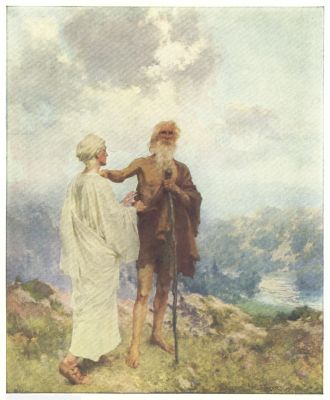
© Curtis Publishing Company
The Parting of Elijah and Elisha
Painted by W. T. Taylor
Then the followers of the prophets at Jericho came near to Elisha
and said, “Do you know that to-day Jehovah will take your master
from you?” He answered, “Yes, I know it; say no more.” And
Elijah said to him, “Stay here, for Jehovah has sent me to the Jordan.”
But he said, “As surely as Jehovah lives and as you live, I
will not leave you.” So they both went on.
Fifty followers of the prophets stood opposite them at a distance,
while they two stood by the Jordan. Then Elijah rolled up his mantle
and with it struck the waters; and they were divided, so that
they two went over on dry ground. When they had gone over, Elijah
said to Elisha, “Ask what I shall do for you before I am taken from
you.” Elisha said, “Let a double portion of your spirit be upon me.”
He replied, “You have asked what is difficult; but if you see me
when I am taken from you, it shall come to you; but if you do not,
it shall not come.”
As they were going on their way talking, a fiery chariot with
horses of fire sudd[138]enly came and separated the two; and Elijah went
up in a whirlwind to heaven. When Elisha saw it, he cried, “My
father, my father! the chariots and the horsemen of Israel!” And
he saw Elijah no more, but he took hold of his own robes and tore
them in two. Then he took up the mantle that had fallen from Elijah.
Back to Top
ELISHA HEALING THE SICK BOY
One day Elisha went over to Shunem where a rich woman lived,
and she asked him to be her guest. Afterward, whenever he passed
by, he stopped there to eat. So she said to her husband, “Now I
see that this is a holy man of God who is constantly passing by our
door. Let us make a little chamber on the roof, and put there for
him a bed, a table, a seat, and a candlestick, so that whenever he
comes to us, he can stay there.”
One day when he came, he went into the upper room and lay
down there. Then he said to Gehazi his servant, “Call this Shunamite.”
So he called her, and she stood before him. Elisha said to
Gehazi, “Say now to her, ‘See, you have been so anxious to care for
us; what can be done for you? May I ask the ruler or the commander
of the army to do a favor for you?'” She answered, “I
am living among my own people.” Elisha said, “What then can
be done for her?” Gehazi answered, “Verily, she has no son, and
her husband is old.” Then Elisha said, “Call her.” So he called
her, and she stood at the door. Then Elisha said, “At this time
a year from now you shall hold a son in your arms!” But she said,
“No, my lord, O man of God, do not deceive your servant!” But
the next year the woman had a son at the very time Elisha
had promised her.
When the child had grown up he went out one day to his father
to the reapers. And he called to his father, “My head, my head!”
So his father said to his servant, “Carry him to his mother.” When
he had been taken to his mother, the boy sat on her lap until noon
and then died. His mother went up and laid him on the bed of the
man of God, and shut the door as she went out.
Then she called her husband and said, “Send me one of the servants
and one of the asses, that I may go quickly to the man of God
and return.” He said, “Why do you go to him to-day, for it
is neither the feast of the new moon nor the sabbath?” She said,
“I have good reason.”
Then she saddled an ass and said to her servant, “Drive on fast,
do not stop until I tell you.” So she went to the man of God
on Mount Carmel. But when Elisha saw her at a distance, he said
to Gehazi, his servant, “See, there is the Shunamite! Run down to
meet her and say to her, ‘Is all well with you? Is your husband
well? Is the child well?'” And she answered, “All is well.” But
when she came to the man of God on the mountain, she caught hold
of his feet. When Gehazi tried to push her away, Elisha said, “Let
her alone, for she is deeply troubled and Jehovah has not told me
the reason.” Then she said, “Did I ask a son of my lord? Did I
not say, ‘Do not deceive me?'”
Elisha said to Gehazi, “Tighten your belt, take my staff in your
hand and go! If you meet any one, do not speak to him, and if any
one speaks to you do not answer him, and lay my staff on the face
of the child.” But the mother of the child said, “As surely as
Jehovah lives and as you live, I will not leave you.” So he rose
and went with her. And Gehazi had gone on before them and had
laid the staff upon the face of the child, but there was neither sound
nor sign of life in the boy. So he went back to meet him and told
him, “The child has not awakened.”
When Elisha came into the house, there was the child lying dead
on his bed. So he went in and shut the door after them and prayed
to Jehovah. He also went up and lay upon the child and put his
mouth upon his mouth, his eyes upon his eyes, and his hands upon
his hands. As he lay upon him, the flesh of the child became warm.
Then he turned and walked backward and forward in the house,
and again went up and lay upon him, and the child sneezed seven
times, and then opened his eyes. Calling Gehazi, he said, “Call
this Shunamite woman.” So he called her. And when she came in
to him, he said, “Take up your son.” Then she went nearer, fell
at his feet, and bowed to the ground; after that she took up her
son and went out.
Back to Top
A SLAVE GIRL WHO HELPED HER MASTER
Naaman, the commander of the army of the king of Aram, was
a man who was beloved by his master and was held in high honor,
for through him Jehovah had given victory to Aram. He was an
able man, but he was a leper.
Now the Arameans had gone out to rob and had brought away
captive from the land of Israel a little maid who became the servant
of Naaman’s wife. She said to her mistress, “O that my master
were with the prophet who is in Samaria! Then he would cure him
of his leprosy.” So Naaman went in and told the king what the
maid from the land of Israel had said. The king of Aram said, “Go
now, and I will send a letter to the ruler of Israel.”
So Naaman set out and took with him a thousand pounds of
silver and six thousand gold pieces and ten suits of fine clothes.
He also brought to the ruler of Israel the letter, which read: “This
letter is to tell you that I have sent Naaman, my servant, to you,
that you may cure him of his leprosy.” When the ruler of Israel
read the letter, he tore his clothes and said, “Am I a god, who can
kill and make alive, that this king sends a man to me to cure him
of his leprosy? But you can clearly see that he is seeking a quarrel
with me!”
When Elisha the man of God heard that the ruler of Israel was
tearing his clothes, he sent this message to him: “Why are you
tearing your clothes? Let him come now to me and he shall know
that there is a prophet in Israel!” So Naaman came with his
horses and chariots and stood at the door of Elisha’s house. And
Elisha sent a messenger to him to say, “Go and wash seven times
in the Jordan and your flesh will again be well and clean.”
But Naaman went away in a rage, saying, “I expected that he
would surely come out to me and stand and call on the name of
Jehovah his God and wave his hand over the place, and so cure the
leper. Are not Amana and Pharpar, the rivers of Damascus, better
than all the waters of Israel? Could I not wash in them and be
clean?” So he turned and went away in a rage. But his servants
came near and said to him, “If the prophet had told you to do some
great thing, would you not have done it? Why not, then, when
he says to you, ‘Wash and be clean!'” So he went down and dipped
himself seven times in the Jordan as the man of God commanded;
and his flesh became again like the flesh of a little child, and he was
cured of his leprosy.
Then Naaman, with all his followers, returned to the man of
God. When he arrived, he stood before him and said, “Now I
know that there is no god in all the earth, but in Israel; therefore
accept a present from your servant.” But Elisha said, “As surely
as Jehovah lives, before whom I stand, I will take nothing.” And
although he urged him to take it, he would not. Then Naaman[141] said, “If not, at least give your servant a load of earth, what two
mules can draw, for your servant will from this time on offer burnt-offering
and sacrifice to no other god but Jehovah.” And Elisha
said to him, “Go, and may good fortune attend you.”
But when he had gone from him a short distance, Gehazi, the
servant of Elisha the man of God, thought to himself, “My master
has let this Naaman the Aramean go without accepting what he
brought! As surely as Jehovah lives, I will run after him and take
something from him.” So Gehazi ran after Naaman; and when
Naaman saw some one running after him, he stepped down from the
chariot to meet him and said, “Is all well?” Gehazi replied, “All
is well. My master has sent me to say, ‘Just now two young men of
the followers of the prophets have come to me from the highland
of Ephraim. Give them a hundred pounds of silver and two suits
of fine clothes.'” Naaman said, “Agree to take twice as much
silver.” So he urged him and bound up two hundred pounds of
silver in two bags, with two suits of fine clothes, and laid them on
two of his servants, and they carried them before Gehazi. But
when he came to the hill, he took them from their hand and hid
them in the house and let the men go.
Then he went in to Elisha; but when he stood before his master,
Elisha said to him, “Where do you come from, Gehazi?” He answered,
“Your servant has not been anywhere.” But Elisha said
to him, “Was I not in spirit with you when the man turned from
his chariot to meet you? Now you have received money and you
may get clothes, olive yards, vineyards, sheep, oxen, and slaves;
but the leprosy of Naaman shall stick to you and to your children
forever.” Then Gehazi went from Elisha’s presence a leper as white
as snow.
Back to Top
ELISHA’S WAY OF TREATING ENEMIES
Once while the king of Aram was at war with Israel, he said to
his officers, “In such and such a place we shall hide and surprise
them.” But Elisha, the man of God, sent word to the ruler of
Israel, “Take care that you do not pass that place, for the Arameans
are hiding there.” So the ruler of Israel sent soldiers to
the place of which the man of God had told him. Thus he warned
him many times, so that he could there be on his guard.
The king of Aram was very much troubled by this, and he
called his officers and said to them, “Can you not tell me who has
betrayed us to the ruler of Israel?” One of his officers replied,
“No one, my lord, O king, for Elisha, the prophet in Israel, tells the
ruler of Israel the words that you speak in your bedchamber.” The
king said, “Go and see where he is, that I may send and seize him.”
And they told the king, “Elisha is now in Dothan.”
So the king sent horses and chariots there and a great army.
And they arrived at night and surrounded the city. When the
man of God rose early the next morning and went out, an army
with horses and chariots was about the city; so that his servant said
to him, “Alas, my master! What shall we do?” He answered,
“Fear not, for they who are with us are more than they who are
with them.” And Elisha prayed and said, “Jehovah open his eyes,
that he may see.” Then Jehovah opened the eyes of the young
man, and he saw that the highlands around about Elisha were full
of horses and chariots of fire.
When the Arameans came toward him, Elisha prayed to Jehovah,
and said, “Make this people blind.” So Jehovah made them
blind, as Elisha asked. Then Elisha said to them, “This is not the
way nor the city. Follow me, and I will bring you to the man
whom you seek!” So he led them to Samaria.
But as soon as they came to Samaria, Elisha said, “O Jehovah,
open the eyes of these men, that they may see.” And Jehovah
opened their eyes, so that they could see, and there they were in
Samaria. When the ruler of Israel saw them, he said to Elisha,
“My father, shall I cut them down?” Elisha answered, “You
shall not cut them down; would you cut down those whom you have
not taken captive with your sword nor with your bow? Set bread
and water before them, that they may eat and drink and go to their
master.” So he prepared a great feast for them; and when they
had had food and drink, he sent them back to their master. So
the robber bands of Arameans no longer invaded the land of
Israel.
Later, Benhadad, king of Aram, gathered all his army and
besieged Samaria. The famine was so severe in Samaria while they
were besieging it, that an ass’s head was sold for eighty pieces of
silver.
Once as the ruler of Israel was passing by on the wall, a woman
cried o[143]ut to him, “Help, my lord.” He answered, “If Jehovah does
not help you, from where can I bring help to you? From the
threshing-floor or from the wine-press?” However, the ruler of
Israel said to her, “What is the trouble with you?” She answered,
“This woman said to me, ‘Give your son, that we may eat him to-day,
and we will eat my son to-morrow!’ So we cooked my son
and ate him, and I said to her on the next day, ‘Give your son that
we may eat him’; but she has hidden her son.”
When the ruler of Israel heard the words of the woman, he tore
his clothes; and as he was passing by on the wall, the people looked
and saw that he wore sackcloth next to his skin.
Now Elisha was sitting in his house with the elders beside him;
and while he was still talking with them, the ruler of Israel came
down to him and said, “See, this is the evil that comes from Jehovah!
Why should I put my hope in Jehovah any longer?” But
Elisha said, “Hear the word of Jehovah, for he says, ‘To-morrow
about this time a peck of fine meal shall be sold for a piece of silver
and two pecks of barley for a piece of silver in the gate of Samaria.'”
Then the charioteer on whose arm the ruler of Israel leaned answered
the man of God, “If Jehovah himself should make windows in
heaven, could this be possible?” He said, “You shall see it with
your own eyes.”
Now there were four lepers just outside the gate; and they said
one to another, “Why do we sit here until we die? If we say, ‘We
will enter the city,’ then, since there is famine in the city, we shall
die there; but if we sit here, we shall die too. Now, come, let us go
over to the army of the Arameans. If they spare our lives, we shall
live; and if they kill us, we shall but die.”
So they set out in the evening to go over to the camp of the
Arameans. But when they came to the edge of the camp of the
Arameans, no one was there, for the Lord had made the army of
the Arameans hear a noise of chariots and of horses and of a great
army, and they said to one another, “Surely the ruler of Israel has
hired the kings of the Hittites and the kings of the Egyptians to
attack us.” So they rose and fled in the twilight; and they left
their tents, their horses and their asses, even the camp as it was,
and fled for their lives. When these lepers came to the edge of the
camp, they went into one tent and ate and drank and carried away
silver and gold and clothing and hid them. Then they came back
and entered another tent and carried away what was in it and went
and hid that.
Then they said to one another, “We are not doing right; this
day is a day of good news. If we keep still and wait until morning
punishment will overtake us. Now, come, let us go and tell those
in the palace.” So they called the watchmen at the city gate and
said to them, “We went to the camp of the Arameans, but there
was no one there and no sound of men’s voices. The horses and
asses were tied and the tents were just as they had been.”
The watchmen at the city gate shouted this news to those in
the palace. And the ruler of Israel rose in the night and said to his
servants, “I will now tell you what the Arameans have done: they
know that we are hungry; so they have gone out of the camp to
hide themselves in the field, thinking, ‘When they come out of the
city, we will take them alive and get into the city.'”
But one of his servants spoke up and said, “Let some men take
a pair of the horses which are left here. If they die, they will be
like most of the Israelites who are dying! Let us send and find
out.” So they took two men on horseback, and the ruler of Israel
sent them after the army of the Arameans with the command, “Go
and see.” They followed them to the Jordan; and all the way was
filled with clothes and weapons which the Arameans had thrown
away in their haste. So the messengers returned and told the ruler
of Israel.
Then the people went and carried things away from the camp
of the Arameans. So a peck of fine meal was sold for a piece of silver,
and two pecks of barley for a piece of silver, just as Jehovah
had said.
Back to Top
THE END OF AHAB’S SELFISH FAMILY
Elisha the prophet called one of the followers of the prophets
and said to him, “Tighten your belt, take this flask of oil in your
hand and go to Ramoth in Gilead. When you arrive there, look
for Jehu, the son of Jehoshaphat, and when you go in take him into
an inner room, away from those who are with him. Then from the
flask pour oil on his head, and say, ‘Jehovah declares, I have
anointed you to rule over Israel.’ Then open the door and flee
without delay.”
So the young man went to Ramoth in Gilead. When he arrived,
the officers of the army were sitting together. And he said, “Commander,
I have a message for you.” Jehu said, “To which of us?”
He replied, “To you, O commander.” Then Jehu rose and went[145] into the house; and the young man poured the oil on his head and
said to him, “Jehovah the God of Israel says, ‘I have anointed you
to rule over Jehovah’s people, over Israel!'” Then he opened the
door and hurried away.
When Jehu came out to the servants of his master, they asked
him, “Is all well? Why did this insane fellow come to you?” He
answered, “You know the man and his message.” But they said,
“You are deceiving us. You must tell us.” Jehu replied, “He said
this to me: ‘Jehovah says, I have anointed you to rule over Israel.'”
Then each quickly took his garment, laid it at his feet on the bare
stairs, and blew the horn and cried, “Jehu is the ruler of Israel.”
So Jehu plotted against Joram.
Now Joram, with all the Israelites, had been defending Ramoth
in Gilead against Hazael king of Aram, but Joram had gone back to
Jezreel to recover from the wounds which he had received from the
Arameans when he fought with Hazael king of Aram. So Jehu
said, “If it is your will, let no one escape from the city to bring
news to Jezreel.” Then Jehu mounted his chariot and went toward
Jezreel.
While the watchman was standing on the tower of Jezreel, he
saw the cloud of dust about Jehu, as he came, and said, “I see a
cloud of dust.” Joram said, “Send a horseman to meet him and
ask whether he comes with peaceful purpose.” So the horseman
went out to meet him and said, “The ruler of Israel asks, ‘Do you
come with peaceful purpose?'” Jehu replied, “What have you to
do with peace? Turn and follow me.” So the watchman said,
“The messenger went to them, but does not return.” Then Joram
sent out a second horseman who went to them and said, “The ruler
of Israel asks, ‘Do you come with peaceful purpose?'” Jehu answered,
“What have you to do with peace? Turn and follow me.”
So the watchman said, “He also went to them but does not return;
however, the driving is like the driving of Jehu, for he drives very
fast.”
Then Joram said, “Get my chariot ready,” and when it was
ready he went to meet Jehu and found him in the field of Naboth
the Jezreelite. When Joram saw Jehu, he said, “Do you come with
peaceful purpose, Jehu?” Then Joram turned to flee, but Jehu
drew his bow and struck Joram between the shoulders, so that the
arrow went through his heart, and he fell down in his chariot.
Then Jehu said to Bidkar, his charioteer, “Take him up and
throw him into the field of Naboth the Jezreelite, for I well remember
that, as you and I rode together after Ahab, his father, Jehovah
pronounced this sentence upon him: ‘Surely I saw yesterday the
blood of Naboth and his sons, and I will punish you on this same
piece of land.’ So throw him into this piece of land, as Jehovah said.”
Then Jehu arrived at Jezreel. As soon as Jezebel heard of it,
she painted her eyes, arranged her hair, and looked out of the window.
As Jehu came in at the gate, she said, “Is all well with you,
you traitor, you murderer of your master?” But he looked up to
the window and cried, “Who is on my side? who?” Two or three
slaves looked down at him, and he said, “Throw her down.” And
they threw her down and the horses trampled on her. When Jehu
had gone in and had had something to eat and drink, he gave this
command, “Look after this woman and bury her, for she is a king’s
daughter.” But when they went to bury her, they found no more
of her than the skull, the feet, and the hands. When they went
back and told Jehu, he said, “This is what Jehovah declared by his
servant Elijah when he said, ‘On the piece of land at Jezreel the
dogs shall eat Jezebel’s flesh, and her body shall be as refuse on the
surface of the field, so that no one can say, This is Jezebel.'”
Back to Top
THE BOY JOASH ON THE THRONE OF JUDAH
When Joram had ruled twelve years over Israel, Ahaziah the
son of Jehoram began to rule over Judah. And he went down to
Jezreel to visit Joram, who was ill. When Jehu struck down Joram,
Ahaziah saw it and fled toward Beth-gannim. But Jehu followed
after him with the words, “Shoot him down, too, in the chariot.”
So they shot him down on the way up to Gur, near Ibleam, but he
escaped to Megiddo and died there.
When Athaliah, the mother of Ahaziah, learned that her son was
dead, she rose and put to death all of Ahaziah’s children except
Joash, whom his aunt, Jehosheba, secretly took and placed with his
nurse in the bedchamber. In this way she hid him from Athaliah,
so that he was not put to death. He was with her, hid in the temple
of Jehovah, six years, while Athaliah ruled over the land.
But in the seventh year Jehoiada the priest called together the
officers of the royal guard and brought them into the temp[147]le of Jehovah.
After he had made them make a solemn promise, he showed
them Ahaziah’s son, and gave them these orders, “This is what you
shall do: a third part of you who go in on the Sabbath to guard the
palace shall keep watch over it. Two divisions of you, including
all who go out on the Sabbath to guard the temple of Jehovah, shall
surround Joash, each with his weapons in his hand. And let every
one who comes within the ranks be put to death. Thus you shall
guard Joash, when he goes out and when he comes in.”
The officers did as Jehoiada the priest commanded. And he
brought out Ahaziah’s son and put the crown and the royal ornaments
upon him; and they made him ruler over Judah and poured
oil upon his head and clapped their hands, crying, “Long live the
ruler!”
But when Athaliah heard the people shouting, she came to them
in the temple of Jehovah. When she saw Joash standing by the
pillar, as was the custom, and the officers and the trumpeters by
him, and all the people of the land rejoicing and blowing trumpets,
she tore her clothes and cried, “Treason! Treason!” But Jehoiada
the priest gave this order to the officers: “Bring her out between
the ranks, and kill with the sword whoever follows her,” for the priest
said, “Let her not be put to death in the temple of Jehovah.” So
they seized her, and she was killed as she went through the horses’
entry to the palace.
Jehoiada made a solemn agreement between Jehovah and the
new ruler and the people, that they should be Jehovah’s people;
also between the ruler and the people, and Joash ruled forty years
in Jerusalem.
Back to Top
A YOUNG MAN WHO SAID, “SEND ME”
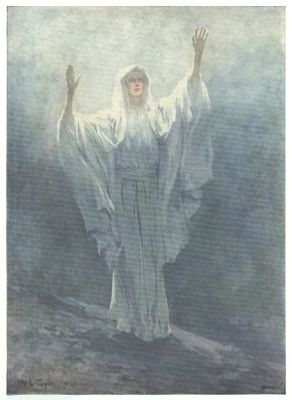
© Curtis Publishing Company
The Prophet Isaiah
Painted by W. L. Taylor
Uzziah, Joash’s grandson, was sixteen years old when he began to
rule over Judah and he ruled fifty-two years in Jerusalem.
He fought against the Philistines, and broke down the wall of
Gath and of Jabneh and of Ashdod and built cities near Ashdod
and among the Philistines. And God helped him against the Philistines.
The Ammonites also paid tribute to Uzziah, for he became
very strong.
And Uzziah built towers in Jerusalem at the Corner Gate and
at the Valley Gate and at the corner of the wall, and fortified them.
He also built towers in the wilderness and dug many cisterns, for
he had many herds in the lowland and farmers in the plain a[148]nd vine-dressers
in the mountains and in the fruitful fields, for he loved to
cultivate the ground. But he was a leper to the day of his death.
He lived in his own house, while Jotham, his son, was at the head
of the royal household, ruling the people of the land. And Uzziah
died; and they buried him with his fathers in the city of David,
and Jotham, his son, became ruler in his place.
Isaiah said it was in the year that Uzziah, the ruler of Judah,
died that I saw the Lord sitting on a high and lofty throne; and the
train of his robe filled the temple. Guardian angels stood above
him. Each had six wings, one pair to cover the face, another pair
to cover the feet, and another pair with which to fly. And they
cried to one another:
The whole earth is full of his glory.”
The foundations of the thresholds trembled at the voice of those
who called, and the temple was filled with smoke. Then I said:
“Woe is me! I am ruined; for I am a man with unclean lips, and
I live among a people with unclean lips; for my eyes have seen the
King, Jehovah of hosts!” But one of the guardian angels flew to
me with a hot coal in his hand that he had taken from off the altar,
and with it he touched my mouth and said: “See, this has touched
your lips; your guilt is taken away and your sin forgiven.”
Then I heard the voice of the Lord, saying:
And who will go for us?”
and I said, “Here am I, send me.”
JEREMIAH’S CALL TO DO A HARD TASK
This was the message which came to me from Jehovah: “Before
you were born I knew you and prepared you for your work. I
have appointed you to be a prophet to the nations.” But I
(Jeremiah) said: “O Lord Jehovah! I do not know how to speak
in public, for I am only a youth.” Then Jehovah said to me: “Do
not say, ‘I am only a youth,’ for you shall go to all to whom I send
you, and you shall speak whatever I command you. Do not be
afraid of them, for I am with you to protect you.”[149]
Then Jehovah stretched out his hand and touched my mouth
and said to me: “See. I have put my words in your mouth, and I
have appointed you this day over the nations and kingdoms, to tear
up and break down, to destroy and to overthrow, to build and to
plant.”
Again this message came from Jehovah, “What do you see?”
I answered, “A great kettle brewing hot, and it faces from the
north.” Then Jehovah said to me: “From the north trouble is
brewing for all the people of the land. For I am about to call all
the kingdoms of the north, and they shall come and each set up his
throne at the entrance to the gates of Jerusalem and around its walls
and against all the cities of Judah. And I will pass judgment upon
Jerusalem and these cities for all their wickedness, for they have
been disloyal to me and offered sacrifices to other gods and have
worshipped that which their own hands have made.
“Therefore make ready, rise, speak to them all that I command
you. Do not be afraid of them, for see, I myself will make you this
day like a fortified city, and like a bronze wall against the rulers
of Judah, its leaders, its priests, and the common people. Though
they fight against you, they will not overcome you, for I am with
you to protect you.”
Back to Top
THE YOUNG JOSIAH AND THE BOOK OF THE LAW
Josiah was eight years old when he began to rule, and he ruled
thirty-one years in Jerusalem. In the eighteenth year of his rule
he sent Shaphan, the scribe, to the temple of Jehovah with the command,
“Go up to Hilkiah, the chief priest, and see that, when he has
taken the money that is brought into the temple of Jehovah and
that which the doorkeepers have gathered from the people, they
give it to the workmen who have charge of the temple of Jehovah.
Then let them give it to the carpenters, the builders, and the masons
who are in the temple of Jehovah, to repair the breaks in it and to
buy timber and cut stone to restore it.” But no account was asked
of them for the money that was given to them, for they dealt honestly.
Then Hilkiah, the chief priest, said to Shaphan, the scribe, “I have
found the book of the law in the temple of Jehovah.” And Hilkiah[150] gave the book to Shaphan, and he read it. Then Shaphan went to
Josiah and told him, “Your servants have taken the money that
was found in the temple and have turned it over to the workmen
who have charge of the temple of Jehovah.” Shaphan, the scribe,
also said to Josiah, “Hilkiah, the priest, has given me a book.” And
Shaphan read it to him.
When Josiah had heard the words of the book of the law, he tore
his clothes. Then he gave this command to Hilkiah, the priest, to
Ahikam, the son of Shaphan, to Achbor, the son of Micaiah, to
Shaphan, the scribe, and to Asaiah, his servant, “Go, ask of Jehovah
for me and for the people and for all Judah about the words of this
book that has been found; for Jehovah must be very angry with
us, because our fathers have not listened to the words of this book
nor done all that we are there commanded to do.”
So Hilkiah, the priest, and Ahikam and Achbor went to Huldah,
the prophetess, who lived in Jerusalem and talked with her. She
said to them, “This is the message of Jehovah, the God of Israel:
‘Tell the man who sent you to me, Jehovah says, I am now about
to bring evil upon this place and upon its people even all that is written
in the book which the ruler of Judah has read. But you shall
say to him who sent you to ask of Jehovah, Jehovah the God of
Israel declares, Because you listened and humbled yourself before
Jehovah and have wept before me, I also have heard you,'” So
they brought back word to Josiah.
Then at his command they got together all the leaders of Judah
and of Jerusalem. And Josiah went up to the temple of Jehovah,
and with him all the men of Judah and all the people of Jerusalem,
as well as the priests and the prophets and all the people, including
the children. And he read to them all the words of the book of the
covenant which was found in the temple of Jehovah. And Josiah
stood by the pillar and made a solemn promise before Jehovah to
obey all the commands and carry out the rules written in this book.
And all the people also agreed to do so.
Then Josiah commanded Hilkiah, the chief priest, and the second
priest and the doorkeepers to bring out from the temple of Jehovah
all the things that were made for Baal and for the Canaanite goddess
of fortune, and for the Babylonian star gods. And he burned
them outside Jerusalem in the lime-kilns by the Kidron, and carried
their ashes to Bethel. He also put away the idolatrous priests, whom
the rulers of Judah had appointed to offer sacrifice at the temples
on the heights in the towns of Judah and in the places about Jerusa[151]lem;
those also who offered sacrifices to Baal, to the sun, the moon,
and the planets and all the starry host.
He also destroyed Topheth, which is in the valley of Ben-Hinnom,
so that no man could ever make his son or his daughter pass
through the fire to Molech. He removed the horses at the entrance
of the temple of Jehovah, which the rulers of Judah had given to
the sun, and burned the chariots of the sun. Josiah broke down
and crushed in pieces the altars that were on the roof, which the
rulers of Judah had made.
Josiah also tore down the altar and the old temple at Bethel,
broke its stones in pieces, and beat it to dust.
Then he gave this command to all the people: “Keep the passover
to Jehovah your God, as is commanded in this book of the covenant.”
Such a passover as this had not been kept from the days of
the judges who ruled Israel and during the period of the rulers of
Israel and of Judah; but this passover was kept in Jehovah’s honor
in Jerusalem for the first time in the eighteenth year of Josiah’s rule.
Josiah put away all the mediums, the wizards, the idols and all
the evil things that were discovered in the land of Judah and in Jerusalem,
that he might carry out the words of the law which were written
in the book that Hilkiah, the priest, found in the temple of Jehovah.
Josiah was the first ruler who turned to Jehovah with all
his heart, with all his soul, and with all his strength in exact accord
with the law of Moses, nor were any of the rulers that followed like
him.
Back to Top
THE WRITING OF AN ANCIENT BOOK
When Jehoiakim, the son of Josiah, had been ruler for four years,
this message came to Jeremiah from Jehovah, “Take a parchment
roll and write on it all the words that I have spoken to you about
Jerusalem and Judah and all the nations from the time of Josiah
to the present. Perhaps the people of Judah will pay attention to
all the evil which I intend to bring upon them, so that they will turn
each from his evil way, that I may forgive their guilt and sin.”
Then Jeremiah called Baruch, the son of Neriah; and Baruch
wrote on a parchment roll as Jeremiah told him all the words which
Jehovah had spoken to him. And Jeremiah commanded Baruch,
saying, “I am not permitted to go to the temple of Jehovah. Therefore
you go and read in the temple on the fast day the words of Jehovah[152] from the roll which you have written at my command. You
shall read them to all the people of Judah who have come from their
towns. Perhaps they will pray to Jehovah and each turn from his
evil way; for great is the anger and wrath of Jehovah against this
people.” So Baruch did as Jeremiah, the prophet, commanded him,
reading in the temple from the writing the words of Jehovah.
The next year, when all the people who had come to Jerusalem
from the cities of Judah were observing a fast in the temple courts,
Baruch read to them all from the writing the words of Jeremiah.
When Micaiah, the grandson of Shaphan, had heard all the words
of Jehovah, he went down to the palace, where all the court officials
were sitting, and told them all that he had heard when Baruch read
the book to the people.
Then all the nobles sent Jehudi, the son of Nethaniah, to Baruch
to say: “Take the roll from which you have read to all the people
and come here.” So Baruch took the roll in his hand and went to
them. And they said to him, “Sit down now and read it to us.”
So Baruch read it to them. But when they had heard all, they turned
in fear to one another and said to Baruch, “We must surely tell Jehoiakim
all this.” So they asked Baruch, “Tell us now: how did
you write all this?” Baruch answered, “Jeremiah told it all to me
and I wrote it down in ink.” Then the nobles said to Baruch, “Go,
hide both yourself and Jeremiah, and let no one know where you
are.”
But after they had put the roll in the room of Elishama, the
chancellor, they went to Jehoiakim’s room, and told all these things
to him. Then he sent Jehudi to bring the roll, and he brought it out
of the room of Elishama, the chancellor. And Jehudi read it to him
and to all the leaders who were with him.
Now Jehoiakim was sitting in the winter house with a brazier
burning before him. When Jehudi had read three or four double
columns, Jehoiakim cut it with a paper-knife and threw it into the
fire that was on the brazier, and the entire roll was burned up. But
neither he nor any of his servants who were present, were disturbed
or tore their garments. Elnathan and Delaiah and Gemariah begged
Jehoiakim not to burn the roll, but he would not listen to them. He
also ordered Jerahmeel, his son, and Seraiah, the son of Azriel, and
Shelemiah, the son of Abdeel, to seize Baruch, the scribe, and
Jeremiah, the prophet, but Jehovah kept them hidden.
Then Jeremiah took another roll and gave it to Baruch, the
scribe, who wrote on it as Jeremiah spoke to him, all the words of
the book which Jehoiakim, the ruler of Judah, had burned in the fire;
and many other similar words were added.
Back to Top
A PROPHET WHO SAVED A GREAT CITY
Once the king of Assyria sent a high official with a great army
to Jerusalem. When they arrived at Jerusalem, they called for Hezekiah
the ruler of Judah, Eliakim, the son of Hilkiah, Shebnah, the
scribe, and Joah, the son of Asaph, and they came out to them. And
the high official said to them, “Why are you so confident? To whom
do you look for help that you have rebelled against me? You count
on Egypt to help you. Pharaoh, king of Egypt, is as weak as a broken
reed. But if you say, ‘We trust in Jehovah our God,’ is not he
the one whose high places and altars Hezekiah has destroyed? Now
therefore make a bargain with my master, the king of Assyria, and
I will give you two thousand horses, if you are able on your part
to set riders upon them. How then can you conquer one of the least
of my master’s servants? Have I now come up against this place
to destroy it without Jehovah’s approval? Jehovah it was who
said to me, ‘Go up against this land and destroy it.'”
Then Eliakim and Shebnah and Joah said to the high official,
“Speak, I pray you, to your servants in the Aramaic language, for
we understand it; but do not speak with us in the Jewish language
in the hearing of the people who are on the wall.” But the high official
said to them, “Has my master sent me to your master and
to you to speak these words? Is it not rather to the men who sit
on the wall, who will suffer most from the siege?”
Then the high official stood and cried with a loud voice, in the
Jewish language, saying, “Hear the message of the great king, the
king of Assyria. ‘Thus saith the king, Let not Hezekiah deceive
you; for he will not be able to save you from my hand. Neither
let Hezekiah make you trust in Jehovah by saying, Jehovah will
surely save us, and this city shall not be given into the power of the
king of Assyria.'”
“Do not listen to Hezekiah, for thus says the king of Assyria,
‘Make your peace with me and come over to me; then each one of
you shall eat from his own vine and his own fig-tree and drink the
waters of his own cistern, until I come and take you away to a[154] land
like your own land, a land full of grain and new wine, a land full of
bread and vineyards, a land full of olive-trees and honey, that you
may live and not die. But do not listen to Hezekiah, when he deceives
you by saying, Jehovah will save us. Has any of the gods
of the nations ever saved his land from the power of the king of
Assyria? Have the gods of the land of Samaria saved Samaria from
my power? Who are they among all the gods of the countries, that
have saved their country from my power, that Jehovah should save
Jerusalem from my power?'”
Then the people were silent and made no answer; for the ruler’s
command was, “Do not answer him.” But Eliakim, the steward of
the palace, and Shebnah, the scribe, and Joah, the son of Asaph, came
to Hezekiah with torn clothes and told him the words of the high
official. And as soon as Hezekiah heard it, he tore his clothes and
covered himself with sackcloth and went into the temple of Jehovah.
And he sent Eliakim, who was in charge of the palace, and Shebnah,
the scribe and the oldest of the priests, covered with sackcloth, to
Isaiah, the prophet. And they said to him, Hezekiah says, “This
is a day of trouble, of discipline and of shame. It may be Jehovah
your God will hear all the words of the high official, whom his master,
the king of Assyria, has sent to defy the living God, and will punish
him for them; therefore lift up your prayer for the people.”
When the servants of Hezekiah came to Isaiah, Isaiah said to
them, “Take back this answer to your master: Jehovah says, ‘Do
not be afraid of the words that you have heard, with which the servants
of the king of Assyria have insulted me. I will put a spirit
in him, so that he will hear bad news and return to his own land;
and I will cause him to fall by the sword in his own land.'”
So the high official returned and found the king of Assyria making
war against Libnah, for he had heard that he had gone from
Lachish. But the king of Assyria had heard that Tirkakah, king of
Ethiopia, had come out to fight against him. Now that very night
the angel of Jehovah went out and struck down in the camp of the
Assyrians a hundred and eighty-five thousand. And when men
arose early the next morning, these were all dead.
Then Sennacherib, king of Assyria, went away and returned to
Nineveh. While he was worshipping in the temple of Nisroch his
god, his sons struck him down with the sword; and they escaped
into the land of Ararat. And Esarhaddon, his son, became king in
his place.[155]
Back to Top
JEREMIAH’S COURAGE IN DANGER
The command came to Jeremiah from Jehovah, “Stand in the
door of the temple and speak this message: ‘Hear the word of Jehovah,
all you people of Judah who enter these gates to worship
him. Jehovah, the God of Israel, says: Change your ways and your
deeds and I will let you live in this place. Trust not in misleading
words, thinking, this is the temple of Jehovah. For if you really
change your ways and your deeds, if you faithfully see that justice
is done between a man and his neighbor, if you do no wrong to the
foreigners who live among you, to the fatherless nor to the widow,
and do not shed the blood of the innocent in this place nor follow
other gods to your hurt, then I will let you stay in this place, in the
land that I gave to your fathers, forever and ever.
“‘But now you are trusting in misleading words that are useless.
Will you steal, murder, tell lies and offer sacrifice to Baal, and follow
other gods whom you have not known, and then come and stand
before me in this house which bears my name and say, We are free
to do all these shameful deeds? Is this my house, which bears my
name, in your eyes a den of robbers? I myself have seen these shameful
deeds,’ says Jehovah.
“‘Then go to my temple which was at Shiloh, where people used
to worship me at first, and see what I did to it because of the
wickedness of my people Israel. Now because you have done all
these deeds, and have paid no attention, although I spoke to you
earnestly and often; and have not answered, although I called you,
I will destroy the temple which bears my name, in which you trust,
and the place which I gave to you and to your fathers, as I did at
Shiloh. I will also send you from my sight, as I have sent away your
relatives, even all the Northern Israelites.'”
When Jeremiah had finished speaking all that Jehovah had commanded
him to say, the priests and prophets seized him and said,
“You must die. Why have you said in the name of Jehovah that
this temple shall be like Shiloh and this city shall be deserted, with
no one living in it?” And all the people were gathered about Jeremiah
in the temple of Jehovah.
But when the public officials of Judah heard of these things, they
came up from the palace t[156]o the temple of Jehovah and held court
at the entrance, at the new gate of the temple. Then the priests
and the prophets said to the officials and to the people, “This man
should be put to death, for he has prophesied against this city as
you have heard with your own ears.” But Jeremiah answered the
officials and all the people, “It was Jehovah who sent me to prophesy
against this temple and city all that you have heard. Now therefore
change your ways and your deeds and listen to Jehovah your
God; and he will not do the evil things that he has threatened to
do to you. But as for me, see, I am in your power; do to me as you
think right and proper. Only remember that, if you put me to death,
you will bring upon yourselves and upon this city and upon its inhabitants
guilt for shedding innocent blood, for Jehovah has indeed
sent me to you to tell you all these things.”
Then the officials and all the people said to the priests and to
the prophets, “This man does not deserve to die, for he has spoken
to us in the name of Jehovah our God.” Certain of the elders of
the land rose and said to the assembly of the people, “Micah prophesied
in the days when Hezekiah ruled over Judah, and said to the
people of Judah, ‘Jehovah of hosts says:
Jerusalem shall become a ruin,
The temple-mount an overgrown hill.”‘
“Did Hezekiah and the people of Judah put him to death? Did
they not rather fear Jehovah and ask him to forgive them, so that
he did not do the evil things that he had threatened to do to them?
But we are in danger of doing great harm to ourselves?”
Back to Top
THE SAD FATE OF A GUILTY NATION
Jerusalem was taken in the eleventh year of the rule of Zedekiah,
on the ninth day of the fourth month. An opening was made
through the walls, and all the princes of the king of Babylon came
and sat in the middle gate. When Zedekiah, the ruler of Judah, and
all the warriors saw them, they fled and left the city by night by the
way of the royal garden, through the gate between the two walls,
and went out toward the Arabah. But the army of the Chaldeans
followed them and captured Zedekiah on the plains of Jericho. Then
they brought him up to Nebuchadrezzar, king of Babylon, who was
then at Riblah in the land of Hamath. And the king of Babylon[157] killed the sons of Zedekiah before his eyes. And the king of Babylon
put to death all the nobles of Judah. Moreover, he put out Zedekiah’s
eyes and bound him in chains to carry him to Babylon.
In the nineteenth year of the reign of Nebuchadrezzar, king of
Babylon, Nebuzaradan, the commander of the body-guard, an officer
of the king of Babylon, came to Jerusalem. He burned the temple
of Jehovah and the royal palace and all the houses in Jerusalem.
All the soldiers of the Chaldeans, who were with the commander of
the body-guard, broke down the walls around Jerusalem. The rest
of the people who were left in the city and the deserters who had
gone over to the king of Babylon, Nebuzaradan carried away captive.
But he left some of the poorest of the people to take care of the vineyards
and farms.
The pillars of brass that were in the temple of Jehovah, and the
stands and the bronze sea that were in the temple of Jehovah the
Chaldeans broke in pieces and carried the brass from them to Babylon.
Also the pots, the shovels, the snuffers, the bowls, and all the
vessels of brass, with which sacrifices were offered in the temple,
they took away. The fire-pans and the basins of silver and of gold,
the commander of the body-guard also melted and took away.
The commander of the body-guard carried away Seraiah, the
chief priest and Zephaniah, the second priest, and the three doorkeepers
and brought them to the king of Babylon at Riblah. And
the king of Babylon put them to death at Riblah in the land of Hamath.
So the people of Judah were carried away captive from their
own homeland.
Nebuchadrezzar made Gedaliah, the grandson of Shaphan, governor
over the people he had left in the land of Judah.
Now Nebuchadrezzar, king of Babylon, had given this command
about Jeremiah to Nebuzaradan, the commander of the body-guard,
“Take good care of him, and do him no harm; but do to him as he
shall tell you.” So Nebuzaradan, the commander of the body-guard,
said to him, “See, I release you this day from the chains which are
upon your hand. If it seems best to you to come with me to Babylon,
come, and I will look out for you. But if you do not wish to
come with me to Babylon, do not come; go back to Gedaliah, whom
the king of Babylon has made governor over the cities of Judah,
and live with him among the people, or go wherever it seems right
for you to go.” So the commander of the body-guard gave Jeremiah
food and a present, and sent him away. Then Jeremiah went to[158] Gedaliah, who was at Mizpah, and lived with him among the people
who were left in the land.
Back to Top
THE COURAGE OF FOUR CAPTIVES
Nebuchadrezzar, the king of Babylon, commanded Ashpenaz,
the chief of his servants, to bring to him certain of the Israelites and
some of their princes and nobles. They were to be young men who
were strong and handsome, well taught and quick to learn and able
to serve in the king’s palace. And they were to be taught the learning
and the language of the Chaldeans. The king gave to them each
day some of his rich food and some of the wine which he drank. He
also commanded that they should be taught for three years, and that
at the end of that time they should enter the royal service.
Among these young men were: Daniel, Hananiah, Mishael, and
Azariah; but the chief of the king’s servants gave other names to
them. To Daniel he gave the name Belteshazzar, and to Hananiah,
Shadrach, and to Mishael, Meshach, and to Azariah, Abednego.
But Daniel made up his mind not to injure himself with the rich
food of the king nor with the wine which he drank. So he asked
the chief of the king’s servants not to make him injure himself. And
God helped Daniel to win the kindness and favor of the chief of the
king’s servants.
But the chief of the king’s servants said to Daniel, “I fear that
my lord, the king, who has given you your food and your drink will
see that your faces are sadder than those of young men who are your
own age, and so you will endanger my head with the king.”
Daniel said to the guardian whom the chief of the king’s servants
had put over Daniel, Hananiah, Mishael, and Azariah, “Try your
servants ten days; and let us have vegetables to eat and water to
drink. Then compare the way we look with that of the young men
who eat of the king’s rich food. Then do to us as seems best.” So
he did as they asked and tried them ten days. At the end of ten
days they looked better and they were fatter than all the young men
who ate of the king’s rich food. So the guardian took away their
rich food and the wine and gave them vegetables.
To these four young men God gave knowledge, learning, and
wisdom; and Daniel understood all kinds of visio[159]ns and dreams.
At the end of the days which the king had fixed for bringing them
in, the chief of his servants brought them in to Nebuchadrezzar,
and the king talked with them. But not one of all the young men
was found equal to Daniel, Hananiah, Mishael, and Azariah. So
they began to serve the king. On every subject which called for
wisdom and understanding and about which the king questioned
them, he found them ten times better than all the wise men and
magicians who were in his entire kingdom.
Back to Top
A KING’S STRANGE DREAM
Nebuchadrezzar in the second year of his reign had dreams, and
his mind was so troubled that he could not sleep. Then the king
sent for the magicians and the wise men, and those who studied the
stars to tell him what his dreams meant. So they came in before
the king, and he said to them, “I have had a dream and my mind
is troubled, for I want to know what the dream means.”
Then those who studied the stars said to the king: “O king, live
forever! Tell the dream to your servants and we will tell you what
it means.” The king answered, “What I now say is certain: if you
do not tell me the dream and what it means, you shall be torn limb
from limb and your houses shall be made ash-heaps. But if you tell
the dream and what it means, you shall receive from me gifts and
rewards and great honors; therefore tell me the dream and what it
means.” They answered the second time, “Let the king tell the
dream to his servants, and we will tell what it means.” The king
replied, “I see clearly that you wish to gain time, for you know that
what I have said is certain, and that if you do not tell the dream
to me, you will all suffer the same punishment. So you have planned
to speak lying and false words before me, until the time when it is
to happen has passed. Therefore tell me the dream, and I shall know
that you can tell me what it means.” The Chaldeans answered the
king, “There is no man on earth who can do what the king asks,
for no king, however great and powerful, has ever asked such a thing
of any wise man or magician, or of one who studies the stars. What
the king asks is too hard. There is no one else who can tell it to the
king, except the gods, who do not live with men.” This made the
king very angry and he ordered all the wise men of Babylon put to
death.
So the command was given that the wise men were to be put
to death. And search was made for Daniel and his friends that they
too might be put to death. Then Daniel spoke wisely, to Arioch,
the captain of the king’s guard, who had gone out to put the wise
men of Babylon to death, and said, “Why is the king’s command
so harsh?” When Arioch told Daniel the facts, he went to the
king and asked that he give him time to tell what the dream meant.
Then Daniel went to his house and told the facts to his friends,
Hananiah, Mishael, and Azariah, that they might ask the God of
heaven to be kind to them and to tell Daniel this secret, so that they
might not die with the rest of the wise men of Babylon. Then the
secret was told to Daniel in a vision at night, and he praised the God
of heaven and said:
From everlasting to everlasting!
For wisdom and power are his.
He gives wisdom to the wise,
And knowledge to those who have insight.
He shows the deep, secret things;
He knows what is in the darkness,
And the light of truth dwells in him.
I give thee thanks and praise,
For thou givest me wisdom and strength,
And hast made known the things we asked;
Thou hast made known to us the king’s secret!”
Then Daniel went to Arioch, whom the king had commanded
to kill the wise men of Babylon, and said to him, “Do not kill the
wise men of Babylon. Take me to the king, and I will tell him what
his dream means.”
Then Arioch quickly brought Daniel to the king and said to him,
“I have found a man among the captives from Judah who will tell
you what this dream means.” The king said to Daniel (whose name
was Belteshazzar), “Can you make known to me the dream which
I have had and what it means?” Daniel answered, “The secret
which the king asks is something that neither wise men, magicians,
nor those who study the stars can make known to him; but there
is a God in heaven who tells secrets, and he has made known to King
Nebuchadrezzar what shall come in the future. Your dream and
the visions which you had as you lay asleep are these: You, O king,
had a vision and saw a great image. That image was large and it
was exceedingly bright as it stood before you, and its appea[161]rance
was terrible. The head of the image was of fine gold, its breast and
its arms of silver, its body and its thighs of brass, its legs of iron,
its feet part of iron and part of clay. You looked at it until a stone
was cut out, not by the hands of men, which struck the image on
its feet of iron and clay and broke them in pieces. Then the iron,
the clay, the brass, the silver, and the gold were all broken in pieces
and became like the chaff which blows from the summer threshing-floors,
and the wind carried them away so that nothing was left of
them. But the stone that struck the image became a great mountain
and filled the earth.
“This is the dream, and we will tell the king what it means: O
king, you are the king of kings to whom God has given the rule, the
power, the strength, and the glory. Over the whole world he has
given into your power, men, the wild beasts and the birds, and has
made you rule over them all. You are the head of gold.
“After you shall rise another kingdom not so strong as you are,
and a third kingdom of brass, which shall rule over the whole earth.
A fourth kingdom shall be strong as iron, for iron breaks in pieces
and shatters all things, and like iron which crushes, it shall break
in pieces and crush all things. As you saw the feet and toes, part
clay and part iron, it shall be a divided kingdom; but there shall
be in it some of the strength of the iron, for you saw the iron mixed
with clay. As the toes of the feet were part iron and part clay, so
the kingdom shall be partly strong and partly broken. You saw the
iron mixed with clay, for the rulers will marry one another, but they
will not stick together, even as iron does not stick to clay.
“During the reigns of these kings the God of heaven will set up
a kingdom which shall never be destroyed, nor shall the power be
left to another people; but it shall break in pieces and destroy all
these kingdoms, and it shall stand forever. This is shown by the
fact that you saw a stone cut out of the mountain, but not with the
hands of men. And it broke in pieces the iron, the brass, the clay,
the silver, and the gold.
“The great God has made known to the king what is to come,
and the dream is real and this meaning true.”
Then King Nebuchadrezzar fell upon his face and worshipped
Daniel, and ordered that a sacrifice and sweet odors should be offered
to him. The king also said to Daniel, “Your God is the God
of gods and the Lord of kings, and one who tells his secrets to his
servant, for you have been able to tell this great secret.” Then [162]the
king gave Daniel a high position and many costly gifts, and made
him ruler over all of Babylon and chief over all the wise men in Babylon.
And at Daniel’s request the king placed Shadrach, Meshach,
and Abednego in charge of the province of Babylon; but Daniel
stayed in the king’s court.
Back to Top
THE TEST BY FIRE
Nebuchadrezzar, the king, made an image of gold ninety feet high
and nine feet wide. He set it up in the plain of Dura, in the province
of Babylon. Then he sent for the officers, the governors, the judges,
the treasurers, and all the rulers of the provinces. So they all came
together and stood before the image that Nebuchadrezzar had set up.
Then the herald cried aloud, “To you it is commanded, O peoples,
nations: ‘The moment you hear the sound of the trumpet, flute,
lute, harp, bagpipe, and all kinds of musical instruments, you shall
fall down and worship the golden image. Whoever does not fall
down and worship shall be thrown into a burning, fiery furnace.'”
So when all the people heard the sound of the trumpet, flute, lute,
harp, bagpipe, and all kinds of musical instruments, all the peoples,
nations, and races fell down and worshipped the golden image that
King Nebuchadrezzar had set up.
But at that time certain Chaldeans came near to the king and
made this charge against the Jews: “O king, live forever! O king,
you have commanded that every man who hears the sound of the
trumpet, flute, lute, harp, bagpipe, and all kinds of musical instruments
shall fall down and worship the golden image, and that whoever
does not fall down and worship shall be thrown into a burning,
fiery furnace. There are certain Jews, Shadrach, Meshach, and Abednego,
whom you have placed in charge of the province of Babylon.
These men, O king, have not obeyed your command; they do not
serve your gods nor worship the golden image which you have set
up.”
Then Nebuchadrezzar in his rage and fury gave command to
bring in Shadrach, Meshach, and Abednego. When they were
brought before the king, Nebuchadrezzar said to them, “Is it true,
O Shadrach, Meshach, and Abednego, that you do not serve my
god nor worship the golden image which I have set up? If you are
now ready, as soon as you hear the sound of the trumpet, flute, lute,
harp, bagpipe, and all kinds of musical instruments, to fal[163]l down
and worship the image which I have made, well; but if you do not
worship, you shall at once be thrown into a burning, fiery furnace.
Where is there a god who can deliver you out of my hands?”
Shadrach, Meshach, and Abednego replied, “O king, there is no need
of our answering you about this. Our God whom we serve is able
to save us from the burning, fiery furnace; he will save us out of
your hand, O king. But if not, know, O king, that we will not serve
your gods nor worship the golden image which you have set up.”
Then Nebuchadrezzar was very angry and the appearance of
his face changed, as he looked at Shadrach, Meshach, and Abednego.
He ordered that the furnace should be heated seven times hotter
than usual. He also commanded certain strong men who were in
his army to bind Shadrach, Meshach, and Abednego, and throw
them into the burning, fiery furnace. Then these men were bound
in their cloaks, their tunics, their robes, and their other garments,
and were thrown into the burning, fiery furnace. As the king’s command
was urgent and the furnace very hot, the flames destroyed
the men who took up Shadrach, Meshach, and Abednego. But Shadrach,
Meshach, and Abednego, fell down, bound, into the midst of
the burning, fiery furnace.
Nebuchadrezzar, the king, was so astonished that he rose up
hastily and said to his counsellors, “Did we not throw three men,
bound, into the fire?” They answered, “True, O king.” He said,
“Now I see four men, unbound, walking in the midst of the fire,
and they are unhurt, and the fourth looks like an angel.”
Then Nebuchadrezzar went near the door of the burning, fiery
furnace and said, “Shadrach, Meshach, and Abednego, servants of
the Most High God, come out.” Then Shadrach, Meshach, and
Abednego came out of the fire. And the officers, governors, and
counsellors who were there saw that the fire had no power over the
bodies of these men, and that the hair of their heads was not singed
and that their cloaks were not harmed, and that there was no smell
of fire. And Nebuchadrezzar said, “Blessed be the God of Shadrach,
Meshach, and Abednego, who has sent his angel to save his
servants who trusted in him and refused to obey the king’s command
and have offered their bodies, that they might not serve nor worship
any god except their own. Therefore I command that every
people, nation, and race that shall say anything against the God of
Shadrach, Meshach, and Abednego shall be cut in pieces and their
house shall be made an ash-heap, for there is no other g[164]od who is
so able to save as is this one.” Then the king gave high positions,
in the province of Babylon, to Shadrach, Meshach, and Abednego.
Back to Top
THE HANDWRITING ON THE WALL
Belshazzar, the king, made a great feast for a thousand of his
nobles and drank wine before them all. Under the influence of wine,
he gave command to bring the gold and silver utensils which his
father, Nebuchadrezzar, had taken from the temple at Jerusalem,
that the king, his nobles, his wives, and the others of his household
might drink from them. So they brought the golden vessels which
were taken from the temple of God which was at Jerusalem. And
the king, his nobles, his wives, and the others of his household drank
from them. They drank wine and praised the gods of gold, of silver,
of brass, of iron, of wood, and of stone.
At that moment the fingers of a man’s hand appeared and wrote
opposite the candlestick upon the plaster of the wall of the king’s
palace; and the king saw the palm of the hand that wrote.
Then the king grew pale, and his thoughts troubled him, his legs
trembled and his knees knocked together. The king called for the
magicians and those who study the stars and said to the wise men
of Babylon, “Whoever shall read this writing and tell what it means
shall be clothed in purple and have a chain of gold about his neck
and shall be the third ruler in the kingdom.” Then all the king’s
wise men came in, but they could not read the writing nor tell the
king what it meant. So King Belshazzar was greatly troubled, and
his face grew pale, and his nobles were thrown into confusion.
Now the queen, because of what the king and his nobles had
said, came into the banquet-house and said, “O king, live forever;
let not your thoughts trouble you nor let yourself grow pale. There
is a man in your kingdom in whom is the spirit of the holy gods, and
in the days of your father he was found to have light and understanding
and wisdom, like the wisdom of the gods. Now let Daniel
be called, and he will tell what it means.”
So Daniel was brought in before the king, and the king said to
him, “Are you that Daniel, one of the men who were carried away
captive, whom the king, my father, brought from Judah? I have
heard that the spirit of the gods is in you, and that you have understanding
and great wisdom. The wise men and the magicians have[165] been brought in before me to read this writing and to tell what it
means; but they are not able. I have heard that you can tell what
dreams mean and answer hard questions. Now if you can read the
writing and tell what it means, you shall be clothed with purple and
have a chain of gold about your neck and shall be the third ruler
in the kingdom.”
Then Daniel answered the king, “Keep your gifts and give your
rewards to another. Without them I will read the writing to the
king, and tell what it means. O king, the Most High God gave
Nebuchadrezzar, your father, the kingdom and power, glory and majesty.
Because of the power that he gave him, all peoples, nations,
and races trembled and feared him. He killed or kept alive as
he wished; and he raised up or put down whom he pleased. But
when he became proud and haughty, he was made to come down
from his kingly throne and his glory was taken from him, and he
was driven away from men, and his mind became like that of the
beasts, and he lived with the wild asses; he was fed with grass like
oxen, and his body was wet with the dew of heaven, until he learned
that the Most High God rules over the kingdom of men and that
he sets up over it whom he will.
“But you, his son, O Belshazzar, have not been humble, though
you knew all this, but you have raised yourself against the Lord of
heaven, and have had the utensils of his temple brought before you,
and you, your nobles, your wives, and the others of your household
have drunk wine from them. You have given praise to the gods of
silver, of gold, of brass, of iron, of wood, and of stone, which cannot
see nor hear nor know; and you have not praised the God in whose
control are your very breath and all that you do.”
“Then the hand was sent out before him and traced this writing:
“This is what it means: Mene: God has numbered your kingdom
and brought it to an end. Tekel: you are weighed in the scales
and found wanting. Peres: your kingdom is divided and given to
the Medes and Persians.”
Then at Belshazzar’s command Daniel was clothed with purple
and a chain of gold was put about his neck, and he was proclaimed
the third ruler in the kingdom. But on that very night Belshazzar,
the Chaldean king, was killed, and Darius, the Mede, received the
kingdom.[166]
Back to Top
DANIEL IN THE LIONS’ DEN
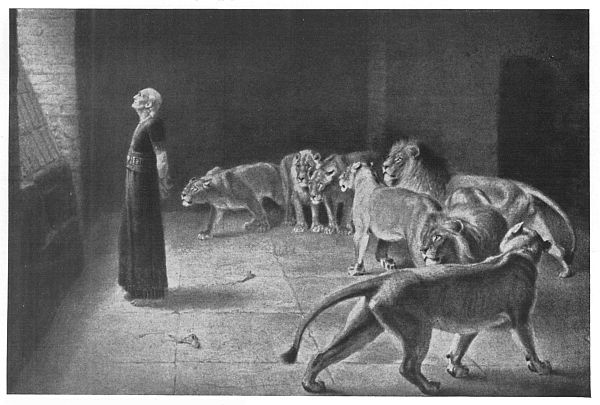
Reproduced by permission of Thomas Agnew & Sons, owners of the copyright
Daniel’s Answer to the King
Painted by Briton Riviere
It pleased Darius to set over the kingdom a hundred and twenty
officers who ruled the whole kingdom, and over them three chief
officials, of whom Daniel was one, that these officers might report
to them and that the king should lose nothing. Daniel was better
than the other chief officials and the officers, for he had a fine spirit;
and the king intended to set him over the whole empire.
Then the chief officials and the officers tried to find a way to accuse
Daniel of not having done his duty, but they could not find
anything against him, for he was faithful and was not guilty of any
mistake or wrong-doing.
Then these men said, “We shall not find any way to accuse this
Daniel unless we find it in connection with the law of his God.”
So these chief officials and officers all went to the king, and said to
him, “King Darius, live forever. All the chief officials of the kingdom,
the counsellors and the officers, the judges and the governors,
have consulted together to have the king make a law and give
a strong command that whoever shall ask a petition of any god or
man for thirty days, except of you, O king, shall be thrown into a
den of lions. Now, O king, give the command and sign the law that,
like the law of the Medes and Persians, it may not be changed.”
So King Darius signed the law and the command.
When Daniel knew that the law was signed, he went into his
house. His windows were open in his room toward Jerusalem, and
he knelt upon his knees three times a day and prayed, and gave
thanks to his God as he had done before. Then these men rushed
in and found Daniel praying and calling upon his God. So they
went before the king and spoke to him about the royal command:
“Have you not signed a command, that every man who shall ask
a petition of any man or god within thirty days, except of you, O
king, shall be thrown into the den of lions?” The king answered,
“The rule is fixed according to the law of the Medes and Persians,
which cannot be changed.” Then they went on to say to the king,
“That Daniel, who is one of the captives from Judah, pays no attention
to you, O king, nor to the command that you have signed,
but prays three times a day.”
When the king heard these words, he was greatly displeased,
and set his heart on savin[167]g Daniel, and he worked until the sun set
to save him. Then these men all went to the king and said to him,
“Know, O king, that it is a law of the Medes and Persians, that no
command nor law which the king gives may be changed.”
So the king gave his command, and they brought Daniel and
threw him into the den of lions. But the king said to Daniel, “Your
God, whom you always serve, will save you.” Then a stone was
brought and laid at the entrance to the den; and the king sealed it
with his own seal-ring and with those of his nobles, that no change
might be made so as to rescue Daniel. Then the king went to his
palace and passed the night fasting.
At dawn, as soon as it was light, the king rose and hurried to
the den of lions. When he came near to the den where Daniel was,
he cried with a very sad voice, “O Daniel, servant of the living God,
has your God, whom you always serve, been able to save you from
the lions?” Daniel said to the king, “O king, live forever. My God
has sent his angel and has closed the lions’ mouths, and they have
not hurt me, for I was innocent before him; and also before you,
O king, I have done no wrong.” Then the king was very glad and
commanded that they should take Daniel up out of the den. So
Daniel was taken up out of the den, and it was found that he was
not injured, for he had trusted in his God.
Then the king commanded that those men who had accused
Daniel should be brought and thrown into the den of lions.
And King Darius wrote to all the peoples, nations, and races in
all his kingdom, “May your peace be great! I make a law that
throughout all my kingdom, men tremble and fear before the God
of Daniel; for he is the living God, and is the same forever, and his
kingdom is one that shall not be destroyed; and his rule shall be
without end. He saves and rescues, and does wonderful things in
heaven and earth; it is he who has saved Daniel from the power of
the lions.” So Daniel was successful and happy during the reign
of Darius.
Back to Top
QUEEN ESTHER’S LOVE FOR HER PEOPLE
After Xerxes had been king of Persia for three years, he gave
a feast for all his officials, officers, and servants. The commanders
of the armies of Persia and Media, the nobles and governors were
before him; while for one hundred and eighty days he showed them
the wonderful riches of his kingdom and the costliness of his magnificent
regalia.[168]
When these days were ended, the king made a seven days’ feast
in the enclosed garden of the royal palace, for all classes of people
who were in the royal palace at Susa. Vashti, the queen, also gave
a feast for the women in the royal palace which belonged to King
Xerxes.
On the seventh day, when King Xerxes had been drinking wine,
he commanded his seven court attendants to bring Vashti, the queen,
before him with the royal crown on her head, to show the peoples
and the officials her beauty, for she was very fair. But Queen Vashti
refused to come as the king commanded. Therefore the king was
very angry.
In his anger the king said to the wise men, “According to law
what shall we do to Queen Vashti?” Memucan, one of the seven
high officials, said before the king and his officers, “Vashti, the queen,
has done wrong not only to the king but also to all the officials and
to all the peoples in all of the king’s provinces. For the refusal of
the queen will be reported to all the women so that they will disobey
their husbands, for they will say, ‘King Xerxes commanded Vashti,
the queen, to be brought in before him, but she did not come!’ And
this very day the ladies of Persia and Media who have heard of the
refusal of the queen will tell it to all the king’s officials, and there
will be contempt and strife! If it seems best to the king, let him send
out a royal command, and let it be written among the laws of Persia
and Media, in order that it may not be changed, that Vashti may
never again come before King Xerxes; and let the king give her
place as queen to another who is better than she. And when the
king’s command shall be heard throughout his kingdom—great as
it is—the wives of all classes will give honor to their husbands!”
The plan pleased the king and the officials, and the king did as
Memucan advised. Then the king’s pages who waited upon him
said, “Let beautiful young girls be sought for the king, and let the
king appoint officers to all the provinces of his kingdom to gather
them all to the palace at Susa. Then give them what is needed to
make them beautiful, and let the girl who pleases the king be queen
instead of Vashti.” The plan pleased the king and he did so.
There was in the royal palace at Susa, a certain Jew named Mordecai,
who had been carried away from Jerusalem with the captives
by Nebuchadrezzar, the king of Babylon. He had adopted Esther,
his uncle’s daughter, for she had neither father nor mother. The
girl was attractive and beautiful, and after her father an[169]d mother
died, Mordecai took her as his own daughter.
So when the king’s command was made known, and when many
girls were brought to the royal palace at Susa, Esther also was taken
into the king’s palace and placed in the charge of Hegai, who took
care of the women. The girl pleased him and won his favor, so that
he quickly gave her what she needed to make her more beautiful
and her allowance of food and the seven maids chosen from the king’s
household. He also moved her and her maids to the best place in
the women’s quarters. Esther had not told who were her people
or her family, for Mordecai had told her not to tell. Every day
Mordecai used to walk in front of the court of the women’s quarters
to ask after Esther’s health and what had been done with
her.
When Esther’s turn came to go in to the king, he loved her more
than all the other women, and she became his favorite and won his
love, so that he placed the royal crown on her head and made her
queen instead of Vashti. Then the king gave a great feast to all
his officials and servants in honor of Esther.
In those days while Mordecai was sitting in the king’s gate, two
of the king’s servants, who guarded the entrance of the palace, became
enraged and tried to kill King Xerxes. But Mordecai learned
of the plot and told it to Queen Esther, and she told the king in Mordecai’s
name. When the truth was known, the men who plotted
against the king were both hanged on a tree; and it was written down
in the daily record of events that was kept before the king.
After these events King Xerxes promoted Haman, the Agagite,
and gave him a place above all the officials who were with him. All
the king’s servants who were in the king’s gate used to bow down
before Haman, for so the king had commanded. But Mordecai
did not bow down before Haman.
Then the king’s servants, who were in the king’s gate, said to
Mordecai, “Why do you disobey the king’s command?” When
they had spoken to him day after day without his listening to them,
they told Haman, so as to find out whether Mordecai’s acts would
be permitted, for he had told them that he was a Jew. When Haman
saw that Mordecai did not bow down before him, he was very angry;
but as they had told him that Mordecai was a Jew, he decided not
to lay hands on him alone but to plot to destroy all the Jews in the
whole kingdom of Xerxes.
So Haman said to King Xerxes, “There is a certain people scattered
among the peoples in all the provinces of your kingdom, whose
laws differ from those of every other and who do not keep the king’s
laws. Therefore it is not right for the king to leave them alone.
If it seems best to the king, let an order be given to destroy them,
and I will pay ten thousand silver talents into the royal treasury.”
So the king took off his ring from his hand and gave it to Haman,
“The money is yours and the people also to do with them as you
wish.” So messages were sent by men on horses to all the king’s
provinces, to destroy, to kill, and to put an end to all the Jews, young
and old, little children and women, on the thirteenth day of the
twelfth month, and to rob them of all that they had. Then the king
and Haman sat down to drink, but the people of Susa were troubled.
When Mordecai learned all that had been done, he tore his
clothes and put on sackcloth and put ashes on his head, and went
out into the city and raised a loud and bitter cry of sorrow. And
he went as far as the king’s gate, for no one could enter the
gate clothed with sackcloth. In every province, wherever the king’s
command went, there was great mourning, fasting, weeping, and
wailing among the Jews; and many of them sat in sackcloth and
ashes.
When Esther’s maids and servants told her about it, she was
greatly troubled. She sent garments for Mordecai to put on, that
he might take off his sackcloth; but he would not accept them. So
Esther called Hathach, one of the king’s servants whom he had appointed
to wait on her, and ordered him to go to Mordecai to learn
what this meant and how it had happened.
So Hathach went to Mordecai at the city square in front of the
king’s gate. And Mordecai told him all that had happened to him
and the exact sum of money that Haman had promised to pay into
the king’s treasury. Also he gave him a copy of the order to destroy
them, that had been given out in Susa, to show to Esther that she
might know about it. He also urged her to go to the king and ask his
mercy and plead with him for her people.
When Hathach came and told Esther what Mordecai had said,
she commanded Hathach to go and say to Mordecai, “All the king’s
servants and the people of the king’s provinces know that death is
the punishment for every man or woman who goes to the king into
the inner court without being called, except for the one to whom
the king may hold out the golden sceptre, which means that he may
live. But now for thirty days I have not been called to go in t[171]o the
king.”
When Mordecai was told what Esther had said, he sent back
this answer to Esther, “Do not think that you alone of all the Jews
will escape because you belong to the king’s household. If you keep
silent at this time, help will come to the Jews from somewhere else,
but you and your family will perish. Who knows but that you have
been raised to the throne for a time like this?”
Then Esther sent this message to Mordecai: “Go, gather all
the Jews in Susa and fast for me; do not eat nor drink anything for
three days and nights. I and my maids will fast also, and so I will
go in to the king, although it is against the law. And if I perish I
perish.” So Mordecai went away and did as Esther directed.
On the third day, Esther put on her royal garments and stood
in the inner court of the royal palace opposite the king’s house. The
king was sitting on his throne in the palace, opposite the entrance.
When he saw Esther, the queen, standing in the court, she won his
favor, and he held out to her the golden sceptre that was in his hand.
So Esther went up and touched the top of the sceptre. Then the
king said to her, “Whatever you wish, Queen Esther, and whatever
you ask, it shall be granted, even if it is the half of the kingdom.”
Esther said, “If it seems best to the king, let the king and Haman
come to-day to the feast that I have prepared for him.” Then
the king said, “Bring Haman quickly, that Esther’s wish may be
granted.”
So the king and Haman went to the feast that Esther had prepared.
While they were drinking wine, the king said to Esther,
“Whatever you ask shall be granted, even if it takes the half of my
kingdom.” Esther answered, “If I have won the king’s favor and
if it seems best to the king to grant what I ask, let the king and Haman
come to the feast which I shall prepare for them; and to-morrow
I will do as the king wishes.”
So Haman went out that day joyful and happy, but when he
saw Mordecai in the king’s gate and noticed that he neither stood
up nor moved for him, he was furiously angry with Mordecai. But
Haman controlled his temper and went home. Then he called together
his friends and Zeresh, his wife, and told them the greatness
of his wealth, how many children he had, and all the ways in which
the king had honored him, and how he had given him a place above
the officials and the royal servants. Haman said, “Queen Esther
brought no one in with the king to the feast which she had prepare[172]d
but me, and to-morrow also I am invited by her along with the king.
Yet all this does not satisfy me as long as I see Mordecai, the Jew,
sitting at the king’s gate.”
Then Zeresh, his wife, and all his friends said to him, “Let a gallows
seventy-five feet high be built and in the morning speak to the
king and let Mordecai be hanged on it. Then go merrily with the
king to the feast.” The advice pleased Haman, and so he had the
gallows built.
On that night the king was unable to sleep; so he gave orders
to bring the books that told of great deeds; and they were read before
the king. And it was written how Mordecai had told about
the two servants of the king who had tried to kill King Xerxes. Then
the king said, “How has Mordecai been honored and rewarded for
this?” When the king’s pages who waited on him replied, “Nothing
has been done for him,” the king said, “Who is in the court?” Now
Haman had just entered the outer court of the king’s house to speak
to the king about hanging Mordecai on the gallows that he had prepared
for him. So the king’s pages said to him, “Haman is standing
there in the court.” The king said, “Let him enter.”
So Haman entered, and the king said to him, “What shall be
done for the man whom the king wishes to honor?” Haman said
to himself, “Whom besides me does the king wish to honor?” So
Haman said to the king, “For the man whom the king wishes to
honor let a royal garment be brought, which the king has worn, and
the horse on which the king has ridden and on whose head a royal
crown has been placed. Then let the garment and the horse be
placed in charge of one of the king’s noble officials and let him clothe
the man whom the king longs to honor and make him ride on the
horse through the city square and proclaim before him, ‘This is
what is done for the man whom the king wishes to honor.'”
Then the king said to Haman, “Make haste and take the garment
and the horse, as you have said, and do thus to Mordecai, the
Jew, who sits in the king’s gate. Do not fail to do all you have said.”
So Haman took the garment and the horse and clothed Mordecai,
and made him ride through the city square and proclaimed before
him, “This is what is done for the man whom the king wishes to
honor.”
Mordecai returned to the king’s gate, but Haman hurried to his
house, [173]mourning, with his head covered. And Haman told Zeresh,
his wife, and all his friends everything that had happened to him.
Then his wise men and Zeresh, his wife, said to him, “If Mordecai
before whom you have already been disgraced is of the Jewish race,
you can do nothing against him, but you will surely fall before him.”
While they were still talking with him, the king’s servants came
and quickly took Haman to the feast that Esther had prepared.
So the king and Haman went to drink with Queen Esther. And
the king said to Esther, as they were drinking wine, “Whatever you
ask, Queen Esther, it shall be granted you, even if it takes half of
the kingdom.” Then Queen Esther answered, “If I have won your
favor, O king, and if it seems best to the king, let my life and my
people be given me at my request, for I and my people have been
sold to be destroyed, to be killed, and to perish!”
The King Xerxes said to Queen Esther, “Who is he and where
is he who dares to do so?” Esther answered, “A foe, an enemy,
this wicked Haman.” Then Haman shrank in terror before the
king and the queen, and Harbonah, one of those who waited on the
king, said, “There, standing in the house of Haman, are the gallows,
seventy-five feet high, which Haman built for Mordecai, who spoke
a good word for the king.” The king said, “Hang him on them.”
So they hanged Haman on the gallows that he had prepared for Mordecai.
Then the wrath of the king was quieted.
At that time King Xerxes gave the property of Haman, the Jews’
enemy, to Queen Esther. And Mordecai was made one of the king’s
advisers, for Esther had told of his relationship to her. The king
also drew off his signet-ring, which he had taken from Haman, and
gave it to Mordecai; and Esther placed Mordecai in charge of Haman’s
property.
Then Esther came again before the king and fell at his feet and
with tears begged him to prevent the evil that Haman had planned
against the Jews. The king held out to her the golden sceptre, and
she arose and stood before him. Then King Xerxes said to Queen
Esther and to Mordecai, the Jew, “Write in behalf of the Jews, as
seems best to you, in the king’s name and seal it with the king’s ring;
for what is written in the king’s name and sealed with the king’s ring
no one may disobey.”
So Mordecai wrote in the name of King Xerxes and sealed it
with the king’s ring. And he sent by messengers, who rode the king’s
swift horses, mules, and camels, the king’s command that the Jews
who were in every city should gather together and protect their lives.
The command had also been given out in the royal palace at
Susa; and Mordecai had gone out from the presence of the king in
royal garments of violet and white and with a great crown of gold
and with a robe of fine linen and purple. The people of Susa shouted
and were glad. To the Jews there came light and gladness and joy
and honor. And in every country and city, where the king’s command
came, there was gladness and joy among the Jews, and a holiday.
On the fourteenth day of the month Adar, the Jews rested and
made it a day of feasting and rejoicing. Therefore the Jews who
live in the country villages keep the fourteenth day of the month
Adar as a day of rejoicing and feasting and a holiday, and as a day
on which they send gifts to one another. But the Jews in Susa rested
on the fifteenth day of the same month and made it a day of feasting
and rejoicing.
The Jews made it a custom for them, and for their children, and
for all who should join them, so that it might not be changed, that
they should observe these two days as feasts each year. For Haman
had plotted to destroy the Jews completely, and he cast pur, that
is, the lot, to destroy them. For this reason these days are called
Purim.
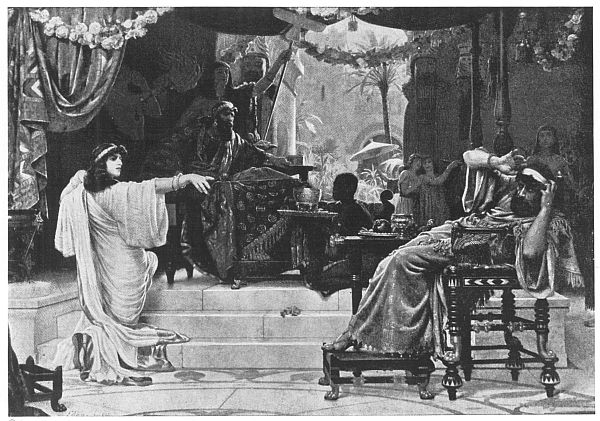
© Ernest Normand
Esther Denouncing Haman
Painted by Ernest Normand
REBUILDING THE TEMPLE
That the promise made by Jehovah through the mouth of Jeremiah
might be fulfilled, Jehovah influenced Cyrus, king of Persia, in
the first year of his reign to make this written law throughout all his
kingdom, “Thus commands Cyrus, king of Persia: ‘Jehovah, the God
of heaven, has given me all the kingdoms of the earth and has charged
me to build him a temple in Jerusalem in Judah. Whoever among
you of all his people wishes to return, may his God be with him, and
let him go up to Jerusalem, in Judah, and rebuild the temple of Jehovah,
the God of Israel. (He is the God who lives at Jerusalem.)
In every place where any who are left of Jehovah’s people now live,
let the men of that place help with silver, with gold, with goods,
and with animals, in addition to the offering each man wishes to
give for the house of God at Jerusalem.'”
Then the heads of the families of Judah and Benjamin and the[175] priests and the Levites, including all whom God had influenced to
build the temple of Jehovah at Jerusalem, started to return. And all
their neighbors supplied them with silver, with gold, with goods, with
animals, and with precious things in addition to all that each man
wished to give.
Cyrus, king of Persia, had the vessels of the temple of Jehovah,
which Nebuchadrezzar had carried from Jerusalem, brought out
under the direction of Mithredath, the treasurer, and given to Sheshbazzar,
the prince of Judah; and he carried them to Jerusalem, with
the people who returned from captivity in Babylon. And Jehovah
commanded them, through Haggai, the prophet, “Go up to the mountains
and bring wood and rebuild the temple, then I will be pleased
with it and I will show my glory.”
Then Zerubbabel and Joshua, the high priest, with all the rest of
the people obeyed the command of Jehovah their God; and they
came and worked on the temple of Jehovah their God. They
finished the building as the God of Israel commanded.
Back to Top
NEHEMIAH’S ANSWER TO A CALL FOR HELP
In the twentieth year of Artaxerxes’ reign, in the month of November,
I (Nehemiah) was in Shushan, the royal palace, when Hanani,
one of my brothers, and certain men came from Judah. I asked them
about Jerusalem and about the Jews who were left from the captivity.
They told me, “Those still living there in the province are in great
trouble and disgrace. The wall of Jerusalem is broken down and
its gates have been destroyed by fire.”
When I heard these words I sat down and wept and mourned
several days. Then I fasted and offered this prayer to the God of
heaven, “I pray thee, O Jehovah, the God of heaven, who showest
kindness to those who love and follow thy commands, let thine ears
now be open to hear the prayers of thy servant which I am now
making before thee day and night for the Israelites, thy servants,
while I confess the sins which we have committed. These are thy
servants and thy people, whom thou hast saved by thy great power
and by thy strong hand. O Lord, I pray thee, let thine ear be open
to the petition of thy servant and to the petitions of thy servants
who take pleasure in worshipping thee, and give success to thy servant
this day, and grant that he may win this man’s sympathy.”
Now I was cupbearer to the king, and in the month of March
in the twentieth year of the reign of Artaxerxes, the kin[176]g, I had charge
of the wine offered to the king. Up to this time I had not been sad;
so the king said to me, “Why is your face sad, for you are not sick?
This is nothing else but sorrow of heart.” Then I was greatly afraid,
and I said to the king, “Let the king live forever! Why should not
my face be sad, when the city, the place where my fathers are buried,
lies in ruins and its gates are destroyed by fire?” Then the king
said to me, “What do you wish?” So I prayed to the God of heaven
and said to the king, “If it please the king and if your servant has
won your favor, then send me to Judah, to the city where my fathers
lie buried, that I may rebuild it.” The king said to me (and the
queen was also sitting by him), “How long will your journey take,
and when will you return?” Then I told him when I would return,
so that the king was willing to let me go.
I also said to the king, “If the king is willing, let letters be given
me to the governors of the province west of the Euphrates, that they
may let me pass through until I come to Judah, and a letter to Asaph,
the keeper of the king’s park, that he may give me timber to make
beams for the gates of the castle which guards the temple and for
the wall of the city and for the house in which I shall live.” The
king granted me all this, for my God kindly cared for me.
Then I went to the governors of the province and gave them
the king’s letters. The king had sent with me officers and horsemen;
and when Sanballat, the Horonite, and Tobiah, the Ammonite
slave, heard of it, it troubled them greatly, that one had come to
look out for the welfare of the Israelites.
So I arrived at Jerusalem. After I had been there three days
I rose in the night, together with a few of my followers. I told no
one what my God had put into my mind to do for Jerusalem, and I
had no animal with me except the one upon which I rode. I went
out by night through the Valley Gate, toward the Dragon’s Well
and to the Dung Gate; and I examined carefully the walls of Jerusalem
which were broken down and the places where its gates had
been destroyed by fire. Then I went on to the Fountain Gate and
to the King’s Pool, but there was no place for the animal on which
I rode to pass.
I also went up in the night along the Brook Kidron and examined
the wall; then I turned back and entered by the Valley Gate and
so returned. The rulers did not know where I went or what I did,
and I had not as yet told my plan to the Jews or to the priests or to
the nobles or to the rulers or to the others who did the work.
Then I said to them, “You see the bad condition in which we
are, how Jerusalem lies in ruins and its gates are destroyed by fire.
Come and let us rebuild the wall of Jerusalem, that we may no longer
be in disgrace.” I told them too how my God had kindly cared for
me and the words which the king had spoken to me. They said,
“Let us go to work and build?” So they entered heartily into the
good work.
Back to Top
OVERCOMING GREAT DIFFICULTIES
Now when Sanballat heard that we were rebuilding the wall,
he was so angry and indignant that he mocked the Jews. He spoke
before his tribesmen and the army of Samaria and said, “What are
these feeble Jews doing? Will they leave it to God? Will they offer
a sacrifice? Will they finish the work in a day? Will they recover
the stones from the heaps of rubbish even after they have been destroyed
by fire?”
Tobiah, the Ammonite, was with him, and he said, “This stone
wall which they are building—if a fox should go up on it, he would
break it down!”
But we went on rebuilding the wall; and all the wall was joined
together to half its height, for the people were eager to work. But
when Sanballat and Tobiah and the Arabians and the Ammonites
and the Ashdodites heard that the rebuilding of the walls of Jerusalem
was going on, so that the broken places began to be closed,
they were very angry. And they all planned together to come and
fight against Jerusalem and frighten the people there. But we prayed
to our God and set a watch as a protection against them day and
night.
When our enemies heard that their plan was known to us and
that God had not let them carry it out, we all returned to the wall,
each to his own work. From that time on, while half of my servants
were at work, half of them held the lances, the shields, the bows and
the coats of mail; and the rulers stood behind all the people of Judah.
Those who built the wall and those who carried burdens were also
armed, each using one of his hands for the work, and was ready with
the other to grasp his spear. And each builder worked with his sword
fastened at his side. The man who sounded the alarm was by me;
and I said to the nobles and to the rulers and to the rest of
the people, “The work is great and spread out, and we on the wall
are far from each other. Wherever you hear the sound of the tr[178]umpet,
gather about us; our God will fight for us.”
So we worked hard, while half of them held the lances from early
in the morning until the stars came out. And I said at that time to
the people, “Let each man with his servant stay in Jerusalem, that
they may protect us at night and work during the day.” So neither
I, nor any of my relatives, nor my servants, nor the men of the guard
who accompanied me took off our clothes, but each kept his spear
in his right hand.
After fifty-two days the wall was finished. When our enemies
heard of it, all the nations around us were afraid, and it seemed very
wonderful to them, and they knew that this work had been done by
our God.
After the wall had been built and I had set up the doors, and
the porters and the singers and the Levites had been appointed, I
placed my brother Hanani, the commander of the castle, in charge
of Jerusalem, for he was a faithful man and more God-fearing than
many. And I said to them, “Let not the gates of Jerusalem be
opened until after sunrise; and at night, while the watchmen are
still on guard, let them shut the doors and bar them. Also let the
people who live in Jerusalem be on guard, each at his post opposite
his own house.”
Now the city was wide and large, but there were few people in
it, and the houses had not been rebuilt. So my God put it into my
mind to gather together the nobles and the officials and the people.
The officials lived in Jerusalem. The rest of the people drew lots
that one out of every ten should live in Jerusalem, the sacred city,
while the others stayed in the villages.
Then I had the officials of Judah take their place on the wall,
and I formed two great processions. The first marched to the right
upon the wall toward the Dung Gate; and behind them went Hoshaiah
and half of the officials of Judah. At the Fountain Gate they
went straight up the stairs of the City of David by the ascent along
the wall above the House of David to the Water Gate on the east
of the city.
The other procession went to the left on the wall above the Tower
of the Furnaces, and I after them, with half of the people, to the
broad wall and above the Gate of Ephraim and past the Old Gate,
the Fish Gate, the Tower of Hananel, and the Tower of the Hundred
to the Sheep Gate. Then they stood in the Gate of the Guard.
So the two processions took their position in the temple and I [179]and
half of the rulers who were with me.
Then the singers sang loudly, and the people offered many sacrifices
that day and rejoiced, for God had given them great cause for
joy. The women and children rejoiced, too, so that the cries of joy
at Jerusalem were heard far away.
Back to Top
A BRAVE KNIGHT
Then the common people and their wives raised a loud cry against
their fellow Jews. Some said, “We must give up our sons and our
daughters in pledge to get grain that we may eat and live.” Others
said, “We must give up our fields and our vineyards and our houses,
that we may get grain because there is so little.” Others said, “We
have borrowed money to pay the king’s taxes. Although our flesh
is as the flesh of our brothers, our children as their children; yet
we must sell our sons and our daughters as slaves. Some of our
daughters have already been made slaves, and it is not in our power
to stop it, for our fields and our vineyards belong to the nobles.”
When I heard their cry and these words, I was very angry. After
I had thought about it, I rebuked the nobles and the rulers and said
to them, “You make each of your fellow Jews pay what you loan
him.”
Then I called a great meeting to protest against what they were
doing. And I said to them, “We ourselves have, as far as we could,
bought back our fellow Jews who have been sold to foreigners.
Would you sell your fellow Jews, and should they be sold to us?”
Then they were silent and could not find a word to say. So I said,
“What you are doing is not good. Ought you not to live in the fear
of God, so as not to be an object of shame to our foreign foes? I,
too, my relatives, and my servants lend the people money and grain.
Let us stop taking anything for what we lend. Give back to them
at once their fields, their vineyards, their olive-yards, and their
houses, and whatever you have made them pay for the money, the
grain, the new wine and the oil.”
Then they said, “We will give them back and will ask nothing
from them; we will do even as you say.” Then I called the priests
and made them solemnly promise that they would do as they had
said.
For twelve years from the time that I was appointed to be their
governor in the land of Judah, I and my relatives did not eat the
food which was my right as governor. But the governors who were
before me were an expense to the people and took from them bread
and wine and forty pieces of silver each day. Their servants also
were cruel to the people. But I did not do so, for I feared God. I
also gave myself to the work on the wall, and we did not buy any
land, but all my servants were gathered there for work. Also a hundred
and fifty of the Jews and rulers, beside those who came to us
from other nations, were fed at my table. Each day one ox and six
choice sheep and fowls were prepared at my expense, and once in
ten days plenty of wine for all. Yet with all this expense, I did not
demand the food which was due me as governor, because the public
work was a heavy burden upon this people. Remember to my
credit, O my God, all that I have done for them!
Back to Top
JONAH THE NARROW-MINDED PATRIOT
This message from Jehovah came to Jonah, the son of Amittai:
“Arise, go to that great city, Nineveh, and preach against it; for
their wickedness is known to me.” But Jonah started to flee to
Tarshish from the presence of Jehovah. He went down to Joppa
and found a ship going to Tarshish. So he paid the fare and went
aboard to go with them to Tarshish from the presence of Jehovah.
But Jehovah made a furious wind blow over the sea, and there
was such a great storm that the ship was in danger of breaking to
pieces. Then the sailors were afraid and each cried for help to his
own god. They threw into the sea the things that were in the ship,
in order to make it lighter. But Jonah had gone down into the bottom
of the ship and lay fast asleep. Then the captain of the ship
went and said to him, “How is it that you are asleep? Call on your
god; perhaps that god will think of us, so that we may not be
lost.”
And they said to one another, “Come, let us cast lots, that we
may know on whose account this evil has come upon us.” So they
cast lots, and the lot fell upon Jonah. Then they said to him, “Tell
us, what is your business, and where do you come from? What is
your country and to what race do you belong?” He said to them,
“I am a Hebrew, and a worshipper of Jehovah, the God of heaven,
who made the sea and the dry land.” Then the men were greatly[181] frightened and said to him, “What is this you have done?” For
they knew that he was fleeing from the presence of Jehovah, because
he had told them.
Then they said to him, “What shall we do to you, that the sea
may be calm for us?” for the sea grew more and more stormy. He
said to them, “Take me up and throw me into the sea, and the sea
will be calm for you, for I know that on account of me this great
storm has overtaken you.” But the men rowed hard to get back
to the land; they could not, however, for the sea grew more and
more stormy ahead.
Therefore they cried to Jehovah and said, “We pray thee, O
Jehovah, we pray thee, let us not die for this man’s life, nor let us
be guilty of shedding innocent blood, for thou art Jehovah; thou
hast done as it pleases thee.” So they took up Jonah, and threw
him into the sea; and the sea became calm. Then the men greatly
feared Jehovah, and they offered a sacrifice and made promises to
him.
But Jehovah prepared a great fish to swallow Jonah, and Jonah
was inside the fish three days and three nights. There Jonah prayed
to Jehovah his God; and Jehovah spoke to the fish, and it threw
Jonah out upon the dry land.
This message from Jehovah came to Jonah the second time,
“Arise, go to that great city, Nineveh, and give to it the message
that I tell you.” So Jonah started for Nineveh, as Jehovah commanded.
Now Nineveh was so large a city, that it took three days’
journey to cross it. And Jonah began by going through the city
a day’s journey, and he said, “Forty days more and Nineveh shall
be overthrown.”
And the people of Nineveh believed God; and they ordered a
fast and put on sackcloth, from the greatest to the least of them.
And when word came to the king of Nineveh, he rose from his throne,
took off his robe, dressed in sackcloth, and sat in ashes. And he gave
this order: “By the order of the king and his nobles: Man, beast,
herd, and flock shall not taste anything; let them not eat nor drink
water. Let both man and beast put on sackcloth and let them cry
earnestly to God; let them turn each from his evil way and from
the deeds of violence which they are doing. Who knows but God
may be sorry for us and turn away his fierce anger, that we may not
die.”
When God saw that they turned from their evil way, he was sorry
for the evil which he said he would do to them, and did not do it.
But this displeased Jonah very much and he was angry. And
he prayed to Jehovah and said, “Ah, Jehovah, was not this what I
said when I was still in my own country? That was why I fled at
once to Tarshish; for I knew that thou art a God, gracious and
merciful, patient, and loving and ready to forgive. Therefore, O
Jehovah, take now, I beg of thee, my life from me; for it is better
for me to die than to live!” But Jehovah said, “Are you doing right
in being angry?”
Then Jonah went out of the city and sat down on the east side,
and there made a hut for himself and sat under it, until he might
see what would become of the city. And Jehovah prepared a gourd
and made it grow up over Jonah as a shade for his head. So the
gourd gave Jonah great pleasure; but at dawn the next day God
prepared a worm which injured the gourd, so that it wilted. And
when the sun rose, God prepared a hot east wind. And the sun beat
upon Jonah’s head, so that he was faint and begged that he might
die, saying, “It is better for me to die than to live.” But God said
to Jonah, “Are you doing right in being angry about the gourd?”
He replied, “It is well for one to be angry, even to death!” Jehovah
said, “You care for a gourd which has cost you no trouble and which
you have not made grow, which came up in a night and wilted in a
night. Should I not care for the great city Nineveh, in which there
are one hundred and twenty thousand people who do not know their
right hand from their left; besides much cattle?”
Back to Top
THE STORY OF JOB
In the land of Uz there lived a man named Job; and he
was blameless and upright, one who revered God and avoided evil.
He had seven sons and three daughters. He owned seven thousand
sheep, three thousand camels, five hundred yoke of oxen, five hundred
asses; and he had many servants, so that he was the richest
man among all the peoples of the East.
One day when the sons of God came before Jehovah, Satan came
with them. Jehovah said to Satan, “From where do you come?”
Satan answered, “From going back and forth on the earth, and walking
up and down on it.” And Jehovah said to Satan, “Have you
seen my servant Job? For there is no man like him on the ea[183]rth,
blameless and upright, who reveres God and avoids evil.” Satan
answered, “But is it for nothing that Job reveres God? Have you
not yourself made a hedge all about him, about his household, and
about all that he has? You have blessed whatever he does, and his
possessions have greatly increased. But just put out your hand
now and take away all he has; he certainly will curse you to your
face.” Then Jehovah said to Satan, “See, everything that he has
is in your power; only do not lay hands on Job himself.” So Satan
left the presence of Jehovah.
One day, as Job’s sons and daughters were eating and drinking
in the oldest brother’s house, a messenger came to Job and said,
“The oxen were ploughing and the asses were grazing near them
when Sabeans suddenly attacked and seized them; the servants
were put to the sword, and I alone have escaped to tell you.”
While he was still speaking, another messenger came and said,
“Lightning has fallen from heaven and has completely burned up
the sheep and the servants, and I alone have escaped to tell you.”
While this man was still speaking, another messenger came and
said, “The Chaldeans, attacking in three bands, raided the camels
and drove them away; the servants were put to the sword, and I
alone have escaped to tell you.”
While this one was still speaking, another messenger came and
said, “Your sons and daughters were eating and drinking in their
oldest brother’s house when a great wind came from across the
wilderness, struck the four corners of the house, and it fell upon the
young men and killed them. I alone have escaped to tell you.”
Then Job rose, tore his robe, shaved his head, threw himself on
the ground and worshipped, saying:
Blessed be the name of Jehovah!”
On another day when the sons of God came before Jehovah, Satan
came with them. And Jehovah said to Satan, “From where do you
come?”
Satan answered, “From going back and forth on the earth, and
from walking up and down on it.” Jehovah said to Satan, “Have
you seen my servant Job? For there is no man like him on the earth,
blameless and upright, one who reveres God and avoids evil; he
still is faithful, although you led me to ruin him without ca[184]use.”
Satan answered Jehovah, “Skin for skin, yes, a man will give all
that he has for his life. But just put out your hand now, and touch
his bone and his flesh; he certainly will curse you to your face.”
Jehovah said to Satan, “See, he is in your power; only spare his
life.”
So Satan left the presence of Jehovah, and afflicted Job from the
sole of his foot to the crown of his head with leprosy so terrible that
Job took a piece of broken pottery with which to scrape himself.
As he sat among the ashes, his wife said to him, “Are you still
holding to your piety? Curse God and die.” But he said to her,
“You speak like a senseless woman. We accept prosperity from
God, shall we not also accept misfortune?” In all this Job said
nothing that was wrong.
When Job’s three friends heard of all this trouble that had befallen
him, they came each from his own home: Eliphaz the Temanite,
Bildad the Shuhite, and Zophar the Naamathite, for they
had arranged to go together and show their sympathy for him and
comfort him. But when they saw him in the distance, they did not
at first know him. Then they all wept aloud and tore their robes
and threw dust upon their heads. And they sat down with him on
the ground seven days and seven nights without any one saying a
word to him, for they saw that he was in great trouble.
Breathe my last when I was born?
I should then have lain down in quiet,
Should have slept and been at rest
With kings and counsellors of earth,
Who built themselves great pyramids;
With princes rich in gold,
Who filled their houses with silver.
“There the wicked cease from troubling,
There the weary are at rest;
Captives too at ease together,
Hearing not the voice of masters.
There the small and great are gathered,
[185]There the slave is free at last.”
But who can keep from speaking?
See! you have instructed many,
And strengthened the drooping hands.
Your words have upheld the fallen,
Giving strength to tottering knees.
But now that trouble comes, you are impatient,
Now that it touches you, you lose courage.
“Is not your religion your confidence;
Your blameless life, your hope?
Remember! What innocent man ever perished?
Or where were the upright ever destroyed?
Happy the man whom God corrects;
Therefore, spurn not the Almighty’s chastening.
For he causes pain but to comfort,
And wounds, that his hands may heal.”
And what is my future, that I should be patient?
Is my strength the strength of stones,
Or is my body made of brass?
A friend should be kind to one fainting,
Though he lose his faith in the Almighty.
Teach me, and I will keep silent.
Show me how I have sinned.”
Or can the Almighty do wrong?
If your children sinned against him,
He has let them suffer the penalty;
But you should earnestly seek him,
And devoutly beseech the Almighty.
If you are pure and upright,
[186]He will surely answer your prayer,
And will prosper your righteous abode.”
But how can a man be just before God?
He is wise in mind and mighty in strength,
Who has ever defied him and prospered,
Blameless I am! I regard not myself;
I hate my life; it is all one to me.
Therefore, I openly declare:
He destroys the blameless as well as the wicked.”
And stretch out your hands to God,
And put away sin from your hand,
And let no wrong dwell in your tent,
You would then lift your face without spot,
You would then be steadfast and fearless.”
And with you wisdom shall die!
But I have a mind as well as you,
And who does not know all this?
Oh, that my words were now written,
That they were inscribed in a book,
That with an iron pen and with lead
In rock they were carved forever!
“For I know that my Defender lives,
That at last he shall stand upon earth;
And after this skin is destroyed.
Freed from my flesh, I shall see him,
Whom I shall behold for myself;
My own eyes shall see, and no stranger’s.”
As in days when God guarded my steps,
When his lamp shone above my head,
And I walked by his light through the darkness;
As I was in my prosperous days,
When God protected my tent;
When still the Almighty was with me,
And my children were all about me!
“When I went to the gate of the city,
And took my seat in the open,
The youths, when they saw me, retired,
And the aged rose up and stood;
The princes refrained from talking,
And laid their hands on their mouths;
The voices of nobles were hushed,
And their tongues stuck fast to their palates.
“He who heard of me called me happy,
He who saw me bore me witness,
For I saved the poor who cried,
And the orphan with none to help him.
The suffering gave me their blessing,
And I made the widow’s heart glad.
“Eyes was I to the blind,
Feet was I to the lame,
And a father to those who were needy.
I defended the cause of the stranger,
I shattered the jaws of the wicked,
And wrested the prey from his teeth.
“Men listened to me eagerly,
And in silence awaited my counsel.
After my words they spoke not,
And my speech fell as rain-drops upon them.
But they sing of me now in derision,
And my name is a by-word among them.
“Oh, for some one to hear me!
[188]Behold my defense all signed!
Let now the Almighty answer,
Let Jehovah write the charge!
On my shoulder I would bear it,
As a crown I would bind it round me;
I would tell him my every act;
Like a prince I would enter his presence!”
You have knowledge and insight, so tell me.
You must know! Who determined its measures?
Or who measured it off with a line?
On what were its foundations placed?
Or who laid its corner-stone,
When the morning stars all sang together,
And the sons of God shouted for joy?
“Can you lift up your voice to the clouds,
That abundance of water may answer you?
Can you send on their missions the lightnings;
To you do they say, ‘Here we are’?
“Does the hawk soar because of your wisdom,
And stretch her wings to the south wind?
Does the eagle mount up at your bidding,
And build her nest on high?
“Will the fault-finder strive with Almighty?
He who argues with God, let him answer.
Will you set aside my judgment,
And condemn me, that you may be justified?”
I lay my hand on my mouth.
I spoke once, but will do so no more;
Yes, twice, but will go no further.
“I know thou canst do all things,
[189]And that nothing with thee is impossible.
I spoke, therefore, without sense,
Of wonders beyond my knowledge.
I had heard of thee but by hearsay,
But now my eye has seen thee;
Therefore I despise my words,
And repent in dust and ashes.”
Then Jehovah gave back to Job, twice as much as he had before.
And Jehovah blessed the last part of Job’s life more than the first
part; and he had fourteen thousand sheep, six thousand camels, a
thousand yoke of oxen, and a thousand asses. He also had seven
sons and three daughters. And after this Job lived an hundred and
forty years.
Back to Top
PSALMS
THE KING OF GLORY
The world and those who live in it;
He founded it upon the seas,
And established it upon the floods.
Who may go up to the hill of the Lord?
Who may stand in his holy place?
The man with clean hands and pure heart,
Who plans no evil purpose,
Nor promises in order to deceive.
He shall win from the Lord a blessing,
And approval from God his Saviour.
Such is the man who may worship him,
Who may enter thy presence, O God of Jacob.
Lift up your heads, O gates,
Be lifted up, O everlasting doors,
Let the King of Glory come in!
Who is this King of Glory?
The Lord, strong and mighty,
The Lord, mighty in battle!
Lift up your heads, O gates,
Be lifted up, O everlasting doors,
That the King of Glory may come in.
Who is this King of Glory?
The Lord, the God of hosts,
He is the King of Glory!
GOD THE LOVING CREATOR
O Lord, my God, thou art great;
Thou art clothed with glory and majesty,
Thou hast put on light as a mantle;
Thou hast stretched the heavens like a tent,
Thou framest thy upper stories in the waters,
Thou makest the clouds thy chariot,
Thou ridest on the wings of the wind,
Thou makest winds thy messengers,
Flames of fire are thy servants.
Thou didst fix the earth on its foundations,
That it should not be moved forever.
Thou didst cover it with the sea as with a garment.
The waters stood far above the mountains,
But at thy reproof they fled,
At the sound of thy thunder they hastened away,
Not to pass the bound thou hadst set,
Not to return to cover the earth.
Mountains rose, valleys sank,
To the place which thou hadst prepared for them.
Thou sendest the springs to the valleys,
They run down between the mountains,
They give drink to every wild beast,
The wild asses quench their thirst.
The birds make their home beside them,
They sing from among the branches.
Thou waterest the mountains from thine upper stories;
The earth is filled with the fruit of thy works.
Thou makest grass spring up for the cattle,
And green herbs for the service of man,
Causing food to spring from the earth,
Wine to gladden man’s heart,
Oil that makes his face shine,
And bread to strengthen his heart.
The trees of the Lord are full of sap,
The cedars of Lebanon, which he has planted,
[192]Where the birds build their nests;
The stork has her home in the fir-trees.
The high mountains are for the wild goats,
The rocks are a hiding-place for the marmots.
Thou createst the moon to divide the year,
The sun knows when it should set.
Thou makest darkness, and it is night,
In which wild beasts creep forth;
The young lions roar for their prey,
And seek their food from God.
When the sun arises they disappear,
And lay themselves down in their dens.
Man goes out to his work,
To toil until evening comes.
O Lord, how many are thy works!
Wisely thou madest them all;
The earth is full of thy creatures.
There is the sea, great and wide,
With its crawling things innumerable,
Living things both small and great;
There go the monsters of the sea,
And the dragon thou madest to play.
These all wait for thee,
To give them their food in due season.
When thou givest to them, they gather it;
Thou openest thy hand, they are satisfied.
Thou hidest thy face, they are frightened;
Thou takest their breath, they die,
And return to the dust from which they came.
Thou sendest thy spirit, and they are created;
Thou refillest the earth with living things.
May the glory of the Lord be eternal,
Let the Lord rejoice in his works.
He looks at the earth, and it trembles,
He touches the mountains, and they smoke.
I will sing to the Lord as long as I live,
[193]I will sing praise to my God while I exist.
May my thoughts be pleasing unto him;
I myself find my joy in the Lord.
GOD THE LOVING FATHER
And all that is within me, bless his holy name.
Bless the Lord, O my soul,
And forget not all his benefits,
Who forgives all your iniquities,
And heals all your diseases,
Who redeems your life from the grave,
And crowns you with love and tender mercy,
Who satisfies your mouth with good things,
So that your youth is renewed like the eagle’s.
The Lord is a doer of righteous acts,
And of justice to all the oppressed.
He made known his laws to Moses,
His deeds to the people of Israel.
The Lord is merciful and gracious,
Patient and full of love.
He will not always chide,
Nor keep his anger forever.
He has not dealt with us according to our sins,
Nor rewarded us according to our iniquities.
For as high as the heavens are above the earth,
So great is his love toward those who revere him.
As far as the east is from the west,
So far has he removed our wrong deeds from us.
As a father loves his children,
So the Lord loves those who revere him,
For he understands our nature,
He remembers that we are dust.
Frail man—his days are as grass;
[194]As a flower of the field he flourishes,
For the wind passes over it, and it is gone,
And its place knows it no more.
But the love of the Lord is eternal,
And his righteousness to children’s children,
To those who keep their covenant with him,
And remember to obey his commands.
He has established his throne in the heavens,
And his rule extends over all.
Bless the Lord, his angels,
You strong ones who do his bidding.
Bless the Lord all his hosts,
You servants who do his will,
Bless the Lord, all his works,
In every place where he rules,
Bless the Lord, O my soul.
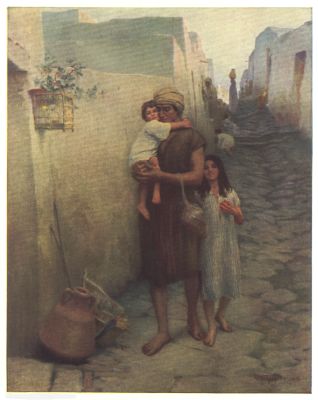
© Curtis Publishing Company
“Lo, Children are a Heritage of the Lord”
Painted by W. L. Taylor
GOD FROM WHOM ALL GOOD THINGS COME
Unless the Lord guards the city, the watchman wakens in vain.
It is vain for you to rise up early, to sit down at your meal late,
And so eat the bread of toil; for he gives to his loved ones sleep.
Children too are a gift from the Lord, they are a reward.
As arrows in the hand of a warrior, so are the children of youth.
Happy indeed is the man whose quiver is full of them,
He shall not be put to shame when he argues with foes in the court.
GOD’S GOODNESS AND MERCY
Patient, and full of loving-kindness.
The Lord is good to all,
Showing mercy to all his creatures.
[195]All thy works give thee thanks, O Lord,
And those who love thee praise thee,
They speak of thy glorious rule,
And proclaim thy mighty power,
That men may know thy great deeds,
And the glorious splendor of thy rule.
Thy rule is an everlasting rule,
Thy dominion endures forever.
The Lord lifts up all who fall,
And raises up all who are bowed down.
The eyes of all wait for thee,
And thou givest them food in due season.
Thou it is who openest thy hand,
And satisfiest the desires of all creatures.
The Lord is righteous in all his ways,
And gracious in all his acts.
He is near all who call upon him,
To all who call upon him in truth.
He fulfils the desire of his worshippers,
He hears their cry and saves them.
He takes care of all who love him,
But destroys all those who do wrong.
My mouth shall speak the praise of the Lord.
Let all flesh praise his holy name forever.
GOD THE ALL-SEEING
Whether I sit or stand, thou knowest,
Thou readest my thought afar off,
When I walk or lie down thou dost know it.
Thou knowest all my ways.
There is not a word on my tongue
That thou, O Lord, dost not know!
Behind and before thou enfoldest me,
[196]Over me thou dost lay thy hand.
Such knowledge for me is too wonderful!
Too high, I cannot attain it.
Where shall I go from thy spirit,
Where shall I flee from thy presence?
If I climb into heaven, thou art there,
If I lie down in the grave, thou art there.
Should I take the wings of the morning,
And dwell on the most distant sea,
Even there thy hand would grasp me,
Thy right hand would hold me fast.
If I say, “The darkness will hide me,
And the night throw its curtain about me,”
Even darkness for thee is not dark,
But the night shines clear as the day.
Thou didst form my vital parts,
Thou didst make me from the beginning,
I thank thee, for I am wonderfully made;
Fearful and marvellous are thy works.
How precious to me are thy thoughts, O God!
How great is the sum of them all!
Should I count them, they would be more than the sand;
When I awake, I am still with thee.
Search me, O God, and know my heart,
Try me, and know my secret thoughts,
And see if I have any evil in me,
And lead me in the way to eternal life.
GOD WHO ALWAYS WATCHES OVER HIS PEOPLE
My help comes from the Lord, who made heaven and earth.
He will not let your foot be moved; he who keeps you does not slumber;
Behold, he who keeps Israel neither slumbers nor sleeps!
The Lord is your protector; the Lord is your shade upon your right hand;
The sun shall not smite you by day, nor the moon by night!
The Lord will keep you from all evil; he will preserve your life;
The Lord will protect your going out and your coming in forevermore!
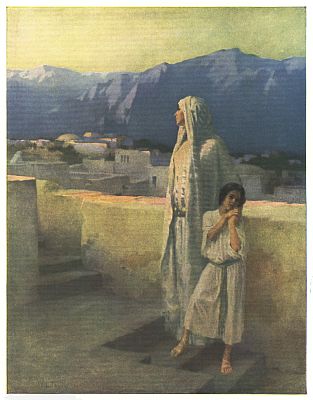
© Curtis Publishing Company
“I will Lift up mine Eyes unto the Hills”
Painted by W. L. Taylor
GOD WHO PROTECTS FROM ALL DANGER
For his love endures forever.
Let those he has redeemed say so,
Whom he has set free from the hand of the foe,
And gathered together from many lands,
From the east, from the west,
From the north and the south.
Some strayed in the barren wilderness,
Finding no inhabited city,
Hungry, indeed, and thirsty,
Their very life ebbing away.
Then they cried to the Lord in their trouble,
And he saved them from their distresses.
He led them along the right way,
Till they reached an inhabited city.
Let them praise the Lord for his love,
And his wonderful works unto men!
For he satisfies the longing soul,
And the hungry he fills with good things.
Some dwelt in darkness and gloom,
[198]Being bound in affliction and iron,
Because they had rebelled against God,
And despised the counsel of the Most High.
He humbled their heart with sorrow;
When they fell, there was none to help them.
Then they cried to the Lord in their trouble,
And he saved them from their distresses.
Out of darkness and gloom he brought them,
And broke their bonds in pieces.
Let them praise the Lord for his love,
And his wonderful works unto men!
For he shattered the gates of brass,
And hewed bars of iron asunder.
Fools because of their wrong-doing,
And because of their sins were afflicted;
They hated all kinds of food,
And drew near to the gates of death.
Then they cried to the Lord in their trouble,
And he saved them from all their distresses.
He sent his command to heal them,
And saved their life from destruction.
Let them praise the Lord for his love,
And his wonderful works unto men!
Let them sacrifice to him a thank-offering,
And with joy recount his deeds.
Those who go to the sea in ships,
Who do business in great waters,
They see the works of the Lord,
And his wonders in the great deep.
When he speaks, the tempest rises,
And tosses the waves on high.
Up to heaven, then down they go,
Their courage melts at the danger,
They stagger and reel like drunkards,
And their skill is all exhausted.
Then they cry to the Lord in their trouble,
And he saves them from their distresses.
He makes the tempest a calm,
And the waves of the sea are still.
[199]They are glad when the waves go down;
To the haven they long for he brings them.
Let them praise the Lord for his love,
For his wonderful works unto men;
In the popular assembly extol him,
In the council of elders praise him.
GOD’S PROTECTION OF THOSE WHO TRUST IN HIM
His praise is continually in my mouth,
My soul glories in the Lord,
Let the afflicted hear and rejoice.
O exalt the Lord with me,
Let us praise his name together.
I sought the Lord and he answered me,
From all my fears he delivered me.
He who looks to him, becomes radiant,
And his face is not covered with shame.
This afflicted man cried and he heard him,
And from all his distresses delivered him.
The angel of the Lord encamps
About those who revere him, and saves them.
Taste and see that the Lord is good;
Happy the man who seeks refuge with him.
Revere the Lord, O holy ones,
For those who revere him lack nothing.
Though young lions feel want and suffer hunger,
Those who seek the Lord shall not lack any good thing.
Come, children, listen to me;
I will teach you true religion:
Who of you desires to live,
Loves long life that he may enjoy happiness?
Then keep your tongue from evil,
And your lips from speaking falsehood;
Turn from evil and do good,
[200]Seek for peace and pursue it.
The Lord is against evil-doers,
To cut off their memory from the earth.
The Lord watches over the upright,
His ear is open to their cry.
When they cry to the Lord, he hears,
And saves them from all their troubles.
The Lord is near those who are broken-hearted,
He delivers those whose spirits are crushed.
The misfortunes of the upright are many,
But the Lord delivers him from them all.
The Lord guards all his bones,
Not one of them is broken.
Misfortune shall slay the wicked,
Those who hate the upright shall be condemned;
But the Lord redeems his servants,
And none who takes refuge in him shall be condemned.
GOD’S LOVING CARE
He makes me lie down in green pastures,
He leads me to the still waters,
He restores my soul.
He guides me in straight paths for his name’s sake;
Though I walk through the valley of death,
I will fear no evil, for thou art with me,
Thy rod and thy staff—they comfort me.
Thou preparest a table before me in the presence of my enemies,
Thou anointest my head with oil, my cup runs over;
Surely goodness and love will follow me all the days of my life,
And I shall dwell in the house of the Lord forever.
TRUSTING IN GOD’S CARE
Nor be envious of those who do wrong;
For like grass they shall quickly wither,
And fade like the green herbs.
Trust in the Lord and do right,
Live in the land and act faithfully.
Then the Lord shall be your delight,
He will grant you your heart’s desire.
Commit your way to the Lord,
Trust in him, and he will work with you,
He will bring to light your honesty,
And make it as clear as the noonday.
A PRAYER OF TRUST
All the day long do I wait for thee.
I trust in thee, O God, let me not be ashamed;
Let not my enemies exult over me,
And let none who hope in thee be ashamed;
But let wicked traitors be disgraced.
Show me thy ways, O Lord,
Teach me thy way to live.
Lead me in thy truth and teach me,
For thou art the God who saves me,
And in thee do I hope continually.
Remember thy tender mercies, O Lord,
And thy loving deeds, for they are eternal.
Do not recall the sins of my youth,
But in thy love remember thou me,
Because of thy goodness, O Lord.
Good and upright is the Lord,
[202]So he teaches sinners the way,
He guides the humble aright,
And teaches the meek his way,
All his rules are loving and true,
To those who follow his law and commands.
For thy name’s sake, O Lord,
Pardon my guilt, for it is great.
Who is the man that reveres the Lord?
He will teach him the way to choose.
That man shall continue to prosper,
And his children inherit the land.
He is friendly with those who revere him,
And with his covenant he makes them acquainted.
My eyes are ever turned toward the Lord,
For he saves my feet from the net.
Turn to me and be gracious,
For I am alone and afflicted;
Relieve the troubles of my heart,
And deliver me from my distresses;
Look on my affliction and suffering,
And pardon all my sins.
Consider my enemies, for they are many,
And they hate me with violent hatred;
Oh save my life and deliver me,
Let me not be ashamed, for I trust thee.
Let innocence and uprightness preserve me,
For I wait for thee, O Lord.
SAFETY IN GOD’S CARE
Who abide in the shadow of the Almighty,
Who say to the Lord, “Thou art my refuge,
And my fortress, my God in whom I trust,”
He will surely deliver you from the snare,
When entrapped from the destructive pit.
With his pinions he will cover you,
And under his wings you may hide.
[203]
His faithfulness is a shield and defense,
You shall not be afraid of the terror by night,
Nor of the arrow that flies by day,
Of the pestilence that stalks in darkness,
Nor the destruction that wastes at noonday.
A thousand may fall at your side,
And ten thousand at your right hand,
But it shall not come near unto you.
You need but look with your eyes,
To see how the wicked are punished.
Because the Lord is your refuge,
And you have made the Most High your abode,
There shall no evil befall you,
No plague come near your tent;
For he will give his angels charge over you,
To keep you in all your ways;
They shall bear you up on their hands,
Lest you strike your foot on a stone.
You shall tread on the lion and adder,
You shall trample on the young lion and dragon.
“Because of his love for me I will deliver him,
I will exalt him, for he knows my name.
He shall call upon me and I will answer him,
In time of trouble I will be with him,
I will deliver him and bring him honor,
With long life will I satisfy him,
And show him my power to save.”
GOD OUR REFUGE
An ever-present help in trouble.
So we fear not, though the earth trembles,
And mountains tumble into the heart of the sea;
Though its waters roar and foam,
Though mountains quake at its uproar.
[204]The Lord of hosts is with us,
The God of Jacob is our refuge.
As the brooks refresh the city of God,
So the Most High makes holy his abiding-place;
God is in her midst, she cannot be moved,
God will help her at the turn of the morn.
Nations were in tumult, kingdoms fell,
He uttered his voice, the earth melted.
The Lord of hosts is with us,
The God of Jacob is our refuge.
Come, see the mighty works of the Lord,
Who makes wars cease to the end of the earth
He snaps the bow, and breaks the spear,
And burns up the chariots with fire.
“Be still, and know that I am God,
Exalted over the nations, exalted on earth.”
The Lord of hosts is with us,
The God of Jacob is our refuge.
THE JOY OF WORSHIPPING GOD
Let us shout to the Rock who saves us,
Let us come before him with thanksgiving,
Let us sing to him joyful songs;
For the Lord is indeed a great God,
A great King above all gods,
In whose hand are the depths of the earth,
The heights of the mountains are his,
The sea is his, for he made it,
And his hands prepared the dry land.
Oh come, let us worship and bow down,
Let us kneel before the Lord, our Maker;
For he is the Lord our God,
And we are his people, the sheep of his pasture.
[205]
Shout with joy to the Lord, all the earth,
Serve the Lord with gladness,
Come into his presence with singing,
Know that the Lord is God,
He has made us and we are his,
His people, the flock that he tends.
Enter his gates with thanksgiving,
His courts with songs of rejoicing,
Give thanks to him, praise his name,
He is good, his kindness eternal,
And his faithfulness unto all generations.
WHAT GOD ASKS OF THOSE WHO WORSHIP HIM
Who may dwell on thy holy hill?
He who lives blamelessly and does right,
And speaks the truth in his heart,
Who utters no slander with his tongue,
Who does no wrong to his friend,
Who makes no charge against his neighbor;
In whose sight the vile are despised,
But he honors those who revere the Lord.
He keeps his oath at all costs,
His money he puts not out to usury,
And cannot be bribed to injure the innocent.
He who does this can never be moved.
A CALL TO PRAISE GOD
Sing to the Lord, all the earth,
Sing to the Lord, praise his name,
Proclaim his salvation each day;
Tell his glory among the heathen,
His wonders among all peoples.
God is great, and worthy of praise,
Above all gods should he be revered,
For all the gods of the peoples are idols,
But it is the Lord who made the heavens.
Honor and majesty are in his presence,
Strength and beauty are in his sanctuary.
Give to the Lord, you tribes of the nations,
Give to the Lord glory and strength.
Give to the Lord the glory that is due him;
Bring an offering, and enter his courts.
Oh, worship the Lord in holy attire,
Tremble before him, all the earth.
Say to the nations, “The Lord reigns,
And he will rule the peoples justly.”
Let the heavens be glad, and the earth rejoice,
Let the sea roar and all of its inhabitants,
Let the fields exult, and all that is in them,
Let the trees of the forest sing with joy
Before the Lord, for he has come,
For he has come to rule the earth;
He will rule the world with justice,
He will rule the nations with faithfulness.
THE UNITED SONG OF PRAISE
Praise him on the heights.
Praise him, all his angels,
Praise him, all his host!
Praise him, sun and moon,
[207]Praise him, all stars of light!
Praise him, heavens of heavens,
And waters above the heavens!
Let them praise the name of the Lord,
For at his command they were made;
He fixed them forever and ever,
Set a bound they must not pass.
Praise the Lord from the earth,
Sea-monsters and all deeps!
Fire, hail, snow, and vapor,
Storm wind, fulfilling his word!
Mountains and all hills,
Fruit-trees and all cedars!
Wild beasts and all cattle,
Creeping things and winged birds!
Kings of earth and all peoples,
All rulers and judges of earth,
Young men and maidens too,
Old men and children together!
Let them praise the name of the Lord,
For his name alone is exalted.
Over heaven and earth is his majesty,
He has strengthened the might of his people;
He is praised by all who are faithful,
By the Israelites, who are near him.
Praise God in his holy place,
Praise him for his mighty firmament,
Praise him for his deeds of power,
Praise him for his infinite greatness.
Praise him with the blast of the horn,
Praise him with lyre and harp,
Praise him with timbrel and dance,
Praise him with strings and pipe,
Praise him with clanging cymbals,
[208]Praise him with clashing cymbals.
Let all that breathes praise the Lord!
MAN’S PLACE IN GOD’S WORLD
Is thy name in all the earth!
Thou hast spread thy splendor over the heavens;
At the cry of babes and infants
Thou hast set up a bulwark, because of thine enemies,
To silence the foe and avenger.
When I see thy heavens, the work of thy fingers,
The moon and stars which thou hast made;
What is man that thou art mindful of him;
Or the son of man that thou visitest him?
Yet thou hast made him little less than divine,
And hast crowned him with glory and honor,
Making him lord of creation,
So that all things are subject to him.
The sheep and the oxen, all of them,
Yes, and the beasts of the field,
The birds of the air and the fish,
That dart through the paths of the sea.
O Lord, our God, how glorious
Is thy name in all the earth!
THE REWARD OF DOING RIGHT
Who follows not the counsel of the wicked,
Nor takes his stand with sinners,
Nor sits among the scoffers,
But delights in the law of the Lord,
And day and night meditates on it.
[209]For he is like a tree planted by streams of water,
Which yields its fruit in due season,
Whose leaf never withers,
And all that he does prospers.
Not so the wicked!
They are like the chaff driven by the wind.
So the wicked shall not rise up at the judgment,
Nor sinners where the righteous are gathered;
For the Lord directs the way of the righteous,
But the way of the wicked leads to ruin.
A PRAYER FOR FORGIVENESS
According to thy loving-kindness,
According to the multitude of thy tender mercies,
Blot out all my transgressions,
Wash me thoroughly from mine iniquity,
And cleanse me from my sin.
For well do I know my misdeeds,
And my sin is always before me.
Against thee, thee only have I sinned,
And done what is wrong in thy sight;
Therefore thou art right when thou speakest,
And just when thou pronouncest thy judgment.
Verily I was born in iniquity,
And in sin did my mother conceive me.
Yet thou desirest truth in the heart,
In my inner soul thou wouldst teach me wisdom.
Cleanse me with hyssop that I may be clean,
Wash me whiter than snow.
Fill me with joy and gladness,
That the bones which thou hast broken may rejoice.
Hide thy face from my sins,
And blot out all mine iniquities.
Create in me a clean heart, O God,
[210]And renew a right spirit within me.
Cast me not away from thy presence,
Withdraw not thy holy spirit from me.
Give me back the glad sense of thy help,
And with a willing spirit sustain me.
Then I will teach sinners thy ways,
And wrong-doers shall turn unto thee.
Save me from bloodshed, O God,
That my tongue may sing of thy righteousness.
O Lord, open thou my lips,
That my mouth may declare thy praise!
For thou takest no pleasure in sacrifice,
No delight in gifts of burnt-offering.
The sacrifices pleasing to thee
Are a broken and a contrite spirit.
THE SAYINGS OF THE WISE
THE REWARDS OF LISTENING TO THE ADVICE OF THE WISE
And store my commands in your mind,
Pay close attention to wisdom,
And give careful heed to reason.
If you will but seek her as silver,
And search for her as for hid treasures,
You shall then understand true religion,
And gain a knowledge of God.
For wisdom shall enter your mind,
And knowledge shall be pleasant to you,
Discretion shall watch over you,
And understanding shall guard you,
To keep you from doing wrong,
From men whose words are evil,
Who leave the paths of right
To walk in ways that are dark,
Who rejoice in doing wrong,
And take pleasure in evil deeds.
Happy the man who finds wisdom,
And he who gains understanding.
In her right hand is long life,
In her left are riches and honor.
Her ways are pleasant ways,
And all her paths are peaceful.
She gives life to those who seek her,
They are happy who hold her fast.
You shall then go on your way securely,
And your foot shall never stumble.
When you sit down, you shall not be afraid,
When you lie down, your sleep shall be sweet.
WHAT GOD LIKES AND DISLIKES
Keeping watch on both wicked and good.
A man thinks all that he does is right,
But the Lord tests the motive.
A man plans the way in his mind,
But the Lord directs his steps.
The Lord detests a false balance,
But a just balance is his delight.
To do what is just and right
Is more acceptable to the Lord than sacrifice.
The conduct of the wicked is hateful to him,
But he loves the man eager to do right.
The Lord detests the evil-minded,
But is well pleased with him who lives uprightly.
The sacrifice of the wicked is hateful to the Lord,
But the prayer of the upright is a delight to him!
The Lord holds aloof from the wicked,
But hears the prayer of the upright.
Lying lips are hateful to the Lord,
But they who act honestly are his delight.
There are six things that the Lord hates,
Yes, seven are detestable to him:
Haughty eyes and a lying tongue,
And hands that shed innocent blood,
A mind that plans wicked schemes,
Feet that make haste to do evil,
A false witness who utters lies,
And he who sows strife between brothers.
GOD’S CARE FOR THOSE WHO TRY TO DO RIGHT
But he blesses the home of him who does right.
Surely he scoffs at the scoffers,
But to the modest he ever shows favor.
The Lord does not let the righteous go hungry,
But he disappoints the desire of the wicked.
The Lord is a stronghold to him who lives rightly,
But he brings destruction to those who do wrong.
The name of the Lord is a strong tower,
To which the righteous runs and is safe.
Every word of God is true;
He is a shield to those who trust him.
Say not, “I will be revenged for a wrong”;
Wait for the Lord, he will save you.
For the Lord gives wisdom,
From his mouth come knowledge and understanding;
He stores up sound wisdom for the upright,
He is a shield to those who live clean lives,
That he may guard the course of justice,
And protect the way of his faithful ones.
Reverence for the Lord is the beginning of knowledge,
But the foolish despise wisdom and discipline.
Reverence comes through wise instruction,
And before honor goes modesty.
Trust in the Lord with all your heart,
Depend not on your own understanding;
In all you do make him your friend,
And he will direct your paths.
Be not wise in your own eyes.
Revere the Lord, and avoid sin.
Then you will have health of body
And your bones will be refreshed.
Honor the Lord with your wealth,
[214]With the best of all you receive,
Then your barns will be filled with grain,
And your vats overflow with wine.
A greedy man stirs up strife,
But he who trusts in the Lord will prosper.
Intrust what you do to the Lord,
Then your plans will succeed.
THE WAY TO BE WELL AND HAPPY
But a trustworthy man who can find?
A child is known by his acts,
Whether his work is pure and right.
Worry in a man’s mind makes it sad,
But a kind word makes it happy.
A man’s spirit upholds him in sickness,
But who can raise up a broken spirit?
A calm mind is the life of the body,
But jealousy rots the bones.
A joyful heart makes a cheerful face,
But by inward sorrow the spirit is broken.
A joyful heart is good medicine,
But a broken spirit dries up the bones.
THE IMPORTANCE OF BEING WILLING TO LEARN
But the fool does not understand.
A fool’s way seems right in his sight,
But a wise man listens to advice.
A fool despises his father’s correction,
But he who regards reproof acts wisely.
Listen to advice and receive instruction,
[215]That you may be wise in your later life.
Advice in a man’s mind is like deep water,
But a man of sense will draw it out.
Hold fast instruction, let it not go;
Keep it, for it is your life.
My son, reject not the discipline of the Lord,
And do not spurn his reproof,
For whom he loves he reproves,
Even as a father the son of whom he is fond.
He who rejects correction despises his own self,
But he who listens to reproof gains understanding.
HOW TO HONOR YOUR PARENTS
And forsake not the teaching of your mother;
They shall be a crown of beauty for your head,
And a necklace about your neck.
Listen to your father who begat you,
And despise not your mother when she is old.
He who does what he is told is a wise son.
But he who makes friends of spendthrifts,
Brings disgrace on his father.
He who robs father or mother,
Saying, “There is no wrong in it,”
Is like him who is a destroyer.
He who curses his father or mother,
His lamp shall go out in the blackest of darkness.
A wise son makes a glad father,
But a foolish son despises his mother.
A foolish son is a grief to his father,
And brings bitterness to her who bore him.
Be wise, my son, and make glad my heart,
That I may answer the one who reproaches me.
Let your father be filled with joy,
And let her who bore you rejoice.
THE TROUBLES OF THOSE WHO ARE LAZY
I shall be killed in the streets!”
As the door turns on its hinges,
So the lazy man turns on his bed.
He dips his hand in the dish,
But does not bring it to his mouth!
The lazy man is wiser in his own mind,
Than seven who can answer intelligently.
The way of the lazy is hedged in with thorns,
But the path of the diligent is a well-built highway.
I went by the field of the lazy man,
By the vineyard of him who lacked sense,
It was all overgrown with thorns,
Its surface was covered with nettles,
And its stone wall was broken down.
Then I beheld and reflected,
I saw and received instruction:
A little sleep, a little slumber,
A little folding of the hands to rest,
And your poverty comes as a robber,
And your want as a well-armed man.
THINGS THAT ARE BETTER THAN RICHES
Than one who is dishonest, though he be rich.
Better is a little with righteousness
Than great abundance with injustice.
Better is a modest spirit with the humble,
Than to divide spoil with the proud.
A good name is better than great riches,
More highly valued than silver and gold.
He who trusts in riches shall fail,
But the upright flourish like a green leaf.
Toil not that you may become rich;
[217]Cease through your own understanding.
Should you set your eyes upon it, it is gone!
For riches fly away,
Like an eagle that flies toward heaven.
Better is little with reverence for the Lord
Than great treasure and trouble as well.
Two things I ask of thee, O God,
Deny me them not ere I die:
Put far from me deceit and lying,
Give me neither poverty nor riches;
Provide me with the food that I need,
That I may not be filled to the full and deny thee,
And say, “Who is the Lord?”
Or else be poor and steal,
And disgrace the name of my God.
RIGHT EATING AND DRINKING
That you may not be too full and be ill.
Wine is a mocker, strong drink makes one quarrelsome,
And whoever is misled by it is not wise.
Who cries, “Woe”? who, “Alas”?
Who has quarrels? Who complains?
Who has wounds without cause?
Who has redness of eyes?
They who linger long over wine,
They who go in to taste mixed wine.
So look not on wine when it is red,
When it sparkles in the cup,
And glides down smoothly.
At last it bites like a snake,
And stings like an adder.
Then you will see strange things,
And your mind will be confused.
You will be like one sleeping at sea,
Like one asleep in a violent storm.
[218]“I have been struck, but I feel no pain;
I have been beaten, but I know it not.
When shall I awake from my wine?
I will seek it yet again.”
THE RIGHT USE OF THE TONGUE
There is more hope for a fool than for him.
He who answers before he hears
Covers himself with confusion.
He who is sparing of words has knowledge,
And he who has a cool spirit is a man of sense.
Even a fool, if he keeps still, is considered wise;
Prudent, if he keeps his lips shut.
He who guards his mouth and tongue
Guards himself against trouble.
Life and death are in the power of the tongue;
They who are fond of using it must eat its fruit.
A man has joy from the utterance of his mouth,
And a word in season, how good it is!
A word fitly spoken
Is like golden fruit in silver settings.
Pleasant words are like honeycomb,
Sweet to the taste and healing to the body.
THE CONTROL OF THE TEMPER
But a harsh word stirs up anger.
A man without self-control
Is a ruined city whose wall is broken.
A fool gives way to his wrath,
But a wise man restrains his anger.
A fool’s anger is known at once,
[219]But a sensible man heeds not an insult.
A man’s wisdom makes him patient,
It is his glory to overlook faults.
He who is patient is better than a warrior,
And he who rules his temper than he who takes a city.
WHAT IT MEANS TO BE MODEST
For you know not what a day may bring forth.
Do you see a man wise in his own opinion?
There is more hope for a fool than for him!
Pride goes before destruction,
And a haughty spirit before a fall.
When pride comes, then comes disgrace,
But with the modest is wisdom.
It is not good to eat much honey;
But to seek the glory of others is glorious.
Let another man praise you, not your own mouth;
Some other, and not your own lips.
BEING GENEROUS AND LOVING
He who returns evil for good,
From his house evil shall not depart.
It is an honor for a man to avoid strife;
Only a fool is quarrelsome.
Charcoal for embers, and wood for fire,
And a quarrelsome man to kindle strife!
Strive not with a man without cause,
If he has done you no harm.
The beginning of strife is as when one lets out water;
[220]Therefore leave off strife before quarrelling begins.
Better a dry crust with quietness
Than a house full of feasting with strife.
A just man regards the life of his beast,
But the heart of the wicked is cruel.
He who oppresses the poor reviles his Maker,
But he who has pity on the needy honors him.
He who listens not to the cry of the poor,
He also shall call and not be answered.
He who pities the poor, lends to the Lord
And he will repay him for his good deed.
If your enemy hungers, give him food;
If he thirsts, give him water to drink;
For you will heap coals of fire on his head,
And the Lord will reward you.
Hatred stirs up strife,
But love overlooks faults.
Better a meal of herbs where love is,
Than a fatted ox with hate.
Let not love and truth leave you,
Bind them about your neck;
So you will enjoy favor and a good reputation
In the sight of God and man.
THE NEW TESTAMENT
JESUS IS BORN AT BETHLEHEM
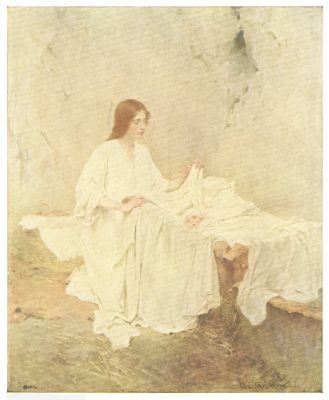
© Curtis Publishing Company
The Nativity
Painted by W. L. Taylor
The angel Gabriel was sent from God to a young woman named
Mary in Nazareth, a town of Galilee. She was to be married to a
man named Joseph of the family of David. When he came to her
the angel said: “Hail, highly honored one! God is with you!”
She was startled by his words and wondered what such a greeting
might mean. But the angel said to her, “Fear not, Mary, for
you have found favor with God. You will have a son and will name
him Jesus. He will be great and will be called the Son of the Most
High.”
Then Mary said to the angel, “How can this be, for I am not
yet married.” The angel answered her, “The Holy Spirit will come
upon you and the power of the Most High will cover you; therefore
your child will be called holy, the Son of God.” Mary said:
“I am God’s servant. May it be with me as you say.” Then the
angel left her.
In those days the Emperor Augustus commanded that every
one should be registered. So all went to be registered, each to his
own town. Joseph, because he was of the family of David, went to
be registered with Mary, his wife, from the town of Nazareth in
Galilee to Bethlehem in Judea where David was born. While they
were there Mary’s first son was born. And she wrapped him
in swaddling-clothes and laid him in a manger, because there was
no room for them in the inn.
In that country there were shepherds living in the fields and
keeping watch over their flocks by night. And an angel from God
stood by them and a heavenly light shone around them, and they
were frightened. But the angel said to them:
Of great joy which shall be for all the people.
For to you is born this day in the town of David
A Saviour who is God’s Anointed.[224]
This will be a sign to guide you:
You will find a baby in swaddling-clothes lying in a manger.”
Then suddenly there was with the angel a great number of the
heavenly ones singing praise to God and saying:
And on earth peace, good-will among men.”
When the angels had gone away from them into heaven, the
shepherds said to one another, “Let us go now to Bethlehem to see
this which God has made known to us.” So they went quickly and
found Mary and Joseph; and the baby was lying in a manger.
When they had seen him, they made known what had been told
them about this child. All who heard the words of the shepherds
wondered, but Mary kept these things to herself and often thought
about them. And the shepherds returned, thanking and praising
God for what they had heard and seen, as it had been foretold.
Back to Top
THE WISE MEN BRING GIFTS TO THE YOUNG CHILD
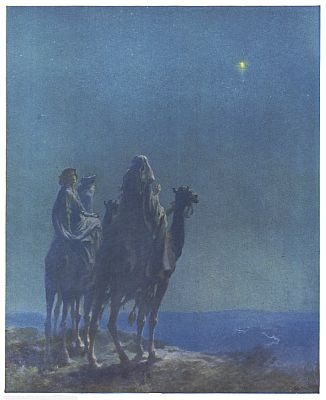
© Curtis Publishing Company
The Three Wise Men
Painted by W. L. Taylor
When Jesus was born in Bethlehem, wise men from the east came
to Jerusalem and asked, “Where is the newly born King of the Jews?
For we saw his star in the east and have come to worship him.”
When Herod heard these things, he and every one else in Jerusalem
were greatly troubled. So when he had gathered all the high
priests and scribes together, he asked them where the Christ was to
be born. They said to him, “In Bethlehem of Judea.”
Then Herod privately called the wise men and asked them exactly
how long the star had been seen since it appeared in the east.
And he sent them to Bethlehem with the command, “Go and search
carefully for the young child, and when you have found him, come
and let me know, that I also may go and worship him.” When they
had heard the king, they went away, and the star which they had
seen in the east went before them until it stood over the place where
the young child was. They were overjoyed at the sight; and when
they came into the house and saw the child with Mary, his mother,
they knelt down and worshipped him. Opening their treasures they
presented to him gifts of gold, frankincense and myrrh. But being[225] warned in a dream not to return to Herod, they went back to their
own country by another way.
Back to Top
THE BOY JESUS ASKS QUESTIONS
After Joseph and Mary had done all that the law commanded,
they returned to Galilee to their own town of Nazareth. And the
boy Jesus grew and became strong in body and mind. And the
blessing of God was upon him.
Now his parents went every year to Jerusalem to the Feast of
the Passover, and when he was twelve years old they went up as
usual. After they had stayed the full number of days and were returning,
the boy Jesus remained behind in Jerusalem. His parents
did not know this; but, supposing him to be in the caravan, they
travelled on for a whole day. Then they searched for him among
their relatives and friends. When they did not find him, they returned
to Jerusalem, still looking for him. After three days they
found him in the Temple, sitting with the teachers, listening to them
and asking them questions. All who heard him were amazed at
his intelligence and his answers.
When his parents saw him, they were astonished; and his mother
said to him, “Son, why have you treated us like this? Your father
and I have been anxiously looking for you.” He said to them, “Why
did you look for me? Did you not know that I must be in
my Father’s house?” But they did not understand what he meant.
Then he went down with them and came to Nazareth; and he
was obedient to them; but his mother kept all these sayings in her
heart. And Jesus grew in wisdom and body and in favor with God
and man.
Back to Top
JOHN THE BAPTIST TELLS OF JESUS’ WORK
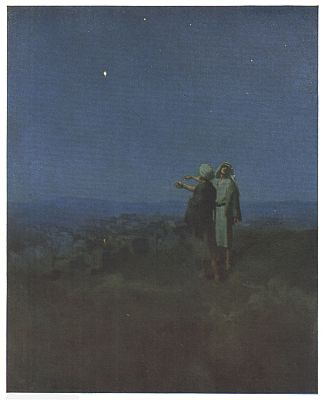
© Curtis Publishing Company
“O Little Town of Bethlehem”
Painted by W. L. Taylor
While Pontius Pilate was governor of Judea and Herod was ruler
of Galilee, a man named John, the son of Zachariah, lived in the desert
country. And God commanded him and he went into all the country
around the river Jordan calling upon men to be baptized to show
that they were sorry for their sins and wished to be forgiven. Those
who were truly sorry for their sins, he baptized in the river Jordan.
This John wore a garment of camel’s hair and a leather belt, and
his food was locusts and wild honey.[226]
Then the people of Jerusalem and all Judea and the country
around the Jordan began to go out to him to confess their sins and
to be baptized by him in the Jordan.
To the crowds that went out to be baptized by him he said,
“You children of vipers! Who warned you to flee from the coming
wrath? Bear fruits, then, that will prove that you are truly sorry
for what you have done. Do not say to yourselves, ‘We are children
of Abraham’; for I tell you, God can raise up children
for Abraham from these stones. Already the axe lies at the root
of the trees. Every tree, therefore, that does not bear good fruit
is cut down and thrown into the fire.”
The crowds kept asking him, “What must we do?” He answered
them, “Let him who has two coats share with him who has none;
and let him who has food do the same.”
When the tax-gatherers came to be baptized, they said to him,
“Teacher, what must we do?” He said to them, “Do not take more
from any one than rightfully belongs to you.” Soldiers also asked
him, “And what must we do?” To them he said, “Do not take
money from anybody by force, nor make false charges, but be content
with your wages.”
Now as the people were wondering whether John might possibly
be the Christ, John said to them all, “I indeed baptize you with
water; but One is coming mightier than I, whose shoe-strings I am
not worthy to untie. He will baptize you with the Holy Spirit and
with fire. His fan is in his hand, and he will thoroughly cleanse his
threshing-floor, and will gather the wheat into his storehouse; but
the chaff he will burn up with fire that cannot be put out.” In this
way, and with many other earnest words, he told the good news to
the people.
Back to Top
JESUS DECIDES HOW HE WILL DO HIS WORK
At this time Jesus came from Nazareth in Galilee and was baptized
by John in the Jordan. And as he was coming up from the
water, he saw the heavens opening and the Spirit, like a dove, coming
down upon him. And a voice from heaven said,
In thee I am well pleased.”
Then Jesus was led by the Spirit into the wilderness to be
tempted by the devil. An[227]d after he had fasted forty days and forty
nights he was hungry. Then the tempter came and said to him,
“If you are the Son of God, command these stones to become
bread.” But Jesus answered, “It is written,
But on every word that comes from God.'”
Then the devil took him to the holy city and, setting him on the
highest point of the Temple, said to him, “If you are the Son of God,
throw yourself down; for it is written,
And on their hands they will bear you up,
Lest you strike your foot against a stone.'”
Jesus said to him, “It is also written,
Once more the devil took him to a high mountain and showed
him all the kingdoms of the world and their glory, and he said to
him, “All these things I will give you if you will fall down and worship
me.” Jesus said to him, “Away with you, Satan! for it is written,
And him only shall you serve.'”
JESUS WINS DEVOTED FRIENDS
Herod seized John the Baptist and bound him, and put him in
prison because of Herodias, his brother Philip’s wife, for John said
to him, “It is not right for you to have her.” And although Herod
wanted to put him to death, he was afraid of the people, for they
believed John to be a prophet.
Now after John was put in prison, Jesus came into Galilee,
preaching God’s good news: “The time has come; repent of your
sins and believe in the good news, for the kingdom of God is
at hand.”
Leaving Nazareth, Jesus went to live in Capernaum, which is
on the Sea of Galilee. As he was passing along the shore of the Sea
of Galilee, he saw Simon and Andrew his brother casting their nets
into the sea, for they were fishermen. Jesus said to them, [228]“Come
with me, and I will make you fishers of men.” And they at once
left their nets and followed him. And going a little farther on, he
saw James, the son of Zebedee, with John his brother, who were in
their boat mending their nets. He called them, and they at once
left their father, Zebedee, in the boat with the hired men, and went
with him.
Then Jesus found Philip and said to him, “Come with me.”
Now Philip was from Bethsaida, the home of Andrew and Peter.
Philip, finding Nathanael, said to him, “We have found him of whom
Moses in the law and also the prophets wrote: Jesus of Nazareth,
the son of Joseph.” But Nathanael said to him, “Can anything
good come out of Nazareth?” Philip replied, “Come and see.”
Jesus saw Nathanael coming to him and said to him, “Here
is a true Israelite, in whom there is no deceit.” Nathanael said to
him, “How do you know me?” Jesus answered, “Before Philip
called you, when you were under the fig-tree, I saw you.” Nathanael
answered him, “Rabbi, you are the Son of God, you are the
King of Israel.” Jesus replied, “Do you believe because I said to
you, ‘I saw you under the fig-tree’? You shall see greater things
than these!”
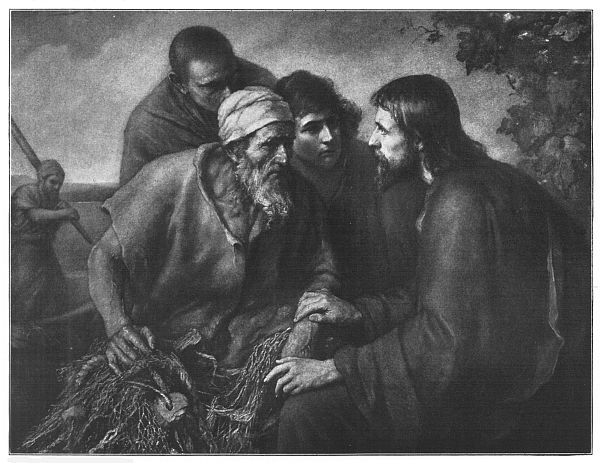
Courtesy of the Hanfstaengl Gallery
Christ and the Fishermen
Painted by E. Zimmerman
THE WEDDING AT CANA
Two days later there was a wedding at Cana in Galilee; and the
mother of Jesus was there. Jesus and his disciples had also been
invited. When the wine had all been used, Jesus’ mother said to
him, “They have no wine.” Jesus answered, “What is that to me?
My time has not yet come.” His mother said to the servants, “Do
whatever he tells you.” Six stone water-jars (such as the Jews used
in washing) were there; each jar would hold about twenty gallons.
Jesus said, “Fill up the jars with water.” So they filled them to
the brim. Then Jesus said, “Pour some out, and take it to the one
in charge of the feast.” And they did so. When the one in charge
of the feast tasted the water which had become wine, he did not know
where it came from (although the servants who had poured out the
water knew), so he called the bridegroom and said to him, “Every
one serves the good wine first, and the wine that is not so good after
men have drunk freely; but you have kept the good wine until now.”
This the first of his wonderful signs, showing his power, Jesus [229]did
at Cana in Galilee; and his disciples believed in him.
Back to Top
THE HEALING OF THE TEN LEPERS
On their way to Jerusalem, Jesus and his disciples passed through
Samaria and Galilee. When he entered a certain village, he was
met by ten lepers, who cried to him from a distance, “Jesus, Master,
have pity on us.” When Jesus saw them he said to them, “Go, and
show yourselves to the priests.” And as they went, they were made
clean.
One of them, when he saw that he was healed, turned back, and
with a loud voice praised God; and he fell down at the feet of Jesus
with his face to the ground and thanked him; and this man was a
Samaritan. Jesus said to him, “Were not ten made clean? Where
are the other nine? Was there no one who returned to give praise
to God except this stranger?” And Jesus said to him, “Arise, and
go on your way, your faith has made you well.”
Back to Top
HEALING THE MAN AT THE POOL
There was a festival of the Jews in Jerusalem, and Jesus went
there. In Jerusalem there is a pool beside the sheep gate. In
Hebrew it is called, Bethesda. It has five porches, and a crowd of
people who were sick, blind, lame or helpless were lying there, waiting
for the water to move, for an angel of the Lord went down into
the pool at certain times and stirred the water; and the first person
who stepped into the water after it was stirred was made well, no
matter what disease he had.
One man was there who had been ill for thirty-eight years. Jesus
saw him lying there, and knew that he had been ill for a long time;
and he said to him, “Do you want to be made well?” The sick
man answered, “Sir, I have no one to put me in the pool when the
water is stirred, and while I am getting in, some one else steps in
before me.” Jesus said to him, “Arise, take up your bed, and walk.”
Immediately the man was made well, and he took up his bed and
walked.
Back to Top
JESUS TALKS WITH A SAMARITAN WOMAN
When Jesus left Judea and went back into Galilee, he had to pass
through Samaria; and he came to a city of Samaria called Sychar,
near the piece of ground that Jacob gave his son Joseph. Now
Jacob’s well was there. Jesus, therefore, being wearied by the journey,
sat down by the well. It was about noon and a woman of Samaria
came to draw water. Jesus said to her, “Give me a drink.”
(For his disciples had gone away into the city to buy food.)
The Samaritan woman said to him, “How is it that you, a Jew,
ask a drink of me who am a Samaritan?” for the Jews have nothing
to do with Samaritans. Jesus answered her, “If you knew the gift
of God and who it is who says to you, ‘Give me a drink,’ you would
have asked him and he would have given you living water.” The
woman said to him, “Sir, you have nothing with which to draw and
the well is deep; where then do you get that living water? Are you
greater than our father Jacob who gave us the well and himself drank
from it, together with his children and his cattle?” Jesus answered
her, “Whoever drinks of this water will thirst again; but whoever
drinks of the water that I will give shall never thirst. The water
that I give him will become in him a well of water springing up into
eternal life.” The woman said to him, “Sir, give me this water,
that I may not thirst again nor have to come here to draw.”
Jesus said to her, “Go, call your husband, then come back here.”
The woman answered, “I have no husband.” Jesus said to her,
“You are right in saying, ‘I have no husband,’ for you have had
five husbands, and he whom you now have is not your husband;
in saying that, you spoke the truth.”
The woman said to him, “Sir, I see that you are a prophet. Our
fathers worshipped in this mountain; and you Jews say that Jerusalem
is the place where men ought to worship.” Jesus said to her,
“Woman, believe me, the time will come when you will worship
the Father neither on this mountain nor at Jerusalem. The time is
coming, yes, has already come, when the true worshippers will worship
the Father in spirit and in truth; for such worshippers the
Father seeks. God is a spirit, and they who worship him must worship
him in spirit and in truth.” The woman said to him, “I know
that the Messiah (which means Christ) is coming. When he comes
he will explain all things to us.” Jesus said to her, “I who am talking
to you am he.”[231]
At this point the disciples came up and were astonished that
he was talking with a woman; but none of them said, “What do
you want?” or, “Why are you talking to her?”
Then the woman left her water-pot and going into the city said
to the men, “Come, see a man who told me all that I ever did. Is
not this the Messiah?” And they set out from the town on their
way to him.
Meanwhile Jesus’ disciples urged him, saying, “Master, take
some food”; but he said to them, “I have food to eat of which you
know not.” So they said to one another, “Has any one brought
him something to eat?” Jesus said to them, “My food is to do the
will of him who sent me and to carry out his work. Do not
say, ‘Four months and then comes the harvest’; I say to you, lift
up your eyes and see these fields white for the harvest! Already the
reaper is receiving his wages and gathering in a crop for eternal life,
that the sower and reaper may rejoice together. For here the
proverb holds true, ‘One sows and another reaps.’ I sent you to
reap a harvest for which you had not toiled; other men have toiled
and you are sharing the results of their toil.”
Because of the words of the woman who had said, “He told me
everything that I ever did,” many Samaritans from the town believed
in Jesus; and when they came to him, they begged him to
stay with them. And he stayed there two days, and many more
believed because of what he himself said. To the woman they said,
“Now we believe, not because of your words but because we have
heard for ourselves and know that this is indeed the Saviour of the
world.”
Back to Top
GIVING LIFE TO A WIDOW’S SON
Jesus went to a town called Nain; and his disciples went with
him followed by a large crowd. Just as Jesus came to the gate of
the town, he saw one who was dead being carried out. He was the
only son of his mother who was a widow. Many people of the town
were with her.
When Jesus saw her, he had sympathy for her and said to her,
“Do not weep.” And he came and touched the coffin, and those who
carried it stood still. Jesus said: “Young man, I say to you, arise.”
And he who had been dead sat up and began to speak. And Jesus
gave him back to his mother. And all the people were filled with[232] fear and praised God, saying, “A great prophet has appeared among
us, and God has visited his people.” And the story of what Jesus
had done was told in all of Judea and the country around there.
Back to Top
JESUS HEALS THE SICK
Jesus and his disciples entered Capernaum; and on the next
Sabbath he went into the synagogue and began to teach. And the
people were astonished at his teaching, for he taught them as one
who had authority, and not as the scribes.
In their synagogue that day was a man under the power of an
unclean spirit, who cried out, “What have you to do with us, Jesus
of Nazareth? Have you come to destroy us? I know you are God’s
Holy One.” But Jesus reproved the unclean spirit, saying, “Be
still, and come out of him.” Then the unclean spirit, after convulsing
the man, came out of him with a loud cry. The people were
so astonished that they began to ask one another, “What is this?
Is it a new teaching? With authority he commands even the unclean
spirits and they obey him.” So the news about Jesus spread
at once in every direction all through the country about Galilee.
After leaving the synagogue they went straight to the house of
Simon and Andrew; and James and John went with them. The
mother of Simon’s wife was ill in bed with a fever; so at once they
told Jesus about her. He went to her and, taking her by the hand,
lifted her up. Then the fever left her, and she began to wait upon
them.
In the evening, after the sun had set, they brought to him all
who were sick or under the control of evil spirits, until all the people
of the city were gathered at the door. He healed many who were
sick with different kinds of diseases, and cast out many evil spirits,
but would not let them speak, because they knew who he was.
One day a leper came to him and on bended knees begged him:
“If you will, you can make me clean.” Feeling sorry for him, Jesus
stretched out his hand and touched him, and said, “I will; be
cleansed!” At once the leprosy left him and he was cleansed. Then
Jesus, after strictly warning him, sent him away with the command,
“See that you do not say a word to any one, but go, show yourself
to the priest and offer what Moses commanded as proof to them
that you are clean.” But the man went away and began to tell every[233] one about it, so that Jesus could no longer enter a city openly, but
had to stay outside in lonely places; and people from everywhere
came to him.
Back to Top
JESUS CURES A MAN WHO CANNOT WALK
When Jesus entered Capernaum again, after some days, it was
reported that he was at home, and so many people gathered about
him that there was no longer room for them, not even at the door.
While Jesus was preaching to them, four men came, carrying a man
who was paralyzed and could not move. As they could not get near
to Jesus on account of the crowd, they tore up the roof over his head.
When they had made a hole, they let down the bed on which the
man who could not move was lying. Seeing their faith, Jesus said
to him, “Son, your sins are forgiven.” But some of the scribes
sitting there said to themselves, “Why should this man say such a
thing? He is blaspheming! Who can forgive sins except God
alone?”
Knowing at once what they were saying, Jesus said to them,
“Why do you say these things to yourselves? Which is easier: to
say to the man who cannot move, ‘Your sins are forgiven’; or to
say, ‘Get up, take your bed, and walk’? But that you may know
that the Son of Man has the power on earth to forgive sins” (he
said to the man who could not walk) “I say to you, Rise, take up
your bed, and go to your home.” Then the man rose and at once
took up his bed and went out in the presence of them all, so that
they were all filled with wonder and praised God, saying, “We have
never seen anything like this.”
Back to Top
JESUS MAKES EVEN WRONG-DOERS HIS FRIENDS
Then Jesus went out again beside the Sea of Galilee; and all
the crowd came to him, and he taught them. As he passed along
he saw Levi, the son of Alphæus, sitting at the house where taxes
were collected, and he said to him, “Come with me.” So Levi arose
and followed him.
Now while Jesus was eating dinner in Levi’s house, many tax-gatherers
and sinners sat down with Jesus and his disciples. The
scribes and Pharisees, seeing this, said to his disciples, “Does he eat
with tax-gatherers and sinners?” On hearing this, Jesus said[234] to
them, “Not those who are well, but those who are sick have need
of a physician. I did not come to call the righteous but sinners to
repentance.”
At another time one of the Pharisees invited Jesus to dine with
him. So Jesus entered the Pharisee’s house and sat down at the
table. In the town was a wicked woman who, when she heard that
Jesus was sitting at the table in the Pharisee’s house, brought an
alabaster jar of perfume. She stood behind at his feet, weeping;
and as her tears began to wet his feet, she wiped them with her hair.
And she tenderly kissed his feet and poured the perfume over them.
When the Pharisee who had invited him saw it, he said to himself,
“If this man were a prophet, he would know about the woman
who is touching him, for she is a sinner.”
Jesus answered him, “Simon, I have a word to say to you.” He
replied, “Say it, Master.” “There were two men who owed a certain
money-lender some silver: one owed him five hundred silver
pieces and the other fifty. Neither of them was able to pay anything;
so he forgave them both. Now which of them will love him
the more?” Simon answered, “I suppose the man who owed the
most.” Jesus said to him, “You have decided rightly.”
Turning to the woman, Jesus said to Simon, “You see this
woman? When I came into your house, you gave me no water for
my feet; but she has wet my feet with her tears and wiped them
with her hair. You gave me no kiss, but she, since I came in, has
not ceased tenderly to kiss my feet. You did not pour any oil on
my head, but she has poured perfume on my feet. Therefore, I say
to you, her sins, though they be many, are forgiven, for she has loved
much. He to whom little is forgiven, loves little.”
Then Jesus said to her, “Your sins are forgiven.” And the other
guests began to say to themselves, “Who is this man who even
forgives sins?” But he said to the woman, “Your faith has saved
you; go and be at peace.”
Back to Top
JESUS FINDS JOY IN ALL HIS WORK
Once when John’s disciples and the Pharisees were keeping a fast,
people came to Jesus and said, “Why do the disciples of John and
the disciples of the Pharisees fast, but your disciples do not fast?”
Jesus said to them, “Can guests fast at a wedding while the
bridegroom is with them? As long as they have the bridegroom[235] with them they cannot fast. But the time will come when the bridegroom
is taken away from them; then they will fast. No one sews
a piece of new cloth on an old coat; otherwise the patch breaks away
from it, the new from the old, and the tear is made worse. No man
pours new wine into old wine-skins; otherwise the new wine bursts
the skins, and both the wine and the wine-skins are lost. Instead
new wine is poured into fresh wine-skins.”
One Sabbath Jesus was walking through the grain-fields; and
his disciples, as they made their way through, began to pull off the
heads of the grain. The Pharisees said to him, “Sir, why are they
doing things that on the Sabbath are unlawful?” He said to them,
“Have you never read what David did when he and his followers
were in need and hungry? how he went into the house of God, when
Abiathar was high priest, and ate the holy bread which only the priests
are allowed to eat, and gave it also to those who were with him?”
And Jesus said to them, “The Sabbath was made for man, and
not man for the Sabbath; so that the Son of Man is master even
of the Sabbath.”
At another time he went into a synagogue. A man was there
whose hand was shrivelled. And they watched Jesus to see whether
he would heal him on the Sabbath day, that they might bring
a charge against him. Jesus said to the man whose hand was shrivelled,
“Rise and come forward.” Then he said to them, “Is it lawful
on the Sabbath day to do good or to do harm? To save life or
to kill? Who of you, if he has but one sheep and it falls into a hole
on the Sabbath, will not take hold of it and lift it out? Is not a man
of much greater value than a sheep?” But they did not answer.
Then looking around upon them with sorrow and indignation because
they had no sympathy, he said to the man, “Stretch out your
hand.” He stretched it out, and his hand was entirely cured. But
the Pharisees went out and at once began to plot with the Herodians
against him, how they might put him out of the way.
Back to Top
JESUS CALMS THE STORM
Jesus withdrew to the sea with his disciples, and a crowd followed
him from Galilee. Also from Judea, Jerusalem, Idumea the
other side of the Jordan, and from the country about Tyre and Sidon
a great number, having heard what he was doing, came to him. So
he told his disciples to have a small boat ready for him to keep him
from being crushed by the crowd; for he had healed so many that[236] all who were sick and in trouble were pressing forward to touch him.
And whenever those who had evil spirits saw him, they fell down
before him and cried, “You are the Son of God.” But again and
again he commanded them not to tell who he was.
In the evening Jesus said to his disciples, “Let us cross to the
other side.” So, leaving the crowd, they took him with them in the
boat just as he was; and there were other boats with his. A heavy
wind-storm arose and the waves began to break into the boat so that
it was filling; but Jesus was in the stern asleep on the cushion. So
they woke him and said to him, “Master, is it nothing to you that
we are lost?” And he awoke and reproved the wind, and said to
the sea, “Peace, be still!” And immediately the wind ceased and
the sea was calm; and he said to them, “Why are you afraid? Why
do you not have faith?” But they were filled with wonder and said
to one another, “Who then is he, that even the wind and the sea
obey him?”
Back to Top
JESUS HEALS A LITTLE GIRL
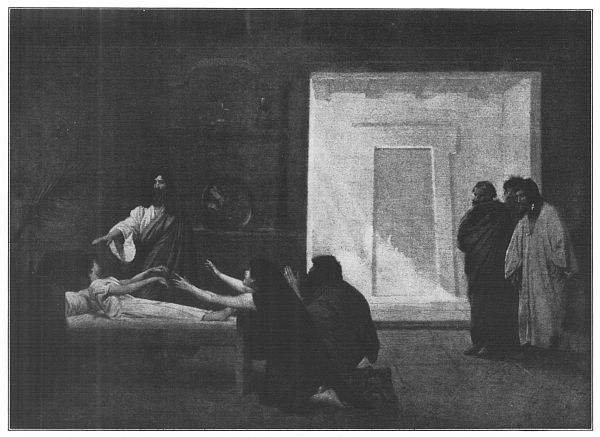 Raising the Daughter of Jairus
Painted by Léon Gérôme
When Jesus again crossed the Sea of Galilee in a boat to the other
side, a large crowd had gathered to meet him; so he stayed beside
the sea. One of the rulers of the synagogue, Jairus by name, came
up, and, on seeing Jesus, fell at his feet and earnestly begged him,
saying, “My little daughter is dying; come, I beg of you, and place
your hands on her that she may be cured and live.” So Jesus went
with him, and a great crowd followed and pressed about him.
In the crowd was a woman who had suffered from hemorrhage
for twelve years and had been treated by many physicians, spending
all that she had, yet was none the better, but rather had grown
worse. Having heard about Jesus, she came up behind him in the
crowd and touched his robe, for she said to herself, “If I can but
touch his garments, I shall be cured.”
Immediately the hemorrhage stopped, and she knew that she
was cured of her disease. Jesus, knowing at once that healing power
had gone from him, turned around in the crowd and said, “Who
touched my garments?” His disciples said to him, “You see the
crowd pressing around you, and yet do you ask, ‘Who touched
me?'” But still he looked for her who had done this, until the
woman, frightened and trembling, knowing what had happened to
her, came forward and fell down before him and told him the[237] truth.
He said to her, “Daughter, your faith has cured you. Go and live
in peace, and be healed of your disease.”
While Jesus was still speaking, messengers came from the house
of the ruler of the synagogue, saying, “Your daughter is dead. Why
trouble the Master further?” But Jesus, overhearing the message,
said to the ruler of the synagogue, “Have no fear, only trust.”
Jesus would allow no one to go with him except Peter and James
and John the brother of James. When they came to the house of
the ruler of the synagogue, he found a crowd of people weeping aloud
and wailing. Entering, Jesus said to them, “Why are you making
an uproar and weeping? The child is not dead, but asleep.” And
they laughed at him scornfully. But he sent them out and took the
father and mother of the child and those who were with him into
the room where she was. Then, taking her by the hand, he said
to her, “Talitha koumi,” which means, “Little girl, arise.” To the
astonishment of all, the little girl (who was twelve years of age) got
up at once and walked about. But Jesus charged them strictly to
let no one know of this, and told them to give the little girl something
to eat.
Back to Top
JESUS VISITS HIS OLD HOME
Jesus went to Nazareth where he had been brought up. As was
his custom, he went into the synagogue on the Sabbath, and stood
up to read the lesson. And he was given the scroll of the prophet
Isaiah, and on unrolling it he found the place where it is written:
For he has called me to preach good news to the poor,
He has sent me to proclaim release to captives,
And recovery of sight to the blind,
To set free those who have been crushed by cruelty,
To proclaim the year when the Lord will show favor.”
Then, having rolled up the scroll, he handed it back to the attendant
and sat down. The eyes of all in the synagogue were fixed
on him, and he said to them, “To-day what is here written is fulfilled
in your sight.”
As he went on to teach in the synagogue, many who heard him
were astonished and said: “Where did he get these teachings?
What is this wisdom which has been given him? and what are these
wonderful acts of healing that he does? Is he not the carpe[238]nter,
the son of Mary and the brother of James and Joses and Judas and
Simon? Are not his sisters living here among us?” And they would
not believe in him. Jesus said to them, “A prophet is not without
honor except in his own country and among his relatives and in his
own home.”
In that place he could do no wonderful acts except laying his
hands on a few sick people and healing them; and he was astonished
at their lack of faith. So he went about the near-by villages teaching.
Back to Top
JESUS CALLS TOGETHER HIS FRIENDS AND HELPERS
Jesus went up on the hillside near Capernaum and called to him
the men whom he wanted, and they came to him. He appointed
twelve to be with him and to go out to preach, with power to cast
out evil spirits. These were the twelve disciples: Simon to whom
he gave also the name Peter, James the son of Zebedee and John his
brother, whom he called “Sons of Thunder,” Andrew, Philip, Bartholomew,
Matthew, Thomas, James the son of Alphæus, Thaddeus,
Simon the Zealot, and Judas Iscariot, who at last betrayed him.
Then Jesus went into a house and the crowd gathered again so
that it was impossible even to eat a meal. When his relatives heard
of this, they set out to get hold of him, for they said, “He is out of
his mind.” Standing outside, his mother and his brothers sent word
to him to come out to them. He was in the midst of a crowd seated
about him when some one said to him, “Here are your mother and
your brothers and sisters outside hunting for you.” He answered,
“Who are my mother and my brothers?” Then looking around at
those who sat in a circle about him, he said, “Here are my mother
and my brothers. Whoever does the will of God is my brother and
sister and mother.”
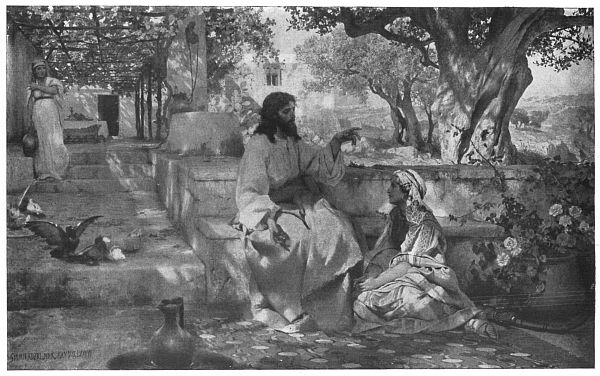 Christ with Mary and Martha
 Painted by H. Siemiradzki
WHAT JESUS ASKS OF HIS FRIENDS AND HELPERS
Once Jesus entered a certain village where a woman named
Martha invited him to her house. She had a sister named Mary
who seated herself at Jesus’ feet and listened to his words. But
Martha was worried by her desire to wait on him, and came and
said to him, “Lord, do you not care that my sister has left me to
do all the work alone? Tell her to help me.” But Jesus said to[239] her, “Martha, Martha, you are anxious and troubled about many
things, but few things are necessary, really only one. Mary has
chosen the better part, which shall not be taken away from her.”
Once when Jesus and his disciples were walking along the road,
some one said to him, “I will follow you wherever you go.” Jesus
said to him, “The foxes have holes and the wild birds their nests,
but the Son of Man has no place to lay his head.” He said to another,
“Follow me”; but the man said, “Let me first go and bury
my father.” Jesus said to him, “Let the dead bury their dead, but
you go and tell about the Kingdom of God.” Still another said,
“I will follow you, Lord, but let me first say good-by to my people
at home.” Jesus said to him, “No one who looks back after having
put his hand to the plough is fit for the Kingdom of God.”
Once, when crowds were following him, he turned and said to
them, “If any one who comes to me is not willing to give up his
father and mother and wife and children and brothers and sisters,
yes, and his very life, he cannot be my disciple. Whoever does not
carry his own cross, as he follows me, cannot be my disciple.
“Who of you, if he wishes to build a tower, does not first sit down
and count the cost, to see whether he has money enough to finish
it? Otherwise, if he has laid the foundation and is unable to finish
the building, all who see it make fun of him and say, ‘This man
began to build but could not finish!'”
Back to Top
THE WAY TO LEARN FROM JESUS
Jesus taught his disciples, saying, “Do not think that I came to
set aside the old law or the teachings of the prophets. I did not come
to set them aside but to complete them.
“Come to me, all you who labor and are heavily burdened, and
I will give you rest. Take my yoke upon you and learn of me, for
I am kind and sympathetic, and you will find rest, for my yoke is
easy and my burden light.
“He who hears these words of mine and keeps them in mind will
be like a wise man who built his house upon the rock. The rain
fell, the floods came, the winds blew and beat upon that house; yet
it did not fall, for its foundation was built on the rock.
“He who hears these words of mine but does not keep them in
mind will be like a foolish man who built his house upon s[240]and. The
rain fell, the floods came, the winds blew and beat upon that house,
and it fell, and great was its downfall.”
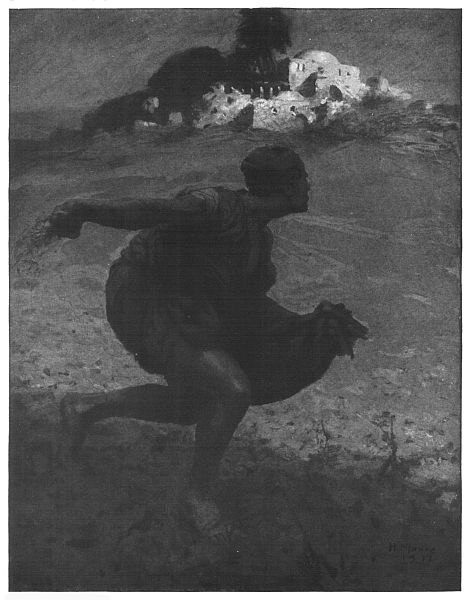
© Curtis Publishing Company
The Sower
Painted by Herbert Moore
At another time when Jesus was teaching beside the lake, such
a large crowd gathered about him that he entered a boat and sat
in it, while the crowd stayed on the shore. He then taught them
many truths by means of stories, and said, “Listen to me. The
sower went out to sow, and as he sowed, some of the seed fell on the
road where birds came and ate it up. Some fell on rocky ground,
where it had but little soil, and because there was no depth of earth
it began to grow at once; but when the sun rose, it was scorched
with the heat, and having no root it withered away. Some of the
seed fell among thorns, and the thorns grew up and choked it so that
it bore nothing. Other seed fell on good soil, and sprouted and grew
and bore at the rate of thirty, sixty, and a hundredfold.” And he
said to them, “Let him who has ears to hear, remember this.”
When Jesus was alone, those who were with him and the twelve
disciples asked him what this story meant. He said to them, “Do
you not see the meaning of this? How then will you understand
all my other stories? The sower sows his teaching. The teaching
that is sown along the road is like some people who hear but immediately
Satan comes and takes away the teaching which has been
sown in them.
“And the seed that has been sown on rocky places, is like those
people who hear the teaching and receive it at once with joy, but it
takes no root in them and they remember it only for a short time.
“The seed sown among thorns is like those who hear the teaching
but the pleasures of this life, the desire for wealth and other
things makes them forget the teaching, and so it bears no fruit.
“But the seed sown on good soil is like those people who hear
the teaching and remember it, and it bears fruit; some thirty, some
sixty, and some a hundredfold.
“Can a blind man guide a blind man? Will not both fall into a
ditch? A disciple is not above his teacher; but every pupil when
perfectly trained will be like his teacher.
“No good tree bears rotten fruit; neither does a rotten tree bear
good fruit; for each tree is known by its own fruit. Figs are not
gathered from thorns, nor grapes picked from a bramble-bush. From
the good stored in his heart the good man brings forth goodness, but
the evil man from his evil store brings forth evil; for the mouth
speaks that with which the heart is filled.
“You are the light of the world. A city on a hill cannot be hidden.
One does not light a candle to put it under a basket but on a
stand, where it shall give light to all who are in the house. So let
your light shine before men that they may see your good deeds and
praise your heavenly Father.”
Back to Top
THE REWARDS FOR FOLLOWING JESUS’ TEACHINGS
James and John, the sons of Zebedee, once came to Jesus and
said, “Master, we want you to do for us what we shall ask.” So
he said, “What do you want me to do for you?” They answered,
“When you enter into your kingly glory, let one of us sit on your
right hand and one on your left.” But Jesus said to them, “You
do not know what you are asking. Can you drink the cup of woe
that I am to drink, or be baptized with the baptism of suffering with
which I am to be baptized?” They said to him, “We can.” Jesus
said, “You will drink the cup that I am to drink and be baptized
with my baptism, but to sit on my right hand and on my left is not
mine to give; for it is for those for whom it has been prepared.”
When the ten other disciples heard this request, they were at
first angry with James and John, but Jesus called them to him and
said, “You know that those who are rulers in foreign countries lord
it over those under them, and their great men have authority over
them; but it is not so among you. Whoever wishes to be great
among you must serve you, and whoever wishes to be first among
you must be ready to be the servant of all. For I did not come to be
served but to be of service to others, and to give my life so as to
secure freedom for many.”
Then he took a little child and set him in their midst. And taking
him in his arms, he said to them, “Whoever receives a little child
like this, in my name, receives me; and whoever receives me receives
not only me, but God who sent me. Whoever gives one of these
little ones even a cup of cold water to drink because he is my disciple
will, I tell you, not lose his reward.
“When the Son of Man comes in his glory and with him all the
angels, he will sit upon his glorious throne, and all people shall be
gathered before him. And he will separate them one from another
as a shepherd separates the sheep from the goats, placing the sheep
on his right hand and the goats on his left.
“Then the King will say to those on his right, ‘Come, you whom
my Father has blessed, enter into possession of the kingdom prepared
for you since the creation of the world; for I was hungry and
you gave me food, I was thirsty and you gave me drink, I was
a stranger and you welcomed me, I was naked and you clothed me, I
was sick and you cared for me, I was in prison and you came to me.’
“Then the upright will answer him, ‘Lord, when did we see you
hungry and feed you? Or thirsty and give you drink? When did
we see you a stranger and welcome you? Or naked and clothe you?
Or when did we see you sick or in prison and come to you?’ The
King will answer them, ‘Truly, I say to you, as you have done it
even to the least of these my brothers, you have done it to me.'”
Back to Top
GOD’S LOVE EVEN FOR SINNERS
© Curtis Publishing Company
Seeking the Lost Sheep
Painted by Herbert Moore
Because tax-gathers and sinners kept coming to Jesus to hear
him, the Pharisees and scribes complained, “This man welcomes
sinners and even eats with them!” So he told them this story:
“What man of you, if he has a hundred sheep and loses one, does
not leave the ninety-nine in the wilderness and go and hunt for the
lost sheep until he finds it? And when he has found it, he joyfully
puts it on his shoulders and when he gets home calls together his
friends and says, ‘Rejoice with me, for I have found the sheep that
I lost.’ So, I tell you, there will be more joy in heaven over one sinner
who is truly sorry and promises to do right than over ninety-nine
upright men who have no need to do so.
“Or which one of you women, if she has ten silver coins but has
lost one, does not light a lamp, sweep the house thoroughly, and
search carefully until she finds it? After finding it she calls together
her friends and neighbors and says, ‘Rejoice with me, for I have
found the coin that I lost.’ So, I tell you, there is rejoicing among
the angels of God over one sinner who is truly sorry and promises
to do right.”
Jesus said, “There was a man who had two sons. The younger
said to his father, ‘Father, give me the part of your property that
belongs to me.’ So the Father divided his property between his
two sons. A few days later, the younger son got together all that
he had and went into a distant country where he wasted his money
in reckless living. After he had spent it all, there was a great famine
in the land, and he began to be in want. So he agreed to work for
a man of that country, who sent him into his fields to feed swin[243]e;
and he was ready to eat even the pods that the swine were eating, for
no one gave him food. But when he came to himself he said, ‘How
many of my father’s hired servants have more than enough to eat
while I die here of hunger! I will go to my father and say, ‘Father,
I have sinned against God and against you. I am no longer worthy
to be called your son. Treat me as one of your hired servants.’
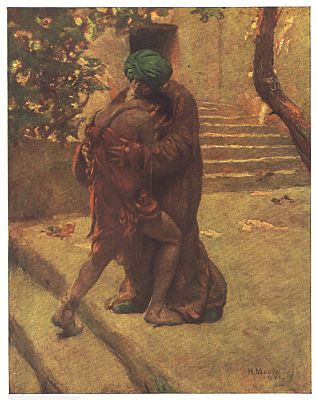
© Curtis Publishing Company
The Prodigal Son
Painted by Herbert Moore
“So he went to his father. But while he was still a long way
off, his father saw him and felt pity for him, and ran and threw his
arms about his neck and tenderly kissed him. Then his son said to
him, ‘Father, I have sinned against God and against you. I am
no longer worthy to be called your son.’ But the father said to his
servants, ‘Quick, bring a coat, the best, and put it on him and put
a ring on his finger and sandals on his feet. And bring the fatted
calf, kill it, and let us eat and be merry; for this son of mine was
dead but has come back to life, he was lost but has been found.’ So
they began to make merry.
“Now the elder son was out in the fields, and as he came near
the house he heard music and dancing. And he called one of the
servants and asked what all this meant. The servant said to him,
‘Your brother has come, and your father has killed the fatted calf
because he has him back safe and sound.’ And he was angry and
would not go in so his father came out to reason with him, but he
answered, ‘See all these many years I have worked for you and never
disobeyed one of your commands, yet you never gave me so much
as a young goat that I might have a feast with my friends. But
now when this son of yours comes, who has wasted your money with
wicked women, you kill the fatted calf for him!’ His father answered,
‘Son, you are with me always and all that I have is yours;
but it was right to make merry and rejoice because of your brother,
for he was dead but has come back to life, he was lost but has been
found.'”
Back to Top
GOD’S READINESS TO ANSWER PRAYER
Jesus said: “Ask and you will receive, seek and you will find,
knock and the door will be opened to you; for every one who asks
receives, and he who seeks finds, and to him who knocks the door
will be opened.
“What man is there among you, who if his son asks him for a
loaf of bread, [244]will give him a stone? Or if he asks for a fish, will give
him a snake? Then if you, evil as you are, know how to give good
gifts to your children, how much more will your Father in heaven
give good things to those who ask him.
“Also I tell you: if two of you on earth agree about that
for which you ask, it will be granted to you by my Father in heaven.
For where two or three have gathered together in my name, I am
there with them.”
Back to Top
HOW TO PRAY
The apostles said to Jesus, “Help us to have greater faith.” But
he said, “If you had faith even the size of a mustard-seed and said
to this mulberry-tree, ‘Be rooted up and be planted in the sea,’ it
would obey you.”
Again he said to them, “Have faith in God. Indeed I tell you
that if any one will say to this hill, ‘Throw yourself into the sea,’
and has no doubt in his heart but believes that what he says will
come to pass, it shall be done for him. Therefore, I say to you, believe
that whatever you ask for in prayer you have received, and it
shall be yours. And whenever you stand up to pray, if any one has
done wrong to you, forgive him, that your Father in heaven may
also forgive you your wrong-doing.”
When Jesus was praying at a certain place and had finished, one
of his disciples said to him, “Lord, teach us to pray as John taught
his disciples.” So he said to them, “When you pray, say: ‘Our
Father who art in heaven, hallowed be thy name, thy kingdom come,
thy will be done on earth as it is in heaven. Give us this day our
daily bread, and forgive us our wrong-doings as we have forgiven
those who have wronged us. Help us to resist temptation and deliver
us from evil.’
“When you pray, do not do as the hypocrites who like to stand
and pray in the synagogues and on the corners of the main streets
so as to be seen by men. I tell you, they have received their full
reward! But when you pray, go into your room, close the door,
and pray to your Father who is found in secret, and your Father
who sees what is done in secret will give you your reward.
“When you pray do not say the same things over and over as do
the heathen, who believe [245]that they will be heard because of their
many words. Do not do as they do. Your Father knows what
things you need before you ask him.”
Back to Top
WHY WE SHOULD TRUST GOD
“Do not be anxious about your life, what you shall eat, or what
you shall wear. Does not life mean more than food, and the body
more than clothing? Consider how the birds of the air neither sow
nor reap nor gather into barns, and yet your heavenly Father feeds
them. Are you not worth far more than they? Are not two sparrows
sold for a penny? Yet not one of them falls to the ground without
your Father’s knowledge. As for you, the very hairs of your head
are numbered. Then have no fear, for you are worth far more than
the sparrows.
“Which of you by being anxious can add a single foot to his
height? And why be anxious about what you wear? Consider the
lilies of the field, how they grow! They neither toil nor spin, and
yet I tell you, not even Solomon in all his splendor was clothed like
one of these. Now if God so clothes the grass of the field which is
alive to-day but to-morrow is thrown into the oven, is it not far more
certain that he will clothe you, O men of little faith?
“Do not be anxious then and say, ‘What shall we eat or what
shall we drink or with what shall we be clothed?’ For all these
things the heathen are seeking, but your heavenly Father knows
that you need all these things. Seek first to do right as he would
have you do, and all these other things will be given to you. Therefore,
do not be anxious about to-morrow, for to-morrow will take
care of itself.”
Back to Top
THE KINGDOM OF GOD
Once when little children were brought to Jesus that he might
touch them, the disciples found fault with those who brought them.
When Jesus saw it, he was displeased and said to his disciples, “Allow
the little children to come to me; and do not forbid them, for
of such as these is the Kingdom of God. I tell you, whoever will
not accept the Kingdom of God like a little child, will never enter
it.” Then he took the children in his arms, laid his hands on them,
and lovingly blessed them.
One Sabbath day Jesus went to dine at the house of a leading
Pharisee. One of the guests said to him, “Fortunate is he who will
have a share in the Kingdom of God.”
But Jesus said to him, “A man once gave a great dinner and invited
many guests. At dinner-time he sent out his servant to say
to those who had been invited, ‘Come, for everything is now ready.’
But all of them began to make excuses. The first said, ‘I have
bought a field and must go and look at it. I must ask you to excuse
me.’ Another said, ‘I have bought five yoke of oxen and am
on my way to try them. I must ask you to excuse me.’ Another
said, ‘I have just married and so I cannot come.’
“The servant returned and reported these answers to his master.
Then the master of the house was angry and said to his servant,
‘Go out at once into the streets and alleys of the city, and bring
in the poor, the crippled, the blind, and the lame.’ When the servant
reported, ‘Sir, your order has been carried out, yet there is still
room,’ the master said to him, ‘Go out into the highways and the
country lanes and compel people to come, so that my house may be
filled; for I tell you, that not one of those who were first invited
shall taste of my dinner.'”
Once when Jesus was walking along the road, a man ran up and
knelt before him and asked, “Good Master, what must I do that I
may be sure of eternal life?” Jesus said to him, “Why do you call
me good? No one is good except one only: God. You know the
commandments: ‘Do not commit adultery. Do not murder. Do
not steal. Do not bear false witness. Do not be dishonest. Honor
your father and mother.'” He said to him, “Master, I have kept
all these commands from my youth.” Looking upon him, Jesus loved
him and said, “One thing you lack; go, sell all that you have and
give to the poor, and you will have treasure in heaven. Then come
with me.” But when the man heard this, he looked sad, and he went
away in sorrow, for he had great wealth. Then Jesus looked around
and said to his disciples, “How hard it is for those who have wealth
to enter the Kingdom of God!” They were surprised at his words,
but again he said, “Children, how hard it is for those who trust in
wealth to enter the Kingdom of God. It is easier for a camel to go
through a needle’s eye than for a rich man to enter the Kingdom of
God.” And they were so astonished that they said, “Then who can
be saved?” Jesus looked at them and said, “With men it is impossible,
but not with God, for with God everything is possible.”
Back to Top
THE TWO GREAT COMMANDMENTS
Once a lawyer asked Jesus, “What is the most important of all
the commandments?” Jesus answered, “The most important is:
‘The Lord our God is one Lord; and you shall love the Lord your
God with your whole heart, with your whole soul, with your whole
mind and with your whole strength.’
“The second is this: ‘You shall love your neighbor as yourself.’
There is no other commandment greater than these.”
The lawyer said to him, “Teacher, you have rightly and truly
said, ‘There is one God and there is none other. Also to love him,
with all one’s heart, and with all one’s understanding, and with all
one’s strength, and to love one’s neighbor as one loves himself is
far more than all whole-burnt offerings and sacrifices.'”
When Jesus saw that the lawyer had answered wisely, he said
to him, “You are not far from the Kingdom of God.”
Back to Top
THE REWARDS OF MODESTY AND UNSELFISHNESS
Once Jesus went into the house of a leading Pharisee to dine.
When he saw how the guests chose the best places, he gave them
this advice: “When any one invites you to a marriage feast, do
not sit down in the best place, for perhaps the host has invited
some one of higher rank than yourself. Then the host will come
to you and say, ‘Make room for this man,’ and with shame you will
take the lowest place.
“Instead, when you are invited, go and sit down in the lowest
place, so that when your host comes he may say to you, ‘Friend,
come up higher.’ Then you will be honored in the sight of all your
fellow guests. For every one who puts himself forward will be humbled,
but he who does not put himself forward will be honored.”
Then Jesus said to his host, “When you give a dinner or a supper,
do not invite your friends or brothers or relatives or rich neighbors,
for they will invite you in return and you be repaid. But when you
give a feast, invite the poor, the crippled, the lame and the blind.
Then you will be blessed. For they have no way of repaying you, and
you will be rewarded when the upright rise from the dead.”
Peter said to him, “But we have left everything and have followed
you.” Jesus answered, “I tell you, there is no one who has
left home or brothers or sisters or mother or father or children or
lands for my sake and for the good cause, who does not receive a
hundredfold as much at this present time: houses, brothers, sisters,
mothers, children, and lands, along with persecution, and in the time
to come eternal life. But many who are first now will be last, and
the last will be first.”
Back to Top
HOW TO USE MONEY
A man from the crowd once said to Jesus, “Master, tell my
brother to give me my share of the property that belongs to us.”
Jesus answered, “Man, who made me your judge to divide between
you?” Then to the people he said, “Take care that you do not become
greedy for wealth, for life does not consist in having more
things than you need.”
And he told them this story: “The land of a certain rich man bore
large crops; so he thought to himself, ‘What am I to do, for I have
no place to store my crops.’ Then he said, ‘This is what I will do:
I will pull down my barns and build larger ones in which I can store
all my grain and goods. Then I will say to myself, Now you have
plenty of things laid up for many years to come; take your ease,
eat, drink and be happy.’
“But God said to him, ‘Foolish man! This very night your life
is required of you, and who will have all the things that you have
gathered?’ So it is with the man who lays up wealth for himself
instead of that which in the sight of God is the true wealth.
“Do not store up for yourselves treasures on earth where moth
and rust destroy, and where thieves break in and steal; but store
up for yourselves treasures in heaven where neither moth nor rust
destroys, and where thieves do not break in and steal. For where
your treasure is, there will your heart be also.
“No man can serve two masters: either he will hate one and
love the other, or else he will be loyal to one and untrue to the other.
You cannot worship both God and wealth.”
Once as Jesus was sitting opposite the treasury of the Temple,
he watched the way in which the people put in their money. Many
rich men were putting in large sums, but a poor woman came and
dropped in two small coins worth less than a penny. He called [249]his
disciples and said to them, “I tell you, this poor widow has given
more than all the rest who have put their money into the treasury,
for they have given out of their plenty, but she out of her poverty has
given all that she has, even that which is needed to keep her alive.”
Back to Top
DIFFERENT WAYS OF USING TALENTS
“The Kingdom of Heaven is like a man who before going abroad
called his servants and gave what he had into their charge. To one
he gave five talents, to another two, and to another one, each according
to what he was able to do. Then the man went on his journey.
“The servant who had received five talents went at once and
traded with them and gained five more talents. In the same way
the one who had received two gained two more. But he who had
received one talent went away and dug a hole in the ground and hid
his master’s money.
“After a long time the master of those servants came back and
settled his accounts with them. When the one who had received
five talents came bringing five more, he said, ‘Master, you gave me
five talents. See, I have gained five more.’ His master said to him
‘Well done, good and faithful servant! You have been faithful over
a few things, I will put you in charge of many things. Share your
master’s happiness.’
“The one who had received the two talents also came and said,
‘Master, you gave me two talents. See, I have gained two more.’
His master said to him, ‘Well done, good and faithful servant! You
have been faithful over a few things, I will put you in charge of many
things. Share your master’s happiness.’
“Then he who had received one talent came and said, ‘Master,
I knew that you are a hard man, reaping where you have not sown
and gathering where you have not winnowed; so I was afraid and
hid your talent in the ground. There you have what belongs to you.’
“But his master answered, ‘Idle, worthless servant! You knew
that I reap where I have not sown and gather where I have not winnowed.
You ought therefore to have put my money in the hands
of bankers and on my return I would have received it with interest.
Take my talent away from him and give it to the servant who has
the ten talents; for to every one who has shall more [250]be given and
he shall have plenty; but from him who has only a little, even what
he has shall be taken away. Throw this worthless servant into the
outer darkness where men shall wail and grind their teeth.'”
Back to Top
THE GOOD SAMARITAN
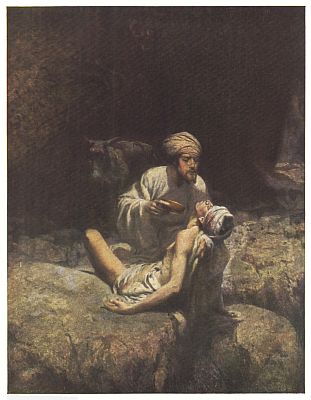
© Curtis Publishing Company
The Good Samaritan
Painted by Herbert Moore
Once a lawyer stood up to test Jesus with this question, “Master,
what shall I do to receive eternal life?” Jesus said to him,
“What is written in the law? How does it read?” He answered,
“You shall love the Lord your God with all your heart, with all your
soul, and with all your strength and with all your mind; also your
neighbor as yourself.” Jesus said to him, “You have answered correctly;
do this and you will live.”
But wishing to justify himself he said to Jesus, “Who is my
neighbor?” Jesus answered, “A certain man going down from Jerusalem
to Jericho fell in with robbers who after stripping and beating
him went away, leaving him half dead. Now it happened that a
certain priest was going by the same road, but when he saw the man,
he passed by on the other side.
“In the same way a Levite, when he came to the place, looked at
the man and passed by on the other side. But a Samaritan, travelling
along, came near to where the man was, and when he saw him he
was filled with pity. He came to him and bound up his wounds,
pouring on them oil and wine. Then he set him on his own beast,
brought him to an inn, and took care of him. The next day he took
out two pieces of money and gave them to the inn-keeper, saying,
‘Take care of him, and whatever more you spend I will pay you when
I return.’
“Which of these three do you think proved neighbor to the man
who fell in with robbers?” He said, “The man who took pity on
him.” Jesus said to him, “Then go and do likewise.”
Back to Top
THE WAY TO TREAT THOSE WHO WRONG US
“If your brother wrongs you, go, show him his fault when you
and he are alone. If he listens to you, you have won over your
brother. Even though he wrongs you seven times in a day, if he
turns to you seven times and says, ‘I am sorry,’ you shall forgive
him.”[251]
Peter came and said to Jesus, “Master, how often am I to let
my brother wrong me and forgive him? Seven times?” Jesus said
to him, “I tell you, not seven times but seventy times seven.
“That is why the Kingdom of Heaven may be compared to a
king who wished to settle his accounts with his servants. When he
had begun to settle them, a man was brought to him who owed him
ten thousand talents; but as he was unable to pay, the master ordered
that he be sold, together with his wife and children and all
that he had, in payment of the debt. At this the servant threw himself
on the ground and begged of him, ‘Master, have patience with
me and I will pay you all I owe you.’ Then the master out of pity
for him let him go and forgave him his debt.
“But as soon as the servant went out, he found one of his fellow
servants who owed him one-sixtieth of a talent, and he seized him
by the throat and said, ‘Pay me what you owe me.’ The man fell
down and begged him, ‘Have patience with me and I will pay you.’
But he would not and had him imprisoned until he should pay what
was due.
“Now when his fellow servants saw what had been done, they
were troubled and came and told their master what had happened.
Then the master called him and said, ‘You wicked servant! When
you begged of me, I forgave you all your debt. Should you not then
show the same mercy to your fellow that I showed to you?’ And
in anger his master turned him over to the jailers until he should
pay all that was due. So also will my heavenly Father do to you
unless each of you sincerely forgives his brother.”
Back to Top
THE GOLDEN RULE
“You have heard the saying, ‘You shall love your neighbor and
hate your enemy.’ But I say to you, love your enemies, bless those
who curse you, do good to those who hate you, and pray for those who
persecute you, that you may become sons of your Father in heaven;
for he makes his sun to rise on the wicked and the good alike, and
sends rain on both those who do right and those who do wrong. For
if you love only those who love you, what reward have you earned?
Do not even the tax-gatherers as much? And if you show courtesy
only to your friends, what more are you doing than others? Do
not even the heathen do as much? You must therefore become[252] perfect, even as your heavenly Father is perfect.
“Therefore, whatever you wish that men should do to you, do
even so to them.”
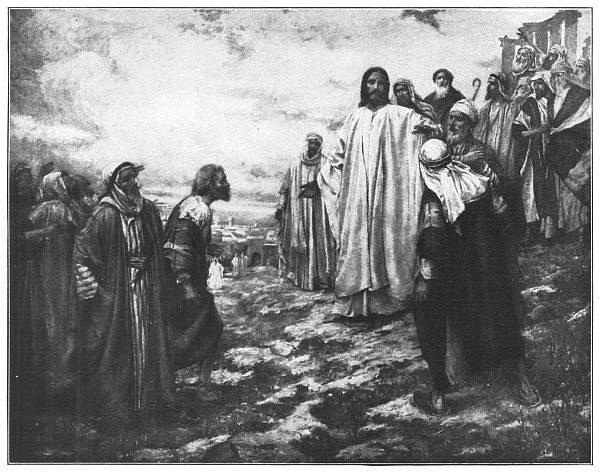 Christ on the Hilltop
Painted by C. A. Slade
THE PEOPLE WHO ARE REALLY HAPPY
Jesus said to his disciples:
For theirs is the Kingdom of Heaven.
Blessed are the meek,
For they shall inherit the earth.
Blessed are they who mourn,
For they shall be comforted.
Blessed are they who hunger and thirst for righteousness,
For they shall be satisfied.
Blessed are the merciful,
For they shall receive mercy.
Blessed are the pure in heart,
For they shall see God.
Blessed are the peacemakers,
For they shall be called the sons of God.
Blessed are they who are persecuted because of their righteousness,
For theirs is the Kingdom of Heaven.
Blessed are you when you are reviled, persecuted, and falsely maligned because of loyalty to me;
Rejoice and be glad, for great is your reward in heaven, for so the prophets were persecuted who came before you.”
JESUS SENDS OUT THE FIRST MISSIONARIES
Jesus went through all the towns and villages, teaching in their
synagogues, preaching the good news about the Kingdom of God,
and healing all kinds of diseases and weaknesses. At sight of the
crowds, troubled and scattered like sheep without a shepherd, he
was filled with pity, and said to his disciples, “This is a large harvest,
but the laborers are few. Pray to the lord of the harvest to send
laborers into his fields.”[253]
Then calling the twelve disciples, he sent them out two by two;
and he gave them power over evil spirits. He told them to take
nothing for their journey but a staff. Also he said, “Go your way.
Remember that I send you out as lambs among wolves. Take with
you neither purse nor bag nor an extra pair of shoes, and do not stop
to greet any one on the road. Whatever household you first enter,
say, ‘Peace to this house!’ And if the man living there is worthy,
your peace will rest upon him; but if not, it shall return to you.
Stay at the same house, eating and drinking what they give you,
for the laborer deserves his wages. Do not go from one house to
another.
“Also in whatever town you enter, if the people receive you,
eat what they set before you. Heal those in that town who are ill,
and tell them, ‘The Kingdom of God is near you.’ But if you enter
any town where the people do not receive you, go out into its streets
and say, ‘Even the dust of your town which clings to our feet, we
wipe off in protest against you.’ But know this: that the Kingdom
of God is at hand. I tell you, on that day it will be better for Sodom
than for that city.
“Do not give to the dogs that which is sacred, nor throw your
pearls before swine, for fear that they trample them under their feet
and then turn back to attack you. He who hears you, hears me;
he who rejects you, rejects me; he who rejects me, rejects him who
sent me.”
So Jesus’ disciples went out and preached so as to lead men to
be sorry for their sins and live as they should. They also cast out
many evil spirits and cured many sick by pouring oil upon them.
Then returning to Jesus they told him what they had done and
taught.
Back to Top
JESUS PRAISES JOHN THE BAPTIST
When John heard in prison what Jesus was doing, he sent his
disciples to ask him, “Are you the Promised One who is coming, or
are we to look for some one else?” Jesus answered them, “Go and
tell John what you see and hear: the blind see, the lame walk, the
lepers are made clean, the deaf hear, the dead are brought back to
life, and the poor have the good news told to them. Blessed is the
man who does not lose faith in me.”
As the disciples of John went away, Jesus talked to the people
about John: “What did you go into the wilderness to see? A reed
shaken by the wind? Then what did you go out to see? A man
wearing fine clothes? Men dressed like that live in palaces. But
why did you go out? To see a prophet? Yes, I tell you, and more
than a prophet! This is he of whom it is written:
Who shall make the way ready for you.’
“I tell you, no man has appeared who is greater than John the
Baptist; and yet he who is least in the Kingdom of God is greater
than he.
“To what shall I compare the people of to-day? They are like
children sitting in the market-places, who call to their playmates
and say:
We cried but you would not lament.’
For John came neither eating nor drinking, and men said, ‘He has
an evil spirit!’ The Son of Man came eating and drinking, and men
say, ‘He is a great eater and drinker, a friend of tax-gatherers and
sinners!’ But what I do shows that I am wise and right.”
Now when Herod’s birthday came, the daughter of Herodias
danced in public and delighted him. Thereupon he promised with
an oath that he would give her whatever she might ask. Prompted
by her mother, she said to him, “Give me here on a dish the head
of John the Baptist.” Although the king did not wish to do it, yet
because of his oath and his guests he ordered that it be given her.
So he commanded that John be beheaded in prison, and his head
was brought on a dish and given to the girl, and she brought it to
her mother. Then John’s disciples came and carried away the body
to bury it.
Back to Top
JESUS FEEDS THE HUNGRY
When Herod the ruler of Galilee heard what Jesus was doing,
he was greatly puzzled, for some said that John had come back from
the dead, some that Elijah had appeared, and others that one of the
old prophets had come to life again. Herod said, “I have beheaded
John; but who is this of whom I hear these stories?” And he tried
to find him.
Then Jesus said to his disciples, “Come by yourselves to some
quiet place [255]and rest a while”; for so many people were coming and
going that the disciples could not find time even to eat. So they
went in a boat by themselves to a quiet place; but many people
saw and knew them as they went, and, running from all the towns,
they arrived before them. When Jesus landed he found a large crowd
waiting for him. Feeling sorry for them because they were like sheep
without a shepherd, he began to teach them many things.
As it was already late in the day, his disciples came to him and
said, “This place is far away from any town and it is now late. Send
the people away to the neighboring farms and villages to buy food
for themselves.” But he answered “Give them some food.” They
replied, “Are we to go and buy two hundred silver pieces’ worth of
food for them?” He said, “Go and see how many loaves you have.”
When they found out, they said, “Five, and two fishes.” Then he
commanded them to make the people sit down in groups on the green
grass.
So they sat down in companies of a hundred and of fifty. Then
Jesus took the five loaves and the two fishes, and, looking up to
heaven, he blessed the loaves, and broke them in pieces; and he gave
to the disciples to set before the people. He also divided the two
fishes among them, and all ate and had enough. Then they picked up
twelve baskets full of broken pieces of the bread and fish, although
the number of the people who had shared them was five thousand.
Then Jesus had his disciples enter the boat and cross before him
to Bethsaida, while he himself sent away the crowd. After sending
them away, he climbed a hill to pray. When evening came the boat
was in the middle of the sea and he alone on the land. Seeing that
they were having trouble as they rowed, for the wind was against
them, he went to them at about three o’clock in the early morning,
walking on the sea as if he intended to pass them. When they saw
him walking on the sea, they believed that he was a ghost and cried
out, for all saw him and were frightened; but he spoke to them at
once, saying, “Have courage, it is I; do not be afraid.” Then he
went on board the boat and the wind dropped, but they were greatly
astonished for they had not learned the lesson of the loaves, for they
were slow to understand its meaning.
After crossing the sea they landed at Gennesaret and fastened
the boat. As soon as they had gone ashore, the people knew Jesus
and searched all that part of the country, and whenever they heard
that he had come to a certain place, they brought to him the sick
on their beds. In every city or town or village to which he went
people would lay their sick in the market-place and beg him to let[256] them touch even the edge of his robe. And all who touched him
were made well.
Back to Top
JESUS TELLS WHAT IT MEANS TO BE CLEAN
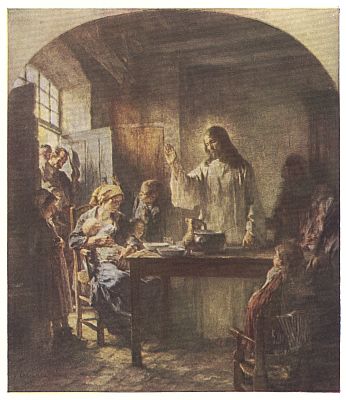 Among the Lowly
Painted by L. L’hermitte. In the Metropolitan Museum of Art
The Pharisees and some of the scribes who had come from Jerusalem
went together to Jesus, because they had seen that some of
his disciples ate their food without washing their hands as the scribes
thought necessary. For the Pharisees and all the Jews always wash
their hands up to the wrists before eating. So the Pharisees and
scribes asked him, “Why do not your disciples obey the old custom
instead of eating food with unwashed hands?” Jesus said to them,
“Well did Isaiah prophesy about you hypocrites: ‘This people
honors me with their lips, but their heart is not with me; their worship
is worthless, for they teach what are only commands of
men.’ You set aside the command of God and follow that of men.
“Moses said, ‘Honor your father and your mother,’ and, ‘He
who speaks evil of father or mother shall die.’ But you say, ‘If a
man says to his father or to his mother, What you were to have received
from me is given to God,’ you hold that he need not do anything
for his father or mother. In this way you set aside the command
of God in favor of the teaching which you have handed down;
and you do many other things like that.”
Then calling the crowd to him again, he said to them, “Hear
me, all of you, and understand. Nothing can make a man unclean
by going into him from outside. It is what comes from him that
makes him unclean, for from within, from the heart of man, come
evil thoughts, acts of theft, murder, greed, wickedness, deceit, impure
thoughts, envy, slander, pride, and recklessness. All these
evil things come from within, and they make a man unclean.”
Back to Top
JESUS IS KIND TO A STRANGER
Certain Pharisees came to Jesus and said to him, “Go away from
here; for Herod wishes to kill you.” He said to them, “Go and tell
that fox, ‘See, I cast out evil spirits and cure the sick to-day and
to-morrow, but on the third day I must go on my way; for it cannot
be that a prophet will be put to death anywhere except in Jerusalem.'”
Jesus left Capernaum and went into the land of Tyre and Sidon.
Going into a house, he wished that no one should know that he was
there, but he could not escape notice. Soon a woman whose little
daughter had an evil spirit heard of him and came and knelt at his
feet. Now the woman was a heathen of the Phœnician race. She
begged him to drive the evil spirit out of her daughter, but he said
to her, “Let the children of Israel first be fed, for it is not fair to take
their bread and throw it to the dogs!” She answered him, “True,
sir, yet the little dogs under the table do eat the children’s crumbs.”
He said to her, “Because of this answer go to your home; the evil
spirit has gone out of your daughter.” On returning home she found
the child lying on the bed and the evil spirit gone from her.
Jesus again left the land of Tyre and passed through Sidon to
the Sea of Galilee, crossing the land of Decapolis. The people
brought to him a deaf man, who also stammered; and they begged
Jesus to lay his hand on him.
Jesus took the man away from the crowd, put his fingers into
the man’s ears, touched his tongue with saliva, and looking up to
heaven, sighed, and said to him, “Ephphatha” (which means “Open”).
And at once, the man could hear and could talk without stammering.
Then Jesus told them to tell no one, but in spite of what he said
the people kept telling about it, saying: “How well he has done
everything! He even makes the deaf hear, and the dumb speak.”
Back to Top
JESUS MAKES AN HEROIC CHOICE
On their way to the villages of Cæsarea Philippi Jesus asked his
disciples, “Who do people say I am?” They told him, “John the
Baptist; others say, ‘Elijah’; some say, ‘One of the prophets.'”
Then he said to them, “But you yourselves, who do you say that I
am?” Peter answered him, “You are the Christ.” But he strictly
charged them to tell no one that he was the Christ.
Then Jesus began to explain to his disciples that he must suffer
many things and be rejected by the elders and high priests and
scribes and be killed, but that after three days he would rise from the
dead. This he said openly; and Peter tried to reprove him. But
Jesus turned and, looking upon his disciples, reproved Peter, saying,
“Away with you, Satan, for your mind is not on the things of God
but of men.”
Then Jesus called the crowd and his disciples to him, and said
to them, “If any one wishes to follow me, let him forget himself,
take up his cross, and come with me. For any one who is thinking
only of saving his life, will lose it; but whoever loses his life for my
sake and for the sake of the good news, will save it. What does it
profit a man to gain the whole world and lose his soul? For what
could a man give in exchange for his soul? Whoever is ashamed
of me and my teachings in this sinful world, of him I will be ashamed
when I come in the glory of my Father with the holy angels.”
Back to Top
JESUS IS GLORIFIED
Six days later Jesus took Peter, James and John up a high mountain
where they were alone, and in their presence he was transfigured.
His clothes glistened with a dazzling whiteness such as no bleaching
could give on earth. And there appeared to them Elijah and Moses,
who talked with Jesus. Then Peter said, “Master, it is fortunate
that we are here. Let us make three tabernacles, one for you, one for
Moses, and one for Elijah.” (For in his terror he did not know what
to say.) Then a cloud came and overshadowed them, and a voice
from the cloud said, “This is my Beloved Son; give heed to him.”
And suddenly, looking around, they saw no one with them but Jesus.
As they came down from the mountain, he commanded them
to tell no one what they had seen until after he had risen from the
dead. And they obeyed the command but discussed among themselves
what “rising from the dead” meant. Therefore they asked
him, “How is it that the scribes say, ‘Elijah must first come’?”
He answered, “Elijah is to come first to restore everything. And
what is written about the Son of Man? Is it not that he is to endure
great suffering and be despised? But I tell you, Elijah has
come, and they have done to him what they pleased, even as it is
written of him.”
Back to Top
JESUS TELLS HOW ONE MAY BECOME GREAT
Leaving Cæsarea Philippi, Jesus and his disciples passed through
Galilee; but he wished no one to know of this, for he was teaching
his disciples. He said to them, “The Son of Man will be betrayed
and men will put him to death, but in three days he will rise from
the dead.” But they did not understand his meaning and were[259] afraid to ask.
When they had reached Capernaum and were in the house, he
asked them, “What were you arguing about on the way?” But
they made no reply, for they had been disputing on the way about
which of them was greatest. Sitting down, he called the twelve disciples,
and said, “If any one wishes to be first, he will be last of all
and servant of all.” Then he took a little child and set him by his
side and with his arm around him said to them, “Whoever receives
a little child like this in my name, receives me, and whoever receives
me, receives not only me, but God who sent me.”
Back to Top
JESUS MAKES THE WICKED ZACCHEUS HIS FRIEND
As Jesus passed through Jericho a man named Zaccheus, who
was the chief tax-gatherer and rich, tried to see what Jesus was like,
but could not on account of the crowd and because he was short.
So he ran ahead and climbed into a sycamore-tree to see Jesus, for
he was to pass that way. When Jesus came to the place, he looked
up and said to him, “Zaccheus, come down, for to-day I must stay
at your house.” And Zaccheus came down quickly and welcomed
him joyfully.
Then all who saw this began to find fault, saying, “He has
gone to eat with a man who is a sinner.” But Zaccheus stood up
and said to Jesus, “Lord, I will give half of all that I have to the
poor; and to every man whom I have cheated out of anything I will
give back four times as much.” And Jesus said to him, “To-day
salvation has come to this house, for you have proved yourself to
be a true son of Abraham. For the Son of Man came to seek and
to save the lost.”
Back to Top
JESUS IS GLADLY WELCOMED BY THE PEOPLE
As Jesus was leaving Jericho with his disciples, followed by a
large crowd, there sat by the road a blind beggar, Bartimæus (the
son of Timæus). When he heard that it was Jesus of Nazareth, he
cried out, “Jesus, son of David, have pity on me!” Many reproved
him, saying, “Keep still,” but he cried out the more, “Son of David,
have pity on me!” Jesus stopped and said, “Call him.” So they[260] called the blind man and said, “Have courage! Get up, he has sent
for you.” Throwing off his cloak, he sprang up and came to Jesus.
Jesus said to him, “What do you want me to do for you?” The
blind man answered, “Master, let me receive my sight.” Then Jesus
said to him, “Go your way, your faith has healed you.” And at
once he received his sight, and followed Jesus along the road.
When Jesus and those with him were drawing near to Jerusalem
and had reached Bethpage and Bethany, near the Mount of Olives,
he sent two of his disciples ahead, saying, “Go into the village over
there. As soon as you enter it, you will find a colt tied, which no
one has ever ridden. Untie it and bring it here. If any one asks
you, ‘Why are you doing that?’ say, ‘The Master needs it and
will immediately send it back.'”
So they left him and found a colt tied, outside a door, on
the street. As they untied it, some of the men standing there said,
“What are you doing, untying the colt?” The disciples answered
as Jesus had told them, and the men let them take it. When they
had brought it to Jesus, they threw their cloaks upon it, and
he mounted it. Many also spread their clothes on the road, while
others strewed leafy branches cut from the fields; and people in
front and behind kept shouting:
Blessed is he who comes in the name of the Lord!
Blessed is the coming Kingdom of our father David!
God on high, save him!”
Jesus entered Jerusalem and went into the Temple. And when
he had looked about, because it was already late in the day, he went
out to Bethany with his twelve disciples.
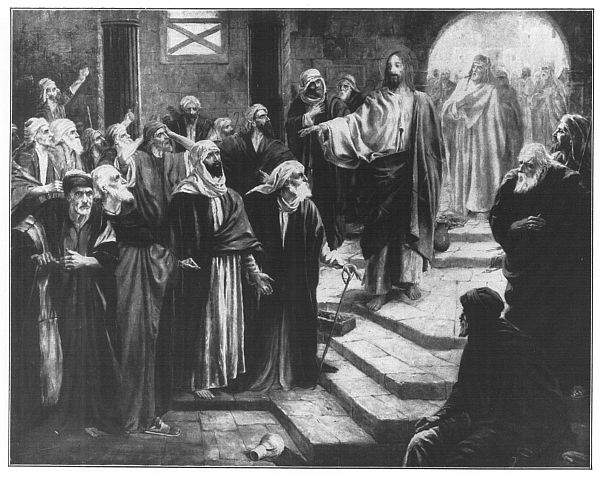 Christ in the Temple
 Painted by C. A. Slade
JESUS FIGHTS WRONG IN THE TEMPLE
About this time certain people came to tell Jesus of the Galileans
whom Pilate had killed while they were offering sacrifices. He said
to them, “Do you believe that these Galileans were worse sinners
than the rest? No, I tell you; and unless you are sorry for your sins
and do right, you too will all likewise perish. Or those eighteen men
who were killed by the fall of the tower of Siloam—do you suppo[261]se
that they were worse sinners than the rest of the people of
Jerusalem? No, I tell you; and unless you are sorry for your sins
and do right, you too will all perish.”
Then Jesus went into the Temple, and drove out those who were
buying and selling there. He upset the tables of the money-changers,
and the seats of those who sold doves, and would allow no one to
carry any goods through the Temple. For he said to them, “Is it
not written, ‘My house shall be called a house of prayer for all nations’?
But you have made it a den of robbers!” When the chief
priests and scribes heard of it, they began to look for some way of
putting him to death, for they feared him because all the people
were deeply stirred by his teachings. But each evening he and his
disciples left the city.
Then once more Jesus and his disciples entered Jerusalem, and
as he was walking about the Temple, some high priests and scribes
and elders came and asked him, “By what right are you doing these
things, and who gave you this right?” Jesus answered, “I will ask
you a question; answer me, and I will tell you by what right I do
such things. What about John’s baptism? Was it from God or
from men? Answer me.” They argued among themselves, saying,
“If we answer, ‘From God,’ he will ask, ‘Why then did you not believe
in him?’ But if we say, ‘From men'”—they were afraid of
the people, for the people believed that John was truly a prophet.
So they answered Jesus, “We do not know.” He said to them,
“Then I will not tell you by what right I do these things.
“But give me your opinion. A man who had two sons went to
one of them and said, ‘Son, go and work in the vineyard to-day.’
And the young man answered, ‘I will not’; but afterward changed
his mind and went. Then the man went with the same request to
the other son, who said, ‘I will go, sir’; but he did not go. Which
of the two did as his father wished?” They answered, “The first.”
Jesus said to them, “I tell you that tax-gatherers and sinners will
enter the Kingdom of God before you; for John showed you the
way to an upright life, and you did not believe him. But the tax-gatherers
and sinners believed him; and even when you saw, you
would not say that you were wrong and believe in him.
“Listen to this: There was a landowner who planted a vineyard,
and set a hedge around it, dug a pit for the wine-press, and built
a watch-tower. Then he leased it to tenants and went to another
country. At vintage time he sent his servants to the tenants t[262]o collect
the fruits of the vineyard, but they took the servants and flogged one,
stoned another, and killed another. Then he sent other servants,
more than at first, but they did the same to these. Finally he sent his
son, saying to himself, ‘They will respect my son.’ But the tenants
said to one another, ‘This is the heir. Come, let us kill him and get
his inheritance.’ So they threw him out of the vineyard and killed
him. Now, when the owner of the vineyard comes, what will he do
to these tenants?” They said, “He will destroy the wretches and
lease the vineyard to others who will give him the fruits in their
season.”
Jesus said to them, “Have you never read in the scriptures:
Has been made the chief corner-stone;
This is the Lord’s doing,
And marvellous in our sight.'”
When the high priests and the Pharisees heard these stories, they
knew that he was speaking about them, and they wished to seize
him but were afraid of the common people who regarded him as a
prophet.
Back to Top
JESUS CONDEMNS THOSE WHO PRETEND TO BE GOOD
The common people were listening to Jesus eagerly. As he
taught he said, “Be on your guard against the scribes, who like to
walk about in long robes and to have the people bow to them in the
market-places. They like to sit in the front seats in the synagogue
and in the best places at feasts. These, who use up the property
of widows and then to cover their guilt make long prayers, will receive
the greater condemnation.”
He also said, “Woe to you scribes! For you load men with burdens
heavy to bear, which you yourselves do not touch with one of
your fingers. Woe to you, scribes and Pharisees, hypocrites! You
shut in men’s faces the door to the Kingdom of God; for you neither
enter yourselves nor let those enter who wish to come in.
“Woe to you, scribes and Pharisees, hypocrites! For you carefully
pay to the Temple the tenth part of what grows in your garden,
but you do not show justice, mercy, and faithfulness. Blind
guides, who strain out the gnat and swallow the camel!
“Woe to you, scribes and Pharisees, hypocrites! For you make
clean the outside of the cup and the plate, and then fill them with
your greed and selfishness. Blind Pharisee! first make clean the
inside of the cup, that the outside as well may become clean.
“Woe to you, scribes and Pharisees, hypocrites! For you are
like whitewashed tombs, beautiful outside, but inside full of dead
men’s bones and filth. So you yourselves appear upright, but inside
you are full of hypocrisy and sin.”
Back to Top
JESUS WARNS HIS DISCIPLES
As Jesus went out of the Temple, one of his disciples said to him,
“Master, see what great stones and what a beautiful building!”
Then Jesus answered, “This Temple, made by man’s hands, shall
be destroyed. But another will soon arise, made without hands.”
And as he sat on the Mount of Olives opposite the Temple, Peter
and James and John and Andrew asked him privately, “Tell us,
when shall these things happen, and what is to be the sign to show
when all these things are about to happen?” Jesus said to them,
“No one knows the day or the hour when this will happen, not even
the angels in heaven, nor the Son, but only the Father.”
“The Kingdom of God shall be like ten maidens who took their
torches and went out to meet the bridegroom. Five of them were
foolish and five were wise. For the foolish ones, when they took their
torches, took no oil with them; but the wise took oil in their vessels
with their torches.
“Now while the bridegroom delayed, they all slumbered and
slept. And at midnight a cry was raised: ‘Look! The bridegroom!
Come out to meet him!’ Then all those maidens rose, and trimmed
their torches. And the foolish ones said to the wise, ‘Give us some
of your oil; for our torches are going out.’ But the wise maidens
answered, ‘There may not be enough for us and for you. Go rather
to those who sell, and buy for yourselves.’ Now while they went
away to buy, the bridegroom came and those who were ready went
in with him to the marriage feast; and the door was shut. Afterward
the other maidens came also and said, ‘Sir, open to us.’ But
he answered, ‘I tell you truly, I do not know you.’
“Watch, therefore, for you do not know the day nor the hour when
the Kingdom of God shall come.”[264]
Back to Top
JESUS CURES A BLIND MAN
As Jesus was passing along the road he saw a man who was born
blind, and the disciples asked him, “Master, for whose sin, his own
or his parents’, was this man born blind?” Jesus answered, “Neither
for his own sin nor his parents’, but that God’s power to heal may
be shown in him. We must do the work of him who sent me while
day lasts; night is coming when no man can work. While I am in
the world, I am the light of the world.”
When he had said this, he spat on the ground and made clay with
the saliva, put the clay on the eyes of the blind man, and said to
him, “Go, wash in the Pool of Siloam.” So he went off and washed,
and returned able to see.
Then the neighbors and those who before had seen him begging
said, “Is not this the man who used to sit and beg?” Some said,
“It is he.” Others said, “No, but he is like him.” He said, “I am
the man.” So they said to him, “How then were your eyes
opened?” He answered, “The man who is called Jesus made clay
and put it upon my eyes, and said to me, ‘Go to the Pool of Siloam
and wash.’ So I went away and washed, and I received my sight.”
They asked him, “Where is he?” He answered, “I do not know.”
Then they brought the man who had once been blind to the
Pharisees. Now it was on the Sabbath that Jesus had made the
clay and opened his eyes. Therefore the Pharisees asked him again
how he had received his sight, and he told them, “Jesus put clay
on my eyes and I washed them and can see.” Then some of the
Pharisees said, “This man does not come from God, for he does not
keep the Sabbath.” Others said, “How can a sinner do such wonderful
deeds of healing?” And they could not agree among themselves.
So they asked the blind man once more, “What have you
to say about him, for it was your eyes that he opened?” The man
replied, “He is a prophet.”
Now the Jews would not believe that he had been born blind
and had received his sight until they called his parents and asked
them, “Is this your son who you say was born blind? How is it
that he now can see?” His parents answered them, “We know
that this is our son and that he was born blind, but we do not know
why he can now see nor who opened his eyes. He is of age; ask him,
he can speak for himself.” His parents said this because [265]they were
afraid of the Jews; for the Jews had already agreed that any one
who said that Jesus was the Christ should be put out of the synagogue.
That was why his parents said, “He is of age, ask him.”
So the Jews again called the man who had been born blind, and
said to him, “Give God the praise; we know that this man Jesus
is a sinner.” He answered and said, “I do not know whether he is
a sinner; one thing I do know, that, although I was blind, I now see.”
So they said to him, “What did he do to you? How did he give you
your sight?” He replied, “I have told you already, but you would
not listen to me. Why do you want to hear it again? Do you also
wish to become his disciples?” Then they reviled him and said,
“You are his disciple, but we are disciples of Moses. We know that
God spoke to Moses, but we do not know where this man came
from.” The man answered, “This is strange! You do not know
where he comes from, and yet he gave me my sight! We know that
God does not listen to sinners but that he does listen to him who
worships him and does his will. Since the world began no one has
ever heard of sight being given to a man born blind. If this man
were not from God, he could do nothing.” They answered, “You
were born wholly bad, and yet you would teach us?” Then they
put him out of the synagogue.
Jesus heard that they had put him out, and meeting him said,
“Do you believe in the Son of God?” He answered, “Who is he,
sir? Tell me that I may believe.” Jesus said to him, “Not only
have you seen him but he is now talking to you.” The man said,
“Then I do believe, Master,” and he worshipped him, and Jesus
said to him, “It is to right wrongs that I have come to this world,
that the blind may see and that those who see may become blind.”
Hearing this, some of the Pharisees who were with him said, “And
are we blind?” Jesus replied, “If you were blind you would not be
guilty; but you say, ‘We can see,’ and so your sin remains.”
Back to Top
JESUS TELLS WHAT HE CAME TO DO
Jesus said to the people, “I am the light of the world; he who
follows me shall not walk in darkness, but shall have the light which
gives life.”
As Jesus spoke these words many believed in him. Then he said
to the Jews [266]who had believed in him, “If you faithfully do what I
say, you are truly my disciples, and you shall know the truth and
the truth shall set you free.” They answered him, “We are Abraham’s
descendants and have never been slaves to any man. What
do you mean by saying, ‘You shall be set free’?” Jesus answered
them, “Truly, I tell you, every one who sins is a slave of sin. The
slave does not remain in the household forever, but the Son remains
forever. If therefore the Son sets you free, you shall be free indeed.
“I am the Door; if any man enters by me he shall be saved and
shall go in and go out and find pasture. The thief comes only to
steal and kill and destroy. I have come that they may have life,
and that they may have it more abundantly.
“I am the Good Shepherd; the good shepherd lays down his life
for the sheep. But a hired man, who is not a shepherd and does not
own the sheep, leaves them and runs away when he sees the wolf
coming, and the wolf snatches the sheep and scatters them. The
hired man runs away because he is only a hired man and does not
care for the sheep.
“I am the Good Shepherd and know my own, and my own know
me, just as the Father knows me and I know the Father, and I lay
down my life for the sheep. I have other sheep which do not belong
to this fold; I must lead them also, and they will hear my voice,
and they will be one flock and one shepherd.”
Back to Top
JESUS BRINGS LAZARUS BACK TO LIFE
Now a certain man, Lazarus of Bethany, was sick. He was the
brother of Martha and of the Mary who anointed the Master with
perfume and wiped his feet with her hair. Jesus loved Martha, and
her sister, and Lazarus. So the sisters sent word to him, “Master,
he whom you love is sick.” But when Jesus heard it he said, “This
sickness is not to end in death, but it is for the glory of God, that
the Son of God may be glorified by it.”
So when he heard that Lazarus was sick, he stayed where he was
two days. After that he said to the disciples, “Let us go again into
Judea. Our friend Lazarus has fallen asleep, but I am going to
waken him.” The disciples said to him, “Master, if he has fallen
asleep he will get well.” Now Jesus had spoken of his death, but
they thought that he meant taking rest in sleep. So Jesus said to
them plainly, “Lazarus is dead, and for your sakes I am glad that
I was not there, so that you may learn to believe. But let us go[267] to
him.”
When Jesus came he found that Lazarus had been in the tomb
four days. Now Bethany was only about two miles from Jerusalem,
and many of the Jews had come to comfort Mary and Martha about
their brother.
When Martha heard that Jesus was coming, she went out to meet
him, while Mary stayed at home. Martha said to Jesus, “Master,
if you had been here my brother would not have died, but I know
that even now God will give you whatever you ask him.” Jesus
said to her, “Your brother shall rise again.” Martha said to him,
“I know that he shall rise again, at the resurrection on the last day.”
Jesus said to her, “I am the resurrection and the life. He who believes
in me shall live even though he die; and whoever lives and
believes in me shall never die. Do you believe this?” She said to
him, “Yes, Master, I do believe that you are the Christ, the Son
of God who was to come into the world.”
When Martha had said this she went away to call Mary, her
sister, telling her secretly, “The Master is here and is calling you.”
When Mary heard this she rose quickly and went to him. Jesus
had not yet come into the village but was still in the place where
Martha met him. When the Jews who were trying to comfort Mary
in the house saw her rise up quickly and go out, they followed her,
supposing that she was going to weep at the tomb. But when Mary
reached the place where Jesus was and saw him, she fell at his feet,
saying to him, “Master, if you had been here, my brother would
not have died.”
When Jesus saw her and the Jews who came with her weeping,
he was deeply moved, and said in great distress, “Where have you
laid him?” They said to him, “Master, come and see.” Jesus wept.
The Jews therefore said, “See how he loved him!” Some of them
said, “Could not this man who gave sight to the blind have also
kept Lazarus from dying?”
Jesus was again deeply moved, as he came to the tomb. It was
a cave, and a stone lay against it. Jesus said, “Take away
the stone.” Martha, the dead man’s sister, said to him, “Master, by
this time his body has begun to decay, for he has been dead four days.”
Jesus said to her, “Did I not tell you that if you only would believe
you should see the glory of God?” So they removed the stone, and
Jesus lifted up his eyes and said, “Father, I thank thee that thou
hast heard me. I knew that thou always dost listen to me, but I[268] spoke for the sake of the people standing near, that they may believe
that thou hast sent me.” When he had said this, he cried in a loud
voice, “Lazarus, come forth.” Then he who was dead came forth
with his hands and feet wrapped in bandages and his face bound
with a cloth. Jesus said to them, “Untie him and let him go.”
Then many of the Jews who had come with Mary and had seen
what Jesus did, believed in him.
Back to Top
JESUS PRAISES A WOMAN WHO GAVE HER BEST
While Jesus was at dinner at Bethany in the house of Simon,
the jar-maker, a woman came in with an alabaster jar of pure perfume,
which was very costly. Breaking the jar she poured the
perfume over his head. Some said to each other in indignation,
“Why this waste of perfume? It might have been sold for more
than three hundred silver pieces and the money given to the poor.”
But because they found fault with her, Jesus said, “Let her alone,
why do you trouble her? She has done me a beautiful service. The
poor are with you always; to them you can do good whenever you
wish, but me you will not always have. She has done what she
could; she has poured oil on my body beforehand for burial. I tell
you, wherever through all the world the good news is told, this deed
of hers will be told in memory of her.”
Back to Top
JESUS EATS THE LAST SUPPER WITH HIS DISCIPLES
Judas Iscariot, one of the twelve disciples, went to the high
priests with the intention of betraying Jesus. And when they heard,
they rejoiced, promising to give him money; and he began to look
for an opportunity to betray him.
On the first day of the Feast of Unleavened Bread, when the
Jews kill the lambs that are sacrificed at the Passover Feast, Jesus’
disciples said to him, “Where do you wish us to make ready for your
passover meal?”
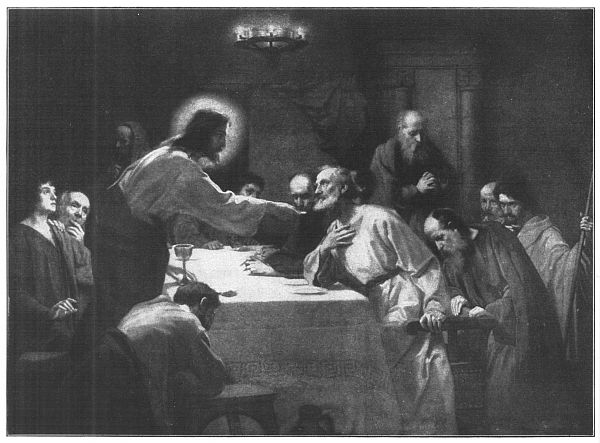 The Last Supper
 So Jesus sent two of his disciples, saying to them, “Go into the
city, where you will meet a man carrying a jar of water. Follow
him and say to the owner of whatever house he enters, ‘The Master
says, Where is my room in which I may eat the passover meal
with my disciples?’ He will show you a large upper room already[269] furnished. There make ready for us.” So the disciples went into
the city and found things as he had said they would; and they prepared
for the Passover.
When it was evening Jesus came with his twelve disciples; and
while they were eating at the table, he said, “I know surely that
one of you now eating with me will betray me.” In deep sorrow
the disciples said to him, one after the other, “Surely it is not I?”
He said to them, “It is one of the twelve, one who is dipping
his fingers into the dish with me. The Son of Man will depart as
it has been foretold of him, but woe to that man by whom the Son
of Man is betrayed! It would be better for that man if he had
never been born!”
Then Jesus took the bread and, when he had given thanks to
God, he broke it and said, “This is my body which is broken for
you; do this in remembrance of me.”
In the same way, after he had eaten, Jesus took the cup, and when
he had given thanks to God, he gave it to his disciples and
they drank of it. Then he said, “This is the new covenant made
by my blood which is shed for many. As often as you drink this
cup, do it in remembrance of me.” Then after singing a hymn they
went out to the Mount of Olives.
There Jesus said to them, “You will all desert me, for it is written
in the scriptures: ‘I will smite the shepherd and the sheep will be
scattered.’ But after I have risen, I will go before you into Galilee.”
Peter said to him, “Though all others should desert you, I will not.”
Jesus said to him, “Indeed I tell you, this very night before the cock
crows you will deny three times that you know me.” But Peter
said more emphatically, “Even if I have to die with you, I will
never deny you.” And all of them said the same.
Back to Top
JESUS ENCOURAGES HIS FRIENDS AND HELPERS
Jesus said, “Let not your heart be troubled; you believe in God,
believe also in me. In my Father’s house are many homes; if it
were not so, I would have told you, for I go to prepare a place for
you. And if I go and prepare a place for you, I will return and take
you to be with me that where I am, you may be also; and you know
the way to the place where I am going.”
Thomas said to him, “Master, we do not know where you are
going; how then can we know the way?” Jesus said to him, “I am
the way, the truth, and the life; no man comes to the Father except
through me. If you had learned to know me, you would have known
my Father also; from now on you know him and have seen him.”
Philip said to him, “Master, let us see the Father and we will
be satisfied.” Jesus said to him, “Have I been all this time with
you and yet you do not know me, Philip? He who has seen me has
seen the Father; then how can you say, ‘Let us see the Father’?
Do you not believe that I am in the Father and the Father in me?
The words that I speak do not come from me but from the Father
who lives in me. Believe me, that I am in the Father and the Father
in me, or else believe me because of the work itself. I say to you,
he who believes in me will do the work which I do and still greater
works than these, for I go to the Father. And whatever you shall
ask in my name I will do, that the Father may be glorified through
the Son. If you ask anything in my name, I will do it.
“If you love me you will keep my commands, and I shall ask
the Father and he will give you another Helper to be with you forever,
even the Spirit of truth.
“In a little while the world will see me no more; but you shall
see me, because I live and you shall live also. He who has my commands
and obeys them is the one who loves me; and he who loves
me will be loved by my Father, and I will love him and will reveal
myself to him.
“I have told you all this while I am still with you; but the
Helper, the Holy Spirit, whom the Father will send in my name,
will teach you everything and remind you of all that I have said
to you.
“Peace I leave with you, my own peace I give to you; not as
the world gives do I give to you. Let not your heart be troubled
nor afraid. You have heard me tell you that I go away and am coming
back to you. If you love me you will be glad because I am going
to the Father, for the Father is greater than I. I have told you this
now, before it takes place, that when it does you may believe.
“I am the true vine and my Father is the vine-dresser. He cuts
away each of my branches that does not bear fruit, and cleans every
branch that bears fruit so as to make it bear more. You are already
clean because of the word which I have spoken to you. Remain
united with me and I will remain with you. Just as the branch cannot
bear fruit unless it remains united with the vine, neither can
you bear fruit unless you remain united with me. I am the vi[271]ne,
you are the branches. He who remains united with me and I with
him bears much fruit, but apart from me you can do nothing.
“If you remain united with me and my words remain in you,
ask whatever you will and you shall have it. It is by your bearing
much fruit and being my true disciples that my Father is glorified.
As the Father has loved me, so have I also loved you; continue
in my love. If you keep my commands, you will continue in my
love, even as I have kept my Father’s commands and continue in
his love.
“I have told you all this that my joy may be yours, and that
your joy may be complete. This is my command: ‘Love one another
even as I have loved you.’ No man has greater love than that
which leads him to lay down his life for his friends. You are my
friends if you do whatever I command you. I call you servants no
longer, for the servant does not know what his master does; but I
call you friends, for I have told you everything that I have heard
from my Father. You did not choose me, but I chose you and appointed
you to bear fruit that will remain, so that whatever you ask
of the Father in my name he will give you.”
Back to Top
JESUS IS SEIZED BY THE MOB
When Jesus and his disciples came to a certain place called
Gethsemane, he said to them, “Sit here while I pray”; but he took
with him Peter and James and John. And as he suffered greatly
from deep sorrow, he said to them, “My heart is heavy with sadness.
Stay here and watch.” Then he went forward a short distance
and threw himself on the ground and prayed that if possible
he might be spared this agony, saying, “Father, with thee all things
are possible. Take away this cup of agony from me. Yet not my
will, but thy will be done.”
When he came back, he found his disciples asleep; and he said to
Peter, “Simon, are you asleep? Could you not watch for one hour?
Watch and pray that you may overcome temptation. The spirit
indeed is willing, but the body is weak.” Again he went away and
prayed the same prayer. And when he returned, again he found
them asleep, for they were very drowsy; and they did not know what
to say to him. Then he came the third time and said to them, “Sleep
on now and take your rest. It is enough; the hour has come; already
the Son of Man has been betrayed into the hands of wicked[272] men. Rise, let us go; for here is the one who has betrayed me.”
While Jesus was still speaking, Judas, one of the Twelve, came
up, followed by a mob with swords and clubs, who had come from
the high priests and the scribes and the elders. Judas had arranged
a signal: “He whom I shall kiss,” he said, “is the man. Take him,
and lead him away without letting him escape.” As soon as he came,
he went up to Jesus, saying, “Master,” and kissed him. Then they
seized Jesus and took him; but one of those who were with him drew
his sword, and, striking the servant of the high priest, cut off his
ear. Jesus turned and said, “Have you come out with swords and
clubs to seize me as you would a robber? Day after day I have been
with you teaching in the Temple, yet you never seized me.”
Then Jesus’ disciples left him and fled. One young man, however,
followed him with only a linen sheet thrown about him; but
when the men tried to seize him, he left the linen sheet and fled away
naked.
The mob led Jesus away and brought him to the house of the
high priest. Peter followed at a distance, and when they had kindled
a fire in the middle of the courtyard and sat down together, he too
sat down among them. A certain maid, seeing him there by the
firelight, looked at him closely and said, “This man also was with
him.” But he denied it, saying, “Woman, I do not know him.”
After a little while another person who saw Peter said, “You too
are one of them”; but he said, “Man, I am not.”
About an hour later another man said, “Certainly this fellow
also was with Jesus, for he is a Galilean.” But Peter said, “Man,
I do not know what you are talking about.” Immediately while
he was still speaking, the cock crowed. And Jesus turned and looked
straight at Peter. Then Peter remembered how the Lord had said
to him, “Before the cock crows to-day you will deny me three times.”
And Peter went out and wept bitterly.
Back to Top
JESUS IN THE HANDS OF HIS ENEMIES
The men who seized Jesus mocked him and flogged him. They
also blindfolded him and said, “Prophet, tell us who is it that struck
you?” And they said many other things, insulting him.
At daybreak they brought him before the council at which were
gathered the elders, both the chief priests and the s[273]cribes. And they
tried to get evidence against him to have him put to death, but could
not find any, for though many made false statements, they did not
agree. Some men stood up and falsely said, “We heard him say,
‘I will destroy this temple made by the hands of men and within
three days I will build another made without hands.'” But the
statements even of these men did not agree.
Then the high priest arose and asked Jesus, “Do you not answer?
What about these statements that these men make against
you?” But he was silent and made no answer. And the high priest
asked him, “Are you the Christ? If you are, tell us.” He said to
them, “If I tell you, you will not believe, and if I ask you questions,
you will not answer me. But after this the Son of Man will
be seated at the right hand of God Almighty.” Then they all said
to him, “Are you then the Son of God?” He replied, “It is as you
say; I am.” So they said, “What further need have we of evidence?
We have heard it from his own lips.”
Then all the high priests and scribes rose and brought Jesus before
Pilate, and began to accuse him, saying, “We found this man
leading our people astray, forbidding them to pay taxes to the
Roman emperor, and saying that he himself is Christ, the King.”
Pilate asked him, “Are you the King of the Jews?” He answered,
“I am.” Pilate said to the high priests and the crowd, “I do not
find that this man has done anything wrong.” But they insisted,
saying, “He stirs up the people by teaching through all Judea. He
began in Galilee, and now he has come even here.” When Pilate
heard this he asked whether Jesus was a Galilean, and when he
learned that he was and that he came under Herod’s rule, he sent
him to Herod Antipas, who was also in Jerusalem at this time.
Herod was glad to see Jesus. He had long wished to see him
because of what he had heard about him, and because he also hoped
to see him do some wonderful deed. Although Herod asked him
many questions, Jesus made no answer, and the high priests and
the scribes loudly shouted their charges against him. Then Herod,
and his soldiers, after mocking him, and dressing him in a bright
colored robe, sent him back to Pilate.
Pilate then called together the high priests and other officials
and the people, and said, “You brought me this man on the charge
that he stirred up the people to rebel. Now I have examined him
before you and found no guilt in him of those things of which you
accuse him; no, nor has Herod, for he has sent him back to us. You
see that he has done nothing that calls for death. I will there[274]fore
have him flogged and then release him” (for it was the custom at
this feast to release for them one man). But they all cried out,
“Away with him and release for us Barabbas” (a man who had been
put into prison because of a riot which had occurred in the city, and
on the charge of murder). Pilate spoke to them again, because he
wished to release Jesus; but still they shouted, “Crucify him!
Crucify him!” He said to them for the third time, “Why, what
crime has this man committed? I have found no reason to put him
to death. I will therefore have him flogged and then release him.”
But they shouted and demanded that he should be crucified. And
so Pilate, wishing to please the people, released Barabbas, but Jesus
he turned over to them to be crucified.
Back to Top
JESUS IS CRUCIFIED BY HIS ENEMIES
The soldiers led Jesus to the courtyard of the governor’s palace
and called together the whole company. Then they clothed him
in a purple robe and, making a crown of thorns, they put it on his
head and began to salute him, “Hail, King of the Jews!” They
struck him on the head with a reed and spat on him, and on bended
knee paid homage to him. After they had made sport of him, they
stripped off the purple robe and put on his own clothes, and led him
out to be crucified.
They forced a man named Simon, of Cyrene, who was coming in
from the country, to carry his cross. So they brought Jesus to the
place called Golgotha, which means, the place of the skull. And
they offered him wine mixed with myrrh, but he would not take it.
Then they crucified him and divided his clothes among them, drawing
lots to decide what each should take. It was nine in the morning
when they crucified him. The inscription over his head stating
the charge against him read:
With him they crucified two robbers, one on his right and one
on his left. And those who passed by scoffed at him, shaking their
heads in derision and saying, “Ha! you who were to destroy the
Temple and rebuild it in three days, save yourself and come down
from the cross!” In the same way the high priests and the scribes
mocked him among themselves and said, “He saved others, but he[275] cannot save himself. Let the Christ, the ‘King of Israel,’ now come
down from the cross, that we may see and believe!” But Jesus said,
“Father, forgive them, for they know not what they do.”
One of the criminals who was crucified also scoffed at him, saying,
“Are you not the Christ? Save yourself and us!” But the
other said in rebuke, “Have you no fear of God even though you
are being put to death? We are suffering justly, receiving what
we deserve for our crimes, but he has done no wrong.” Then he said,
“Jesus, remember me when you enter your kingdom.” Jesus said
to him, “This very day you will be with me in paradise.”
Now beside the cross of Jesus stood his mother. Seeing her and
the disciple whom he loved standing near, Jesus said to her, “Woman,
he is your son!” And to the disciple he said, “She is your mother!”
And from that hour the disciple took her into his own home.
Darkness covered the whole land from noon until three o’clock
in the afternoon. At that hour Jesus cried aloud, “Eloi, Eloi, lama
sabachthani,” which means, “My God, my God, why hast thou
forsaken me?” When they heard it, some who stood by, said, “He
is calling Elijah.” And a man ran and, soaking a sponge in vinegar,
put it on the end of a reed and was about to give it to him to drink
when the others said, “Stop, let us see if Elijah will come to take
him down.” But Jesus uttered a loud cry and gave up his life.
And the curtain of the Temple was torn in two from the top to the
bottom. When the Roman captain who stood facing him saw in
what way he died, he said, “Surely this man was a son of God.”
Looking on from a distance were some women also, among them
Mary of Magdala, Mary the mother of James, the younger, and of
Joses, and Salome, who had followed him and waited on him when
he was in Galilee, and many other women who had come up with
him to Jerusalem.
Because it was now evening of the day before the Sabbath,
Joseph of Arimathæa, an honorable member of the Jewish national
council, who was himself looking for the coming of the Kingdom of
God, went to Pilate and had the courage to ask him for the body of
Jesus. Pilate, surprised that he was dead, called the captain and
asked whether Jesus was already dead, and when he learned this
from the captain he gave the body to Joseph. After Joseph had
taken Jesus from the cross, he wrapped him in a linen sheet which
he had bought, and laid him in a tomb cut out of rock; and he rolled
a stone against the door of the tomb. And Mary of Magdala and[276] Mary the mother of Joses, watched to see where Jesus was laid.
Back to Top
JESUS CONQUERS DEATH
When the Sabbath was over, Mary of Magdala, Mary the mother
of James, and Salome bought spices to embalm Jesus. Soon after
sunrise on the first day of the week they went to the tomb, and they
said to one another, “Who will roll away the stone for us from the
door?” But they found that the stone, although very large, had
been rolled to one side. On entering the tomb they saw a young
man in a white robe sitting on the right, and they trembled and were
afraid. But he said to them, “Do not be afraid. You are looking
for Jesus of Nazareth, who was crucified. He is risen; he is not
here. See the place where he was laid! But go and tell his disciples
and Peter, ‘He is going before you into Galilee; there you will see
him, as he told you.'”
Then they remembered Jesus’ words, and returning from the
tomb they told these things to the eleven disciples and to all the
others; but to them, the story seemed to be nonsense, and they were
not believed. Peter, however, ran to the tomb, but when he looked
in he saw only the linen bandages; and he went home wondering
what had happened.
But Mary of Magdala stood weeping outside the tomb. As she
wept, she stooped down and looked into the tomb and saw two angels
in white sitting, one at the head and the other at the feet, where the
body of Jesus had lain. They said to her, “Woman, why are you
weeping?” She said, “Because they have taken away my Master
and I do not know where they have laid him!”
When she had said this, she turned around and saw Jesus standing
there, but she did not know that it was Jesus. “Woman,” said
he, “Why are you weeping? For whom are you looking?” Supposing
that he was the gardener, she said, “Sir, if you have carried
him away, tell me where you have laid him, and I will take
him away.” Jesus said to her, “Mary!” She turned to him and
cried out, “Master!” Jesus said, “Do not touch me, for I have
not yet ascended to the Father; but go to my brothers and tell them,
‘I am ascending to my Father and to your Father, to my God and
your God.'” Mary went to the disciples with the news, “I have
seen the Master,” and to tell them what he had said to her.[277]
Back to Top
JESUS WALKS AND TALKS WITH TWO OF HIS DISCIPLES
On the same day two of Jesus’ disciples were on their way to a
village called Emmaus, about seven miles from Jerusalem; and as
they talked together about what had happened, Jesus himself drew
near and went with them; but their eyes were kept from knowing
him.
He said to them, “What are you talking about so earnestly as
you walk along?” And they stood still, looking sad, and one of
them, named Cleopas, answered, “Are you only a stranger stopping
in Jerusalem? Do you not know the things that have happened
there within these last few days?” He asked, “What things?”
They answered, “Why, about Jesus of Nazareth, who proved himself
a prophet, mighty in word and deed before God and all the people,
and how our high priests and rulers gave him over to be sentenced
to death and had him crucified. But we were hoping that he was
the one to save Israel. It is now the third day since these things
happened. Yet some of our women who were at the tomb early this
morning, amazed us. They told us that they had not found his body
but that they had seen a vision of angels who said that he was alive.
Then some of those who were with us went to the tomb and found
it as the women had said. But him they did not see.”
Then Jesus said to them, “O foolish men, so slow of heart to believe
in what the prophets have spoken! Was it not necessary for
the Christ to suffer and so win his glory?”
When they came to the village to which they were going, he
seemed to be going farther on, but they urged him, saying, “Stay
with us, for it is almost evening, the day is nearly over.” So he went
in to stay with them.
As he sat with them at table, he took the bread, blessed it, broke
it, and passed it to them. Then their eyes were opened so that they
knew him; but he disappeared from their sight. They said to one
another, “Did not our hearts glow while he was talking with us on
the way!”
At once they started back to Jerusalem, where they found the
eleven disciples gathered with their companions, and from them
they learned that the Lord had really risen and that he had appeared
to Simon. Then they told of their own experience on the road[278], and
how they knew him when he broke the bread.
Back to Top
JESUS GIVES HIS LAST COMMANDS TO HIS HELPERS
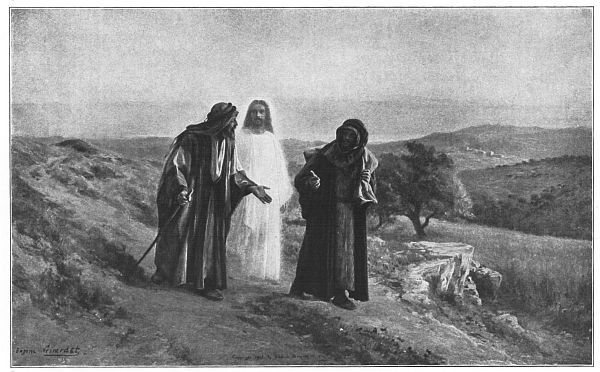 03, Braun Clement et Cie
The Walk to Emmaus
Painted by Eugène Girardet
While the two disciples were speaking, Jesus himself stood among
them. And they were frightened and believed that they saw a ghost;
but he said to them, “Why are you so frightened? Why do you
doubt? See my hands and my feet, that it is I myself. Touch me
and see, for a ghost has not flesh and bones as you see that I have.”
While they were still unable for very joy and wonder to believe, he
said to them, “Have you anything to eat here?” And when they
gave him a piece of broiled fish, he ate before them.
Then he said to them, “This is what I told you when I was still
with you, that everything written about me in the law of Moses
and the prophets and the psalms must be fulfilled.” Then he helped
them to understand the scriptures, and said, “It is written that the
Christ must suffer and on the third day rise from the dead, and that
in his name all nations must be called upon to turn from their sins
and gain God’s forgiveness. You yourselves, beginning at Jerusalem,
are to tell men about these things.”
Now Thomas, one of the twelve disciples, who was called “The
Twin,” was not with them when Jesus came. The other disciples
told him, “We have seen the Master.” But he said to them, “Unless
I see the marks of the nails in his hands and put my finger where
they were and put my hand in his side, I will not believe.”
Eight days later Jesus’ disciples were again together, and Thomas
was with them. Though the doors were closed, Jesus came and stood
among them and said, “Peace be with you.” Then he said to
Thomas, “Put your finger here and look at my hands, and put your
hand here in my side. Do not be a doubter but a believer.” Thomas
answered him, “My Master and my God!” Jesus said to him, “You
believe because you have seen me? Blessed are those who believe
though they have never seen me!”
Later Jesus appeared to his disciples by the Sea of Galilee, and
in this way. As Simon Peter, Thomas, Nathanael from Cana in
Galilee, and the sons of Zebedee, were together with two other of
his disciples, Simon Peter said to them, “I am going fishing.” “We
will go too,” they said, and they set out and went on board the boat;
but that night they caught nothing. At daybreak Jesus stood on[279] the beach, though the disciples did not know that it was he.
He said to them, “Children, have you anything to eat?” They
answered, “No.” And he said, “Throw your net over on the right
side of the boat and you will catch something.” So they threw over
the net, and now they could not haul it in because of the great number
of fish. Then the disciple whom Jesus loved said to Peter, “It
is the Master.” As soon as Simon Peter heard that it was the Master,
he put on his fisherman’s coat (for he was stripped for his work),
and jumped into the water; but the other disciples, being only about
one hundred yards from the shore, came in the small boat dragging
the net full of fish.
When they landed, they saw a charcoal fire burning, and over
it a fish cooking, and some bread. Jesus said to them, “Bring some
of the fish that you have just caught.” So Simon Peter went aboard
the boat and hauled the net ashore filled with large fish; and although
there were so many, the net was not torn. Then Jesus said
to them, “Come and eat breakfast.” Not one of the disciples had
courage to ask, “Who are you?” for they knew that it was the Master.
Jesus came and gave them the bread and also the fish. This
was the third time he appeared to his disciples after he had risen
from the dead.
After breakfast Jesus said to Simon Peter, “Simon, son of John,
do you love me more than these?” He said, “Surely, Master, you
know I love you.” Jesus said to him, “Feed my lambs.” Then he
asked him a second time, “Simon, son of John, do you love me?”
And he answered, “Surely, Master, you know that I love you.”
Jesus said to him, “Tend my sheep.” Jesus said to him a third time,
“Simon, son of John, do you love me with all your heart?” Peter
was grieved because Jesus asked a third time, “Do you love me?”
And he answered, “Master, you know everything, you know that
I love you.” Jesus said to him, “Feed my sheep.”
And Jesus said to them, “All authority has been given to me in
heaven and on earth. Go you, therefore, and make disciples of all
the nations, baptizing them in the name of the Father and of the
Son and of the Holy Spirit, teaching them to observe all things
whatsoever I commanded you; and, lo, I am with you always,
even to the end of the world.”
Jesus showed his disciples, by many proofs, that he still lived,
revealing himself to them duri[280]ng forty days and telling them about
the Kingdom of God. When he and his disciples were together he
told them not to leave Jerusalem but to wait for what the Father
had promised—”the promise,” he said, “of which you have heard
me speak; for John baptized with water, but before many days have
passed you will be baptized with the Holy Spirit.”
While they were together they asked him, “Master, is this the
time when you are going to restore the rulership to Israel?” Jesus
said to them, “It is not for you to know the time or the season which
the Father has fixed by his own authority; but you will receive
power when the Holy Spirit comes upon you, and you will be my
witnesses at Jerusalem, throughout all Judea and Samaria and to
every part of the earth.” When he had said this and while they
were still looking at him, he was lifted up, and a cloud took him out
of their sight. And while they were staring into heaven, as he went
up, two men clothed in white stood beside them, who said, “Men of
Galilee, why do you stand looking up into heaven? This Jesus,
who has been taken from you into heaven, will come back in the
same way as you have seen him go.”
On the Day of Pentecost, as they were all together, suddenly,
there came from heaven a sound like the rushing blast of a mighty
wind which filled the whole house where they were seated. And
they were filled with the Holy Spirit and began to speak in a strange
way and to cry aloud and shout.
When this was reported a crowd gathered, astonished and perplexed,
and asked one another, “What can it mean?” Others with
a sneer said, “They are full of new wine!”
But Peter, together with the eleven apostles, stood up and addressed
them: “Men of Judea and all who live in Jerusalem, understand
this and listen to what I say: these men are not drunk as you
suppose, for it is only nine in the morning, but this is what was foretold
by the prophet Joel:
‘I will pour out my Spirit on all mankind;
Your sons and your daughters shall prophesy,
Your young men shall see visions.
“‘And your old men shall dream dreams,
[281]Even upon my slaves and slave-girls
In those days I will pour out my Spirit,
And they shall prophesy.'”
“Men of Israel, hear these words: By the help of lawless men
you nailed to the cross and murdered Jesus of Nazareth, a man who
was proved to be from God through the deeds of healing and the
wonderful acts which God performed by him among you, as you
yourselves know. But God released him from the bonds of death
and raised him to life, for death could not hold him. Lifted on high
at God’s right hand and having received from the Father the
promised Holy Spirit, he has poured it upon us as you now see and
hear. Let the whole nation of Israel know beyond a doubt that God
has made this Jesus, whom you crucified, both Lord and Christ.”
When they heard this, their conscience troubled them, and they
said to Peter and the rest of the apostles, “Brothers, what are we
to do?” Peter answered, “Say that you are sorry for your sins,
and let each of you be baptized in the name of Jesus Christ, that
your sins may be forgiven; then you will receive the gift of the Holy
Spirit, for it is promised to you, and to your children, and to all in
distant lands, to any and to all whom the Lord our God shall call.”
With many other words he warned and urged them to save themselves
from this wicked time. So those who believed what he taught
were baptized; and on that day about three thousand were added
to the brotherhood.
Back to Top
THE HEALING OF THE LAME MAN AT THE BEAUTIFUL GATE
By agreement the believers met together daily in the Temple.
They had their meals from house to house, eating their food with
gladness and simple-heartedness, praising God and having the good-will
of all the people. Day by day God added many to the number
of the saved.
One day Peter and John were on their way to the Temple for
the hour of prayer at three in the afternoon. A man who had been
lame from birth, and who was placed daily at what was called the
Beautiful Gate of the Temple, was being carried there to beg from
the people who went in. When he saw that Peter and John were
about to go in, he asked them to give him something. But Peter
fixed his eyes on him, and John did also, and said, “Look at us.”
And the man looked attentively, expecting to receive somethi[282]ng
from them. Peter said, “I have neither silver nor gold, but what
I have I give you. In the name of Jesus Christ of Nazareth, walk!”
And he took him by the right hand and raised him up. And immediately
his feet and his ankles received strength and he leaped
up, stood on his feet, walked about and went with them into the
Temple, walking, and leaping and praising God.
When the people who saw him walking about and praising God
knew that he was the man who used to sit begging at the Beautiful
Gate of the Temple, they were filled with wonder and amazement
at what had happened to him; and as he still kept close to Peter
and John, the astonished crowd rushed to them in what was called
Solomon’s Porch.
Then Peter said to the people: “Men of Israel, why do you wonder
at this? Or why do you stare at us as though we had made him
walk by some power or goodness of our own? The God of Abraham
and of Isaac and of Jacob, the God of our forefathers, has honored
Jesus his servant, whom you delivered up and denied before Pilate
when he had decided to let him go. But you denied the Holy and
Just One and asked that a murderer be set free and put to death
the One who brings life to men! But God brought him back from
the dead, as we bear witness. Jesus, through faith in his name, has
given strength to this man whom you see and know. Yes, it is
faith in him that has made this man perfectly well in the presence
of you all.
“And now, brothers, I know that you acted in ignorance, as did
also your rulers. Turn then to God and live right lives that your
sins may be forgiven, so that God may send you strength. After
raising his Servant from the grave, God sent him first to you to bless
you by turning each of you from your wickedness.”
While they were speaking to the people, they were interrupted
by the priests, the officer in charge of the Temple, and the Sadducees,
who were angry because they were teaching the people and telling
how Jesus rose from the dead. They arrested the apostles and, as
it was already evening, put them in prison until the following day.
The next morning a meeting of their rulers, elders and scribes
was held in Jerusalem at which the high priest Annas, and Caiaphas,
John, Alexander and all the members of the high priest’s family were
present. They made the apostles stand before them and inquired,
“By whose power and in whose name have you done this?”
Then Peter was filled with the Holy Spirit and said to them,
“Rulers of the people and elders of Israel, if we are being examined
this day for a good deed done to a lame man, to find out how he was
healed, you and all the people of Israel should know that this man
stands before you completely cured through the name of Jesus Christ
of Nazareth, whom you crucified and whom God raised from the
dead. He is the stone despised by you builders that has become
the chief corner-stone. And salvation comes by none other, for there
is no other name under heaven revealed among men through which
we can be saved.”
When they saw how bold Peter and John were and found out
that they were uneducated and ignorant men, they were astonished
but they remembered that they had been with Jesus. Ordering
them to go out from the council, they said among themselves, “What
are we to do with these men? All the people who live in Jerusalem
know that a wonderful miracle has been done by them, and we cannot
deny it. But to keep this thing from spreading any farther
among the people let us stop them by threats from speaking in the
future to any one in the name of Jesus.” So they called them and
ordered them not to teach nor speak a word in the name of Jesus.
But Peter and John replied, “Decide for yourselves whether it is
right before God to obey you rather than God; for we cannot give
up speaking of what we have seen and heard.”
Seeing the man who had been healed standing beside them, the
rulers could say nothing. So, after further threatening them, they
let them go, being unable to find any reason for punishing them on
account of the people, for they were all praising God for what had
been done.
Back to Top
THE GENEROSITY OF THE EARLY CHRISTIANS
All of the believers were as one in heart and mind; and not one
of them called what he had his own, but they all shared with one
another. No one among them was in want, for those who owned
lands or houses sold them and brought the money that came from
the sale to the apostles. The money was then given to whoever
needed it. Joseph, whom the apostles called Barnabas, sold his farm
and brought the money to the apostles.
But a man named Ananias and his wife Sapphira sold some property,
and with her approval kept back part of the price and brought
only a part of it to the apostles. “Ananias,” said Peter, “why has
Satan put into your heart the desire to deceive the Holy Spirit and
keep back part of the price of the land? While the land remained
unsold, was it not your own? Even after it was sold, was not the
money yours to do with as you pleased? How could you plan a thing
like this? You have lied not to man but to God.” When Ananias
heard these words, he fell down and died; and great fear seized all
who heard of it. The younger men arose, wrapped up the body, and
carried it away to be buried.
About three hours later his wife came in, knowing nothing of
what had taken place. Peter said to her, “Tell me, did you sell the
land for so much?” And she answered, “Yes, for so much.” Peter
said to her, “How is it that you two agreed together to test the Spirit
of the Lord? The men who have buried your husband are here at
the door and they shall carry you out.” Instantly she fell dead at
his feet; so when the young men came in and found her dead, they
carried her out and buried her beside her husband.
Then great fear came upon the whole church and upon all who
heard of these things. Many miracles and wonders were done among
the people by the apostles. Even from the towns about Jerusalem
crowds gathered, bringing sick people, and all were healed.
Back to Top
STEPHEN THE FIRST CHRISTIAN MARTYR
During these days, while the number of the disciples was rapidly
increasing, the Jews who came from lands where Greek was spoken
began to complain against those who were born and lived in Palestine,
because their widows were neglected when the food was given
out each day. Therefore the twelve apostles called together all the
disciples and said, “It is not right that we should give up our preaching
so as to wait on tables. Brothers, choose seven of your own
number, men of good reputation, wise and spiritually-minded, whom
we will put in charge of this work. But we will continue to give ourselves
to prayer and to preaching the good news.” This plan pleased
all the disciples; so they chose Stephen, a man of strong faith and
spiritual power, Philip, Prochorus, Nicanor, Timon, Parmenas, and
Nicolaus, who came from Antioch but had become a Jew. These[285] men they brought before the apostles, who after praying laid their
hands upon them.
And the message of the Lord continued to spread, and the number
of disciples in Jerusalem was greatly increased. A large number
of the priests also accepted the faith.
Stephen, who had personal charm and power, did great wonders
and miracles among the people. Some belonging to the Synagogue
of the Libyans, and Jews from Cyrene, Alexandria, Cilicia, and the
province of Asia began to argue with Stephen; but they were unable
to get the better of him because of the wisdom and spirit with
which he spoke.
Then secretly they bribed certain men to say, “We have heard
him speaking blasphemous words against Moses and God.” In this
way they stirred up the people, the elders and the scribes, so that
they seized Stephen and took him before the council. They also
brought in false witnesses who said, “This man is always talking
against this holy place and the law. We have heard him say that
this Jesus of Nazareth will destroy this place and change the customs
which Moses handed down to us!”
Then all who were sitting in the council fixed their eyes on
Stephen and saw that his face shone like the face of an angel. But
the high priest said, “Are these charges true?” Stephen answered,
“Brothers and fathers, listen. The Most High God does not live
in houses made by men.
“You stubborn and evil-minded people! you always resist the
Holy Spirit, as did your fathers before you. Which of the prophets
did they not persecute? They also killed those who foretold the
coming of the Just One, whose betrayers and murderers you have
become—you who received the law given through angels, and have
not kept it!”
When they heard these words, they were furious and gnashed
their teeth at him. But Stephen, filled with the Holy Spirit, looked
up into heaven and saw the glory of God, and Jesus standing at the
right hand of God. “Look, I see heaven open,” he said, “and the
Son of Man standing at the right hand of God.” But they stopped
their ears and with a howl rushed at him all together. Then they
threw him out of the city and stoned him. The witnesses who threw
the first stones, laid their clothes at the feet of a young man named
Saul. As they stoned Stephen, he prayed, “Lord, Jesus, receive
my spirit!” Then he knelt down and cried aloud, “Lord, do not[286] lay this sin to their charge!” When he had said this, he fell asleep.
Certain devout men buried Stephen, mourning deeply for him.
But Saul consented to his murder. He also tried to destroy the
church, entering into every house, and dragging out men and women,
put them in prison.
Back to Top
PHILIP AND THE ETHIOPIAN
When Stephen was stoned to death a great persecution broke
out against the church in Jerusalem, and all except the apostles were
scattered throughout Judea and Samaria. Those who were scattered
went in different directions telling the good news about Jesus.
Philip went down to the city of Samaria, where he told the people
about Jesus, the Christ. And the crowds, when they saw the
miracles he performed, paid attention to what he said. Many who
could not walk or were lame were healed. So there was great joy
in that city. Both the men and women who believed Philip, as he
told the good news about the Kingdom of God and the name of Jesus,
were baptized.
When the apostles at Jerusalem heard that the Samaritans had
believed God’s message, they sent Peter and John to them, who,
when they came, prayed that the Samaritans might receive the Holy
Spirit, for it had not yet come upon any of them; they had only
been baptized in the name of the Lord Jesus. Then Peter and John
laid their hands on them, and they received the Holy Spirit.
When the apostles had told the people about Jesus and preached
the word of the Lord, they went back to Jerusalem; and as they
went, they told the good news in many villages of the Samaritans.
But an angel of the Lord said to Philip, “Rise, and go south along
the desert road from Jerusalem to Gaza.” As he went on his way
he met an Ethiopian who had charge of the treasures of Candace,
the queen of the Ethiopians. He had gone to Jerusalem to worship
and was on his way home. As the Ethiopian sat in his chariot reading
from the prophet Isaiah, the Spirit said to Philip, “Go up and
speak to the man in the chariot.” As Philip ran up and heard him
reading from the prophet Isaiah, he asked, “Do you understand
what you are reading?” “How can I,” said the Ethiopian, “unless
there is some one to tell me what it means?” So he begged Philip
to come up and sit beside him.[287]
Now the passage of scripture that he was reading was this:
And as a lamb is dumb before the shearer,
So he opened not his mouth.”
The Ethiopian said to Philip, “I beg of you, tell me of whom is
the prophet speaking? Of himself or of some one else?” Then
Philip, taking this verse as his text, told him the good news about
Jesus. As they went along, they came to some water, and the Ethiopian
said, “Here is water. What prevents my being baptized?”
So he ordered the chariot to stop, and both went down into the
water, and Philip baptized the man. After they had come up from
the water, the Spirit of the Lord sent Philip on his way, and the Ethiopian
did not see him again, but went away happy. But Philip told
the good news in every town until he reached Cæsarea.
Back to Top
PETER AND THE ROMAN OFFICER
While Peter was going through the whole country, he stayed for
a long time at Joppa, in the house of Simon, a tanner.
Cornelius, the captain of the Italian guard, lived in Cæsarea.
He was a righteous man and he and all his household worshipped
God. He gave many gifts to the poor people, and prayed to God
at all times.
One day, about three o’clock in the afternoon, Cornelius had a
vision; and he saw an angel of God coming and saying to him,
“Cornelius.” Looking straight at him, although he was afraid, Cornelius
said, “What is it, Lord?” The angel said to him, “Your
prayers and your gifts to the poor are pleasing to God. Now send
men to Joppa, and bring a certain Simon, whose other name is Peter.
He is staying with Simon, a tanner, whose house is by the seaside.”
When the angel who spoke to him had gone away, Cornelius called
two of his household servants, and a trusted soldier who constantly
waited on him. After he had explained everything to them, he sent
them to Joppa.
On the next day, about noon, as they were on their way, and
were coming near to Joppa, Peter went up to the housetop to pray.
While he was praying, the men who were sent by Cornelius, having
found the way to Simon’s house, stood before the gate, and [288]called
out to ask whether Simon, whose other name was Peter, was staying
there. The Spirit said to Peter, “See, three men are looking for
you. Rise and go down, and do not hesitate to go with them; for
I have sent them.” So Peter went down to the men and said, “I
am the man you are looking for; what do you want?” They said,
“Cornelius, a captain of the guard, a righteous man and one who
worships God and is well spoken of by all the Jews, was told by a
holy angel to send for you and ask you to come to his house, that
he may hear what you have to say.” So Peter invited them in and
they stayed all night.
The next day he rose and went with them, and some of the disciples
from Joppa went with him. The next day after that, they
reached Cæsarea. Cornelius was waiting for them, having called
together his relatives and his near friends. When Peter came in,
Cornelius met him and fell down at his feet and worshipped him.
But Peter said, “Stand up, I am only a man, like you.” After he
had talked with him, he went in, and found many people there.
Then Cornelius said, “Just four days ago, in the afternoon, I was
praying in my house, when a man stood before me in bright clothing,
and said, ‘Cornelius, your prayer is heard, and your gifts to the
poor are pleasing to God. Send therefore to Joppa, and call for
Simon, whose other name is Peter; he is staying in the house
of Simon, a tanner, by the seaside.’ So I sent to you at once; and
you have done well in coming. Now therefore we are all here in the
presence of God, to listen to whatever the Lord has commanded
you to say.”
Peter said, “I see, truly, that God shows no partiality; but in
every nation, the man who reveres him, and does what is right, is
pleasing to him.”
While Peter was still speaking, the Holy Spirit filled all those
who heard the word. And the Jewish disciples who came with Peter
were amazed, because the gift of the Holy Spirit was poured out on
those who were not Jews. For the Jews heard them shout and praise
God. Then Peter said, “Can any one refuse to baptize those who,
as well as we, have received the Holy Spirit?” And he commanded
that they be baptized in the name of Jesus Christ. Then they begged
him to stay with them several days.
When Peter came up to Jerusalem, the Jewish followers of Jesus
found fault with him for preaching [289]to those who were not Jews. But
Peter explained the matter to them, saying, “I was in the city of
Joppa praying; and while I was praying, three men stood before
the house in which we were staying, having been sent to me from
Cæsarea. And the Spirit told me to go with them, even though they
were not Jews. These six brothers here went with me also; and we
went into the man’s house. He told us how he had seen the angel
standing in his house, and saying, ‘Send to Joppa, and bring Simon,
whose other name is Peter, who shall tell you certain things through
which you and your whole family shall be saved.’ As I began to
speak, the Holy Spirit came upon them, even as on us at the beginning.
And I remembered the word of the Lord, how he said,
‘John indeed baptized with water, but you shall be baptized with
the Holy Spirit.’ If then God gave to them the like gift as he gave
also to us, when we believed on the Lord Jesus Christ, who was I,
that I could stand against God?” When they heard these things,
they stopped finding fault, and praised God, saying, “Then also
to those who are not Jews, God has given, that they may turn from
their wicked deeds and live.”
Back to Top
PETER’S ESCAPE FROM PRISON
Now about that time Herod, the king, began to persecute the
members of the church; and he killed James, the brother of John,
with the sword. When Herod saw that it pleased the Jews, he seized
Peter also. This was during the feast of the unleavened bread.
Therefore when he arrested Peter, he put him in prison, and gave
him into the keeping of four bands of four soldiers each. And he
planned to bring him out to the people after the Passover.
So Peter was kept in prison; but the members of the church
prayed earnestly to God for him. On the very night before the day
on which Herod meant to bring him up for trial, Peter was sleeping
between two soldiers, fastened to them with two chains. Watchmen
were also on guard at the doors. All at once an angel of the
Lord stood by him and a light shone in the cell. And he struck Peter
on the side and awoke him, saying, “Get up quickly.” And his
chains fell off his hands. The angel said to him, “Put on your
belt and your sandals.” And Peter did so. The angel said to him,
“Throw your coat around you, and follow me.” So Peter went out
with him; and he did not know that what had been done by the
angel was really true, but he thought he was dreaming. They went[290] past the first and the second guards, and came to the iron gate that
leads into the city; and it opened to them of itself. They went out,
and passed on through one street; and all at once the angel left him.
When Peter found himself alone, he said, “Now I know for certain
that the Lord has sent his angel, and saved me from the hand of
Herod and from all that the Jews were expecting he would do to
me.” And after he had thought what to do, he went to the house of
Mary, the mother of John Mark. Now many people had gathered
together there for prayer. When he knocked at the door a girl named
Rhoda came to answer. And hearing Peter’s voice, she was so glad
that she forgot to open the door, but ran in, and told that Peter was
standing outside. They said to her, “You are out of your mind.”
But she insisted that it was so. They said, “It is his angel.” But
Peter kept on knocking: and when they opened the door and saw
him, they were amazed. But he motioned to them with the hand
to be silent, and told them how the Lord had brought him out of
prison. And he said, “Go and tell James and the other brothers.”
Then he left the house and went to another place. Now as soon as
it was morning, there was great excitement among the soldiers, as
to what had become of Peter. After Herod had searched for him,
and had failed to find him, he questioned the guards, and commanded
that they should be executed.
Back to Top
PAUL’S ACCOUNT OF WHAT HE SAW AND HEARD ON HIS
WAY TO DAMASCUS
I am a Jew, born at Tarsus in Cilicia, but I was brought up in
Jerusalem, educated as a disciple of Gamaliel in the strict way laid
down in the laws received from our fathers, and devoted to God,
as you all are.
You know what I did in the past among the Jews. You know
how bitterly I persecuted the church of God and tried to destroy
it and how in my zeal for the laws and customs handed down from
my forefathers I did more than any of my fellow countrymen. I
indeed believed that it was my duty to do all in my power to oppose
the cause of Jesus of Nazareth. This I did in Jerusalem. With authority
from the high priests, I put many of Jesus’ followers in prison.
When they were put to death, I voted against them. In all the synagogues
I often punished them and tried to make them speak against[291] the name of Jesus, and in my insane fury I followed them even to
distant cities.
When I was travelling to Damascus on this business, with written
authority from the high priests, I saw, on the road in the middle of
the day, a light from heaven, more dazzling than the glare of the
sun, shining around me and those who were travelling with me. We
fell to the ground, and I heard a voice say to me in Hebrew, “Saul,
Saul, why do you persecute me? It is hard for you to kick against
the goads.” I asked, “Who art thou, Lord?” and the Lord answered,
“I am Jesus whom you are persecuting. Rise and stand on your feet,
for I have appeared to you to appoint you to be my servant and a
witness to what you have seen and to the things that I will show
you. I chose you from the Jews and the other peoples to whom I
am sending you to open their eyes, that they may turn from darkness
to light, from the power of Satan to God, so that they may receive
forgiveness of their sins and a place among those who have
given themselves to me because they believe in me.”
When the God, who had set me apart even from my birth and
called me by his love, chose to reveal his Son in me that I might tell to
other races the good news about him, I at once went into Arabia
instead of talking with any one else or going up to Jerusalem to see
those who had been apostles before me. When I came back I
preached first to those at Damascus. There the governor, appointed
by King Aretas, put guards in the city to arrest me, but I was
lowered in a basket through a window in the wall and so escaped from
their hands.
After three years I went up to Jerusalem to visit Peter and
stayed with him fifteen days. I saw no other apostle except James
the brother of Jesus.
Back to Top
THE CHRISTIAN CHURCH AT ANTIOCH
The disciples who had been scattered by the persecution which
came after the killing of Stephen went to Phœnicia and Cyprus and
Antioch, but told about Jesus only to Jews. Some of them, citizens
of Cyprus and Cyrene, when they reached Antioch also told the good
news about the Lord Jesus to the Greeks. The power of the Lord
was with them, and a large number believed and turned to him.
When the news of this reached the church in Jerusalem, they
sent Barnabas to Antioch. After he saw the proofs of God’s goodness,
he was very glad and urged all to remain loyal to the Lord;
and many more believed.
Then Barnabas went to Tarsus to look for Paul, whose name
had been Saul. When he had found him, he brought him to Antioch,
and for a whole year they were with the church there and taught
a large number of people. It was at Antioch also that the disciples
were first called Christians.
During these days some prophets came to Antioch from Jerusalem.
One of them, Agabus, under the influence of the Spirit, told
that a severe famine would come all through that part of the world,
and this famine came when Claudius was emperor. Therefore, the
disciples, each as he was able, sent something to help the brothers
living in Judea. They sent their gifts to the elders by Barnabas
and Paul. After Barnabas and Paul had done that for which they
were sent, they returned from Jerusalem, bringing with them John,
who was also called Mark.
Now in the church at Antioch there were prophets and preachers:
Barnabas, Symeon (called Niger), and Lucius the Cyrenean, besides
Manean (a childhood friend of Herod the ruler), and Paul. As
they were worshipping the Lord and fasting, the Holy Spirit said,
“Set apart for me Barnabas and Paul for the work to which I have
called them.” Then when they had fasted and prayed, they gave
them their blessing and sent them on their way.
Back to Top
PAUL AND BARNABAS IN FOREIGN LANDS
Paul and Barnabas, sent by the Holy Spirit, went to Seleucia
and from there sailed to Cyprus. When they came to Salamis, they,
with Mark as their helper, told God’s message in the Jewish synagogue.
When they had gone over the whole island as far as Paphos, they
set sail, and Paul and his companions came to Perga in Pamphylia.
There Mark left them to return to Jerusalem, but they went on to
Antioch. On the Sabbath they went into the synagogue and sat
down. After the reading of the law and the prophets the men in
charge of the synagogue service sent word to them, “Brothers, if
you have any word of encouragement for the people, say it.” So
Paul stood up and motioning with his hand said, “Listen, men o[293]f
Israel and you who worship God. The God of this people Israel
chose our fathers. While they were in Egypt he made them a great
people, and then with wonderful signs of his power he led them out
of that land. After destroying seven nations in the land of Canaan,
he gave them that land to have as their own and later made David
their king. From David’s family God brought to Israel, as he had
promised, a Saviour, Jesus.
“Brothers, sons of Abraham’s race, and all among you who worship
God, to us has been sent this saving message. The people of
Jerusalem and their rulers did not believe Jesus, and though they
could find no reason why he should be killed, they asked Pilate to
put him to death. But God raised him from the dead, and for many
days he was seen by those who had come with him from Galilee to
Jerusalem. They are now his witnesses to the people. So we bring
you the good news that God, by raising Jesus from the dead, has
fulfilled for our children the promise made to our fathers.”
As Paul and Barnabas were going out, the people begged that
this be repeated to them on the following Sabbath. After the congregation
broke up, many of the Jews and religious Greeks followed
Paul and Barnabas, who spoke to them, urging them through God’s
help to remain loyal.
On the next Sabbath nearly all the people of the city came to
hear the message of the Lord. But when the Jews saw the crowd,
they were jealous and began to contradict what Paul said, and to
insult him. But Paul and Barnabas spoke out fearlessly and said,
“It was necessary that God’s message should be spoken first to you;
but since you will not hear it and prove yourselves unworthy of eternal
life, here and now we turn to those who are not Jews. For this
is the Lord’s command to us: ‘I have set you as a light to other
races, to bring salvation to the ends of the earth.'”
When those who were not Jews heard this, they were glad and
gave thanks for God’s message; and as many as were ordained to
receive eternal life believed, and God’s message was carried far and
wide throughout the country. But the Jews, with the help of women
of high rank and the leading men in the city, started a persecution
against Paul and Barnabas and drove them from the city. So the
apostles shook the dust from their feet as a protest against them,
and went on to Iconium. The new disciples, however, were filled
with joy and the Holy Spirit.
At Iconium, Paul and Barnabas went into the Jewish synagogue
and spoke, so that a great number of both Jews and Greeks believed.
But the Jews who did not believe stirred up the other races and
poisoned their minds against the apostles. The people of the town
were divided, some being on the side of the Jews and others on the
side of the apostles. An attempt was made both by the other races
and by the Jews, with the help of their rulers, to attack and stone
the apostles; but they learned of it and escaped to the towns
of Lystra and Derbe, and there they continued to preach the good
news.
At Lystra there was a man who could not move his feet, who
had been lame from his birth and had never walked. As this man
listened to Paul’s preaching, the apostle fixed his eyes on him and,
seeing that he had faith enough to make him well, said in a
loud voice, “Stand up on your feet.” And the man sprang up and
began to walk. When the crowds saw what Paul had done, they
shouted in their language, “The gods have come down to us in the
form of men!” Barnabas they called “Zeus,” and Paul “Hermes,”
because he was the chief speaker. The priests of the temple of Zeus,
which stood in front of the town, brought oxen and wreaths to the
gates, so as to join the crowds in offering sacrifice to them.
But when Barnabas and Paul heard this, they tore their clothes
and rushed into the crowd, shouting, “Men, why are you doing this?
We are but men like yourselves, and are bringing you the good news
so that you may turn from these idols and worship the living God
who made the heaven, the earth, the sea, and all that is in them.
In past ages he allowed all nations to worship as they pleased; yet
as the bountiful Giver he did not leave himself without a witness,
for he gives you rain from heaven and fruitful seasons and makes
your hearts happy with food and good cheer.” Yet even with these
words they could hardly keep the crowd from sacrificing to them.
But Jews came from Antioch and Iconium and won over the
crowds, who stoned Paul, and then, believing him dead, dragged
him out of the city. However, when the disciples had gathered about
him, he got up and went into the city.
The next day he went with Barnabas to Derbe. After they had
preached the good news to that city and had won many disciples,
they returned to Lystra, Iconium, and Antioch, and encouraged the
disciples urging them to be true to the faith. Then they passed
through Pisidia and came to Pamphylia, and after preaching in
Perga, they went down to Attaleia. From there they set sail for[295] Antioch.
When they reached Antioch, they called together the members of
the church and told everything that God had done with them, and
how he had opened the door of faith to those who were not Jews.
And they stayed there a long time with the disciples.
Back to Top
WHY PAUL WENT TO MACEDONIA
After they had stayed at Antioch for some time, Paul said to
Barnabas, “Let us return and visit the brothers in all the cities where
we have told the good news from the Lord, and see how they are
getting on.” Barnabas wished to take Mark with them, but Paul
did not think it wise to take with them one who had deserted them
in Pamphylia instead of going on with them to work in Pisidia. So
they parted company, and Barnabas took Mark with him to Cyprus.
Paul chose Silas and went away, commended by the brothers to the
gracious care of the Lord. He went through Syria and Cilicia, encouraging
the churches.
He also went to Derbe and Lystra. At Lystra there was a disciple,
called Timothy, the son of a Christian Jewess and a Greek
father. As he had a good reputation among the brothers at Lystra
and Iconium, Paul wished to have him go with him. And the
churches were strengthened in the faith and increased in numbers
daily.
Then Paul and his companions crossed the Phrygian and Galatian
country, but were prevented by the Holy Spirit from preaching
in the province of Asia. When they reached Mysia they tried to
enter Bithynia, but the Spirit of Jesus did not permit them; so passing
by Mysia they went down to Troas.
One night Paul had a vision: a man of Macedonia was standing
and begging him, “Come over into Macedonia and help us.” As
soon as Paul saw the vision, we were eager to start at once for Macedonia,
believing that God had called us to tell the good news to them.
So, setting sail from Troas, we ran straight to Samothrace, and on
the next day to Neapolis. From there we went to Philippi, which
is the principal city in that part of Macedonia. In that city we spent
some days.
On the Sabbath we went outside the city gate by the river, where
we believed there was a place of prayer. And we sat down and
talked to the women who had gathered. Among them was a woman
named Lydia, a dealer in purple cloth from the city of Thyatira,
who was already a worshipper of God. The Lord opened her mind,
so that she listened to what Paul was saying; and when she and
her household had been baptized, she urged us, saying, “If you are
sure that I am a true believer in the Lord, come and stay at
my house.” And she made us do so.
Back to Top
PAUL AND SILAS IN MACEDONIA
One day as we were going to the place of prayer, a slave girl met
us who was under the control of a spirit that made her clairvoyant,
so that she brought great gain to her owners by fortune-telling. She
kept following Paul and the rest of us, crying, “These men are servants
of the Most High God; they proclaim to you the way of salvation.”
This she did for many days until Paul, unable to stand
it longer, turned and said to the spirit, “In the name of Jesus Christ
I command you to come out of her.” And it left her at once.
But when her owners saw that their hope of gain was gone, they
seized Paul and Silas and dragged them into the public square before
the city officials. Bringing them before the military rulers,
they said, “These are Jews who are making a disturbance in our
city; they proclaim customs which it is not lawful for us as Romans
to adopt or follow.” The mob also joined in the attack upon them,
so the military rulers tore their garments off them and ordered them
to be beaten with rods. After beating them severely, they threw
them in prison and ordered the jailer to be sure to keep them safely.
On receiving this strict order, he put them into the inner prison and
fastened their feet in the stocks.
About midnight, as Paul and Silas were praying and singing
hymns to God, and while the prisoners were listening to them, there
was suddenly such a great earthquake that the very foundations of
the prison were shaken. Immediately all the doors were opened and
the chains that bound all the prisoners were loosened.
When the jailer suddenly awoke and saw the prison doors wide
open, he drew his sword and was about to kill himself, thinking the
prisoners had escaped. But Paul shouted, “Do no harm to yourself,
for we are all here!” So calling for lights, the jailer rush[297]ed in,
and trembling with fear, fell down before Paul and Silas. Then
bringing them out of the prison he said, “Sirs, what must I do to
be saved?” They answered, “Believe in the Lord Jesus Christ and
you and your household will be saved.” So Paul and Silas preached
the word of the Lord to him and to all his family. Then the jailer
took them at that very hour of the night and washed their wounds,
and he and all his family were at once baptized. He then brought
them to his house and gave them food to eat, and greatly rejoiced
with all his family that they had come to believe in God.
The next morning the city officials sent the police with the order,
“Release these men.” So the jailer told Paul, “The police have
brought an order to have you released; now you may come out and
go in peace.” But Paul answered, “They have beaten us publicly
without trial, although we are Roman citizens, and they put us in
prison! Now they are going to send us out secretly! No, indeed.
Let them come here themselves and take us out.”
The police reported this to the military rulers, who, when they
heard that they were Roman citizens, were afraid and came to make
peace with them, and when they had brought them out of prison,
they begged them to leave the city. So Paul and Silas left the prison,
and went to Lydia’s house; and after they had seen the brothers
and encouraged them, they left the city.
After they had passed through Amphipolis and Apollonia, they
came to Thessalonica, where the Jews had a synagogue. As usual,
Paul went in, and for three weeks he argued with them, to prove to
them from the scriptures that the Christ had to suffer and rise from
the dead, and Paul said that “this Jesus I proclaim to you is the
Christ.” Some of the Jews and a large number of God-fearing
Greeks and many of the leading women believed and threw in their
lot with Paul and Silas.
But the Jews were jealous and got hold of the loafers in the
market-place, and raised a mob and started a riot in the city. They
attacked Jason’s house, so as to bring Paul and Silas out before the
people, and when they did not find them, they dragged Jason and
some of the brothers before the city officials, shouting, “These men
who have upset the whole world have come here too! Jason has welcomed
them. They do not keep the laws of Cæsar and declare that
some one else called Jesus is king.” On hearing this the crowd and
the city officials were greatly troubled; but after Jason and the
others had pledged to keep the peace, they let them go.
Then the brothers at once sent Paul and Silas away by night to Berœa. When they arrived there, they went to the Jewish synagogue,
where the people were of a nobler spirit than at Thessalonica,
for they were very ready to hear the teaching about Jesus, and studied
their scriptures daily to see if what Paul said was true. Many of
the Jews believed and also prominent Greek women and many men.
As soon as the Jews at Thessalonica learned that God’s message
was being proclaimed by Paul at Berœa, they came there also to stir
up the people to riot. Then the brothers at once sent Paul on his
way to the sea-coast, but Silas and Timothy stayed at Berœa. The
friends who escorted Paul went with him as far as Athens, and left
him there, after receiving instructions that Silas and Timothy were
to come to him as soon as possible.
Back to Top
PAUL’S GREAT SPEECH AT ATHENS
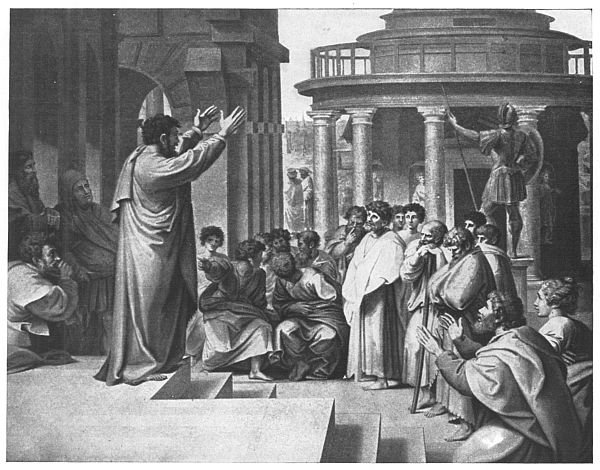 St. Paul Preaching at Athens
Painted by Raphael
While Paul was waiting at Athens for Silas and Timothy, his
anger was aroused when he saw that the city was filled with idols.
So he argued in the synagogue with the Jews and with the Greeks
who joined in their worship, and every day with those whom he happened
to meet in the market-place. A few of the philosophers also
met him. Some of them said, “What has this picker-up of scraps
of learning to say?” Others said, “He seems to be a herald of some
new deities.” This was because he had been telling the good news
about Jesus and how he rose from the dead. And they took him to
the Court of Areopagus and said, “May we hear what this new teaching
of yours is? For the things you are saying sound strange to us;
so we want to know what they mean.” (For all the Athenians and
the foreign visitors spent their time doing nothing but telling or hearing
something new.)
So Paul stood in the middle of the Court and said, “Men of
Athens, I see wherever I go that you are very religious, for as I
passed along and looked at your objects of worship, I found an altar
with the inscription,
Whom, therefore, you worship without knowing, him I proclaim
to you. The God who made the world and all things in it is Lord
of heaven and earth and does not live in temples made by men. He
is not served by men’s hands, as though he needed anything, for he
it is who gives to all men life and breath and all things. He h[299]as made
all nations from one family that they may live over the whole earth.
He has also fixed for them when and where they are to live, that they
should seek God in the hope that, as they feel after him, they may
find him, for he is not far from each one of us; for it is in him that
we live, and move, and have our being, as in fact, some of your
own poets have said, ‘We also are his children.’
“Therefore, as the children of God, we ought not to think of the
divine nature as being like gold or silver or stone, carved by man’s
art and invention. God overlooked the ages of ignorance, but now
he commands all men everywhere to repent, for he has fixed a day
on which he will judge the world justly by the one whom he has appointed,
and he has given proof of this to all mankind by raising him
from the dead.”
When they heard of raising one from the dead, some sneered,
but others said, “We will hear what you have to say about that some
other time.” So Paul went out from among them. Some men, however,
joined him and believed, among whom were Dionysius, a member
of the Court of the Areopagus, a woman named Damaris, and
several others. After this Paul left Athens and went to Corinth.
Back to Top
PAUL WRITES TO HIS FRIENDS AT THESSALONICA
Paul and Silas and Timothy to the church of the Thessalonians
which lives in God the Father and the Lord Jesus Christ.
May good-will and peace be granted to you.
We thank God always for you all and mention you in our
prayers, for we constantly remember before our God and Father
your active faith and loving service and firm hope in our Lord
Jesus Christ.
You yourselves know, brothers, that our visit to you was not
without results. At Philippi, as you remember, we had the courage
through divine help to tell you the good news of God even though
we had been ill treated and insulted. We loved you so much and
you had become so dear to us that we would gladly have given to
you not only God’s good news, but also our very lives.
Brothers, you remember our hard labor and toil, how we worked
at our trade night and day so as not to be a burden to[300] any of you,
while we told you God’s good news. You are witnesses, and so is
God, that our dealings with you who believe in Christ were pure,
just, and beyond reproach, and that we treated each of you as
a father treats his own children, persuading and encouraging you,
and appealing to you to live so that you would be worthy of the God
who calls you to his own Kingdom and glory.
We thank God constantly for this also, that when you received
God’s message from us you accepted it not as a mere word of man
but for what it really is, the message of God, which even now is doing
its work in the hearts of you who believe. You have begun to
follow the example of the churches of God in Judea which are united
with Jesus Christ, for you have suffered the same things from your
own countrymen as they have suffered from the Jews who killed
the Lord Jesus.
Brothers, when we were torn away from you for a little time (out
of sight but not out of mind!), we were exceedingly eager to see you
face to face. We did want to come to you—I, Paul, did more than
once, but Satan put difficulties in our way. For who is “our hope,
our joy, our crown” of which we have a right to be proud? Is it
not you? For you are our glory and our joy!
So when I could stand it no longer, I decided that it was best to
remain alone at Athens and send Timothy, our brother and God’s
servant in telling the good news about Christ, to strengthen your
faith and so to encourage you that none of you might be disturbed
by the troubles through which you are passing, for you know that
we must have them.
But now that Timothy has just come back and brought me the
good news of your faith and love and how you always remember
me lovingly, longing to see me as I long to see you, I have been comforted,
brothers, in all my distress and trouble by your faith.
How can we thank God enough for all the joy that comes to us
through you? Night and day we pray most earnestly that we may
see your faces and supply whatever is lacking in your faith. May
our God and Father himself and our Lord Jesus direct our way to
you, and may the Lord make your love for one another and for all
men grow ever greater, even as does our love for you, so as to make
your hearts strong and your characters without fault in the sight
of our God and Father.
I solemnly charge you in the name of the Lord to have this letter
read aloud to all the [301]brothers. The love of our Lord Jesus Christ
be with you.
Back to Top
PAUL’S WORK AT CORINTH
And Paul left the place and went to the home of Titius Justus,
who worshipped God, whose house was next to the synagogue. Crispus,
the president of the synagogue, and all his family, believed in
the Lord; and many of the Corinthians when they heard Paul, believed
and were baptized. One night the Lord said to Paul in
a vision, “Do not be afraid, but speak and do not stop, for I am with
you and no one shall harm you; I have many followers in this city.”
So Paul lived there a year and a half and taught them the word of
God.
But when Gallio was governor of Greece, the Jews joined in an
attack on Paul and brought him before the court on the charge that
he led people to worship God contrary to the law. But just as Paul
was about to speak, Gallio said to the Jews, “If it were something
about wrong-doing or a serious crime, there would be some reason
for my listening to you, O Jews; but if these are only questions about
names and your own law, take care of them yourselves. I do not
wish to be a judge of matters like these.” And he drove them out
of the court. Then all the people caught hold of Sosthenes, the president
of the synagogue, and beat him in front of the court; but Gallio
paid no attention to these things. Paul, after staying some time
longer in Corinth, said good-by to the brothers and with Priscilla
and Aquila, sailed for Syria.
Back to Top
PAUL WRITES TO HIS FRIENDS IN CORINTH
Paul, called to be an apostle of Christ Jesus by the will of God,
and brother Sosthenes to the church of God at Corinth.
I thank God continually for the blessing which he has given you
through Jesus Christ. Through him you have been so richly and
fully gifted with every kind of speech and knowledge that you have
proved the truth of the testimony which I bore to Christ when I
was with you.
Brothers, in the name of our Lord Jesus Christ I beg of you all
to agree in your statement of faith. There must be no quarrels
among you, but you must be one both in your way of thinking and
in your purpose. For I have been told, brothers, by the members of
Chloe’s household, that there are quarrels among you.
Avoid all impurity! Every other sin that a man commits is outside
the body, but the impure man sins against his own body. Do
you not know that your body is the temple of the Holy Spirit that
is within you, which you have received from God? You do not belong
to yourselves, for you were bought for a price. Be sure to honor
God with your bodies.
No temptation has come to you that is beyond your power to
resist. God is faithful and will not let you be tempted beyond what
you can stand; but when the temptation comes, he will provide the
way of escape, so that you will have strength to endure.
In all things I can do as I like, but they are not all good for me.
In all things I can do as I like, but they do not all make me a better
man. Each of us must seek not only his own good but that of his
neighbor.
Do you not know that in a race, though all run, only one wins
the prize? So run that you may win the prize. Every athlete exercises
self-restraint in every way; but while they do this to win a
crown that perishes, we do it to secure one that is eternal. So then
I run as one who is sure of his goal. I do not plant my blows as a
boxer who beats the air; rather I constantly train my body and
keep it under control for fear that I, who told others of the contest,
might myself be disqualified.
Now brothers, I wish you to understand about spiritual gifts.
There are different kinds of gifts, but all are given by the same Spirit.
There are different ways of serving, but all are for the same Master.
There are different ways in which God’s power is shown, but the
same God is working in all of you in all these ways. Each is given
his own gift of the Spirit for the common good.
Just as a man’s body has many parts, and these parts, although
many, form only one body, so it is with Christ. For we have all
been baptized by the one Spirit so as to form one body. Whether
we were Jews or Greeks, slaves or freemen, we have all been given
the same Spirit. For the body consists not of one part but of many.
If the foot were to say, “Because I am not the hand I do not belong
to the body,” that would not make it any less a part of the body.
If the ear were to say, “Because I am not an eye, I do not belong[303] to the body,” it would be, for all that, a part of the body. If the
whole body were an eye, where would the hearing be? If the whole
body were an ear, where would the sense of smell be? But as it is,
God gave each part of the body its proper place, exactly as he wished.
If they were all only one part, where would the body be? As it is,
while there are many parts, there is only one body.
The eye cannot say to the hand, “I have no need of you,” nor
can the head say to the feet, “I have no need of you.” On the contrary,
even those parts of the body which seem weaker are necessary.
If one part suffers, all parts suffer with it. If one part is honored,
all the parts share its honor.
Now you are one body—the body of Christ, and each of you
are parts of it. And God gave each his proper place in the church:
apostles first, prophets next, teachers third, then workers of miracles,
healers, helpers, and directors.
Are all apostles? Are all prophets? Are all teachers? Are all
able to work miracles? Are all healers? Are all able to tell what
their words mean? But always seek to attain the highest gifts.
Yet I will show you a far better way. Though I speak with the
tongues of men and of angels but have not love, I am only sounding
brass or a clanging cymbal. Even though I have the gift of
prophecy, and can understand all mysteries and all knowledge, and
have faith enough to remove mountains, but have not love, I am
nothing. And if I give all I have to feed the poor and my body to
be burned, but have not love, I gain nothing.
Love is patient and kind; love is not envious; love is not boastful,
is not conceited, does not act rudely, is not selfish, is never provoked,
does not resent wrong; rejoices not in evil, but rejoices in
the truth. Love forgives all things, believes all things, hopes for
all things, endures all things.
Love never fails. As for prophecies they shall come to an end.
As for tongues they shall cease. As for knowledge it also shall come
to an end; for we know in part, and we prophesy in part. But
when that which is perfect has come, that which is imperfect shall
come to an end.
When I was a child, I spoke as a child, I felt as a child, I thought
as a child; but now that I am a man I have put away childish
ways. For now we see only the dim reflection in a mirror, but then
face to face. Now I know only in part, but then I shall know fully,
even as also I am fully known.[304]
And now abide faith, hope, and love, these three; but the greatest
of these is love.
Back to Top
THE NEW LIFE AFTER DEATH
Now, brothers, remember the good news I preached to you, that
Christ died for our sins, and that he was buried and rose again the
third day.
Now if we preach that Christ rose from the dead, why do some
of you say that there is no resurrection of the dead? If there is no
such thing as a resurrection of the dead, then Christ did not rise;
and if Christ did not rise then our preaching is of no value and your
faith also is of no value.
But some one will say, “How do the dead rise and what kind
of body will they have when they come back?” Foolish one! The
seed you sow does not come to life again unless it dies. What you
sow is not the body that will be, but a mere grain, perhaps of wheat
or of some other seed. God gives it the kind of body that he sees
fit, to each kind of seed a body of its own.
All flesh is not the same; there is human flesh, another flesh of
beasts, another flesh of birds, and another of fishes. There are
heavenly bodies and also earthly bodies, but the splendor of the
heavenly is one thing and that of the earthly is another. There is
one splendor of the sun, another splendor of the moon, and another
splendor of the stars; for one star differs from another in
splendor.
So it is with a man’s body when he rises from the dead. It is
sown a perishable thing, it is raised imperishable; it is sown without
honor, it is raised in glory; it is sown in weakness, it is raised
in power; it is sown a natural body, it is raised a spiritual body. If
there is a natural body, there is also a spiritual body.
In a moment, in the twinkling of an eye, we shall be changed and
this perishable body must put on the imperishable and this mortal
body put on immortality. Then shall come true what is written
in Scripture “Death is swallowed up by victory. O grave, where
is your victory? O death, where is your sting?” Thanks be to God
who gives us the victory through our Lord Jesus Christ.
Back to Top
WAYS OF SHOWING LOVE
Now about the collection for God’s people in Jerusalem, you
must carry out the same directions that I gave to the churches in
Galatia. On the first day of every week let each one put aside a
certain part of what he has gained, so that the money will not have
to be collected when I come. When I arrive I will send those whom
you select, with letters, to carry your gift to Jerusalem, and if it is
worth while for me to go too, they shall go with me.
I will come to you after I have passed through Macedonia, for
I am going there. Perhaps I shall spend some time, or even pass
the winter with you, that you may start me on my way, wherever
I may be going. I do not wish to see you merely in passing, for my
hope is to stay some time with you, if the Lord permits. But I will
stay in Ephesus until the Feast of Pentecost, for I have a great opportunity
here for work, and there are many foes.
If Timothy comes, see that he has nothing to fear while among
you, for he is carrying on the Lord’s work even as I am. So let no
one slight him, but see him safely on his way that he may come to
me, for I am waiting for him along with the other brothers.
Be watchful, stand firm in the faith, be men, be strong! Let
all that you do be done in love.
The churches of the province in Asia send you greetings. Aquila
and Prisca, with the church that meets in their home, also send you
greetings, and so do all the brothers.
I, Paul, add this greeting with my own hand: “The Love of the
Lord Jesus Christ be with you. My love be with you all in Christ
Jesus.”
Back to Top
PAUL’S TRIALS AND VICTORIES AT EPHESUS
After spending some time at Antioch Paul went off on a trip to
Galatia and Phrygia to strengthen the faith of all the disciples; then
he returned to Ephesus. There Paul entered the synagogue, and
spoke out fearlessly for three months, arguing and trying to convince
people about the Kingdom of God. But as some were
stubborn and refused to be convinced and publicly slandered the
Christian way of thinking and living, Paul, taking the disciples[306] with him, left the synagogue and continued his teaching every day
in the lecture-room of Tyrannus. This continued for two years,
so that all the people who lived in the province of Asia, both Jews
and Greeks, heard the message of the Lord.
And God did wonderful miracles through Paul, and the name
of the Lord Jesus was held in high honor. Many who believed in
him came to confess and to tell all the wicked things they had done.
About that time a great disturbance arose over the Christian
way of teaching and living. A silversmith, by the name of Demetrius,
made silver models of the temple of Artemis which brought
much profit to his workmen. He gathered the workmen together,
and others who were in the same kind of business, and said to them,
“Men, you know that we get our wealth from this business of ours.
You also see and hear that, not only at Ephesus but throughout the
whole province of Asia, this Paul has drawn away many people by
telling them that gods made by human hands are not gods at all.
There is danger not only that this business will be hurt, but also
that the temple of the great goddess Artemis will be neglected, and
that she will even lose her importance in all the province of Asia
and throughout the world.”
When they heard this they were greatly enraged, and shouted,
“Great is Artemis of the Ephesians!” The uproar spread throughout
the whole city until the people all rushed into the theatre, dragging
along Gaius and Aristarchus, men of Macedonia, who were
Paul’s travelling companions. Paul wanted to enter the assembly,
but the disciples would not let him. Some of the leading religious
officers of the province of Asia, who were friends of his, also sent
messages begging him not to risk going into the theatre.
Some of the people shouted one thing and some another, for the
assembly was all in confusion, and most of those present did not
know why they had come together. For about two hours they
shouted, “Great is Artemis of the Ephesians!” When the city recorder
had quieted the mob, he said: “Men of Ephesus, what man
is there who does not know that this city is the guardian of the temple
of the great Artemis and of the statue that fell from heaven?
As these facts cannot be denied, you should keep calm and do
nothing reckless. You have brought these men here who are neither
robbers of temples nor blasphemers of our goddess. If Demetrius
and his fellow workers have a complaint against anybody, there are
the courts and the Roman officials; let both sides state their ch[307]arges.
But if there is anything else you want, it must be settled in the regular
assembly. We are indeed in danger of being charged with riot
because of what we have done to-day, for there is no good reason
that we can give for this gathering.” With these words he dismissed
the assembly.
When the uproar had ceased, Paul sent for the disciples and encouraged
them. Then, after bidding them good-by, he started for
Macedonia.
Back to Top
PAUL WRITES TO THE CHRISTIANS AT ROME
Paul, a servant of Jesus Christ, called to be an apostle, set apart
to tell God’s good news about Jesus Christ our Lord, to all God’s
loved ones who are in Rome and have been called to be his people:
Love to you, and peace from God our Father and the Lord Jesus
Christ.
First of all I thank my God through Jesus Christ for you all,
because your faith is reported throughout the whole world. The
God whom I serve with my spirit, as I tell the good news about his
Son, is my witness how often I speak of you in my prayers, asking
that at last the way may be opened for me to come to you, if it is
God’s will. For I long to see you that I may give you some spiritual
gift, that you may be strengthened; or rather that we may each be
encouraged by the other’s faith, I by yours, and you by mine.
Brothers, I also wish you to know that many times I planned
to come to you (but thus far was prevented) that I might gather
some fruit from my labors among you, as I have already in the other
nations. I have a duty to perform both to Greeks and to barbarians;
both to the wise and to the ignorant; so I am eager to tell the good
news to you also who are in Rome. I am not ashamed of the good
news, for it is the power of God that is able to save every one who
believes it, the Jew first and the Greek as well.
Do not follow the example of those who have not heard the good
news, but be made different by a complete change of mind, so that
you may be able to know what is the will of God, even what is good
and perfect and acceptable to him.
Let your love be sincere; abhor that which is evil, cling to that
which is good. In your love for your brothers, feel genuine devotion
for one another. Be eager to honor one another. Never let
your zeal grow less; keep alive your enthusiasm; serve the Lord;[308] rejoice in your hope. Be patient in trouble, persevering in prayer;
share with fellow Christians in need, be friendly and generous.
Bless those who persecute you, bless and curse not. Rejoice
with those who rejoice, and weep with those who weep. Be sympathetic
with one another. Set not your heart on high things but
be ready to do humble tasks. Do not be conceited.
Do not pay back evil for evil; aim to do what is honorable in
the eyes of all men. If possible, as far as it depends on you, live at
peace with all men. Never seek revenge, dear friends, but let God
punish those who wrong you. Therefore, if your enemy is hungry,
feed him; if he is thirsty, give him drink, for in so doing you will
heap coals of fire upon his head. Do not let evil overcome you, but
overcome evil with good.
Owe no man anything, except to love one another, for he who
loves his neighbor has done what the law demands. For all the commandments
are summed up in this one command: “You shall love
your neighbor as yourself.” Love never wrongs a fellow man; that
is why love meets all the demands of the law.
I have, for several years, been longing to visit you when I go to
Spain. I am hoping to see you on my way there, and to be sent on
my journey by you after I have first enjoyed being with you for a
time. But now I am on my way to Jerusalem to do a service for
God’s people; for the Christians in Macedonia and Greece have
been good enough to make a contribution for the poor Christians
at Jerusalem.
Now I beg of you, brothers, in the name of our Lord Jesus Christ
and by the love which his Spirit inspires, that you join me in earnest
prayer to God in my behalf. Pray that I may be delivered from
those in Judea who refuse to believe in Jesus, that my mission to
Jerusalem may prove acceptable to God’s people, and that I may
through the will of God come to you joyfully and find rest with you.
May the God who gives peace be with you all. Amen.
Back to Top
PAUL’S LAST JOURNEY TO JERUSALEM
After we had said good-by to the elders of Ephesus we sailed to
Syria and landed at Tyre, where the ship was to unload her cargo.
There we found certain Christian disciples and stayed a week with
them. Speaking under the influence of the Spirit, they told Paul
not to set foot in Jerusalem; but when it was time for us to go, [309]we
went on our way, and they all, with their wives and children, came
with us until we were out of the city. Then kneeling on the beach,
we prayed and said good-by to one another; we went on board and
they returned home.
Sailing from Tyre to Ptolemais, we completed our voyage. After
greeting the Christian brothers who lived there, we spent a day with
them. The next morning we set out and reached Cæsarea, where
we went to the house of Philip the evangelist, who was one of the
Seven, and stayed with him. He had four daughters who had the
gift of prophecy.
During our stay there, which lasted a number of days, a prophet
named Agabus came down from Judea. Coming up to us, he took
Paul’s belt, bound his own feet and hands with it, and said: “This
is what the Holy Spirit says, ‘In the same way the Jews will bind
the owner of this belt at Jerusalem and will turn him over to the
Romans.'” When we and the brothers who lived there heard this,
we begged Paul not to go up to Jerusalem, but Paul answered,
“What do you mean by weeping and breaking my heart? For I
am ready not only to be bound but to die in Jerusalem for the cause
of the Lord Jesus.” So when he could not be kept from going, we
stopped pleading and said: “The Lord’s will be done.”
After some days we started for Jerusalem. Some of the disciples
from Cæsarea went with us and brought us to the house of Mnason
of Cyprus, one of the early disciples, with whom we were to stay.
When we reached Jerusalem the brothers welcomed us gladly.
The next day Paul went with us to see James, and all the elders
of the church were present. After Paul had greeted them, he told,
one by one, all the things that God had done among the foreign
peoples through his ministry. When they heard it they praised
God and said to him, “Brother, you see how many thousands of
Christian believers there are among the Jews and that they are all
eager to have men keep the law. They have been told that you teach
all Jews living in foreign lands not to keep the law of Moses. Now
what is to be done? They will certainly hear that you have come;
therefore do this: we have here four men who have solemnly promised
to make certain offerings at the Temple. Join with them, pay
their expenses, and all will know that there is no truth in the stories
told about you, but that you live as the law of Moses commands.”
So Paul joined the men the next day and went with them into[310] the Temple to give notice of the time when sacrifice was to be offered
for every one of them.
Back to Top
PAUL’S NARROW ESCAPE FROM DEATH
The seven days during which the men had promised to make
special offerings were almost over when some Jews from Asia, who
saw Paul in the Temple, stirred up the whole crowd and laid hands
on him, shouting, “Men of Israel, help! This is the man who
teaches all men, everywhere, to despise the Jewish people, the Jewish
law, and this sacred place.” So the whole city was aroused. The
people rushed together, seized Paul, and dragged him outside the
Temple; and at once the doors were closed.
The people were trying to kill Paul when it was reported to the
commander of the soldiers that all Jerusalem was in an uproar. He
at once took some soldiers and officers and rushed down among them.
When they saw the commander and the soldiers, they stopped beating
Paul. Then the commander came up and arrested him and ordered
him to be bound with two chains, and inquired, “Who is he
and what has he done?” Some of the crowd shouted one thing,
some another; and as the commander could not learn the real truth
on account of the uproar, he ordered Paul to be taken to the castle.
When Paul reached the steps, he had to be carried by the soldiers
on account of the violence of the crowd, for all the people followed,
shouting, “Kill him!”
Just as Paul was being taken into the castle, he said to the commander,
“May I say something to you?” The commander said:
“Do you speak Greek? Then you are not the Egyptian who some
time ago started a rebellion and led four thousand outlaws into the
desert?” Paul answered, “I am a Jew, of Tarsus in Cilicia, a citizen
of a great city. I beg of you, let me speak to the people.”
So when the commander had given him permission, Paul stood
on the steps and motioned with his hand to the people, and when
there was a great silence, he spoke to them in Hebrew: “Brothers,
and fathers, listen to the defense I now make before you.” When
they heard him speaking to them in Hebrew they were all the more
quiet; so he went on to say, “I am a Jew, born in Tarsus in Cilicia,
but brought up in this city, educated under Gamaliel in all the strictness
of our law. I was as eager to serve God as you all are to-day.
I persecuted and even killed the followers of Jesus. I bound and[311] put in prison both men and women, as the high priest himself and
all the elders can testify.
“It was also from them that I had letters to our fellow Jews in
Damascus, and I was on my way to bring the Christians who were
there back to Jerusalem in chains for punishment. While I was on
my way not far from Damascus, suddenly, about noon, a bright light
from heaven shone around me. I fell to the ground and heard a
voice saying to me, ‘Saul, Saul, why do you persecute me?’ ‘Who
art thou, Lord?’ I asked. He answered, ‘I am Jesus of Nazareth,
the one whom you are persecuting.’ And I said, ‘What shall I do,
Lord?’ And the Lord said to me, ‘Rise, and go to Damascus, and
there it shall be told you what you are to do.’ And when I could
not see because of the bright light, I went to Damascus, led by the
hand of those who were with me. And one Ananias, a religious man,
well thought of by the Jews, came and, standing beside me, said,
‘Brother Saul, receive your sight,’ and that very minute I received
my sight and saw him. And he said to me, ‘The God of our fathers
has chosen you to know his will and to see the Righteous One. For
you shall be his witness to all men of what you have seen and heard.’
And the Lord said to me, ‘Go, for I will send you far away to those
who are not Jews.'”
Up to this time the people had listened to him, but when they
heard these words they shouted, “Away with such a fellow from the
earth, for he is not fit to live,” and they threw off their clothes and
flung dust into the air until the commander ordered Paul to be taken
into the castle and examined, by flogging, to find out why the people
had shouted so against him. When they had tied him up with
straps, Paul said to the officer who was standing by, “Is it lawful
for you to flog a Roman citizen without trial?” When the officer
heard this he reported it to the commander and said: “Take care
what you do, for this man is a Roman citizen.” Then the
commander came to Paul and said, “Tell me, are you a Roman citizen?”
He said, “Yes.” The commander answered, “I paid a large
sum for this citizenship”; and Paul said, “But I was born a Roman
citizen.” The men who were to have examined him, at once left
him. And the commander, when he learned that Paul was a Roman
citizen, was also afraid because he had bound him.
The next day the commander, so as to find out just what charge
the Jews had made against Paul, unbound him and or[312]dered the high
priests and all the members of the council to come together. Then
they brought Paul down and placed him before them. Paul, looking
straight at the members of the council, said: “Brothers, I have
done my duty, with a clear conscience before God, up to the present
moment.”
When Paul saw that some of the council were Sadducees and
some Pharisees, he cried out, “Brothers, I am a Pharisee, a son of
Pharisees. It is because of my hope that the dead will live again
that I am on trial!” When he said this a quarrel arose between
the Pharisees and the Sadducees, and there was a great difference
of opinion among them. For the Sadducees say that there is no
life after death, nor angel, nor spirit; but the Pharisees believe in
all these; so there was a great uproar. Some of the scribes who belonged
to the party of the Pharisees sprang to their feet and protested,
“We find this man guilty of no crime. What if some spirit
or an angel has spoken to him?” When the uproar became so great
that the commander was afraid that Paul would be torn in pieces
by them, he ordered the troops to go down and take him from among
them by force and bring him into the castle.
The next night the Lord stood beside Paul and said, “Be of good
cheer, for as you have spoken for me at Jerusalem, so you must speak
also at Rome.”
Early the next morning the Jews plotted together and solemnly
promised not to eat or drink until they had killed Paul, and there
were more than forty who made this promise. They went to the
high priests and elders and said, “We have made a solemn promise
to taste no food until we have killed Paul. Now you and the council
must tell the commander that you wish him to bring Paul down
to you, as though you wanted to examine more carefully the charges
brought against him. We shall be ready to kill him before he comes
here.”
But Paul’s sister’s son heard of their plot and went to the castle
and told Paul. And Paul called one of the officers and said, “Take
this young man to the commander, for he has something to tell him.”
So the officer took him to the commander and said, “Paul the prisoner
asked me to bring this young man to you, for he has something
to tell you.” The commander then took him by the hand, and after
he had led him aside, asked him privately, “What is it that you have
to tell me?” He said, “The Jews have agreed to ask you to bring
Paul down to-morrow to the council pretending that they wish to
examine his case more carefully. Now do not grant their request,[313] for more than forty are lying in wait for him and have solemnly
promised not to eat or drink until they have killed him. Even now
they are ready, only waiting for your consent.”
The commander let the young man go, bidding him, “Tell no
one that you have informed me of this.” Then he called two officers
and said, “Get ready two hundred soldiers, seventy horsemen, and
two hundred spearmen by nine o’clock to-night to go as far as Cæsarea.”
He also told them to provide horses for Paul to ride on so as
to bring him safely to Felix the governor. So the soldiers, as they
had been commanded, took Paul and brought him by night to Antipatris.
The next day the soldiers returned to the castle, leaving the
horsemen to go on with him. When they reached Cæsarea they
brought Paul to the governor.
Back to Top
A PRISONER WHO PREACHED TO HIS JUDGES
Some days later Felix came with his wife, Drusilla, who was a
Jewess, and sent for Paul and heard what he had to say about the
faith in Christ Jesus. But when he talked about upright living,
self-control, and the future judgment, Felix became alarmed and
said, “You may go for the present; when I can find a convenient
time I will send for you.” All the time Felix was hoping that Paul
would give him money, and for this reason he sent for him often
and talked with him. But after two years had passed Felix was
succeeded by Porcius Festus, who, wishing to win the favor of the
Jews, left Paul in prison.
After Festus had been governor three days, he went up from
Cæsarea to Jerusalem. Then the high priests and the leading Jews
made charges to him against Paul and begged Festus as a favor to
send and have him brought to Jerusalem, for they were plotting to
kill him on the way. But Festus answered that Paul would be kept
in Cæsarea and that he himself was going there in a short time.
“Therefore,” he said, “let your leading men go down with me and
let them charge the man with whatever crime he has committed.”
After staying eight or ten days in Jerusalem, Festus went back to
Cæsarea.
The next day Festus took his place on the judgment seat and
ordered Paul to be brought in. When he came, the Jews who had
come down from Jerusalem surrounded him and brought many and
serious charges against him which they were unable to prove[314]. In
answer to them Paul said, “I have committed no crime against the
Jewish law or the Temple or the Emperor.”
But as Festus wished to win the favor of the Jews, he interrupted
Paul with the question, “Are you willing to go up to Jerusalem and
be tried before me there on these charges?” Paul said, “I am
standing before the Emperor’s judgment seat, where I ought to be
tried. I have done no wrong to the Jews, as you yourself very well
know. If, however, I have broken the law or have committed any
crime that deserves death, I am willing to die. But if there is no
truth in any of their charges against me, then no man has the right
to give me up to them. I appeal to the Emperor!” After talking
with the council, Festus answered, “You have appealed to the Emperor,
to the Emperor you shall go.”
After some days had passed, King Agrippa and Bernice arrived
at Cæsarea to visit Festus. As they remained there for many days,
Festus laid Paul’s case before the King. Agrippa said to Festus,
“I should like to hear the man myself.” “You shall hear him to-morrow,”
said Festus. So the next day Agrippa and Bernice came
with much pomp to the court-room, along with the commanders
and the leading citizens; and at the command of Festus Paul was
brought in. And Agrippa said to Paul, “You have permission to
speak for yourself.” At this Paul stretched out his hand and began
his defense: “I am happy, King Agrippa, that I am permitted this
day to defend myself before you against all the charges which the
Jews have brought against me, for you know all about the Jewish
customs and questions. So I beg of you to hear me patiently. All
the Jews know the kind of life I lived from my youth, among the
men of my own nation and in Jerusalem. As a Pharisee I lived according
to the standards of the strictest party in our religion. I
indeed believed that it was my duty to do all in my power to oppose
the cause of Jesus of Nazareth. This I did in Jerusalem. With
authority from the high priests, I put many of Jesus’ followers in
prison. When they were put to death, I voted against them. In
all the synagogues I often punished them and tried to make them
speak against the name of Jesus, and in my insane fury I followed
them even to distant cities.
“When I was travelling to Damascus on this business, with written
authority from the high priests, I saw, on the road in the middle of
the day, a light from heaven, more dazzling than the glare of the
sun, shining around me and those who were travelling with me. We
fell to the ground, and I heard a voice say to me in Hebrew, ‘Saul,[315] Saul, why do you persecute me? It is hard for you to kick against
the goads.’ I asked, ‘Who art thou, Lord?’ and the Lord answered,
‘I am Jesus whom you are persecuting. Rise and stand on your feet,
for I have appeared to you so as to appoint you my servant and a
witness to what you have seen and to the things that I will show
you. I chose you from the Jews and the other peoples to whom I
am sending you to open their eyes, that they may turn from darkness
to light, from the power of Satan to God, so that they may receive
forgiveness of their sins and a place among those who have
given themselves to me because they believe in me.’ O, King
Agrippa, I have not disobeyed the heavenly vision. To this day I
have had the help of God and have stood firm and, without adding
a single word beyond what the prophets and Moses said would take
place, I have testified to small and great how the Christ was to
suffer and to be the first to rise from the dead and to proclaim the
message of light not only to the Jews but to all peoples.”
When Paul said these words in his defense, Festus cried, “Paul,
you are mad! Your great learning is driving you insane!” But
Paul said, “I am not insane, most noble Festus, but I am speaking
the sober truth. For the King, to whom I can speak freely, knows
about these things, for I am sure that nothing escaped his notice,
since this has not been done in a corner. King Agrippa, do you believe
the prophets? I know that you do.” But Agrippa said to
Paul, “With but little persuasion you would make me a Christian!”
Paul replied, “I pray to God that whether with little or much not
only you but also every one who hears me this day may become a
Christian as I am.”
Then the King, together with the governor and Bernice and
those who had been sitting with them, rose and, when they were
alone, they said to one another, “This man has done nothing deserving
of death or of imprisonment.” And Agrippa said to Festus,
“This man might have been set free if he had not appealed to
the Emperor.”
Back to Top
PAUL’S SHIPWRECK
When it was decided that we were to sail for Italy, Paul and certain
other prisoners were placed in charge of Julius, an officer of the
Emperor’s regiment. We went on board a ship which was bound
for the seaports of Asia Minor. The next day we stopped at Sidon,
where Julius very kindly allowed Paul to visit his friends and be[316] entertained by them. Putting to sea again, we sailed under the lee
of Cyprus, for the wind was against us. Then after sailing past Cilicia
and Pamphylia, we came to Myra in Lycia. There the officer
found a ship from Alexandria bound for Italy and put us on board.
For many days we made slow progress and it was only with great
difficulty that we arrived off Cnidus. Then as the wind was against
us we sailed under the lee of Crete, opposite Cape Salmone, and after
coasting along with great difficulty came to a place called Fair
Havens, near the city of Lasea.
As our voyage had taken some time and sailing had become dangerous
(for it was already late in October) Paul warned them, saying,
“Men, I see that the voyage will mean serious injury and loss,
not only to the cargo and the ship but also to our own lives.” But
the officer paid more attention to the captain and to the owner of
the ship than to what Paul said. As the harbor was not a good one
in which to winter, most of them advised putting to sea from there,
hoping that they could get to Phœnix (a safe harbor) so as to winter
there.
When a light breeze from the south sprang up, they thought
that they could reach Phœnix. So, after lifting up the anchor, they
ran close along the coast of Crete: but in a short time a tempestuous
wind called a “Northeaster” beat down upon them. The ship was
caught in it and was unable to keep her head to the wind. So we
had to give up and run before it. Running under the lee of a little
island called Cauda, we managed with difficulty to haul in the ship’s
boat. After lifting it on board, the men used ropes to bind together
the lower part of the ship. As they were afraid that they might run
ashore on the African quicksands, they lowered the sail and drifted.
But as we were being terribly battered by the storm, the next day
the men began to throw out the ship’s cargo. On the third day,
with their own hands, they threw overboard the ship’s tackle. For
many days neither sun nor stars were seen and the heavy gale continued,
so at last all hope that we would be saved was given up.
When the men had gone a long time without food, Paul stood
up among them and said, “Men, you should have listened to me
and not have sailed from Crete, then you would have escaped this
hardship and loss. But now I urge you to cheer up, for there will
be no loss of life, but only of the ship. For last night, an angel of
the God, to whom I belong and whom I serve, stood beside me and
said, ‘Paul, have no fear, for you must stand before the Emperor.[317] God also has granted you the lives of all of those who sail with you.’
Therefore, men, cheer up! For I believe God and am sure that it
will be just as I have been told; but we will be wrecked on a certain
island.”
When the fourteenth night came and we were drifting about in
the Adriatic Sea, the sailors about midnight thought that they were
nearing land. So they took soundings and found one hundred and
twenty feet of water; and when they had gone a little farther they
found ninety feet. Fearing that we might be wrecked on the rocks,
they threw out four anchors from the stern and prayed for daylight.
The sailors wanted to escape from the ship and had even lowered
the boat into the sea, pretending that they were going to lay out
anchors from the bow, when Paul said to the officer and to the soldiers,
“Unless these men stay on board, we cannot be saved.” Then
the soldiers cut the ropes which held the boat and let her drift away.
Just before daybreak Paul begged them all to take some food,
and said, “This is the fourteenth day that you have been constantly
on the watch, taking little or no food. Take some food, then, I beg
of you, because this will keep you alive, for not one of you will lose
even a hair from his head.” When he had said this, he took bread,
and gave thanks to God before them all, and he broke the bread
and began to eat it. Then they were all cheered up and they also
took food. There were about seventy-six of us on board. When
they had eaten enough, they lightened the ship by throwing the
wheat into the sea.
When it was day they could not make out what land it was; but
they saw an inlet with a sandy beach on which they planned, if possible,
to run the ship ashore. So cutting away the anchors they left
them in the sea. At the same time unloosing the ropes which tied
the rudders and hoisting the foresail to the wind, they made for the
beach; but coming to a place where two seas met they ran the ship
aground. The prow stuck fast and could not be moved, but the
stern began to break up under the beating of the waves. Then the
soldiers wanted to kill the prisoners for fear some of them might
swim ashore and escape. But as the officer wished to save Paul,
he kept them from carrying out their plan, and ordered those who
could swim to jump overboard and get first to the land; the rest
followed, some on planks and some on other things from the ship.
In this way they all got safely to land. After we had escaped we
found that the island was called Malta.[318]
Back to Top
THE END OF PAUL’S LONG JOURNEY
The natives of the island showed us unusual kindness, for they
kindled a fire and welcomed us all, because of the pouring rain and
the cold. Now Paul had gathered a bundle of sticks and was laying
it on the fire when a poisonous snake, driven out by the heat, fastened
itself on his hand. When the natives saw the creature hanging
from his hand, they said to one another, “Surely this man is a murderer;
although he has been saved from the sea, justice will not let
him live.” But he shook the creature off into the fire and was unhurt.
They expected that he would at once swell up or fall down
dead; but after they had waited a long time and saw that no harm
had come to him, they changed their minds and said that he was a
god.
On the part of the island where we landed there was an estate
belonging to Publius the governor. He welcomed us and entertained
us most generously for three days. Now it happened that the father
of Publius was lying ill from fever and dysentery. So Paul went to
see him and prayed, and, laying his hands on him, cured him. After
this the other sick people in the island came and were cured. They
also presented us with many gifts, and when we sailed, they put on
board everything we needed.
After three months we set sail on a ship from Alexandria called
“The Twin Brothers,” which had wintered at the island. We put
in at Syracuse, and remained there three days. Then we tacked
around and came to Rhegium. The next day a south wind sprang
up, and we arrived on the following day at Puteoli, where we found
Christian brothers who asked us to spend a week with them, and
so we reached Rome.
The brothers there, when they heard about us, came as far as
the Market of Appius and the Three Taverns to meet us. When
Paul saw them, he thanked God and took courage.
When we reached Rome, Paul received permission to live by himself
with the soldier who guarded him. Three days after our arrival,
Paul invited the leading Jews to meet him and said to them,
“Brothers, although I have done nothing against the Jewish law
or the customs of our fathers, I was handed over as a prisoner from
Jerusalem to the Romans, who, when they had examined me, we[319]re
willing to set me free, for I was innocent of any crime deserving of
death. But the Jews objected; so I was forced to appeal to the Emperor—not
that I had any charge to bring against my nation. This
is the reason why I have asked to see you and speak with you, for
it is on account of Israel’s hope that I am bound.”
They replied, “We have received no letters about you from Judea
nor has any brother come here with any bad report or statement
about you; but we wish to hear from you what you teach, for we
know that the Christian sect is everywhere attacked.” So they
fixed a day and many of them came to him to the place where he
was staying. Then from morning until evening he explained his
teachings and told them about the Kingdom of God, and tried to
lead them to believe in Jesus by proofs from the law of Moses and
from the prophets. Some believed what he taught and others would
not believe. When they could not agree among themselves they
departed after Paul had said to them: “Well did the Holy Spirit
say to your fathers through the prophet Isaiah:
You will hear and hear but never understand,
You will look and look but never see;
For this people’s mind is stupid,
And their ears are too dull to hear,
And they have closed their eyes,
To keep them from seeing with their eyes,
Or hearing with their ears,
Or understanding with their minds,
And turning back that I may heal them.’
“Remember, therefore, that this opportunity to be saved, that God
has given you, is given to other peoples, and they will listen to it.”
For two whole years Paul lived in his own hired house. He welcomed
all who came to him, and preached the Kingdom of God,
and taught about the Lord Jesus Christ openly, no one stopping
him.
Back to Top
PAUL’S LAST WORDS TO HIS FRIENDS
Paul and Timothy, servants of Jesus Christ, to all of Christ’s
followers in Philippi, as well as to the ministers and their helpers.
May love and peace be granted you from God our Father and the
Lord Jesus Christ.
I hope, if the Lord permits, to send Timothy to you before long,
that I too may be cheered by news about you. I have no other like
him who will take a genuine interest in you, for every one is looking
out for his own interests, not those of Christ Jesus. But you
know how Timothy has stood the test, how like a son working with
his father he has served with me in spreading the good news. So
I hope to send him shortly, as soon as I see how it will go with me;
though I am confident, if the Lord permits, that I myself will come
to you before long.
Rejoice in the Lord always. Again, I say, rejoice. Let all know
that you are patient. Do not be anxious, but always make your
requests known to God in earnest prayer and thanksgiving; so shall
the peace of God, which is beyond all human understanding, keep
guard over your hearts and your minds in union with Christ Jesus.
Finally, brothers, whatever is true, whatever is honorable, whatever
is just, whatever is pure, whatever is lovely, whatever is of good
report, if there be any virtue or anything worthy of praise, consider
the value of these things. Practise also what you have learned and
received and heard and seen in me, and then the God of peace will
be with you.
It is a great joy to me as a Christian brother to know that you
are again thoughtful of me. Indeed, you have always been thoughtful,
but you did not have an opportunity to show it. Not that I
speak of want, for I have learned, wherever I am, to be content. I
know how to live simply; I know, too, how to live in prosperity.
I have learned in all things the secret of being content, both when
I have plenty and when I am hungry, when I am in prosperity and
when I am in want. I can do everything through Christ who
strengthens me.
But you acted nobly in sharing my affliction. Even when I was
in Thessalonica, more than once you sent money for my needs. It
is not the gift I am seeking, but the growing reward that is to your
credit! I have enough of everything, and more than enough. I
am fully supplied by what I received from you through Epaphroditus.
It is like fragrant incense, a sacrifice acceptable and well
pleasing to God. My God will supply your every need out of his
glorious wealth in Christ Jesus. Now to God our Father be glory
forever and ever.
Already my life-blood is poured out and the time for me to go
has come. I have fought the good fight. I have finished the course,
I have kept the faith. Now the crown for right-doing awaits me
which the Lord, the righteous judge, will give to me on that [321]day,
and not to me only but to all who have loved and longed for his appearing.
Back to Top
THE MEANING OF FAITH
Now faith is the confidence that we shall receive the things for
which we hope, the proof of the reality of things we do not see. It
was because of their faith that the men of old were approved by God.
Through faith we know that the universe was made perfect by God’s
command and that what is seen was made out of what is not seen.
Through faith Abel offered God a better sacrifice than Cain, and
so received the assurance that he was an upright man, for God approved
of his gifts. Though dead, yet because of his faith he still
speaks.
Through faith Noah, having been told by God about things still
unseen, in reverent obedience built an ark to save his household;
and in doing so he condemned the world and became heir to the
righteousness that comes through faith.
Through faith Abraham obeyed, when he was called to go to the
place which he was to receive as an inheritance, and he set out, not
knowing where he was going. Through faith he made his home in
the land that had been promised to him as in a foreign country, living
in tents with Isaac and Jacob, who shared the same promise with him.
Through faith Abraham, when put to the test, sacrificed Isaac,
yes, was ready to sacrifice his only son, although he had received
the divine promises and had been told, “It is through Isaac that
your family name will be carried on,” for he believed that God was
able to raise men even from the dead. In a sense, he did receive his
son back from the dead.
Through faith, also, Isaac blessed Jacob and Esau, even telling
them of things to come. Through faith Joseph, as he was dying,
thought of the time when the Israelites would go out of Egypt and
gave orders about his own bones.
Through faith Moses was hidden by his parents for three months
after birth because they saw that the child was beautiful, and because
they did not fear the King’s command.
Through faith Moses, when he had grown up, refused to be called
the son of Pharaoh’s daughter, choosing rather to share ill treatment
with God’s people than to enjoy for a short time the pleasures of sin.
Through faith he left Egypt, not because he feared the King’s
wrath, but like one who saw the Unseen King he never faltered.[322]
Through faith the Israelites crossed the Red Sea as through dry
land, and when the Egyptians tried to cross they were drowned.
What more shall I say? For time would fail me if I tried to tell
of Gideon and Barak and Samson and Jephthah, of David and
Samuel and the prophets—they who through faith conquered kingdoms,
did righteous acts, received promises from God, closed the
mouths of lions, quenched the power of fire, escaped the edge of the
sword, in the hour of weakness were made strong, who proved mighty
in war and put to flight foreign armies!
Women received back their dead restored to life. Others were
tortured, refusing release, that they might be raised to a better life.
Others stood the test of taunts and blows, yes, even chains and imprisonment.
They were stoned, they were burned, they were sawn
in two, they were killed by the sword. They went about in skins of
sheep and goats, lacking everything, persecuted, ill treated (men of
whom the world was unworthy), wandering in lonely places and
among the hills, in caves and in holes in the ground. Through faith
they all won God’s approval, but they did not receive the promised
blessing, for God had planned something better for us, that apart
from us they should not be made perfect.
Therefore, surrounded as we are by such a host of witnesses, let
us also lay aside every handicap and the sin which clings so closely
to us, and let us run with patience the race that is set before us, fixing
our eyes on Jesus, the Author and Perfecter of faith, who for the
joy which lay before him, patiently endured the cross, thinking
nothing of the shame, and is now seated at the right hand of the
throne of God.
Back to Top
THE IMPORTANCE OF DOING WHAT IS RIGHT
James, a servant of God and of the Lord Jesus Christ, to the
true Israelites scattered among the nations, greeting.
My brothers, regard it as only a cause for joy, when you fall into
all kinds of trials. Know that the testing of your faith develops
patience; but let your patience do its perfect work, that you may be
perfect and complete, lacking nothing.
If any of you lacks wisdom, let him ask God who gives to all men
liberally and without reproach, and it will be given him. Only let
him ask with faith, with never a doubt, for the man who doubts is
like the waves of the sea, driven and tossed by the winds. Let not
such a man think, that a half-hearted man, unstable in all his ways,
will receive anything from God.[323]
Blessed is the man who endures temptation; for when he has
stood the test, he will receive the crown of life which is promised to
all who love God. Let no man say when he is being tempted: “I
am tempted of God,” for God cannot be tempted to do wrong, and
he himself tempts no one. Each man is tempted when he is drawn
away and enticed by his own evil desire. Then the evil desire gives
birth to sin, and sin, when it is full grown, brings death.
Do not be deceived, my beloved brothers. Every good gift and
every perfect blessing comes from above, from the Father who is
the source of all light, with whom there is no variation nor shadow
made by turning.
Know this, my beloved brothers: let every one be quick to hear,
slow to speak, slow to be angry, for a man’s anger does not promote
the righteousness that God approves. So putting away all that is
vile and wicked, receive with humility the message of truth that
is deeply rooted in you which is able to save your soul.
Do what that message commands, and do not merely hear it
and deceive yourselves. For if any one hears that message but does
not do as it commands, he is like a man who looks at his own face
in the mirror, for he looks at himself, goes off, and at once forgets
what he is like. But he who looks into the perfect law of freedom
and continues to do so, not merely listening to it and then forgetting,
but does real work, will be blessed in what he does.
If any one thinks he is religious and does not bridle his tongue
but deceives himself, his religion is worthless. Religion that is pure
and stainless, such as God our Father approves is this: to visit the
orphans and widows in their trouble and to keep oneself clean from
the evil of the world.
Back to Top
THE LOVE THAT MAKES MEN BROTHERS
We know what love is by this, that Christ laid down his life for
us; so we ought to lay down our lives for the brothers. But if any
one has this world’s wealth and looks on while his brother is in need
and shows no sympathy for him, how can the love of God remain
in him? My dear children, let us show our love not with words nor
with our lips only, but by deeds and sincerity.
Beloved, let us love one another, for love comes from God and
every one who loves is a child of God and knows God. He who loves
not man does not know God, for God is love. God showed his love
for us, for he sent his only Son into the world that through [324]him we
might have life. His love is shown in this, not that we loved God,
but that he loved us and sent his Son to be the sacrifice that made
possible the forgiveness of our sins.
Beloved, if God so loved us, then we ought also to love one another.
No one has ever seen God; but if we love one another, then
God lives in us, and the love which is his is made perfect in us. By
this we know that we shall live in him and he in us, because he has
given us a portion of his own Spirit, and we have seen and bear witness
that the Father has sent the Son to be the Saviour of the world.
We ourselves know and believe in the love that God has for us.
God is love, and he whose life is full of love lives in God and God
lives in him. In love there is no fear, but perfect love drives out
all fear, for fear means punishment, and he who fears has not become
perfect in love. We love him because he first loved us.
If any one says, “I love God,” and yet hates his brother, he is
a liar; for he who does not love his brother whom he has seen, cannot
love God whom he has not seen. And we have this command
from him, that he who loves God is to love his brother also.
Every one who believes that Jesus is the Christ, is a child of God;
and every one who loves the Father, loves every child of his. We
know that we are his children when we love him and obey his commands,
for love for God means obeying his commands. And his
commands are not hard to follow, for whatever is born of God conquers
the world. And our faith is the power that conquers the world.
Who is the conqueror of the world but he who believes that Jesus
is the Son of God?
Now the confidence that we have in God is this, that he listens
to us whenever we ask anything in accordance with his will. And
if we know that he listens to whatever we ask, we know that we have
the things which we have asked from him.
Back to Top
THE GLORY AND HONOR THAT JESUS HAS WON
John, to the seven churches in the province of Asia. May a
blessing be granted you and peace from him who is and was and
ever shall be, and from the seven spirits before his throne, and from
Jesus Christ who is the faithful witness, the first of the dead to be
restored to life and the ruler of the kings of the earth.
I, John, your brother who shares with you the distress, the
dominion, and the patient endurance which we have through our
faith in Jesus, found myself in the island called Patmos because of
my loyalty to God’s message and to the testimony of Jesus. On
the Lord’s Day I was under the influence of the Spirit, and I heard
behind me a loud voice like a trumpet calling, “Write what you see
in a book and send it to the seven churches.”
Then I turned to see whose voice it was that spoke to me; and
on turning around I saw seven golden lamps and in the midst of the
lamps One, like a Son of man, clothed in a long robe and with a
belt of gold around his breast. His head and hair were white as
wool, white as snow; his eyes were like a flame of fire, his feet were
like burnished bronze melted in the furnace, his voice was like the
sound of many waters. In his right hand he held seven stars; a sharp,
two-edged sword came out from his mouth, and his face shone like
the sun in its full strength.
When I saw him, I fell at his feet as if I were dead; but he laid
his hand on me and said: “Do not be afraid; I am the First and the
Last, I was dead but now I am alive for evermore. Therefore write
down what you see and what is now and shall be hereafter. As for
the secret meaning of the seven stars which you have seen in my
right hand and of the seven golden lamps—the seven stars represent
the angels of the seven churches, and the seven lamps represent
the seven churches.”
After this I saw a door opening into heaven. And the voice like
a trumpet which I had previously heard talking with me, said:
“Come up here, and I will show you what must take place in the
future.” At once I found myself under the influence of the Spirit,
and there stood a throne in heaven whose appearance was like a
diamond or ruby and One was sitting on the throne. Encircling the
throne was a rainbow which looked like an emerald; also around
the throne were twenty-four other thrones, and on these thrones
were seated twenty-four elders, clothed in white robes with golden
crowns upon their heads. From the throne came flashes of lightning
and voices and peals of thunder, while in front of the throne
were seven flaming torches, which were the seven spirits of God.
In front of the throne there appeared to be a sea of glass which
looked like crystal. In the space about the throne and encircling it
were four living creatures, and day and night they never ceased
chanting:
Who was and is and ever shall be.”
Then I saw, lying at the right hand of him who was seated on the
throne, a book sealed with seven seals. And I saw a mighty angel
saying in a loud voice: “Who is worthy to open the book and
to break its seals?” But no one was worthy, either in heaven or on
the earth or under the earth to open the book or look into it. So I
began to weep bitterly because no one was found worthy to open
the book or look into it; but one of the elders said to me: “Weep
not; behold the Lion of Judah’s tribe, the Scion of David—he has
won the right to open the book and its seven seals.”
Then in the space between the throne and the four living creatures
I saw a Lamb standing among the elders. He seemed to have
been slain, but he had seven horns and seven eyes. And he came
and took the book out of the right hand of him who was seated on
the throne. And when he took the book, the four living creatures
and the twenty-four elders fell down before the Lamb, each with
his harp, and with his golden bowls full of incense which represent
the prayers of the saints. They were singing this new song: “Thou
art worthy to take the book and open its seals, for thou wast slain
and by thy blood thou hast ransomed for God, men from every tribe
and language and people and nation; thou hast made them a kingdom
and priests for our God, and they shall reign on the earth.”
And I looked and I heard the voice of many angels around the
throne and of the living creatures and of the elders, numbering ten
thousand times ten thousand and thousands of thousands, crying
aloud, “Worthy is the Lamb that has been slain to receive power
and wealth and wisdom and might and honor and glory and blessing.”
And I heard every creature in heaven and on earth and under
the earth and in the sea and all things that are in them crying, “To
him who is seated on the throne and to the Lamb, be blessing and
honor and praise and dominion forever and ever!” Then the four
living creatures said, “Amen,” and the elders fell down and worshipped.
Back to Top
THE REWARD OF THE FAITHFUL
After that I saw a vast host, which no one could count, from
every nation and tribe and people and language, standing before
the throne and before the Lamb, dressed in white robes, with palm
branches in their hands. They cried aloud, “It is to our God who
is seated on the throne and to the Lamb that we owe our salvati[327]on!”
Then one of the elders turned to me and said: “Who are these
dressed in white robes, and from where have they come?” I said
to him, “You know, my lord.” So he told me, “These are the people
who have come through the great persecution and have washed their
robes and made them white in the blood of the Lamb. For this
reason they are now before the throne of God and serve him day
and night within his temple. He who is sitting on the throne will
shelter them; never again will they be hungry or thirsty; never
again will the sun or any scorching heat smite them, for the Lamb
that stands in the space before the throne will be their shepherd
and will guide them to fountains of living water; and God will wipe
away all tears from their eyes.”
Then I saw another angel flying in mid-heaven with an eternal
message of good news for the inhabitants of the earth, for every
nation, tribe, language, and people. He cried aloud, “Revere
God, praise him, for the hour of his judgment has come. Worship
him who made heaven and earth, the sea and the flowing
springs.”
And I saw a great white throne and One seated upon it from
whose presence earth and sky fled away, and were no more to be
found. And I saw the dead, the great and the lowly, standing before
the throne. Then books were opened; also another book, the
Book of Life, was opened, and the dead were judged by what was
written in the books according to what they had done. The sea
gave up its dead, and Death and the Abode of the Departed also
gave up their dead, and all were judged according to what they had
done.
Back to Top
THE NEW HEAVEN ON EARTH
Then I saw a new heaven and a new earth, for the first heaven
and the first earth had passed away and the sea was no more. And
I saw the Holy City, the New Jerusalem, coming down from God
out of heaven, all ready like a bride attired to meet her husband.
I also heard a loud voice from the throne which said: “Behold, God’s
dwelling-place is with men, and he shall dwell among men, and they
shall be his people, and God himself will be with them. He shall
wipe away every tear from their eyes, and death shall be no more;
neither shall there be mourning nor wailing, nor pain, for the fir[328]st
things have passed away.” The One who is seated on the throne
said: “Behold, I make all things new!” And he added, “Write
this: ‘These words are faithful and true.'”
And he said to me, “All is over! I am the Alpha and the Omega,
the First and the Last. I will let the thirsty drink freely of the fountain
of life. He who conquers shall obtain this, and I will be his God
and he shall be my son.”
The city has no need of the sun nor of the moon to give it light,
for the glory of God illumines it and its light is the Lamb. Its gates
shall never be shut by day and there shall be no night there. Nothing
unclean nor any one who does what is shameful or deceitful
shall enter it, but only those whose names are written in the Lamb’s
book of life.
Then he showed me the river of the water of life, clear as crystal,
flowing through the streets of the city from the throne of God and
the Lamb. On both sides of the river grew the tree that gives
life, which bore twelve kinds of fruit and yielded its fruit each
month; and the leaves of the tree were for the healing of the
nations.
And the throne of God and the Lamb will be in that city; and
his servants will serve and worship him; they will see his face and
his name will be on their foreheads. There will be no more night
there, and they will have no need of the light of lamp or sun, for
the Lord God will be their light, and they will reign forever and
ever.
And he said to me: “Do not keep secret the prophetic words
contained in this book, for the time of their fulfilment is near. He
who does wrong, let him still do wrong, and he who is filthy, let him
still be filthy, and he who is righteous, let him still do right, and he
who is pure, let him still be pure. Know that I am coming quickly
and I will bring my rewards to repay each for what he has done.
I am the Alpha and the Omega, the First and the Last, the Beginning
and the End. Blessed are those who wash their robes, that they
may have a right to the tree of life and to go through the gates into
the city.
“I, Jesus, have sent my angel to testify to you for the churches.
I am the Scion and Offspring of David, the bright, the Morning Star.
Both the Spirit and the Bride say, ‘Come.’ Let him who hears say,
‘Come,’ let him who is thirsty come, and whoever will, let him take
of the water of life freely.”[329]
“For God so loved the world, that he gave
his only begotten Son, that whosoever believeth
in him, should not perish, but have
everlasting life.”
Back to Top
|
|---|
Copyright 2008. Bibles Net. Com. All Rights Reserved.