
BIBLES NET. COM
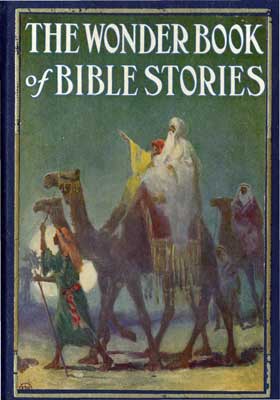
THE WONDER BOOK
OF BIBLE STORIES
edited and arranged by
LOGAN MARSHALL
Bible Stories
CONTENTS
AND EVE
THE STORY OF NOAH
AND THE ARK
THE STORY OF HAGAR
AND ISHMAEL
THE STORY OF
ABRAHAM AND ISAAC
THE STORY OF
JACOB
THE
THE STORY OF THE LADDER THAT REACHED TO HEAVEN
THE
THE COAT OF MANY COLORS
THE DREAMS
THE STORY OF THE MONEY IN THE SACKS
THE MYSTERY OF THE LOST BROTHER
THE STORY OF MOSES, THE CHILD WHO WAS FOUND IN THE
RIVER
THE STORY OF
THE STORY OF GIDEON AND HIS THREE HUNDRED
SOLDIERS
THE STORY OF
SAMSON, THE STRONG MAN
THE STORY OF RUTH,
THE GLEANER
THE STORY OF
THE STORY OF THE FIGHT WITH THE GIANT
THE STORY OF THE
CAVE OF ADULLAM
THE STORY OF
SOLOMON AND HIS TEMPLE
THE STORY OF
ELIJAH, THE PROPHET
THE STORY OF
JONAH AND THE WHALE
THE STORY OF THE
FIERY FURNACE
THE STORY OF
DANIEL IN THE LION’S DEN
THE STORY OF
THE ANGEL BY THE ALTAR
THE
THE STORY OF THE STAR AND THE WISE MEN
THE STORY OF THE CHILD IN THE TEMPLE
THE STORY OF THE WATER THAT WAS TURNED INTO WINE
THE STORY OF THE STRANGER AT THE WELL
THE
THE STORY OF THE SERMON ON THE MOUNT
THE STORY OF THE MIRACLE WORKER
THE GOOD SHEPHERD AND THE GOOD SAMARITAN
THE
STORY OF THE PALM BRANCHES
THE
STORY OF THE BETRAYAL
THE
STORY OF THE EMPTY TOMB
THE
STORY OF THE MAN AT THE BEAUTIFUL GATE
THE STORY
OF STEPHEN, THE FIRST MARTYR
INTRODUCTION
The Bible is one of the two or three oldest books in the
world, but unlike most of the ancient books, it is found not
only in great libraries, but in almost every home of the
civilized world; and it is not only studied by learned
scholars, but read by the common people; and its many stories
grasp and hold the attention of little children. Happy is that
child who has heard, over and over again, the Bible stories
until they have become fixed in his mind and memory, to become
the foundations of a noble life.
It is with the desire of aiding parents and teachers in
telling these stories, and aiding children to understand them,
also in the hope that they may be read in many schools, that a
few among the many interesting stories in the Bible have been
chosen, brought together and as far as necessary simplified to
meet the minds of the young.

Jesse Lyman Hurlbut
THE STORY OF ADAM AND
EVE
The first man’s name was Adam and his wife he called Eve.
They lived in a beautiful Garden away in the East Country which
was called Eden, filled with beautiful trees and flowers of all
kinds. But they did not live in Eden long for they did not obey
God’s command, but ate the fruit of a tree which had been
forbidden them. They were driven forth by an angel and had to
give up their beautiful home.
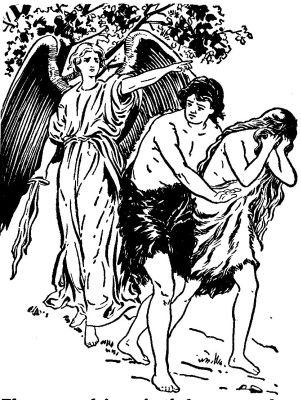
They were driven forth by an angel
So Adam and his wife went out into the world to live and to
work. For a time they were all alone, but after a while God
gave them a little child of their own, the first baby that ever came into the
world. Eve named him Cain; and after a time another baby
came, whom she named Abel.
When the two boys grew up, they worked, as their father
worked before them. Cain, the older brother, chose to work in
the fields, and to raise grain and fruits. Abel, the younger
brother, had a flock of sheep and became a shepherd.
While Adam and Eve were living in the Garden of Eden, they
could talk with God and hear God’s voice speaking to them. But
now that they were out in the world, they could no longer talk
with God freely, as before. So when they came to God, they
built an altar of stones heaped up, and upon it, they laid
something as a gift to God, and burned it, to show that it was
not their own, but was given to God, whom they could not see.
Then before the altar they made their prayer to God, and asked
God to forgive their sins, all that they had done was wrong;
and prayed God to bless them and do good to them.
Each of these brothers, Cain and Abel, offered upon the
altar to God his own gift. Cain brought the fruits and the
grain which he had grown; and Abel brought a sheep from his
flock, and killed it and burned it upon the altar. For some
reason God was pleased with Abel and his offering, but was not
pleased with Cain and his offering. Perhaps God wished Cain to
offer something that had life, as Abel offered; perhaps
Cain’s heart was not right when he came before God.
And God showed that He was not pleased with Cain; and Cain,
instead of being sorry for his sin, and asking God to forgive
him, was very angry with God, and angry also toward his brother
Abel. When they were out in the field together Cain struck his
brother Abel and killed him. So the first baby in the world
grew up to be the murderer of his own brother.
And the Lord said to Cain, “Where is Abel, your
brother?”
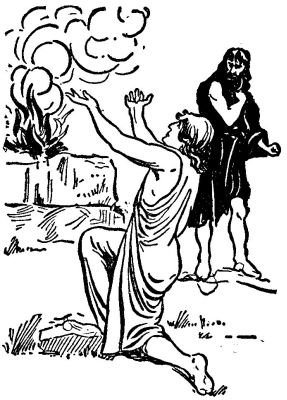
Cain and Abel
And Cain answered, “I do not know; why should I take care of
my brother?”
Then the Lord said to Cain, “What is this that you have
done? Your brother’s blood is like a voice crying to me from
the ground. Do you see how the ground has opened, like a mouth,
to drink your brother’s blood? As long as you live, you shall
be under God’s curse for the murder of your brother. You shall
wander over the earth, and shall never find a home, because you have
done this wicked deed.”
And Cain said to the Lord, “My punishment is greater than I
can bear. Thou hast driven me out from among men; and thou hast
hid thy face from me. If any man finds me he will kill me,
because I shall be alone, and no one will be my friend.”
And God said to Cain, “If any one harms Cain, he shall be
punished for it.” And the Lord God placed a mark on Cain, so
that whoever met him should know him and should know also that
God had forbidden any man to harm him. Then Cain and his wife
went away from Adam’s home to live in a place by themselves,
and there they had children. And Cain’s family built a city in
that land; and Cain named the city after his first child, whom
he had called Enoch.
THE STORY OF NOAH AND
THE ARK
After Abel was slain, and his brother Cain had gone into
another land, again God gave a child to Adam and Eve. This
child they named Seth; and other sons and daughters were given
to them; for Adam and Eve lived many years. But at last they
died, as God had said they must die, because they had eaten of
the tree that God had forbidden them to eat.
By the time that Adam died, there were many people on the
earth; for the children of Adam and Eve had many other
children; and when these grew up they had other children; and
these had children also. These men and women and children lived
in tents. They owned sheep and cattle, and they moved about
with them, wherever they could find pasture. The children
played around the tent doors, and sat beside the camp-fires in
the evenings, where they all sang together, and the older
people told them stories. And after a time this land where
Adam’s sons lived began to be full of people.
It is sad to tell that as time went on more and more of
these people became wicked, and fewer and fewer of them grew up
to become good men and women. All the people lived near
together, and few went away to other lands; so it came to
pass that even the children of good men and
women learned to be bad, like the people around them, and no
longer did what was right and good.
And as God looked down on the world that he had made, he saw
how wicked the men in it had become, and that every thought and
every act of man was evil and only evil continually.
But while most of the people in the world were very wicked,
there were some good people also, though they were very few.
The best of all the men who lived at that time was a man whose
name was Enoch. He was not the son of Cain, but another Enoch,
who came from the family of Seth, the son of Adam, who was born
after the death of Abel. While so many around Enoch were doing
evil, this man did only what was right. He walked with God and
God walked with him, and talked with him. And at last, when
Enoch was a very old man and weary with life, God took him away
from earth to heaven. He did not die, as all the people have
since Adam disobeyed God, but “he was not, for God took him.”
This means that Enoch was taken up from earth without
dying.
All the people in the time of Enoch were not shepherds. Some
of them had learned how to make rude bows and arrows and axes
and plows. And after a long time they melted iron, and they
made knives and swords and dishes to use in
their homes. They sowed grain in the fields and reaped
harvests, and they planted vines and fruit trees. But God
looked down on the earth and said:
“I will take away all men from the earth that I have made;
because the men of the world are evil, and do evil
continually.”
But even in those bad times God saw one good man. His name
was Noah. Noah tried to do right in the sight of God. As Enoch
had walked with God, so Noah walked with God, and talked with
him. And Noah had three sons; their names were Shem, and Ham,
and Japheth.
God said to Noah, “The time has come when all the men and
women on the earth are to be destroyed. Every one must die,
because they are all wicked. But you and your family shall be
saved, because you alone are trying to do right.”
Then God told Noah how he might save his life and the lives
of his sons. He was to build a very large boat, as large as the
largest ships that are made in our time; very long, and very
wide and very deep; with a roof over it; and made like a long,
wide house in three stories; but so built that it would float
on the water. Such a ship as this was called “an ark.” God told
Noah to build this ark, and to have it ready for the time when
he would need it.
“For,” said God to Noah, “I am going to
bring a great flood of water on the earth to cover all the
land and to drown all the people on the earth. And as the
animals on the earth will be drowned with the people, you
must make the ark large enough to hold a pair of each kind
of animals and several pairs of some animals that are needed
by men, like sheep and goats and oxen; so that there will be
animals as well as men to live upon the earth after the
flood has passed away. And you must take in the ark food for
yourself and your family, and for all the animals with you;
enough food to last for a year, while the flood shall stay
on the earth.”
And Noah did what God told him to do, although it must have
seemed very strange to all the people around, to build this
great ark where there was no water for it to sail upon. And it
was a long time, because this ship was so big, that Noah and
his sons were at work building the ark, which God had told them
to build, while the wicked people around wondered, and no doubt
laughed at Noah for building a great ship where there was no
sea.
At last the ark was finished, and stood like a great house
on the land. There was a door on one side, and a window on the
roof, to let in the light. Then God said to Noah:
“Come into the ark, you and your wife, and your three sons, and their wives with them;
for the flood of waters will come very soon. And take with
you animals of all kinds, and birds, and things that creep;
seven pairs of these that will be needed by men, and one
pair of all the rest, so that all kinds of animals may be
kept alive upon the earth.”
So Noah and his wife, and his three sons, Shem, Ham and
Japheth, with their wives, went into the ark. And God brought
to the door of the ark the animals, and the birds, and the
creeping things of all kinds; and they went into the ark. And
Noah and his sons put them in their places, and brought in food
enough to feed them all for many days. And then the door of the
ark was shut and no more people and no more animals could come
in.
In a few days the rain began to fall, as it had never rained
before. It seemed as though the heavens were opened to pour
great floods upon the earth. The streams filled, and the rivers
rose higher and higher, and the ark began to float on the
water. The people left their houses and ran up to the hills;
but soon the hills were covered, and all the people on them
were drowned.
Some had climbed up to the tops of higher mountains, but the
water rose higher and higher, until even the mountains were
covered and all the people, wicked as they had been, were
drowned in the great sea that now rolled
over all the earth where man had lived. And all the animals,
the tame animals, cattle, and sheep, and oxen, were drowned;
and the wild animals, lions, and tigers, and all the rest
were drowned also. Even the birds were drowned, for their
nests in the trees were swept away, and there was no place
where they could fly from the terrible storm. For forty days
and nights the rain kept on, until there was no breath of
life remaining outside of the ark.
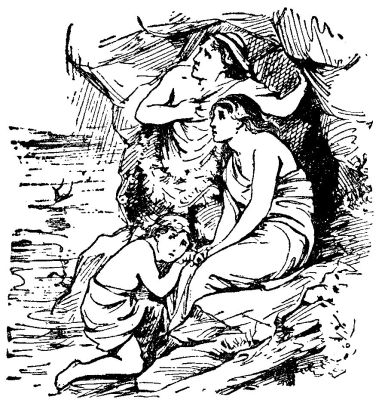
The water rose higher and higher
After forty days the rain stopped, but the water stayed upon
the earth for more than six months, and the ark with all that
were in it floated over the great sea that covered the land.
Then God sent a wind to blow over the waters, and to dry them
up; so by degrees the waters grew less and less. First
mountains rose above the waters, then the hills rose up, and finally the ark
ceased to float and lay aground on a mountain which is
called Mount Ararat.
But Noah could not see what had happened on the earth,
because the door was shut, and the only window was up in the
roof. But he felt that the ark was no longer moving, and he
knew that the water must have gone down. So, after waiting for
a time, Noah opened a window, and let loose a bird called a
raven. Now the raven has strong wings; and this raven flew
round and round until the waters had gone down, and it could
find a place to rest, and it did not come back to the ark.
After Noah had waited for it awhile, he sent out a dove; but
the dove could not find any place to rest, so it flew back to
the ark, and Noah took it into the ark again. Then Noah waited
a week longer, and afterward he sent out the dove again. And at
the evening, the dove came back to the ark, which was its home;
and in its bill was a fresh leaf which it had picked off from
an olive tree.
So Noah knew that the water had gone down enough to let the
trees grow again. He waited another week, and sent out the dove
again; but this time the dove flew away and never came back.
And Noah knew that the earth was becoming dry again. So he took
off a part of the roof, and looked out, and saw that there was
dry land all around the ark, and the waters were no
longer everywhere.
Noah had now lived in the ark a little more than a year, and
he was glad to see the green land and the trees once more. And
God said to Noah:
“Come out of the ark, with your wife, and your sons, and
their wives, and all the living things that are with you in the
ark.”
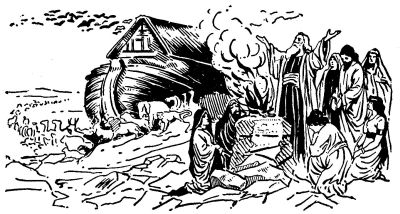
So Noah opened the door of the Ark
So Noah opened the door of the ark, and with his family came
out, and stood once more on the ground. And the animals, and
birds, and creeping things in the ark, came out also, and began
again to bring life to the earth.
The first thing that Noah did when he came out of the ark,
was to give thanks to God for saving all his family when the
rest of the people on the earth were destroyed. He built an
altar, and laid upon it an offering to the Lord, and gave
himself and his family to God and promised to do God’s
will.
And God was pleased with Noah’s offering, and God said:
“I will not again destroy the earth on account of men, no
matter how bad they may be. From this time no flood shall again
cover the earth; but the seasons of spring and summer and fall
and winter, shall remain without change. I give to you the
earth; you shall be the rulers of the ground and of every
living thing upon it.”
Then God caused a rainbow to appear in the sky, and he told
Noah and his sons that whenever they or the people after them
should see the rainbow, they should remember that God had
placed it in the sky and over the clouds as a sign of his
promise, that he would always remember the earth, and the
people upon it, and would never again send a flood to destroy
man from the earth.
So as often as we see the beautiful rainbow, we are to
remember that it is the sign of God’s promise to the world.
THE STORY OF HAGAR
AND ISHMAEL
After the great flood the family of Noah and those who came
after him grew in number, until, as the years went on, the
earth began to be full of people once more. But there was one
great difference between the people who had lived before the
flood and those who lived after it. Before the flood, all the
people stayed close together, so that very many lived in one
land, and no one lived in other lands. After the flood families
began to move from one place to another, seeking for themselves
new homes. Some went one way, and some another, so that as the
number of people grew, they covered much more of the earth than
those who had lived before the flood.
Part of the people went up to the north and built a city
called Nineveh, which became the ruling city of a great land
called Assyria, whose people were called Assyrians.
Another company went away to the west and settled by the
great river Nile, and founded the land of Egypt, with its
strange temples and pyramids, its sphinx and its monuments.
Another company wandered northwest until they came to the
shore of the great sea which they called the Mediterranean Sea. There
they founded the cities of Sidon and Tyre, where the people
were sailors, sailing to countries far away, and bringing
home many things from other lands to sell to the people of
Babylon, and Assyria, and Egypt, and other countries.
Among the many cities which the people built were two called
Sodom and Gomorrah. The people in these cities were very wicked
and were nearly all destroyed. One good man named Lot and his
family escaped. There was another good man named Abraham who
did not live in these cities. He tried to do God’s will and was
promised a son to bring joy into his family.
After Sodom and Gomorrah were destroyed, Abraham moved his
tent and his camp away from that part of the land, and went to
live near a place called Gerar, in the southwest, not far from
the Great Sea. And there at last, the child whom God had
promised to Abraham and Sarah, his wife, was born, when
Abraham, his father, was a very old man.
They named this child Isaac, as the angel had told them he
should be named. And Abraham and Sarah were so happy to have a
little boy, that after a time they gave a great feast and
invited all the people to come and rejoice with them, and all
in honor of the little Isaac.
Now Sarah had a maid named Hagar, an Egyptian woman, who ran away from her
mistress, and saw an angel by a well, and afterward came
back to Sarah. She, too, had a child and his name was
Ishmael. So now there were two boys in Abraham’s tent, the
older boy, Ishmael, the son of Hagar, and the younger boy,
Isaac, the son of Abraham and Sarah.
Ishmael did not like the little Isaac, and did not treat him
kindly. This made his mother Sarah very angry, and she said to
her husband:
“I do not wish to have this boy Ishmael growing up with my
son Isaac. Send away Hagar and her boy, for they are a trouble
to me.”
And Abraham felt very sorry to have trouble come between
Sarah and Hagar, and between Isaac and Ishmael; for Abraham was
a kind and good man, and he was friendly to them all.
But the Lord said to Abraham, “Do not be troubled about
Ishmael and his mother. Do as Sarah has asked you to do, and
send them away. It is best that Isaac should be left alone in
your tent, for he is to receive everything that is yours. I the
Lord will take care of Ishmael, and will make a great people of
his descendants, those who shall come from him.”
So the next morning Abraham sent Hagar and her boy away,
expecting them to go back to the land of Egypt, from which
Hagar had come. He gave them some food for the journey, and
a bottle of water to drink by the way. The
bottles in that country are not like ours, made of glass.
They are made from the skin of a goat. One of these
skin-bottles Abraham filled with water and gave to
Hagar.
And Hagar went away from Abraham’s tent, leading her little
boy. But in some way she lost the road, and wandered over the
desert, not knowing where she was, until all the water in the
bottle was used up; and her poor boy in the hot sun and the
burning sand had nothing to drink. She thought that he would
die of his terrible thirst; and she laid him down under a
little bush; and then she went away, for she said to
herself:
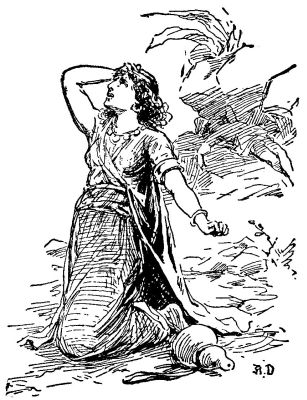
In some way she lost the road
“I cannot bear to look at my poor boy suffering and dying
for want of water.”
And just at that moment, while Hagar was
crying, and her boy was moaning with thirst, she heard a
voice saying to her:
“Hagar, what is your trouble? Do not be afraid. God has
heard your cry and the cry of your child. God will take care of
you both, and will make of your boy a great nation of
people.”
It was the voice of an angel from heaven; and then Hagar
looked, and there, close at hand, was a spring of water in the
desert. How glad Hagar was as she filled the bottle with water
and took it to her suffering boy under the bush!
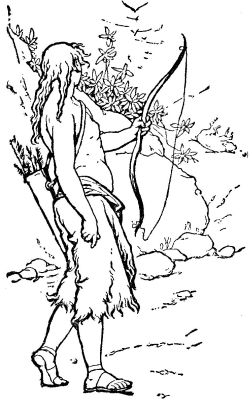
Learned to shoot with the bow and arrow
After this Hagar did not go down to Egypt. She found a place
where she lived and brought up her son in the wilderness, far
from other people. And Ishmael grew up in the desert and
learned to shoot with the bow and arrow. He became
a wild man, and his children after him grew
up to be wild men also. They were the Arabians of the
desert, who even to this day have never been ruled by any
other people, but wander through the desert, and live as
they please. So Ishmael came to be the father of many
people, and his descendants, the wild Arabians of the
desert, are living unto this day in that land.
THE STORY OF ABRAHAM
AND ISAAC
You remember that in those times of which we are telling,
when men worshipped God, they built an altar of earth or of
stone, and laid an offering upon it as a gift to God. The
offering was generally a sheep, or a goat, or a young
ox—some animal that was used for food. Such an offering
was called “a sacrifice.”
But the people who worshipped idols often did what seems to
us strange and very terrible. They thought that it would please
their gods if they would offer as a sacrifice the most precious
living things that were their own; and they would take their
own little children and kill them upon their altars as
offerings to the gods of wood and stone, that were no real
gods, but only images.
God wished to show Abraham and all his descendants, those
who should come after him, that he was not pleased with such
offerings as those of living people, killed on the altars. And
God took a way to teach Abraham, so that he and his children
after him would never forget it. Then at the same time he
wished to see how faithful and obedient Abraham would be to his
commands; how fully Abraham would trust in
God, or, as we would say, how great was Abraham’s faith in
God.
So God gave to Abraham a command which he did not mean to
have obeyed, though this he did not tell to Abraham. He
said:
“Take now your son, your only son Isaac, whom you love so
greatly, and go to the land of Moriah, and there on a mountain
that I will show you, offer him for a burnt-offering to
me.”
Though this command filled Abraham’s heart with pain, yet he
would not be as surprised to receive it as a father would in
our day; for such offerings were very common among all those
people in the land where Abraham lived. Abraham never for one
moment doubted or disobeyed God’s word. He knew that Isaac was
the child whom God had promised, and that God had promised,
too, that Isaac should have children, and that those coming
from Isaac should be a great nation. He did not see how God
could keep his promise with regard to Isaac, if Isaac should be
killed as an offering; unless indeed God should raise him up
from the dead afterward.
But Abraham undertook at once to obey. God’s command. He
took two young men with him and an ass laden with wood for the
fire; and he went toward the mountain in the
north, Isaac, his son, walking by his side. For
two days they walked, sleeping under the trees at night in
the open country. And on the third day Abraham saw the
mountain far away. And as they drew near to the mountain
Abraham said to the young men:
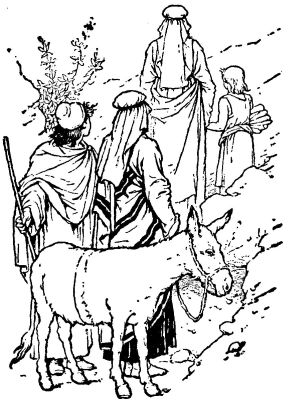
For two days they walked
“Stay here with the ass, while I go up yonder mountain with
Isaac to worship; and when we have worshipped, we will come
back to you.” For Abraham believed that in some way God
would bring back Isaac to life. He took the wood from the
ass and placed it on Isaac, and they two walked up the
mountain together. As they were walking, Isaac said:
“Father, here is the wood, but where is the lamb for the
offering?”
And Abraham said, “My son, God will provide himself a Lamb
for a burnt offering.”
And they came to the place on the top of the mountain. There
Abraham built an altar of stones and earth heaped up; and on it
he placed the wood. Then he tied the hands and the feet of
Isaac, and laid him on the altar, on the wood. And Abraham
lifted up his hand, holding a knife to kill his son. Another
moment longer and Isaac would be slain by his own father’s
hand.
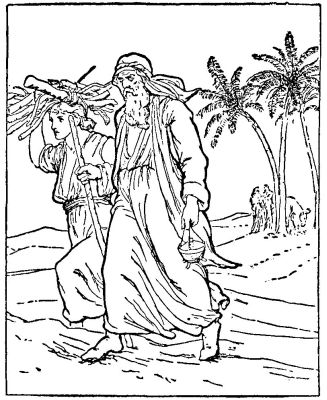
“God will provide himself a lamb for a burnt
offering”
But just at that moment the angel of the Lord out of heaven called to Abraham, and
said:
“Abraham! Abraham!”
And Abraham answered, “Here I am, Lord.” Then the angel of
the Lord said:
“Do not lay your hand upon your son. Do no harm to him. Now
I know that you love God more than you love your only son, and
that you are obedient to God, since you are ready to give up
your son, your only son, to God.”
What a relief and a joy these words from heaven brought to
the heart of Abraham! How glad he was to know that it was not
God’s will for him to kill his son! Then Abraham looked around,
and there in the thicket was a ram caught by his horns. And
Abraham took the ram and offered him up for a burnt-offering in
place of his son. So Abraham’s words came true when he said
that God would provide for himself a lamb.
The place where this altar was built Abraham named
Jehovah-jireh, words in the language that Abraham spoke
meaning, “The Lord will provide.”
This offering, which seems so strange, did much good. It
showed to Abraham, and to Isaac also, that Isaac belonged to
God, for to God he had been offered; and in Isaac all those who
should come from him, his descendants, had been given to God. Then it showed to
Abraham and to all the people after him, that God did not
wish children or men killed as offerings for worship; and
while all the people around offered such sacrifices, the
Israelites, who came from Abraham and from Isaac, never
offered them, but offered oxen and sheep and goats
instead.
These gifts, which cost so much toil, they felt must be
pleasing to God, because they expressed their thankfulness to
him. But they were glad to be taught that God does not desire
men’s lives to be taken, but loves our living gifts of love and
kindness.
THE STORY OF JACOB
After Abraham died, his son Isaac lived in the land of
Canaan. Like his father, Isaac had his home in a tent; around
him were the tents of his people, and many flocks of sheep and
herds of cattle feeding wherever they could find grass to eat
and water to drink.
Isaac and his wife Rebekah had two children. The older was
named Esau and the younger Jacob.
Esau was a man of the woods and very fond of hunting; and he
was rough and covered with hair.
Jacob was quiet and thoughtful, staying at home, dwelling in
a tent, and caring for the flocks of his father.
Isaac loved Esau more than Jacob, because Esau brought to
his father that which he had killed in his hunting; but Rebekah
liked Jacob, because she saw that he was wise and careful in
his work.
Among the people in those lands, when a man dies, his older
son receives twice as much as the younger of what the father
has owned. This was called his “birthright,” for it was his
right as the oldest born. So Esau, as the older, had a
“birthright” to more of Isaac’s possessions
than Jacob. And besides this, there was the
privilege of the promise of God that the family of Isaac
should receive great blessings.
THE SALE OF A
BIRTHRIGHT
Now Esau, when he grew up, did not care for his birthright
or the blessing which God had promised. But Jacob, who was a
wise man, wished greatly to have the birthright which would
come to Esau when his father died. Once, when Esau came home,
hungry and tired from hunting in the fields, he saw that Jacob
had a bowl of something that he had just cooked for dinner. And
Esau said:
“Give me some of that red stuff in the dish. Will you not
give me some? I am hungry.”
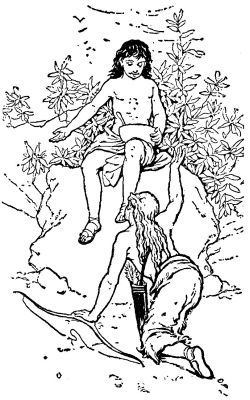
“Sell me your birthright”
And Jacob answered, “I will give it to you,
if you will first of all sell to me your birthright.”
And Esau said, “What is the use of the birthright to me now,
when I am almost starving to death? You can have my birthright
if you will give me something to eat.”
Then Esau made Jacob a solemn promise to give to Jacob his
birthright, all for a bowl of food. It was not right for Jacob
to deal so selfishly with his brother; but it was very wrong in
Esau to care so little for his birthright and God’s
blessing.
Some time after this, when Esau was forty years old, he
married two wives. Though this would be very wicked in our
times, it was not supposed to be wrong then; for even good men
then had more than one wife. But Esau’s two wives were women
from the people of Canaan, who worshipped idols, and not the
true God. And they taught their children also to pray to idols;
so that those who came from Esau, the people who were his
descendants, lost all knowledge of God, and became very wicked.
But this was long after that time.
Isaac and Rebekah were very sorry to have their son Esau
marry women who prayed to idols and not to God; but still Isaac
loved his active son Esau more than his quiet son Jacob. But
Rebekah loved Jacob more than Esau.
Isaac became at last very old and feeble,
and so blind that he could see scarcely anything. One day he
said to Esau:
“My son, I am very old, and do not know how soon I must die.
But before I die, I wish to give to you, as my older son, God’s
blessing upon you, and your children, and your descendants. Go
out into the fields, and with your bow and arrows shoot some
animal that is good for food, and make for me a dish of cooked
meat such as you know I love; and after I have eaten it I will
give you the blessing.”
Now Esau ought to have told his father that the blessing did
not belong to him, for he had sold it to his brother Jacob. But
he did not tell his father. He went out into the fields
hunting, to find the kind of meat which his father liked the
most.
Now Rebekah was listening, and heard all that Isaac had said
to Esau. She knew that it would be better for Jacob to have the
blessing than for Esau; and she loved Jacob more than Esau. So
she called to Jacob and told him what Isaac had said to Esau,
and she said:
“Now, my son, do what I tell you, and you will get the
blessing instead of your brother. Go to the flocks and bring to
me two little kids from the goats, and I will cook them just
like the meat which Esau cooks for your father. And you will
bring it to your father, and he will think
that you are Esau, and will give you the blessing; and it
really belongs to you.”
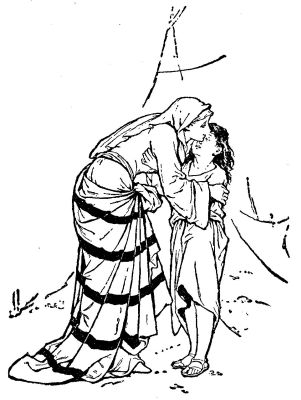
“Now, my son, do what I tell you”
But Jacob said, “You know that Esau and I are not alike. His
neck and arms are covered with hairs, while mine are smooth. My
father will feel of me, and he will find that I am
not Esau; and then, instead of giving me a
blessing, I am afraid that he will curse me.”
But Rebekah answered her son, “Never mind; you do as I have
told you, and I will take care of you. If any harm comes it
will come to me; so do not be afraid, but go and bring the
meat.”
Then Jacob went and brought a pair of little kids from the
flocks, and from them his mother made a dish of food, so that
it would be to the taste just as Isaac liked it. Then Rebekah
found some of Esau’s clothes, and dressed Jacob in them; and
she placed on his neck and hands some of the skins of the kids,
so that his neck and his hands would feel rough and hairy to
the touch.
Then Jacob came into his father’s tent, bringing the dinner,
and speaking as much like Esau as he could, he said:
“Here I am, my father.”
And Isaac said, “Who are you, my son?”
And Jacob answered, “I am Esau, your oldest son; I have done
as you bade me; now sit up and eat the dinner that I have made,
and then give me your blessing as you promised me.”
And Isaac said, “How is it that you found it so
quickly?”
Jacob answered, “Because the Lord your God showed me where
to go and gave me good success.”
Isaac did not feel certain that it was his
son Esau, and he said, “Come near and let me feel you, so
that I may know that you are really my son Esau.”
And Jacob went up close to Isaac’s bed, and Isaac felt of
his face, and his neck, and his hands, and he said:
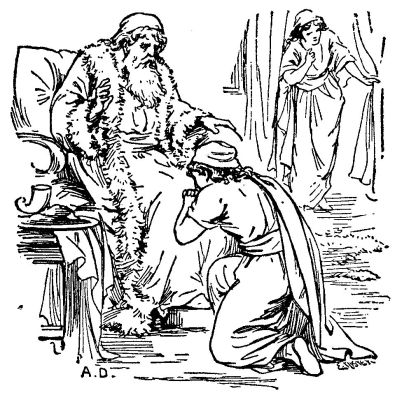
“May nations bow down to you.”
“The voice sounds like Jacob, but the hands are the hands of
Esau. Are you really my son Esau?”
And Jacob told a lie to his father, and said, “I am.”
Then the old man ate the food that Jacob had
brought to him; and he kissed Jacob,
believing him to be Esau; and he gave him the blessing,
saying to him:
“May God give you the dew of heaven, and the richness of the
earth, and plenty of grain and wine. May nations bow down to
you and peoples become your servants. May you be the master
over your brother, and may your family and descendants that
shall come from you rule over his family and his descendants.
Blessed be those that bless you, and cursed be those that curse
you.”
Just as soon as Jacob had received the blessing he rose up
and hastened away. He had scarcely gone out, when Esau came in
from hunting, with the dish of food that he had cooked. And he
said:
“Let my father sit up and eat the food that I have brought,
and give me the blessing.”
And Isaac said, “Why, who are you?”
Esau answered, “I am your son; your oldest son, Esau.”
And Isaac trembled, and said, “Who then is the one that came
in and brought to me food? and I have eaten his food and have
blessed him; yes, and he shall be blessed.”
When Esau heard this, he knew that he had been cheated; and
he cried aloud, with a bitter cry, “O, my father, my brother
has taken away my blessing, just as he took away my
birthright! But cannot you give me another blessing, too?
Have you given everything to my brother?”
And Isaac told him all that he had said to Jacob, making him
the ruler over his brother.
But Esau begged for another blessing; and Isaac said:
“My son, your dwelling shall be of the riches of the earth
and of the dew of heaven. You shall live by your sword and your
descendants shall serve his descendants. But in time to come
they shall break loose and shall shake off the yoke of your
brother’s rule and shall be free.”
All this came to pass many years afterward. The people who
came from Esau lived in a land called Edom, on the south of the
land of Israel, where Jacob’s descendants lived. And after a
time the Israelites became rulers over the Edomites; and later
still, the Edomites made themselves free from the Israelites.
But all this took place hundreds of years afterward.
It was better that Jacob’s descendants, those who came after
him, should have the blessing, than that Esau’s people should
have it; for Jacob’s people worshipped God, and Esau’s people
walked in the way of the idols and became
THE
STORY OF THE LADDER THAT REACHED TO HEAVEN
After Esau found that he had lost his birthright and his
blessing, he was very angry against his brother Jacob; and he
said to himself, and told others:
“My father Isaac is very old and cannot live long. As soon
as he is dead, then I shall kill Jacob for having robbed me of
my right.”
When Rebekah heard this, she said to Jacob, “Before it is
too late, do you go away from home and get out of Esau’s sight.
Perhaps when Esau sees you no longer, he will forget his anger,
and then you can come home again. Go and visit my brother
Laban, your uncle, in Haran, and stay with him for a little
while.”
We must remember that Rebekah came from the family of Nahor,
Abraham’s younger brother, who lived in Haran, a long distance
to the northeast of Canaan, and that Laban was Rebekah’s
brother.
So Jacob went out of Beersheba, on the border of the desert,
and walked alone, carrying his staff in his hand. One evening,
just about sunset, he came to a place among the mountains, more
than sixty miles distant from his home. And as he had no bed to lie down upon, he
took a stone and rested his head upon it for a pillow, and
lay down to sleep.
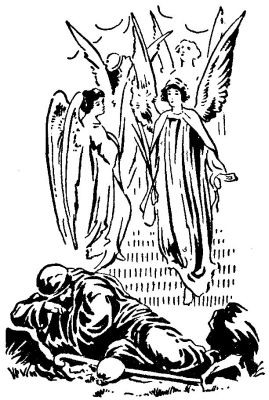
Angels were upon the stairs
And on that night Jacob had a wonderful dream. In his dream
he saw stairs leading from the earth where he lay up to heaven;
and angels were going up and coming down upon the stairs. And
above the stairs, he saw the Lord God standing. And God said to
Jacob:
“I am the Lord, the God of Abraham, and the God of Isaac
your father; and I will be your God, too. The land where you
are lying all alone, shall belong to you and to your children
after you; and your children shall spread abroad over the
lands, east and west, and north and south, like the dust of the
earth; and in your family all the world shall receive a
blessing. And I am with you in your journey, and I will keep
you where you are going, and will bring you back to this land.
I will never leave you, and I will surely keep my promise to
you.”
And in the morning Jacob awakened from his
sleep, and he said:
“Surely, the Lord is in this place, and I did not know it! I
thought that I was all alone, but God has been with me. This
place is the house of God; it is the gate of heaven!”
And Jacob took the stone on which his head had rested, and
he set it up as a pillar, and poured oil on it as an offering
to God. And Jacob named that place Bethel, which in the
language that Jacob spoke means “The House of God.”
And Jacob made a promise to God at that time, and said:
“If God really will go with me and will keep me in the way
that I go, and will give me bread to eat and will bring me to
my father’s house in peace, then the Lord shall be my God: and
this stone shall be the house of God, and of all that God gives
me I will give back to God one-tenth as an offering.”
Then Jacob went onward in his long journey. He walked across
the river Jordan in a shallow place, feeling his way with his
staff; he climbed mountains and journeyed beside the great
desert on the east, and at last came to the city of Haran.
Beside the city was the well, where Abraham’s servant had met
Jacob’s mother, Rebekah; and there, after Jacob had waited for
a time, he saw a young woman coming with
her sheep to give them water.
Then Jacob took off the flat stone that was over the mouth
of the well, and drew water and gave it to the sheep. And when
he found that this young woman was his own cousin Rachel, the
daughter of Laban, he was so glad that he wept for joy. And at
that moment he began to love Rachel, and longed to have her for
his wife.
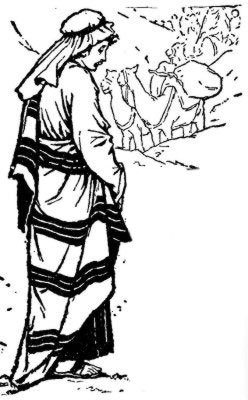
Jacob went onward in his long journey
Rachel’s father, Laban, who was Jacob’s uncle, gave a
welcome to Jacob, and took him into his home.
And Jacob asked Laban if he would give his daughter, Rachel,
to him as his wife; and Jacob said, “If you give me Rachel, I
will work for you seven years.”
And Laban said, “It is better that you should have her, than
that a stranger should marry her.”
So Jacob lived seven years in Laban’s house, caring for his
sheep and oxen and camels; but his love for Rachel made the
time seem short.
At last the day came for the marriage; and
they brought in the bride, who, after the manner of that
land, was covered with a thick veil, so that her face could
not be seen. And she was married to Jacob, and when Jacob
lifted up her veil he found that he had married, not Rachel,
but her older sister, Leah, who was not beautiful, and whom
Jacob did not love at all.
Jacob was very angry that he had been deceived,—though
that was just the way in which Jacob himself had deceived his
father and cheated his brother Esau. But his uncle Laban
said:
“In our land we never allow the younger daughter to be
married before the older daughter. Keep Leah for your wife, and
work for me seven years longer, and you shall have Rachel
also.”
For in those times, as we have seen, men often had two
wives, or even more than two. So Jacob stayed seven years more,
fourteen years in all, before he received Rachel as his
wife.
While Jacob was living at Haran, eleven sons were born to
him. But only one of these was the child of Rachel, whom Jacob
loved. This son was Joseph, who was dearer to Jacob than any
other of his children, partly because he was the youngest, and
because he was the child of his beloved Rachel.
THE
STORY OF JOSEPH AND HIS COAT OF MANY COLORS
After Jacob came back to the land of Canaan with his eleven
sons, another son was born to him, the second child of his wife
Rachel, whom Jacob loved so well. But soon after the baby came,
his mother Rachel died, and Jacob was filled with sorrow. Even
to this day you can see the place where Rachel was buried, on
the road between Jerusalem and Bethlehem. Jacob named the child
whom Rachel left, Benjamin; and now Jacob had twelve sons. Most
of them were grown-up men; but Joseph was a boy seventeen years
old, and his brother Benjamin was almost a
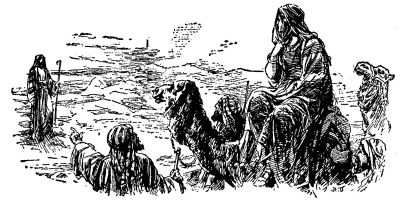
Back to the Land of Canaan
Of all his children, Jacob loved Joseph the best, because he
was Rachel’s child; because he was so much younger than most of
his brothers; and because he was good, and faithful, and
thoughtful. Jacob gave to Joseph a robe or coat of bright
colors, made somewhat like a long cloak with wide sleeves. This
was a special mark of Jacob’s favor to Joseph, and it made his
older brothers envious of him.
Then, too, Joseph did what was right, while his older
brothers often did very wrong acts, of which Joseph sometimes
told their father; and this made them very angry at Joseph. But
they hated him still more because of two strange dreams he had,
and of which he told them. He said one day: “Listen to this
dream that I have dreamed. I dreamed that we were out in the
field binding sheaves, when suddenly my sheaf stood up, and all
your sheaves came around it and bowed down to my sheaf!”
And they said scornfully, “Do you suppose that the dream
means that you will some time rule over us, and that we shall
bow down to you?”
Then, a few days after, Joseph said, “I have dreamed again.
This time, I saw in my dream the sun, and the moon, and eleven
stars, all come and bow to me!”
And his father said to him, “I do not like you
to dream such dreams. Shall I, and your
mother, and your brothers, come and bow down before you as
if you were a king?”
His brothers hated Joseph, and would not speak kindly to
him; but his father thought much of what Joseph had said.
At one time, Joseph’s ten brothers were taking care of the
flock in the fields near Shechem, which was nearly fifty miles
from Hebron, where Jacob’s tents were spread. And Jacob wished
to send a message to his sons, and he called Joseph, and said
to him:
“Your brothers are near Shechem with the flock. I wish that
you would go to them, and take a message, and find if they are
well, and if the flocks are doing well; and bring me word from
them.”
That was quite an errand, for a boy to go alone over the
country, and find his way, for fifty miles, and then walk home
again. But Joseph was a boy who could take care of himself, and
could be trusted; so he went forth on his journey, walking
northward over the mountains, past Bethlehem, and Jerusalem,
and Bethel—though we are not sure those cities were then
built, except Jerusalem, which was already a strong city.
When Joseph reached Shechem, he could not find his brothers,
for they had taken their flocks to another place. A man met Joseph
wandering in the field, and asked him, “Whom are you
seeking?”
Joseph said, “I am looking for my brothers; the sons of
Jacob. Can you tell me where I will find them?”
And the man said, “They are at Dothan; for I heard them say
that they were going there.”
Then Joseph walked over the hills to Dothan, which was
fifteen miles further. And his brothers saw him afar off coming
toward them. They knew him by his bright garment; and one said
to another: “Look, that dreamer is coming! Come, let us kill
him, and throw his body into a pit, and tell his father that
some wild beast has eaten him; and then we will see what
becomes of his dreams.”
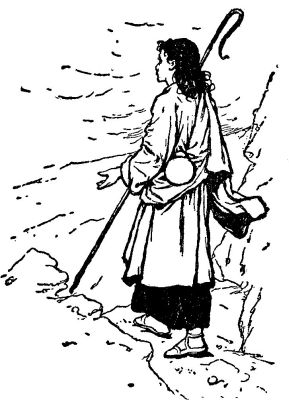
Walking northward over the mountains
One of his brothers, whose name was Reuben, felt more kindly
toward Joseph than the others. He said:
“Let us not kill him, but let us throw him
into this pit, in the wilderness, and leave him there to
die.”
But Reuben intended, after they had gone away, to lift
Joseph out of the pit, and take him home to his father. The
brothers did as Reuben told them; they threw Joseph into the
pit, which was empty. He cried, and begged them to save him;
but they would not. They calmly sat down to eat their dinner on
the grass, while their brother was calling to them from the
pit.
After the dinner, Reuben chanced to go to another part of
the field; so that he was not at hand when a company of men
passed by with their camels, going from Gilead, on the east of
the river Jordan, to Egypt, to sell spices and fragrant gum
from trees to the Egyptians.
Then Judah, another of Joseph’s brothers, said, “What good
will it do us to kill our brother? Would it not be better for
us to sell him to these men, and let them carry him away? After
all, he is our brother, and we would better not kill him.”
His brothers agreed with him; so they stopped the men who
were passing, and drew up Joseph from the pit, and for twenty
pieces of silver they sold Joseph to these men; and they took
him away with them down to Egypt.
After a while, Reuben came to the pit, where
they had left Joseph, and looked into it;
but Joseph was not there. Then Reuben was in great trouble;
and he came back to his brothers, saying: “The boy is not
there! What shall I do!”
Then his brothers told Reuben what they had done; and they
all agreed together to deceive their father. They killed one of
the goats, and dipped Joseph’s coat in its blood; and they
brought it to their father, and they said to him: “We found
this coat out in the wilderness. Look at it, father, and tell
us if you think it was the coat of your son.”
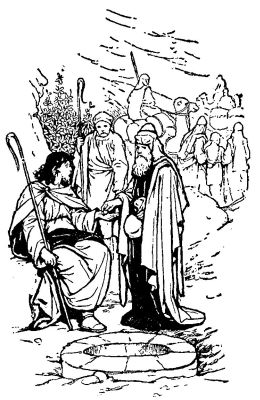
For twenty pieces of silver they sold Joseph
And Jacob knew it at once. He said: “It is my son’s coat.
Some wild beast has eaten him. There is no doubt that Joseph
has been torn in pieces!”
And Jacob’s heart was broken over the loss of Joseph, all
the more because he had sent Joseph alone on the journey through the
wilderness. They tried to comfort him, but he would not be
comforted. He said: “I will go down to the grave mourning
for my poor lost son.”
So the old man sorrowed for his son Joseph; and all the time
his wicked brothers knew that Joseph was not dead; but they
would not tell their father the dreadful deed they had done to
their brother, in selling him as a slave.
THE DREAMS OF A KING
The men who bought Joseph from his brothers were called
Ishmaelites, because they belonged to the family of Ishmael,
who, you remember, was the son of Hagar, the servant of Sarah.
These men carried Joseph southward over the plain which lies
beside the great sea on the west of Canaan; and after many days
they brought Joseph to Egypt. How strange it must have seemed
to the boy who had lived in tents to see the great river Nile,
and the cities thronged with people, and the temples, and the
mighty pyramids!
The Ishmaelites sold Joseph as a slave to a man named
Potiphar, who was an officer in the army of Pharaoh, the king
of Egypt. Joseph was a beautiful boy, and cheerful and willing
in his spirit, and able in all that he undertook; so that his
master Potiphar became very friendly to him, and after a time,
he placed Joseph in charge of his house, and everything in it.
For some years Joseph continued in the house of Potiphar, a
slave in name, but in reality the master of all his affairs,
and ruler over his fellow-servants.
But Potiphar’s wife, who at first was very friendly to Joseph, afterward became his
enemy, because Joseph would not do wrong to please her. She
told her husband falsely, that Joseph had done a wicked
deed. Her husband believed her, and was very angry at
Joseph, and put him in the prison with those who had been
sent to that place for breaking the laws of the land. How
hard it was for Joseph to be charged with a crime, when he
had done no wrong, and to be thrust into a dark prison among
wicked people!
But Joseph had faith in God, that at some time all would
come out right; and in the prison he was cheerful, and kind,
and helpful, as he had always been. The keeper of the prison
saw that Joseph was not like the other men around him, and he
was kind to Joseph. In a very little while, Joseph was placed
in charge of all his fellow-prisoners, and took care of them,
just as he had taken care of everything in Potiphar’s house.
The keeper of the prison scarcely looked into the prison at
all; for he had confidence in Joseph, that he would be faithful
and wise in doing the work given to him. Joseph did right, and
served God, and God blessed Joseph in everything.
While Joseph was in the prison, two men were sent there by
the king of Egypt, because he was displeased with them. One was
the king’s chief butler, who served the king with wine; the
other was the chief baker, who served him with bread. These
two men were under Joseph’s care; and Joseph waited on them,
for they were men of rank.
One morning, when Joseph came into the room where the butler
and the baker were kept, he found them looking quite sad.
Joseph said to them:
“Why do you look so sad today?” Joseph was cheerful and
happy in his spirit; and he wished others to be happy also,
even in prison.
And one of them said, “Each one of us dreamed last night a
very strange dream, and there is no one to tell us what our
dreams mean.”
For in those times, before God gave the Bible to men, he
often spoke to men in dreams; and there were wise men who could
sometimes tell what the dreams meant.
“Tell me,” said Joseph, “what your dreams are. Perhaps my
God will help me to understand them.”
Then the chief butler told his dream. He said, “In my dream
I saw a grape-vine with three branches; and as I looked, the
branches shot out buds; and the buds became blossoms; and the
blossoms turned into clusters of ripe grapes. And I picked the
grapes, and squeezed their juice into king Pharaoh’s cup, and it
became wine; and I gave it to king Pharaoh to drink, just as
I used to do when I was beside his table.”
Then Joseph said, “This is what your dream means. The three
branches mean three days. In three days, king Pharaoh shall
call you out of prison and shall put you back in your place;
and you shall stand at his table, and shall give him his wine,
as you have given it before. But when you go out of prison,
please to remember me, and try to find some way to get me, too,
out of this prison. For I was stolen out of the land of Canaan,
and sold as a slave; and I have done nothing wrong to deserve
being put in this prison. Do speak to the king for me, that I
may be set free.”
Of course, the chief butler felt very happy to hear that his
dream had so pleasant a meaning. And the chief baker spoke,
hoping to have an answer as good:
“In my dream,” said the baker, “there were three baskets of
white bread on my head, one above another, and on the topmost
basket were all kinds of roasted meat and food for Pharaoh; and
the birds came, and ate the food from the baskets on my
head.”
And Joseph said to the baker:
“This is the meaning of your dream, and I am
sorry to tell it to you. The three baskets
are three days. In three days, by order of the king you
shall be lifted up, and hanged upon a tree; and the birds
shall eat your flesh from your bones as you are hanging in
the air.”
And it came to pass just as Joseph had said. Three days
after that, king Pharaoh sent his officers to the prison. They
came and took out both the chief butler and the chief baker.
The baker they hung up by his neck to die, and left his body
for the birds to pick in pieces. The chief butler they brought
back to his old place, where he waited at the king’s table, and
handed him his wine to drink.
You would have supposed that the butler would remember
Joseph, who had given him the promise of freedom, and had shown
such wisdom. But in his gladness, he forgot all about Joseph.
And two full years passed by, while Joseph was still in prison,
until he was a man thirty years old.
But one night, king Pharaoh himself dreamed a dream—in
fact, two dreams in one. And in the morning he sent for all the
wise men of Egypt, and told to them his dreams; but there was
not a man who could give the meaning of them. And the king was
troubled, for he felt that the dreams had some meaning which it
was important for him to know.
Then suddenly the chief butler who was by
the king’s table remembered his own dream in the prison two
years before, and remembered, too, the young man who had
told its meaning so exactly. And he said:
“I do remember my faults this day. Two years ago king
Pharaoh was angry with his servants, with me and the chief
baker; and he sent us to the prison. While we were in the
prison, one night each of us dreamed a dream; and the next day
a young man in the prison, a Hebrew from the land of Canaan,
told us what our dreams meant; and in three days they came
true, just as the young Hebrew had said. I think that if this
young man is in the prison still, he could tell the king the
meaning of his dreams.”
You notice that the butler spoke of Joseph as “a Hebrew.”
The people of Israel, to whom Joseph belonged, were called
Hebrews as well as Israelites. The word Hebrew means, “One who
crossed over,” and it was given to the Israelites because
Abraham, their father, had come from a land on the other side
of the great river Euphrates, and had crossed over the river on
his way to Canaan.
Then king Pharaoh sent in haste to the prison for Joseph;
and Joseph was taken out, and he was dressed in new garments,
and was led in to Pharaoh in the palace. And Pharaoh said:
“I have dreamed a dream; and there is no one
who can tell what it means. And I have been told that you
have power to understand dreams and what they mean.”
And Joseph answered Pharaoh:
“The power is not in me; but God will give Pharaoh a good
answer. What is the dream that the king has dreamed?”
“In my first dream,” said Pharaoh, “I was standing by the
river: and I saw seven fat and handsome cows come up from the
river to feed in the grass. And while they were feeding, seven
other cows followed them up from the river, very thin, and
poor, and lean—such miserable creatures as I had never
seen before. And the seven lean cows ate up the seven fat cows;
and after they had eaten them up, they were as lean and
miserable as before. Then I awoke.
“And I fell asleep again, and dreamed again. In my second
dream, I saw seven heads of grain growing up on one stalk,
large, and strong, and good. And then seven heads came up after
them, that were thin, and poor, and withered. And the seven
thin heads swallowed up the seven good heads; and afterward
were as poor and withered as before.
“And I told these two dreams to all the wise men, and there
is no one who can explain them. Can you tell me what these
dreams mean?”
“The two dreams have the same meaning. God has been showing
to king Pharaoh what he will do in this land. The seven good
cows mean seven years, and the seven good heads of grain mean
the same seven years. The seven lean cows and the seven thin
heads of grain also mean seven years. The good cows and the
good grain mean seven years of plenty, and the seven thin cows
and thin heads of grain mean seven poor years. There are coming
upon the land of Egypt seven years of such plenty as have never
been seen; when the fields shall bring greater crops than ever
before; and after those years shall come seven years when the
fields shall bring no crops at all. And then for seven years
there shall be such need, that the years of plenty will be
forgotten, for the people will have nothing to eat.
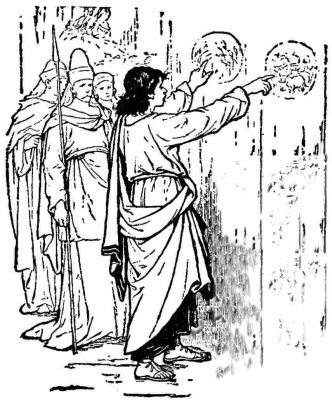
The two dreams have the same meaning
“Now, let king Pharaoh find some man who is
able and wise, and let him set this man to
rule over the land. And during the seven years of plenty,
let a part of the crops be put away for the years of need.
If this shall be done, then when the years of need come,
there will be plenty of food for all the people, and no one
will suffer, for all will have enough.”
And king Pharaoh said to Joseph: “Since God has shown you
all this, there is no other man as wise as you. I will appoint
you to do this work, and to rule over the land of Egypt. All
the people shall be under you; only on the throne of Egypt I
will be above you.”
And Pharaoh took from his own hand the ring which held his
seal, and put on Joseph’s hand, so that he could sign for the
king, and seal in the king’s place. And he dressed Joseph in
robes of fine linen, and put around his neck a gold chain. And
he made Joseph ride in a chariot which was next in rank to his
own. And they cried out before Joseph, “Bow the knee.” And thus
Joseph was ruler over all the land of Egypt.
THE STORY OF
THE MONEY IN THE SACKS
When Joseph was made ruler over the land of Egypt, he did
just as he had always done. It was not Joseph’s way to sit
down, to rest and enjoy himself, and make others wait on him.
He found his work at once, and began to do it faithfully and
thoroughly. He went out over all the land of Egypt, and saw how
rich and abundant were the fields of grain, giving much more
than the people could use for their own needs. He told the
people not to waste it, but to save it for the coming time of
need.
And he called upon the people to give him for the king one
bushel of grain out of every five, to be stored up. The people
brought their grain, after taking for themselves as much as
they needed, and Joseph stored it up in great storehouses in
the cities; so much at last that no one could keep account of
it.
The king of Egypt gave a wife to Joseph from the noble young
women of his kingdom. Her name was Asenath; and to Joseph and
his wife God gave two sons. The oldest son he
named Manasseh, a word which means “Making to
Forget.”
“For,” said Joseph, “God has made me to forget all my
troubles and my toil as a slave.”
The second son he named Ephraim, a word that means
“Fruitful.” “Because,” said Joseph, “God has not only made the
land fruitful; but he has made me fruitful in the land of my
troubles.”
The seven years of plenty soon passed by, and then came the
years of need. In all the lands around people were hungry, and
there was no food for them to eat; but in the land of Egypt
everybody had enough. Most of the people soon used up the grain
that they had saved; many had saved none at all, and they all
cried to the king to help them.
“Go to Joseph!” said king Pharaoh, “and do whatever he tells
you to do.”
Then the people came to Joseph, and Joseph opened the
storehouses, and sold to the people all the grain that they
wished to buy. And not only the people of Egypt came to buy
grain, but people of all the lands around as well, for there
was great need and famine everywhere. And the need was as great
in the land of Canaan, where Jacob lived, as in other lands.
Jacob was rich in flocks and cattle, and gold and silver, but
his fields gave no grain, and there was danger
that his family and his people would
starve. And Jacob—who was now called Israel
also—heard that there was food in Egypt and he said to
his sons: “Why do you look at each other, asking what to do
to find food? I have been told that there is grain in Egypt.
Go down to that land, and take money with you, and bring
grain, so that we may have bread, and may live.”
Then the ten older brothers of Joseph went down to the land
of Egypt. They rode upon asses, for horses were not much used
in those times, and they brought money with them. But Jacob
would not let Benjamin, Joseph’s younger brother, go with them,
for he was all the more dear to his father, now that Joseph was
no longer with him; and Jacob feared that harm might come to
him.
Then Joseph’s brothers came to Joseph to buy food. They did
not know him, grown up to be a man, dressed as a prince, and
seated on a throne. Joseph was now nearly forty years old, and
it had been almost twenty-three years since they had sold him.
But Joseph knew them all, as soon as he saw them. He wished to
be sharp and stern with them, not because he hated them; but
because he wished to see what their spirit was, and whether
they were as selfish, and cruel, and wicked as they had been in
other days.
They came before him, and bowed, with their
faces to the ground. Then, no doubt, Joseph
thought of the dream that had come to him while he was a
boy, of his brothers’ sheaves bending down around his sheaf.
He spoke to them as a stranger, as if he did not understand
their language, and he had their words explained to him in
the language of Egypt.
“Who are you? And from what place do you come?” said Joseph,
in a harsh, stern manner.
They answered him very meekly: “We have come from the land
of Canaan to buy food.”
“No,” said Joseph, “I know what you have come for. You have
come as spies, to see how helpless the land is, so that you can
bring an army against us, and make war on us.”
“No, no,” said Joseph’s ten brothers. “We are no spies. We
are the sons of one man, who lives in the land of Canaan; and
we have come for food, because we have none at home.”
“You say that you are the sons of one man, who is your
father? Is he living? Have you any more brothers? Tell me all
about yourselves.”
And they said: “Our father is an old man in Canaan. We did
have a younger brother, but he was lost; and we have one
brother still, who is the youngest of all, but his father could
not spare him to come with us.”
“No,” said Joseph. “You are not good, honest
men. You are spies. I shall put you all in
prison, except one of you; and he shall go and bring that
youngest brother of yours; and when I see him, then I will
believe that you tell the truth.”
So Joseph put all the ten men in prison, and kept them under
guard for three days; then he sent for them again. They did not
know that he could understand their language, and they said to
each other, while Joseph heard, but pretended not to hear:
“This has come upon us because of the wrong that we did to our
brother Joseph, more than twenty years ago. We heard him cry,
and plead with us, when we threw him into the pit, and we would
not have mercy on him. God is giving us only what we have
deserved.”
And Reuben, who had tried to save Joseph, said: “Did I not
tell you not to harm the boy? and you would not listen to me.
God is bringing our brother’s blood upon us all.”
When Joseph heard this, his heart was touched, for he saw
that his brothers were really sorry for the wrong that they had
done to him. He turned away from them, so that they could not
see his face, and he wept. Then he turned again to them and
spoke roughly as before, and said:
“This I will do, for I serve God. I will let you
all go home, except one man. One of you I
will shut up in prison; but the rest of you can go home and
take food for your people. And you must come back and bring
your youngest brother with you, and I shall know then that
you have spoken the truth.”
Then Joseph gave orders, and his servants seized one of his
brothers, whose name was Simeon, and bound him in their sight
and took him away to prison. And he ordered his servants to
fill the men’s sacks with grain, and to put every man’s money
back into the sack before it was tied up, so that they would
find the money as soon as they opened the sack. Then the men
loaded their asses with the sacks of grain, and started to go
home, leaving their brother Simeon a prisoner.
When they stopped on the way to feed their asses, one of the
brothers opened his sack, and there he found his money lying on
the top of the grain. He called out to his brothers: “See, here
is my money given again to me!” And they were frightened, but
they did not dare to go back to Egypt and meet the stern ruler
of the land. They went home and told their old father all that
had happened to them, and how their brother Simeon was in
prison, and must stay there until they should return, bringing
Benjamin with them.
When they opened their sacks of grain,
there in the mouth of each sack was the money that they had
given; and they were filled with fear. Then they spoke of
going again to Egypt and taking Benjamin, but Jacob said to
them:
“You are taking my sons away from me. Joseph is gone, and
Simeon is gone, and now you would take Benjamin away. All these
things are against me!” Reuben said: “Here are my own two boys.
You may kill them, if you wish, in case I do not bring Benjamin
back to you.” But Jacob said: “My youngest son shall not go
with you. His brother is dead, and he alone is left to me. If
harm should come to him, it would bring down my gray hairs with
sorrow to the grave.”
THE MYSTERY OF THE
LOST BROTHER
The food which Jacob’s sons had brought from Egypt did not
last long, for Jacob’s family was large. Most of his sons were
married and had children of their own; so that the children and
grandchildren were sixty-six, besides the servants who waited
on them, and the men who cared for Jacob’s flocks. So around
the tent of Jacob was quite a camp of other tents and an army
of people.
When the food that had come from Egypt was nearly eaten up,
Jacob said to his sons:
“Go down to Egypt again, and buy some food for us.”
And Judah, Jacob’s son, the man who years before had urged
his brothers to sell Joseph to the Ishmaelites, said to his
father: “It is of no use for us to go to Egypt, unless we take
Benjamin with us. The man who rules in that land said to us,
‘You shall not see my face, unless your youngest brother be
with you’.”
And Israel said, “Why did you tell the man that you had a
brother? You did me great harm when you told him.”
“Why,” said Jacob’s sons, “we could not help telling him.
The man asked us all about our family, ‘Is your father yet living? Have
you any more brothers?’ And we had to tell him, his
questions were so close. How should we know that he would
say, ‘Bring your brother here, for me to see him’?”
And Judah said, “Send Benjamin with me, and I will take care
of him. I promise you that I will bring him safely home. If he
does not come back, let me bear the blame forever. He must go,
or we shall die for want of food; and we might have gone down
to Egypt and come home again, if we had not been kept
back.”
And Jacob said, “If he must go, then he must. But take a
present to the man, some of the choicest fruits of the land,
some spices, and perfumes, and nuts, and almonds. And take
twice as much money, besides the money that was in your sacks.
Perhaps that was a mistake, when the money was given back to
you. And take your brother Benjamin, and may the Lord God make
the man kind to you, so that he will set Simeon free, and let
you bring Benjamin back. But if it is God’s will that I lose my
children, I cannot help it.”
So ten brothers of Joseph went down a second time to Egypt,
Benjamin going in place of Simeon. They came to Joseph’s
office, the place where he sold grain to the people; and they
stood before their brother, and bowed as
before. Joseph saw that Benjamin was with them,
and he said to his steward, the man who was over his
house:
“Make ready a dinner, for all these men shall dine with me
today.”
When Joseph’s brothers found that they were taken into
Joseph’s house, they were filled with fear. They said to each
other:
“We have been taken here on account of the money in our
sacks. They will say that we have stolen it, and then they will
sell us all for slaves.”
But Joseph’s steward, the man who was over his house,
treated the men kindly; and when they spoke of the money in
their sacks, he would not take it again, saying:
“Never fear; your God must have sent you this as a gift. I
had your money.”
The stewards received the men into Joseph’s house, and
washed their feet, according to the custom of the land. And at
noon, Joseph came in to meet them. They brought him the present
from their father, and again they bowed before him, with their
faces on the ground.
And Joseph asked them if they were well, and said: “Is your
father still living, the old man of whom you spoke? Is he
well?”
And they said, “Our father is well and he is living.” And
again they bowed to Joseph.
And Joseph looked at his younger brother
Benjamin, the child of his own mother Rachel, and said:
“Is this your youngest brother, of whom you spoke to me? God
be gracious unto you, my son.”
And Joseph’s heart was so full that he could not keep back
the tears. He went in haste to his own room, and wept there.
Then he washed his face, and came out again, and ordered the
table to be set for dinner. They set Joseph’s table for
himself, as the ruler, and another table for his Egyptian
officers, and another for the eleven men from Canaan; for
Joseph had brought Simeon out of the prison, and had given him
a place with his brothers.
Joseph himself arranged the order of the seats for his
brothers, the oldest at the head, and all in order of age down
to the youngest. The men wondered at this, and could not see
how the ruler of Egypt could know the order of their ages. And
Joseph sent dishes from his table to his brothers, and he gave
to Benjamin five times as much as to the others. Perhaps he
wished to see whether they were as jealous of Benjamin as in
other days they had been toward him.
After dinner, Joseph said to his steward: “Fill the men’s
sacks with grain, as much as they can carry, and put each man’s
money in his sack. And put my silver cup in the sack of
the youngest, with his money.”
The steward did as Joseph had said; and early in the morning
the brothers started to go home. A little while afterward,
Joseph said to his steward:
“Hasten, follow after the men from Canaan, and say, ‘Why
have you wronged me, after I had treated you kindly? You have
stolen my master’s silver cup, out of which he drinks’.”
The steward followed the men, and overtook them, and charged
them with stealing. And they said to him:
“Why should you talk to us in this manner? We have stolen
nothing. Why, we brought back to you the money that we found in
our sacks; and is it likely that we would steal from your lord
his silver or gold? You may search us, and if you find your
master’s cup on any of us, let him die, and the rest of us may
be sold as slaves.”
Then they took down the sacks from the asses, and opened
them; and in each man’s sack was his money, for the second
time. And when they came to Benjamin’s sack, there was the
ruler’s silver cup! Then, in the greatest sorrow, they tied up
their bags again, and laid them on the asses, and came back to
Joseph’s palace.
And Joseph said to them:
“What wicked thing is this that you have done? Did you not know that I would surely
find out your deeds?”
Then Judah said, “O, my lord, what can we say? God has
punished us for our sins; and now we must all be slaves, both
we that are older, and the younger in whose sack the cup was
found.”
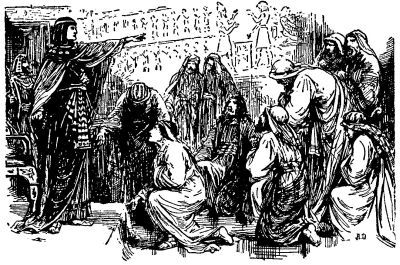
“What wicked thing is this that you have done?”
“No,” said Joseph. “Only one of you is guilty; the one who
has taken away my cup. I will hold him as a slave, and the rest
of you can go home to your father.
Joseph wished to see whether his brothers were still
selfish, and were willing to let Benjamin suffer, if they could
escape.
Then Judah, the very man who had urged his brothers to sell Joseph as a slave, came
forward, and fell at Joseph’s feet, and pleaded with him to
let Benjamin go. He told again the whole story, how Benjamin
was the one whom his father loved the most of all his
children, now that his brother was lost. He said:
“I promised to bear the blame, if this boy was not brought
home in safety. If he does not go back it will kill my poor old
father, who has seen much trouble. Now let my youngest brother
go home to his father, and I will stay here as a slave in his
place!”
Joseph knew now, what he had longed to know, that his
brothers were no longer cruel nor selfish, but one of them was
willing to suffer, so that his brother might be spared. And
Joseph could not any longer keep his secret, for his heart
longed after his brothers; and he was ready to weep again, with
tears of love and joy. He sent all of his Egyptian servants out
of the room, so that he might be alone with his brothers, and
then he said:
“Come near to me; I wish to speak with you.” And they came
near, wondering. Then Joseph said:
“I am Joseph; is my father really alive?”
How frightened his brothers were, as they heard these words
spoken in their own language by the ruler of Egypt and for the
first time knew that this stern man, who had their lives in
his hand, was their own brother whom they had wronged! Then
Joseph said again:
“I am Joseph, your brother, whom you sold into Egypt. But do
not feel troubled because of what you did. For God sent me
before you to save your lives. There have been already two
years of need and famine, and there are to be five years more,
when there shall neither be plowing of the fields nor harvest.
It was not you who sent me here, but God; and he sent me to
save your lives. God has made me like a father to Pharaoh and
ruler over all the land of Egypt. Now I wish you to go home,
and to bring down to me my father and all his family.”
Then Joseph placed his arms around Benjamin’s neck, and
kissed him, and wept upon him. And Benjamin wept on his neck.
And Joseph kissed all his brothers, to show them that he had
fully forgiven them; and after that his brothers began to lose
their fear of Joseph and talked with him more freely.
Afterward Joseph sent his brothers home with good news, and
rich gifts, and abundant food. He sent also wagons in which
Jacob and his sons’ wives and the little ones of their families
might ride from Canaan down to Egypt. And Joseph’s brothers
went home happier than they had been for many years.
THE
STORY OF MOSES, THE CHILD WHO WAS FOUND IN THE RIVER
The children of Israel stayed in the land of Egypt much
longer than they had expected to stay. They were in that land
about four hundred years. And the going down to Egypt proved a
great blessing to them. It saved their lives during the years
of famine and need. After the years of need were over, they
found the soil in the land of Goshen, that part of Egypt where
they were living, very rich, so that they could gather three or
four crops every year.
Then, too, the sons of Israel, before they came to Egypt,
had begun to marry the women in the land of Canaan who
worshipped idols, and not the Lord. If they had stayed there,
their children would have grown up like the people around them
and soon would have lost all knowledge of God.
But in Goshen they lived alone and apart from the people of
Egypt. They worshipped the Lord God, and were kept away from
the idols of Egypt. And in that land, as the years went on,
from being seventy people, they grew in number until they
became a great multitude. Each of the twelve sons of Jacob was the father of
a tribe, and Joseph was the father of two tribes, named
after his two sons, Ephraim and Manasseh.
As long as Joseph lived, and for some time after, the people
of Israel were treated kindly by the Egyptians, out of their
love for Joseph, who had saved Egypt from suffering by famine.
But after a long time another king began to rule over Egypt,
who cared nothing for Joseph or Joseph’s people. He saw that
the Israelites (as the children of Israel were called) were
very many, and he feared that they would soon become greater in
number and in power than the Egyptians.
He said to his people: “Let us rule these Israelites more
strictly. They are growing too strong.”
Then they set harsh rules over the Israelites, and laid
heavy burdens on them. They made the Israelites work hard for
the Egyptians, and build cities for them, and give to the
Egyptians a large part of the crops from their fields. They set
them at work in making brick and in building storehouses. They
were so afraid that the Israelites would grow in number that
they gave orders to kill all the little boys that were born to
the Israelites; though their little girls might be allowed to
live.
But in the face of all this hate, and wrong, and
cruelty, the people of Israel were growing
in number, and becoming greater and greater.
At this time, when the wrongs of the Israelites were the
greatest, and when their little children were being killed, one
little boy was born.
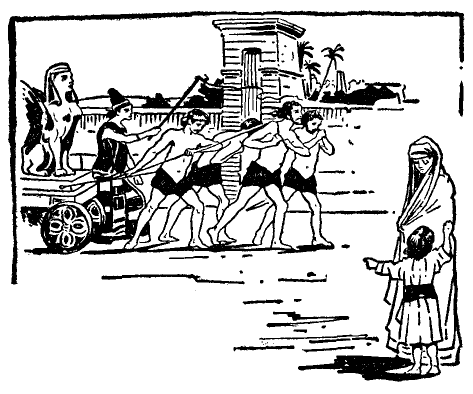
They made the Israelites work hard
He was such a lovely child that his mother kept him hid, so
that the enemies did not find him. When she could no longer
hide him, she formed a plan to save his life; believing that
God would help her and save her beautiful little boy.
She made a little box like a boat and covered it with
something that would not let the water into it. Such a boat as
this covered over was called “an ark.” She knew that at certain
times the daughter of king Pharaoh—all the kings of Egypt
were called Pharaoh, for Pharaoh means a king—would come down to the river
for a bath. She placed her baby boy in the ark, and let it
float down the river where the princess, Pharaoh’s daughter,
would see it. And she sent her own daughter, a little girl
named Miriam, twelve years old, to watch close at hand. How
anxious the mother and the sister were as they saw the
little ark floating away from them on the river!
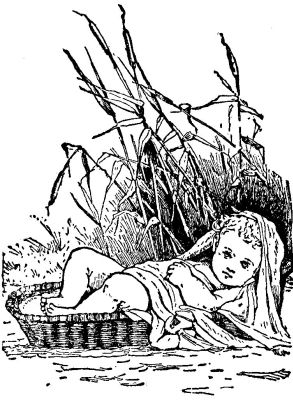
She placed her baby in the ark
Pharaoh’s daughter, with her maids, came down to the river,
and they saw the ark floating on the water, among the reeds.
She sent one of her maids to bring it to her so that she might
see what was in the curious box. They opened it, and there was
a beautiful little baby, who began to cry to be taken up.
The princess felt kind toward the little one, and loved it
at once. She said: “This is one of the Hebrews’ children.” You
have heard how the children of Israel came to be called
Hebrews. Pharaoh’s daughter thought that it would
be cruel to let such a lovely baby as this die out on the
water. And just then a little girl came running up to her,
as if by accident, and she looked at the baby also, and she
said: “Shall I go and find some woman of the Hebrews to be a
nurse to the child for you and take care of it?”
“Yes,” said the princess. “Go and find a nurse for me.”
The little girl—who was Miriam, the baby’s
sister—ran as quickly as she could and brought the baby’s
own mother to the princess. Miriam showed in this act that she
was a wise and thoughtful little girl. The princess said to the
little baby’s mother: “Take this child to your home and nurse
it for me, and I will pay you wages for it.”
How glad the Hebrew mother was to take her child home! No
one could harm her boy now, for he was protected by the
princess of Egypt, the daughter of the king.
When the child was large enough to leave his mother
Pharaoh’s daughter took him into her own house in the palace.
She named him “Moses,” a word that means “drawn out,” because
he was drawn out of the water.
So Moses, the Hebrew boy, lived in the palace among the
nobles of the land, as the son of the princess. There he
learned much more than he could have learned among his own people;
for there were very wise teachers. Moses gained all the
knowledge that the Egyptians had to give. There in the court
of the cruel king who had made slaves of the Israelites,
God’s people, was growing up our Israelite boy who should at
some time set his people free!
Although Moses grew up among the Egyptians, and gained their
learning, he loved his own people. They were poor and were
hated, and were slaves, but he loved them, because they were
the people who served the Lord God, while the Egyptians
worshipped idols and animals. Strange it was that so wise a
people as these should bow down and pray to an ox, or to a cat,
or to a snake, as did the Egyptians.
When Moses became a man, he went among his own people,
leaving the riches and ease that he might have enjoyed among
the Egyptians. He felt a call from God to lift up the
Israelites and set them free. But at that time he found that he
could do nothing to help them. They would not let him lead
them, and as the king of Egypt had now become his enemy, Moses
went away from Egypt into a country in Arabia, called
Midian.
He was sitting by a well, in that land, tired from his long
journey, when he saw some young women come to draw water for
their flocks of sheep. But some rough men came, and drove
the women away, and took the water for their own flocks.
Moses saw it, and helped the women and drew the water for
them.
These young women were sisters, the daughters of a man named
Jethro, who was a priest in the land of Midian. He asked Moses
to live with him, and to help him in the care of his flocks.
Moses stayed with Jethro and married one of his daughters. So
from being a prince in the king’s palace in Egypt, Moses became
a shepherd in the wilderness of Midian.
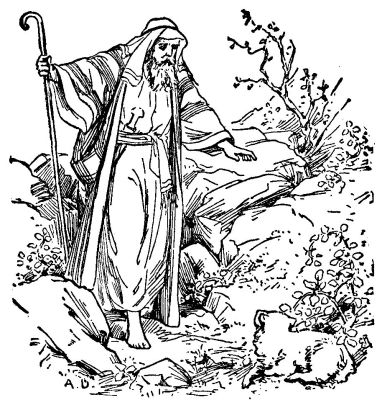
Moses became a shepherd in the wilderness of Midian
But Moses did not remain a shepherd. While
he was tending his sheep God appeared to him in a burning
bush and told him that he should return to Egypt and become
the leader of his people. The Lord told him that the wicked
Egyptians would be punished for the ill-treatment they were
giving the Israelites. In your Bible you will find in the
book of Exodus how God wonderfully fulfilled his promise.
The Egyptians were punished by many plagues, and finally
allowed the Israelites to go. They crossed the Red Sea in a
wonderful way, and traveled for a long time through a
wilderness, where God fed them day by day with manna
from heaven. God also gave them rules as a guide for their
daily living; these rules we call the Ten Commandments; yet
they forgot the Lord so far as to make images and worship
them.
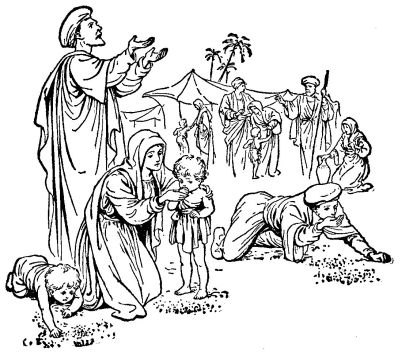
God fed them day by day with manna
THE STORY OF
THE GRAPES FROM CANAAN
The Israelites stayed in their camp before Mount Sinai
almost a year, while they were building the Tabernacle and
learning God’s laws given through Moses. At last the cloud over
the Tabernacle rose up, and the people knew that this was the
sign for them to move. They took down the Tabernacle and their
own tents, and journeyed toward the land of Canaan for many
days.
At last they came to a place just on the border between the
desert and Canaan, called Kadesh, or Kadesh-barnea. Here they
stopped to rest, for there were many springs of water and some
grass for their cattle. While they were waiting at
Kadesh-barnea and were expecting soon to march into the land
which was to be their home, God told Moses to send onward some
men who should walk through the land and look at it, and then
come back and tell what they had found; what kind of a land it
was, and what fruits grew in it, and what people were living in
it. The Israelites could more easily win the land if these men,
after walking through it, could act as their guides and point
out the best places in it and the best plans of making war upon
it.
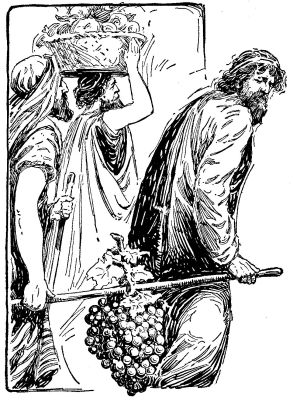
A cluster of grapes so large that two men carried
it.
So Moses chose out some men of high rank among the people,
one ruler from each tribe, twelve men in all. One of these was
Joshua, who was the helper of Moses in caring for the people,
and another was Caleb, who belonged to the tribe of Judah. These twelve men went out
and walked over the mountains of Canaan and looked at the
cities and saw the fields. In one place, just before they
came back to the camp, they cut down a cluster of ripe
grapes which was so large that two men carried it between
them, hanging from a staff. They named the place where they
found this bunch of grapes Eshcol, a word which means “a
cluster.” These twelve men were called “spies,” because they
went “to spy out the land”; and after forty days they came
back to the camp, and this was what they said:
“We walked all over the land and found it a rich land. There
is grass for all our flocks, and fields where we can raise
grain, and trees bearing fruits, and streams running down the
sides of the hills. But we found that the people who live there
are very strong and are men of war. They have cities with walls
that reach almost up to the sky; and some of the men are
giants, so tall that we felt that we were like grasshoppers
beside them.”
One of the spies, who was Caleb, said, “All that is true,
yet we need not be afraid to go up and take the land. It is a
good land, well worth fighting for; God is on our side, and he
will help us to overcome those people.”
But all the other spies, except Joshua,
said, “No, there is no use in trying to make war
upon such strong people. We can never take those walled
cities, and we dare not fight those tall giants.”
And the people, who had journeyed all the way through the
wilderness to find this very land, were so frightened by the
words of the ten spies that now, on the very border of Canaan,
they dared not enter it. They forgot that God had led them out
of Egypt, that he had kept them in the dangers of the desert,
that he had given them water out of the rock, and bread from
the sky, and his law from the mountain.
All that night, after the spies had brought back their
report, the people were so frightened that they could not
sleep. They cried out against Moses, and blamed him for
bringing them out of the land of Egypt. They forgot all their
troubles in Egypt, their toil and their slavery, and resolved
to go back to that land. They said:
“Let us choose a ruler in place of Moses, who has brought us
into all these evils, and let us turn back to the land of
Egypt!”
But Caleb and Joshua, two of the spies, said, “Why should we
fear? The land of Canaan is a good land; it is rich with milk
and honey. If God is our friend and is with us, we can easily
conquer the people who live there. Above all things, let us not rebel against the Lord,
or disobey him, and make him our enemy.”
But the people were so angry with Caleb and Joshua that they
were ready to stone them and kill them. Then suddenly the
people saw a strange sight. The glory of the Lord, which stayed
in the Holy of Holies, the inner room of the Tabernacle, now
flashed out, and shone from the door of the Tabernacle.
And the Lord, out of this glory, spoke to Moses, and said,
“How long will this people disobey me and despise me? They
shall not go into the good land that I have promised them. Not
one of them shall enter in, except Caleb and Joshua, who have
been faithful to me. All the people who are twenty years old
and over it shall die in the desert; but their little children
shall grow up in the wilderness, and when they become men they
shall enter in and own the land that I promised to their
fathers. You people are not worthy of the land that I have been
keeping for you. Now turn back into the desert and stay there
until you die. After you are dead, Joshua shall lead your
children into the land of Canaan. And because Caleb showed
another spirit and was true to me, and followed my will fully,
Caleb shall live to go into the land, and shall have his choice
of a home there. To-morrow, turn back into the desert by the
way of the Red Sea.”
And God told Moses that for every day that
the spies had spent in Canaan, looking at the land the
people should spend a year in the wilderness; so that they
should live in the desert forty years, instead of going at
once into the promised land.
When Moses told all God’s words to the people they felt
worse than before. They changed their minds as suddenly as they
had made up their minds.
“No,” they all said, “we will not go back to the wilderness;
we will go straight into the land, and see if we are able to
take it, as Joshua and Caleb have said.”
“You must not go into the land,” said Moses.
But the people would not obey. They marched up the mountain
and tried to march at once into the land. But they were without
leaders and without order—a mob of men, untrained and in
confusion. And the people in that part of the land, the
Canaanites and the Amorites, came down upon them and killed
many of them and drove them away. Then, discouraged and beaten,
they obeyed the Lord and Moses, and went once more into the
desert.
And in the desert of Paran, on the south of the land of
Canaan, the children of Israel stayed nearly forty years; and
all because they would not trust in the Lord.
THE
STORY OF GIDEON AND HIS THREE HUNDRED SOLDIERS
At last the people of Israel came into the promised land,
but they did evil in the sight of the Lord in worshipping Baal;
and the Lord left them to suffer for their sins. Once the
Midianites, living near the desert on the east of Israel, came
against the tribes. The two tribes that suffered the hardest
fate were Ephraim, and the part of Manasseh on the west of
Jordan. For seven years the Midianites swept over their land
every year, just at the time of harvest, and carried away all
the crops of grain, until the Israelites had no food for
themselves, and none for their sheep and cattle. The Midianites
brought also their own flocks and camels without number, which
ate all the grass of the field.
The people of Israel were driven away from their villages
and their farms, and were compelled to hide in the caves of the
mountains. And if any Israelite could raise any grain, he
buried it in pits covered with earth, or in empty winepresses,
where the Midianites could not find it.
One day, a man named Gideon was threshing out wheat in a hidden place, when he saw an
angel sitting-under an oak-tree. The angel said to him: “You
are a brave man, Gideon, and the Lord is with you. Go out
boldly, and save your people from the power of the
Midianites.” Gideon answered the angel:
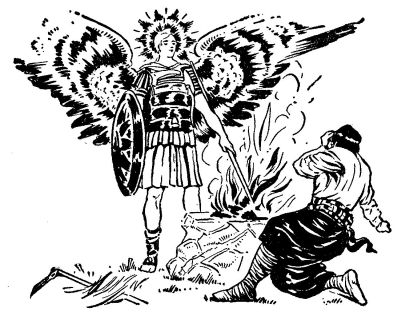
The angel touched the offering with his staff.
“O, Lord, how can I save Israel? Mine is a poor family in
Manasseh, and I am the least in my father’s house.”
And the Lord said to him: “Surely I will be With you, and I
will help you drive out the Midianites.”
Gideon felt that it was the Lord who was talking with him,
in the form of an angel. He brought an offering, and laid it on a rock
before the angel. Then the angel touched the offering with
his staff. At once, a fire leaped up and burned the
offering; and then the angel vanished from his sight. Gideon
was afraid when he saw this; but the Lord said to him:
“Peace be unto you, Gideon, do not fear, for I am with
you.”
On the spot where the Lord appeared to Gideon, under an oak
tree, near the village of Ophrah, in the tribe-land of
Manasseh, Gideon built an altar and called it by a name which
means: “The Lord is peace.” This altar was standing long
afterward in that place.
Then the Lord told Gideon that before setting his people
free from the Midianites, he must first set them free from the
service of Baal and Asherah, the two idols most worshipped
among them. Near the house of Gideon’s own father stood an
altar to Baal, and the image of Asherah.
On that night, Gideon went out with ten men, and threw down
the image of Baal, and cut in pieces the wooden image of
Asherah, and destroyed the altar before these idols. And in its
place he built an altar to the God of Israel; and on it laid
the broken pieces of the idols for wood, and with them offered
a young ox as a burnt-offering.
On the next morning, when the people of the
village went out to worship their idols,
they found them cut in pieces, the altar taken away; in its
place an altar of the Lord, and on it the pieces of the
Asherah were burning as wood under a sacrifice to the Lord.
The people looked at the broken and burning idols; and they
said: “Who has done this?”
Some one said: “Gideon, the son of Joash, did this last
night.”
Then they came to Joash, Gideon’s father, and said:
“We are going to kill your son because he has destroyed the
image of Baal, who is our god.”
And Joash, Gideon’s father, said: “If Baal is a god, he can
take care of himself, and punish the man who has destroyed his
image. Why should you help Baal? Let Baal help himself.”
And when they saw that Baal could not harm the man who had
broken down his altar and his image, the people turned from
Baal, back to their own Lord God.
Gideon sent messengers through all Manasseh on the west of
Jordan, and the tribes near on the north; and the men of the
tribes gathered around him, with a few swords and spears, but
very few, for the Israelites were not ready for war. They met
beside a great spring on Mount Gilboa, called “the fountain of
Harod.” Mount Gilboa is one of the three mountains on the east
of the plain of Esdraelon, or the plain of
Jezreel, where once there had been a great battle. On the
plain, stretching up the side of another of these mountains,
called “the Hill of Moreh,” was the camp of a vast Midianite
army. For as soon as the Midianites heard that Gideon had
undertaken to set his people free, they came against him
with a mighty host.
Gideon was a man of faith. He wished to be sure that God was
leading him, and he prayed to God and said:
“O Lord God, give me some sign that thou wilt save Israel
through me. Here is a fleece of wool on this threshing floor.
If to-morrow morning the fleece is wet with dew, while the
grass around it is dry, then I shall know that thou art with
me; and that thou wilt give me victory over the
Midianites.”
Very early the next morning, Gideon came to look at the
fleece. He found it wringing wet with dew, while all around the
grass was dry. But Gideon was not yet satisfied. He said to the
Lord:
“O Lord, be not angry with me; but give me just one more
sign. To-morrow morning let the fleece be dry, and let the dew
fall all around it, and then I will doubt no more.”
The next morning, Gideon found the grass, and the bushes wet
with dew, while the fleece of wool was dry. And Gideon was now sure that
God had called him, and that God would give him victory over
the enemies of Israel.
The Lord said to Gideon: “Your army is too large. If Israel
should win the victory, they would say, ‘we won it by our own
might.’ Send home all those who are afraid to fight.”
For many of the people were frightened, as they looked at
the host of their enemies, and the Lord knew that these men
would only hinder the rest in the battle. So Gideon sent word
through the camp:
“Whoever is afraid of the enemy may go home.” And twenty-two
thousand people went away, leaving only ten thousand in
Gideon’s army. But the army was stronger though it was smaller,
for the cowards had gone, and only the brave men were left.
But the Lord said to Gideon: “The people are yet too many.
You need only a few of the bravest and best men to fight in
this battle. Bring the men down the mountain, past the water,
and I will show you there how to find the men whom you
need.”
In the morning Gideon, by God’s command called his ten
thousand men out, and made them march down the hill, just as
though they were going to attack the enemy. And as they were
beside the water, he noticed how they drank, and
set them apart in two companies, according
to their way of drinking.
When they came to the water, most of the men threw aside
their shields and spears, and knelt down and scooped up a draft
of the water with both hands together like a cup. These men
Gideon commanded to stand in one company.
There were a few men who did not stop to take a large draft
of water. Holding spear and shield in the right hand, to be
ready for the enemy if one should suddenly appear, they merely
caught up a handful of the water in passing and marched on,
lapping up the water from one hand. God said to Gideon:
“Set by themselves these men who lapped up each a handful of
water. These are the men whom I have chosen to set Israel
free.”
Gideon counted these men, and found that there were only
three hundred of them, while all the rest bowed down on their
faces to drink. The difference between them was that the three
hundred were earnest men, of one purpose; not turning aside
from their aim even to drink, as the others did. Then, too,
they were watchful men, always ready to meet their enemies.
So Gideon, at God’s command, sent back to the camp on Mount
Gilboa all the rest of his army, nearly ten thousand men,
keeping with himself only his little band of three hundred.
Gideon’s plan did not need a large army;
but it needed a few careful, bold men, who should do exactly
as their leader commanded them. He gave to each man a lamp,
a pitcher, and a trumpet, and told the men just what was to
be done with them. The lamp was lighted, but was placed
inside the pitcher, so that it could not be seen. He divided
his men into three companies, and very quietly led them down
the mountain in the middle of the night, and arranged them
all in order around the camp of the Midianites.
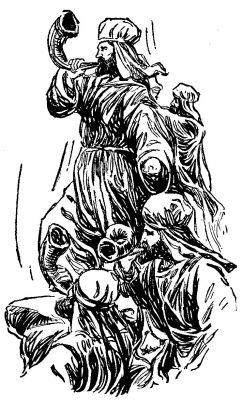
The men blew their trumpets with a mighty noise.
Then at one moment a great shout rang out in the darkness,
“The sword of the Lord and of Gideon,” and after it came a
crash of breaking pitchers, and then a flash of light in every
direction. The three hundred men had given the shout, and
broken their pitchers, so that on every side lights were shining.
The men blew their trumpets with a mighty noise; and the
Midianites were roused from sleep, to see enemies all round
them, lights beaming and swords flashing, while everywhere
the sharp sound of the trumpets was heard.
They were filled with sudden terror, and thought only of
escape, not of fighting. But wherever they turned, their
enemies seemed to be standing with swords drawn. They trampled
each other down to death, flying from the Israelites. Their own
land was in the east, across the river Jordan, and they fled in
that direction, down one of the valleys between the
mountains.
Gideon had thought that the Midianites would turn toward
their own land, if they should be beaten in the battle, and he
had already planned to cut off their flight. The ten thousand
men in the camp he had placed on the sides of the valley
leading to the Jordan. There they slew very many of the
Midianites as they fled down the steep pass toward the river.
And Gideon had also sent to the men of the tribe of Ephraim,
who had thus far taken no part in the war, to hold the only
place at the river where men could wade through the water.
Those of the Midianites who had escaped from Gideon’s men on
either side of the valley were now met by the Ephraimites at
the river, and many more of them were slain. Among the slain were two of the princes
of the Midianites, named Oreb and Zeeb.
A part of the Midianite army was able to get across the
river, and to continue its flight toward the desert; but Gideon
and his brave three hundred men followed closely after them,
fought another battle with them, destroyed them utterly, and
took their two kings, Zebah and Zalmunna, whom he killed. After
this great victory the Israelites were freed forever from the
Midianites. They never again ventured to leave their home in
the desert to make war on the tribes of Israel.
After this, as long as Gideon lived, he ruled as Judge in
Israel. The people wished him to make himself a king.
“Rule over us as king,” they said, “and let your son be king
after you, and his son king after him.”
But Gideon said:
“No, you have a king already; for the Lord God is the King
of Israel. No one but God shall be king over these tribes.”
Of all the fifteen men who ruled as Judges of Israel,
Gideon, the fifth Judge, was the greatest, in courage, in
wisdom, and in faith in God.
THE STORY OF
SAMSON, THE STRONG MAN
Now we are to learn of three judges who ruled Israel in
turn. Their names were Ibzan, Elon, and Abdon. None of these
were men of war, and in their days the land was quiet.
But the people of Israel again began to worship idols; and
as a punishment God allowed them once more to pass under the
power of their enemies. The seventh oppression, which now fell
upon Israel, was by far the hardest, the longest and the most
widely spread of any, for it was over all the tribes. It came
from the Philistines, a strong and warlike people who lived on
the west of Israel upon the plain beside the Great Sea. They
worshipped an idol called Dagon, which was made in the form of
a fish’s head on a man’s body.
These people, the Philistines, sent their armies up from the
plain beside the sea to the mountains of Israel and overran all
the land. They took away from the Israelites all their swords
and spears, so that they could not fight; and they robbed their
land of all the crops, so that the people suffered for want of
food. And as before, the Israelites in their trouble,
cried out to the Lord, and the Lord heard their prayer.
In the tribe-land of Dan, which was next to the country of
the Philistines, there was living a man named Manoah. One day
an angel came to his wife and said:
“You shall have a son, and when he grows up he will begin to
save Israel from the hand of the Philistines. But your son must
never drink any wine or strong drink as long as he lives. And
his hair must be allowed to grow long and must never be cut,
for he shall be a Nazarite under a vow to the Lord.”
When a child was given especially to God, or when a man gave
himself to some work for God, he was forbidden to drink wine,
and as a sign, his hair was left to grow long while the vow or
promise to God was upon him. Such a person as this was called a
Nazarite, a word which means “one who has a vow”; and Manoah’s
child was to be a Nazarite, and under a vow, as long as he
lived.
The child was born and was named Samson. He grew up to
become the strongest man of whom the Bible tells. Samson was no
general, like Gideon or Jephthah, to call out his people and
lead them in war. He did much to set his people free; but all
that he did was by his own strength.
When Samson became a young man he went
down to Timnath, in the land of the Philistines. There he
saw a young Philistine woman whom he loved, and wished to
have as his wife. His father and mother were not pleased
that he should marry among the enemies of his own people.
They did not know that God would make this marriage the
means of bringing harm upon the Philistines and of helping
the Israelites.
As Samson was going down to Timnath to see this young woman,
a hungry lion came out of the mountain, roaring against him.
Samson seized the lion, and tore him in pieces as easily as
another man would have killed a little kid of the goats, and
then went on his way. He made his visit and came home, but said
nothing to any one about the lion.
After a time Samson went again to Timnath for his marriage
with the Philistine woman. On his way he stopped to look at the
dead lion; and in its body he found a swarm of bees, and honey
which they had made. He took some of the honey and ate it as he
walked, but told no one of it.
At the wedding-feast, which lasted a whole week, there were
many Philistine young men, and they amused each other with
questions and riddles.
“I will give you a riddle,” said Samson. “If
you answer it during the feast, I will
give you thirty suits of clothing; and if you cannot answer
it then you must give me the thirty suits of clothing.” “Let
us hear your riddle,” they said. And this was Samson’s
riddle:
“Out of the eater came forth meat, And out of the strong
came forth sweetness.”
They could not find the answer, though they tried to find it
all that day and the two days that followed. And at last they
came to Samson’s wife and said to her:
“Coax your husband to tell you the answer. If you do not
find it out, we will set your house on fire, and burn you and
all your people.”
And Samson’s wife urged him to tell her the answer. She
cried and pleaded with him and said:
“If you really loved me, you would not keep this a secret
from me.”
At last Samson yielded, and told his wife how he had killed
the lion and afterward found the honey in its body. She told
her people, and just before the end of the feast they came to
Samson with the answer. They said:
“What is sweeter than honey? And what is stronger than a
lion?” And Samson said to them:
“If you had not plowed with
my heifer,
You had not found out my
riddle.”
By his “heifer,”—which is a young
cow,—of course Samson meant his wife. Then Samson was
required to give them thirty suits of clothing. He went out
among the Philistines, killed the first thirty men whom he
found, took off their clothes, and gave them to the guests
at the feast. But all this made Samson very angry. He left
his wife and went home to his father’s house. Then the
parents of his wife gave her to another man.
But after a time Samson’s anger passed away, and he went
again to Timnath to see his wife. But her father said to
him:
“You went away angry, and I supposed that you cared nothing
for her. I gave her to another man, and now she is his wife.
But here is her younger sister; you can have her for your wife,
instead.”
But Samson would not take his wife’s sister. He went out
very angry; determined to do harm to the Philistines, because
they had cheated him. He caught all the wild foxes that he
could find, until he had three hundred of them. Then he tied
them together in pairs, by their tails; and between each pair
of foxes he tied to their tails a piece of dry wood which he
set on fire. These foxes with firebrands on their tails he
turned loose among the fields of the Philistines when the grain
was ripe. They ran wildly over the fields, set the grain on fire, and burned
it; and with the grain the olive trees in the fields.
When the Philistines saw their harvests destroyed, they
said, “Who has done this?”
And the people said, “Samson did this, because his wife was
given by her father to another man.”
The Philistines looked on Samson’s father-in-law as the
cause of their loss; and they came and set his home on fire,
and burned the man and his daughter whom Samson had married.
Then Samson came down again, and alone fought a company of
Philistines, and killed them all, as a punishment for burning
his wife.
After this Samson went to live in a hollow place in a split
rock, called the rock of Etam. The Philistines came up in a
great army, and overran the fields in the tribe-land of
Judah.
“Why do you come against us?” asked the men of Judah, “what
do you want from us?”
“We have come,” they said, “to bind Samson, and to deal with
him as he has dealt with us.”
The men of Judah said to Samson:
“Do you not know that the Philistines are ruling over us?
Why do you make them angry by killing their people? You see
that we suffer through your pranks. Now we must bind you and
give you to the Philistines, or they will ruin us all.”
And Samson said, “I will let you bind me,
if you will promise not to kill me yourselves; but only to
give me safely into the hands of the Philistines.”
They made the promise; and Samson gave himself up to them,
and allowed them to tie him up fast with new ropes. The
Philistines shouted for joy as they saw their enemy brought to
them, led in bonds by his own people. But as soon as Samson
came among them, he burst the bonds as though they had been
light strings; and picked up from the ground the jawbone of an
ass, and struck right and left with it as with a sword. He
killed almost a thousand of the Philistines with this strange
weapon. Afterward he sang a song about it, thus:
“With the jawbone of an ass,
heaps upon heaps,
With the jawbone of an ass,
have I slain a thousand men.”
After this Samson went down to the chief city of the
Philistines, which was named Gaza. It was a large city; and
like all large cities, was surrounded with a high wall. When
the men of Gaza found Samson in their city, they shut the
gates, thinking that they could now hold him as a prisoner. But
in the night Samson rose up, went to the gates, pulled their
posts out of the ground, and put the gates with their
posts upon his shoulder. He carried off the gates of the
city and left them on the top of a hill not far from the
city of Hebron.
After this Samson saw another woman among the Philistines,
and he loved her. The name of this woman was Delilah. The
rulers of the Philistines came to Delilah and said to her:
“Find out, if you can, what it is that makes Samson so
strong, and tell us. If you help us to get control of him, so
that we can have him in our power, we will give you a great sum
of money.”
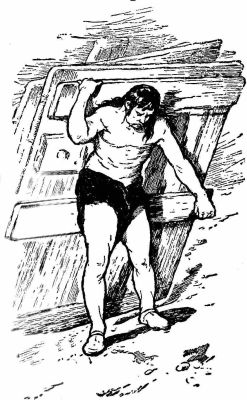
He carried off the gates of the city
And Delilah coaxed and pleaded with Samson to tell her what
it was that made him so strong. Samson said to her:
“If they will tie me with seven green twigs
from a tree, then I shall not be strong
any more.”
They brought her seven green twigs, like those of a willow
tree; and she bound Samson with them while he was asleep. Then
she called out to him:
“Wake up, Samson, the Philistines are coming against
you!”
And Samson rose up and broke the twigs as easily as if they
had been charred in the fire, and went away with ease.
And Delilah tried again to find his secret. She said:
“You are only making fun of me. Now tell me truly how you
can be bound.” And Samson said:
“Let them bind me with new ropes that have never been used
before; and then I cannot get away.”
While Samson was asleep again, Delilah bound him with new
ropes. Then she called out as before:
“Get up, Samson, for the Philistines are coming!” And when
Samson rose up, the ropes broke as if they were thread. And
Delilah again urged him to tell her; and he said:
“You notice that my long hair is in seven locks. Weave it
together in the loom, just as if it were the threads in a piece
of cloth.”
Then, while he was asleep, she wove his
hair in the loom, and fastened it with a large pin to the
weaving-frame. But when he awoke, he rose up, and carried
away the pin and the beam of the weaving-frame; for he was
as strong as before.
And Delilah, who was anxious to serve her people, said:
“Why do you tell me that you love me, as long as you deceive
me and keep from me your secret?” And she pleaded with him day
after day, until at last he yielded to her and told her the
real secret of his strength. He said:
“I am a Nazarite, under a vow to the Lord, not to drink
wine, and not to allow my hair to be cut. If I should let my
hair be cut short, then the Lord would forsake me, and my
strength would go from me, and I would be like other men.”
Then Delilah knew that she had found the truth at last. She
sent for the rulers of the Philistines, saying:
“Come up this once, and you shall have your enemy; for he
has told me all that is in his heart.”
Then while the Philistines were watching outside, Delilah
let Samson go to sleep, with his head upon her knees. While he
was sound asleep, they took a razor and shaved off all his
hair. Then she called out as at other times.
“Rise up, Samson, the Philistines are upon
you.”
He awoke, and rose up, expecting to find himself strong as
before; for he did not at first know that his long hair had
been cut off. But the vow to the Lord was broken, and the Lord
had left him. He was now as weak as other men, and helpless in
the hands of his enemies. The Philistines easily made him their
prisoner; and that he might never do them more harm, they put
out his eyes. Then they chained him with fetters, and sent him
to prison at Gaza. And in the prison they made Samson turn a
heavy millstone to grind grain, just as though he were a beast
of burden.
But while Samson was in prison, his hair grew long again;
and with his hair his strength came back to him; for Samson
renewed his vow to the Lord.
One day, a great feast was held by the Philistines in the
temple of their fish-god, Dagon. For they said:
“Our god has given Samson, our enemy, into our hand. Let us
be glad together and praise Dagon.”
And the temple was thronged with people, and the roof over
it was also crowded with more than three thousand men and
women. They sent for Samson, to rejoice over him; and Samson
was led into the court of the temple,
before all the people, to amuse them. After a time, Samson
said to the boy who was leading him:
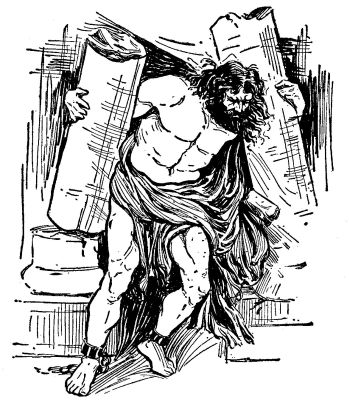
He bowed forward with all his might and pulled the
pillars with him
“Take me up to the front of the temple, so that I may stand
by one of the pillars, and lean against it.”
And while Samson stood between the two
pillars, he prayed:
“O Lord God, remember me, I pray thee, and give me strength,
only this once, O God: and help me, that I may obtain vengeance
upon the Philistines for my two eyes!”
Then he placed one arm around the pillar on one side, and
the other arm around the pillar on the other side; and he said:
“Let me die with the Philistines.”
And he bowed forward with all his might, and pulled the
pillars over with him, bringing down the roof and all upon it
upon those that were under it. Samson himself was among the
dead; but in his death he killed more of the Philistines than
he had killed during his life.
Then in the terror which came upon the Philistines the men
of Samson’s tribe came down and found his dead body, and buried
it in their own land. After that it was years before the
Philistines tried again to rule over the Israelites.
Samson did much to set his people free; but he might have
done much more, if he had led his people, instead of trusting
alone to his own strength; and if he had lived more earnestly,
and not done his deeds as though he was playing pranks. There
were deep faults in Samson, but at the end he sought God’s
help, and found it, and God used Samson to set his people
free.
THE STORY OF RUTH,
THE GLEANER
In the time of the Judges in Israel, a man named Elimelech
was living in the town of Bethlehem, in the tribe of Judah,
about six miles south of Jerusalem. His wife’s name was Naomi,
and his two sons were Mahlon and Chilion. For some years the
crops were poor, and food was scarce in Judah; and Elimelech
with his family went to live in the land of Moab, which was on
the east of the Dead Sea, as Judah was on the west.
There they stayed ten years, and in that time Elimelech
died. His two sons married women of the country of Moab, one
named Orpah, the other named Ruth. But the two young men also
died in the land of Moab; so that Naomi and her two
daughters-in-law were all left widows.
Naomi heard that God had again given good harvests and bread
to the land of Judah, and she rose up to go from Moab back to
her own land and her own town of Bethlehem. The two
daughters-in-law loved her, and both would have gone with her,
though the land of Judah was a strange land to them, for they
were of the Moabite people.
Naomi said to them: “Go back, my daughters,
to your own mothers’ homes. May the Lord
deal kindly with you, as you have been kind to your husbands
and to me. May the Lord grant that each of you may yet find
another husband and a happy home.”
Then Naomi kissed them in farewell, and the three women all
wept together. The two young widows said to her:
“You have been a good mother to us, and we will go with you,
and live among your people.”
“No, no,” said Naomi. “You are young, and I am old. Go back
and be happy among your own people.”
Then Orpah kissed Naomi, and went back to her people; but
Ruth would not leave her. She said:
“Do not ask me to leave you, for I never will. Where you go,
I will go; where you live, I will live; your people shall be my
people; and your God shall be my God. Where you die, I will
die, and be buried. Nothing but death itself shall part you and
me.”
When Naomi saw that Ruth was firm in her purpose, she ceased
trying to persuade her; so the two women went on together. They
walked around the Dead Sea, and crossed the river Jordan, and
climbed the mountains of Judah, and came to Bethlehem.
Naomi had been absent from Bethlehem for ten years, but her friends were all glad
to see her again. They said:
“Is this Naomi, whom we knew years ago?”
Now the name Naomi means “pleasant.” And Naomi said:
“Call me not Naomi; call me Mara, for the Lord has made my
life bitter. I went out full, with my husband and two sons; now
I come home empty, without them. Do not call me ‘Pleasant,’
call me ‘Bitter.'”
The name “Mara,” by which Naomi wished to be called means
“bitter.” But Naomi learned later that “Pleasant” was the right
name after all.
There was living in Bethlehem at that time a very rich man
named Boaz. He owned large fields that were abundant in their
harvests; and he was related to the family of Elimelech,
Naomi’s husband, who had died.
It was the custom in Israel when they reaped the grain not
to gather all the stalks, but to leave some for the poor
people, who followed after the reapers with their sickles, and
gathered what was left. When Naomi and Ruth came to Bethlehem,
it was the time of the barley harvest; and Ruth went out into
the fields to glean the grain which the reapers had left. It so
happened that she was gleaning in the field that belonged to
Boaz, this rich man.
Boaz came out from the town to see his men
reaping, and he said to them, “The Lord be with you”; and
they answered him, “The Lord bless you.”
And Boaz said to his master of the reapers: “Who is this
young woman that I see gleaning in the field?”
The man answered: “It is the young woman from the land of
Moab, who came with Naomi. She asked leave to glean after the
reapers, and has been here gathering grain since
yesterday.”
Then Boaz said to Ruth: “Listen to me, my daughter. Do not
go to any other field, but stay here with my young women. No
one shall harm you; and when you are thirsty, go and drink at
our vessels of water.”
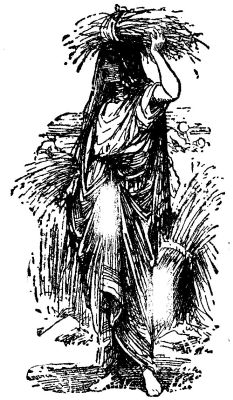
Ruth went out into the fields to glean the grain
Then Ruth bowed to Boaz, and thanked him for his kindness,
all the more kind because she was a stranger in Israel. Boaz
said: “I have heard how true you have been to your
mother-in-law Naomi, in leaving your own
land and coming with her to this land. May the Lord, under
whose wings you have come, give you a reward!”
And at noon, when they sat down to rest and to eat, Boaz
gave her some of the food. And he said to the reapers:
“When you are reaping, leave some of the sheaves for her;
and drop out some sheaves from the bundles, where she may
gather them.”
That evening, Ruth showed Naomi how much she had gleaned,
and told her of the rich man Boaz, who had been so kind to her.
And Naomi said:
“This man is a near relation of ours. Stay in his fields, as
long as the harvest lasts.” And so Ruth gleaned in the fields
of Boaz until the harvest had been gathered.
At the end of the harvest, Boaz held a feast on the
threshing-floor. And after the feast, by the advice of Naomi,
Ruth went to him, and said to him:
“You are a near relation of my husband and of his father,
Elimelech. Now will you not do good to us for his sake?”
And when Boaz saw Ruth, he loved her; and soon after this he
took her as his wife. And Naomi and Ruth went to live in his
home; so that Naomi’s life was no more bitter, but
pleasant. And Boaz and Ruth had a son, whom they
named Obed; and later Obed had a son named Jesse; and Jesse
was the father of David, the shepherd boy who became king.
So Ruth, the young woman of Moab, who chose the people and
the God of Israel, became the mother of kings.
THE STORY OF
DAVID, THE SHEPHERD BOY
Living at Ramah, in the mountains of Ephraim, there was a
man whose name was Elkanah. He had two wives, as did many men
in that time. One of these wives had children, but the other
wife, whose name was Hannah, had no child.
Every year Elkanah and his family went up to worship at the
house of the Lord in Shiloh, which was about fifteen miles from
his home. And at one of these visits Hannah prayed to the Lord,
saying:
“O Lord, if thou wilt look upon me, and give me a son, he
shall be given to the Lord as long as he lives.”
The Lord heard Hannah’s prayer, and gave her a little boy,
and she called his name Samuel, which means “Asked of God”;
because he had been given in answer to her prayer.
Samuel grew up to be a good man and a wise Judge, and he
made his sons Judges in Israel, to help him in the care of the
people. But Samuel’s sons did not walk in his ways. They did
not try always to do justly.
The elders of all the tribes of Israel came
to Samuel at his home in Ramah; and they
said to him: “You are growing old, and your sons do not rule
as well as you ruled. All the lands around us have kings.
Let us have a king also; and do you choose the king for
us.”
This was not pleasing to Samuel. He tried to make the people
change their minds, and showed them what trouble a king would
bring them.
But they would not follow his advice. They said: “No; we
will have a king to reign over us.”
So Samuel chose as their king a tall young man named Saul,
who was a farmer’s son of the tribe of Benjamin. When Saul was
brought before the people he stood head and shoulders above
them all. And Samuel said:
“Look at the man whom the Lord has chosen! There is not
another like him among all the people!”
And all the people shouted, “God save the king! Long live
the king!”
Then Samuel told the people what should be the laws for the
king and for the people to obey. He wrote them down in a book,
and placed the book before the Lord. Then Samuel sent the
people home; and Saul went back to his own house at a place
called Gibeah; and with Saul went a company of men to whose
hearts God had given a love for the king.
So after three hundred years under the
fifteen Judges, Israel now had a king. But among the people
there were some who were not pleased with the new king,
because he was an unknown man from the farm. They said:
“Can such a man as this save us?”
They showed no respect to the king, and in their hearts
looked down upon him. But Saul said nothing, and showed his
wisdom by appearing not to notice them. But in another thing he
was not so wise. He forgot to heed the old prophet’s advice and
instructions about ruling wisely and doing as the Lord said. It
was not long before Samuel told him that he had disobeyed God
and would lose his kingdom.
When Samuel told Saul that the Lord would take away the
kingdom from him, he did not mean that Saul should lose the
kingdom at once. He was no longer God’s king; and as soon as
the right man in God’s sight should be found, and should be
trained for his duty as king, then God would take away Saul’s
power, and would give it to the man whom God had chosen. But it
was years before this came to pass.
The Lord said to Samuel: “Do not weep and mourn any longer
over Saul, for I have refused him as king. Fill the horn with
oil, and go to Bethlehem in Judah. There find a man named
Jesse, for I have chosen a king among his sons.”
But Samuel knew that Saul would be very
angry, if he should learn that Samuel had named any other
man as king. He said to the Lord:
“How can I go? If Saul hears of it, he will kill me.”
The Lord said to Samuel: “Take a young cow with you; and
tell the people that you have come to make an offering to the
Lord. And call Jesse and his sons to the sacrifice. I will tell
you what to do, and you shall anoint the one whom I name to
you.”
Samuel went over the mountains southward from Ramah to
Bethlehem, about ten miles, leading a cow. The rulers of the
town were alarmed at his coming, for they feared that he had
come to judge the people for some evil-doing. But Samuel
said:
“I have come in peace to make an offering and to hold a
feast to the Lord. Prepare yourselves and come to the
sacrifice.”
And he invited Jesse and his sons to the service. When they
came, he looked at the sons of Jesse very closely. The oldest
was named Eliab, and he was so tall and noble-looking that
Samuel thought:
“Surely this young man must be the one whom God has
chosen.”
But the Lord said to Samuel:
“Do not look on his face, nor on the height of
his body, for I have not chosen him. Man
judges by the outward looks, but God looks at the
heart.”
Then Jesse’s second son, named Abinadab, passed by. And the
Lord said: “I have not chosen this one.” Seven young men came
and Samuel said:
“None of these is the man whom God has chosen. Are these all
your children?”
“There is one more,” said Jesse. “The youngest of all. He is
a boy, in the field caring for the sheep.”
And Samuel said:
“Send for him; for we will not sit down until he comes.” So
after a time the youngest son was brought in. His name was
David, a word that means “darling,” and he was a beautiful boy,
perhaps fifteen years old, with fresh cheeks and bright
eyes.
As soon as the young David came, the Lord said to
Samuel:
“Arise, anoint him, for this is the one whom I have
chosen.”
Then Samuel poured oil on David’s head, in the presence of
all his brothers. But no one knew at that time the anointing to
mean that David was to be the king. Perhaps they thought that
David was chosen to be a prophet like Samuel.
From that time the Spirit of God came upon
David, and he began to show signs of coming greatness. He
went back to his sheep on the hillsides around Bethlehem,
but God was with him.
David grew up strong and brave, not afraid of the wild
beasts which prowled around and tried to carry away his sheep.
More than once he fought with lions, and bears, and killed
them, when they seized the lambs of his flock. And David, alone
all day, practiced throwing stones in a sling, until he could
strike exactly the place for which he aimed. When he swung his
sling, he knew that the stone would go to the very spot at
which he was throwing it.
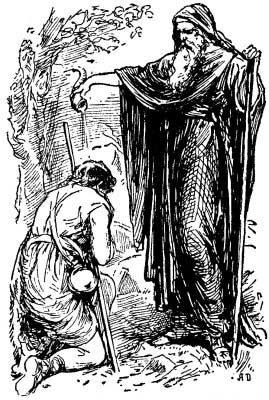
Then Samuel poured oil on David’s head
And young as he was, David thought of God,
and talked with God, and God talked with
David, and showed to David His will.
After Saul had disobeyed the voice of the Lord, the Spirit
of the Lord left Saul, and no longer spoke to him. And Saul
became very sad of heart. At times a madness would come upon
him, and at all times he was very unhappy. The servants of Saul
noticed that when some one played on the harp and sang, Saul’s
spirit was made more cheerful; and the sadness of soul left
him. At one time Saul said: “Find some one who can play well,
and bring him to me. Let me listen to music; for it drives away
my sadness.”
One of the young men said: “I have seen a young man, a son
of Jesse in Bethlehem, who can play well. He is handsome in his
looks, and agreeable in talking. I have also heard that he is a
brave young man, who can fight as well as he can play, and the
Lord is with him.”
Then Saul sent a message to Jesse, David’s father. He said:
“Send me your son David, who is with the sheep. Let him come
and play before me.”
Then David came to Saul, bringing with him a present for the
king from Jesse. When Saul saw him, he loved him, as did
everybody who saw the young David. And David played on the
harp, and sang before Saul. And David’s music cheered Saul’s heart, and drove away his
sad feelings.
Saul liked David so well that he made him his armorbearer;
and David carried the shield and spear, and sword for Saul,
when the king was before his army. But Saul did not know that
David had been anointed by Samuel.
After a time, Saul seemed well; and David returned to
Bethlehem and was once more among his sheep in the field.
Perhaps it was at this time that David sang his shepherd song,
or it may have been long afterward, when David looked back in
thought to those days when he was leading his sheep. This is
the song, which you have heard often:
“The Lord is my shepherd; I shall not want.
He maketh me to lie down in green pastures;
He leadeth me beside the still waters,
He restoreth my soul;
He leadeth me in the paths of righteousness for his
name’s sake.
Yea, though I walk through the valley of the shadow
of death,
I will fear no evil; for thou art with me;
Thy rod and thy staff, they comfort me.
Thou preparest a table before me in the presence of
mine enemies;
Thou anointest my head with oil; my cup runneth
over.
Surely goodness and mercy shall follow me all the
days of my life:
And I will dwell in the house of the Lord
THE STORY OF
THE FIGHT WITH THE GIANT
All through the reign of Saul, there was constant war with
the Philistines, who lived upon the lowlands west of Israel. At
one time, when David was still with his sheep, a few years
after he had been anointed by Samuel, the camps of the
Philistines and the Israelites were set against each other on
opposite sides of the valley of Elah. In the army of Israel
were the three oldest brothers of David.
Every day a giant came out of the camp of the Philistines,
and dared some one to come from the Israelites’ camp and fight
with him. The giant’s name was Goliath. He was nine feet high;
and he wore armor from head to foot, and carried a spear twice
as long and as heavy as any other man could hold; and his
shield bearer walked before him. He came every day and called
out across the little valley:
“I am a Philistine, and you are servants of Saul. Now choose
one of your men, and let him come out and fight with me. If I
kill him; then you shall submit to us; and if he kills me, then
we will give up to you. Come, now, send out your man!”
But no man in the army, not even King
Saul, dared to go out and fight with the giant. Forty days
the camps stood against each other, and the Philistine giant
continued his call.
One day, old Jesse, the father of David, sent David from
Bethlehem to visit his three brothers in the army. David came,
and spoke to his brothers; and while he was talking with them,
Goliath the giant came out as before in front of the camp
calling for some one to fight with him.
They said one to another:
“If any man will go out and kill this Philistine, the king
will give him a great reward and a high rank; and the king’s
daughter shall be his wife.”
And David said:
“Who is this man that speaks in this proud manner against
the armies of the living God? Why does not some one go out and
kill him?”
David’s brother Eliab said to him:
“What are you doing here, leaving your sheep in the field? I
know that you have come down just to see the battle.”
But David did not care for his brother’s words. He thought
he saw a way to kill this boasting giant; and he said:
“If no one else will go, I will go out and fight with this
enemy of the Lord’s people.”
They brought David before King Saul. Some
years had passed since Saul had met David, and he had grown
from a boy to a man, so that Saul did not know him as the
shepherd who had played on the harp before him in other
days.
Saul said to David:
“You cannot fight with this great giant. You are very young;
and he is a man of war, trained from his youth.”
And David answered King Saul:
“I am only a shepherd, but I have fought with lions and
bears, when they have tried to steal my sheep. And I am not
afraid to fight with this Philistine.”
Then Saul put his own armor on David—a helmet on his
head, and a coat of mail on his body, and a sword at his waist.
But Saul was almost a giant, and his armor was far too large
for David. David said:
“I am not used to fighting with such weapons as these. Let
me fight in my own way.”
So David took off Saul’s armor. While everybody in the army
had been looking on the giant with fear, David had been
thinking out the best way for fighting him; and God had given
to David a plan. It was to throw the giant off his guard, by
appearing weak and helpless; and while so far away that the
giant could not reach him with sword or spear, to strike him
down with a weapon which the giant would not
expect and would not be prepared for.
David took his shepherd’s staff in his hand, as though that
were to be his weapon. But out of sight, in a bag under his
mantle, he had five smooth stones carefully chosen, and a
sling,—the weapon that he knew how to use. Then he came
out to meet the Philistine.
The giant looked down on the youth and despised him, and
laughed.
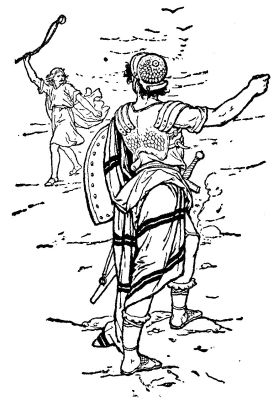
The giant looked down on the youth and despised him
“Am I a dog?” he said, “that this boy comes to me with a
staff? I will give his body to the birds of the air, and the
beasts of the field.”
And the Philistine cursed David by the gods of his people.
And David answered him:
“You come against me with a sword, and a
spear, and a dart; but I come to you in the name of the Lord
of hosts, the God of the armies of Israel. This day will the
Lord give you into my hand. I will strike you down, and take
off your head, and the host of the Philistines shall be dead
bodies, to be eaten by the birds and the beasts; so that all
may know that there is a God in Israel, and that He can save
in other ways besides with sword and spear.”
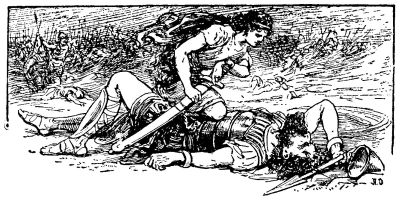
David drew out the giant’s own sword
And David ran toward the Philistine, as if to fight him with
his shepherd’s staff. But when he was just near enough for a
good aim, he took out his sling, and hurled a stone aimed at
the giant’s forehead. David’s aim was good; the stone struck
the Philistine in his forehead. It stunned him, and he fell to
the ground.
While the two armies stood wondering, and
scarcely knowing what had caused the giant to fall so
suddenly, David ran forward, drew out the giant’s own sword,
and cut off his head. Then the Philistines knew that their
great warrior in whom they trusted was dead. They turned to
flee to their own land; and the Israelites followed after
them, and killed them by the hundred and the thousand, even
to the gates of their own city of Gath.
So in that day David won a great victory and stood before
all the land as the one who had saved his people from their
enemies.
THE STORY OF THE
CAVE OF ADULLAM
Now Saul had a son, Jonathan, near David’s own age. He and
David became fast friends and loved one another as brothers.
Saul the king became very jealous of David because the people
praised him after his fight with Goliath. He even threatened to
take David’s life. He tried to catch him in his own house, but
David’s wife let him down from a window by a rope and he
escaped. He met his friend Jonathan, who told him that he
should flee. They renewed their promises of friendship, which
they kept ever afterward.
From his meeting with Jonathan, David went forth to be a
wanderer, having no home as long as Saul lived. He found a
great cave, called the cave of Adullam, and hid in it. Soon
people heard where he was, and from all parts of the land,
especially from his own tribe of Judah, men who were not
satisfied with the rule of King Saul gathered around David.
Saul soon heard that David, with a band of men, was hiding
among the mountains of Judah, and that among those who aided
him were certain priests.
This enraged King Saul, and he ordered his
guards to kill all the priests. The guards
would not obey him, for they felt that it was a wicked thing
to lay hands upon the priests of the Lord.
But he found one man whose name was Doeg, an Edomite, who
was willing to obey the king. And Doeg, the Edomite, killed
eighty-five men who wore the priestly garments.
All through the land went the news of Saul’s dreadful deed,
and everywhere the people began to turn from Saul, and to look
toward David as the only hope of the nation.
When Saul died he was followed by David, the shepherd boy,
now grown to manhood and greatly loved by the people. He had
many battles to fight with the Philistines and was nearly
always victorious. He was a warrior king; but he was more than
a warrior. He played on his harp and composed many beautiful
hymns and songs, which are collected in the book of Psalms. He
was a good king and tried to obey God’s command. He had a long
reign and his people were happy and prosperous. He had many
sons and daughters and beautiful palaces for them to live
in.
THE STORY OF
SOLOMON AND HIS TEMPLE
During the later years of David’s reign, he laid up great
treasure of gold and silver, and brass, and iron, for the
building of a house to the Lord on Mount Moriah. This house was
to be called “The Temple”; and it was to be made very
beautiful, the most beautiful building, and the richest in all
the land. David had greatly desired to build this house while
he was king of Israel, but God said to him:
“You have been a man of war, and have fought many battles,
and shed much blood. My house shall be built by a man of peace.
When you die, your son Solomon shall reign, and he shall have
peace, and shall build my house.”
So David made ready great store of precious things for the
temple; also stone and cedar to be used in the building. And
David said to Solomon, his son: “God has promised that there
shall be rest and peace to the land while you are king; and the
Lord will be with you, and you shall build a house, where God
shall live among His people.”
But David had other sons who were older than Solomon; and
one of these sons, whose name was Adonijah, formed a plan to make himself
king. David was now very old; and he was no longer able to
go out of his palace, and to be seen among the people.
Adonijah gathered his friends; and among them were Joab, the
general of the army, and Abiathar, one of the two high-priests.
They met at a place outside the wall, and had a great feast,
and were about to crown Adonijah as king, when word came to
David in the palace. David, though old and feeble, was still
wise. He said:
“Let us make Solomon king at once, and thus put an end to
the plans of these men.”
So at David’s command they brought out the mule on which no
one but the king was allowed to ride; and they placed Solomon
upon it; and with the king’s guards, and the nobles, and the
great men, they brought the young Solomon down to the valley of
Gihon, south of the city.
And Zadok, the priest, took from the Tabernacle the horn
filled with holy oil, that was used for anointing or pouring
oil on the head of the priests when they were set apart for
their work. He poured oil from this horn on the head of
Solomon, and then the priests blew the trumpets, and all the
people cried aloud, “God save King Solomon.”
All this time Adonijah and Joab, and their friends were not
far away, almost in the same valley, feasting and making merry,
intending to make Adonijah king. They heard the sound of the
trumpets, and the shouting of the people. Joab said: “What
is the cause of all this noise and uproar?”
A moment later, Jonathan, the son of Abiathar, came running
in. Jonathan said to the men who were feasting:
“Our lord King David has made Solomon king, and he has just
been anointed in Gihon; and all the princes, and the heads of
the army, are with him, and the people are shouting, ‘God save
King Solomon!’ And David has sent from his bed a message to
Solomon, saying, ‘May the Lord make your name greater than mine
has been! Blessed be the Lord, who has given me a son to sit
this day on my throne!'”
When Adonijah and his friends heard this they were filled
with fear. Every man went at once to his house, except
Adonijah. He hastened to the altar of the Lord, and knelt
before it, and took hold of the horns that were on its corners
in front. This was a holy place, and he hoped that there
Solomon might have mercy on him. And Solomon said:
“If Adonijah will do right, and be faithful to me as the
king of Israel, no harm shall come to him; but if he does
wrong, he shall die.”
Then Adonijah came and bowed down before King Solomon, and promised to obey him,
and Solomon said, “Go to your own house.”
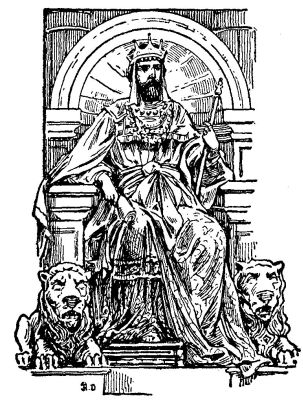
Solomon on his throne
Not long after this David sent for Solomon, and from his bed
he gave his last advice to Solomon. And soon after that David
died, an old man, having reigned in all forty years, seven
years over the tribe of Judah, at Hebron, and thirty-three
years over all Israel, in Jerusalem. He was buried in great
honor on Mount Zion, and his tomb remained standing for many
years.
The great work of Solomon’s reign was the building of the
House of God. It was generally called the Temple. It was built
on Mount Moriah, one of the hills of Jerusalem. King David had
prepared for it by gathering great stores of silver, stone and
cedar-wood. The walls were made of stone and the roof of cedar.
Solomon had great ships which visited other lands and brought
precious stones and fine woods for the
building. Seven years were spent in building the
Temple, and it was set apart to the worship of God with
beautiful ceremonies in which Solomon, in his robes of
state, took part.
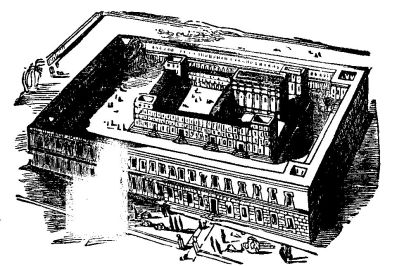
Supposed form of Solomon’s temple
Solomon was indeed a great king, and it was said that he was
also the wisest man in all the world. He wrote many of the wise
sayings in the Book of Proverbs, and many more that have been
lost.
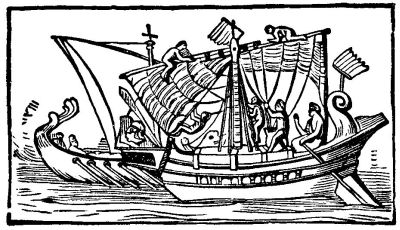
Ship in Solomon’s time
THE STORY OF
ELIJAH, THE PROPHET
One of the greatest of all the kings of the Ten Tribes was
Jeroboam the second. Under him the kingdom of Israel grew rich
and strong. He conquered nearly all Syria, and made Samaria the
greatest city of all those lands.
But though Syria went down, another nation was now rising to
power—Assyria, on the eastern side of the river Tigris.
Its capital was Nineveh, a great city, so vast that it would
take three days for a man to walk around its walls. The
Assyrians were beginning to conquer all the lands near them,
and Israel was in danger of falling under their power.
One of the kings who ruled over Israel was named Ahab. He
provoked the anger of the Lord. His wife, Jezebel, who was a
worshiper of Baal, persuaded him to build an altar to the false
god.
Elijah, a prophet of the Lord, was sent to him and proposed
a test. Two altars were built; one to Jehovah and one to Baal.
The priests of Baal called upon their god to send down fire;
but there was no answer. Then Elijah called upon the Lord God
of Abraham, Isaac and Israel, and fire came down and burnt up
the offering.
The people turned upon the priests of Baal
and killed them all. Later the wicked queen, Jezebel,
coveted a vineyard for Ahab, and she caused Naboth, the
owner of the vineyard, to be placed in front of the battle.
When he was slain Ahab took the vineyard.
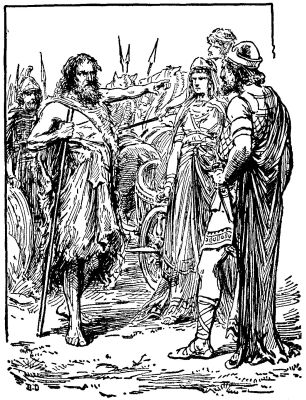
Denounced Ahab and Jezebel
Once more Elijah came and denounced Ahab
and Jezebel, telling them that they had done wickedly, and
that the Lord would punish them.
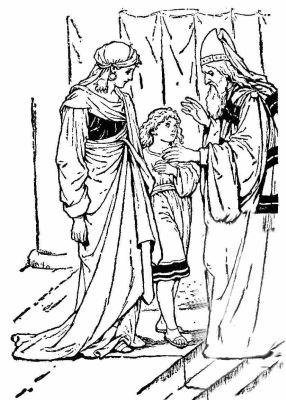
Made king when he was only seven years old
In a little while the prophet’s words came true, for Ahab
was slain in battle and Jezebel was put to death by order of
King Jehu. Elijah was taken up to heaven in a chariot of
fire.
There was another prophet, a companion of Elijah, whose name
was Elisha, a brave and courageous man who did not fail to
deliver God’s message.
It happened that when Elisha was an old man there can to him
King Joash, who had been made king when he was only seven years
old. Joash was now a young man and was trying to do right in
the sight of the Lord. But he felt the need of the prophet’s
aid, and he came to Elisha and said:
“My father, my father, you are more to
Israel than its chariots and horsemen.”
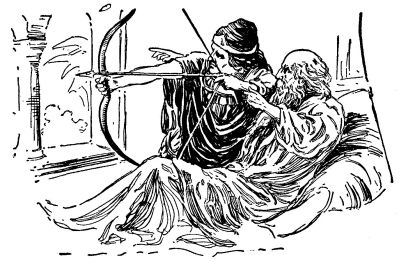
This is the arrow of victory
Elisha, though weak in body, was yet strong in soul. He told
Joash to bring him a bow and arrows, and to open the window to
the east, looking toward the land of Syria. Then Elisha caused
the king to draw the bow; and he placed his hands on the king’s
hands. And as the king shot an arrow, Elisha said:
“This is the arrow of victory; of victory over Syria; for
you shall smite the Syrians in Aphek and shall destroy
them.”
It happened as Elisha had foretold and the Syrians were
defeated and their cities taken.
THE STORY OF JONAH
AND THE WHALE
At this time another prophet, named Jonah, was giving the
word of the Lord to the Israelites. To Jonah the Lord spoke,
saying:
“Go to Nineveh, that great city, and preach to it; for its
wickedness rises up before me.”
But Jonah did not wish to preach to the people of Nineveh;
for they were the enemies of his land, the land of Israel. He
wished Nineveh to die in its sins, and not to turn to God and
live. So Jonah tried to go away from the city where God had
sent him. He went down to Joppa and took a ship for
Tarshish.
But the Lord saw Jonah on the ship; and the Lord sent a
great storm upon the sea, so that the ship seemed as though it
would go to pieces. The sailors threw overboard everything on
the ship; and when they could do no more, every man prayed to
his god to save the ship and themselves. Jonah was now lying
fast asleep, and the ship’s captain came to him, and said:
“What do you mean by sleeping in such a time as this? Awake,
rise up, and call upon your God. Perhaps He will hear you and
save our lives.”
But the storm continued to rage around the ship; and they
said:
“There is some man on this ship who has
brought upon us this trouble. Let us cast lots and find who
it is.”
Then they cast lots, and the lot fell on Jonah. They said to
him, all at once:
“Tell us, who are you? From what country do you come? What
is your business? To what people do you belong? Why have you
brought all this trouble upon us?”
Then Jonah told them the whole story, how he came from the
land of Israel, and that he had fled away from the presence of
the Lord. And they said to him:
“What shall we do to you, that the storm may cease?”
Then said Jonah:
“Take me up and throw me into the sea; then the storm will
cease and the waters will be calm; for I know that for my sake
this great tempest is upon you.”
But the men were not willing to throw Jonah into the sea.
They rowed hard to bring the ship to the land, but they could
not. Then they cried unto the Lord, and said:
“We pray thee, O Lord, we pray thee, let us not die for this
man’s life; for thou, O Lord, hast done as it pleased
thee.”
At last, when they could do nothing else to save themselves,
they threw Jonah into the sea.
At once the storm ceased, and the waves
became still. Then the men on the ship feared the Lord
greatly. They offered a sacrifice to the Lord, and made
promises to serve him.
And the Lord caused a great fish to swallow up Jonah; and
Jonah was alive within the fish for three days and three
nights. In the fish Jonah cried to the Lord; and the Lord
caused the great fish to throw up Jonah upon the dry land.
Notice all through this story that, although Jonah was God’s
servant, he was always thinking about himself. God protected
Jonah and saved him, not because he was such a good man, but
because he wanted to teach him a great lesson.
By this time Jonah had learned that some men who worshipped
idols were kind in their hearts, and were dear to the Lord.
This was the lesson that God meant Jonah to learn; and now the
call of the Lord came to Jonah a second time:
“Arise, go to Nineveh, that great city, and preach to it
what I command you.” So Jonah went to the city of Nineveh; and
as he entered into it, he called out to the people:
“Within forty days shall Nineveh be destroyed.”
And he walked through the city all day crying out only
this:
“Within forty days shall Nineveh be destroyed.”
And the people of Nineveh believed the
word of the Lord as spoken by Jonah. They turned away from
their sins and fasted and sought the Lord, from the greatest
of them even to the least. The king of Nineveh arose from
his throne, and laid aside his royal robes, and covered
himself with sack-cloth and sat in ashes, as a sign of his
sorrow. And the king sent out a command to his people that
they should fast, and seek the Lord, and turn from sin.
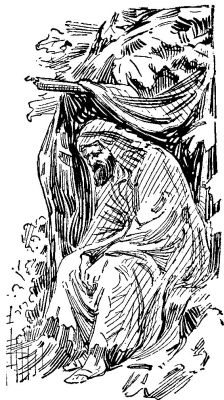
To shade Jonah from the sun
And God saw that the people of Nineveh were sorry for their
wickedness, and he forgave them, and did not destroy their
city. But this made Jonah very angry. He did not wish to have
Nineveh spared, because it was the enemy of his own land; and
also he feared that men would call him a false prophet when his
word did not come to pass. And Jonah said to the Lord:
“O Lord, I was sure that it would be thus, that thou
wouldest spare the city; and for that reason I tried to flee
away; for I know that thou wast a gracious God, full of pity, slow to
anger, and rich in mercy. Now, O Lord, take away my life,
for it is better for me to die than to live.”
And Jonah went out of the city, and built a little hut on
the east side of it, and sat under its roof, to see whether God
would keep the word that he had spoken. Then the Lord caused a
plant with thick leaves to grow up, and to shade Jonah from the
sun; and Jonah was glad, and sat under its shadow. But a worm
destroyed the plant; and the next day a hot wind blew, and
Jonah suffered from the heat; and again Jonah wished that he
might die. And the Lord said to Jonah:
“You were sorry to see the plant die, though you did not
make it grow, and though it came up in a night and died in a
night. And should not I have pity on Nineveh, that great city,
where are more than a hundred thousand little children, and
also many cattle,—all helpless and knowing nothing?”
And Jonah learned that men, and women, and little children,
are all precious in the sight of the Lord, even though they
know not God.
THE STORY OF THE
FIERY FURNACE
There was in the land of Judah a wicked king-named
Jehoiakim, son of the good Josiah. While Jehoiakim was ruling
over the land of Judah, Nebuchadnezzar, a great conqueror of
the nations, came from Babylon with his army of Chaldean
soldiers. He took the city of Jerusalem, and made Jehoiakim
promise to submit to him as his master. And when he went back
to his own land he took with him all the gold and silver that
he could find in the Temple; and he carried away as captives
very many of the princes and nobles, the best people in the
land of Judah.
When these Jews were brought to the land of Chaldea or
Babylon, King Nebuchadnezzar gave orders to the prince, who had
charge of his palace, to choose among these Jewish captives
some young men who were of noble rank, and beautiful in their
looks, and also quick and bright in their minds; young men who
would be able to learn readily. These young men were to be
placed under the care of wise men, who should teach them all
that they knew, and fit them to stand before the king of
Babylon, so that they might be his helpers to carry out his
orders; and the king wished them to be
wise, so that they might give him advice in ruling his
people.
Among the young men thus chosen were four Jews, men who had
been brought from Judah. By order of the king the names of
these men were changed. One of them, named Daniel, was to be
called Belteshazzer; the other three young men were called
Shadrach, Meshach and Abed-nego. They were taught in all the
knowledge of the Chaldeans; and after three years of training
they were taken into the king’s palace.
King Nebuchadnezzar was pleased with them, more than with
any others who stood before him. He found them wise and
faithful in the work given to them, and able to rule over men
under them. And these four men came to the highest places in
the kingdom of the Chaldeans.
At one time King Nebuchadnezzar caused a great image to be
made, and to be covered with gold. This image he set up, as an
idol to be worshipped, on the plain of Dura, near the city of
Babylon. When it was finished, it stood upon its base or
foundation almost a hundred feet high; so that upon the plain
it could be seen far away. Then the king sent out a command for
all the princes, and rulers, and nobles in the land, to come to
a great gathering, when the image was to be set apart for
worship.
The great men of the kingdom came from far
and near and stood around the image. Among them, by command
of the king, were Daniel’s three friends, the young Jews,
Shadrach, Meshach, and Abed-nego. For some reason, Daniel
himself was not there. He may have been busy with the work
of the kingdom in some other place.
At one moment in the service before the image, all the
trumpets sounded, the drums were beaten, and music was made
upon musical instruments of all kinds, as a signal for all the
people to kneel down and worship the great golden image. But
while the people were kneeling, there were three men who stood
up, and would not bow down. These were the three young Jews,
Shadrach, Meshach, and Abed-nego. They knelt down before the
Lord God only.
Many of the nobles had been jealous of these young men,
because they had been lifted to high places in the rule of the
kingdom; and these men who hated Daniel and his friends, were
glad to find that these three men had not obeyed the command of
King Nebuchadnezzar. The king had said that if any one did not
worship the golden image he should be thrown into a furnace of
fire. These men who hated the Jews came to the king and
said:
“O king, may you live for ever! You gave orders that when the music sounded, every
one should bow down and worship the golden image; and that
if any man did not worship, he should be thrown into a
furnace of fire. There are some Jews, whom you have made
rulers in the land, who have not done as you commanded.
Their names are Shadrach, Meshach and Abed-nego. They do not
serve your gods, nor worship the golden image that you have
set up.”
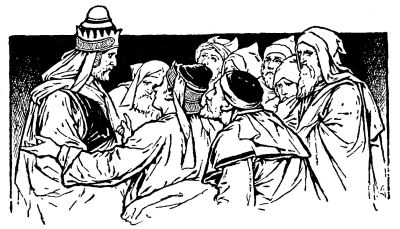
Nebuchadnezzar was fitted with rage
Then Nebuchadnezzar was filled with rage and fury at knowing
that any one should dare to disobey his words. He sent for
these three men and said to them:
“O Shadrach, Meshach, and Abed-nego, was it by purpose that
you did not fall down and worship the image of gold? The music shall
sound once more, and if you then will worship the image, it
will be well. But if you will not, then you shall be thrown
into the furnace of fire, to die.”
These three young men were not afraid of the king. They
said:
“O King Nebuchadnezzar, we are ready to answer you at once.
The God whom we serve is able to save us from the fiery
furnace, and we know that he will save us. But if it is God’s
will that we should die, even then you may understand, O king,
that we will not serve your gods, nor worship the golden
image.”
This answer made the king more furious than before. He said
to his servants:
“Make a fire in the furnace hotter than ever it has been
before, as hot as fire can be made; and throw these three men
into it.”
Then the soldiers of the king’s army seized the three young
Jews, as they stood in their loose robes, with their turbans on
their heads. They tied them with ropes, and dragged them to the
mouth of the furnace, and threw them into the fire. The flames
rushed from the opened door with such fury that they burned
even to death the soldiers who were holding these men; and the
men themselves fell down bound into the middle of the fiery
furnace.
But an angel befriended them and they were
unhurt.
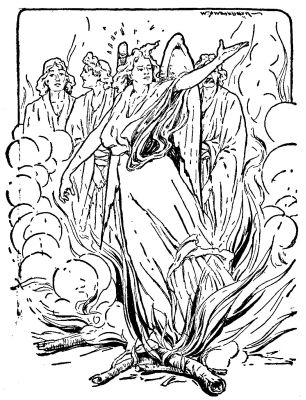
An angel befriended them
King Nebuchadnezzar stood in front of the furnace, and
looked into the open door. As he looked, he was filled with
wonder at what he saw; and he said to the nobles around
him:
“Did we not throw three men bound into the
fire? How is it then that I see four men
loose walking in the furnace; and the fourth man looks as
though he were a son of the gods?”
And the nobles who stood by could scarcely speak, so great
was their surprise.
“It is true, O king,” at last they said to Nebuchadnezzar,
“that we cast these men into the flames, expecting them to be
burned up; and we cannot understand how it happens that they
have not been destroyed.”
The king came near to the door of the furnace, as the fire
became lower; and he called out to the three men within it:
“Shadrach, Meshach, and Abed-nego, ye who serve the Most
High God, come out of the fire, and come to me.”
They came out and stood before the king, in the sight of all
the princes, and nobles, and rulers; and every one could see
that they were alive.
Their garments had not been scorched, nor their hair singed,
nor was there even the smell of fire upon them.
Then King Nebuchadnezzar said before all his rulers:
“Blessed be the God of Shadrach, Meshach, and Abed-nego, who
has sent his angel, and has saved the lives of these men who
trusted in him. I make a law that no man in all my
kingdoms shall say a word against their God, for
there is no other god who can save in this manner those who
worship him. And if any man speaks a word against their God,
the Most High God, that man shall be cut in pieces, and his
house shall be torn down.”
After King Nebuchadnezzar died, his kingdom became weak, and
the city of Babylon was taken by the Medes and Persians, under
Cyrus, a great warrior.
THE STORY OF
DANIEL IN THE LIONS’ DEN
The lands which had been the Babylonian or Chaldean empire,
now became the empire of Persia; and over these Darius was the
king. King Darius gave to Daniel, who was now a very old man, a
high place in honor and in power. Among all the rulers over the
land, Daniel stood first, for the king saw that he was wise and
able to rule. This made the other princes and rulers very
jealous, and they tried to find something evil in Daniel, so
that they could speak to the king against him.
These men saw that three times every day Daniel went to his
room and opened the window that was toward the city of
Jerusalem, and looking toward Jerusalem, made his prayer to
God. Jerusalem was at that time in ruins, and the Temple was no
longer standing; but Daniel prayed three times each day with
his face toward the place where the house of God had once
stood, although it was many hundreds of miles away.
These nobles thought that in Daniel’s prayers they could
find a chance to do him harm, and perhaps cause him to be put
to death. They came to King Darius, and said to him:
“All the rulers have agreed together to
have a law made that for thirty days no one shall ask
anything of any god or of any man, except from you, O king;
and that if any one shall pray to any god, or shall ask
anything from any man during the thirty days, except from
you, O king, he shall be thrown into the den where the lions
are kept. Now, O king, make the law, and sign the writing,
so that it cannot be changed, for no law among the Medes and
the Persians can be altered.”
The king was not a wise man; and being foolish and vain, he
was pleased with this law which would set him even above the
gods. So without asking Daniel’s advice, he signed the writing;
and the law was made, and the word was sent out through the
kingdom, that for thirty days no one should pray to any
god.
Daniel knew that the law had been made, but every day he
went to his room three times, and opened the window that looked
toward Jerusalem, and offered his prayers to the Lord, just as
he had prayed in other times. These rulers were watching near
by, and they saw Daniel kneeling in prayer to God. Then they
came to the king, and said:
“O King Darius, have you not made a law, that if any one in
thirty days offers a prayer, he shall be thrown into the den of
lions?”
“It is true,” said the king. “The law has
been made, and it must stand.”
They said to the king: “There is one man who does not obey
the law which you have made. It is that Daniel, one of the
captive Jews. Every day Daniel prays to his God three times,
just as he did before you signed the writing of the law.”
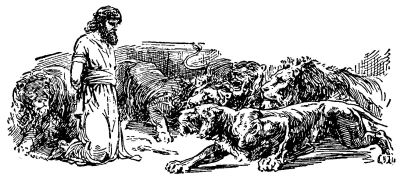
Thrown into the den of lions
Then the king was very sorry for what he had done, for he
loved Daniel, and knew that no one could take his place in the
kingdom. All day, until the sun went down, he tried in vain to
find some way to save Daniel’s life; but when evening came,
these men again told him of the law that he had made, and said
to him that it must be kept. Very unwillingly the king sent for
Daniel, and gave an order that he should be thrown into the den
of lions. He said to Daniel: “Perhaps your God, whom you serve so
faithfully, will save you from the lions.”
They led Daniel to the mouth of the pit where the lions were
kept, and they threw him in; and over the mouth they placed a
stone; and the king sealed it with his own seal, and with the
seals of his nobles; so that no one might take away the stone
and let Daniel out of the den.
Then the king went again to his palace; but that night he
was so sad that he could not eat, nor did he listen to music as
he was used to listen. He could not sleep, for all through the
night he was thinking of Daniel. Very early in the morning he
rose up from his bed and went in haste to the den of lions. He
broke the seal and took away the stone, and in a voice full of
sorrow he called out, scarcely hoping to have an answer:
“O Daniel, servant of the living God, has your God been able
to save you from the lions?”
And out of the darkness in the den came the voice of Daniel,
saying:
“O king, may you live forever! My God has sent his angel and
has shut the mouths of the lions. They have not hurt me,
because my God saw that I had done no wrong. And I have done no
wrong toward you, O king!”
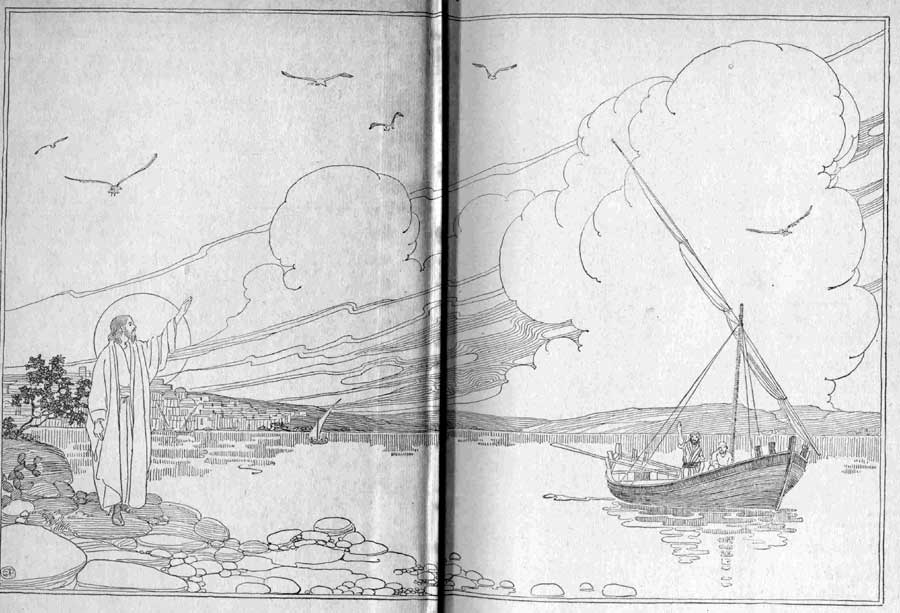
DANIEL’S ANSWER TO THE KING—Then said
Daniel unto the King, O King, live forever. My God hath
sent his angel, and hath shut the lions’ mouths, that they
have not hurt me.—(Daniel 6: 21-22.)
Then the king was glad. He gave to his servants orders to
take Daniel out of the den. Daniel was brought out safe and without harm,
because he had trusted fully in the Lord God. Then by the
king’s command, they brought those men who had spoken
against Daniel, and with them their wives and their
children, for the king was exceedingly angry with them. They
were all thrown into the den, and the hungry lions leaped
upon them, and tore them in pieces, so soon as they fell
upon the floor of the den.
After this king Darius wrote to all the lands and the
peoples in the many kingdoms under his rule:
“May peace be given to you all abundantly! I make a law that
everywhere among my kingdoms men fear and worship the Lord God
of Daniel; for he is the living God, above all other gods, who
only can save men.”
And Daniel stood beside king Darius until the end of his
reign, and afterward while Cyrus the Persian was king over all
the lands.
THE STORY OF
THE ANGEL BY THE ALTAR
At the time when the story of the New Testament begins, the
land of Israel, called also the land of Judea, was ruled by a
king named Herod. He was the first of several Herods, who at
different times ruled either the whole of the land, or parts of
it. But Herod was not the highest ruler. Many years before this
time, the Romans, who came from the city of Rome in Italy, had
won all the lands around the Great Sea, the sea which we call
the Mediterranean; and above king Herod of Judea was the great
king of Rome, ruling over all the lands, and over the land of
Judea among them. So Herod, though king of Judea, obeyed his
overlord, the emperor at Rome. At the time when this story
begins, the emperor at Rome was named Augustus C�sar.
At this time, the land where the Jews lived was full of
people. Jerusalem was its largest city, and in Jerusalem was
standing the Temple of the Lord, which king Herod had lately
built anew, taking the place of the old Temple built very many
years before, which had long needed repair. There were also
many other large cities besides Jerusalem. In the
south was Hebron among the mountains; on the shore of the
Great Sea were Gaza, and Joppa, and C�sarea; in the middle
of the land were Shechem and Samaria; and in the north were
Nazareth, and Cana; down by the shore of the Sea of Galilee
were Tiberias, and Capernaum, and Bethsaida. Far up in the
north, at the foot of snowy Mount Hermon, was another
C�sarea; but so that it might not be confused with C�sarea
upon the seacoast this city was called C�sarea-Philippi, or
“Philip’s C�sarea,” from the name of one of Herod’s
sons.
One day, an old priest named Zacharias was leading the
service of worship in the Temple. He was standing in front of
the golden altar of incense, in the Holy Place, and was holding
in his hand a censer, or cup, full of burning coals and
incense; while all the people were worshipping in the court of
the Temple, outside the court of the Priests, where the great
altar of burnt-offering stood.
Suddenly, Zacharias saw an angel from the Lord, standing on
the right side of the altar of incense. He felt a great fear
when he saw this strange being with shining face; but the angel
said to him:
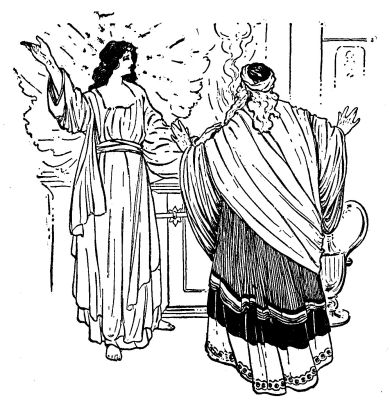
“Do not be afraid, Zacharias”
“Do not be afraid, Zacharias; for I have come from the Lord
to bring good news. Your wife Elizabeth shall have a son, and you shall
name him John. You shall be made glad, for your son John
shall bring joy and gladness to many. He shall be great in
the sight of the Lord; and he shall never taste wine nor
strong drink as long as he lives; but he shall be filled
with God’s Holy Spirit. He shall lead many of the people
of Israel to the Lord, for he shall go before the Lord in
the power of Elijah the prophet, as was promised by Malachi,
the last of the old prophets. He shall turn the hearts of
the fathers to the children, and those who are disobeying
the Lord to do his will.”
As Zacharias heard these words, he was filled with wonder,
and could hardly believe them true. He was now an old man, and
his wife Elizabeth was also old; so that they could not expect
to have a child. He said to the angel:
“How shall I know that your words are true, for I am an old
man, and my wife is old?”
“I am Gabriel, who stands in the presence of God,” said the
angel. “And I was sent from the Lord to speak to you, and to
bring you this good news. But because you did not believe my
words, you shall become dumb, and shall not be able to speak,
until this which I have said comes to pass.”
All this time the people outside in the court were wondering
why the priest stayed so long in the Temple. When at last he
came out, they found that he could not speak a word; but he
made signs to them, to tell them that he had seen a vision in
the Temple.
After the days of his service were over, Zacharias went to
his own home, which was near Hebron, a city of the priests, among the
mountains in the south of Judea. When his wife Elizabeth
found that God was soon to give her a child, she was very
happy, and praised the Lord.
About six months after Zacharias saw the vision in the
Temple, the same angel Gabriel was sent from the Lord to a city
in the part of the land called Galilee, which was in the north.
The city to which the angel was sent was Nazareth. There the
angel found a young girl named Mary, who was a cousin to
Elizabeth. Mary was soon to be married to a good man who had
sprung from the line of king David, though he was not himself a
king, nor a rich man. He was a carpenter, living in Nazareth,
and his name was Joseph. The angel came into the room where
Mary was, and said to her: “Hail, woman favored by the Lord;
the Lord is with you!”
Mary was surprised at the angel’s words, and wondered what
they could mean. Then the angel spoke again, and said: “Do not
be afraid, Mary. The Lord has given to you his favor, and has
chosen you to be the mother of a son whose name shall be Jesus,
which means ‘salvation,’ because he shall save his people from
their sins. He shall be great, and shall be called the Son of
God; and the Lord shall give to him the throne of his father
David. He shall be a king, and shall reign over the people of God
forever; and of his kingdom there shall be no end.”
But Mary could not see how all this was to come to pass. And
the angel said to her:
“The Holy Spirit shall come upon you, and the power of the
Most High God shall be over you; and the child which you shall
have shall be called holy, the Son of God.”
Then the angel told Mary that her cousin Elizabeth was soon
to have a child, through the power of the Lord. And when Mary
heard all this, she said: “I am the servant of the Lord, to do
his will. Let it be to me as you have said.”
When the angel had given his message and had gone away, Mary
rose up in haste and made a journey to the home of Zacharias
and Elizabeth. When Elizabeth saw Mary, she was filled with the
Spirit of the Lord, and said:
“Blessed are you among women, and blessed among men shall be
your son! And why is it that the mother of my Lord comes to
visit me? Blessed is the woman who believed that the promise of
the Lord to her shall be made true!”
Then Mary was filled with the Spirit of the Lord, and broke
out into a song of praise. She stayed with Elizabeth for nearly
three months, and then went again to her own home at
Nazareth.
As the angel had said, to the aged woman Elizabeth was given a son. They were
going to name him Zacharias, after his father. But his
mother said: “No, his name shall be John.”
“Why,” they said, “none of your family have ever been named
John!”
They asked his father Zacharias, by signs, what name he
wished to be given to the child. He asked for something to
write upon; and when they brought it, he wrote, “His name is
John.” Then all at once, the power to hear and to speak came
back to Zacharias. He spoke, praising and blessing God; and he
sang a song of thanks to God, in which he said:
“You O child, shall be called a prophet of the Most High; to
go before the Lord, and to make ready his ways.”
When John was growing up, they sent him out into the desert
on the south of the land, and there he stayed until the time
came for him to preach to the people; for this child became the
great prophet John the Baptist.
THE STORY
OF JESUS, THE BABE OF BETHLEHEM
Soon after the time when John the Baptist was born, Joseph
the carpenter of Nazareth had a dream. In his dream he saw an
angel from the Lord standing beside him. The angel said to
him:
“Joseph, sprung from the line of king David, I have come to
tell you, that Mary, the young woman whom you are to marry,
will have a son, sent by the Lord God. You shall call his name
Jesus, which means ‘salvation,’ because he shall save his
people from their sins.”
God’s people had had several kings. Some of them had been
selfish and cruel, but Jesus was to be a new kind of king, one
who would save, not destroy men.
Soon after Joseph and Mary were married in Nazareth, a
command went forth from the emperor Augustus C�sar through all
the lands of the Roman empire, for all the people to go to the
cities and towns from which their families had come, and there
to have their names written down upon a list, for the emperor
wished a list to be made of all the people under his rule. As
both Joseph and Mary had come from the family
of David the king, they went together from
Nazareth to Bethlehem, there to have their names written
upon the list. For you remember that Bethlehem in Judea, six
miles south of Jerusalem, was the place where David was
born, and where his father’s family had lived for many
years.
It was a long journey from Nazareth to Bethlehem; down the
mountains to the river Jordan, then following the Jordan almost
to its end, and then climbing the mountains of Judah to the
town of Bethlehem. When Joseph and Mary came to Bethlehem they
found the city full of people who, like themselves, had come to
have their names enrolled or written upon the list. The inn or
hotel was full, and there was no room for them; for no one but
themselves knew that this young woman was soon to be the mother
of the Lord of all the earth. The best that they could do was
to go to a stable where the cattle were kept. There the little
baby was born, and was laid in a manger, where the cattle were
fed.
On that night, some shepherds were tending their sheep in a
field near Bethlehem. Suddenly, a great light shone upon them,
and they saw an angel of the Lord standing before them. They
were filled with fear, as they saw how glorious the angel was.
But the angel said to them:
“Be not afraid; for behold I bring you news of
great joy, which shall be to all the
people; for there is born to you this day in Bethlehem, the
city of David, a Saviour who is Christ the Lord, the
anointed king. You may see him there; and you may know him
by this sign: He is a new-born baby, lying in a manger, at
the inn.”
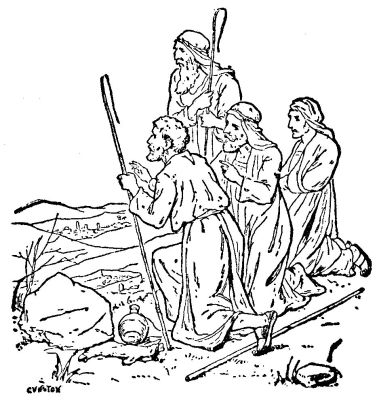
They were filled with fear
And then they saw that the air around and the sky above them
were filled with angels, praising God and singing:
“Glory to God in the highest. And on earth peace among men
in whom God is well pleased.”
While they looked with wonder, and listened,
the angels went out of sight as suddenly
as they had come. Then the shepherds said one to
another:
“Let us go at once to Bethlehem, and see this wonderful
thing that has come to pass, and which the Lord has made known
to us.”
The baby in the manger
Then as quickly as they could go to Bethlehem, they went,
and found Joseph, the carpenter of Nazareth, and his young wife Mary, and
the little baby lying in the manger. They told Mary and
Joseph, and others also, how they had seen the angels, and
what they had heard about this baby. All who heard their
story wondered at it; Mary, the mother of the child, said
nothing. She thought over all these things, and silently
kept them in her heart. After their visit, the shepherds
went back to their flocks, praising God for the good news
that he had sent to them.
When the little one was eight days old, they gave him a
name; and the name given was “Jesus,” a word which means
“salvation,” as the angel had told both Mary and Joseph that he
should be named. So the very name of this child told what he
should do for men; for he was to bring salvation to the
THE STORY OF
THE STAR AND THE WISE MEN
For some time after Jesus was born, Joseph and Mary stayed
with him in Bethlehem. The little baby was not kept long in the
stable sleeping in a manger; for after a few days they found
room in a house; and there another visit was made to Jesus by
strange men from a land far away.
In a country east of Judea, and many miles distant, were
living some very wise men who studied the stars. One night they
saw a strange star shining in the sky, and in some way they
learned that the coming of this star meant that a king was soon
to be born in the land of Judea. These men felt a call of God
to go to Judea, far to the west of their own home, and there to
see this new-born king. They took a long journey, with camels
and horses, and at last they came to, the land of Judea, just
at the time when Jesus was born at Bethlehem. As soon as they
were in Judea, they supposed that every one would know all
about the king, and they said:
“Where is he that is born king of the Jews? In the east we
have seen his star, and we have come to worship him.”
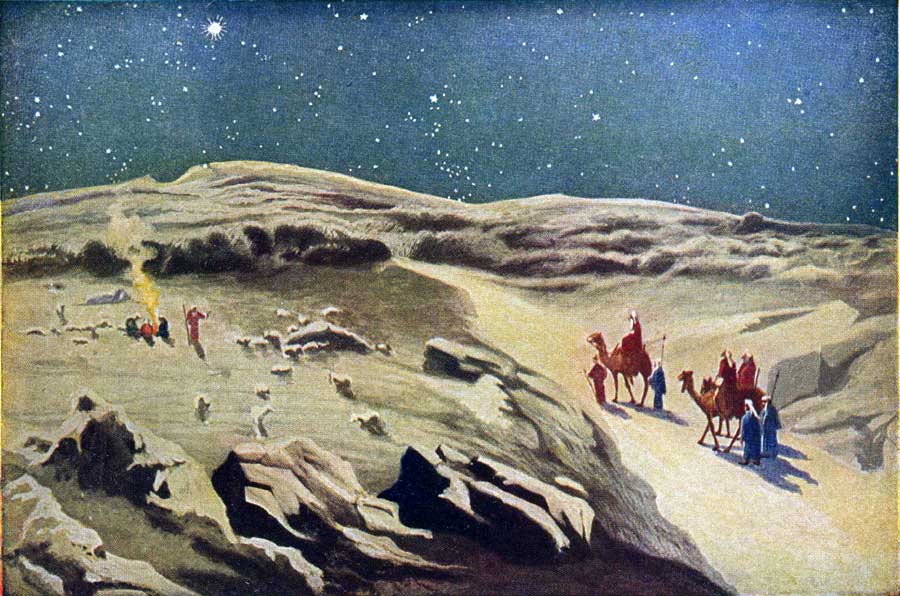
THE SHEPHERDS IN THE FIELD—And there were
in the same country shepherds abiding in the field, keeping
watch over their flock by night…. And the angel said unto
them, ‘Fear not: for, behold, I bring you good tidings of
great joy, which shall be to all people. For unto you is
born this day in the city of David a Saviour, which is
Christ the Lord.’—(Luke 2: 8-10-11.)
But no one of whom they asked had ever
seen this king, or had heard of him. The news of their
coming was sent to Herod the king, who was now a very old
man. He ruled the land of Judea, as you know, under the
emperor at Rome, Augustus C�sar. Herod was a very wicked
man, and when he heard of some one born to be a king, he
feared that he might lose his own kingdom. He made up his
mind to kill this new king.
He sent for the priests and scribes, the men who studied and
taught the books of the Old Testament, and asked them about
this Christ for whom all the people were looking. He said: “Can
you tell me where Christ, the king of Israel, is to be born?”
They looked at the books of the prophets, and then they said:
“He is to be born in Bethlehem of Judea; for thus it is written
by the prophet, ‘And thou Bethlehem in the land of Judah are
not the least among the princes of Judah; for out of thee shall
come forth one who shall rule my people Israel.'”
Then Herod sent for the wise men from the east, and met them
alone, and found from them at what time the star was first
seen. Then he said to them:
“Go to Bethlehem; and there search carefully for the little
child; and when you have found him, bring me word again, so
that I also may come and worship him.”
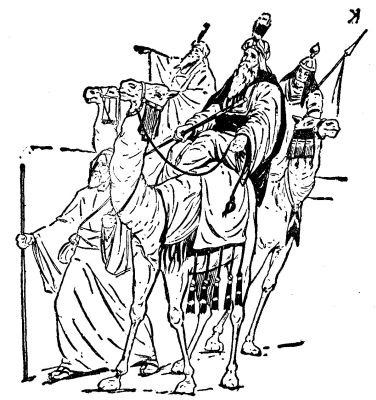
The wise men went their way
Then the wise men went on their way toward Bethlehem; and
suddenly they saw the star again shining upon the road before
them. At this they were glad, and followed the star until it
led them to the very house where the little child was. They
came in, and there they saw the little one, with Mary, its
mother. They knew at once that this was the king; and they fell
down on their faces and worshipped him as the
Lord. Then they brought out gifts of gold and precious
perfumes, frankincense and myrrh, which were used in
offering sacrifices; and they gave them as presents to the
royal child.
That night God sent a dream to the wise men, telling them
not to go back to Herod, but to go home at once to their own
land by another way. They obeyed the Lord, and found another
road to their own country without passing through Jerusalem
where Herod was living. So Herod could not learn from those men
who the child was that was born to be a king.
And very soon after these wise men had gone away, the Lord
sent another dream to Joseph, the husband of Mary. He saw an
angel, who spoke to him, saying:
“Rise up quickly; take the little child and his mother, and
go down to the land of Egypt, for Herod will try to find the
child to kill him.”
Then at once Joseph rose up in the night, without waiting
even for the morning. He took his wife and her baby, and
quietly and quickly went with them down to Egypt, which was on
the southwest of Judea. There they all stayed in safety, as
long as the wicked king Herod lived, which was not many
months.
King Herod waited for the wise men to come back to him from
their visit to Bethlehem; but he soon found that they had gone to their
home without bringing to him any word. Then Herod was very
angry. He sent out his soldiers to Bethlehem. They came, and
by the cruel king’s command they seized all the little
children in Bethlehem who were three years old, or younger,
and killed them all. What a cry went up to God from the
mothers in Bethlehem, as their children were torn from their
arms and slain!
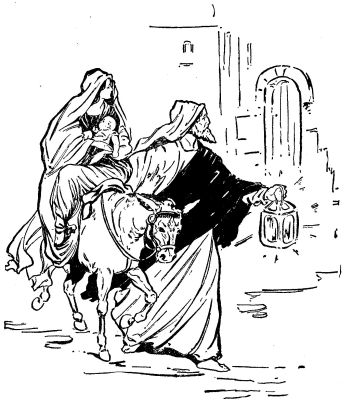
He took his wife and baby and went down to Egypt
But all this time, the child Jesus whom they were seeking
was safe with his mother in the land of Egypt.
Soon after this king Herod died, a very old man, cruel to
the last. Then the angel of the Lord came again and spoke to
Joseph in a dream, saying: “You may now take the young child
back to his own land, for the king who sought to kill him is
dead.”
Then Joseph took his wife and the little child Jesus, and
started to go again to the land of Judea. Perhaps it was his
thought to go again to Bethlehem, the city of David, and there
bring up the child. But he heard that in that part of the land
Archelaus, a son of Herod, was now ruling, and who was as
wicked and cruel as his father.
He feared to go under Archelaus’ rule, and instead took his
wife and the child to Nazareth, which had been his own home and
that of Mary his wife before the child was born. Nazareth was
in the part of the land called Galilee, which at that time was
ruled by another son of king Herod, a king named Herod Antipas.
He was not a good man, but was not so cruel nor
bloody as his wicked father had been.
So again Joseph the carpenter and Mary his wife were living
in Nazareth. And there they stayed for many years while Jesus
was growing up. Jesus was not the only child in their house,
and he had many other playmates among the boys of
THE STORY OF
THE CHILD IN THE TEMPLE
Jesus was brought to Nazareth when he was a little child not
more than three years old; there he grew up as a boy and a
young man, and there he lived until he was thirty years of age.
We should like to know many things about his boyhood, but the
Bible tells us very little. As Joseph was a working man, it is
likely that he lived in a house with only one room, with no
floor except the earth, no window except a hole in the wall, no
pictures upon the walls, and neither bedstead, nor chair, nor
looking-glass. They sat upon the floor or upon cushions; they
slept upon rolls of matting, and their meals were taken from a
low table not much larger than a stool.
Jesus may have learned to read at the village school, which
was generally held in the house used for worship, called the
“synagogue.” The lessons were from rolls on which were written
parts of the Old Testament; but Jesus never had a Bible of his
own. From a child he went with Joseph to the worship in the
synagogue twice every week. There they sat on the floor and
heard the Old Testament read and explained, while Mary and the younger sisters of
Jesus listened from a gallery behind a lattice-screen. The
Jewish boys of that time were taught to know almost the
whole of the Old Testament by heart.
It was the custom of the Jews from all parts of the land to
go up to Jerusalem to worship at least once every year, at the
feast of the Passover, which was held in the spring. Some
families also stayed to the feast of Pentecost, which was fifty
days after Passover; and some went again in the fall to the
feast of Tabernacles, when for a week all the families slept
out of doors, under roofs made of green twigs and bushes.
When Jesus was a boy twelve years old, he was taken up to
the feast of the Passover, and there for the first time he saw
the holy city Jerusalem, and the Temple of the Lord on Mount
Moriah. Young as he was, his soul was stirred, as he walked
among the courts of the Temple and saw the altar with its
smoking sacrifice, the priests in their white robes, and the
Levites with their silver trumpets. Though a boy, Jesus began
to feel that he was the Son of God, and that this was his
Father’s house.
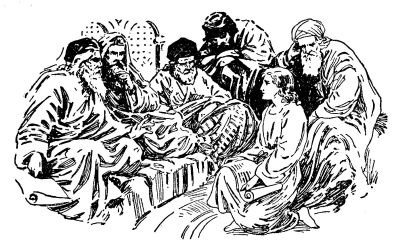
Sitting in a company of the doctors of the law
His heart was so filled with the worship of the Temple, with
the words of the scribes or teachers whom he heard in the
courts, and with his own thoughts, that when it was time to go home
to Nazareth, he stayed behind, held fast by his love for the
house of the Lord. The company of people who were traveling
together was large, and at first he was not missed. But when
night came and the boy Jesus could not be found, his mother
was alarmed. The next day Joseph and Mary left their company
and hastened back to Jerusalem. They did not at first think
to go to the Temple. They sought him among their friends and
kindred who were living in the city, but could not find
him.
On the third day, they went up to the Temple with heavy
hearts, still looking for their boy. And there they found him
sitting in a company of the doctors of the law, listening to
their words and asking them questions. Everybody who stood
near was surprised to find how deep was the knowledge of
this boy in the word of the Lord.
His mother spoke to him a little sharply, for she felt that
her son had not been thoughtful of his duty. She said: “Child,
why have you treated us in this way? Do you not know that your
father and I have been looking for you with troubled
hearts?”
“Why did you seek for me,” said Jesus. “Did you not know
that I must be in my Father’s house?”
They did not understand these words; but Mary thought often
about them afterward; for she felt her son was no common child,
and that his words had a deep meaning. Though Jesus was wise
beyond his years, he obeyed Joseph and his mother in all
things. He went with them to Nazareth, and lived contented with
the plain life of their country home.
As the years went on, Jesus grew from a boy to a young man.
He grew, too, in knowledge, and in wisdom, and in the favor of
God. He won the love of all who knew him, for there was
something in his nature that drew all hearts, both young and
old.
Jesus learned the trade of a carpenter
with Joseph; and when Joseph died, while Jesus
was still a young man, Jesus worked as a carpenter, and
helped his mother take care of the family. And so in the
carpenter shop, and the quiet life of a country village, and
the worship of the synagogue, the years passed until Jesus
THE
STORY OF THE WATER THAT WAS TURNED INTO WINE
A few days after Jesus met his followers or disciples at the
river Jordan, he came with these men to a town in Galilee
called Cana, to be present at a wedding. In those lands a feast
was always held at a wedding, and often the friends of those
who were married stayed several days, eating and drinking
together.
The mother of Jesus was at this wedding as a friend of the
family; for Nazareth, where she lived, was quite near to Cana.
Before the wedding feast was over, all the wine had been used,
and there was no more for the guests to drink. The mother of
Jesus knew that her son had power to do whatever he chose; and
she said to him; “They have no wine.”
Jesus said to her: “O woman, what have I to do with thee? My
hour is not yet come.”
But his mother knew that Jesus would in some way help the
people in their need, and she said to the servants who were
waiting at the table:
“Whatever he tells you to do, be sure to do it.”
In the dining hall were standing six large stone jars, each
about as large as a barrel, holding twenty-five gallons. These
jars held water for washing, as the Jews washed their
hands before every meal, and washed their feet as often as
they came from walking in the street, since they wore no
shoes, but only sandals. Jesus said to the servants:
“Fill the jars with water.”
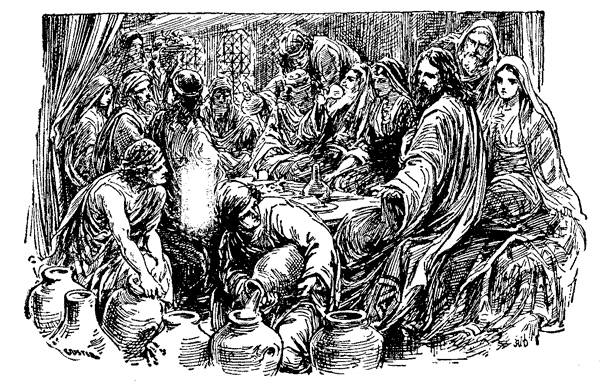
“Fill the jars with water”
The servants obeyed Jesus, and filled the jars up to the
brim. Then Jesus spoke to them again, and said:
“Now draw out some of the water, and take it to the ruler of
the feast.”
They drew out water from the jars, and saw that it had been
turned into wine. The ruler did not know from what place the
wine had come; but he said to the young man who had just
been married, the bridegroom:
“At a feast everybody gives his best wine at the beginning,
and afterward, when his guests have drunk freely, he brings on
wine that is not so good; but you have kept the good wine until
now.”
This was the first time that Jesus used the power that God
had given him, to do what no other man could do. Such works as
these were called “miracles”; and Jesus did them as signs of
his power as the Son of God. When the disciples saw this
miracle, they believed in Jesus more fully than before.
After this Jesus went with his mother and his younger
brothers to a place called Capernaum, on the shore of the Sea
of Galilee. But they stayed there only a few days, for the
feast of the Passover was near, and Jesus went up to Jerusalem
to attend it. You remember that the feast of the Passover was
held every year, to keep in mind how God had led the people of
Israel out of Egypt long before.
When Jesus came to Jerusalem, he found in the courts of the
Temple men who were selling oxen and sheep and doves for the
sacrifices, and other men sitting at tables changing the money
of Jews who came from other lands into the money of Judea. All
this made the courts around the Temple seem like a market, and
not a place for the worship of God.
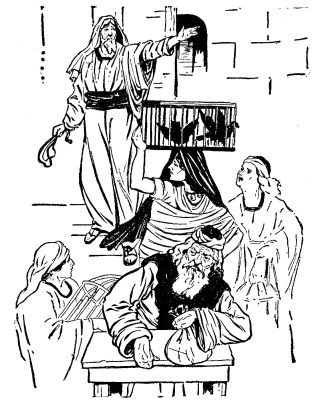
“Take these things away”
Jesus picked up some cord and made from it a little whip.
With it he began to drive out of the Temple all the buyers and
sellers. He was but one, and they were many; but such power was
in his look, that they ran before him. He drove the men and the sheep and the oxen;
he overturned the tables and threw on the floor the money,
and to those who were selling the doves he said: “Take these
things away; make not my Father’s house a house for selling
and buying!”
The acts of Jesus were not pleasing to the rulers of the
Jews, for many of them were making money by this selling of
sacrifices and changing of money. Some of the rulers came to
Jesus and said to him: “What right have you to come here and do
such things as these? What sign can you show that God has given
to you power to rule in this place?”
Jesus said to them: “I will give you a sign. Destroy this
house of God, and in three days I will raise it up.”
Then said the Jews, “It has taken forty-six years to build
this Temple, and it is not finished yet. Will you raise it up
in three days?”
But Jesus did not mean that Temple on Mount Moriah. He was
speaking of himself, for in him God was dwelling as in a
temple, and he meant that when they should put him to death, he
would rise again in three days. Afterward, when Jesus had died
and risen again, his followers, the disciples, thought of what
he had said, and understood these words.
THE STORY OF
THE STRANGER AT THE WELL
While Jesus was teaching in Jerusalem and in the country
places near it, John the Baptist was still preaching and
baptizing. But already the people were leaving John and going
to hear Jesus. Some of the followers of John the Baptist were
not pleased as they saw that fewer people came to their master,
and that the crowds were seeking Jesus. But John said to them:
“I told you that I am not the Christ, but that I am sent before
him. Jesus is the Christ, the king. He must grow greater, while
I must grow less; and I am glad that it is so.”
Soon after this, Herod Antipas, the king of the province or
land of Galilee, put John in prison. Herod had taken for his
wife a woman named Herodias, who had left her husband to live
with Herod, which was very wicked. John sent word to Herod,
that it was not right for him to have this woman as his wife.
These words of John made Herodias very angry. She hated John,
and tried to kill him. Herod himself did not hate John so
greatly, for he knew that John had spoken the truth. But he was
weak, and yielded to his wife Herodias. To please
her, he sent John the Baptist to a lonely prison among the
mountains east of the Dead Sea; for the land in that region,
as well as Galilee, was under Herod’s rule. There in prison
Herod hoped to keep John safe from the hate of his wife
Herodias.
Soon after John the Baptist was thrown into prison, Jesus
left the country near Jerusalem with his disciples, and went
toward Galilee, the province in the north. Between Judea in the
south and Galilee in the north, lay the land of Samaria, where
the Samaritans lived, who hated the Jews. They worshipped the
Lord as the Jews worshipped him, but they had their own Temple
and their own priests. And they had their own Bible, which was
only the five books of Moses; for they would not read the other
books of the old Testament. The Jews and the Samaritans would
scarcely ever speak to each other, so great was the hate
between them.
When Jews went from Galilee to Jerusalem, or from Jerusalem
to Galilee, they would not pass through Samaria, but went down
the mountains to the river Jordan, and walked beside the river,
in order to go around Samaria. But Jesus, when he would go from
Jerusalem to Galilee, walked over the mountains straight
through Samaria. One morning while he was on his journey,
he stopped to rest beside an old well at
the foot of Mount Gerizim, not far from the city of Shechem,
but nearer to a little village that was called Sychar. This
well had been dug by Jacob, the great father or ancestor of
the Israelites, many hundreds of years before. It was an old
well then in the days of Jesus; and it is much older now;
for the same well may be seen in that place still. Even now
travelers may have a drink from Jacob’s well.
It was early in the morning, about sunrise, when Jesus was
sitting by Jacob’s well. He was very tired, for he had walked a
long journey; he was hungry, and his disciples had gone to the
village near at hand to buy food. He was thirsty, too; and as
he looked into the well he could see the water a hundred feet
below, but he had no rope with which to let down a cup or a jar
to draw up some water to drink.
Just at this moment a Samaritan woman came to the well, with
her water-jar upon her head, and her rope in her hand. Jesus
looked at her, and in one glance read her soul, and saw all her
life.
He knew that Jews did not often speak to Samaritans, but he
said to her:
“Please to give me a drink?”
The woman saw from his looks and his dress that he was a
Jew, and she said to him:
“How is it that you, who are a Jew, ask
drink of me, a Samaritan woman?”
Jesus answered her:
“If you knew what God’s free gift is, and if you knew who it
is that says to you, ‘Give me a drink,’ you would ask him to
give you living water, and he would give it to you.”
There was something in the words and the looks of Jesus
which made the woman feel that he was not a common man. She
said to him: “Sir, you have nothing to draw water with, and the
well is deep. Where can you get that living water? Are you
greater than our father Jacob, who drank from this well, and
who gave it to us?”
“Whoever drinks of this water,” said Jesus, “shall thirst
again, but whoever drinks of the water that I shall give him,
shall never thirst; but the water that I shall give him shall
be in him a well of water springing up unto everlasting
life.”
“Sir,” said the woman, “give me some of this water of yours,
so that I will not thirst any more, nor come all the way to
this well.”
Jesus looked at the woman, and said to her, “Go home, and
bring your husband, and come here.”
“I have no husband,” answered the woman.
“Yes,” said Jesus, “you have spoken the
truth. You have no husband. But you have had
five husbands, and the man whom you now have is not your
husband.”
The woman was filled with wonder as she heard this. She saw
that here was a man who knew what others could not know. She
felt that God had spoken to him, and she said:
“Sir, I see that you are a prophet of God. Tell me whether
our people or the Jews are right. Our fathers have worshipped
on this mountain. The Jews say that Jerusalem is the place
where men should go to worship. Now, which of these is the
right place?”
“Woman, believe me,” said Jesus, “there is coming a time
when men shall worship God in other places besides on this
mountain and in Jerusalem. The time is near; it has even now
come, when the true worshippers everywhere shall pray to God in
spirit and in truth; for God himself is a Spirit.”
The woman said: “I know that the Anointed one is coming, the
Christ. When he comes, he will teach us all things.”
Jesus said to her:
“I that speak to you now am he, the Christ!”
Just at this time the disciples of Jesus came back from the
village. They wondered to see Jesus talking with this Samaritan
woman, but they said nothing.
The woman had come to draw water, but in
her interest in this wonderful stranger, she forgot her
errand. Leaving her water-jar, she ran back to her village,
and said to the people:
“Come, see a man who told me everything that I have done in
all my life! Is not this man the Christ whom we are looking
for?”
Soon the woman came back to the well with many of her
people. They asked Jesus to come to their town, and to stay
there and teach them. He went with them, and stayed there two
days, teaching the people, who were Samaritans. And many of the
people in that place believed in Jesus, and said:
“We have heard for ourselves; now we know that this is
indeed the Saviour of the world.”
THE STORY OF THE
FISHERMEN
When Jesus began to teach the people by the river Jordan, a
few young men came to him as followers, or disciples. Some of
these men were Andrew and John, Peter and Philip and Nathanael.
While Jesus was teaching near Jerusalem and in Samaria, these
men stayed with Jesus; but when he came to Galilee, they went
to their homes and work, for most of them were fishermen from
the Sea of Galilee.
One morning, soon after Jesus came to Capernaum, he went out
of the city, by the sea, followed by a great throng of people,
who had come together to see him and to hear him. On the shore
were lying two fishing boats, one of which belonged to Simon
and Andrew, the other to James and John and their father
Zebedee. The men themselves were not in the boats, but were
washing their nets near by.
Jesus stepped into the boat that belonged to Simon Peter and
his brother Andrew, and asked them to push it out a little into
the lake, so that he could talk to the people from it without
being crowded too closely. They pushed it out, and then Jesus
sat in the boat, and spoke to the people, as they stood upon
the beach. After he had finished speaking to the people, and had
sent them away, he said to Simon Peter:
“Put out into the deep water and let down your nets to catch
some fish.”
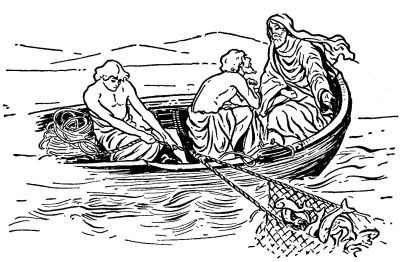
The net caught so many fishes they could not pull it
up
“Master,” said Simon, “we have been fishing all night, and
have caught nothing; but if it is your will, I will let down
the net again.”
They did as Jesus bade them; and now the net caught so many
fishes that Simon and Andrew could not pull it up, and it was
in danger of breaking. They made signs to the two brothers,
James and John, who were in the other boat, for them to come
and help them. They came, and lifted the net, and poured out
the fish. There were so many of them that both the boats
were filled, and began to sink.
When Simon Peter saw this, he was struck with wonder, and
felt that it was by the power of God. He fell down at the feet
of Jesus, saying: “Oh Lord, I am full of sin, and am not worthy
of all this! Leave me, O Lord.”
But Jesus said to Simon, and to the others, “Fear not; but
follow me, and I will make you from this time fishers of
men.”
From that time these four men, Simon and Andrew, James and
John, gave up their nets and their work, and became disciples
of Jesus.
On the Sabbath, after this, Jesus and his disciples went
together to the synagogue, and spoke to the people. They
listened to him and were surprised at his teaching; for while
the scribes always repeated what other scribes had said before,
Jesus never spoke of what the men of old time had taught, but
spoke in his own name, and by his own power, saying, “I say
unto you,” as one who had the right to speak. Men felt that
Jesus was speaking to them as the voice of God.
On one Sabbath, while Jesus was preaching, a man came into
the synagogue who had in him an evil spirit; for sometimes evil
spirits came into men, and lived in them and spoke out from
them. The evil spirit in this man cried out, saying:
“Let us alone, thou Jesus of Nazareth! What
have we to do with thee? Hast thou come to destroy us? I
know thee; and I know who thou art, the Holy one of
God!”
Then Jesus spoke to the evil spirit in the man:
“Be still; and come out of this man!”
Then the evil spirit threw the man down, and seemed as if he
would tear him apart; but he left the man lying on the ground,
without harm.
Then wonder fell upon all the people. They were filled with
fear, and said: “What mighty word is this? This man speaks even
to the evil spirits, and they obey him!”
After the meeting in the synagogue, Jesus went into the
house where Simon Peter lived. There he saw lying upon a bed
the mother of Simon’s wife, who was very ill with a burning
fever. He stood over her, and touched her hand. At once the
fever left her; she rose up from her bed and waited upon
them.
At sunset, the Sabbath day was over; and then they brought
to Jesus from all parts of the city those that were sick, and
some that had evil spirits in them. Jesus laid his hands upon
the sick, and they became well; he drove out the evil spirits
by a word, and would not allow them to speak.
THE STORY OF
THE SERMON ON THE MOUNT
Among the Jews there was one class of men hated and despised
by the people more than any other. That was “the publicans.”
These were the men who took from the people the tax which the
Roman rulers had laid upon the land. Many of these publicans
were selfish, grasping, and cruel. They robbed the people,
taking more than was right. Some of them were honest men,
dealing fairly, and taking no more for the tax than was
needful; but because so many were wicked, all the publicans
were hated alike; and they were called “sinners” by the
people.
One day, when Jesus was going out of Capernaum, to the
seaside, followed by a great crowd of people, he passed a
publican, or tax-gatherer, who was seated at his table taking
money from the people who came to pay their taxes. This man was
named Matthew, or Levi; for many Jews had two names. Jesus
could look into the hearts of men, and he saw that Matthew was
one who might help him as one of his disciples. He looked upon
Matthew, and said:
“Follow me!”
At once, the publican rose up from his
table, and left it to go with Jesus. All the people
wondered, as they saw one of the hated publicans among the
disciples, with Peter, and John, and the rest. But Jesus
believed that there is good in all kinds of people. Most of
the men who followed him were poor fishermen. None of them,
so far as we know, was rich. And when he called Matthew he
saw a man with a true and loving heart, whose rising up to
follow Jesus just as soon as he was called showed what a
brave and faithful friend he would be. The first of the four
books about Jesus bears Matthew’s name.
A little while after Jesus called him, Matthew made a great
feast for Jesus at his house; and to the feast he invited many
publicans, and others whom the Jews called sinners. The
Pharisees saw Jesus sitting among these people, and they said
with scorn to his disciples:
“Why does your Master sit at the table with publicans and
sinners?”
Jesus heard of what these men had said, and he said:
“Those that are well do not need a doctor to cure them, but
those that are sick do need one. I go to these people because
they know that they are sinners and need to be saved. I came
not to call those who think themselves to be good, but those
who wish to be made better.”
One evening Jesus went alone to a mountain
not far from Capernaum. A crowd of people and his disciples
followed him; but Jesus left them all, and went up to the
top of the mountain, where he could be alone. There he
stayed all night, praying to God, his Father and our Father.
In the morning, out of all his followers, he chose twelve
men who should walk with him and listen to his words, so
that they might be able to teach others in turn. Some of
these men he had called before; but now he called them
again, and others with them. They were called “The Twelve,”
or “the disciples”; and after Jesus went to heaven, they
were called “The Apostles,” a word which means “those who
were sent out,” because Jesus sent them out to preach the
gospel to the world.
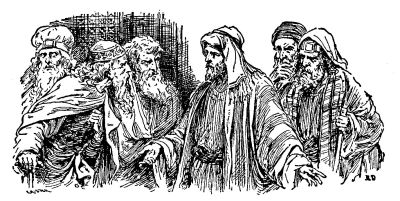
“I came not to call those who think themselves to be
good”
The names of the twelve disciples, or
apostles, were these: Simon Peter and his brother Andrew;
James and John, the two sons of Zebedee; Philip of
Bethsaida, and Nathanael, who was also called Bartholomew, a
name which means “the son of Tholmai”; Thomas, who was also
called Didymus, a name which means “a twin,” and Matthew the
publican, or tax-gatherer; another James, the son of
Alpheus, who was called “James the Less,” to keep his name
apart from the first James, the brother of John; and
Lebbeus, who was also called Thaddeus. Lebbeus was also
called Judas, but he was a different man from another Judas,
whose name is always given last. The eleventh name was
another Simon, who was called “the Cananean” or “Simon
Zelotes”; and the last name was Judas Iscariot, who was
afterward the traitor. We know very little about most of
these men, but some of them in later days did a great work.
Simon Peter was a leader among them, but most of them were
common sort of men of whom the best we know is that they
loved Jesus and followed him to the end. Some died for him,
and some served him in distant and dangerous places.
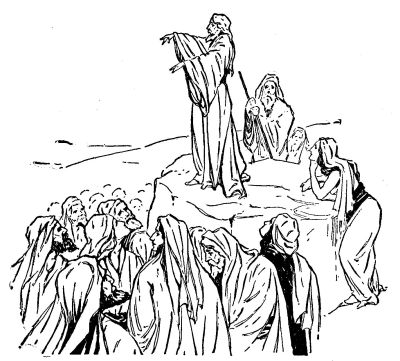
Then, on the mountain, he preached
Before all the people who had come to hear him, Jesus called
these twelve men to stand by his side. Then, on the mountain,
he preached to these disciples and to the great company of
people. The disciples stood beside him,
and the great crowd of people stood in front, while Jesus
spoke. What he said on that day is called “The Sermon on the
Mount.” Matthew wrote it down, and you can read it in his
gospel, in the fifth, sixth, and seventh chapters. Jesus
began with these words to his disciples:
“Blessed are the poor in spirit: for theirs is the kingdom
of heaven.
“Blessed are they that mourn: for they
shall be comforted.
“Blessed are the meek: for they shall inherit the earth.
“Blessed are they which do hunger and thirst after
righteousness: for they shall be filled.
“Blessed are the merciful: for they shall obtain mercy.
“Blessed are the pure in heart: for they shall see God.
“Blessed are the peacemakers: for they shall be called the
children of God.
“Blessed are they which are persecuted for righteousness’
sake: for theirs is the kingdom of heaven.
“Blessed are ye when men shall revile you, and persecute
you, and shall say all manner of evil against you falsely, for
my sake.
“Rejoice, and be exceedingly glad: for great is your reward
in heaven: for so persecuted they the prophets which were
before you.
“Ye are the salt of the earth: but if the salt have lost his
savor, wherewith shall it be salted? it is thenceforth good for
nothing, but to be cast out, and to be trodden under foot of
men.
“Ye are the light of the world. A city that is set on an
hill cannot be hid. Neither do men light a candle, and put it
under a bushel, but on a candlestick; and it giveth light unto
all that are in the house. Let your light so shine
before men, that they may see your good works, and glorify
your Father which is in heaven.”
It was in this Sermon on the Mount that Jesus told the
people how they should pray, and he gave them the prayer which
we all know as the Lord’s Prayer.
And this was the end of the Sermon:
“Therefore, whosoever heareth these sayings of mine, and
doeth them, I will liken him unto a wise man, which built his
house upon a rock:
“And the rain descended, and the floods came, and the winds
blew, and beat upon that house; and it fell not; for it was
founded upon a rock.
“And every one that heareth these sayings of mine, and doeth
them not, shall be likened unto a foolish man, which built his
house upon the sand:
“And the rain descended, and the floods came, and the winds
blew, and beat upon that house; and it fell: and great was the
THE STORY OF THE
MIRACLE WORKER
There was at Capernaum an officer of the Roman army, a man
who had under him a company of a hundred men. They called him
“a centurion,” a word which means “commanding a hundred”; but
we should call him “a captain.” This man was not a Jew, but was
what the Jews called “a Gentile,” “a foreigner”; a name which
the Jews gave to all people outside their own race. All the
world except the Jews themselves were Gentiles.
This Roman centurion was a good man, and he loved the Jews,
because through them he had heard of God, and had learned how
to worship God. Out of his love for the Jews, he had built for
them with his own money a synagogue, which may have been the
very synagogue in which Jesus taught on the Sabbath days.
The centurion had a young servant, a boy whom he loved
greatly; and this boy was very sick with a palsy, and near to
death. The centurion had heard that Jesus could cure those who
were sick; and he asked the chief men of the synagogue, who
were called its “elders,” to go to Jesus and ask him to come
and cure his young servant.
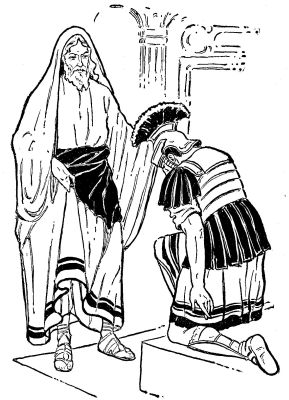
“Speak the word and my servant shall be cured”
The elders spoke to Jesus, just as he came again to
Capernaum, after the Sermon on the Mount. They asked Jesus to
go with them to the centurion’s house; and they said:
“He is a worthy man, and it is fitting that
you should help him, for, though a Gentile, he loves our
people, and he has built for us our synagogue.”
Then Jesus said, “I will go and heal him.”
But while he was on his way—and with him were the
elders, and his disciples, and a great crowd of people, who
hoped to see the work of healing—the centurion sent some
other friends to Jesus with this message:
“Lord, do not take the trouble to come to my house; for I am
not worthy that one so high as you are should come under my
roof; and I did not think that I was worthy to go and speak to
you. But speak only a word where you are, and my servant shall
be made well. For I also am a man under rule, and I have
soldiers under me; and I say to one ‘Go,’ and he goes; and to
another, ‘Come,’ and he comes; and to my servant, ‘Do this,’
and he does it. You, too, have power to speak and to be obeyed.
Speak the word, and my servant shall be cured.”
When Jesus heard this, he wondered at this man’s faith. He
turned to the people following him, and said:
“In truth I say to you, I have not found such faith as this
in all Israel!”
Then he spoke to the friends of the centurion who had
brought the word from him:
“Go and say to this man, ‘As you have
believed in me, so shall it be done to you.'”
Then those who had been sent, went again to the centurion’s
house, and found that in that very hour his servant had been
made perfectly well.
On the day after this, Jesus with his disciples and many
people went out from Capernaum, and turned southward, and came
to a village called Nain. Just as Jesus and his disciples came
near to the gate of the city, they were met by a company who
were carrying out a dead man to be buried. He was a young man,
and the only son of his mother, and she was a widow.
When the Lord Jesus saw the mother in her grief, he pitied
her, and said, “Do not weep.”
He drew near, and touched the frame on which they were
carrying the body, wrapped round and round with long strips of
linen. The bearers looked with wonder on this stranger, and set
down the frame with its body, and stood still. Standing beside
the body, Jesus said:
“Young man, I say to you, Rise up!”
And in a moment the young man sat up and began to speak.
Jesus gave him to his mother, who now saw that her son who had
been dead, was alive again.
And Jesus went through all that part of Galilee, working
miracles and preaching and teaching in all the villages, telling the people
everywhere the good news of the kingdom of God.
The children loved to gather around him, and when his
disciples would have driven them away he said, “Suffer the
little children to come unto me and forbid them not, for of
such is the kingdom of heaven.”
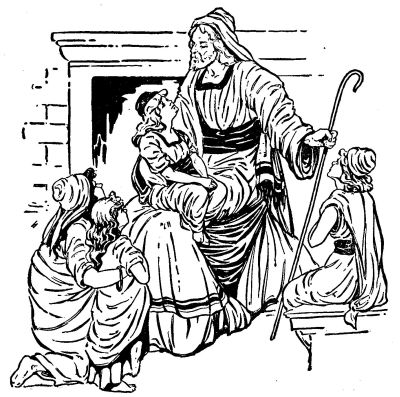
The children loved to gather around him
One Sabbath day, as Jesus and his
disciples were walking in Jerusalem, they met a blind man
begging. This man in all his life had never seen; for he had
been born blind. The disciples said to Jesus as they were
passing him: “Master, whose fault was it that this man was
born blind? Was it because he has sinned, or did his parents
sin?”
For the Jews thought that when any evil came, it was caused
by some one’s sin. But Jesus said:
“This man was born blind, not because of his parents’ sin,
nor because of his own, but so that God might show his power in
him. We must do God’s work while it is day, for the night is
coming when no man can work. As long as I am in the world, I am
the light of the world.”
When Jesus had said this, he spat on the ground, and mixed
up the spittle with earth, making a little lump of clay. This
clay Jesus spread on the eyes of the blind man; and then he
said to him: “Go wash in the pool of Siloam.”
The pool of Siloam was a large cistern, or, reservoir, on
the southeast of Jerusalem, outside the wall, where the valley
of Gihon and the valley of Kedron come together. To go to this
pool, the blind man, with two great blotches of mud on his
face, must walk through the streets of the city, out of the
gate, and into the valley. He went, and felt his way down the
steps into the pool of Siloam. There he washed, and then
at once his life-long blindness passed away, and he could
see.
When the man came back to the part of the city where he
lived, his neighbors could scarcely believe that he was the
same man. They said: “Is not this the man who used to sit on
the street begging?”
“This must be the same man,” said some; but others said:
“No, it is some one who looks like him.”
But the man said, “I am the very same man who was
blind!”
“Why, how did this come to pass?” they asked. “How were your
eyes opened?”
“The man, named Jesus,” he answered, “mixed clay, and put it
on my eyes, and said to me, ‘Go to the pool of Siloam and
wash,’ and I went and washed, and then I could see.”
“Where is this man?” they asked him.
“I do not know,” said the man.
Some of the Pharisees, the men who made a show of always
obeying the law, asked the man how he had been made to see. He
said to them, as he had said before:
“A man put clay on my eyes, and I washed, and my sight came
to me.”
Some of the Pharisees said:
“The man who did this is not a man of God,
because he does not keep the Sabbath. He
makes clay, and puts it on men’s eyes, working on the
Sabbath day. He is a sinner!”
Others said, “How can a man who is a sinner do such
wonderful works?”
And thus the people were divided in what they thought of
Jesus. They asked the man who had been blind: “What do you
think of this man who has opened your eyes?”
“He is a prophet of God,” said the man.
But the leading Jews would not believe that this man had
gained his sight, until they had sent for his father and his
mother. The Jews asked them:
“Is this your son, who you say was born blind? How is it
that he can now see?”
His parents were afraid to tell all they knew; for the Jews
had agreed that if any man should say Jesus was the Christ, the
Saviour, he should be turned out of the synagogue, and not be
allowed to worship any more with the people. So his parents
said to the Jews:
“We know that this is our son, and we know that he was born
blind. But how he was made to see, we do not know; or who has
opened his eyes, we do not know. He is of age; ask him, and let
him speak for himself.”
Then again the rulers of the Jews called the man who had
been blind; and they said to him:
“Give God the praise for your sight. We
know that this man who made clay on the Sabbath day is a
sinner.”
“Whether that man is a sinner, or not, I do not know,”
answered the man; “but one thing I do know, that once I was
blind, and now I see. We know that God does not hear sinners;
but God hears only those who worship him, and do his will.
Never before has any one opened the eyes of a man born blind.
If this man were not from God, he could not do such works as
these!”
The rulers of the Jews, these Pharisees, then said to the
man: “You were born in sin, and do you try to teach us?”
And they turned him out of the synagogue, and would not let
any one worship with him. Jesus heard of this; and when Jesus
found him, he said to him:
“Do you believe on the Son of God?”
The man said:
“And who is he, Lord, that I may believe on him?”
“You have seen him,” said Jesus, “and it is he who now talks
with you!”
The man said, “Lord, I believe.”
And he fell down before Jesus, and worshipped
THE GOOD
SHEPHERD AND THE GOOD SAMARITAN
Soon afterward Jesus gave to the people in Jerusalem the
parable or story of “The Good Shepherd.”
“Verily, verily (that is, ‘in truth, in truth’), I say to
you, if any one does not go into the sheepfold by the door, but
climbs up some other way, it is a sign that he is a thief and a
robber. But the one who comes in by the door is a shepherd of
the sheep. The porter opens the door to him, and the sheep know
him, and listen to his call, for he calls his own sheep by name
and leads them out to the pasture-field. And when he has led
out his sheep, he goes in front of them, and the sheep follow
him, for they know his voice. The sheep will not follow a
stranger, for they do not know the stranger’s voice.”
The people did not understand what all this meant, and as
Jesus explained it to them, he said: “Verily, verily, I say
unto you, I am the door that leads to the sheepfold. If any man
comes to the sheep in any other way than through me and in my
name, he is a thief and a robber; but those who are the true
sheep will not hear such. I am the door; if any man goes
into the fold through me, he shall be
saved, and shall go in and go out, and shall find
pasture.
“The thief comes to the fold that he may steal and rob the
sheep, and kill them; but I came to the fold that they may have
life, and may have all that they need. I am the good shepherd;
the good shepherd will give up his own life to save his sheep;
and I will give up my life that my sheep may be saved.
“I am the good shepherd; and just as a true shepherd knows
all the sheep in his fold, so I know my own, and my own know
me, even as I know the Father, and the Father knows me; and I
lay down my life for the sheep. And other sheep I have, which
are not of this fold; them also I must lead; and they shall
hear my voice; and there shall be one flock and one
shepherd.”
The Jews could not understand these words of Jesus; but they
became very angry with him, because he spoke of God as his
Father. They took up stones to throw them at him, and tried to
seize him, intending to kill him. But Jesus escaped from their
hands, and went away to the land beyond Jordan, at the place
called “Bethabara,” or “Bethany beyond Jordan,” the same place
where he had been baptized by John the Baptist more than two
years before. From this place Jesus wished to go out through
the land in the east of the Jordan, a land which is
called “Perea,” a word that means
“beyond.” But before going out through this land, Jesus sent
out seventy chosen men from among his followers to go to all
the villages, and to make the people ready for his own
coming afterward. He gave to these seventy the same commands
that he had given to the twelve disciples when he sent them
through Galilee, and sent them out in pairs, two men to
travel and to preach together. He said:
“I send you forth as lambs among wolves. Carry no purse, no
bag for food, no shoes except those that you are wearing. Do
not stop to talk with people by the way; but go through the
towns and villages, healing the sick, and preaching to the
people, ‘The kingdom of God is coming,’ He that hears you,
hears me; and he that refuses you, refuses me; and he that will
not hear me, will not hear him that sent me.”
And after a time the seventy men came again to Jesus,
saying:
“Lord, even the evil spirits obey our words in thy
name!”
And Jesus said to them:
“I saw Satan, the king of the evil spirits, falling down
like lightning from heaven. I have given you power to tread
upon serpents and scorpions, and nothing shall harm you. Still,
do not rejoice because the evil spirits obey you;
but rejoice that your names are written in
heaven.”
And at that time, one of the scribes—men who wrote
copies of the books of the Old Testament, and studied them, and
taught them—came to Jesus and asked him a question, to
see what answer he would give. He said: “Master, what shall I
do to have everlasting life?”
Jesus said to the scribe: “What is written in the law? You
are a reader of God’s law; tell me what it says.”
Then the man gave this answer:
“Thou shalt love the Lord thy God with all thy heart, and
with all thy soul, and with all thy strength, and with all thy
mind; and thou shalt love thy neighbor as thyself.”
Jesus said to the man: “You have answered right; do this,
and you shall have everlasting life.”
But the man was not satisfied. He asked another question:
“And who is my neighbor?”
To answer this question, Jesus gave the parable or story of
“The Good Samaritan.” He said: “A certain man was going down
the lonely road from Jerusalem to Jericho; and he fell among
robbers, who stripped him of all that he had and beat him; and
then went away, leaving him almost dead. It happened that a
certain priest was going down that road; and when he saw
the man lying there, he passed by on the
other side. And a Levite, also, when he came to the place,
and saw the man, he too went by on the other side. But a
certain Samaritan, as he was going down, came where this man
was; and as soon as he saw him, he felt a pity for him. He
came to the man, and dressed his wounds, pouring oil and
wine into them. Then he lifted him up, and set him on his
own beast of burden, and walked beside him to an inn. There
he took care of him all night; and the next morning he took
out from his purse two shillings, and gave them to the
keeper of the inn, and said: ‘Take care of him; and if you
need to spend more than this, do so; and when I come again I
will pay it to you.'”
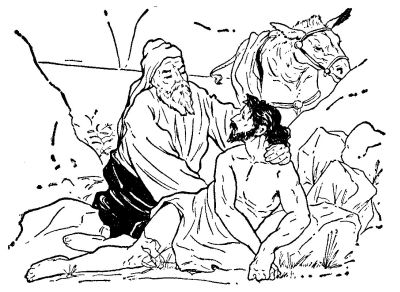
Then he lifted him up
“Which one of these three, do you think,
showed himself a neighbor to the man who fell among the
robbers?”
The scribe said: “The one who showed mercy on him.”
Then Jesus said to him: “Go and do thou likewise.”
By this parable, Jesus showed that “our neighbor” is the one
who needs the help that we can give him, whoever he may
THE STORY OF THE
PALM BRANCHES
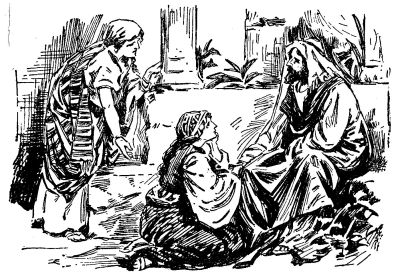
Came to Bethany where his friends Martha and Mary
lived
From Jericho, Jesus and his disciples went up the mountains,
and came to Bethany, where his friends Martha and Mary lived,
and where he had raised Lazarus to life. Many people in
Jerusalem heard that Jesus was there, and they went out of the
city to see him, for Bethany was only two miles from Jerusalem.
Some came also to see Lazarus, whom Jesus had raised from the
dead; but the rulers of the Jews said to each other:
“We must not only kill Jesus, but Lazarus,
also; because on his account so many of the people are going
after Jesus and are believing on him.”
The friends of Jesus in Bethany made a supper for Jesus, at
the house of a man named Simon. He was called “Simon the
leper”; and perhaps he was one whom Jesus had cured of leprosy.
Jesus and his disciples, with Lazarus, leaned upon the couches
around the table, as the guests; and Martha was one of those
who waited upon them. While they were at the supper, Mary, the
sister of Lazarus, came into the room, carrying a sealed jar of
very precious perfume. She opened the jar, and poured some of
the perfume upon the head of Jesus, and some upon his feet; and
she wiped his feet with her long hair. And the whole house was
filled with the fragrance of the perfume.
But one of the disciples of Jesus, Judas Iscariot, was not
pleased at this. He said: “Why was such a waste of the perfume
made? This might have been sold for more than forty-five
dollars, and the money given to the poor!”
This he said, but not because he cared for the poor. Judas
was the one who kept the bag of money for Jesus and the twelve;
and he was a thief, and took away for his own use all the money
that he could steal. But Jesus said:
“Let her alone; why do you find fault with
the woman? She has done a good work upon me. You have the
poor always with you, and whenever you wish, you can give to
them. But you will have me with you only a little while. She
has done what she could; for she has come to perfume my body
for its burial. And truly I say to you, that wherever the
gospel shall be preached throughout all the world, what this
woman has done shall be told in memory of her.”
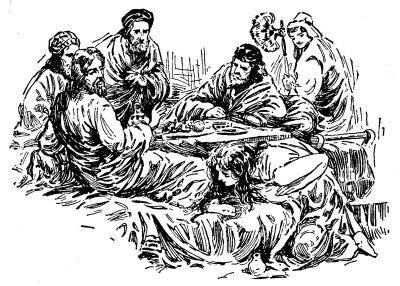
She wiped his feet with her hair
Perhaps Mary knew what others did not believe, that Jesus
was soon to die; and she showed her love for him, and her sorrow for his
coming death, by this rich gift. But Judas, the disciple who
carried the bag, was very angry at Jesus; and from that time
he was looking for a chance to betray Jesus, or to give him
up to his enemies. He went to the chief priests, and said:
“What will you give me, if I will put Jesus in your
hands?”
They said, “We will give you thirty pieces of silver.”
And for thirty pieces of silver Judas promised to help them
take Jesus, and make him their prisoner.
On the morning after the supper at Bethany, Jesus called two
of his disciples, and said to them:
“Go into the next village, and at a place where two roads
cross; and there you will find an ass tied, and a colt with it.
Loose them, and bring them to me. And if any one says to you,
‘Why do you do this?’ say, ‘The Lord has need of them,’ and
they will let them go.”
They went to the place and found the ass and the colt, and
were loosing them, when the owner said:
“What are you doing, untying the ass?”
And they said, as Jesus had told them to say:
“The Lord has need of it.”
Then the owner gave them the ass and the colt
for the use of Jesus. They brought them to
Jesus on the Mount of Olives; and they laid some of their
own clothes on the colt for a cushion, and set Jesus upon
it. Then all the disciples and a very great multitude threw
their garments upon the ground for Jesus to ride upon.
Others cut down branches from the trees and laid them on the
ground. And as Jesus rode over the mountain toward
Jerusalem, many walked before him waving branches of palm
trees. And they all cried together:
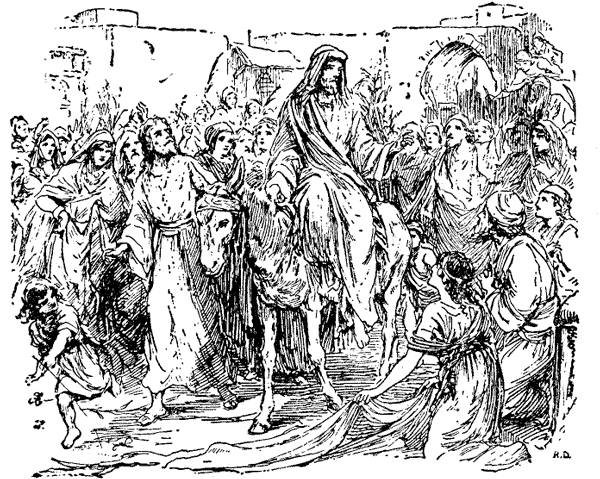
They threw their garments upon the ground for Jesus to
ride upon
“Hosanna to the son of David! Blessed is he
that cometh in the name of the Lord! Blessed be the kingdom
of our father David, that cometh in the name of the Lord!
Hosanna in the highest!”
These things they said, because they believed that Jesus was
the Christ, the Anointed King; and they hoped that he would now
set up his throne in Jerusalem. Some of the Pharisees in the
crowd, who did not believe in Jesus, said to him:
“Master, stop your disciples!”
But Jesus said:
“I tell you, that if these should be still, the very stones
would cry out!”
And when he came into Jerusalem with all this multitude, all
the city was filled with wonder. They said: “Who is this?”
And the multitude answered:
“This is Jesus, the prophet of Nazareth in Galilee!”
And Jesus went into the Temple, and looked around it; but he
did not stay, because the hour was late. He went again to
Bethany, and there stayed at night with his friends.
These things took place on Sunday, the first day of the
week; and that Sunday in the year is called Palm Sunday,
because of the palm branches which the people carried before
Jesus.
Many people heard him gladly, but the
great city was deaf to his pleadings. “O Jerusalem,
Jerusalem,” he cried, “thou that killest the prophets, how
often would I have gathered thy children together, even as a
hen gathereth her chickens under her wings, and ye would
not!”
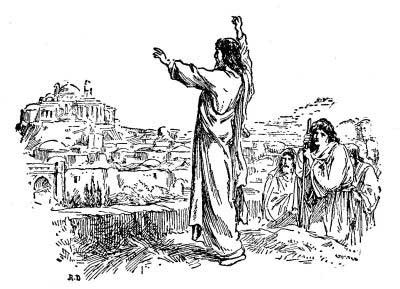
The great city was deaf to his pleadings
THE STORY OF THE
BETRAYAL
At the foot of the Mount of Olives, near the path over the
hill toward Bethany, there was an orchard of olive trees,
called “The Garden of Gethsemane.” The word “Gethsemane” means
“oil press.” Jesus often went to this place with his disciples,
because of its quiet shade. At this garden he stopped, and
outside he left eight of his disciples, saying to them, “Sit
here while I go inside and pray.”
He took with him the three chosen ones, Peter, James, and
John, and went within the orchard. Jesus knew that in a little
while Judas would be there with a band of men to seize him;
that in a few hours he would be beaten, and stripped, and led
out to die. The thought of what he was to suffer came upon him
and filled his soul with grief. He said to Peter and James and
John:
“My soul is filled with sorrow, a sorrow that almost kills
me. Stay here and watch while I am praying.”
He went a little further among the trees, and flung himself
down upon the ground, and cried out:
“O my Father, if it be possible, let this cup pass away from
me; nevertheless, not as I will, but as thou willest!”
So earnest was his feeling and so great
his suffering that there came out upon his face great drops
of sweat like blood, falling upon the ground. After praying
for a time, he rose up from the earth and went to his three
disciples, and found them all asleep. He awaked them, and
said to Peter: “What, could you not watch with me one hour?
Watch and pray that you may not go into temptation. The
spirit indeed is willing, but the flesh is weak.”
He left them, and went a second time into the woods, and
fell on his face, and prayed again, saying:
“O my Father, if this cup cannot pass away, and I must drink
it, then thy will be done.”
He came again to the three disciples, and found them
sleeping; but this time he did not awake them. He went once
more into the woods, and prayed, using the same words. And an
angel from heaven came to him and gave him strength. He was now
ready for the fate that was soon to come, and his heart was
strong. Once more he went to the three disciples, and said to
them: “You may as well sleep on now, and take your rest, for
the hour is at hand; and already the Son of man is given by the
traitor into the hands of sinners. But rise up and let us be
going. See, the traitor is here!”
The disciples awoke; they heard the noise of
a crowd, and saw the flashing of torches
and the gleaming of swords and spears. In the throng they
saw Judas standing, and they knew now that he was the
traitor of whom Jesus had spoken the night before. Judas
came rushing forward, and kissed Jesus, as though he were
glad to see him. This was a signal that he had given
beforehand to the band; for the men of the guard did not
know Jesus, and Judas had said to them:
“The one that I shall kiss is the man that you are to take;
seize him and hold him fast.”
Jesus said to Judas, “Judas, do you betray the Son of man
with a kiss?”
Then he turned to the crowd, and said, “Whom do you
seek?”
They answered, “Jesus of Nazareth.”
Jesus said, “I am he.”
When Jesus said this, a sudden fear came upon his enemies;
they drew back and fell upon the ground.
After a moment, Jesus said again, “Whom do you seek?”
And again they answered, “Jesus of Nazareth.”
And Jesus said, pointing to his disciples, “I told you that
I am he. If you are seeking me, let these disciples go their
own way.”
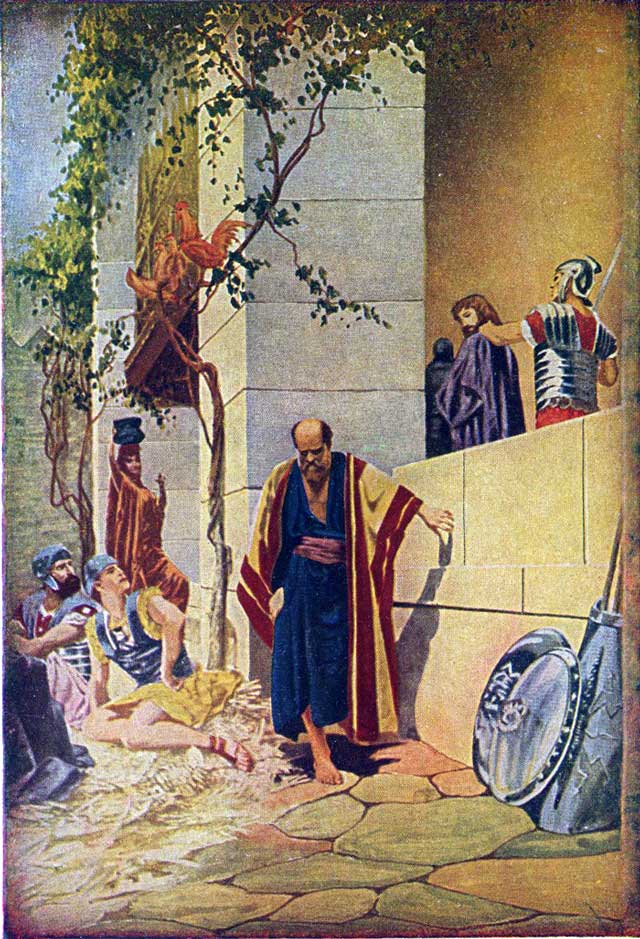
PETER DENIES CHRIST—And Peter remembered
the word of Jesus, which said unto him, ‘Before the cock
crow, thou shalt deny me thrice.—(Matt. 26:75.)
But as they came forward to seize Jesus, Peter
drew his sword, and struck at one of the
men in front, and cut off his right ear. The man was a
servant of the high-priest, and his name was Malchus. Jesus
said to Peter:
“Put up the sword into its sheath; the cup which my Father
has given me, shall I not drink it? Do you not know that I
could call upon my Father, and he would send to me armies upon
armies of angels?”
Then he spoke to the crowd, “Let me do this.” And he touched
the place where the ear had been cut off, and it came on again
and was well. Jesus said to the rulers and leaders of the armed
men:
“Do you come out against me with swords and clubs as though
I were a robber? I was with you every day in the Temple, and
you did not lift your hands against me. But the words in the
scriptures must come to pass; and this is your hour.”
When the disciples of Jesus saw that he would not allow them
to fight for him, they did not know what to do. In their sudden
alarm they all ran away, and left their Master alone with his
enemies. These men laid their hands on Jesus, and bound him,
and led him away to the house of the high-priest. There were at
that time two men called high-priests by the Jews. One was
Annas, who had been high-priest until his office had been taken from him by the
Romans, and given to Caiphas, his son-in-law. But Annas
still had great power among the people; and they brought
Jesus, all bound as he was, first to Annas.
Simon Peter, and John, the disciple whom Jesus loved, had
followed after the crowd of those who carried Jesus away; and
they came to the door of the high-priest’s house. John knew the
high-priest and went in; but Peter at first stayed outside,
until John went out and brought him in. He came in, but did not
dare to go into the room where Jesus stood before the
high-priest Annas. In the court-yard of the house, they had
made a fire of charcoal, and Peter stood among those who were
warming themselves at the fire.
Annas in the inner room asked Jesus about his disciples and
his teaching. Jesus answered him:
“What I have taught has been open in the synagogues and in
the Temple. Why do you ask me? Ask those that heard me; they
know what I said.”
Then one of the officers struck Jesus on the mouth, saying
to him:
“Is this the way that you answer the high-priest?”
Jesus answered the officer calmly and quietly:
“If I have said anything evil, tell what
the evil is; but if I have spoken the truth, why do you
strike me?”
While Annas and his men were thus showing their hate toward
Jesus, who stood bound and alone among his enemies, Peter was
still in the court-yard warming himself at the fire. A woman,
who was a serving-maid in the house, looked at Peter sharply,
and finally said to him:
“You were one of those men with this Jesus of Nazareth!”
Peter was afraid to tell the truth, and he answered her:
“Woman, I do not know the man; and I do not know what you
are talking about.”
And to get away from her, he went out into the porch of the
house. There another woman-servant saw him and said: “This man
was one of those with Jesus!”
And Peter swore with an oath that he did not know Jesus at
all. Soon a man came by, who was of kin to Malchus, whose ear
Peter had cut off. He looked at Peter, and heard him speak, and
said:
“You are surely one of this man’s disciples; for your speech
shows that you came from Galilee.”
Then Peter began again to curse and to swear, declaring that
he did not know the man.
Just at that moment the loud, shrill
crowing of a cock startled Peter; and at the same time he
saw Jesus, who was being dragged through the hall from Annas
to the council-room of Caiphas, the other high-priest. And
the Lord turned as he was passing and looked at Peter.
Then there flashed into Peter’s mind what Jesus had said on
the evening before!
“Before the cock crows to-morrow morning, you will three
times deny that you have ever known me.”
Then Peter went out of the high-priest’s house into the
street; and he wept bitterly because he had denied his
THE STORY OF THE EMPTY
TOMB
After Jesus was taken before the high-priest where he was
ridiculed and the people spat upon him, he was taken before the
Roman Governor, Pontius Pilate, who ruled over Judea. He heard
their complaints, but did not find any cause for putting him to
death. But at last he yielded to their demands, although he
declared Jesus was innocent of all wrong.
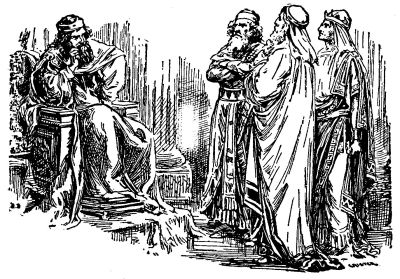
He heard their complaints
And so Pontius Pilate, the Roman governor,
gave command that Jesus should die by the
cross. The Roman soldiers then took Jesus and beat him most
cruelly; and then led him out of the city to the place of
death. This was a place called “Golgotha” in the Jewish
language, “Calvary” in that of the Romans; both words
meaning “The Skull Place.”
With the soldiers, went out of the city a great crowd of
people; some of them enemies of Jesus, glad to see him suffer;
others of them friends of Jesus, and the women who had helped
him, now weeping as they saw him, all covered with his blood
and going out to die. But Jesus turned to them and said:
“Daughters of Jerusalem, do not weep for me, but weep for
yourselves and for your children. For the days are coming when
they shall count those happy who have no little ones to be
slain; when they shall wish that the mountain might fall on
them, and the hills might cover them, and hide them from their
enemies!”
They had tried to make Jesus bear his own cross, but soon
found that he was too weak from his sufferings, and could not
carry it. They seized on a man who was coming out of the
country into the city, a man named Simon, and they made him
carry the cross to its place at Calvary.
It was the custom among the Jews to give to men about to die
by the cross some medicine to deaden their feelings, so that they would
not suffer so greatly. They offered this to Jesus, but when
he had tasted it and found what it was, he would not take
it. He knew that he would die, but he wished to have his
mind clear, and to understand what was done and what was
said, even though his sufferings might be greater.
At the place Calvary, they laid the cross down, and
stretched Jesus upon it, and drove nails through his hands and
feet to fasten him to the cross; and then they stood it upright
with Jesus upon it. While the soldiers were doing this dreadful
work, Jesus prayed for them to God, saying: “Father, forgive
them; for they know not what they are doing.”
The soldiers also took the clothes that Jesus had worn,
giving to each one a garment. But when they came to his
undergarment, they found that it was woven and had no seams; so
they said, “Let us not tear it, but cast lots for it, to see
who shall have it.” So at the foot of the cross the soldiers
threw lots for the garment of Christ.
Two men who had been robbers and had been sentenced to die
by the cross, were led out to die at the same time with Jesus.
One was placed on a cross at his right side, and the other at
his left; and to make Jesus appear as the worst, his cross
stood in the middle. Over the head of Jesus on his cross, they placed, by
Pilate’s order, a sign, on which was written:
“This is Jesus of Nazareth,
The King of the Jews.”
This was written in three languages; in Hebrew, which was
the language of the Jews; in Latin, the language of the Romans,
and in Greek. Many of the people read this writing; but the
chief priests were not pleased with it. They urged Pilate to
have it changed from “The King of the Jews” to “He said, I am
King of the Jews.” But Pilate would not change it. He said:
“What I have written, I have written.”
And the people who passed by on the road, as they looked at
Jesus on the cross, mocked at him. Some called out to him:
“You that would destroy the Temple and build it in three
days, save yourself. If you are the Son of God, come down from
the cross!”
And the priests and scribes said:
“He saved others, but he cannot save himself. Come down from
the cross, and we will believe in you!”
And one of the robbers, who was on his own cross beside that
of Jesus, joined in the cry, and said: “If you are the Christ,
save yourself and save us!”
But the other robber said to him: “Have
you no fear of God, to speak thus, while you are suffering
the same fate with this man? And we deserve to die, but this
man has done nothing wrong.”
Then this man said to Jesus: “Lord, remember me when thou
comest into thy kingdom!”
And Jesus answered him, as they were both hanging on their
crosses: “To-day you shall be with me in heaven.”
Before the cross of Jesus his mother was standing, filled
with sorrow for her son, and beside her was one of his
disciples, John, the disciple whom he loved best. Other women
besides his mother were there—his mother’s sister, Mary
the wife of Cleophas, and a woman named Mary Magdalene, out of
whom a year before Jesus had sent an evil spirit. Jesus wished
to give his mother, now that he was leaving her, into the care
of John, and he said to her, as he looked from her to John:
“Woman, see your son.”
And then to John he said: “Son, see your mother.”
And on that day John took the mother of Jesus home to his
own house, and cared for her as his own mother.
At about noon, a sudden darkness came over the land, and
lasted for three hours. And in the middle of the afternoon, when Jesus had
been on the cross six hours of terrible pain, he cried out
aloud words which meant:
“My God, my God, why hast thou forsaken me!” words which are
the beginning of the twenty-second psalm, a psalm which long
before had spoken of many of Christ’s sufferings.
After this he spoke again, saying, “I thirst!”
And some one dipped a sponge in a cup of vinegar, and put it
upon a reed, and gave him a drink of it. Then Jesus spoke his
last words upon the cross:
“It is finished! Father, into thy hands I give my
spirit!”
And then Jesus died. And at that moment, the veil in the
Temple between the Holy Place and the Holy of Holies, was torn
apart by unseen hands from the top to the bottom. And when the
Roman officer, who had charge of the soldiers around the cross,
saw what had taken place, and how Jesus died, he said: “Surely
this was a righteous man; he was the Son of God.”
After Jesus was dead, one of the soldiers, to be sure that
he was no longer living, ran his spear into the side of his
dead body; and out of the wound came pouring both water and
blood.
There were even among the rulers of the Jews a few who were
friends of Jesus, though they did not dare to follow Jesus
openly. One of these was Nicodemus, the ruler who came to see
Jesus at night. Another was a rich man who came from the
town of Arimathea, and was named Joseph. Joseph of Arimathea
went boldly in to Pilate, and asked that the body of Jesus
might be given to him. Pilate wondered that he had died so
soon, for often men lived on the cross two or three days.
But when he found that Jesus was really dead, he gave his
body to Joseph.
Then Joseph and his friends took down the body of Jesus from
the cross, and wrapped it in fine linen. And Nicodemus brought
some precious spices, myrrh and aloes, which they wrapped up
with the body. Then they placed the body in Joseph’s own new
tomb, which was a cave dug out of the rock, in a garden near
the place of the cross. And before the opening of the cave they
rolled a great stone.
And Mary Magdalene, and the other Mary, and some other
women, saw the tomb, and watched while they laid the body of
Jesus in it. On the next morning, some of the rulers of the
Jews came to Pilate, and said:
“Sir, we remember that that man Jesus of Nazareth, who
deceived the people, said while he was yet alive, ‘After three
days I will rise again.’ Give orders that the tomb shall be
watched and made sure for three days, or else his disciples may
steal his body, and then say, ‘He is risen from the dead’; and thus even after his
death he may do more harm than he did while he was
alive.”
Pilate said to them:
“Set a watch, and make it as sure as you can.”
Then they placed a seal upon the stone, so that no one might
break it; and they set a watch of soldiers at the door.
And in the tomb the body of Jesus lay from the evening of
Friday, the day when he died on the cross, to the dawn of
Sunday, the first day of the week, when he arose from the dead
and appeared unto his disciples.
But the brightest day in all the world was this Sunday
morning. For on that day the stone was rolled away from the
tomb and Jesus came forth from the dead to gladden his
disciples. This he had told them he would do. On this Sunday
morning, Mary Magdalene and another Mary, called Salome, came
to the tomb, found the stone rolled away and an angel standing
by the open tomb. He told them that Jesus was not there, but
had risen.
Afterward Jesus was with his disciples for forty days, after
which he was taken up into heaven.
THE
STORY OF THE MAN AT THE BEAUTIFUL GATE
Soon after Jesus was taken up into heaven, his disciples
began to preach, as he had told them to do. They stood up in
the streets, and in the Temple, and spoke to the people all the
words that Jesus had given to them. And although they could no
longer see Jesus, he was with them, and helped them, and gave
them great power.
The two apostles, Peter and John, were one day going up to
the temple at the afternoon hour of prayer, about three
o’clock. They walked across the court of the Gentiles, which
was a large, open square paved with marble, having on its
eastern side a double row of pillars with a roof above them,
called Solomon’s Porch. In front of this porch was the
principal entrance to the Temple, through a gate which was
called “The Beautiful Gate.” In front of this gate they saw a
lame man sitting. He was one who in all his life had never been
able to walk; and as he was very poor, his friends carried him
every day to this place; and there he sat, hoping that some of
those who went into the Temple might take pity on him, and give
him a little money.
In front of this man Peter and John
stopped; and Peter said: “Look at us!”
The lame man looked earnestly on the two apostles, thinking
they were about to give him something. But Peter said:
“Silver and gold have I none; but what I have that I will
give you. In the name of Jesus Christ of Nazareth, walk!”
And Peter took hold of the lame man’s right hand, and raised
him up. At once the lame man felt a new power entering into his
feet and ankle-bones. He leaped up, and stood upon his feet,
and began to walk, as he had never done before in all his life.
He walked up the steps with the two apostles, and went by their
side into the Temple, walking, and leaping, and praising God.
The people who now saw him leaping up and running knew him, for
they had seen him every day sitting as a beggar at the
Beautiful Gate: and every one was filled with wonder at the
change which had come over him.
After worshipping and praising God in the Temple, the man,
still holding fast to Peter and John, went out with them
through the Beautiful Gate, into Solomon’s Porch. And in a very
few minutes a great crowd of people were drawn together to the
place to see the man who had been made well, and to see also
the two men who had healed him.
Then Peter stood up before the throng of
people, and spoke to them:
“Ye men of Israel,” he said, “why do you look wondering on
this man? or why do you fix your eyes upon us, as though by our
own power or goodness we had made this man to walk? The God of
Abraham, of Isaac, and of Jacob, has in this way shown the
power and the glory of his Son Jesus, whom you gave up to his
enemies, and whom you refused before Pontius Pilate, when
Pilate was determined to set him free. But you refused the Holy
One and the Righteous One, and chose a murderer, Barabbas, to
be set free in his place; and you killed the Prince of Life,
whom God raised from the dead. We who have seen him risen,
declare that this is true. And the power of Jesus, through
faith in his name, has made this man strong. Yes, it is faith
in Christ that has given him this perfect soundness before you
all. Now, my brothers, I am sure that you did not know that it
was the Son of God and your own Saviour whom you sent to the
cross. Therefore turn to God in sorrow for this great sin, and
God will forgive you, and in his own time he will send again
Jesus Christ. God, who has raised up his Son, is ready to bless
you, and turn away every one of you from his sins.”
While Peter was speaking, the priests, and the captain of
the Temple, and the rulers, came upon them; for they were angry as they
heard Peter speak these words. They laid hold of Peter and
John, and put them into the guardroom for the night. But
many of those who had heard Peter speaking believed on
Jesus, and sought the Lord; and the number of the followers
of Christ rose from three thousand to five thousand.
On the next day the rulers came together; and Annas and
Caiphas, the high priests, were there, and with them many of
their friends. They brought Peter and John, and set them before
the company. The lame man who had been healed was still by the
side of the two apostles. The rulers asked them:
“By what power, or through whom have you done this?”
Then Peter spoke boldly:
“Ye rulers of the people and elders, if you are asking us
about the good deed done to this man who was so helpless, how
it was that he was made well, I will tell you that by the name
of Jesus of Nazareth whom you put to death on the cross, whom
God raised from the dead; even by him this man stands here
before you all strong and well. And there is no salvation
except through Jesus Christ, for there is no other name under
heaven given among men that can save us from our sins.”
When these rulers saw how bold and strong
were the words of Peter and John, they wondered, especially
as they knew that they were plain men, not learned in books,
and not used to speaking. They remembered that they had seen
these men among the followers of Jesus, and they felt that
in some way Jesus had given them his power. And as the man
who had been healed was standing beside them, they could say
nothing to deny that a wonderful work had been done.
The rulers sent Peter and John out of the council-room,
while they talked together. They said to each other:
“What shall we do to these men? We cannot deny that a
wonderful work has been done by them, for every one knows it.
But we must stop this from spreading any more among the people.
Let us command them not to speak to any man about the name of
Jesus; and let us tell them, that if they do speak, we will
punish them.”
So they called the two apostles into the room again, and
said to them: “We forbid you to speak about Jesus, and the
power of his name, to any man. If you do not stop talking about
Jesus, we will lay hands on you, and put you in prison, and
will have you beaten.”
But Peter and John answered the rulers: “Whether it is right to obey you or to
obey God, you can judge. As for ourselves we cannot keep
silent; we must speak of what we have seen and heard.”
The rulers were afraid to do any harm to Peter and John,
because they knew that the people praised God for the good work
that they had done; and they would be angry to have harm come
to them. For fear of the people, they let them go. And being
let go, they went to their own friends, the company who met in
the upper room, and there they gave thanks to God for helping
them to speak his word without fear.
THE STORY OF
STEPHEN, THE FIRST MARTYR
In the New Testament, in the book of Acts, you will learn
how the members of the church in Jerusalem gave their money
freely to help the poor. This free giving led to trouble, as
the church grew so fast; for some of the widows who were poor
were passed by, and their friends made complaints to the
apostles. The twelve apostles called the whole church together,
and said:
“It is not well that we should turn aside from preaching and
teaching the word of God to sit at tables and give out money.
But, brethren, choose from among yourselves seven good men; men
who have the Spirit of God and are wise, and we will give this
work to them; so that we can spend our time in prayer and in
preaching the gospel.”
This plan was pleasing to all the church, and they chose
seven men to take charge of the gifts of the people, and to see
that they were sent to those who were in need. The first man
chosen was Stephen, a man full of faith and of the Spirit of
God; and with him was Philip and five other good men. These
seven men they brought before the apostles; and the apostles laid their
hands on their heads, setting them apart for their work of
caring for the poor.
But Stephen did more than to look after the needy ones. He
began to preach the gospel of Christ, and to preach with such
power as made every one who heard him feel the truth. Stephen
saw before any other man in the church saw, that the gospel of
Christ was not for Jews only, but was for all men; that all men
might be saved if they would believe in Jesus; and this great
truth Stephen began to preach with all his power. Such
preaching as this, that men who were not Jews might be saved by
believing in Christ, made many of the Jews very angry. They
called all the people who were not Jews “Gentiles,” and they
looked upon them with hate and scorn; but they could not answer
the words that Stephen spoke. They roused up the people and the
rulers, and set them against Stephen, and at last they seized
Stephen, and brought him before the great council of the
rulers. They said to the rulers:
“This man is always speaking evil words against the Temple
and against the law of Moses. We have heard him say that Jesus
of Nazareth shall destroy this place, and shall change the laws
that Moses gave to us!”
This was partly true and partly false; but no
lie is so harmful as that which has a
little truth with it. Then the high-priest said to
Stephen:
“Are these things so?”
And as Stephen stood up to answer the high-priest, all fixed
their eyes upon him; and they saw that his face was shining, as
though it was the face of an angel. Then Stephen began to speak
of the great things that God had done for his people Israel in
the past; how he had called Abraham, their father, to go forth
into a new land; how he had given them great men, as Joseph,
and Moses, and the prophets. He showed them how the Israelites
had not been faithful to God, who had given them such wonderful
blessings.
Then Stephen said:
“You are a people with hard hearts and stiff necks, who will
not obey the words of God and his Spirit. As your fathers did,
so you do, also. Your fathers killed the prophets whom God sent
to them; and you have slain Jesus, the Righteous One!”
As they heard these things, they became so angry against
Stephen, that they gnashed on him with their teeth, like wild
beasts. But Stephen, full of the Holy Spirit, looked up toward
heaven with his shining face; and he saw the glory of God, and
Jesus standing on God’s right hand, and he said:
“I see the heavens opened, and the Son of
man standing on the right hand of God!”
But they cried out with angry voices, and rushed upon him,
and dragged him out of the council-room, and outside the wall
of the city. And there they threw stones upon him to kill him,
while Stephen was kneeling down among the falling stones, and
praying:
“Lord Jesus, receive my spirit! Lord, lay not this sin up
against them!”
And when he had said this, he fell asleep in death, the
first to be slain for the gospel of Christ.
Copyright 2008. Bibles Net. Com. All Rights Reserved.